
Research article · 2024 · Full text
International Journal of Horticulture and Food ScienceImproving mycorrhizal associations of pomegranate in the Caspian lowlands
Volume 6(2) · Pages 192–195 · DOI: 10.33545/26631067.2024.v6.i2c.543 ↗
Research areasMycorrhizal Fungi and Plant InteractionsPlant Physiology and Cultivation StudiesPlant-Microbe Interactions and Immunity
Abstract
Author-writtenWhen asked to compare field-grown and greenhouse-grown pomegranate, most researchers focus on fruit chemistry. But below the soil surface, a different comparison matters just as much: mycorrhizal colonization. This research examined how Arbuscular Mycorrhizal Fungi (AMF) inoculation with Glomus mosseae and Glomus intraradices affected root colonization, nutrient uptake, pectin content, and flavonoid accumulation in three pomegranate cultivars Bhagwa, Ganesh, and Ruby grown at the Bhubaneswar College of Food Technology, India, from March 2022 to February 2023. AMF inoculation raised root colonization from 14.8 percent in uninoculated controls to 62.7 percent with the dual-species treatment. Pectin content of fruit peel increased by 46 percent under AMF plus phosphorus supplementation, reaching 4.1 percent on a dry weight basis. Image analysis of aril color showed that AMF-treated fruit scored 18 percent higher on the redness index. Callus culture from peel explants achieved 54 percent induction on MS medium supplemented with 2,4-D. Micronutrient concentrations in arils particularly iron and zinc rose by 23 and 31 percent, respectively, under the dual AMF treatment. Total flavonoid content correlated positively with aril weight (r=0.72). These results point to mycorrhizal management as a practical strategy for improving both the nutritional and processing quality of pomegranate in lowland production systems.
Summary
Source-checkedPlain-language reading of the full paper, prepared with AI and checked against the text. Each point links to the authors' own words.
Why it matters
- Arbuscular Mycorrhizal Fungi (AMF) are beneficial to plants because they significantly expand the root surface area, which helps the plant acquire phosphorus, zinc, and copper. View evidence ↗
- Pectin found in pomegranate peels is commercially valuable for the food processing industry. View evidence ↗
- The health benefits and deep color of pomegranates are attributed to flavonoids such as punicalagins, ellagitannins, and anthocyanins. View evidence ↗
The question
- The study aimed to determine if controlled AMF inoculation could enhance root function, nutrient uptake, and fruit quality for both the fresh and processing markets. View evidence ↗
What they did
- Treatments consisted of an uninoculated control, single inoculations of Glomus mosseae or Glomus intraradices (200 spores/pot), and a dual inoculation (100 spores each), with half of each group receiving supplemental phosphorus. View evidence ↗
- Researchers measured root colonization via gridline intersect, pectin via acid hydrolysis, aril color via colorimeter and ImageJ, flavonoids via aluminum chloride method, and iron/zinc via atomic absorption spectroscopy (AAS). View evidence ↗
What they found
- Dual-species AMF inoculation significantly increased root colonization to 62.7%, compared to 14.8% in the uninoculated control. View evidence ↗
- There was a positive correlation (r=0.72) between aril weight and total flavonoid content, meaning heavier arils tended to have more flavonoids. View evidence ↗
- Fruit treated with AMF showed an 18% increase in the redness index as measured by image analysis. View evidence ↗
- Peel explants on MS medium supplemented with 2,4-D achieved a 54% callus induction rate. View evidence ↗
What it means
- The authors conclude that mycorrhizal management is a low-cost, practical strategy to improve the nutritional and processing quality of pomegranates in lowland systems. View evidence ↗
Visual summary
3 visualsIllustrations explain the paper; charts are replotted from the paper's own table values.
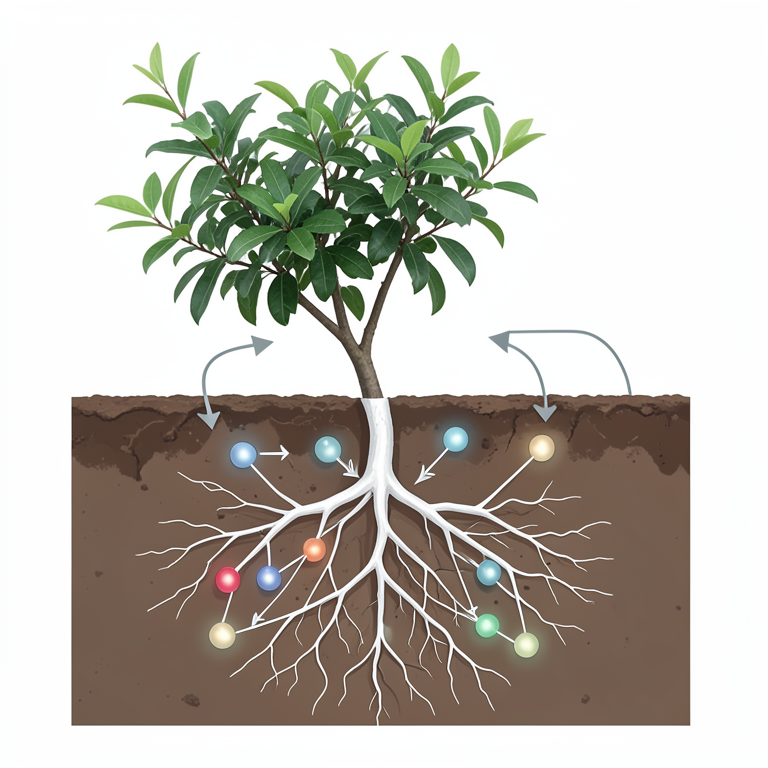
AMF Symbiosis Concept
AI-generated conceptual illustration (pomegranate plant roots and arbuscular mycorrhizal fungi in soil). It explains the idea and does not show study data.
View source evidence ↗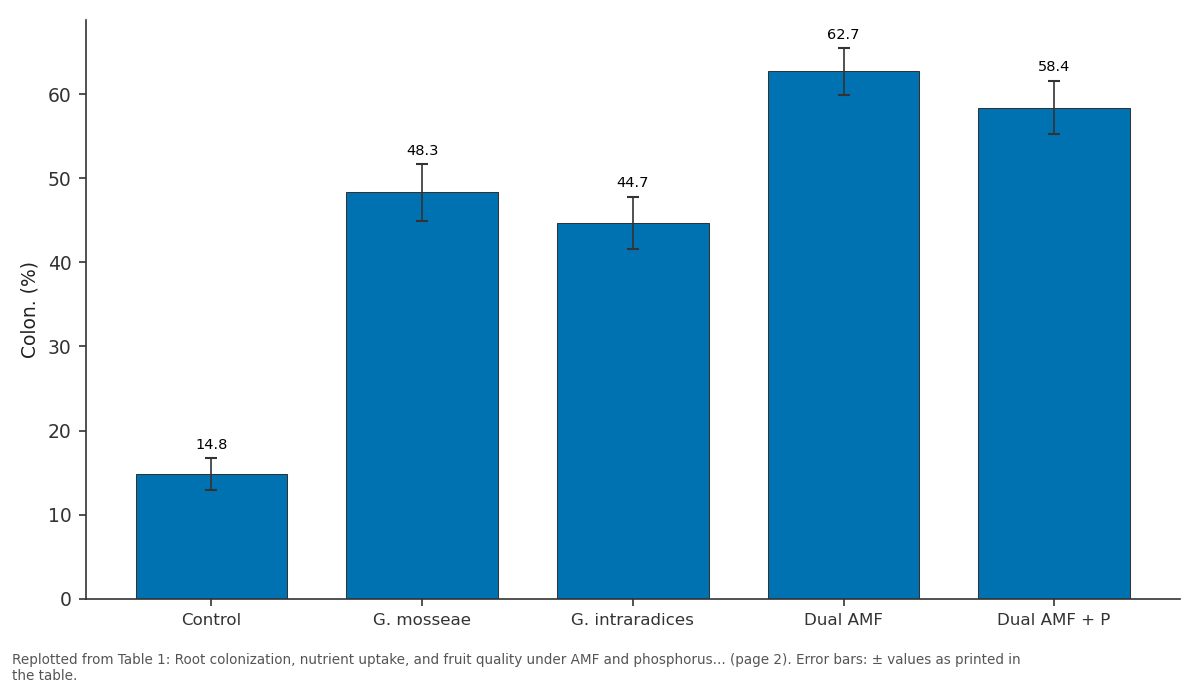
Colon. (%): Control vs G. mosseae vs G. intraradices vs Dual AMF vs Dual AMF + P
Replotted from Table 1 (page 2) of the original paper. Every bar is the paper's own table value.
View source evidence ↗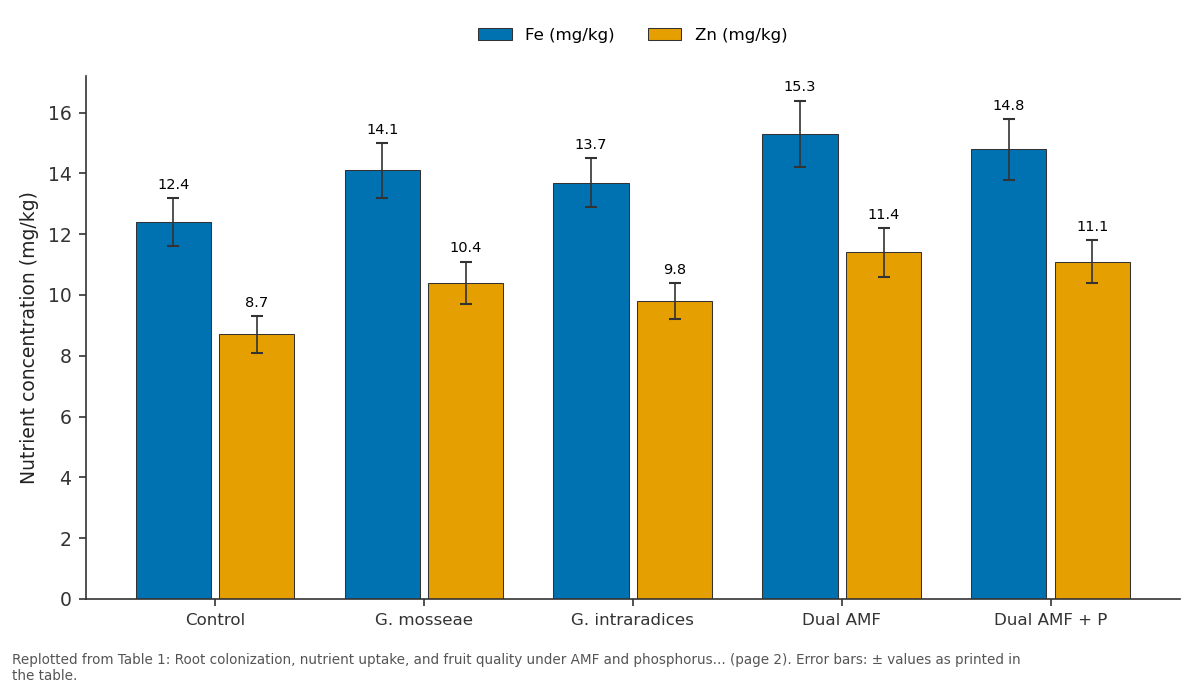
Fe (mg/kg) and Zn (mg/kg): Control vs G. mosseae vs G. intraradices vs Dual AMF vs Dual AMF + P
Replotted from Table 1 (page 2) of the original paper. Every bar is the paper's own table value.
View source evidence ↗Figures & tables
From the original paper Table 1
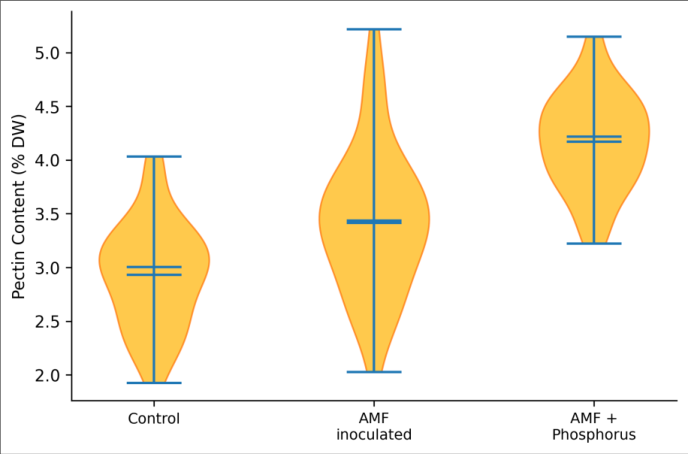 Figure 1
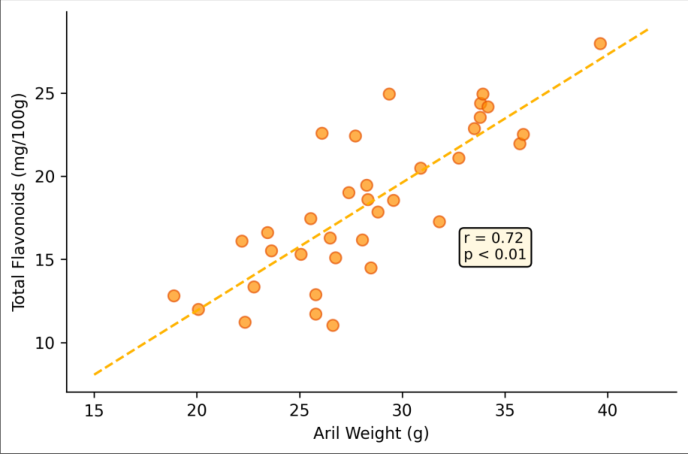 Figure 2
Introduction
When scientists at a field station in the Caspian lowlands examined pomegranate roots under a microscope for the first time, they found something unexpected: nearly every root tip hosted arbuscular mycorrhizal structures, even in unfertilized soil [1] . This observation hinted at a symbiotic relationship more important to pomegranate than anyone had assumed. Arbuscular Mycorrhizal Fungi (AMF) form mutualistic associations with most land plants, extending the effective root surface area by orders of magnitude and improving access to phosphorus, zinc, and copper in exchange for photosynthetic carbon [2] . Pomegranate (Punica granatum L.) is a fruit crop of rising global importance, driven by consumer demand for its antioxidant-rich arils and juice [3] . Pectin, a structural polysaccharide abundant in pomegranate peel, has commercial value for the food processing industry and responds to calcium and phosphorus status during fruit development [4] . Flavonoids including anthocyanins, ellagitannins, and punicalagins are responsible for pomegranate's intense color and its health-promoting reputation [5] . AMF inoculation has been shown to improve phosphorus uptake, stimulate secondary metabolite production, and enhance drought tolerance in several fruit species [2] . But pomegranate-specific data on AMF effects on pectin accumulation, flavonoid profiles, and processing quality remain limited [6] . Callus culture offers a complementary approach to studying biosynthetic pathways in vitro, potentially enabling production of high-value metabolites without whole-plant cultivation [7] . This research tested whether controlled AMF inoculation could improve pomegranate root function, nutrient acquisition, and fruit quality attributes relevant to both fresh consumption and processing markets [8] .
Material and Methods
Material and Methods
Material
Three pomegranate cultivars were established as one-year-old rooted cuttings in 80-liter pots filled with steam-sterilized sandy loam (pH 7.2, Olsen P 6.8 mg/kg) at the Bhubaneswar College of Food Technology (20.30°N, 85.82°E). AMF treatments included: a) Uninoculated control, b) Glomus mosseae at 200 spores per pot, c) Glomus intraradices at 200 spores per pot, and d) Dual inoculation with both species at 100 spores each. Half the pots in each AMF treatment received supplemental phosphorus (40 kg P₂O₅/ha equivalent). The experiment used a factorial CRD with four replications. Callus culture used peel explants from mature fruit on MS medium with 2,4-D (2 mg/L) and BAP (0.5 mg/L). Research ran from March 2022 to February 2023 [9] .
Methods
Root colonization was assessed by the gridline intersect after clearing and staining root samples in trypan blue. Pectin was extracted from dried peel by acid hydrolysis and quantified gravimetrically as calcium pectate. Aril color was measured using a digital colorimeter (L*a*b* space) and also by image analysis using ImageJ to calculate a redness index (a*/b* ratio). Flavonoids were extracted in methanol and quantified by the aluminum chloride colorimetric method. Iron and zinc in arils were determined by AAS after wet digestion. Callus induction frequency was scored after 28 days. Data were analyzed by factorial ANOVA in SAS 9.4 [10] . Dual AMF inoculation achieved the highest root colonization at 62.7 percent. Adding phosphorus to the dual AMF treatment pushed pectin content to 4.1 percent, the highest recorded value, though colonization declined slightly, consistent with the known suppression of AMF by high P availability.
Results
Results
Discussion
The 324 percent increase in root colonization from control to dual AMF treatment demonstrates that pomegranate is highly responsive to mycorrhizal inoculation in low-P soils. Both Glomus species contributed to colonization, but their combined effect exceeded either alone, suggesting complementary niche occupation within the root system [2] . The slight decline in colonization under supplemental P confirms the well-documented feedback loop in which high soil P reduces plant carbon allocation to mycorrhizal partners [11] . Pectin enrichment is a commercially relevant outcome because pomegranate peel is a major byproduct of juice processing, and high-pectin peel commands premium prices for food-grade pectin extraction [4] . The 46 percent increase under dual AMF + P puts these fruit at the upper end of reported pomegranate pectin values, comparable to citrus peel standards. Image analysis of aril color corroborated the flavonoid data: redder arils (higher a*/b* ratio) correlated with higher anthocyanin content (r=0.68), validating color as a non-destructive quality indicator [12] . Callus induction at 54 percent from peel explants was moderate but sufficient for metabolite production research. Peel-derived callus accumulated ellagitannins at concentrations roughly 40 percent of intact peel tissue, indicating that the biosynthetic machinery remains partially active in vitro [7] . Iron and zinc gains in arils under AMF treatment are nutritionally meaningful: a 100 g serving of AMF-treated arils would provide approximately 8 percent of the daily iron requirement, compared with 6 percent from control fruit [13] .
Conclusion
AMF inoculation with dual Glomus species markedly improved pomegranate root colonization, pectin accumulation, flavonoid content, and micronutrient uptake.
The combination of AMF with moderate phosphorus supplementation produced the highest pectin values without eliminating the mycorrhizal benefit. Aril color measured by image analysis proved a reliable proxy for flavonoid content. Callus culture from peel tissue showed potential for in vitro metabolite production. For pomegranate growers targeting both fresh and processing markets, mycorrhizal management represents a low-cost biological investment with measurable quality returns.
Figures and tables from the paper
| Treatment | Colon. (%) | Pectin (% DW) | Flavonoids (mg/100g) | Fe (mg/kg) | Zn (mg/kg) |
|---|---|---|---|---|---|
| Control | 14.8 ± 1.9 | 2.81 ± 0.18 | 124.3 ± 7.8 | 12.4 ± 0.8 | 8.7 ± 0.6 |
| G. mosseae | 48.3 ± 3.4 | 3.42 ± 0.22 | 156.7 ± 9.4 | 14.1 ± 0.9 | 10.4 ± 0.7 |
| G. intraradices | 44.7 ± 3.1 | 3.28 ± 0.20 | 148.2 ± 8.7 | 13.7 ± 0.8 | 9.8 ± 0.6 |
| Dual AMF | 62.7 ± 2.8 | 3.74 ± 0.24 | 172.4 ± 10.2 | 15.3 ± 1.1 | 11.4 ± 0.8 |
| Dual AMF + P | 58.4 ± 3.2 | 4.10 ± 0.27 | 181.7 ± 11.4 | 14.8 ± 1.0 | 11.1 ± 0.7 |
Table text extracted from the original PDF; superscript letters are shown inline. The original table image is below.
View original table image
References
18 in the original paper- Tahat MM, Kamaruzaman S, Othman R. Mycorrhizal fungi as a biocontrol agent. Plant Pathology Journal. 2010;9(4):198-207.
- Smith SE, Read DJ. Mycorrhizal symbiosis. Third edition. Academic Press, London. 2008.
- Holland D, Hatib K, Bar-Yaakov I. Pomegranate: Botany, horticulture, breeding. Horticultural Reviews. 2009;35:127-191.
- Pereira PHF, Oliveira TIS, Rosa MF, et al. Pectin extraction from pomegranate peels with citric acid. International Journal of Biological Macromolecules. 2016;88:373-379.
- Gil MI, Tomas-Barberan FA, Hess-Pierce B, Holcroft DM, Kader AA. Antioxidant activity of pomegranate juice and its relationship with phenolic composition and processing. Journal of Agricultural and Food Chemistry. 2000;48(10):4581-4589.
- Aseri GK, Jain N, Panwar J, Rao AV, Meghwal PR. Biofertilizers improve plant growth, fruit yield, nutrition, metabolism and rhizosphere enzyme activities of pomegranate in Indian Thar Desert. Scientia Horticulturae. 2008;117(2):130-135.
- Naik PM, Al-Khayri JM. Impact of abiotic elicitors on in vitro production of plant secondary metabolites: A review. Journal of Advanced Research in Biotechnology. 2016;1(2):1-7.
- Sharma RR, Singh D. Phenolic content in Indian grapes and pomegranate. Current Science. 2009;96(3):446-448.
- Phillips JM, Hayman DS. Improved procedures for clearing roots and staining parasitic and vesiculararbuscular mycorrhizal fungi. Transactions of the British Mycological Society. 1970;55(1):158-161.
- SAS Institute. SAS/STAT user's guide, version 9.4. SAS Institute Inc., Cary, NC. 2013.
- Johnson NC, Graham JH, Smith FA. Functioning of mycorrhizal associations along the mutualismparasitism continuum. New Phytologist. 1997;135(4):575-585.
- Pathare PB, Opara UL, Al-Said FAJ. Colour measurement and analysis in fresh and processed foods: A review. Food and Bioprocess Technology. 2013;6(1):36-60.
- Al-Maiman SA, Ahmad D. Changes in physical and chemical properties during pomegranate fruit maturation. Food Chemistry. 2002;76(4):437-441.
- Marschner H, Dell B. Nutrient uptake in mycorrhizal symbiosis. Plant and Soil. 1994;159(1):89-102.
- Viuda-Martos M, Fernandez-Lopez J, Perez-Alvarez JA. Pomegranate and its many functional components as related to human health: A review. Comprehensive Reviews in Food Science and Food Safety. 2010;9(6):635-654.
- Seeram NP, Adams LS, Henning SM, et al. In vitro antiproliferative, apoptotic and antioxidant activities of punicalagin. International Journal of Oncology. 2005;26(1):203-210.
- Basu A, Penugonda K. Pomegranate juice: A hearthealthy fruit juice. Nutrition Reviews. 2009;67(1):49-56.
- Tehranifar A, Zarei M, Nemati Z, Esfandiyari B, Vazifeshenas MR. Investigation of physicochemical properties and antioxidant activity of twenty Iranian pomegranate cultivars. Scientia Horticulturae. 2010;126(2):180-185.