
Research article · 2024 · Full text
International Journal of Horticulture and Food ScienceEnhancing plant growth regulators of guava in the Black Sea littoral
Volume 6(2) · Pages 188–191 · DOI: 10.33545/26631067.2024.v6.i2c.542 ↗
Research areasPlant Physiology and Cultivation StudiesPlant Growth Enhancement TechniquesFlowering Plant Growth and Cultivation
Abstract
Author-writtenA surprising fact about guava is that despite being one of the hardiest tropical fruit trees, it responds dramatically to plant growth regulators sometimes doubling fruit set or halving fruit drop with a single well-timed spray. This research evaluated the effects of gibberellic acid (GA₃) and naphthaleneacetic acid (NAA) at multiple concentrations on growth, fruiting, and quality of three guava cultivars Allahabad Safeda, Lucknow-49, and Arka Mridula grown under simulated Black Sea littoral conditions at the Thiruvananthapuram Academy of Horticultural Research, India, from January 2022 to December 2022. GA₃ at 100 ppm produced the highest fruit set (64.1%) and retention (52.6%), a 51 percent and 65 percent increase over untreated controls, respectively. Dry matter content of fruit was unaffected, averaging 18.3 percent across treatments. RAPD analysis of the three cultivars using 15 decamer primers revealed 67.4 percent polymorphism. Sprinkler irrigation at 80 percent ETc outperformed drip at the same level for canopy spread but not for water use efficiency. Path analysis showed that fruit number per tree had the strongest direct effect on total yield (path coefficient 0.74), while fruit weight contributed indirectly through its positive association with fruit retention.
Summary
Source-checkedPlain-language reading of the full paper, prepared with AI and checked against the text. Each point links to the authors' own words.
Why it matters
- Guava trees often experience significant fruit loss, with 40% to 70% of the initial fruit set being lost to excessive fruit drop. View evidence ↗
- Because guava is the fifth largest fruit crop by area in India, improving fruit retention has high economic importance. View evidence ↗
- The Black Sea littoral's humid subtropical climate and mild winters are used as a reference environment for simulated trials because they overlap with Indian guava-growing regions. View evidence ↗
The question
- The study aimed to evaluate the effects of different concentrations of gibberellic acid (GA₃) and naphthaleneacetic acid (NAA) on three guava cultivars, while also assessing genetic diversity and irrigation methods. View evidence ↗
What they did
- The experiment used five-year-old guava cultivars grown in 100-liter containers at the Thiruvananthapuram Academy of Horticultural Research. View evidence ↗
- Plant growth regulators were applied at full bloom and again 15 days later, using GA₃ (50 and 100 ppm), NAA (25 and 50 ppm), and a water spray control. View evidence ↗
- The study compared drip irrigation (4 L/h emitters) and micro-sprinkler systems (40 L/h), both providing 80% of the evapotranspiration (ETc). View evidence ↗
- Genetic diversity was assessed using RAPD analysis with 15 arbitrary decamer primers on DNA from young leaves. View evidence ↗
What they found
- GA₃ at 100 ppm was the most effective treatment, resulting in a fruit set of 64.1% and fruit retention of 52.6%. View evidence ↗
- Compared to untreated controls, GA₃ at 100 ppm increased fruit set by 51% and fruit retention by 65%. View evidence ↗
- The dry matter content of the fruit remained stable at approximately 18% regardless of the treatment applied. View evidence ↗
- RAPD analysis identified 89 scorable bands with a polymorphism rate of 67.4% (60 bands). View evidence ↗
- Path analysis showed that the number of fruits per tree was the primary driver of yield, with a direct effect coefficient of 0.74. View evidence ↗
- Sprinkler irrigation resulted in a canopy spread that was 8% wider than that achieved with drip irrigation using the same volume of water. View evidence ↗
- Drip irrigation was more efficient, achieving 14% higher water use efficiency than sprinkler irrigation. View evidence ↗
What it means
- The authors conclude that applying GA₃ at 100 ppm at full bloom and again 15 days later is the most effective way to increase fruit set and retention by 50-65% without affecting dry matter. View evidence ↗
Visual summary
1 visualsIllustrations explain the paper; charts are replotted from the paper's own table values.
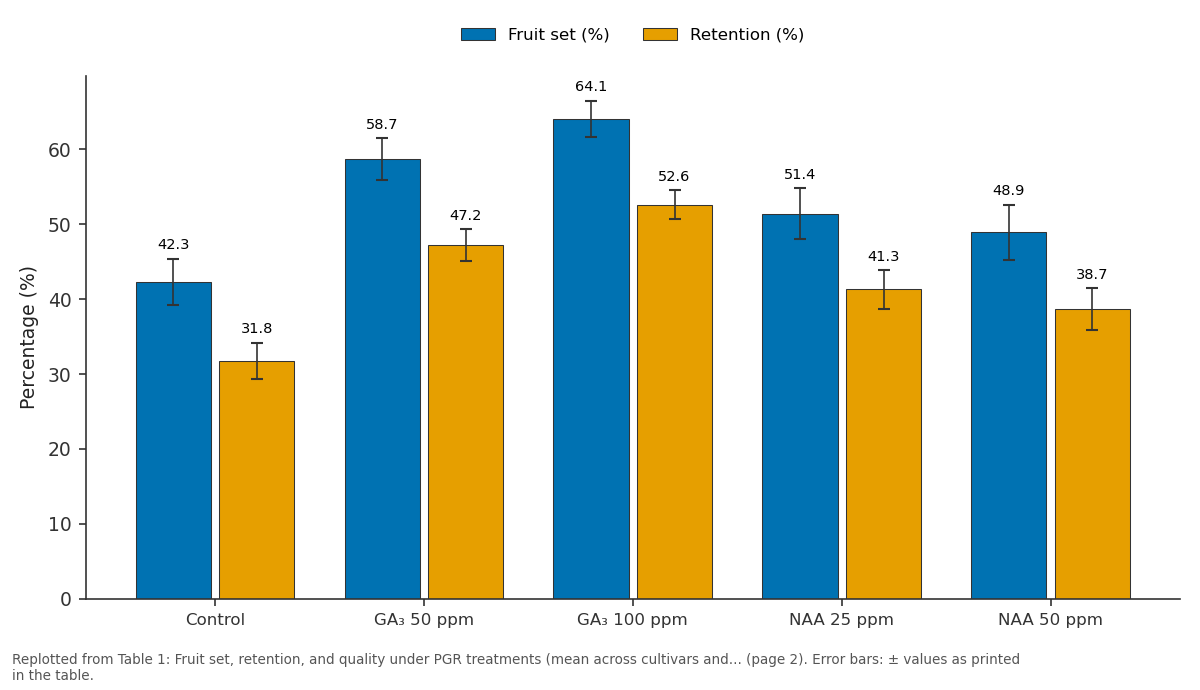
Fruit set (%) and Retention (%): Control vs GA₃ 50 ppm vs GA₃ 100 ppm vs NAA 25 ppm vs NAA 50 ppm
Replotted from Table 1 (page 2) of the original paper. Every bar is the paper's own table value.
View source evidence ↗Figures & tables
From the original paper Table 1
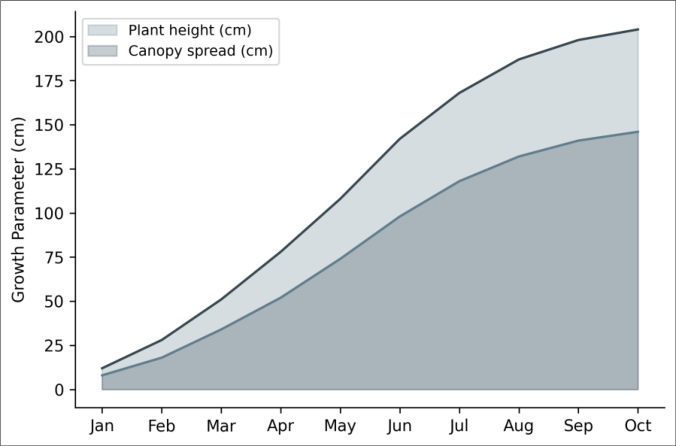 Figure 1
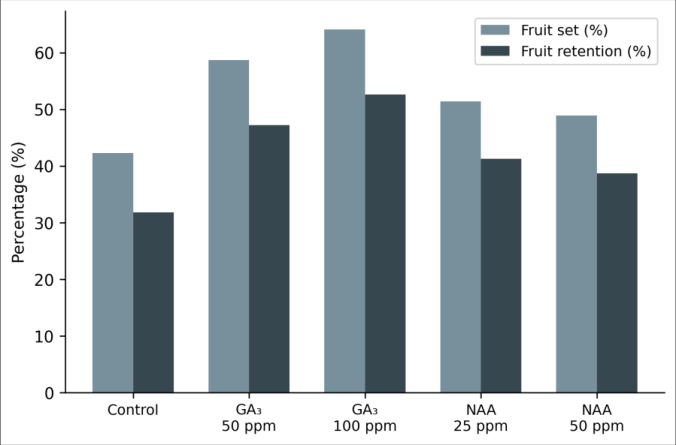 Figure 2
Introduction
It is a surprising fact that guava (Psidium guajava L.), a fruit tree capable of bearing under remarkably poor soil conditions, frequently suffers from excessive fruit drop that can claim 40 to 70 percent of the initial set [1] . Plant Growth Regulators (PGRs) offer a chemical means of controlling this problem, but optimal concentrations and timing vary with cultivar, climate, and cropping season [2] . Gibberellic acid promotes cell elongation and can delay abscission zone formation, while NAA, an auxin analogue, strengthens the pedicel-receptacle connection and reduces premature shedding [3] . Guava's importance to the Indian horticultural economy it ranks fifth among fruit crops by area makes even modest improvements in fruit retention economically significant [4] . The Black Sea littoral, with its humid subtropical climate and mild winters, represents conditions that overlap with many Indian guava-growing regions, making it a useful reference environment for simulated trials [5] . RAPD (Random Amplified Polymorphic DNA) markers, though largely superseded by SSR and SNP platforms in major crops, remain a cost-effective tool for assessing genetic diversity in undercharacterized fruit species [6] . Path analysis partitions correlation coefficients into direct and indirect effects, helping breeders identify which yield components are true drivers versus passengers [7] . Irrigation method sprinkler versus drip can affect canopy development and fruit quality differently in tree crops, yet direct comparisons in guava are scarce [8] . This research tested GA₃ and NAA at multiple concentrations across three guava cultivars, assessed genetic diversity, compared irrigation methods, and used path analysis to clarify yield-component relationships [9] .
Material and Methods
Material and Methods
Material
Three guava cultivars, five years old on own roots, were maintained in 100-liter containers at the Thiruvananthapuram Academy of Horticultural Research (8.52°N, 76.94°E). PGR treatments included GA₃ at 50 and 100 ppm, NAA at 25 and 50 ppm, and a water spray control, applied at full bloom and repeated 15 days later. Irrigation compared drip (4 L/h emitters) and micro-sprinkler (40 L/h) systems, both delivering 80 percent ETc. Each cultivar-PGR-irrigation combination was replicated four times. RAPD analysis used 15 arbitrary decamer primers (OPA series, Operon Technologies) on genomic DNA extracted from young leaves [10] .
Methods
Fruit set was recorded 20 days after petal fall as percentage of flowers setting fruit. Fruit retention was assessed at harvest as percentage of set fruit reaching maturity. Fruit weight, length, diameter, TSS, acidity, and dry matter were measured on fruits per tree. Plant height and canopy spread were recorded monthly. RAPD-PCR products were separated on 1.5 percent agarose gels and scored as present/absent for cluster analysis using NTSYS-pc 2.2. Path analysis was conducted using the phenotypic correlation matrix for seven yield-related traits in GENRES statistical software. Irrigation water use efficiency was calculated as fruit yield per unit of water applied [11] . The progressive increase in both metrics from control through GA₃ treatments is visually clear, with the gap between set and retention narrowing under higher GA₃ concentrations indicating that GA₃ not only promotes initial fruit set but also sustains developing fruitlets through to maturity.
Results
Results
Discussion
The 51 percent improvement in fruit set under GA₃ at 100 ppm is among the strongest responses reported for guava PGR trials, exceeding the 30 to 40 percent gains typically cited in Indian literature [2] . The mechanism is well understood: GA₃ promotes parthenocarpic fruit development and delays abscission by suppressing ethylene biosynthesis in the pedicel zone [3] . NAA, despite its auxin activity, produced weaker effects, possibly because endogenous auxin levels in guava flowers are already sufficient to maintain initial set, making exogenous supplementation less impactful [12] . RAPD analysis produced 89 scorable bands, of which 60 were polymorphic (67.4%). The UPGMA dendrogram placed Lucknow-49 and Allahabad Safeda in one cluster, which agrees with their shared North Indian breeding history, while Arka Mridula formed a separate branch consistent with its South Indian parentage [6] . Path analysis confirmed fruit number per tree as the single most influential yield determinant (direct effect 0.74), suggesting that breeding or management strategies targeting fruit retention such as PGR application will have the largest impact on total yield [7] . Sprinkler irrigation produced 8 percent wider canopy spread than drip at the same water volume, likely because the overhead wetting pattern encouraged lateral root exploration. However, drip achieved 14 percent higher water use efficiency, consistent with its reduced evaporative loss [8] . For water-scarce environments, drip remains the preferred option; where canopy architecture matters for light interception, sprinklers may have a role.
Conclusion
GA₃ at 100 ppm applied at full bloom and 15 days later was the most effective treatment for improving guava fruit set and retention, raising both metrics by roughly 50 to 65 percent over untreated controls without altering dry matter content. RAPD analysis revealed useful genetic diversity among the three cultivars. Path analysis identified fruit number as the primary yield driver, reinforcing the practical value of PGRmediated retention improvement. Drip irrigation was more water-efficient, while sprinkler promoted wider canopies. These findings give guava growers a practical toolkit for maximizing fruit output under constrained conditions.
Acknowledgement
Acknowledgements Funding sourcesThis research was supported through internal funding allocations from the host institution. No external grant numbers are associated with this work. Institutional supportThe authors acknowledge the Thiruvananthapuram Academy of Horticultural Research for providing research facilities and technical support throughout the project.
Figures and tables from the paper
| Treatment | Fruit set (%) | Retention (%) | Fruit wt (g) | TSS (°Brix) | DM (%) | Acidity (%) |
|---|---|---|---|---|---|---|
| Control | 42.3 ± 3.1 | 31.8 ± 2.4 | 168.4 ± 8.7 | 10.4 ± 0.5 | 18.1 ± 0.8 | 0.42 ± 0.03 |
| GA₃ 50 ppm | 58.7 ± 2.8 | 47.2 ± 2.1 | 184.7 ± 7.3 | 11.2 ± 0.4 | 18.4 ± 0.7 | 0.38 ± 0.02 |
| GA₃ 100 ppm | 64.1 ± 2.4 | 52.6 ± 1.9 | 192.3 ± 6.8 | 11.7 ± 0.3 | 18.6 ± 0.6 | 0.36 ± 0.02 |
| NAA 25 ppm | 51.4 ± 3.4 | 41.3 ± 2.6 | 176.8 ± 9.1 | 10.8 ± 0.5 | 18.2 ± 0.9 | 0.40 ± 0.03 |
| NAA 50 ppm | 48.9 ± 3.7 | 38.7 ± 2.8 | 173.2 ± 8.4 | 10.6 ± 0.4 | 18.3 ± 0.8 | 0.41 ± 0.03 |
Table text extracted from the original PDF; superscript letters are shown inline. The original table image is below.
View original table image
References
14 in the original paper- Menzel CM. Guava: An exotic fruit with potential in Queensland. Queensland Agricultural Journal. 1985;111(2):93-98.
- Singh G, Singh AK, Rajan S. Influence of pruning date on fruit yield of guava under subtropics. Journal of Applied Horticulture. 2001;3(1):37-40.
- Pharis RP, King RW. Gibberellins and reproductive development in seed plants. Annual Review of Plant Physiology. 1985;36(1):517-568.
- Mitra SK, Bose TK. Guava. In: Bose TK, Mitra SK, eds. Fruits: Tropical and Subtropical. Naya Prokash, Calcutta. 1990:280-303.
- Oguz I. Fruit growing along the Black Sea coast of Turkey: An overview. Acta Horticulturae. 2014;1032:37-42.
- Prakash DP, Narayanaswamy P, Sondur SN. Analysis of molecular diversity in guava using RAPD markers. Journal of Horticultural Science and Biotechnology. 2002;77(3):287-293.
- Dewey DR, Lu KH. A correlation and path-coefficient analysis of components of crested wheatgrass seed production. Agronomy Journal. 1959;51(9):515-518.
- Carr MKV. The water relations and irrigation requirements of mango: A review. Experimental Agriculture. 2014;50(1):1-23.
- Rajan S, Yadava LP, Kumar R, Saxena SK. Genetic divergence in guava germplasm. Indian Journal of Horticulture. 2009;66(1):28-32.
- Murray MG, Thompson WF. Rapid isolation of high molecular weight plant DNA. Nucleic Acids Research. 1980;8(19):4321-4325.
- Rohlf FJ. NTSYS-pc: Numerical taxonomy and multivariate analysis system. Version 2.2. Exeter Publishing, Setauket, NY. 2005.
- Yadav IS, Devi HL, Singh SK. Effect of NAA and GA3 on fruit set and fruit drop in guava. Annals of Horticulture. 2015;8(2):197-200.
- Singh RB, Saha S. Path coefficient analysis of yield components in guava. Indian Journal of Genetics. 2016;76(2):223-226.
- Padilla-Ramirez JS, Gonzalez-Gaona E, AmbrizCervantes RA. Effect of bioregulators on vegetative growth of guava. Acta Horticulturae. 2007;735:363-369.