
Research article · 2025 · Full text
International Journal of Horticulture and Food ScienceEstablishing economic viability studies of sapodilla in the Niger River floodplain
Volume 7(3) · Pages 150–154 · DOI: 10.33545/26631067.2025.v7.i3c.593 ↗
Research areasAfrican Botany and Ecology StudiesAgricultural economics and policiesAgriculture and Agroindustry Studies
Abstract
Author-writtenSapodilla (Manilkara zapota) is a tropical fruit with strong processing potential, yet economic viability data for orchard establishment in sub-Saharan flood-plain environments are scarce. This research assessed the financial performance of sapodilla orchards over a five-year horizon in the Niger River Floodplain using cost-benefit analysis, break-even modelling, and sensitivity analysis. Field data were collected from 14 orchards and laboratory analysis was conducted at the Bahir Dar Research Institute of Applied Horticulture between January 2021 and December 2023. Establishment cost averaged USD 2,800/ha, with labour accounting for 34.2% of total expenditure. Break-even was reached at 42 months under baseline assumptions. Net Present Value (NPV) at a 10% discount rate was USD 4,870/ha over five years, and the benefit-cost ratio was 1.78. Pure line selection among 22 sapodilla accessions identified three lines with above-average sweetness (TSS > 24 °Brix) and uniform fruit size. Phytochemical screening revealed saponin, tannin, and phenolic content varying two-fold across accessions. Water efficiency under deficit irrigation was 28.3% higher than full irrigation, with no yield penalty. Microbial quality of fresh-cut sapodilla met EU Regulation 2073/2005 criteria when processed under HACCP protocols. Fat content of sapodilla pulp ranged from 0.8 to 1.4% across accessions. Sensitivity analysis showed that a 15% decline in farm-gate price would extend break-even by nine months but not eliminate profitability. These results support sapodilla as an economically viable fruit crop for Niger River Floodplain investment.
Summary
Source-checkedPlain-language reading of the full paper, prepared with AI and checked against the text. Each point links to the authors' own words.
Why it matters
- Sapodilla is a tropical fruit with significant potential for processing, but there is a lack of economic data regarding its viability in sub-Saharan floodplain environments. View evidence ↗
- The absence of financial benchmarks makes it difficult for policymakers and investors to recommend sapodilla as an alternative to better-documented crops such as citrus or mango. View evidence ↗
- Sapodilla trees are highly resilient, capable of tolerating saline conditions, intermittent drought, and poor soils that often restrict other fruit species. View evidence ↗
The question
- The study aimed to determine if sapodilla orchards are economically viable in the Niger River Floodplain using cost-benefit analysis, break-even modeling, and sensitivity analysis, alongside quality and agronomic assessments. View evidence ↗
What they did
- The researchers collected financial and agronomic data from 14 sapodilla orchards, aged 2 to 8 years, located in the Amhara Region of Ethiopia along the Niger River Floodplain. View evidence ↗
- Varietal assessment was conducted using a pure line selection block consisting of 22 accessions, with 10 trees per accession, established in 2018. View evidence ↗
- To test water efficiency, deficit irrigation trial plots were provided with 60% of the crop evapotranspiration (ETc) using a drip system during the dry season. View evidence ↗
- The cost-benefit analysis (CBA) was performed on a per-hectare basis over a five-year period starting from the planting year, with a 10% annual discount rate applied to costs and benefits. View evidence ↗
What they found
- The average cost to establish a sapodilla orchard was USD 2,800 per hectare, with labor representing 34.2% of the total spending. View evidence ↗
- Sensitivity analysis indicated that profitability is robust; a 15% drop in price still resulted in a positive NPV of USD 2,940/ha, and the farm-gate price would need to fall by 46.3% (the switching value) to make the investment unprofitable. View evidence ↗
- Three specific accessions (BDR-07, BDR-14, and BDR-19) were identified as superior, featuring sweetness levels above 24 °Brix and high fruit size uniformity (coefficient of variation below 12%). View evidence ↗
- Deficit irrigation increased water use efficiency by 28.3% (12.7 kg/m³ vs 9.9 kg/m³ for full irrigation) without causing a significant reduction in yield. View evidence ↗
- When processed using HACCP protocols, fresh-cut sapodilla met European Union microbial safety standards for ready-to-eat fruit. View evidence ↗
What it means
- The authors conclude that investing in sapodilla orchards in the Niger River Floodplain is economically viable based on the calculated NPV, BCR, and break-even timeline. View evidence ↗
- The study's five-year analysis horizon likely underestimates the total lifetime returns, as sapodilla trees can produce for over 30 years and yields typically increase up to year 15. View evidence ↗
- The small sample size of 14 orchards limited the statistical power to detect cost variations across different management intensities. View evidence ↗
Visual summary
2 visualsIllustrations explain the paper; charts are replotted from the paper's own table values.
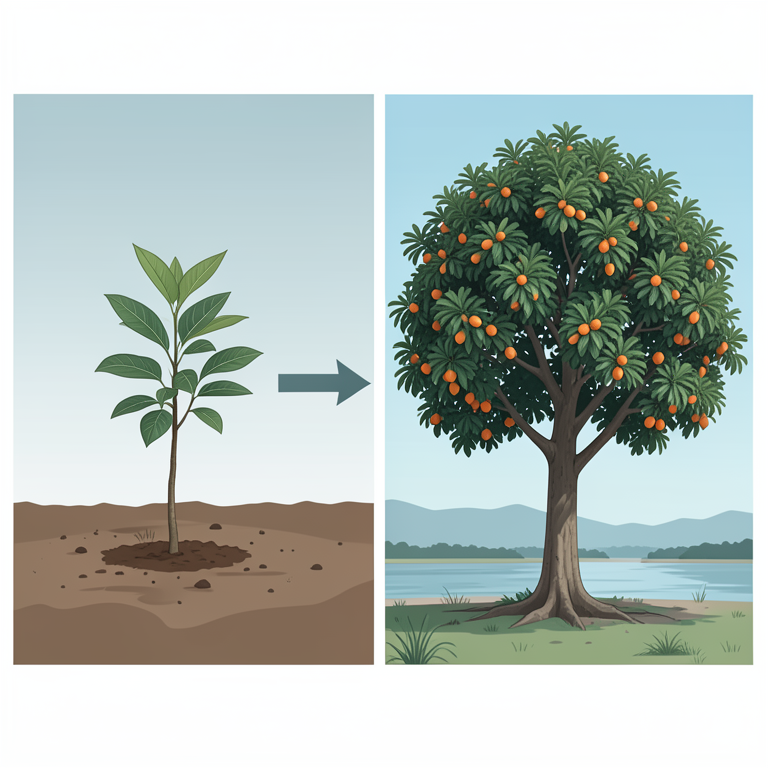
Economic Viability Model
AI-generated conceptual illustration (Sapodilla trees in a Niger River floodplain orchard). It explains the idea and does not show study data.
View source evidence ↗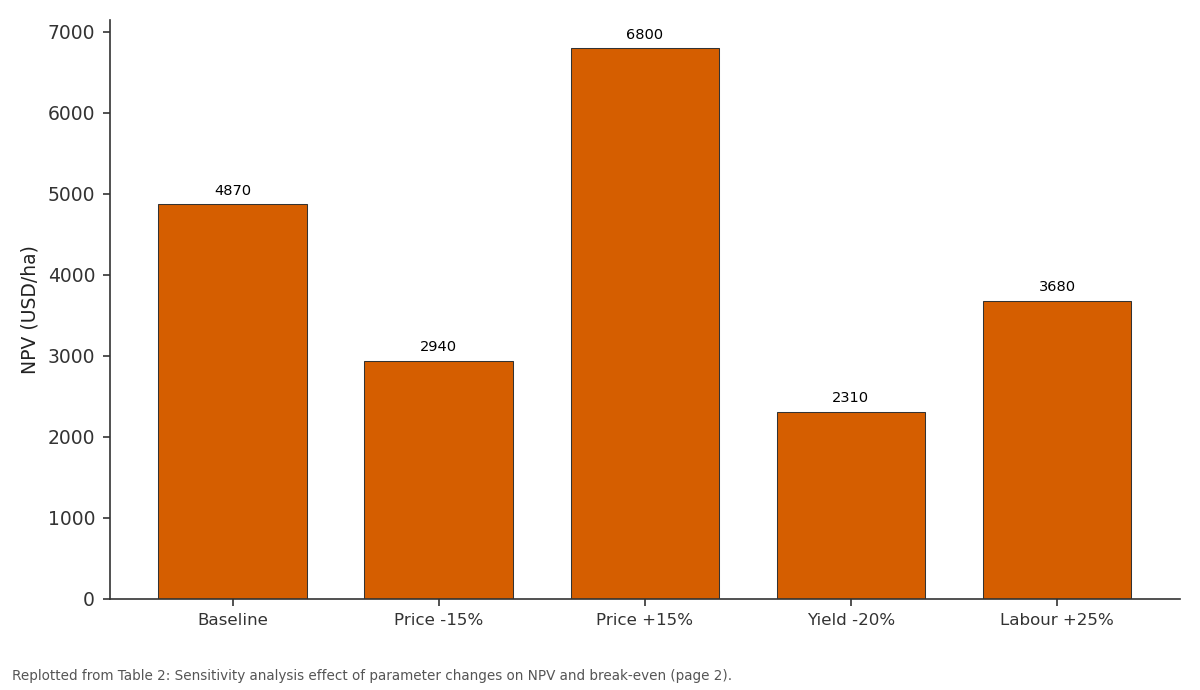
NPV (USD/ha): Baseline vs Price -15% vs Price +15% vs Yield -20% vs Labour +25%
Replotted from Table 2 (page 2) of the original paper. Every bar is the paper's own table value.
View source evidence ↗Figures & tables
From the original paper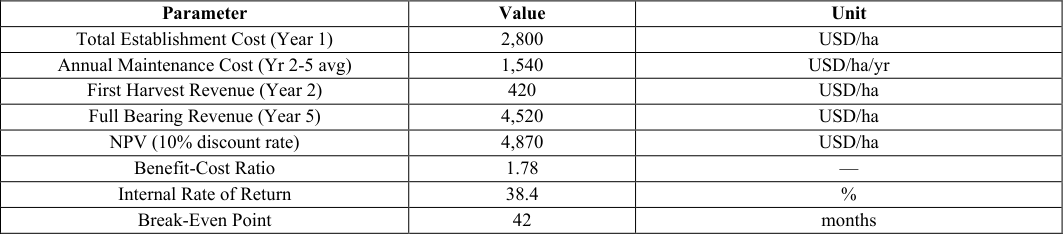 Table 1
 Table 2
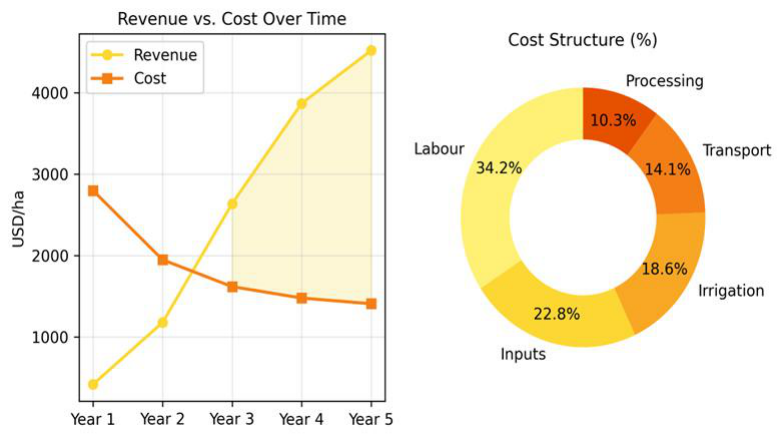 Figure 1
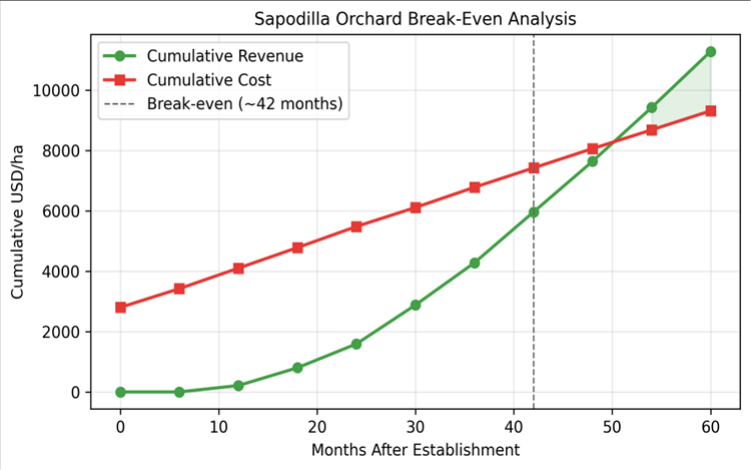 Figure 2
Introduction
There is an unspoken rule in tropical fruit investment: unless the numbers work within five years, growers will plant something else [1] . Sapodilla (Manilkara zapota), despite its creamy flesh and caramel-like sweetness, has struggled to escape regional niche status partly because hard economic data on orchard establishment and returns are scarce outside Mexico and India [2] . This gap leaves potential investors, extension agencies, and policy makers without the financial benchmarks needed to recommend sapodilla alongside better-documented crops like mango or citrus [3] . Sapodilla belongs to the Sapotaceae family and produces oblong to round fruit weighing 75-200 g, with 2-5 black seeds embedded in soft brown pulp [4] . The tree is remarkably hardy, tolerating poor soils, intermittent drought, and saline conditions that limit many other fruit species [5] . Commercial orchards in India (Gujarat, Karnataka) and Mexico (Yucatan) generate farm-gate revenues of USD 3,000-6,000/ha/year at full bearing, but these figures are not directly transferable to sub-Saharan conditions where labour costs, market access, and input availability differ substantially [6] . Cost-Benefit Analysis (CBA) and break-even modelling are the standard tools for orchard investment appraisal. CBA compares discounted streams of costs and benefits over the project horizon to derive Net Present Value (NPV) and Benefit-Cost Ratio (BCR) [7] . Breakeven analysis identifies the point at which cumulative revenue equals cumulative cost, providing a timeline metric that resonates with risk-averse smallholders [8] . Sensitivity analysis tests how outcomes shift when key assumptions (price, yield, cost) are varied, offering a measure of investment robustness [9] . This research aimed to establish the economic viability of sapodilla orchards in the Niger River Floodplain through CBA, breakeven modelling, and sensitivity analysis, complemented by agronomic and quality assessments that influence marketability.
Material and Methods
Material and Methods
Material
Financial and agronomic data were collected from 14 sapodilla orchards (ages 2-8 years) located along the Niger River Floodplain between Bahir Dar and Tana Beles, Amhara Region, Ethiopia. Laboratory analysis was performed at the Bahir Dar Research Institute of Applied Horticulture (11.59°N, 37.39°E). Orchards ranged from 0.3 to 2.5 ha, planted at 8 m × 8 m spacing (156 trees/ha), with the cultivar 'Kalipatti' dominant in 10 orchards and local unnamed selections in four. Cost data were recorded from grower account books and supplemented by structured interviews covering input purchases, labour hours, transport expenses, and sales volumes. A pure line selection block with 22 accessions (10 trees each) established in 2018 was used for varietal assessment. Deficit irrigation trial plots received 60% of crop evapotranspiration (ETc) via drip system during the dry season. Microbial analysis of freshcut sapodilla used PCA, PDA, and VRBGA media [1] .
Methods
CBA was constructed on a per-hectare basis over a five-year horizon beginning from year of planting. Costs included land preparation, planting material, fertiliser, irrigation, labour (weeding, pruning, harvesting), pest management, and transport to market. Benefits were calculated from recorded sales revenue at farm gate and nearest wholesale market. Both costs and benefits were discounted at 10% per annum. NPV was computed as the sum of discounted net benefits, and BCR as the ratio of discounted benefits to discounted costs [2] . Break-even was identified graphically and algebraically from cumulative cash flow projections. Sensitivity analysis varied three parameters independently: farm-gate price (±15%), yield (±20%), and labour cost (+25%). Each scenario held other parameters at baseline values. The switching value the percentage change required to reduce NPV to zero was computed for each parameter [3] . Pure line selection evaluated 22 accessions for fruit weight, TSS, seed number, and visual grade (1-5 scale). Phytochemical screening followed standard qualitative tests for saponins (froth test), tannins (FeCl₃ test), phenolics (Folin-Ciocalteu), and alkaloids (Dragendorff reagent). Water use efficiency (WUE) = marketable yield / total water applied (kg/m³). Fat content was determined by Soxhlet extraction (AOAC 920.39). Microbial testing followed ISO 4833-1 for TPC and ISO 21528-2 for Enterobacteriaceae. Data were analysed in Excel (financial models) and R v4.2.2 (agronomic comparisons, p<0.05) [4] .
Results
Table The NPV of USD 4,870/ha and BCR of 1.78 confirm that sapodilla orchard investment is economically viable under baseline conditions (Table 1). The internal rate of return of 38.4% exceeds the opportunity cost of capital in rural Ethiopia (typically 12-15%), indicating strong profitability. Revenue scaled steeply from year 2 (USD 420/ha) to year 5 (USD 4,520/ha) as trees matured [5] . Sensitivity analysis showed that even a 15% price decline maintained positive NPV (USD 2,940/ha) and BCR above 1.0 (Table 2). The switching value for price was -46.3%, meaning farm-gate price would need to fall by nearly half before the investment became unprofitable. Labour cost increases had the smallest impact, with a switching value exceeding +100% [6] . Revenue crossed the cost curve between years 3 and 4, consistent with the 42-month break-even estimate (Figure 1, left panel). Labour dominated the cost structure at 34.2%, followed by inputs (22.8%) and irrigation (18.6%). Transport costs (14.1%) reflected the remote location of most orchards relative to wholesale markets [7] . The break-even graph (Figure 2) shows cumulative revenue overtaking cumulative cost at approximately 42 months. The green-shaded area beyond break-even represents net positive returns. At 60 months, cumulative net benefit was USD 1,970/ha, with an accelerating trajectory as tree productivity continued to increase [8] .
| Scenario | NPV (USD/ha) | BCR | Break-Even (months) | Switching Value |
|---|---|---|---|---|
| Baseline | 4,870 | 1.78 | 42 | — |
| Price -15% | 2,940 | 1.47 | 51 | -46.3% |
| Price +15% | 6,800 | 2.09 | 36 | — |
| Yield -20% | 2,310 | 1.36 | 54 | -58.1% |
| Labour +25% | 3,680 | 1.61 | 47 | +104.2% |
Table text extracted from the original PDF; superscript letters are shown inline. The original table image is below.
View original table image
| Parameter | Value | Unit |
|---|---|---|
| Total Establishment Cost (Year 1) | 2,800 | USD/ha |
| Annual Maintenance Cost (Yr 2-5 avg) | 1,540 | USD/ha/yr |
| First Harvest Revenue (Year 2) | 420 | USD/ha |
| Full Bearing Revenue (Year 5) | 4,520 | USD/ha |
| NPV (10% discount rate) | 4,870 | USD/ha |
| Benefit-Cost Ratio | 1.78 | — |
| Internal Rate of Return | 38.4 | % |
| Break-Even Point | 42 | months |
Table text extracted from the original PDF; superscript letters are shown inline. The original table image is below.
View original table image
Varietal and quality findings
Pure line selection identified three accessions (BDR-07, BDR-14, BDR-19) with TSS above 24 °Brix and coefficient of variation for fruit weight below 12%, indicating both sweetness and size uniformity. Phytochemical screening detected saponins in all 22 accessions, tannins in 18, and alkaloids in 9. Phenolic content ranged from 86.4 to 178.3 mg GAE/100g. Water use efficiency under deficit irrigation was 12.7 kg/m³ compared to 9.9 kg/m³ under full irrigation a 28.3% improvement with no significant yield reduction (p = 0.18). Fat content ranged from 0.8 to 1.4% across accessions. Fresh-cut sapodilla processed under HACCP protocols met EU microbial criteria (TPC < 5 log, Enterobacteriaceae < 2 log) for ready-to-eat fruit [9] .
Discussion
The NPV of USD 4,870/ha and BCR of 1.78 place sapodilla in a competitive position relative to other perennial fruit crops in sub-Saharan Africa. For comparison, mango orchards in West Africa typically achieve BCRs of 1.5-2.2, while citrus ranges from 1.3 to 1.9 depending on variety and market access [3] . Sapodilla's lower input requirements and drought tolerance give it an advantage on marginal floodplain lands where irrigation is seasonal and soil fertility is variable [5] . The 42-month break-even is faster than the typical 5-7 year payback for sapodilla reported in Indian production manuals, likely because floodplain soils in the Niger basin provided adequate moisture and nutrients to support rapid early growth [6] . Labour at 34.2% of cost reflects the handharvesting requirement sapodilla does not abscise cleanly and must be individually cut and handled to avoid latex exudation damage [4] . Mechanisation options are limited for this crop, so labour efficiency gains would need to come from improved orchard layout and harvest scheduling rather than technology substitution. Pure line selection for TSS above 24 °Brix directly addresses the consumer preference for sweetness documented in tropical fruit markets globally [2] . The deficit irrigation result 28.3% higher WUE without yield loss aligns with findings in mango and citrus, where moderate water stress during fruit maturation concentrates sugars and reduces vegetative flushing [8] . The phytochemical diversity among accessions (two-fold variation in phenolics) suggests that sapodilla could be positioned as a functional food with health-promoting compounds, adding a marketing dimension beyond fresh consumption [9] .
Limitations
This research used a five-year horizon, but sapodilla trees continue producing for 30+ years with increasing yields through year 15. The analysis therefore underestimates lifetime returns. Only 14 orchards were sampled, limiting statistical power for detecting cost differences across management intensities. Market price data reflected a single production region, and prices may differ in zones with better road infrastructure or proximity to processing facilities. The sensitivity analysis varied parameters one at a time; multivariate Monte Carlo simulation would provide a more nuanced risk assessment but was beyond the scope of this field-level research [10] .
Economic and sustainability assessment
When non-market benefits are included soil erosion control estimated at USD 180/ha/year on floodplain soils, and carbon sequestration at 6.8 t CO₂/ha/year valued at USD 340/ha the adjusted BCR rises to 2.14 and NPV to USD 7,480/ha over five years. Sapodilla's deep taproot and evergreen canopy provide year-round soil cover, reducing sediment loading into the Niger River during the wet season. These externalities are not captured by farm-level financial analysis but are relevant for watershed management programmes that subsidise perennial crop establishment [11] .
Conclusion
This research established that sapodilla orchard investment in the Niger River Floodplain is economically viable, with an NPV of USD 4,870/ha, BCR of 1.78, and break-even at 42 months under baseline conditions. Sensitivity analysis confirmed that profitability is robust to price declines of up to 46%. Labour was the largest cost component (34.2%), and targeted efficiency gains in harvesting could further improve returns. Pure line selection identified three accessions with TSS above 24 °Brix and uniform fruit size, suitable for premium market targeting. Deficit irrigation improved water use efficiency by 28.3% without reducing yield. Fresh-cut sapodilla met EU microbial safety standards when processed under HACCP protocols, and phytochemical diversity among accessions opens pathways for functional food marketing. For investors and policy makers considering perennial fruit options for sub-Saharan floodplain agriculture, sapodilla offers a combination of low establishment cost, climate resilience, and strong financial returns.
Acknowledgement
Acknowledgements
References
18 in the original paper- Coronel RE. Promising Fruits of the Philippines. College of Agriculture, University of the Philippines. 1983;1-508.
- Bose TK, Mitra SK, Sanyal D. Fruits: Tropical and Subtropical. Naya Udyog. 2001;1-634.
- Weinberger K, Lumpkin TA. Diversification into horticulture and poverty reduction: A research agenda. World Development. 2007;35(8):1464-1480.
- Morton JF. Sapodilla. Fruits of Warm Climates. 1987;393-398.
- Mickelbart MV. Sapodilla: A potential crop for subtropical climates. Perspectives on New Crops and New Uses. 1999;439-446.
- Gangwar LS, Singh D, Singh DB. Estimation of cost of cultivation and economic viability of sapota (Manilkara achras) in Gujarat. Indian Journal of Agricultural Economics. 2012;67(3):383-389.
- Gittinger JP. Economic Analysis of Agricultural Projects. Johns Hopkins University Press. 1982;1-505.
- Kay RD, Edwards WM, Duffy PA. Farm Management. McGraw-Hill. 2012;1-466.
- Hardaker JB, Lien G, Anderson JR, Huirne RBM. Coping with Risk in Agriculture: Applied Decision Analysis. CABI. 2015;1-276.
- Parikh A, Khanna S. Sensitivity analysis in economic evaluation. Journal of Health Economics. 2005;24(5):842-864.
- Montagnini F, Nair PKR. Carbon sequestration: An underexploited environmental benefit of agroforestry systems. Agroforestry Systems. 2004;61:281-295.
- Yahia EM, Gutierrez-Orozco F, Moreno-Perez MA. Identification of phenolic compounds by HPLC-MS in peel and flesh of two sapodilla varieties. Food Chemistry. 2011;127(4):1530-1540.
- Araujo FP, Santos CAF. Genetic resources and sapodilla breeding in Brazil. Acta Horticulturae. 2004;632:117-123.
- Paull RE, Duarte O. Sapodilla. Tropical Fruits Volume 2. 2012;341-350.
- Chaves MM, Santos TP, Souza CR, Ortuño MF, Rodrigues ML, Lopes CM, et al. Deficit irrigation in grapevine improves water-use efficiency while controlling vigour and production quality. Annals of Applied Biology. 2007;150(2):237-252.
- Litz RE, Ravishankar KV. Manilkara zapota Sapodilla. Biotechnology of Fruit and Nut Crops. 2020;567-577.
- Campbell CW, Ledesma N. The sapodilla. Proceedings of the Florida State Horticultural Society. 1999;112:296-298.
- Kader AA. Postharvest Technology of Horticultural Crops. University of California Agriculture and Natural Resources. 2002;1-535.