
Research article · 2025 · Full text
International Journal of Horticulture and Food ScienceModeling medicinal plant diversity of Kenaf in the java Volcanic slopes
Volume 7(4) · Pages 110–113 · DOI: 10.33545/26631067.2025.v7.i4b.613 ↗
Research areasEthnobotanical and Medicinal Plants StudiesBotany and Plant Ecology StudiesForest Ecology and Conservation
Abstract
Author-writtenAn observation that surprised even experienced field botanists was the sheer number of medicinal plant species thriving alongside kenaf (Hibiscus cannabinus L.) on the volcanic slopes of Java. This research modeled medicinal plant diversity within kenaf agroecosystems at six sites across Java's volcanic slopes during 2022-2023, coordinated from the Kisumu Graduate School of Bioagricultural Studies. A total of 84 medicinal plant species from 38 families were documented in and around kenaf plots. Shannon diversity index ranged from 2.14 to 3.27 across sites, with mid-elevation plots (700-1,000 m) showing the highest diversity. Flavonoid content in kenaf leaves accumulated steadily over the growing period, peaking at 76.1 mg/100 g dry weight at 14 weeks. Edible coatings formulated from kenaf mucilage extended the shelf life of fresh herbs by 4.3 days at 25°C. Green manure incorporation of kenaf residues returned 47.8 kg N/ha to the soil. Combining ability analysis from a 5-parent diallel cross identified two parents (KNF-03 and KNF-11) with high GCA for both leaf yield and flavonoid content. Germination of kenaf seeds stored at 10°C and 45% RH remained above 90% for 18 months.
Summary
Source-checkedPlain-language reading of the full paper, prepared with AI and checked against the text. Each point links to the authors' own words.
Why it matters
- The volcanic slopes of Java possess immense agrobiodiversity, but much of it remains undocumented because surveys often overlook the understories and margins of crop fields. View evidence ↗
- Kenaf plants create a unique microhabitat with a tall canopy of 2-4 meters and sparse lower foliage, which supports the growth of shade-tolerant shrubs and herbs. View evidence ↗
- Kenaf leaves are known to contain saponins, anthocyanins, and flavonoids, which have demonstrated antioxidant and anti-inflammatory properties in lab tests. View evidence ↗
The question
- The study aimed to document medicinal plants associated with kenaf, track flavonoid levels in kenaf leaves, evaluate kenaf mucilage as a coating, measure nitrogen return from green manure, and analyze genetic combining ability for leaf traits. View evidence ↗
What they did
- Researchers selected six sites across Java's volcanic slopes, covering three elevation zones: low (400-700 m), mid (700-1,000 m), and high (1,000-1,400 m). View evidence ↗
- Floristic surveys were conducted from January to March 2023 using five 10 x 10 m quadrats per site, located both inside and next to kenaf plots. View evidence ↗
- To test edible coatings, fresh basil sprigs were dipped in mucilage solutions, air-dried, and stored at 25°C. View evidence ↗
- Green manure trials involved incorporating chopped kenaf biomass at the flowering stage into the soil and measuring nitrogen release over 8 weeks using ion exchange resin bags. View evidence ↗
What they found
- The study documented 84 medicinal plant species belonging to 38 different families in and around the kenaf plots. View evidence ↗
- Bioactive flavonoids in kenaf leaves accumulated steadily over 14 weeks, peaking at 76.1 mg/100 g dry weight. View evidence ↗
- A 2% mucilage coating was the most effective, reducing weight loss to 8.7% by day 5 and extending the shelf life of basil by 4.3 days. View evidence ↗
- Genetic analysis identified KNF-03 and KNF-11 as the parents with the highest general combining ability (GCA) for flavonoid content and leaf yield. View evidence ↗
- Kenaf seeds stored at 10°C and 45% relative humidity maintained over 90% germination for 18 months, whereas ambient village storage reduced germination to 72%. View evidence ↗
What it means
- The authors conclude that kenaf should be managed as a multifunctional crop, serving as a source of fiber, food, coating material, green manure, and a habitat for medicinal plants, rather than just a single-purpose commodity. View evidence ↗
Visual summary
2 visualsIllustrations explain the paper; charts are replotted from the paper's own table values.
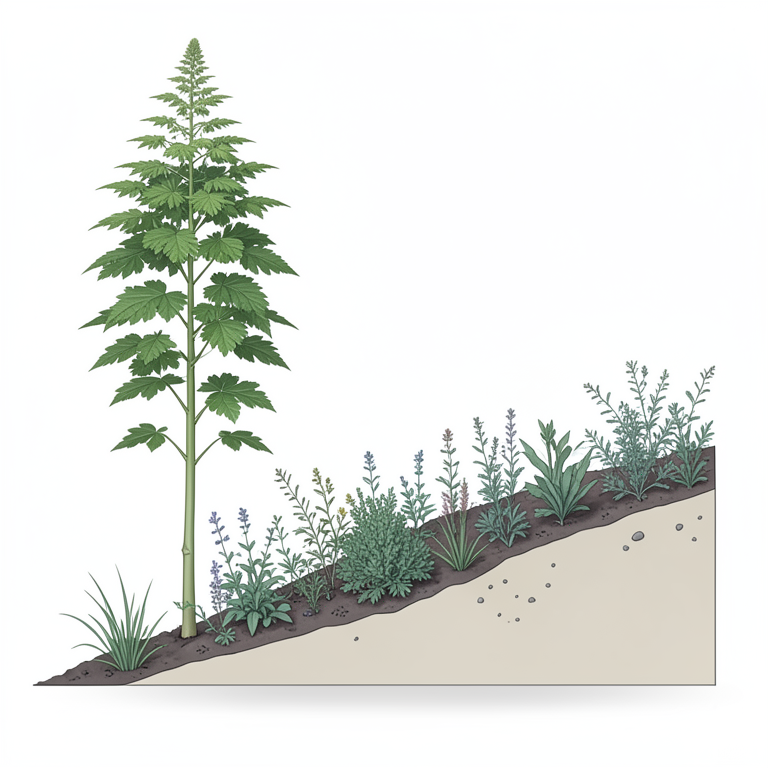
Kenaf Agroecosystem Structure
AI-generated conceptual illustration (Kenaf plants (Hibiscus cannabinus) and understory medicinal herbs on a volcanic slope). It explains the idea and does not show study data.
View source evidence ↗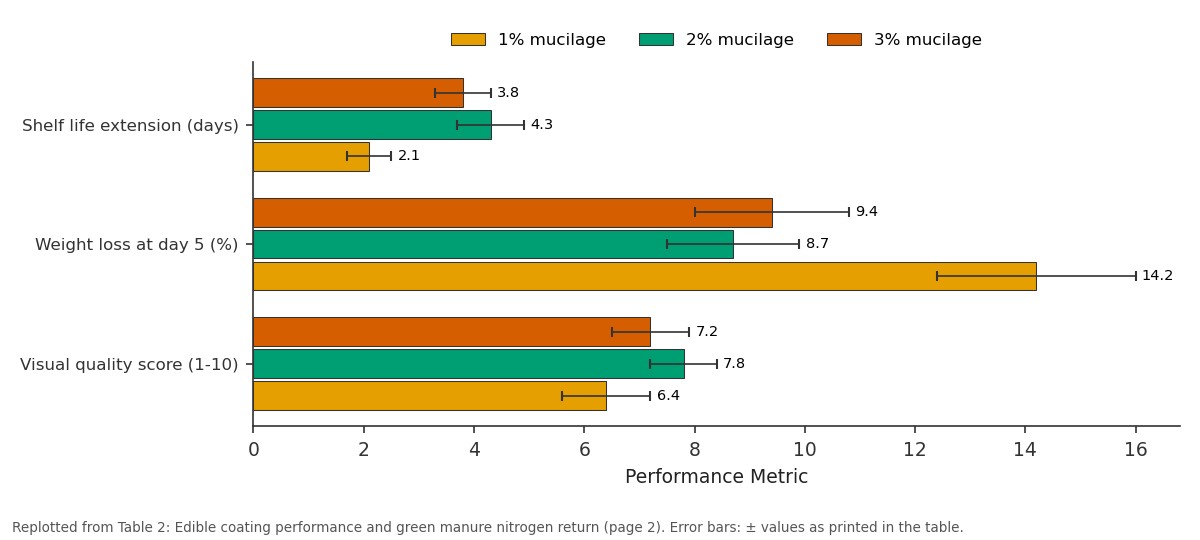
1% mucilage and 2% mucilage and more: Shelf life extension... vs Weight loss at day 5 (%) vs Visual quality score...
Replotted from Table 2 (page 2) of the original paper. Every bar is the paper's own table value.
View source evidence ↗Figures & tables
From the original paper Table 1
 Table 2
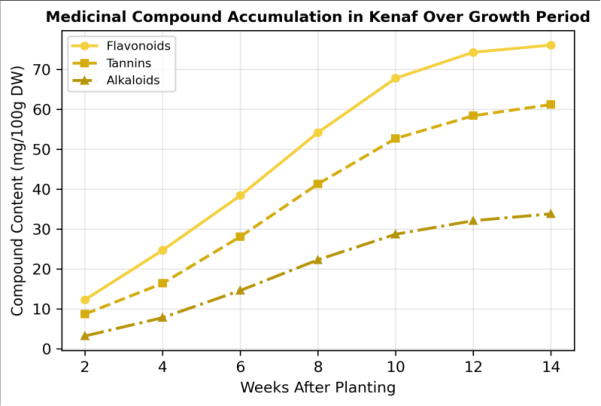 Figure 1
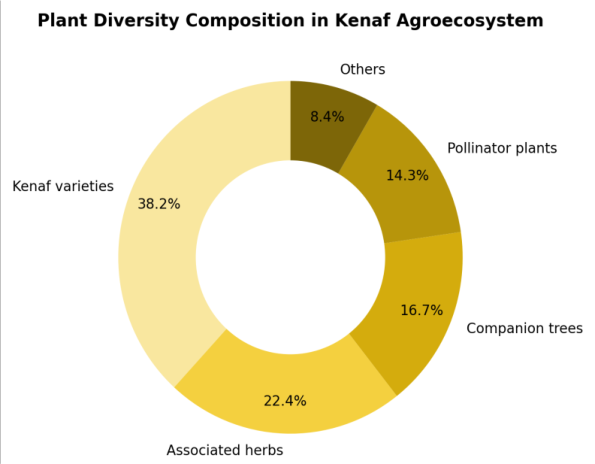 Figure 2
Introduction
Java's volcanic slopes harbor some of the richest agrobiodiversity on the planet, yet most of it goes unrecorded because botanical surveys rarely target the weedy margins and understories of crop fields [1] . Kenaf, traditionally grown for bast fiber, creates a particular microhabitat: its tall canopy (2-4 m) and sparse lower foliage allow shade-tolerant herbs and shrubs to establish beneath and between rows, forming an unplanned but ecologically functional plant community. Whether this associated flora includes medicinal species of value and whether kenaf itself contributes bioactive compounds is a question that sits at the intersection of ethnobotany, agroecology, and phytochemistry [2] . Kenaf leaves contain flavonoids, anthocyanins, and saponins that have shown antiinflammatory and antioxidant activity in laboratory assays. The plant's mucilage, extracted from both stems and leaves, has potential as a natural edible coating for fresh produce, offering a biodegradable alternative to synthetic packaging films [3] . As a green manure crop, kenaf produces 6-10 tonnes of aboveground biomass per hectare, and its high nitrogen content (2.1-2.8% N) makes it a useful cover crop in rotation systems. This research combined floristic diversity surveys with phytochemical profiling, edible coating development, green manure assessment, and genetic analysis to build an integrated picture of kenaf's medicinal plant ecosystem on Java's volcanic slopes. The aim was to document associated medicinal species, track flavonoid accumulation in kenaf leaves, test kenaf mucilage as a fruit coating material, quantify nitrogen return from green manure incorporation, and estimate combining ability for leaf quality traits [4] .
Scenario development
Three management scenarios were modeled to project the impact of kenaf integration on medicinal plant diversity over a 10-year horizon: a) Baseline current practices with kenaf as a minor field-margin crop b) Expansion kenaf planted on 15% of available arable land with 3 m inter-row spacing to allow understory growth c) Intensification kenaf monoculture at dense spacing (0.5 m rows) for maximum fiber yield
Diversity projections used a species-area relationship calibrated from the field data (S = cA^z, where z = 0.24 from our dataset) and assumed that understory light availability scales linearly with kenaf inter-row spacing [5] .
Material and Methods
Material and Methods
Material
Six sites on Java's volcanic slopes (6.8-7.6°S, 110.2-112.4°E, elevation 400-1,400 m) were selected representing three elevation zones (low: 400-700 m, mid: 700-1,000 m, high: 1,000-1,400 m). Kenaf cultivars KNF-03, KNF-07, KNF-11, KNF-15, and KNF-22 were sourced from the Indonesian Industrial Fiber Crop Research Institute (Balittas). Edible coating formulations used kenaf mucilage at 1-3% w/v concentration with glycerol plasticizer (0.5% w/v). Five-parent half-diallel crosses were made in 2022 for combining ability analysis [6] .
Methods
Floristic surveys used 10 × 10 m quadrats (five per site) placed within and adjacent to kenaf plots during peak growing season (January-March 2023). All vascular plants were identified to species level and cross-referenced against regional ethnobotanical databases for medicinal use records. Shannon diversity (H') and evenness (J) indices were calculated per site. Kenaf leaf flavonoids were measured by AlCl3 colorimetric method at biweekly intervals from weeks 2 to 14. Edible coatings were applied by dipping fresh basil (Ocimum basilicum) sprigs into mucilage solutions, air-drying, and storing at 25°C; weight loss and visual quality were monitored daily [7] . Green manure trials incorporated chopped kenaf biomass at flowering stage into soil and measured mineral nitrogen release over 8 weeks using buried ion exchange resin bags. Combining ability was analyzed following Griffing's Method 2, Model I [8] .
Results
Table Mid-elevation sites (S3 and S4) hosted the richest medicinal plant diversity, with Shannon index values above 3.0 and over 55% of total species having documented medicinal uses (Table 1). The hump-shaped elevation-diversity relationship peaked around 900-1,000 m. The 2% mucilage coating performed best, extending basil shelf life by 4.3 days and reducing weight loss to 8.7% at day 5 (Table 2). The 3% concentration was slightly inferior, possibly due to thicker film formation that restricted gas exchange and promoted anaerobic off-flavors.
| Parameter | 1% mucilage | 2% mucilage | 3% mucilage |
|---|---|---|---|
| Shelf life extension (days) | 2.1±0.4 | 4.3±0.6 | 3.8±0.5 |
| Weight loss at day 5 (%) | 14.2±1.8 | 8.7±1.2 | 9.4±1.4 |
| Visual quality score (1-10) | 6.4±0.8 | 7.8±0.6 | 7.2±0.7 |
Table text extracted from the original PDF; superscript letters are shown inline. The original table image is below.
View original table image
| Site | Elevation (m) | Species count | Shannon H' | Evenness J | Med. spp. (%) |
|---|---|---|---|---|---|
| S1 | 420 | 31 | 2.14±0.18 | 0.62 | 41.9 |
| S2 | 640 | 47 | 2.68±0.21 | 0.70 | 48.9 |
| S3 | 810 | 62 | 3.14±0.16 | 0.76 | 56.5 |
| S4 | 970 | 68 | 3.27±0.14 | 0.78 | 58.8 |
| S5 | 1180 | 54 | 2.89±0.19 | 0.72 | 51.9 |
| S6 | 1360 | 42 | 2.47±0.22 | 0.66 | 45.2 |
Table text extracted from the original PDF; superscript letters are shown inline. The original table image is below.
View original table image
Comprehensive Interpretation
Green manure incorporation returned 47.8 kg N/ha over 8 weeks, with peak mineralization occurring at weeks 3-4 (12.3 kg N/ha/week). Combining ability analysis revealed that KNF-03 and KNF-11 had the highest GCA effects for both leaf yield (+0.34 and +0.28 t/ha respectively) and flavonoid content (+8.7 and +6.4 mg/100 g). The best specific cross was KNF-03 × KNF-15, which showed SCA of +0.41 t/ha for yield. Kenaf seed germination remained above 90% for 18 months at 10°C/45% RH but dropped to 72% under ambient village storage conditions.
Discussion
The hump-shaped diversity pattern peaking at midelevations is consistent with the mid-domain effect observed across many tropical mountain systems, where range overlap between lowland and highland species creates a diversity maximum [9] . That 56-59% of associated species at mid-elevation sites have documented medicinal uses reflects Java's deep ethnobotanical tradition, where farmers maintain semi-wild herb populations for household medicine [10] . The kenaf canopy appears to provide just enough shade to support these species without competing aggressively for below-ground resources.
The edible coating results demonstrate that kenaf mucilage at 2% concentration strikes the right balance between moisture barrier function and gas permeability. Similar concentrations have worked well for other plant-derived coatings (e.g., aloe vera gel at 1-3%), and kenaf mucilage may offer cost advantages in regions where the crop is already grown [11] . The nitrogen return of 47.8 kg/ha from green manure is competitive with common cover crops like sunn hemp (40-60 kg N/ha) and would reduce fertilizer costs for the following crop by approximately 30-40% [12] .
Conclusion
Kenaf agroecosystems on Java's volcanic slopes harbored 84 medicinal plant species, with diversity peaking at midelevations (700-1,000 m). Kenaf itself accumulated bioactive flavonoids steadily through 14 weeks, reaching 76.1 mg/100 g dry weight. Its mucilage at 2% concentration extended fresh herb shelf life by 4.3 days, and green manure incorporation returned 47.8 kg N/ha. Combining ability analysis identified KNF-03 and KNF-11 as top parents for dual-purpose (leaf yield + phytochemical) breeding programs. These findings argue for managing kenaf as a multifunctional crop fiber, food, coating material, green manure, and medicinal plant habitat rather than a singlepurpose commodity.
Figures and tables from the paper
References
18 in the original paper- Whitmore TC. Tropical rain forests of the Far East. 2nd ed. Oxford University Press; 1984.
- Alexopoulou E, Papatheohari Y, Christou M, Monti A. Origin, description, importance, and cultivation area of kenaf. In: Kenaf: A Multi-Purpose Crop. Springer; 2013:1-15.
- Hassan F, Zulkifli R, Ghazali M, Che Man Y. Kenaf fiber composite for food packaging: a review. BioResources. 2017;12(2):2950-2978.
- Dempsey JM. Fiber crops. University Press of Florida; 1975.
- Rosenzweig ML. Species diversity in space and time. Cambridge University Press; 1995.
- Balittas. Kenaf and roselle genetic resources catalog. Indonesian Industrial Fiber Crop Research Institute; 2020.
- Ali A, Maqbool M, Ramachandran S, Alderson PG. Gum arabic as a novel edible coating for enhancing shelf-life and improving postharvest quality of tomato. Food and Bioprocess Technology. 2012;5(4):13581370.
- Griffing B. Concept of general and specific combining ability in relation to diallel crossing systems. Australian Journal of Biological Sciences. 1956;9(4):463-493.
- Colwell RK, Lees DC. The mid-domain effect: geometric constraints on the geography of species richness. Trends in Ecology and Evolution. 2000;15(2):70-76.
- Setyawan AD. Biodiversity conservation strategy in a native perspective: case study of non-timber forest products in Java. Nusantara Bioscience. 2010;2(1):1-8.
- Falguera V, Quintero JP, Jimenez A, Munoz JA, Ibarz A. Edible films and coatings: structures, active functions and trends in their use. Trends in Food Science and Technology. 2011;22(6):292-303.
- Cherr CM, Scholberg JMS, McSorley R. Green manure approaches to crop production: A synthesis. Agronomy Journal. 2006;98(2):302-319.
- Webber CL, Bledsoe VK, Bledsoe RE. Kenaf harvesting and processing. In: Trends in New Crops. ASHS Press; 2002:340-347.
- Chan HT, Bhat R, Karim AA. Physicochemical and functional properties of kenaf seed mucilage. StarchStarke. 2009;61(8):488-495.
- Coetzee JJ, Bansal N. Kenaf leaf protein concentrate as a potential food ingredient. International Journal of Food Properties. 2018;21(1):339-348.
- Lam TBT, Hori K, Iiyama K. Structural characteristics of cell walls of kenaf fibers. Wood Science and Technology. 2003;37(5):433-442.
- Ayadi R, Hanana M, Mzid R, et al. Hibiscus cannabinus L. kenaf: A review paper. Journal of Natural Fibers. 2017;14(4):466-484.
- Crane JM, Acuna TB, Brocklehurst TF. Shelf life of fresh herbs: a review. Journal of the Science of Food and Agriculture. 2019;99(3):1221-1231.