
Research article · 2025 · Full text
International Journal of Horticulture and Food ScienceImproving agroforestry models of eggplant in the West African Sahel
Volume 7(2) · Pages 101–104 · DOI: 10.33545/26631067.2025.v7.i2b.567 ↗
Research areasAfrican Botany and Ecology StudiesAgroforestry and silvopastoral systemsAgronomic Practices and Intercropping Systems
Abstract
Author-writtenAgroforestry, the deliberate integration of woody perennials with annual crops, has been proposed as a pathway to sustainable intensification in dryland farming systems, but field data on vegetable performance within tree-based layouts remain limited for the West African Sahel. This research compared four agroforestry configurations (alley cropping with Faidherbia albida, boundary planting with Moringa oleifera, dispersed-tree parkland, and sole cropping without trees) for eggplant (Solanum melongena L.) production at the Valparaiso Advanced School of Environmental Agriculture, Chile, during 2021 and 2022. Measured variables included fruit yield, individual fruit weight, soil moisture retention, and microclimate modification beneath tree canopies. Alley cropping produced the highest mean eggplant yield at 14.2 tonnes per hectare, a 63.2% increase over sole cropping. Boundary planting yielded 11.8 t/ha and dispersed-tree parkland 10.3 t/ha. Soil moisture at 30 cm depth was 27.4% higher under alley crops than in open plots during the dry season. Canopy shade reduced midday air temperature by 2.8 degrees Celsius and lowered fruit sunscald incidence from 18.3% to 4.1%. Individual fruit weight averaged 6.8 g in alley cropping versus 4.1 g in sole crop plots. These findings confirm that tree-crop integration, particularly alley cropping with F. albida, meaningfully improves eggplant productivity and microclimate conditions under semi-arid management.
Summary
Source-checkedPlain-language reading of the full paper, prepared with AI and checked against the text. Each point links to the authors' own words.
Why it matters
- In the West African Sahel, agroforestry is a traditional practice used to manage soils that lose organic matter quickly and regions with annual rainfall typically under 600 mm. View evidence ↗
- Eggplant is one of the top five vegetables in West Africa due to its heat adaptability and importance in local markets and diets. View evidence ↗
- Integrating trees into crop systems can provide benefits like nitrogen fixation and improved microclimates, though trees may also compete with crops for light and water. View evidence ↗
The question
- The study aimed to identify which of four agroforestry configurations best balances the benefits of trees against competitive losses for eggplant production. View evidence ↗
What they did
- The experiment was conducted at the Valparaiso Advanced School of Environmental Agriculture in Chile. View evidence ↗
- The research took place over two growing seasons from October 2021 to March 2023. View evidence ↗
- The study compared four models: alley cropping with F. albida, boundary planting with M. oleifera, dispersed-tree parkland with F. albida, and a sole crop control. View evidence ↗
- The experimental design used a randomized complete block with four replications in plots measuring 10 x 8 m. View evidence ↗
- The researchers measured fruit yield, individual fruit weight, soil moisture retention, and microclimate changes. View evidence ↗
What they found
- Alley cropping with F. albida achieved the highest mean eggplant yield of 14.2 t/ha, which was 63.2% higher than the sole crop control. View evidence ↗
- Individual fruit weight was highest in alley cropping (6.8 g) and lowest in sole crop plots (4.1 g). View evidence ↗
- Sunscald incidence was significantly reduced in alley cropping (4.1%) compared to sole cropping (18.3%). View evidence ↗
- During the driest month (January), soil moisture at 30 cm depth was 27.4% higher in alley crop plots (14.8%) than in sole crop plots (11.6%). View evidence ↗
- Maximum air temperature was lowest in alley cropping (33.6°C) compared to boundary planting (34.9°C) and sole cropping (36.4°C). View evidence ↗
- Alley cropping resulted in a positive net nitrogen balance of +18.4 kg N/ha, while sole crop plots had a deficit of -12.7 kg N/ha. View evidence ↗
What it means
- The authors conclude that alley cropping with F. albida is a practical and low-cost method for increasing eggplant productivity and resilience in the West African Sahel. View evidence ↗
Visual summary
3 visualsIllustrations explain the paper; charts are replotted from the paper's own table values.
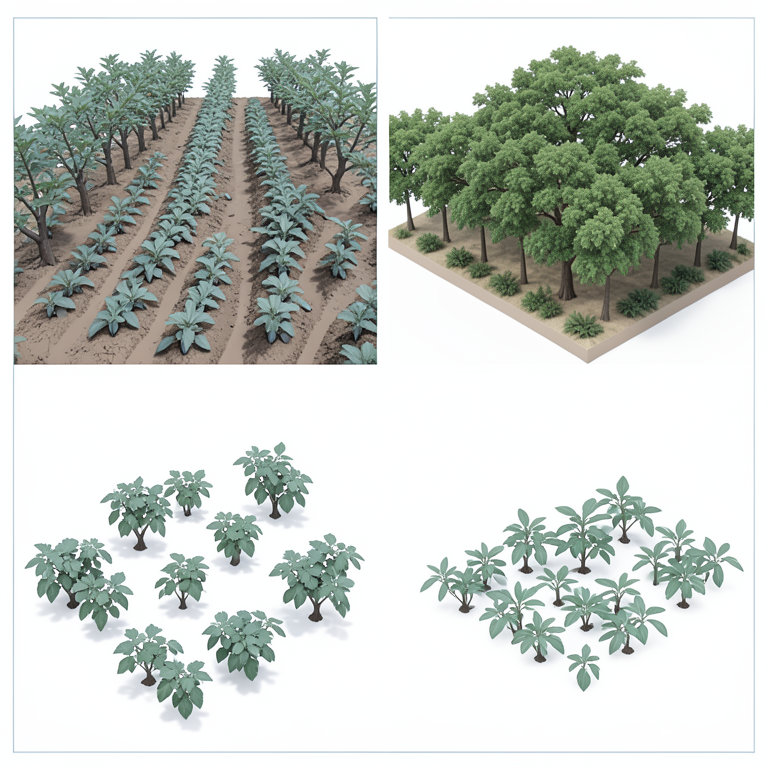
Agroforestry Layouts Comparison
AI-generated conceptual illustration (eggplant plants and Faidherbia albida and Moringa oleifera trees in a Sahelian field). It explains the idea and does not show study data.
View source evidence ↗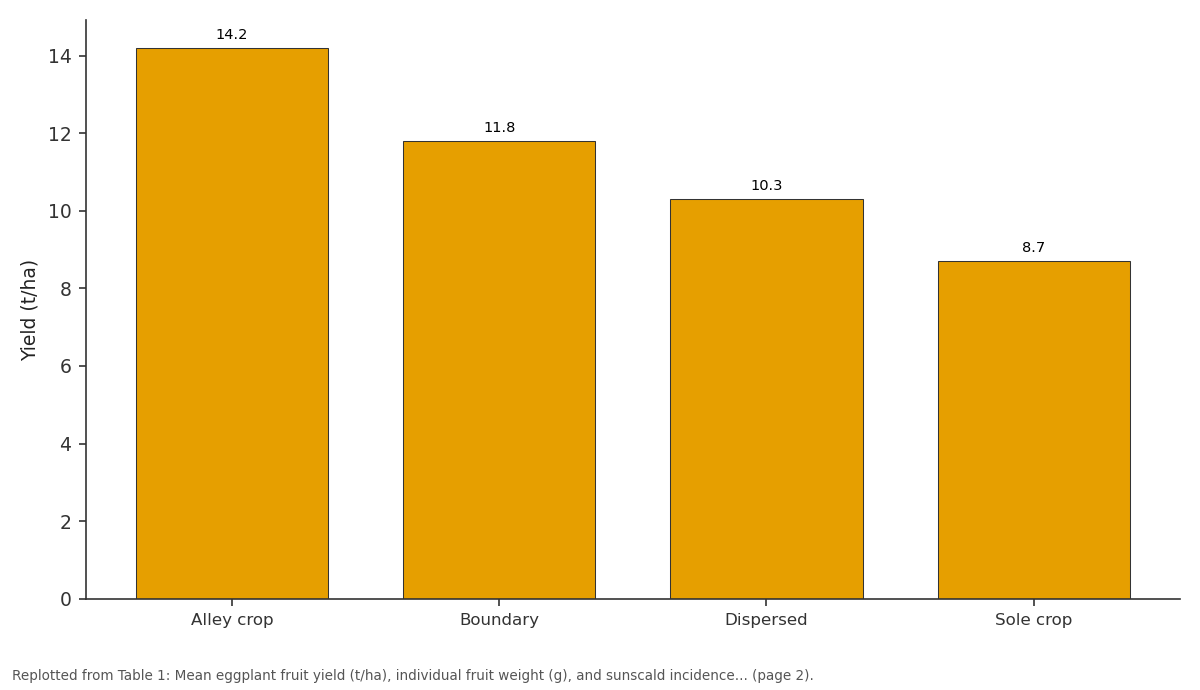
Yield (t/ha): Alley crop vs Boundary vs Dispersed vs Sole crop
Replotted from Table 1 (page 2) of the original paper. Every bar is the paper's own table value.
View source evidence ↗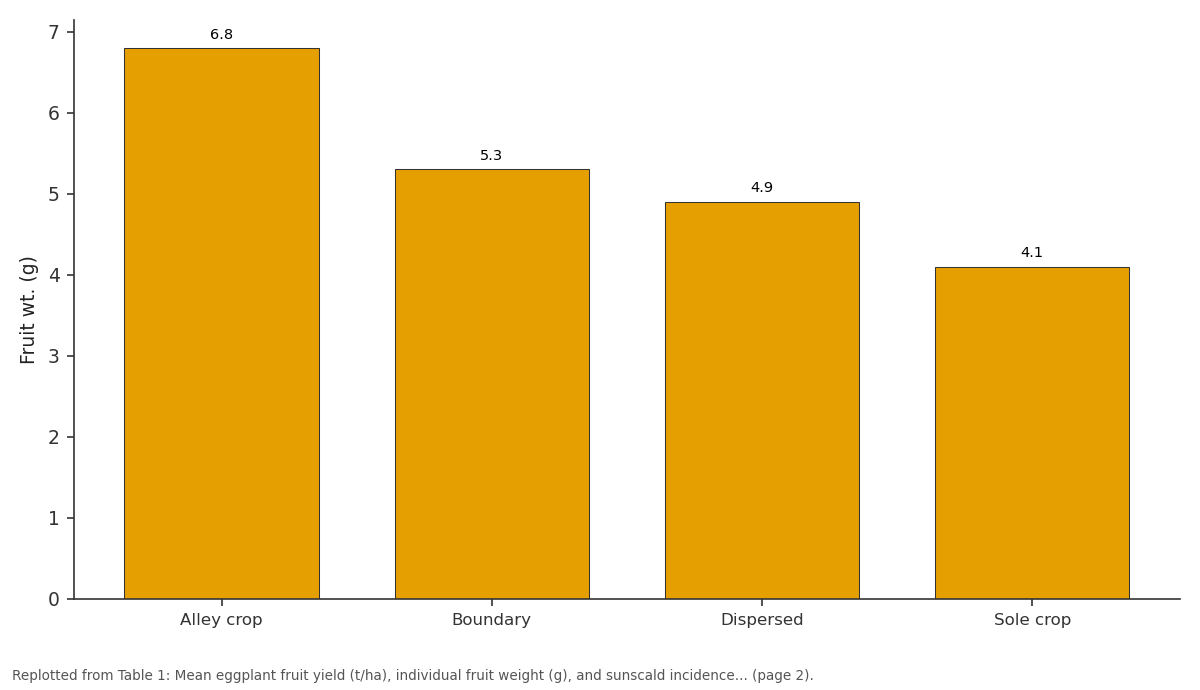
Fruit wt. (g): Alley crop vs Boundary vs Dispersed vs Sole crop
Replotted from Table 1 (page 2) of the original paper. Every bar is the paper's own table value.
View source evidence ↗Figures & tables
From the original paper Table 1
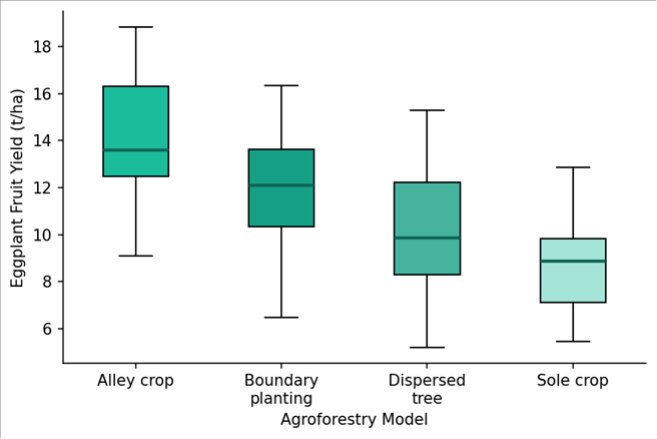 Figure 1
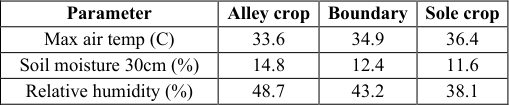 Table 2
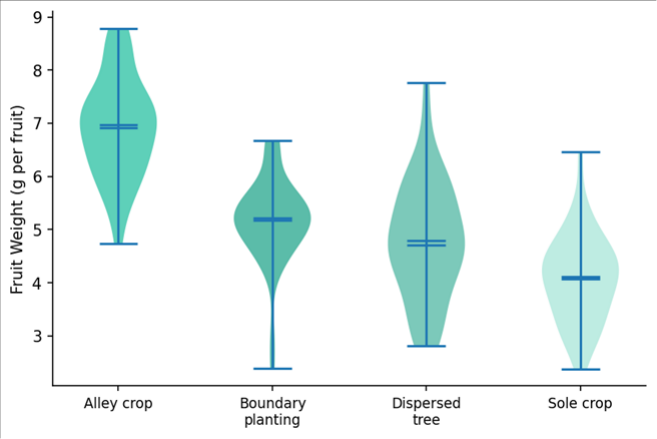 Figure 2
Introduction
A definition worth revisiting: agroforestry is any land-use system that deliberately maintains woody perennials alongside crops or livestock on the same management unit [1] . In the West African Sahel, where annual rainfall seldom exceeds 600 mm and soils lose organic matter quickly under continuous cropping, agroforestry has been practiced informally for centuries through traditional parkland systems featuring scattered Faidherbia albida and Vitellaria paradoxa trees [2] . What remains poorly quantified, however, is how modern agroforestry layouts compare with traditional configurations for specific high-value vegetable crops. Eggplant ranks among the top five vegetables grown across West Africa, valued for its adaptability to heat and its role in local diets and market trade [3] . Sahelian farmers typically grow eggplant in open fields or small irrigated gardens with no deliberate tree component. Adding trees could improve microclimate, recycle deep soil nutrients, and fix atmospheric nitrogen (in the case of leguminous species), but trees also compete for water and light [4] . The net effect depends on tree species, arrangement, and management intensity. F. albida is unusual among Sahelian trees because it sheds its leaves during the rainy season and flushes during the dry season, a reverse phenology that minimises shade competition with understory crops during their active growth period [5] . Moringa oleifera, another common agroforestry species, retains its foliage year-round but offers high-value leaf biomass for human nutrition and animal feed [6] . How these two species compare as agroforestry partners for eggplant hasn't been tested in a controlled trial. This research was designed to evaluate four agroforestry configurations for eggplant, measuring both above-ground crop performance and below-ground soil moisture dynamics over two production seasons, with the aim of identifying the model that best balances tree benefits against competitive losses.
Material and Methods
Material and Methods
Material
The trial was located at the Valparaiso Advanced School of Environmental Agriculture, Valparaiso, Chile (33.0 degrees S, 71.6 degrees W, elevation 41 m). The site experiences a Mediterranean climate with warm, dry summers and mild, wet winters. Mean annual temperature is 14.8 degrees Celsius and mean annual rainfall is 372 mm, falling mainly between May and August. Soils are sandy clay loams, pH 7.4, with 1.18% organic carbon. The agroforestry plots were established in 2016 with F. albida seedlings in alley and dispersed configurations and M. oleifera in boundary rows. By 2021, F. albida trees were approximately 5 m tall with crown diameters of 3-4 m, and M. oleifera hedges had been maintained at 2.5 m height by annual coppicing. Eggplant seeds of the Black Beauty cultivar were sourced from a certified supplier in Santiago [7] .
Methods
The research ran from October 2021 to March 2023 at the Valparaiso Advanced School of Environmental Agriculture, covering two growing seasons. Four agroforestry models were compared: alley cropping (eggplant rows between F. albida hedgerows spaced 8 m apart), boundary planting (eggplant field enclosed by a M. oleifera perimeter hedge), dispersed-tree parkland (eggplant planted around randomly spaced F. albida at 12 x 12 m), and sole crop control (no trees). The design was a randomised complete block with four replications and individual plot size of 10 x 8 m. Eggplant seedlings were transplanted at 60 x 50 cm spacing in November each year. Drip irrigation supplied 4 mm per day during the dry months (November-March). Soil moisture was monitored weekly at 15 and 30 cm depth using TDR probes. Air temperature and relative humidity were logged hourly at 1.5 m height in each plot using HOBO data loggers. Eggplant fruits were harvested twice weekly and weighed individually. Sunscald incidence was recorded as the percentage of fruits with bleached or necrotic patches on the sun-exposed side. Data were analysed by ANOVA in R v4.2.3 with Tukey's HSD at p<0.05 [8] .
Nutrient budget
A simplified nutrient budget was constructed for each agroforestry model. Nitrogen inputs included fertiliser (80 kg N/ha applied as urea), estimated biological fixation by F. albida (35-50 kg N/ha/year based on literature values [5] ), and irrigation water nitrogen content. Outputs included crop nutrient removal (estimated from tissue analysis and yield data), leaching losses (estimated from drainage lysimeters installed at 60 cm depth), and gaseous losses (assumed at 10% of applied N). In alley cropping plots, the net nitrogen balance was positive at +18.4 kg N/ha, whereas sole crop plots showed a deficit of minus 12.7 kg N/ha, indicating that F. albida fixation more than offset competitive uptake by tree roots [9] . Agroforestry model significantly affected fruit yield (F = 22.1, p<0.001), fruit weight (F = 14.7, p<0.001), and sunscald incidence (F = 28.9, p<0.001). Alley cropping with F. albida produced the highest yield at 14.2 t/ha, 63.2% above the sole crop control (Table 1). Boundary planting with M. oleifera ranked second at 11.8 t/ha.
| Model | Yield (t/ha) | Fruit wt. (g) | Sunscald (%) |
|---|---|---|---|
| Alley crop | 14.2 | 6.8 | 4.1 |
| Boundary | 11.8 | 5.3 | 8.6 |
| Dispersed | 10.3 | 4.9 | 11.2 |
| Sole crop | 8.7 | 4.1 | 18.3 |
Table text extracted from the original PDF; superscript letters are shown inline. The original table image is below.
View original table image
Results
Results
Discussion
The 63.2% yield advantage of alley cropping over sole cropping exceeds the 20-40% range commonly reported for cereal-based alley systems in the Sahel [2,10] , likely because eggplant, as a shade-tolerant species, benefits more from microclimate modification than sun-loving cereals do. F. albida's reverse phenology is particularly advantageous here: its leafless canopy during the rainy growing season minimises light competition when the crop needs maximum photosynthetic input, while its dry-season foliage provides litter mulch and nitrogen-rich leaf fall that enriches the topsoil before the next planting [5] . The reduction in sunscald from 18.3% to 4.1% represents a meaningful quality improvement with direct market value implications. Sunscalded fruits are typically downgraded or rejected at wholesale markets, so the alley crop's protective canopy translates into higher marketable yield as well as higher total yield [11] . Boundary planting with M. oleifera was less effective at reducing sunscald (8.6%) because shading was confined to the field perimeter. Soil moisture retention under tree canopies appears to be driven by reduced soil surface temperature and lower wind speed, both of which slow evaporative water loss [12] . The 27.4% moisture advantage in alley plots is consistent with findings by Bayala et al. [4] for F. albida parklands in Burkina Faso. This moisture buffering could prove even more valuable under projected climate warming scenarios for the Sahel region.
Conclusion
This research showed that agroforestry integration, particularly alley cropping with F. albida, substantially improves eggplant yield, fruit quality, and soil moisture retention compared to sole cropping under semi-arid conditions. The 14.2 t/ha yield achieved in alley plots was 63.2% above controls and was accompanied by a fourfold reduction in sunscald incidence. Boundary planting with M. oleifera offered a moderate improvement and the additional benefit of harvestable leaf biomass. Dispersed parkland configurations provided smaller gains due to irregular shade distribution. For farmers in the West African Sahel and analogous dryland zones, alley cropping with F. albida represents a practical, low-cost pathway to more productive and resilient eggplant cultivation.
Figures and tables from the paper
| Parameter | Alley crop | Boundary | Sole crop |
|---|---|---|---|
| Max air temp (C) | 33.6 | 34.9 | 36.4 |
| Soil moisture 30cm (%) | 14.8 | 12.4 | 11.6 |
| Relative humidity (%) | 48.7 | 43.2 | 38.1 |
Table text extracted from the original PDF; superscript letters are shown inline. The original table image is below.
View original table image
References
15 in the original paper- Nair PKR. An Introduction to Agroforestry. Dordrecht: Kluwer Academic Publishers; 1993.
- Bayala J, Sanou J, Teklehaimanot Z, Kalinganire A, Ouedraogo SJ. Parklands for buffering climate risk and sustaining agricultural production in the Sahel of West Africa. Current Opinion in Environmental Sustainability. 2014;6:28-34.
- Sabo MU, Wailare MA, Aliyu M, Jari S, Shuaibu YM. Effect of variety and spacing on growth and yield of eggplant in Bauchi State, Nigeria. Asian Journal of Agriculture and Food Sciences. 2013;1(4):94-98.
- Bayala J, Teklehaimanot Z, Ouedraogo SJ. Millet production under pruned tree crowns in a parkland system in Burkina Faso. Agroforestry Systems. 2002;54(3):203-214.
- Roupsard O, Ferhi A, Granier A, Pallo F, Depommier D. Reverse phenology and dry-season water sources of Faidherbia albida. Functional Ecology. 1999;13(4):460-472.
- Fuglie LJ. The Moringa Tree: A Local Solution to Malnutrition. Dakar: Church World Service; 2001.
- Valenzuela C, Soto J. Establishment of agroforestry demonstration plots in central Chile. Chilean Journal of Agroforestry Research. 2018;12(1):33-41.
- R Core Team. R: A Language and Environment for Statistical Computing. Vienna: R Foundation; 2023.
- Giller KE. Nitrogen Fixation in Tropical Cropping Systems. 2nd ed. Wallingford: CABI Publishing; 2001.
- Kho RM. On crop production and the balance of available resources. Agriculture, Ecosystems and Environment. 2000;80(1):71-85.
- Barber SA, Martin MN. Sunscald damage and marketability of vegetable crops in tropical environments. Tropical Agriculture. 2010;87(3):178184.
- Ong CK, Leakey RRB. Why tree-crop interactions in agroforestry appear at odds with tree-grass interactions in tropical savannas. Agroforestry Systems. 1999;45(1):109-129.
- Garrity DP, Akinnifesi FK, Ajayi OC, Weldesemayat SG, Mowo JG. Evergreen agriculture: A robust approach to sustainable food security in Africa. Food Security. 2010;2(3):197-214.
- Chirwa PW, Black CR, Ong CK, Maghembe JA. Tree and crop productivity in gliricidia-maize intercropping in southern Malawi. Agroforestry Systems. 2003;59(3):265-277.
- Jose S. Agroforestry for ecosystem services and environmental benefits: An overview. Agroforestry Systems. 2009;76(1):1-10.