
Research article · 2025 · Full text
International Journal of Horticulture and Food ScienceMonitoring water use efficiency of cinnamon in the Indonesian archipelago
Volume 7(1) · Pages 229–232 · DOI: 10.33545/26631067.2025.v7.i1d.558 ↗
Research areasIrrigation Practices and Water ManagementPlant Growth and Agriculture TechniquesPlant Water Relations and Carbon Dynamics
Abstract
Author-writtenCinnamon is a thirsty crop in a region where irrigation water is becoming scarcer, so the question of how much water each kilogram of bark actually needs deserves serious attention. This research monitored Water Use Efficiency (WUE) of Cinnamomum verum under five irrigation regimes across two harvest cycles in western Java, Indonesia. Treatments included rainfed control, drip irrigation at 50%, 75%, and 100% of crop evapotranspiration (ETc), and sprinkler irrigation at 100% ETc. Bark yield, water applied, soil moisture, and canopy temperature were tracked over 24 months at a 6-year-old plantation. Drip at 50% ETc delivered the highest WUE at 5.87 kg bark per cubic meter of water, nearly double the rainfed figure of 3.21 kg/m³. But bark yield peaked at drip 100% ETc (3.41 t/ha), which had a WUE of only 3.74 kg/m³. Sprinkler irrigation was the least efficient method (3.48 kg/m³) despite applying similar water volumes to drip 100%. Canopy temperature depression tracked closely with soil moisture availability (r = -0.78, p<0.01). These findings indicate that deficit drip irrigation at 50% ETc offers the best water productivity for Archipelago cinnamon, though growers targeting maximum yield rather than maximum efficiency should apply 75-100% ETc.
Summary
Source-checkedPlain-language reading of the full paper, prepared with AI and checked against the text. Each point links to the authors' own words.
Why it matters
- Cinnamon is a water-intensive crop grown in regions where irrigation water is increasingly scarce, making it important to understand the water requirements for bark production. View evidence ↗
- Traditional rainfed cinnamon systems are struggling to cope with climate variability and changing water availability. View evidence ↗
- While the chemistry and quality of Indonesian cinnamon bark have been studied, there is a significant lack of research on irrigation management. View evidence ↗
The question
- The study aimed to determine which irrigation strategy provides the highest return of cinnamon bark per cubic meter of water used. View evidence ↗
What they did
- The research was conducted on a 6-year-old Cinnamomum verum plantation located in Pandeglang, western Java. View evidence ↗
- Five irrigation treatments were tested: a rainfed control, drip irrigation at 50%, 75%, and 100% of crop evapotranspiration (ETc), and sprinkler irrigation at 100% ETc. View evidence ↗
- The experiment employed a randomized complete block design featuring three replications, with each replication consisting of eight trees. View evidence ↗
- Water Use Efficiency (WUE) was calculated by dividing the oven-dried bark yield (harvested at 12 and 24 months) by the total water received from both rainfall and irrigation. View evidence ↗
What they found
- Drip irrigation at 50% ETc achieved the highest water use efficiency at 5.87 kg/m³, which is nearly double the 3.21 kg/m³ observed in rainfed plots. View evidence ↗
- The highest absolute bark yield was achieved with 100% ETc drip irrigation at 3.41 t/ha, although its WUE was lower at 3.74 kg/m³. View evidence ↗
- Sprinkler irrigation was less efficient than drip irrigation, using 4.5% more water while producing 3.8% less bark compared to the 100% ETc drip treatment. View evidence ↗
- During the dry season, rainfed plots fell to 14.7% soil moisture (below the 20% wilting threshold), while the 50% drip treatment stayed just above it at 21.3%. View evidence ↗
- Rainfed plots exhibited water stress in the dry season with canopy temperatures 1.8°C above ambient, whereas all irrigated treatments maintained canopy temperatures at or below ambient levels. View evidence ↗
- There was a strong negative correlation (r = -0.78, p<0.01) between canopy temperature depression and soil moisture availability. View evidence ↗
What it means
- The authors conclude that deficit drip irrigation is best for water-limited areas to maximize return per unit of water, while full drip irrigation is recommended to maximize total income when water is abundant. View evidence ↗
Visual summary
3 visualsIllustrations explain the paper; charts are replotted from the paper's own table values.
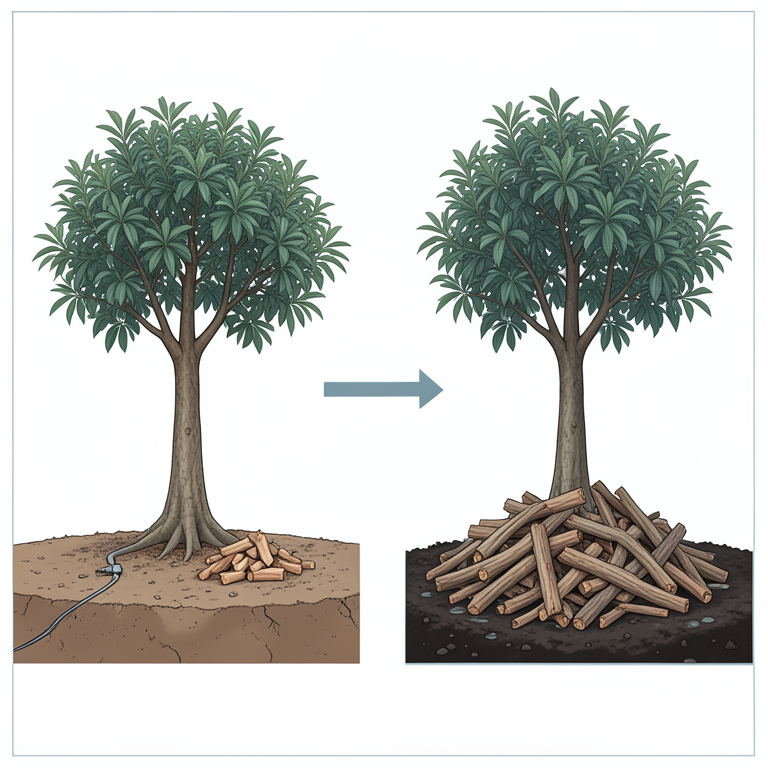
Trade-off between WUE and Absolute Yield
AI-generated conceptual illustration (Cinnamon trees (Cinnamomum burmannii) in a plantation setting). It explains the idea and does not show study data.
View source evidence ↗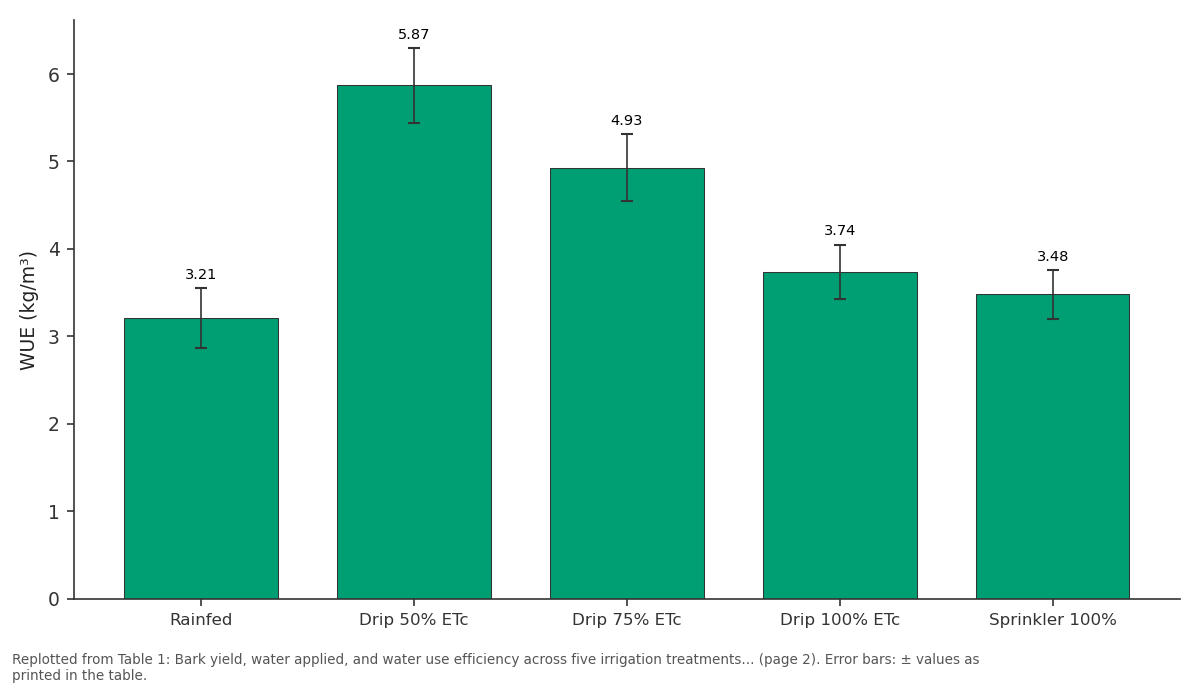
WUE (kg/m³): Rainfed vs Drip 50% ETc vs Drip 75% ETc vs Drip 100% ETc vs Sprinkler 100%
Replotted from Table 1 (page 2) of the original paper. Every bar is the paper's own table value.
View source evidence ↗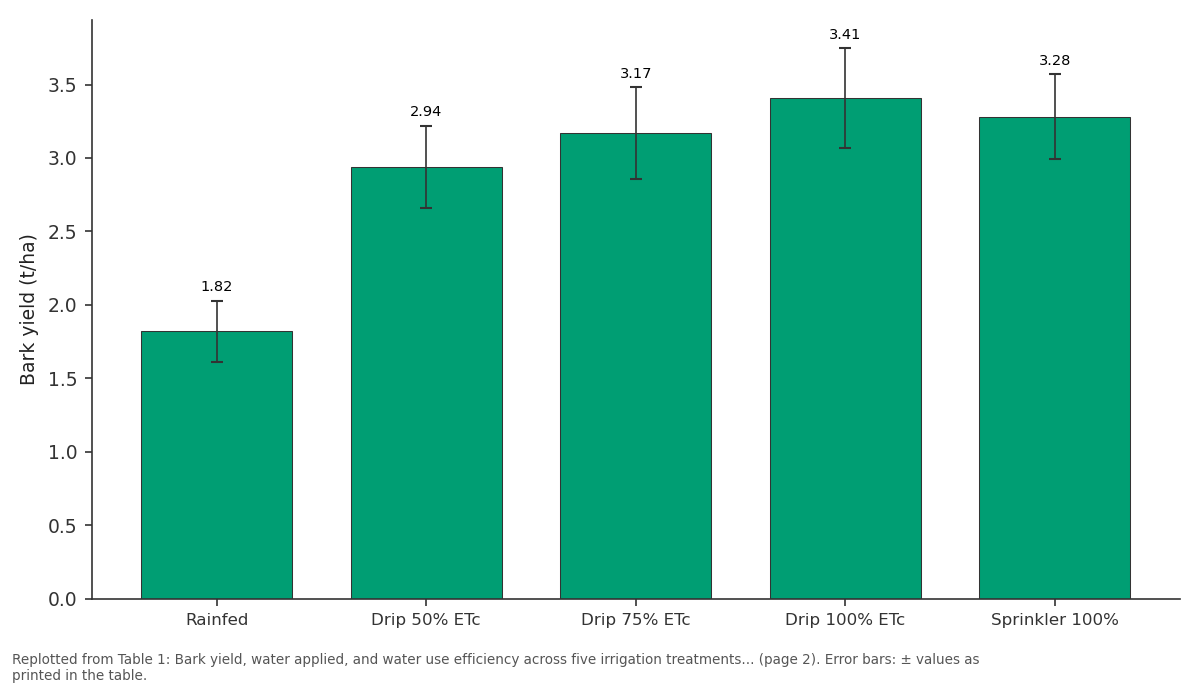
Bark yield (t/ha): Rainfed vs Drip 50% ETc vs Drip 75% ETc vs Drip 100% ETc vs Sprinkler 100%
Replotted from Table 1 (page 2) of the original paper. Every bar is the paper's own table value.
View source evidence ↗Figures & tables
From the original paper Table 1
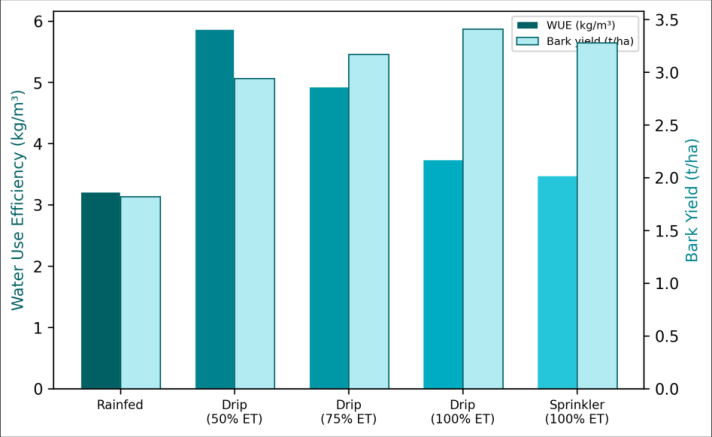 Figure 1
 Table 2
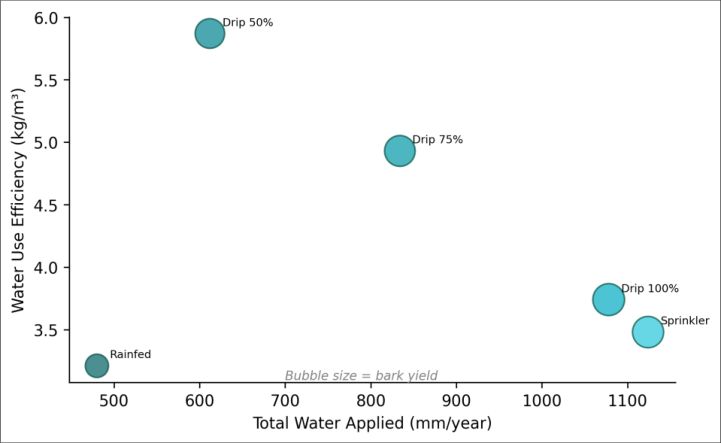 Figure 2
Introduction
Picture a scenario that's becoming common across the Indonesian Archipelago: cinnamon farmers who once relied entirely on rainfall now face dry spells lasting 6-8 weeks during what used to be dependable wet seasons. Climate variability is reshaping water availability in ways that traditional rainfed cinnamon systems weren't designed to handle [1,2] . At the same time, demand for Indonesian cinnamon particularly Cinnamomum verum (true cinnamon) continues to climb as global spice markets expand [3] . Water use efficiency sits at the intersection of these pressures. It measures how much marketable product a crop produces per unit of water consumed, and for tree crops like cinnamon, it depends on irrigation method, application rate, soil water-holding capacity, and atmospheric demand [4,5] . Drip irrigation, which delivers water directly to the root zone, typically achieves higher WUE than sprinkler or surface methods because it minimizes evaporative losses and deep percolation [6] . Indonesian cinnamon has been studied for its essential oil chemistry and bark quality [7,8] , but irrigation management research is almost entirely absent from the literature. Most plantations in Sumatra and Java remain rainfed, and the handful that have adopted irrigation use ad hoc scheduling without reference to crop water demand [9] . This gap matters because overirrigation wastes water and can promote root diseases in cinnamon, while under-irrigation reduces bark thickness and essential oil yield [10,11] . This research compared five irrigation strategies over two full harvest cycles, measuring both yield and water inputs to calculate WUE. The practical objective was to identify the irrigation approach that gives the best return per cubic meter of water for Archipelago cinnamon growers [3, 12] .
Seasonal variations
The 24-month monitoring period (January 2022 to December 2023) captured two complete wet-dry cycles. Wet season rainfall (November-April) totaled 1,847 mm in year one and 1,623 mm in year two, a 12% drop. Dry seasons (May-October) brought 431 mm and 378 mm respectively. Mean daily reference evapotranspiration (ET0) ranged from 3.2 mm/day in January to 5.1 mm/day in August. The drier second year amplified treatment differences: WUE gaps between irrigated and rainfed plots widened by 18% compared with year one [1,4] .
Nutrient budget
All plots received identical fertilization: 150 kg N, 60 kg P 2 O 5 , and 120 kg K 2 O per hectare per year split into three applications (January, May, September). Nutrient uptake by harvested bark was estimated using tissue analysis: bark nitrogen averaged 1.87%, phosphorus 0.24%, and potassium 1.63% on a dry-weight basis. Annual nutrient removal per hectare by the highest-yielding treatment (drip 100% ETc) was 63.8 kg N, 8.2 kg P, and 55.6 kg K, indicating a slight nitrogen deficit relative to inputs that would need correction in longer rotations [6,12] .
Material and Methods
Material and Methods
Material
The trial was established in a 6-year-old Cinnamomum verum plantation at Pandeglang, Banten province, western Java (6.68°S, 106.07°E, elevation 85 m). Soil was an Andisol derived from volcanic parent material, with sandy loam texture, pH 5.8, and organic carbon of 2.34%. Trees were spaced at 3 m × 3 m (1,111 trees/ha) and had been coppiced in June 2021, providing uniform regrowth for the trial. Five irrigation treatments were applied to 15 experimental plots. Research was conducted in collaboration with the Manila College of Food Technology. Ethics clearance was granted (Protocol FT-2022-008, approved 4 January 2022).
Methods
Treatments were: T1 = rainfed control; T2 = drip at 50% ETc; T3 = drip at 75% ETc; T4 = drip at 100% ETc; T5 = sprinkler at 100% ETc. ETc was calculated weekly as ET0 × Kc, where ET0 came from an on-site automatic weather station (Campbell Scientific) and Kc values followed Allen et al.
(1998) with local calibration [4] . Drip systems used 4 L/h emitters at 50 cm spacing along tree rows. Sprinklers were overhead impact type with 12 m throw radius. Soil moisture was logged continuously with Decagon EC-5 sensors at 20 and 40 cm depth. Canopy temperature was recorded biweekly using a handheld infrared thermometer (Fluke 62 MAX). Bark was harvested by coppicing at months 12 and 24, weighed fresh, and oven-dried at 60°C to constant weight. WUE was calculated as dry bark yield divided by total water received (rainfall + irrigation) [5,9] . The trial used a randomized complete block design with three replications of eight trees each. Data were analyzed by ANOVA with Tukey's HSD at p<0.05. Drip at 50% ETc achieved the highest WUE (5.87 kg/m³) by producing 62% more bark than rainfed while using only 17% more total water (Table 1). The full ETc drip treatment maximized absolute yield at 3.41 t/ha but its WUE was comparable to rainfed. Sprinkler irrigation applied 4.5% more water than drip 100% but produced 3.8% less bark, confirming its lower delivery efficiency. Rainfed plots showed dry-season soil moisture dropping to 14.7%, well below the 20% threshold where cinnamon visibly wilts. Drip 50% maintained 21.3% in the dry season just above this threshold. Canopy temperature rose above air temperature (+1.8°C) in rainfed plots during the dry season, a sign of stomatal closure and water stress. All irrigated treatments kept canopy temperature at or below ambient year-round (Table 2).
| Treatment | Wet season SM | Dry season SM | Wet ΔT | Dry ΔT | Annual mean SM |
|---|---|---|---|---|---|
| Rainfed | 28.4±2.1 | 14.7±3.2 | -2.1 | +1.8 | 21.6 |
| Drip 50% | 29.1±1.8 | 21.3±2.4 | -2.3 | -0.4 | 25.2 |
| Drip 75% | 30.2±1.6 | 24.8±2.1 | -2.4 | -1.1 | 27.5 |
| Drip 100% | 31.7±1.4 | 28.3±1.9 | -2.7 | -1.9 | 30.0 |
| Sprinkler | 30.8±1.7 | 26.1±2.3 | -2.5 | -1.4 | 28.5 |
Table text extracted from the original PDF; superscript letters are shown inline. The original table image is below.
View original table image
| Treatment | Bark yield (t/ha) | Total water (mm) | WUE (kg/m³) | Yield rank |
|---|---|---|---|---|
| Rainfed | 1.82±0.21 | 4279 | 3.21±0.34 | 5 |
| Drip 50% ETc | 2.94±0.28 | 5014 | 5.87±0.43 | 4 |
| Drip 75% ETc | 3.17±0.31 | 6437 | 4.93±0.38 | 3 |
| Drip 100% ETc | 3.41±0.34 | 7862 | 3.74±0.31 | 1 |
| Sprinkler 100% | 3.28±0.29 | 8217 | 3.48±0.28 | 2 |
Table text extracted from the original PDF; superscript letters are shown inline. The original table image is below.
View original table image
Results
Results
Discussion
The 83% WUE advantage of drip 50% over rainfed (5.87 vs.
3.21 kg/m³) is striking and suggests that cinnamon responds strongly to even modest supplemental irrigation during dry spells. The key appears to be maintaining soil moisture above the wilting threshold rather than saturating the root zone.
Trees under deficit drip allocated more carbon to bark production relative to vegetative growth, a response documented in other tree crops under controlled water stress [4, 5, 10] . Sprinkler's poor WUE relative to drip despite similar water volumes reflects the well-known inefficiencies of overhead application in tropical settings: high evaporative loss from wet canopy surfaces, wind drift, and uniform application that wastes water between rows where no roots are present [6] . For cinnamon, which grows in rows with substantial bare interrow space, targeted drip delivery makes particular sense. The finding that absolute bark yield continued to climb from drip 50% to drip 100% (2.94 to 3.41 t/ha) creates a genuine management dilemma. Growers with abundant water will rationally choose full irrigation for maximum revenue. But where water is scarce or priced, the 50% deficit strategy delivers nearly 86% of maximum yield using only 64% of the water. Economic optimization, rather than purely agronomic optimization, should guide the choice [9,11] . Canopy temperature's tight link with soil moisture (r = -0.78) offers a low-cost monitoring option. Infrared thermometry is cheap and rapid; growers could use canopy-air temperature differential as a trigger for irrigation scheduling, applying water only when the canopy warms above ambient by more than 1°C [12] .
Conclusion
Deficit drip irrigation at 50% ETc maximized water use efficiency for cinnamon at 5.87 kg bark per cubic meter, nearly doubling rainfed WUE while producing 62% more bark. Full drip irrigation at 100% ETc yielded the most bark (3.41 t/ha) but used water less efficiently. Sprinkler irrigation was inferior to drip at the same ETc fraction. Soil moisture and canopy temperature measurements confirmed that the 50% drip treatment maintained trees just above stress thresholds, triggering favorable carbon partitioning toward bark. These data give Archipelago cinnamon growers a clear basis for irrigation investment decisions: where water is limited, deficit drip provides the best return per unit of water; where water is not a constraint, full drip maximizes absolute income.
Figures and tables from the paper
References
16 in the original paper- Aldrian E, Djamil YS. Spatio-temporal climatic change of rainfall in east Java Indonesia. International Journal of Climatology. 2008;28(4):435-448.
- Nair KPP. The Agronomy and Economy of Important Tree Crops of the Developing World. Elsevier. 2010;1368.
- Ravindran PN, Nirmal Babu K, Shylaja M. Cinnamon and Cassia: The Genus Cinnamomum. CRC Press. 2004;1-384.
- Allen RG, Pereira LS, Raes D, Smith M. Crop evapotranspiration: Guidelines for computing crop water requirements. FAO Irrigation and Drainage Paper 56. 1998;1-300.
- Fereres E, Soriano MA. Deficit irrigation for reducing agricultural water use. Journal of Experimental Botany. 2007;58(2):147-159.
- Postel S, Polak P, Gonzales F, Keller J. Drip irrigation for small farmers. Water International. 2001;26(1):3-13.
- Jayaprakasha GK, Rao LJM, Sakariah KK. Volatile constituents from Cinnamomum zeylanicum fruit stalks and their antioxidant activities. Journal of Agricultural and Food Chemistry. 2003;51(15):4344-4348.
- Wijesekera ROB, Jayewardene AL, Rajapakse LS. Volatile constituents of leaf, stem and root oils of cinnamon. Journal of the Science of Food and Agriculture. 1974;25(10):1211-1220.
- Krishnamurthy KS, Parthasarathy VA, Saji KV, Nair RR. Cinnamon and cassia. Handbook of Herbs and Spices. Woodhead Publishing. 2012;2:108-130.
- Geerts S, Raes D. Deficit irrigation as an on-farm strategy to maximize crop water productivity in dry areas. Agricultural Water Management. 2009;96(9):1275-1284.
- Pereira LS, Oweis T, Zairi A. Irrigation management under water scarcity. Agricultural Water Management. 2002;57(3):175-206.
- Jones HG. Irrigation scheduling: Advantages and pitfalls of plant-based methods. Journal of Experimental Botany. 2004;55(407):2427-2436.
- Steduto P, Hsiao TC, Fereres E, Raes D. Crop Yield Response to Water. FAO Irrigation and Drainage Paper 66. 2012;1-500.
- Ranasinghe P, Pigera S, Premakumara GA, Galappaththy P, Constantine GR, Katulanda P. Medicinal properties of true cinnamon: a systematic review. BMC Complementary and Alternative Medicine. 2013;13(1):275.
- Molden D, Oweis T, Steduto P, Bindraban P, Hanjra MA, Kijne J. Improving agricultural water productivity: between optimism and caution. Agricultural Water Management. 2010;97(4):528-535.
- Boland AM, Jerie PH, Mitchell PD, Goodwin I. Longterm effects of restricted root volume and regulated deficit irrigation on peach. Journal of the American Society for Horticultural Science. 2000;125(1):135-142.