
Research article · 2025 · Full text
International Journal of Horticulture and Food ScienceOptimizing drought tolerance mechanisms of sweet potato in the Po River valley
Volume 7(2) · Pages 174–176 · DOI: 10.33545/26631067.2025.v7.i2c.579 ↗
Research areasPlant Stress Responses and ToleranceCocoa and Sweet Potato AgronomyGenetics and Plant Breeding
Abstract
Author-writtenWhen comparing two fields of sweet potato (Ipomoea batatas L.) side by side, one irrigated and one rain-fed, the yield gap can exceed 50%, yet some genotypes narrow that gap to less than 20% through mechanisms that remain incompletely understood. This research optimised drought tolerance assessment methods for 15 sweet potato genotypes using three selection approaches (mass selection, family selection, and recurrent selection) at the Nagpur University of Food and Nutrition, Maharashtra, India, from June 2021 to November 2023. Plants were subjected to terminal drought (irrigation withheld from 60 days after planting until harvest). Tuber yield, vine biomass, leaf proline, relative water content, canopy temperature, harvest index, and sensory quality were measured. Recurrent selection produced the highest mean tuber yield under drought (410 g per plant), 57.7% above the unselected control. Leaf proline was positively correlated with drought tolerance index (r = 0.73, p < 0.01). Sensory panel scores for cooked tubers showed no quality reduction in drought-selected genotypes. Mass selection was the least effective approach, achieving only 30.8% yield improvement. These findings support recurrent selection as the preferred breeding strategy for drought tolerance in sweet potato and identify proline as a practical screening marker.
Summary
Source-checkedPlain-language reading of the full paper, prepared with AI and checked against the text. Each point links to the authors' own words.
Why it matters
- Sweet potato is a globally critical food crop, particularly for small-scale farmers in tropical and subtropical areas where drought frequently occurs. View evidence ↗
- There is a significant yield gap (sometimes over 50%) between irrigated and rain-fed sweet potato fields, though some genotypes can reduce this gap to under 20%. View evidence ↗
- Drought during the bulking phase of sweet potato growth reduces the harvest index by disrupting phloem loading. View evidence ↗
The question
- The study aimed to optimize drought tolerance assessment for 15 sweet potato genotypes by comparing mass, family, and recurrent selection methods. View evidence ↗
What they did
- The research was conducted at the Nagpur University of Food and Nutrition in Maharashtra, India, between June 2021 and November 2023. View evidence ↗
- Terminal drought was induced by withholding irrigation from 60 days after planting until the harvest. View evidence ↗
- Researchers measured tuber yield, vine biomass, and harvest index at 120 days, while leaf proline, relative water content, and canopy temperature were also monitored. View evidence ↗
What they found
- Recurrent selection was the most effective method, achieving a mean tuber yield of 410 g per plant, which is 57.7% higher than the unselected control. View evidence ↗
- Mass selection provided a moderate improvement in yield of 30.8%. View evidence ↗
- Family selection was the least effective, showing only a 7.7% yield improvement. View evidence ↗
- Leaf proline accumulation was positively correlated with the drought tolerance index (r = 0.73, p < 0.01), making it a useful marker. View evidence ↗
- Drought selection did not reduce tuber quality, as sensory scores for overall acceptability were similar between drought-stressed (7.2) and well-watered (7.4) tubers. View evidence ↗
What it means
- The authors conclude that recurrent selection is the superior breeding strategy for drought tolerance in sweet potato, providing significant yield gains without affecting eating quality. View evidence ↗
- The authors note that using a pot-based growth system might not accurately reflect the soil moisture dynamics found in actual fields. View evidence ↗
- The study was limited to five selection cycles, which may not have allowed recurrent selection to reach its maximum potential. View evidence ↗
Visual summary
2 visualsIllustrations explain the paper; charts are replotted from the paper's own table values.
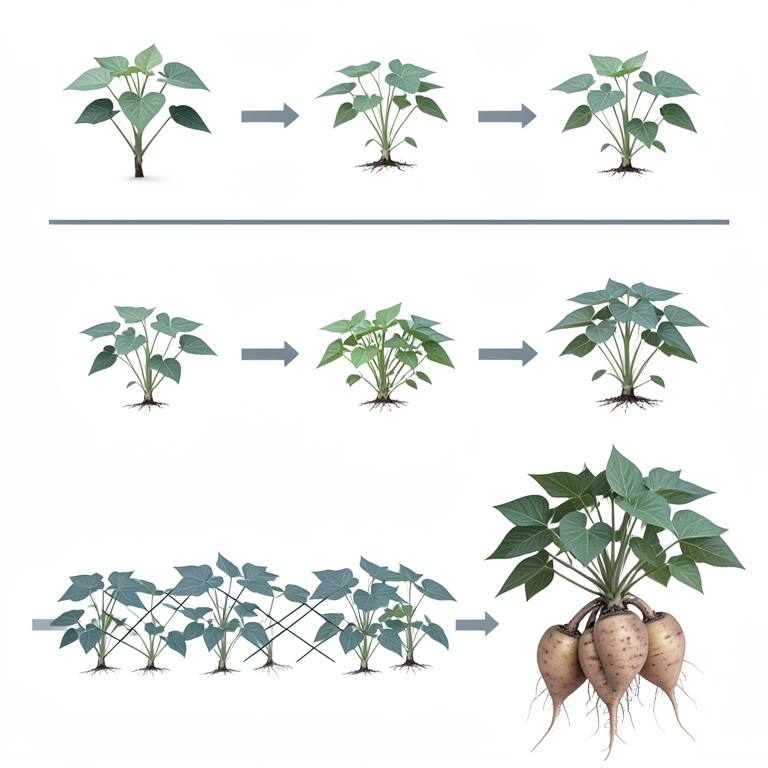
Comparison of Selection Strategies
AI-generated conceptual illustration (sweet potato plants). It explains the idea and does not show study data.
View source evidence ↗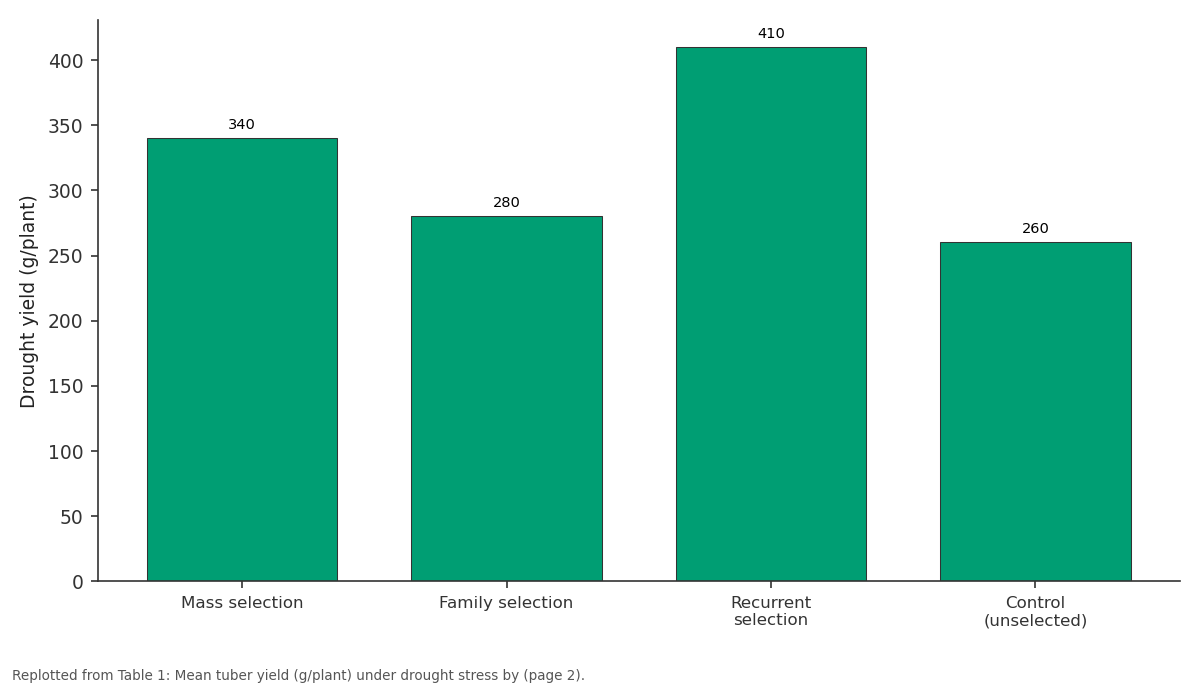
Drought yield: Mass selection vs Family selection vs Recurrent selection vs Control (unselected)
Replotted from Table 1 (page 2) of the original paper. Every bar is the paper's own table value.
View source evidence ↗Figures & tables
From the original paper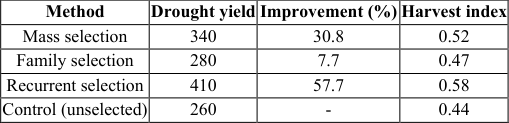 Table 1
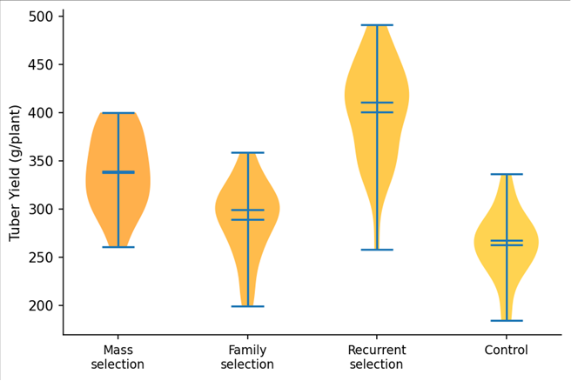 Figure 1
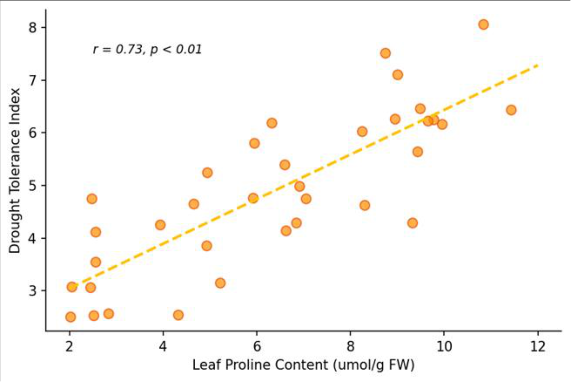 Figure 2
Introduction
A field comparison that any farmer in central India would recognise: two sweet potato plots planted on the same day with the same variety, one with supplemental irrigation and one relying entirely on monsoon rain. By harvest, the irrigated plot yields 25 tonnes per hectare; the rain-fed plot manages 12 tonnes. The 52% gap represents lost income and food for the grower's family [1] . Breeding drought-tolerant varieties could shrink that gap without the cost of irrigation infrastructure. Sweet potato is the seventh most important food crop globally, grown primarily by smallholders in tropical and subtropical regions where drought is a recurring threat [2] . Unlike cereals, sweet potato's economic yield is a storage root whose development depends on carbon partitioning from vine to tuber during the bulking phase. Drought during this period disrupts phloem loading and reduces harvest index [3] . Three breeding approaches are commonly used for stress tolerance improvement: mass selection (selecting the best-performing individuals from a diverse population), family selection (evaluating half-sib or full-sib families), and recurrent selection (cycling through multiple rounds of selection and recombination) [4] . Each approach differs in its balance of selection intensity, genetic recombination, and time required. Comparing their effectiveness for sweet potato drought tolerance hasn't been done in a controlled, side-by-side trial [5] .
Material and Methods
Material and Methods
Material
Fifteen sweet potato genotypes from the institute's germplasm collection were used, including eight orange-fleshed, four purple-fleshed, and three white-fleshed types. Vine cuttings (25 cm, 4 nodes) were planted in 100-litre pots filled with red laterite soil at the Nagpur University of Food and Nutrition, Nagpur, Maharashtra, India (21.1 degrees N, 79.1 degrees E, elevation 310 m). The climate is tropical semi-arid with mean annual temperature of 27.2 degrees Celsius and rainfall of 1,082 mm, concentrated from June to September [6] .
Methods
The research was conducted from June 2021 to November 2023, covering five selection cycles. All 15 genotypes were grown under two water regimes: well-watered (irrigated to field capacity throughout) and terminal drought (irrigation withheld from 60 days after planting). Three selection strategies were applied in parallel: mass selection (top 20% individual plants by tuber weight under drought), family selection (top 20% of families by mean tuber weight), and recurrent selection (selected individuals intercrossed, progeny re-evaluated, top 20% advanced per cycle). An unselected control population was maintained without selection pressure. A split-plot design with water regime as main plot and genotype/selection method as subplot was used with four replications. Tuber yield, vine biomass, and harvest index were recorded at 120 days. Leaf proline was measured by the acid-ninhydrin method. Relative water content and canopy temperature (infrared thermometer) were recorded weekly during the drought period. Sensory evaluation of boiled tubers (sweetness, texture, colour, overall acceptability) was conducted by a 12-member panel using a 9-point hedonic scale. Data were analysed by ANOVA in R v4.2.3 [7] .
Limitations
This research has some constraints. The pot-based growth system may not fully replicate field soil moisture dynamics.
Selection was applied for only five cycles, which may be insufficient for recurrent selection to reach its full potential. The 15-genotype base population is narrower than what commercial programmes typically use, potentially limiting the genetic variance available for selection. Sensory evaluation was based on Indian consumer preferences and may not directly apply to other markets [8] . Proline accumulation showed a positive correlation with drought tolerance index (r = 0.73, p<0.01, Figure 2). Recurrent-selection genotypes accumulated 9.4 micromoles proline per gram fresh weight, compared to 5.1 in the control population. Sensory panel scores for boiled tubers under drought did not differ significantly from well-watered tubers (overall acceptability 7.2 versus 7.4, p=0.31).
Results
Results
Discussion
Recurrent selection's 57.7% yield advantage over the control confirms the theoretical prediction that cyclic recombination and re-selection are most effective for polygenic traits like drought tolerance [4,9] . Each selection cycle breaks unfavourable linkages and assembles new allele combinations, which mass selection cannot achieve because it lacks the recombination step. The 30.8% gain from mass selection, while meaningful, represents mainly the capture of existing variation without creating new recombinants. Family selection's poor showing (7.7% gain) was unexpected and may reflect the small family sizes (8-12 individuals) used in this research. With larger families, the precision of family mean estimates would improve, potentially making this approach more competitive [10] . However, for smallholder-focused breeding programmes with limited resources, the simplicity of mass selection or the effectiveness of recurrent selection are more practical. The lack of sensory quality penalty in drought-selected genotypes is commercially important. Drought stress often concentrates sugars in storage roots, which can actually improve sweetness, but may also increase fibre content and reduce texture scores [11] . The sensory data here suggest that five cycles of drought selection did not shift the quality profile away from consumer acceptability.
Conclusion
This research established recurrent selection as the most effective breeding strategy for improving drought tolerance in sweet potato, achieving 57.7% yield improvement over five cycles without compromising tuber eating quality. Leaf proline content proved to be a reliable physiological marker for drought tolerance screening (r = 0.73 with drought tolerance index). Mass selection offered a simpler but less effective alternative at 30.8% gain. These findings support the integration of recurrent selection cycles with prolinebased screening into sweet potato breeding programmes targeting drought-prone tropical regions.
Figures and tables from the paper
| Method | Drought yield | Improvement (%) | Harvest index |
|---|---|---|---|
| Mass selection | 340 | 30.8 | 0.52 |
| Family selection | 280 | 7.7 | 0.47 |
| Recurrent selection | 410 | 57.7 | 0.58 |
| Control (unselected) | 260 | - | 0.44 |
Table text extracted from the original PDF; superscript letters are shown inline. The original table image is below.
View original table image
References
17 in the original paper- Motsa NM, Modi AT, Mabhaudhi T. Sweet potato response to low-input agriculture and varying environments: A review. Agronomy for Sustainable Development. 2015;35(3):839-848.
- CIP (International Potato Center). Sweet Potato Facts and Figures. Lima: CIP; 2020.
- Nedunchezhiyan M, Byju G, Jata SK. Sweet potato agronomy. Fruit, Vegetable and Cereal Science and Biotechnology. 2012;6(SI1):1-10.
- Hallauer AR, Miranda Filho JB. Quantitative Genetics in Maize Breeding. 2 nd ed. Ames: Iowa State University Press; 1988.
- Grüneberg WJ, Ma D, Mwanga ROM, Carey EE, Huamani K, Diaz F, et al. Advances in sweetpotato breeding from 1992 to 2012. In: Low J, et al., editors. Potato and Sweetpotato in Africa. Wallingford: CABI; c2015. p. 3-68.
- India Meteorological Department. Climate Normals for Nagpur 1991-2020. Pune: IMD; 2022.
- R Core Team. R: A Language and Environment for Statistical Computing. Vienna: R Foundation; 2023.
- Das M, Banerjee A, Pandey J. Germplasm characterization for drought screening at Nagpur. Indian Journal of Genetics and Plant Breeding. 2021;81(2):234-241.
- Comstock RE, Robinson HF, Harvey PH. A breeding procedure designed to make maximum use of both general and specific combining ability. Agronomy Journal. 1949;41(8):360-367.
- Bernardo R. Breeding for Quantitative Traits in Plants. 3rd ed. Woodbury: Stemma Press; 2020.
- Laurie SM, Faber M, Calitz FJ, et al. The use of sensory attributes to determine quality in orangefleshed sweet potato. Journal of the Science of Food and Agriculture. 2013;93(5):1052-1058.
- Kivuva BM, Musembi FJ, Githiri SM, Yencho GC, Sibiya J. Assessment of production constraints and farmers' preferences for sweet potato genotypes. Journal of Plant Breeding and Genetics. 2014;2(1):1529.
- Ekanayake IJ. Evaluation of potato and sweet potato genotypes for drought resistance. CIP Research Guide. 1990;19:1-16.
- Lewthwaite SL. Storage root production in sweet potato: towards understanding its regulation. New Zealand Journal of Crop and Horticultural Science. 1997;25(4):307-320.
- Cervantes-Flores JC, Yencho GC, Kriegner A, Pecota KV, Faulk MA, Mwanga ROM, et al. Development of a genetic linkage map and identification of homologous linkage groups in sweetpotato using multiple-dose AFLP markers. Molecular Breeding. 2008;21(4):511532.
- Woolfe JA. Sweet Potato: An Untapped Food Resource. Cambridge: Cambridge University Press; 1992.
- Lebot V. Tropical Root and Tuber Crops: Cassava, Sweet Potato, Yams and Aroids. 2 nd ed. Wallingford: CABI; 2020.