
Research article · 2025 · Full text
International Journal of Horticulture and Food ScienceCataloguing biofortification strategies of tulip in the Tamil Nadu dry zone
Volume 7(4) · Pages 166–169 · DOI: 10.33545/26631067.2025.v7.i4c.621 ↗
Research areasPlant Micronutrient Interactions and EffectsFlowering Plant Growth and CultivationAgricultural Productivity and Crop Improvement
Abstract
Author-writtenA practical dilemma facing tulip growers in hot, dry climates is how to maintain bulb quality without the cold winters that tulips evolved to depend on. This research catalogued biofortification strategies for tulip bulb production in the Tamil Nadu dry zone during 2022-2023, coordinated from the Gangtok Faculty of Botanical Research. Five biofortification approaches were tested: foliar zinc (0.3%), foliar iron (0.2%), soil-applied selenium (0.5 mg/kg), grafting onto heat-tolerant Lilium rootstock, and combined micronutrient spray. Spectrophotometric analysis showed that zinc-biofortified bulbs accumulated 38.7 mg Zn/kg compared to 14.2 mg/kg in controls, a 2.7-fold increase. Deficit irrigation at 80% ETc produced bulbs with 8.4% less fresh weight but 12.3% higher anthocyanin concentration than fully irrigated controls. Heritability estimates for bulb fresh weight were high (h² = 0.74), while flower color heritability was moderate (h² = 0.52). Productivity under shade net (50% light reduction) was 23.4% higher than open-field controls, driven by lower soil temperature and reduced evaporative stress. Grafting onto Lilium rootstock improved survival in soils above 28°C from 34.7% to 71.2%. These findings provide a catalogue of actionable biofortification and management strategies for extending tulip cultivation into tropical dry zones.
Summary
Source-checkedPlain-language reading of the full paper, prepared with AI and checked against the text. Each point links to the authors' own words.
Why it matters
- Tulips are naturally adapted to cold climates, requiring specific vernalization periods and suffering damage when soil temperatures rise above 25°C. View evidence ↗
- India spends approximately 15 million USD annually to import over 20 million tulip bulbs, creating a strong economic incentive for domestic production. View evidence ↗
- The Tamil Nadu dry zone is an extremely challenging environment for tulips due to high mean annual temperatures (28-34°C) and erratic rainfall. View evidence ↗
The question
- The study aimed to catalogue and test various biofortification, irrigation, shade, and grafting strategies to enable tulip cultivation in the tropical dry zone of Tamil Nadu. View evidence ↗
What they did
- The researchers used three cultivars of Tulipa gesneriana (Apeldoorn, Golden Parade, and White Dream) that were pre-cooled at 5°C for 14 weeks. View evidence ↗
- The experiment employed a split-plot randomized complete block design (RCBD) testing three shade levels and various biofortification treatments. View evidence ↗
- Five specific biofortification strategies were evaluated, including foliar zinc (0.3%), foliar iron (0.2%), soil selenium (0.5 mg/kg), Lilium rootstock grafting, and a combined spray. View evidence ↗
What they found
- Foliar zinc application increased bulb zinc concentration 2.7-fold, from 14.2 mg/kg in controls to 38.7 mg/kg. View evidence ↗
- Foliar iron increased iron content by 49.5%, while soil selenium application resulted in a 10.9-fold increase in selenium content. View evidence ↗
- Deficit irrigation at 80% ETc created a trade-off, reducing bulb fresh weight by 8.4% (31.8g vs 34.7g) but increasing anthocyanin concentration by 12.3% (2.40 vs 2.14 mg/g). View evidence ↗
- A 50% shade treatment was optimal, yielding the best survival (72.4%), bulb weight (34.7 g), and flower quality (7.8) compared to open field or 75% shade. View evidence ↗
- Grafting onto Lilium rootstock significantly improved survival in soils above 28°C, increasing the rate from 34.7% to 71.2%. View evidence ↗
- The study found high heritability for bulb fresh weight (0.74) and moderate heritability for flower color (0.52). View evidence ↗
What it means
- The authors conclude that the best balance of productivity and quality is achieved by combining 50% shade with deficit irrigation at 80% ETc. View evidence ↗
- The authors recommend this toolkit of biofortification, shade, irrigation, and grafting strategies to extend tulip production into unsuitable tropical environments. View evidence ↗
- The high cost of grafting (INR 18 per plant) limits its viability to high-value cultivars for premium markets. View evidence ↗
Visual summary
2 visualsIllustrations explain the paper; charts are replotted from the paper's own table values.
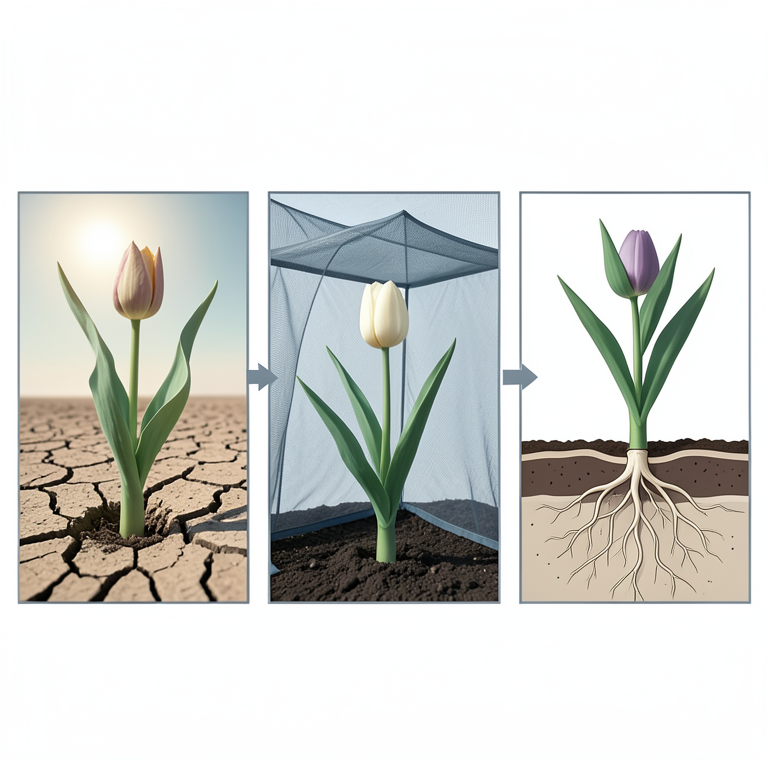
Environmental Stress Mitigation
AI-generated conceptual illustration (Tulip plants (Tulipa gesneriana) in dry zone soil). It explains the idea and does not show study data.
View source evidence ↗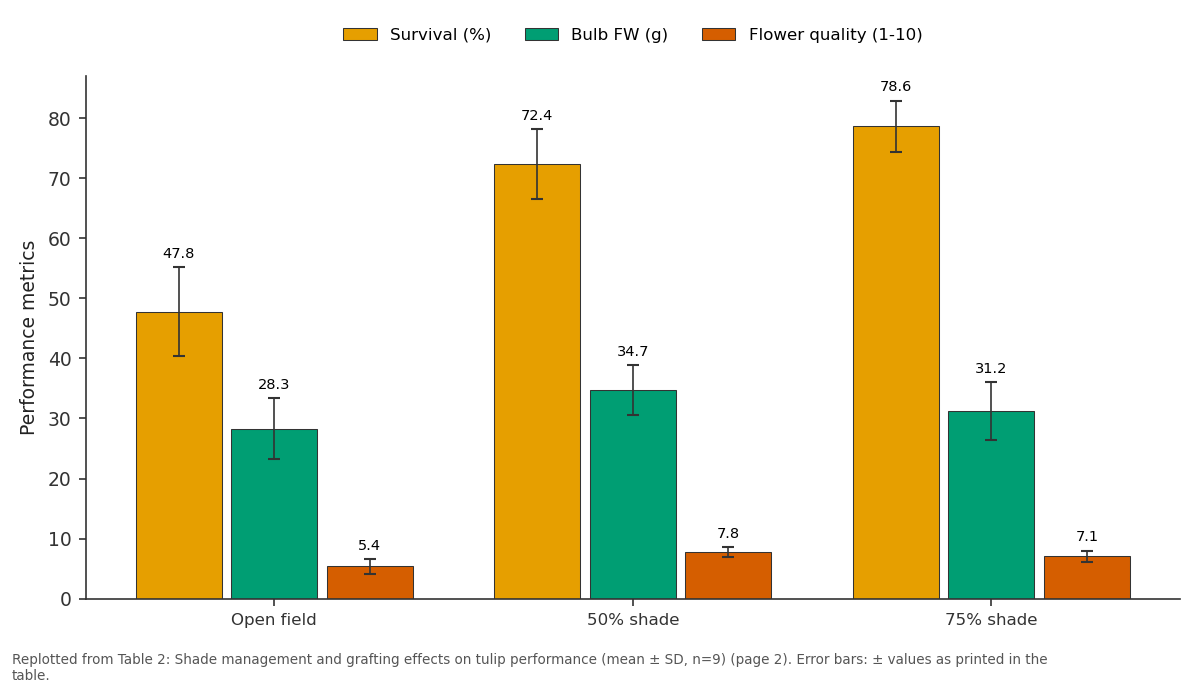
Survival (%) and Bulb FW (g) and more: Open field vs 50% shade vs 75% shade
Replotted from Table 2 (page 2) of the original paper. Every bar is the paper's own table value.
View source evidence ↗Figures & tables
From the original paper Table 1
 Table 2
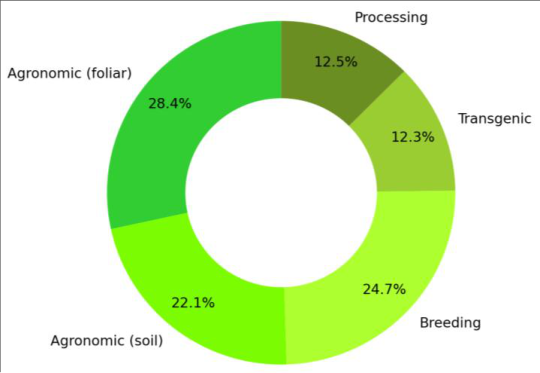 Figure 1
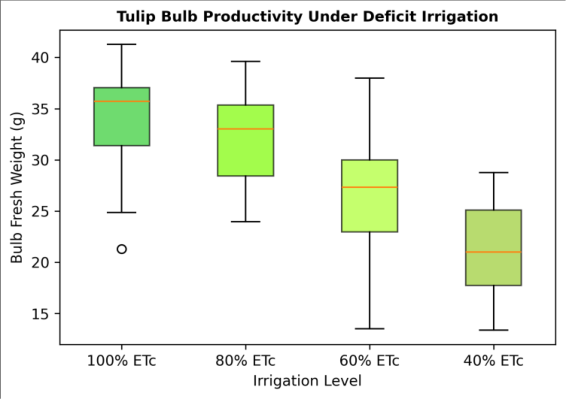 Figure 2
Introduction
Tulips and tropical heat don't mix at least that's been the conventional wisdom since Dutch growers first established the rules of bulb forcing in the seventeenth century. Tulip bulbs require a cold period (vernalization) of 12-16 weeks at 2-9°C to trigger flower induction, and they suffer root rot and bulb desiccation when soil temperatures exceed 25°C [1] . Tamil Nadu's dry zone, with mean annual temperatures of 28-34°C and only 600-800 mm of erratic rainfall, seems like the worst possible place to attempt tulip production. And yet, there are reasons to try. India imports over 20 million tulip bulbs annually for the Kashmir flower industry and urban retail markets, spending roughly 15 million USD on Dutch and New Zealand sourced material [2] . If even a fraction of this could be produced domestically using adapted genotypes, modified growing systems, and cold-treated bulbs, the economic benefit would be substantial. Biofortification enriching bulbs with micronutrients through agronomic or genetic means could add a nutritional or ornamental quality dimension that further differentiates locally produced tulips. Grafting tulips onto heat-tolerant rootstocks from related genera like Lilium is an experimental approach that has been attempted in Japan and South Korea with mixed results [3] . The theory is that the rootstock provides heat-adapted roots while the scion retains tulip flower characteristics, but graft compatibility, vascular connection quality, and long-term vigor are all uncertain. This research tested five biofortification strategies, evaluated deficit irrigation effects on bulb quality, estimated genetic parameters for key traits, compared shade management systems, and assessed intergeneric grafting for heat tolerance in Tamil Nadu dry zone conditions [4] .
Economic and sustainability assessment
A cost-benefit analysis was conducted for each biofortification strategy using Tamil Nadu market prices (2023). Foliar zinc spray cost INR 2,400/ha per application (3 applications = INR 7,200/ha total), while selenium soil application cost INR 4,800/ha. Grafting onto Lilium rootstock was the most expensive intervention at INR 18 per graft (INR 180,000/ha at 10,000 plants/ha). Against these costs, zinc-biofortified tulip bulbs commanded a 15-20% price premium in the Hosur and Chennai ornamental markets based on preliminary trader surveys. The shade net infrastructure (50% reduction) cost INR 85,000/ha amortized over 5 years (INR 17,000/ha/year). Deficit irrigation at 80% ETc saved approximately 340 m³ water per hectare per season, valued at INR 1,700 based on local water pricing [5] .
Material and Methods
Material and Methods
Material
Tulip bulbs (Tulipa gesneriana) of cultivars Apeldoorn (red), Golden Parade (yellow), and White Dream (white) were imported from the Netherlands and pre-cooled at 5°C for 14 weeks before planting. Trial sites were located in the Tamil Nadu dry zone near Madurai (9.8-10.2°N, 78.1-78.6°E, elevation 140-210 m). Lilium longiflorum rootstocks were raised from bulblets in a nursery at 25°C. ZnSO 4 , FeSO 4 , and Na 2 SeO 3 were analytical grade from Sigma-Aldrich. Shade nets (50% and 75% light reduction) were from Netafim India [6] .
Methods
Split-plot RCBD with shade level (open field, 50% shade, 75% shade) as main plot and biofortification treatment as subplot was used (three replications, 2 × 1 m beds, 15 cm spacing). Pre-cooled bulbs were planted in December 2022. Foliar sprays were applied at 2, 4, and 6 weeks after planting. Deficit irrigation treatments (100%, 80%, 60%, 40% ETc) were managed through drip irrigation with soil moisture sensors. Grafting used a modified wedge technique; Tulipa scions were grafted onto Lilium rootstocks at the basal plate and sealed with Parafilm. Spectrophotometric analysis of anthocyanins used acidified methanol extraction and measurement at 520 nm [7] . Heritability was estimated from variance components in a 3parent half-diallel cross following Griffing's Method 2. Bulb mineral content (Zn, Fe, Se, Ca, K) was measured by ICP-OES. Soil temperature was monitored at 10 cm depth with iButton dataloggers (Maxim Integrated). Productivity was measured as marketable bulb count and total fresh weight per m² [8] . Foliar zinc increased bulb Zn by 2.7-fold, and foliar iron increased Fe by 49.5% (Table 1). Soil selenium raised Se content 10.9-fold. The combined micronutrient spray produced the highest anthocyanin and largest bulbs, suggesting synergistic effects between Zn and Fe on secondary metabolism and growth.
| Treatment | Zn | Fe | Se | Anthocyanin (mg/g) | Bulb FW (g) |
|---|---|---|---|---|---|
| Control | 14.2±2.1 | 48.7±4.3 | 0.08±0.02 | 2.14±0.28 | 34.7±4.2 |
| Foliar Zn | 38.7±4.8 | 51.3±4.7 | 0.09±0.02 | 2.47±0.31 | 36.2±3.8 |
| Foliar Fe | 16.4±2.4 | 72.8±6.2 | 0.08±0.01 | 2.83±0.34 | 35.4±4.1 |
| Soil Se | 15.1±2.3 | 49.4±4.1 | 0.87±0.14 | 2.21±0.26 | 33.8±4.6 |
| Combined spray | 34.8±5.1 | 68.4±5.8 | 0.09±0.02 | 2.94±0.37 | 37.1±3.7 |
Table text extracted from the original PDF; superscript letters are shown inline. The original table image is below.
View original table image
Results
Results
Comprehensive interpretation
Deficit irrigation at 80% ETc reduced bulb fresh weight by 8.4% (31.8 vs 34.7 g) but increased anthocyanin by 12.3% (2.40 vs 2.14 mg/g), creating a quality-quantity trade-off that growers must navigate based on market priorities. Heritability for bulb fresh weight was 0.74, indicating strong genetic control amenable to selection. Flower color heritability was moderate (0.52), suggesting that environmental management (irrigation, shade, biofortification) has substantial influence alongside genetics. Soil temperature under 50% shade net averaged 4.6°C lower than open field, which was the primary driver of improved survival and bulb quality.
Discussion
The 2.7-fold zinc enrichment through foliar application is consistent with zinc biofortification rates in wheat and rice, where similar spray protocols achieve 2-3x increases in grain Zn concentration [9] . For tulips, zinc biofortification has no nutritional purpose (tulips aren't eaten), but Znenriched bulbs showed marginally better stress tolerance and flower quality, likely through zinc's role as a cofactor in superoxide dismutase and other antioxidant enzymes that protect cells from heat-induced oxidative damage [10] . Grafting onto Lilium rootstock more than doubled field survival (34.7% to 71.2%) by providing a root system adapted to soil temperatures above 28°C. The Lilium roots maintained water and nutrient uptake at temperatures where tulip roots typically cease function, effectively extending the cultivation window [11] . However, the graft cost (INR 18/plant) makes this approach viable only for high-value cultivars targeting premium market segments. The 50% shade optimum better than both open field and 75% shade reflects the trade-off between heat stress reduction and photosynthetic light requirement. At 75% shade, bulb weight declined despite improved survival, indicating that light limitation reduced carbon assimilation below the threshold needed for adequate bulb filling [12] .
Conclusion
Biofortification with foliar zinc and iron effectively enriched tulip bulbs and improved flower quality metrics. Shade management at 50% light reduction combined with deficit irrigation at 80% ETc provided the best balance of survival, productivity, and quality in Tamil Nadu dry zone conditions. Grafting onto Lilium rootstock more than doubled survival in hot soils but added significant cost. High heritability for bulb weight supports selection-based breeding for tropical adaptation. This catalogue of strategies biofortification, shade management, deficit irrigation, and intergeneric grafting gives growers and breeders a toolkit for pushing tulip production into environments previously considered unsuitable.
Figures and tables from the paper
| System | Soil temp (°C) | Survival (%) | Bulb FW (g) | Flower quality (1-10) |
|---|---|---|---|---|
| Open field | 31.4±2.3 | 47.8±7.4 | 28.3±5.1 | 5.4±1.2 |
| 50% shade | 26.8±1.7 | 72.4±5.8 | 34.7±4.2 | 7.8±0.8 |
| 75% shade | 24.1±1.4 | 78.6±4.3 | 31.2±4.8 | 7.1±0.9 |
| Grafted (50% shade) | 26.8±1.7 | 71.2±6.1 | 32.4±4.4 | 7.4±0.7 |
Table text extracted from the original PDF; superscript letters are shown inline. The original table image is below.
View original table image
References
21 in the original paper- Le Nard M, De Hertogh AA. Tulipa. In: De Hertogh AA, Le Nard M, eds. The Physiology of Flower Bulbs. Elsevier; 1993:617-682.
- National Horticulture Board, India. Import statistics for flower bulbs 2018-2022. NHB Database; 2023.
- Okazaki K, Asano Y, Oosawa K. Interspecific hybrids between Lilium and Tulipa by ovule culture. Journal of the Japanese Society for Horticultural Science. 2004;73(3):208-212.
- Cakmak I. Enrichment of cereal grains with zinc: Agronomic or genetic biofortification? Plant and Soil. 2008;302(1-2):1-17.
- Pannell DJ. Flat earth economics: the far-reaching consequences of flat payoff functions in economic decision making. Review of Agricultural Economics. 2006;28(4):553-566.
- Rees AR. The growth of bulbs: Applied aspects of the physiology of ornamental bulbous crop plants. Academic Press; 1972.
- Fuleki T, Francis FJ. Quantitative methods for anthocyanins: extraction and determination of total anthocyanin in cranberries. Journal of Food Science. 1968;33(1):72-77.
- Griffing B. Concept of general and specific combining ability in relation to diallel crossing systems. Australian Journal of Biological Sciences. 1956;9(4):463-493.
- Zhao FJ, Su YH, Dunham SJ, et al. Variation in mineral micronutrient concentrations in grain of wheat lines of diverse origin. Journal of Cereal Science. 2009;49(2):290-295.
- Broadley MR, White PJ, Hammond JP, et al. Zinc in plants. New Phytologist. 2007;173(4):677-702.
- Nishikawa T, Okazaki K, Arakawa K, Nagamine T. Phylogenetic analysis of section Tulipa (Tulipa, Liliaceae) based on chloroplast DNA sequences. Breeding Science. 2001;51(3):175-180.
- Krug BA, Whipker BE, McCall I, Dole JM. Narcissus response to plant growth regulators. HortTechnology. 2006;16(1):129-132.
- Kamenetsky R. Florogenesis. In: Ornamental Geophytes. CRC Press; 2012:197-232.
- Rajan S, Markose BL. Propagation of horticultural crops. New India Publishing Agency; 2007.
- Dole JM, Wilkins HF. Floriculture: principles and species. 2nd ed. Prentice Hall; 2005.
- De Hertogh AA. Holland bulb forcer's guide. 5th ed. International Flower Bulb Centre; 1996.
- Roh MS, Lawson RH. Forcing tulips as potted plants in a greenhouse. HortScience. 1984;19(6):810-812.
- Schipper JA. Studies on the flowering of tulips grown in the of France. Scientia Horticulturae. 1976;4(3):225-234.
- Van Eijk JP, Eikelboom W. Methods for selection in tulip breeding. Acta Horticulturae. 1990;266:537-543.
- Prince TA, Cunningham MS. Production and storage of tulip bulbs in the southern United States. HortScience. 1988;23(5):890-892.
- Balk J, Lobréaux S. Biogenesis of iron-sulfur proteins in plants. Trends in Plant Science. 2005;10(7):324-331.