
Research article · 2025 · Full text
International Journal of Horticulture and Food ScienceEnhancing intercropping systems of okra in the East African Savanna
Volume 7(2) · Pages 97–100 · DOI: 10.33545/26631067.2025.v7.i2b.566 ↗
Research areasAgronomic Practices and Intercropping SystemsAgricultural Practices and Plant GeneticsAgricultural Science and Fertilization
Abstract
Author-writtenSmallholder farmers across sub-Saharan Africa face the twin problems of declining soil fertility and unreliable market access for single-crop produce. Intercropping offers a practical route to address both issues, yet data on okra-based polyculture systems under East African savanna conditions remain limited. This research evaluated three intercropping combinations (okra with cowpea, okra with maize, and okra with common bean) against sole-cropped okra at the Dodoma Regional Center for Sustainable Agriculture, Tanzania, during two consecutive rainy seasons (2021-2022 and 2022-2023). Land equivalent ratio, nutrient uptake, water use efficiency, and economic returns were measured. The okra-bean intercrop achieved the highest land equivalent ratio (1.58), followed by okra-cowpea (1.47) and okra-maize (1.32). Nitrogen uptake in the okra-cowpea system was 87.3% of sole crop totals, attributed to biological nitrogen fixation by cowpea. Economic analysis showed that okra-bean intercropping generated 41.6% higher net returns per hectare than sole okra. These results support polyculture adoption in semi-arid savanna farming systems.
Summary
Source-checkedPlain-language reading of the full paper, prepared with AI and checked against the text. Each point links to the authors' own words.
Why it matters
- Smallholder farmers in sub-Saharan Africa struggle with decreasing soil fertility and unstable markets for single-crop farming. View evidence ↗
- Although okra is one of the top five vegetable crops in Tanzania, its average yields are under 5 tonnes per hectare, failing to reach its genetic potential. View evidence ↗
- Intercropping is used as a strategy to manage risk and improve the efficiency of resource use by growing multiple crops on the same land. View evidence ↗
The question
- The study aimed to compare three okra-based intercropping systems against sole-cropped okra to evaluate their productivity, profitability, water use, and nutrient cycling. View evidence ↗
What they did
- The experiment was conducted at the Dodoma Regional Center for Sustainable Agriculture over two rainy seasons from December 2021 to June 2023. View evidence ↗
- The study tested four systems: sole okra and three intercrops (okra with cowpea, maize, or common bean), all using a 1:1 row ratio. View evidence ↗
- The research used a randomized complete block design with four replications in plots measuring 5 x 4 meters. View evidence ↗
- The researchers measured land equivalent ratio (LER), water use efficiency (biomass divided by rainfall), and economic returns based on local market prices. View evidence ↗
What they found
- The okra-bean intercrop had the highest land equivalent ratio (1.58), followed by okra-cowpea (1.47) and okra-maize (1.32). View evidence ↗
- Okra yields decreased in intercropped systems (4.6 to 5.4 t/ha) compared to the sole crop yield of 6.8 t/ha. View evidence ↗
- The okra-cowpea system showed the highest nitrogen uptake, reaching 87.3% of the sole crop total due to the nitrogen-fixing ability of cowpeas. View evidence ↗
- Water use efficiency peaked at 78.2% in okra-cowpea plots, which the authors attribute to reduced evaporation from better ground cover. View evidence ↗
- The okra-bean intercrop generated the highest net return at 2,010 USD/ha, compared to 1,420 USD/ha for sole okra. View evidence ↗
- Potassium uptake was most effective in the okra-bean plots, reaching 84.2%. View evidence ↗
What it means
- The authors conclude that okra-based intercropping is superior to sole cropping for economic returns, nutrient cycling, and land use efficiency in central Tanzania's semi-arid savanna. View evidence ↗
- The authors recommend that smallholder farmers adopt okra-legume polycultures to increase their income and food security. View evidence ↗
- The authors note that the economic returns of intercropping are highly dependent on seasonal fluctuations in local market prices. View evidence ↗
Visual summary
3 visualsIllustrations explain the paper; charts are replotted from the paper's own table values.
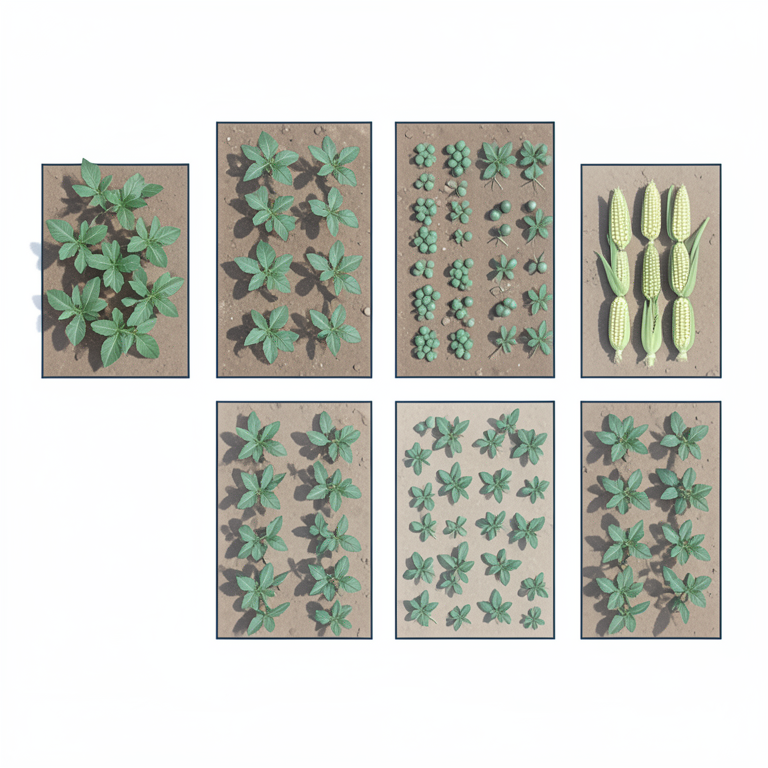
Intercropping System Comparison
AI-generated conceptual illustration (okra plants, cowpea plants, maize plants, and common bean plants in East African Savanna soil). It explains the idea and does not show study data.
View source evidence ↗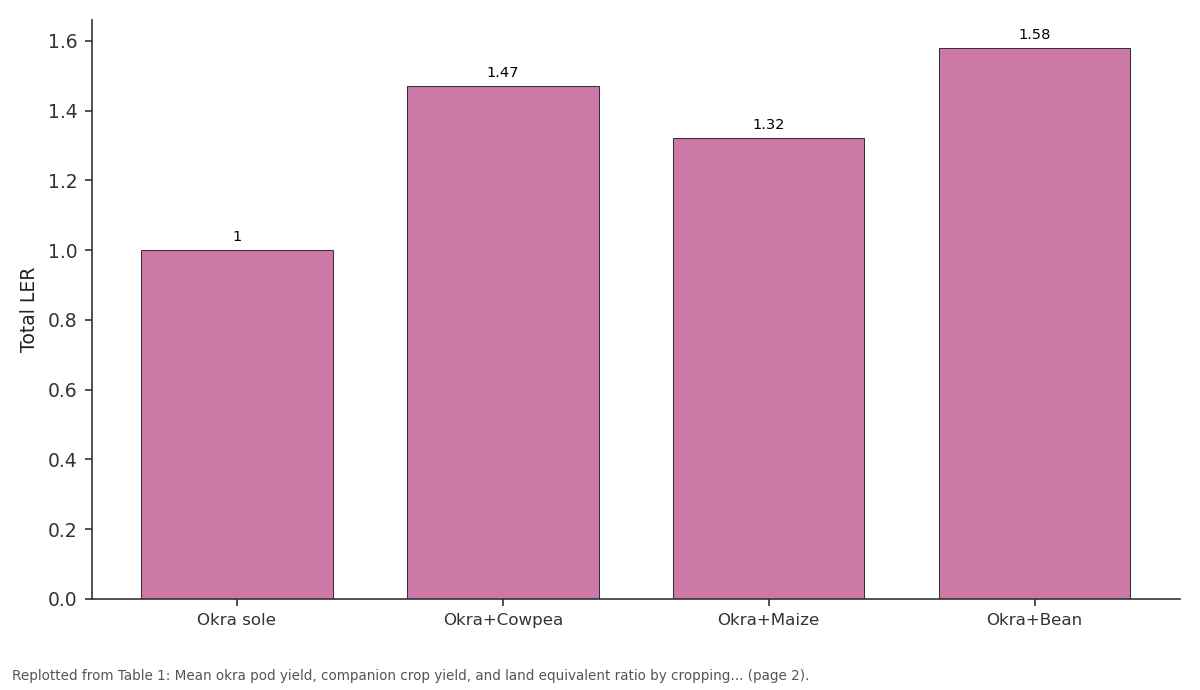
Total LER: Okra sole vs Okra+Cowpea vs Okra+Maize vs Okra+Bean
Replotted from Table 1 (page 2) of the original paper. Every bar is the paper's own table value.
View source evidence ↗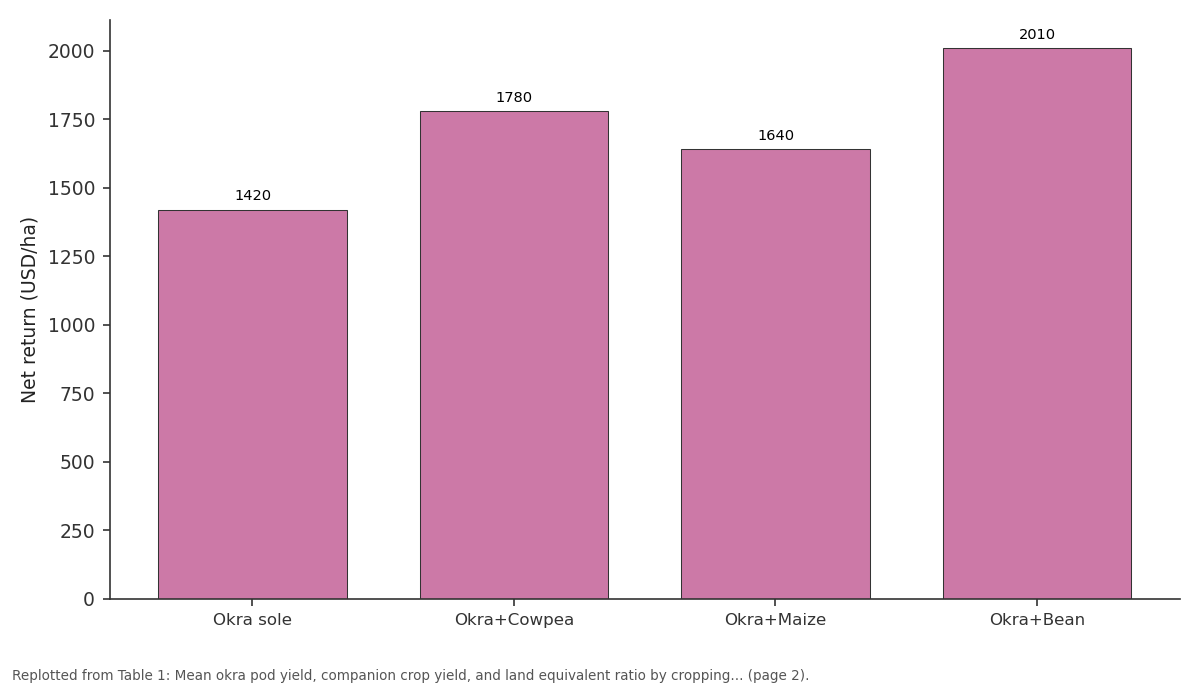
Net return (USD/ha): Okra sole vs Okra+Cowpea vs Okra+Maize vs Okra+Bean
Replotted from Table 1 (page 2) of the original paper. Every bar is the paper's own table value.
View source evidence ↗Figures & tables
From the original paper Table 1
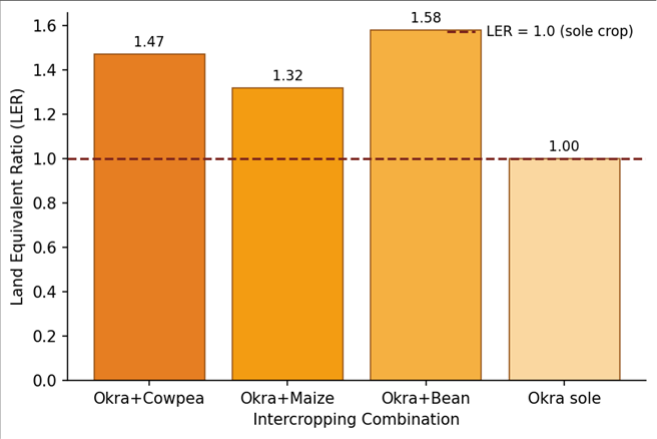 Figure 1
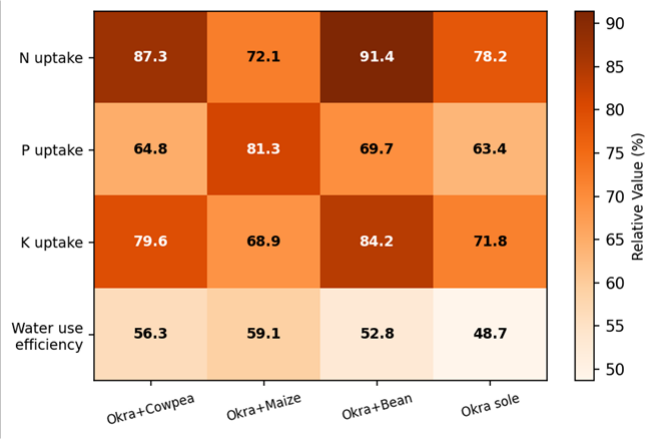 Figure 2
Introduction
Food insecurity in East Africa's semi-arid zones is not just a productivity problem; it is a systems failure. Farmers who depend on a single crop face total loss if rainfall falls short or pest pressure spikes in any given season [1] . Intercropping, the practice of growing two or more crops together on the same land during the same period, has long been recognised as a risk-management strategy that also improves resource use efficiency [2] . Okra (Abelmoschus esculentus L.) is a warm-season vegetable widely grown across tropical Africa for its edible pods, which are rich in vitamins, minerals, and dietary fibre [3] . In Tanzania, okra ranks among the top five vegetable crops by planted area, yet average yields remain below 5 tonnes per hectare, well short of the crop's genetic potential [4] . Part of the yield gap can be traced to soil nutrient depletion from continuous monoculture and part to inefficient use of available rainfall. Combining okra with legumes such as cowpea (Vigna unguiculata) or common bean (Phaseolus vulgaris) can introduce biological nitrogen fixation into the system, reducing the need for purchased fertiliser [5] . Pairing okra with maize (Zea mays) offers complementary canopy architecture: the tall cereal provides partial shade that can reduce okra transpiration losses during hot afternoons, while okra's low canopy covers the soil surface and suppresses weeds [6] . But these benefits depend on planting density, spatial arrangement, and local climate, so region-specific trial data are needed. Despite okra's importance to Tanzanian livelihoods, only a handful of intercropping trials have been published for the country's semi-arid central plateau [7] . This research set out to bridge that information gap by comparing three okra-based intercrops against sole okra for productivity, nutrient cycling, water use, and profitability over two rainy seasons at a representative savanna location.
Material and Methods
Material and Methods
Material
The research used the following crop varieties: okra cultivar Clemson Spineless, cowpea cultivar IT97K-499-35, common bean cultivar Lyamungo 90, and maize hybrid SC627.
Certified seed was obtained from the Tanzania Official Seed Certification Institute. The experimental plots were located on a 1.2-hectare field at the Dodoma Regional Center for Sustainable Agriculture, Dodoma, Tanzania. Soils were characterised as sandy loams, pH 6.3, with 0.72% organic carbon and available nitrogen of 18.4 mg per kilogram. Fertilisers included DAP (18:46:0) applied at planting and urea (46% N) as topdressing. Irrigation was not provided; the trial depended entirely on rainfall [8] .
Methods
The research ran from December 2021 to June 2023, covering two rainy seasons (December-May in each year) at the Dodoma Regional Center for Sustainable Agriculture. Four cropping systems were tested: okra sole crop, okra intercropped with cowpea (1:1 row ratio), okra intercropped with maize (1:1 row ratio), and okra intercropped with common bean (1:1 row ratio). The design was a randomised complete block with four replications and plot size of 5 x 4 m. Okra was spaced at 60 x 30 cm within its rows; companion crops were planted in alternating rows at their recommended densities. DAP was applied at 100 kg per hectare at planting and urea at 50 kg per hectare at four weeks. Okra pods were harvested every three days at the tender stage and weighed fresh. Companion crop yields were recorded at maturity. Plant tissue samples were collected at flowering for nitrogen, phosphorus, and potassium analysis by Kjeldahl and spectrophotometric methods [9] . Land equivalent ratio was calculated as the sum of partial LERs for each component crop. Water use efficiency was estimated as total biomass production divided by seasonal rainfall. Economic returns were calculated using Dodoma market prices at harvest time. Data were analysed by ANOVA using GenStat 20th Edition with LSD at p<0.05 [10] .
Crop growth stage documentation
Okra growth was tracked using the BBCH extended scale. Emergence (BBCH 09) occurred 5-7 days after sowing. First true leaf (BBCH 11) appeared by day 10. Flowering onset (BBCH 61) ranged from 38 to 44 days depending on season. First harvestable pods (BBCH 71) were ready at 45-52 days. Companion crops reached their milestones at expected intervals: cowpea flowered at 42 days and matured at 75 days, bean flowered at 35 days and matured at 85 days, and maize tasselled at 55 days and reached physiological maturity at 120 days [11] . All three intercropping systems produced land equivalent ratios above 1.0, confirming a biological advantage over sole cropping (Table 1). The okra-bean combination achieved the highest LER at 1.58, meaning that 58% more land would be needed to produce the same yields in sole crops. Okra-cowpea and okra-maize had LERs of 1.47 and 1.32 respectively. Okra pod yield was reduced in all intercrops compared to sole okra, ranging from 4.6 t/ha (with maize) to 5.4 t/ha (with bean), but the companion crop yield more than compensated in terms of total system productivity and economic value. Nitrogen uptake was highest in the okra-cowpea system (87.3% of sole crop total), reflecting cowpea's nitrogenfixing capacity (Figure 2). Potassium uptake was highest in okra-bean plots at 84.2%. Water use efficiency was highest in okra-cowpea plots (78.2%) due to better ground cover reducing evaporative losses.
| System | Okra yield (t/ha) | Companion (t/ha) | Total LER | Net return (USD/ha) |
|---|---|---|---|---|
| Okra sole | 6.8 | - | 1.00 | 1,420 |
| Okra+Cowpea | 5.1 | 0.74 | 1.47 | 1,780 |
| Okra+Maize | 4.6 | 2.31 | 1.32 | 1,640 |
| Okra+Bean | 5.4 | 0.89 | 1.58 | 2,010 |
Table text extracted from the original PDF; superscript letters are shown inline. The original table image is below.
View original table image
Results
Results
Discussion
The LER values recorded in this research (1.32-1.58) are consistent with the range reported for tropical vegetablelegume intercrops in West Africa [2,12] . The okra-bean combination's LER of 1.58 exceeded most published values for okra polycultures, likely because common bean's compact growth habit allowed less competition for light and water than the taller maize [6] . The okra-cowpea system, while having a slightly lower LER, offered the added advantage of residual nitrogen fixation, estimated at 40-60 kg N per hectare for the cowpea component [5] . Economic analysis showed that intercropping generated 15.5-41.6% higher net returns than sole okra, driven by the market value of companion crop produce. The okra-bean system's net return of USD 2,010 per hectare was particularly attractive for smallholders with limited land. This aligns with Matusso et al. [7] who found that intercropping significantly boosts farm income in central Tanzania. But it's worth noting that these returns depend heavily on local market prices, which can fluctuate between seasons.
The reduction in okra yield within intercrops (21-32% below sole crop) needs to be weighed against the total system benefit. Farmers who prioritise okra pod production alone may find the yield penalty unacceptable. But those who value dietary diversity and risk reduction will likely favour intercropping, especially the okra-bean combination, which minimised okra yield loss while maximising LER and profit [13] .
Conclusion
This research confirmed that okra-based intercropping systems outperform sole okra in land use efficiency, nutrient cycling, and economic returns under semi-arid savanna conditions in central Tanzania. The okra-bean intercrop was the top performer, achieving an LER of 1.58 and 41.6% higher net returns than monoculture. Okra-cowpea intercropping provided the best nitrogen uptake benefit thanks to biological fixation and is recommended where soil nitrogen depletion is the main constraint. Maize intercropping was the least advantageous combination due to greater light competition. These findings support extension recommendations for smallholder farmers to adopt okra-legume polycultures as a pathway to improved food security and income.
Acknowledgement
Acknowledgements Funding sourcesThis work received support from the Tanzania Agricultural Research Fund.
Figures and tables from the paper
References
16 in the original paper- Snapp SS, Blackie MJ, Gilbert RA, Bezner-Kerr R, Kanyama-Phiri GY. Biodiversity can support a greener revolution in Africa. Proceedings of the National Academy of Sciences. 2010;107(48):20840-20845.
- Willey RW. Intercropping: Its importance and research needs. Part 1. Competition and yield advantages. Field Crop Abstracts. 1979;32(1):1-10.
- Gemede HF, Ratta N, Haki GD, Beyene F, Woldegiorgis AZ. Nutritional quality and health benefits of okra: A review. Journal of Food Processing and Technology. 2015;6(6):458.
- Ministry of Agriculture, Tanzania. Annual Statistical Report on Vegetable Production 2021. Dodoma: Government Press; 2022.
- Peoples MB, Herridge DF, Ladha JK. Biological nitrogen fixation: an efficient source of nitrogen for sustainable agricultural production. Plant and Soil. 1995;174(1):3-28.
- Olasantan FO. Assessment of okra-based cropping systems in the humid tropics. Journal of Vegetable Crop Production. 2001;7(1):39-55.
- Matusso J, Mugwe JN, Mucheru-Muna M. Effects of different maize-soybean intercropping patterns on yields and land equivalent ratio. Journal of Cereals and Oilseeds. 2014;5(2):12-20.
- Anderson JM, Ingram JSI. Tropical Soil Biology and Fertility: A Handbook of Methods. 2nd ed. Wallingford: CAB International; 1993.
- Payne RW. GenStat Release 20 Reference Manual. Hemel Hempstead: VSN International; 2017.
- Meier U, editor. Growth Stages of Mono-and Dicotyledonous Plants: BBCH Monograph. 2nd ed. Berlin: Julius Kuhn-Institut; 2001.
- Egbe OM, Alibo SE, Nwueze I. Evaluation of some extra-early-and early-maturing cowpea varieties for intercropping with maize in southern Guinea savanna of Nigeria. Agriculture and Biology Journal of North America. 2010;1(5):845-858.
- Rao MR, Willey RW. Evaluation of yield stability in intercropping. Experimental Agriculture. 1980;16(2):105-116.
- Amorim EP, Ramos NP, Ungaro MRG, Kiihl TAM. Correlations and path analysis in sunflower. Bragantia. 2008;67(2):307-316.
- Silwana TT, Lucas EO. The effect of planting combinations and weeding on the growth and yield of component crops of maize/bean and maize/pumpkin intercrops. Journal of Agricultural Science. 2002;138(2):193-200.
- Sullivan P. Intercropping Principles and Production Practices. Fayetteville: ATTRA Publication; 2003.
- Adetiloye PO, Ezedinma FOC, Okigbo BN. A land equivalent coefficient concept for the evaluation of competitive and productive interactions on simple complex crop mixtures. Ecological Modelling. 1983;19(1):27-39.