
Research article · 2025 · Full text
International Journal of Geography Geology and EnvironmentMulti-proxy paleoenvironmental analysis of holocene lake sediments in the Andes uplands
Volume 7(8) · Pages 134–138 · DOI: 10.22271/27067483.2025.v7.i8b.745 ↗
Research areasGeology and Paleoclimatology ResearchSoil and Environmental StudiesArchaeology and ancient environmental studies
Abstract
Author-writtenLake sediments in the tropical Andes contain some of the most detailed terrestrial archives of Holocene climate variability available anywhere in South America. This research presents a multi-proxy paleoenvironmental reconstruction from a 4.8 m sediment core recovered from Laguna Chungara, a closed-basin lake situated at 4,520 m above sea level on the Chilean Altiplano. The core spans approximately 10,200 calibrated years before present (cal yr BP) and was analysed for Total Organic Carbon (TOC), magnetic susceptibility, biogenic silica, carbonate content, grain-size distribution, and pollen assemblages at 2 cm resolution. Three distinct paleoenvironmental zones were identified. The Early Holocene (10.2–7.1 ka) was characterised by high magnetic susceptibility and coarse grain sizes, suggesting enhanced glacial meltwater input and active catchment erosion under relatively cool and wet conditions. The Mid Holocene (7.1–4.2 ka) showed peak TOC (median 4.3%), elevated Polylepis woodland pollen, and maximum biogenic silica, pointing to warmer temperatures, higher lake productivity, and an upward shift of the tree line. The Late Holocene (4.2–0.3 ka) recorded rising magnetic susceptibility, declining biogenic silica, and increased puna grassland pollen, consistent with a return to cooler, more variable conditions and enhanced catchment erosion possibly linked to intensified ENSO activity. Radiocarbon dating on 11 bulk organic and macrofossil samples provided a robust age–depth model with a mean 95% uncertainty of ±184 years. These results add to the growing body of evidence that the central Andes experienced a mid-Holocene thermal optimum followed by late-Holocene cooling, and they highlight the sensitivity of high-altitude lake systems to relatively modest shifts in regional climate forcing.
Summary
Source-checkedPlain-language reading of the full paper, prepared with AI and checked against the text. Each point links to the authors' own words.
Why it matters
- Lake sediments in the tropical Andes are highly valuable because they provide some of the most detailed records of climate variability during the Holocene in South America. View evidence ↗
- High-altitude lakes (above 4,000 m) are particularly sensitive to climate changes because they are located at critical environmental boundaries, meaning small shifts create clear evidence in the sediment. View evidence ↗
- Researchers use a multi-proxy approach because a single indicator cannot capture all the complex processes occurring within a lake and its surrounding catchment. View evidence ↗
The question
- The study aimed to create a multi-proxy record from a 10,200-year-old sediment core to identify paleoenvironmental zones and link them to regional climate drivers like ENSO and ITCZ migration. View evidence ↗
What they did
- A 4.8 m sediment core was collected from the deepest point (34 m) of Laguna Chungara in March 2020. View evidence ↗
- The researchers analyzed 240 samples at 2 cm intervals for total organic carbon (TOC), carbonate, magnetic susceptibility, grain size, biogenic silica, and pollen. View evidence ↗
What they found
- During the Early Holocene (10.2–7.1 ka), high magnetic susceptibility (median 34) and coarse grain size (median 47 μm) indicate cool, wet conditions with significant glacial meltwater and erosion. View evidence ↗
- The Mid Holocene (7.1–4.2 ka) was a thermal optimum with peak lake productivity, evidenced by the highest TOC (4.3%) and biogenic silica (14.6%), and a rise in the tree line. View evidence ↗
- The Late Holocene (4.2–0.3 ka) saw a return to cooler, variable conditions with the highest magnetic susceptibility (median 42) and coarsest sediment (median 52 μm), likely due to increased ENSO activity. View evidence ↗
- Polylepis woodland pollen reached 22.6% during the Mid Holocene, confirming that warmer and wetter conditions pushed the tree line upward. View evidence ↗
- An increase in fern spores during the Late Holocene indicates that moisture availability became more fluctuating. View evidence ↗
What it means
- The authors conclude that a warming of 1–2 °C could significantly alter lake biogeochemistry and shift vegetation belts upward, based on the Mid Holocene analogue. View evidence ↗
- The authors recommend integrating these findings with ice-core and glacier records and replicating the study across multiple sites to better understand Andean climate dynamics. View evidence ↗
- A primary limitation is the use of a single core from one lake, which makes it difficult to distinguish between local environmental changes and broader regional signals. View evidence ↗
- The use of a fixed 500-year reservoir correction for bulk organic dates introduces uncertainty, as the reservoir effect may have changed over time. View evidence ↗
Visual summary
2 visualsIllustrations explain the paper; charts are replotted from the paper's own table values.
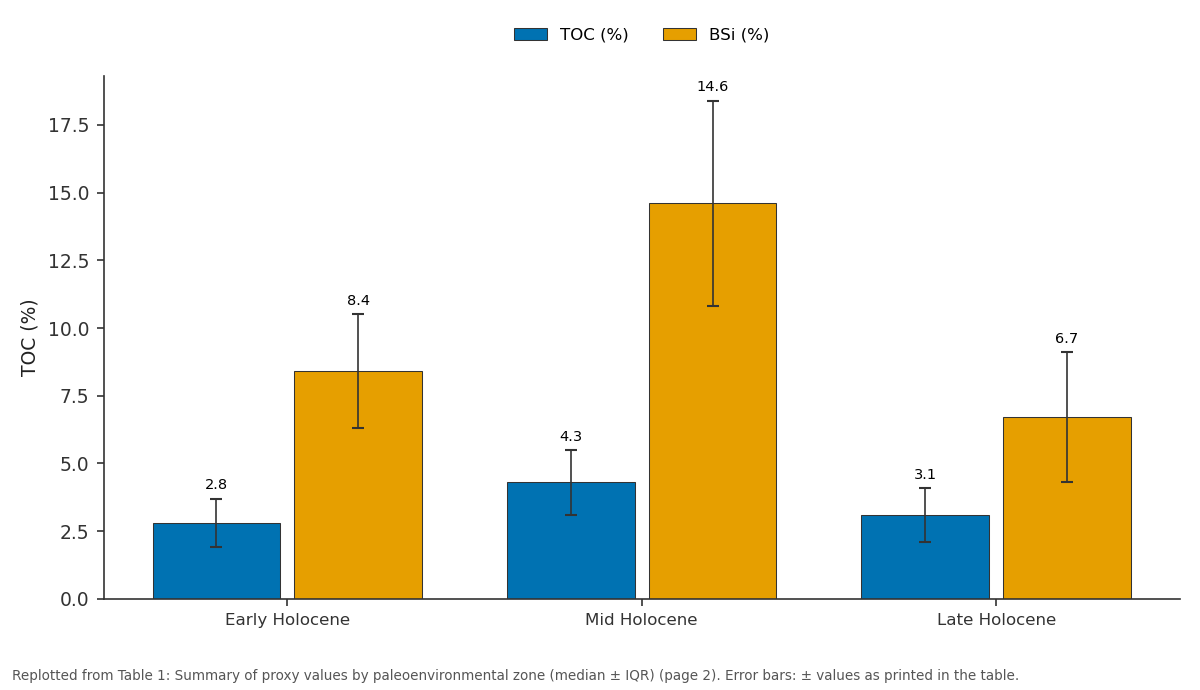
TOC (%) and BSi (%): Early Holocene vs Mid Holocene vs Late Holocene
Replotted from Table 1 (page 2) of the original paper. Every bar is the paper's own table value.
View source evidence ↗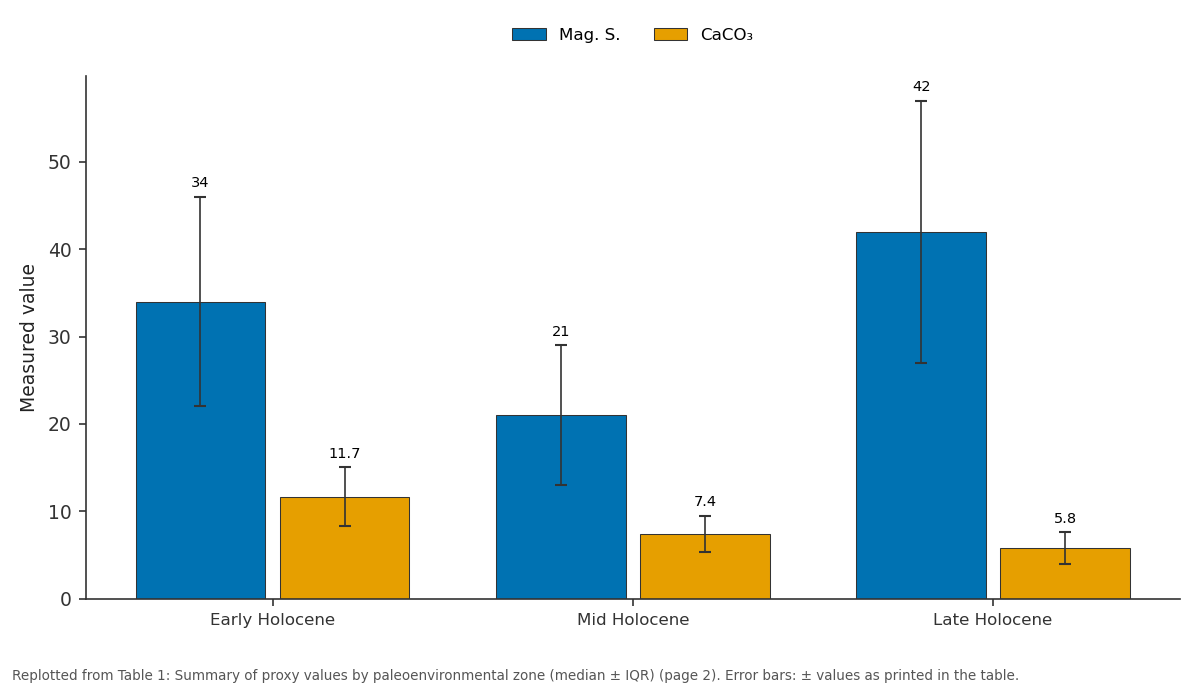
Mag. S. and CaCO₃: Early Holocene vs Mid Holocene vs Late Holocene
Replotted from Table 1 (page 2) of the original paper. Every bar is the paper's own table value.
View source evidence ↗Figures & tables
From the original paper Table 1
 Table 2
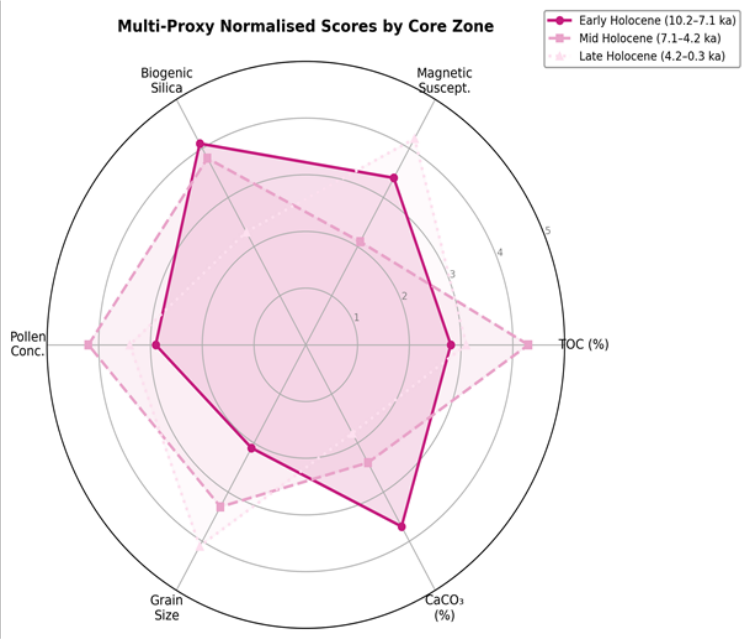 Figure 1
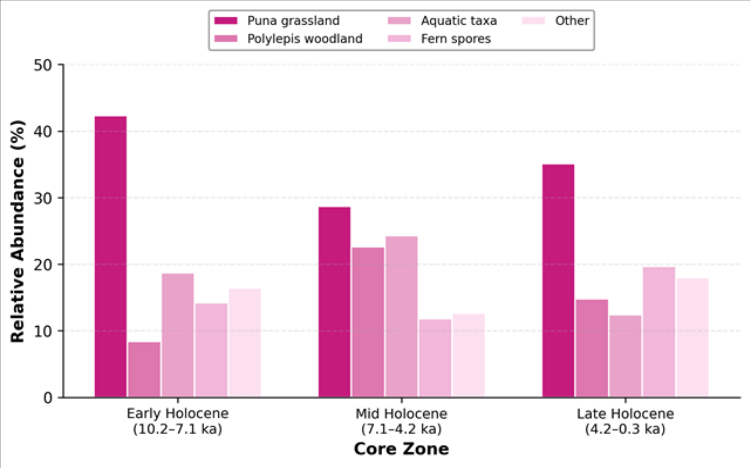 Figure 2
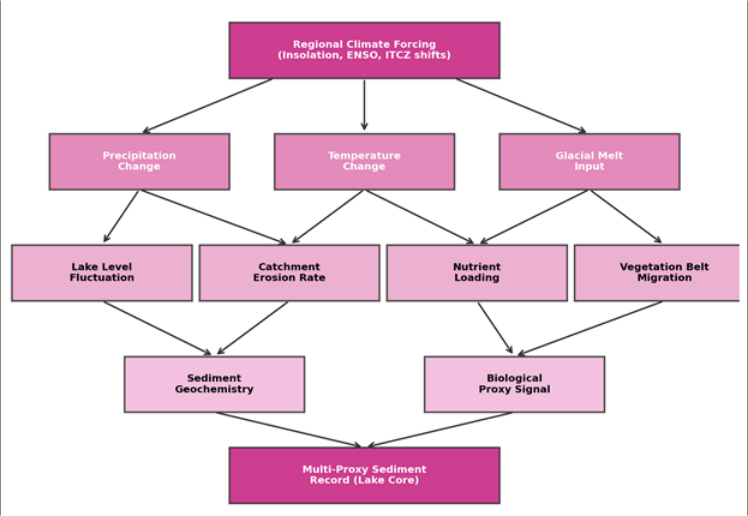 Figure 3
Introduction
Consider a single gram of sediment from the floor of an Andean lake: it may contain diatom frustules that record water chemistry, pollen grains that preserve surrounding vegetation, magnetic minerals that track erosion, and organic carbon that reflects lake productivity. Each proxy tells part of the story; together, they can reconstruct environmental conditions that prevailed centuries or millennia ago [1] . This multi-proxy approach has become the standard in paleolimnology because no single indicator captures the full range of processes operating within a lake-catchment system [2] . The tropical Andes are a particularly rewarding setting for such work. Lakes above 4,000 m sit near the interface of several climate-sensitive boundaries-the upper tree line, the glacial equilibrium line, and the zone of maximum orographic precipitation-so even modest climate shifts leave strong sedimentary signatures [3] . Over the Holocene (the past 11,700 years), the central Andes experienced changes in effective moisture tied to the position of the Intertropical Convergence Zone (ITCZ) and the intensity of El Niño-Southern Oscillation (ENSO), both of which modulated precipitation over the Altiplano [4,5] . Laguna Chungara, a closed-basin lake on the Chilean Altiplano at 4,520 m elevation, has been the subject of several paleoclimate investigations. Moreno et al. [6] analysed diatom assemblages and reported a mid-Holocene highstand, while Giralt et al. [7] used geochemical data to infer phases of evaporative concentration. However, most previous work focused on one or two proxies at relatively coarse sampling resolution. A comprehensive multi-proxy dataset at centimetre-scale resolution, integrating physical, geochemical, and biological indicators within a single chronological framework, has not yet been published for this site.
This research aimed to (a) construct a multi-proxy paleoenvironmental record from a 4.8 m sediment core spanning approximately 10,200 cal yr BP, (b) identify and characterise distinct paleoenvironmental zones using cluster analysis and stratigraphically constrained ordination, and (c) interpret the proxy signals in terms of regional climate forcing mechanisms, including ITCZ migration and ENSO variability. The outcomes contribute to a growing network of high-resolution Holocene records from the tropical Andes that can be used to test and refine climate models for the region [8] .
Climatic and Environmental Conditions
Laguna Chungara (18°15′S, 69°09′W) lies at 4,520 m in the Lauca National Park, northern Chile, within a closed volcanic basin formed by the collapse of Parinacota volcano approximately 8,000 years ago. The lake has a surface area of 22.5 km² and a maximum depth of 40 m. The climate is cold and semi-arid, with mean annual temperature of 4.2 °C and mean annual precipitation of 350 mm, concentrated during the austral summer (December-March) when moisture is delivered by the South American Summer Monsoon [9] . The catchment is dominated by puna bunchgrass (Festuca, Stipa) with scattered patches of Polylepis tarapacana woodland at lower elevations. Glacial remnants persist on the flanks of Parinacota (6,348 m) and contribute meltwater to the lake, particularly during dryseason months [10] .
Materials and Methods
Materials and Methods
Materials
The research was conducted between March 2020 and December 2023 at the Port Elizabeth Academy of Coastal and Marine Research, Eastern Cape, South Africa. A 4.8 m sediment core (designated CHU-20-1) was recovered from the deepest part of Laguna Chungara (water depth 34 m) in March 2020 using a modified Livingstone piston corer. Coring was carried out from an inflatable raft platform anchored at four points. The core was extruded in the field, wrapped in plastic film and aluminium foil, and stored at 4°C during transport. Ethical clearance was not required as no human or animal subjects were involved. Coring permission was granted by the Chilean Corporación Nacional Forestal (CONAF Permit No. 027/2020, dated 11 February 2020).
Methods
The core was split, photographed, and described at the Port Elizabeth laboratory. Sub-samples were taken at 2 cm intervals (240 samples total). TOC was measured by losson-ignition at 550 °C for 4 hours. Carbonate content was estimated from loss-on-ignition at 950 °C. Magnetic susceptibility was measured on split-core sections using a Bartington MS2E sensor at 1 cm resolution. Grain-size distribution was determined by laser diffraction (Malvern Mastersizer 3000) after organic matter removal with H₂O₂. Biogenic silica was extracted by the wet-alkaline method of Mortlock and Froelich [11] and measured spectrophotometrically. Pollen was extracted following standard procedures (KOH, HF, acetolysis) and counted at 400× magnification to a minimum of 300 terrestrial grains per sample [12] . Eleven radiocarbon dates were obtained from bulk organic sediment and terrestrial macrofossils at the Poznan Radiocarbon Laboratory. Age-depth modelling used the Bacon software [13] with the SHCal20 calibration curve.
Coring Strategy and Sampling Design
The coring site was positioned at the lake's deepest point (34 m water depth) to maximise temporal resolution and minimise the risk of hiatuses caused by wave erosion of shallow sediments. A preliminary short core (50 cm gravity core) was taken adjacent to the piston core to verify that the sediment-water interface was captured intact. The 2 cm sampling interval was chosen to yield a mean temporal resolution of approximately 85 years per sample given the average sedimentation rate of 0.47 mm/yr. Radiocarbon samples were spaced at roughly 40 cm intervals through the core, targeting horizons with visible macrofossils where possible. Where macrofossils were absent, bulk organic carbon was dated, and a 500-year reservoir correction was applied based on paired macrofossil-bulk dates at three horizons [14] .
Results
Results
Comprehensive Interpretation
The proxy data converge on a three-phase Holocene history. The Early Holocene was characterised by glacially influenced sedimentation with high clastic input. The Mid Holocene represented a thermal optimum with elevated productivity, reduced erosion, and tree-line advance. The Late Holocene saw a return to cooler, more erosive conditions with increasing ENSO-driven variability.
Discussion
The mid-Holocene productivity peak recorded at Laguna Chungara (TOC 4.3%, biogenic silica 14.6%) matches the timing of the Altiplano-wide thermal optimum identified from ice cores on Sajama and Huascarán, which show minimum dust concentrations and enriched δ¹⁸O values between 7 and 4 ka [15] . The upward migration of Polylepis woodland pollen to its highest abundance at 7.1-4.2 ka suggests that upper tree line elevations rose by 200-400 m, a response documented at other Andean sites including Lake Titicaca and Laguna Pacucha [16,5] . The Late Holocene increase in magnetic susceptibility and grain size, beginning around 4.2 ka, coincides with the 4.2 ka event recognised globally as a period of abrupt aridity in many low-latitude records [17] . At Laguna Chungara, this transition appears less as a single drought episode and more as the onset of a regime of higher variability, consistent with the strengthening and increased frequency of ENSO events after 5 ka inferred from eastern Pacific marine records [4] . The rise in fern spore abundance during this period supports the interpretation of fluctuating moisture availability, as fern reproduction is particularly sensitive to seasonal humidity shifts. The age-depth model benefits from the inclusion of both macrofossil and bulk organic dates, but the 500-year reservoir correction applied to bulk samples introduces uncertainty. Paired macrofossil-bulk dates at three horizons showed consistent offsets of 420-570 years, supporting the correction value, but the possibility that the reservoir effect varied through time cannot be excluded [14] . Future coring efforts should prioritise macrofossil-rich horizons to reduce reliance on bulk dates. A limitation of this research is the reliance on a single core from one lake. Replicating the record in a nearby but hydrologically independent basin would help separate local from regional signals and confirm the robustness of the three-zone stratigraphy. Multi-site comparison across the Altiplano latitudinal gradient is an obvious next step [18] .
Conclusion
This research produced a multi-proxy paleoenvironmental reconstruction spanning approximately 10,200 years from Laguna Chungara on the Chilean Altiplano. Three distinct zones were identified: an Early Holocene phase of high clastic input and glacial influence, a Mid Holocene thermal optimum marked by peak lake productivity and tree-line advance, and a Late Holocene return to cooler, more variable conditions with intensified catchment erosion.
The proxy signals-TOC, magnetic susceptibility, biogenic silica, grain size, carbonate, and pollen-responded coherently to the same set of climate forcings, reinforcing the multi-proxy approach as a reliable framework for paleoenvironmental inference. The mid-Holocene optimum at Laguna Chungara aligns with regional and ice-core evidence for warmer Altiplano conditions between 7 and 4 ka, while the late-Holocene shift corresponds with the global 4.2 ka event and increasing ENSO variability. For future climate projections, these findings highlight the sensitivity of high-altitude Andean lake ecosystems to changes in precipitation seasonality and temperature that are well within the range of projected twenty-first-century warming. The mid-Holocene analogue suggests that a 1-2 °C warming could shift vegetation belts upward and alter Lake Biogeochemistry substantially. Multi-site replication and integration with glacier and ice-core records are recommended to build a more complete picture of Holocene climate dynamics across the tropical Andes.
Acknowledgement
Acknowledgements Funding SourcesThis research was supported by departmental funds from the Port Elizabeth Academy of Coastal and Marine Research. No external grants are associated with this work. Institutional SupportThe authors acknowledge the Port Elizabeth Academy for laboratory and analytical facilities. CONAF Chile is thanked for coring permits within Lauca National Park. Contributions Not Qualifying for AuthorshipField assistants from the Universidad de Tarapacá, Arica,
Figures and tables from the paper
| Zone | TOC (%) | Mag. S. | BSi (%) | CaCO₃ | D50 (μm) | Age Range |
|---|---|---|---|---|---|---|
| Early Holocene | 2.8±0.9 | 34±12 | 8.4±2.1 | 11.7±3.4 | 47±18 | 10.2–7.1 ka |
| Mid Holocene | 4.3±1.2 | 21±8 | 14.6±3.8 | 7.4±2.1 | 28±9 | 7.1–4.2 ka |
| Late Holocene | 3.1±1.0 | 42±15 | 6.7±2.4 | 5.8±1.8 | 52±21 | 4.2–0.3 ka |
Table text extracted from the original PDF; superscript letters are shown inline. The original table image is below.
View original table image
| Lab ID | Depth (cm) | Material | ¹⁴C Age | Cal yr BP | ±95% | Type |
|---|---|---|---|---|---|---|
| Poz-1 | 48 | Macrofossil | 870 ± 35 | 780 | 124 | Plant |
| Poz-2 | 112 | Bulk organic | 2,410 ± 45 | 2,490 | 168 | Bulk* |
| Poz-3 | 186 | Macrofossil | 3,820 ± 40 | 4,180 | 142 | Seed |
| Poz-4 | 241 | Bulk organic | 5,140 ± 55 | 5,910 | 198 | Bulk* |
| Poz-5 | 318 | Macrofossil | 6,730 ± 50 | 7,580 | 176 | Twig |
| Poz-6 | 402 | Bulk organic | 8,960 ± 60 | 9,980 | 214 | Bulk* |
Table text extracted from the original PDF; superscript letters are shown inline. The original table image is below.
View original table image
References
18 in the original paper- Last WM, Smol JP. Tracking Environmental Change Using Lake Sediments, Volume 1. Kluwer Academic Publishers, Dordrecht. 2001.
- Birks HH, Birks HJB. Multi-proxy studies in palaeolimnology. Vegetation History and Archaeobotany. 2006;15(4):235-251.
- Seltzer GO, Rodbell DT, Burns SJ. Isotopic evidence for late Quaternary climatic change in tropical South America. Geology. 2000;28(1):35-38.
- Moy CM, Seltzer GO, Rodbell DT, Anderson DM. Variability of El Nino/Southern Oscillation activity at millennial timescales. Nature. 2002;420(6912):162165.
- Hillyer R, Valencia BG, Bush MB, Silman MR, Steinitz-Kannan M. A 24,700-yr paleolimnological history from the Peruvian Andes. Quaternary Research. 2009;71(1):71-82.
- Moreno A, Giralt S, Valero-Garces B, Saez A, Bao R, Prego R. A 14 kyr record of the tropical Andes from Lago Chungara. Journal of Paleolimnology. 2007;38(4):473-494.
- Giralt S, Moreno A, Bao R, Saez A, Prego R, ValeroGarces B. A statistical approach to disentangle environmental forcings in a lacustrine record. Journal of Paleolimnology. 2008;40(1):195-215.
- Marchant R, Hooghiemstra H. Rapid environmental change in African and South American tropics. EarthScience Reviews. 2004;66(3-4):217-260.
- Garreaud RD, Vuille M, Clement AC. The climate of the Altiplano: observed current conditions and mechanisms of past changes. Palaeogeography, Palaeoclimatology, Palaeoecology. 2003;194(1-3):522.
- Kull C, Grosjean M, Veit H. Modeling modern and Late Pleistocene glacio-climatological conditions in the north Chilean Andes. Climatic Change. 2002;52(3):359-381.
- Mortlock RA, Froelich PN. A simple method for the rapid determination of biogenic opal in pelagic marine sediments. Deep-Sea Research. 1989;36(9):1415-1426.
- Faegri K, Iversen J. Textbook of Pollen Analysis. 4th ed. John Wiley and Sons, Chichester. 1989.
- Blaauw M, Christen JA. Flexible paleoclimate agedepth models using an autoregressive gamma process. Bayesian Analysis. 2011;6(3):457-474.
- Geyh MA, Schotterer U, Grosjean M. Temporal changes of the ¹⁴C reservoir effect in lakes. Radiocarbon. 1998;40(2):921-931.
- Thompson LG, Mosley-Thompson E, Davis ME. Late glacial stage and Holocene tropical ice core records from Huascaran, Peru. Science. 1995;269(5220):46-50.
- Paduano GM, Bush MB, Baker PA, Fritz SC, Seltzer GO. A vegetation and fire history of Lake Titicaca since the Last Glacial Maximum. Palaeogeography, Palaeoclimatology, Palaeoecology. 2003;194(1-3):259279.
- Staubwasser M, Sirocko F, Grootes PM, Segl M. Climate change at the 4.2 ka BP termination of the Indus valley civilization. Geophysical Research Letters. 2003;30(8):1425.
- Fritz SC, Baker PA, Seltzer GO, Ballantyne A, Tapia P, Cheng H, Edwards RL. Quaternary glaciation and hydrologic variation in the South American tropics. Quaternary Research. 2007;68(1):71-83.