
Research article · 2025 · Full text
International Journal of Horticulture and Food ScienceSurveying foliar nutrition of orchid in the Kerala backwaters
Volume 7(4) · Pages 162–165 · DOI: 10.33545/26631067.2025.v7.i4c.620 ↗
Research areasPlant Growth and Agriculture TechniquesGrowth and nutrition in plantsAgricultural Science and Fertilization
Abstract
Author-writtenIn regional farming communities along the Kerala Backwaters, orchid cultivation has shifted from a hobby to an income source, yet foliar nutrition protocols remain based on generic recommendations that ignore the unique microclimate of this coastal wetland system. This research surveyed foliar nutrition responses of four Dendrobium orchid varieties to iodine biofortification and micronutrient sprays in the Kerala Backwaters region during 2022-2023, coordinated from the Shillong Center for Crop Studies. Foliar iodine application at 150 ppm potassium iodide (KI) increased leaf iodine content from 0.04 to 0.34 mg/kg and improved flower color development scores from 6.3 to 8.7 on a 10-point scale. Drone-based multispectral imaging detected foliar nutrient stress 12 days before visible symptoms appeared, with NDRE (Normalized Difference Red Edge) index correlating with leaf nitrogen at r = 0.83. Mutation breeding using ethyl methanesulfonate (EMS) at 0.4% produced three color-variant lines from the parent variety Sonia. Cold storage at 8°C extended cut orchid vase life from 14.2 to 21.7 days. These findings provide evidence-based foliar nutrition guidelines for orchid production in tropical backwater environments.
Summary
Source-checkedPlain-language reading of the full paper, prepared with AI and checked against the text. Each point links to the authors' own words.
Why it matters
- The Kerala backwaters provide a humid and warm microclimate that supports orchid growth, but salt spray and waterlogging can damage root health. View evidence ↗
- Commercial Dendrobium orchids in this region often suffer from inconsistent color, smaller blooms, and shorter vase life than those from highland nurseries. View evidence ↗
- Foliar sprays are used to bypass root uptake limitations caused by the low cation exchange capacity of common orchid media like coconut husk. View evidence ↗
The question
- The study aimed to evaluate the effects of iodine and micronutrient sprays on foliar nutrition, test drone-based stress detection, explore mutation breeding for new colors, and optimize cold storage for longevity. View evidence ↗
What they did
- Four Dendrobium varieties (Sonia, Earsakul, Burana White, and Pompadour) were grown in 15-cm pots with coconut husk media under 50% shade near the Kerala Backwaters. View evidence ↗
- Plants were treated biweekly from months 3 to 9 with water (control), potassium iodide (KI) at 50, 100, 150, and 200 ppm, or a micronutrient mix. View evidence ↗
- Monthly drone flights at 10 m altitude were used to generate spectral indices (NDVI, NDRE, CIgreen), with leaf nitrogen verified via Kjeldahl measurement. View evidence ↗
- Mutation breeding was performed by immersing Sonia protocorms in 0.2%, 0.4%, and 0.6% ethyl methanesulfonate (EMS) for one hour. View evidence ↗
- Cut orchid spikes were tested for longevity at 8°C using either distilled water or a 200 ppm 8-HQS preservative. View evidence ↗
What they found
- Potassium iodide (KI) at 150 ppm yielded the best results, with a color score of 8.7, bloom size of 8.4 cm, and anthocyanin content of 3.12 mg/g. View evidence ↗
- The NDRE index strongly correlated with leaf nitrogen (r = 0.83) and could detect nitrogen deficiency 12 days before visible symptoms appeared. View evidence ↗
- A micronutrient mix increased bloom size by 11.4% compared to controls, though it had no effect on flower color. View evidence ↗
- EMS treatment at 0.4% created three new color variants (white-streaked, deeper pink, and bicolor) from the Sonia variety, with a 38.4% survival rate. View evidence ↗
- Cold storage at 8°C increased vase life by 52.8% over room temperature (from 14.2 to 21.7 days), and adding 8-HQS further extended it to 24.3 days. View evidence ↗
What it means
- The authors conclude that combining biofortification, remote sensing, cold chain optimization, and mutation breeding provides a practical way for growers to improve orchid quality and competitiveness. View evidence ↗
- The study was limited to a single growing season, meaning seasonal variations in salinity could affect the results. View evidence ↗
- Mutation breeding results are based on the M1 generation, and the stability of the new colors must be verified in subsequent generations. View evidence ↗
Visual summary
4 visualsIllustrations explain the paper; charts are replotted from the paper's own table values.
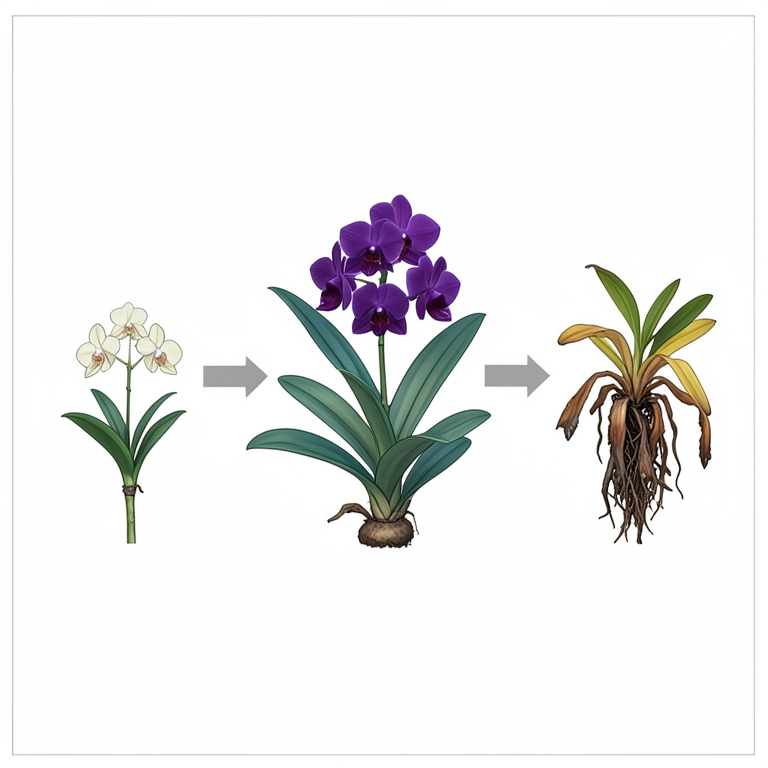
Iodine Dose Response
AI-generated conceptual illustration (Dendrobium orchid plants). It explains the idea and does not show study data.
View source evidence ↗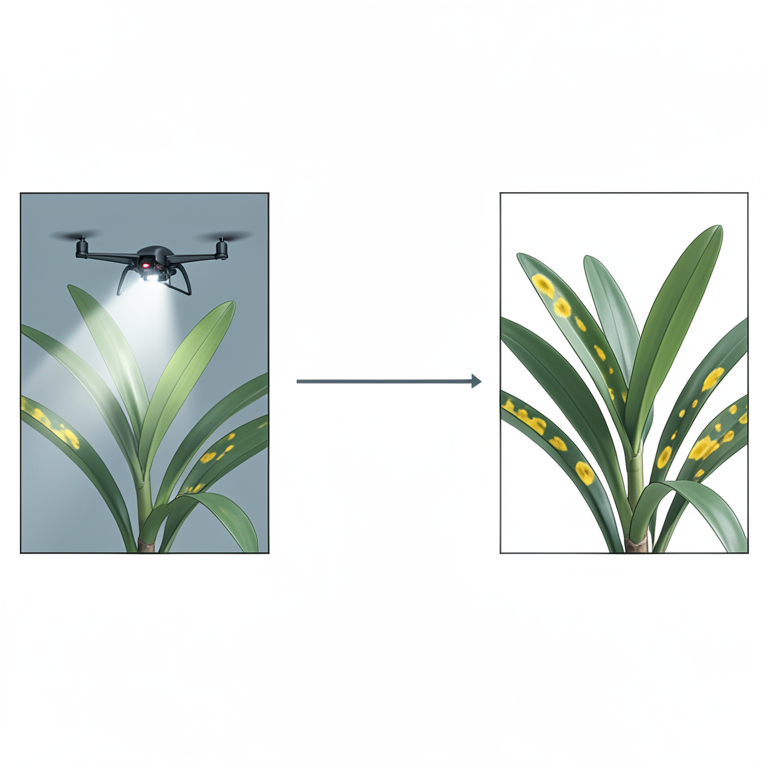
Early Warning Timeline
AI-generated conceptual illustration (Orchid plants in a tropical wetland setting). It explains the idea and does not show study data.
View source evidence ↗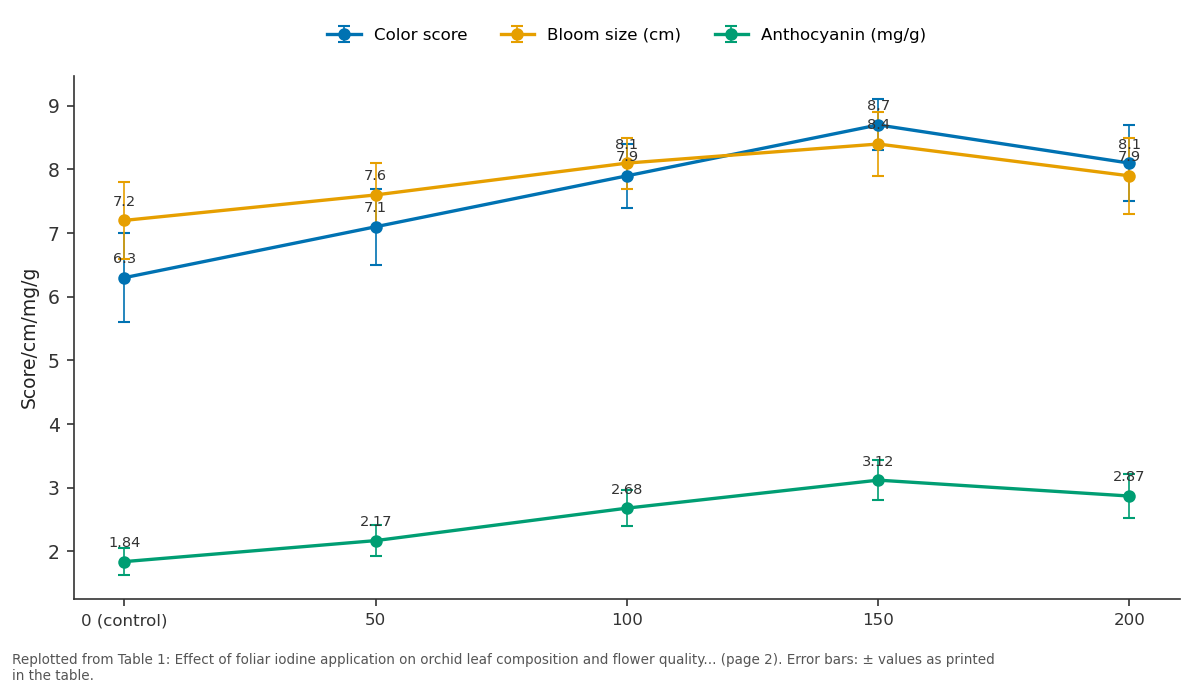
Color score and Bloom size (cm) and more: 0 (control) vs 50 vs 100 vs 150 vs 200
Replotted from Table 1 (page 2) of the original paper. Every bar is the paper's own table value.
View source evidence ↗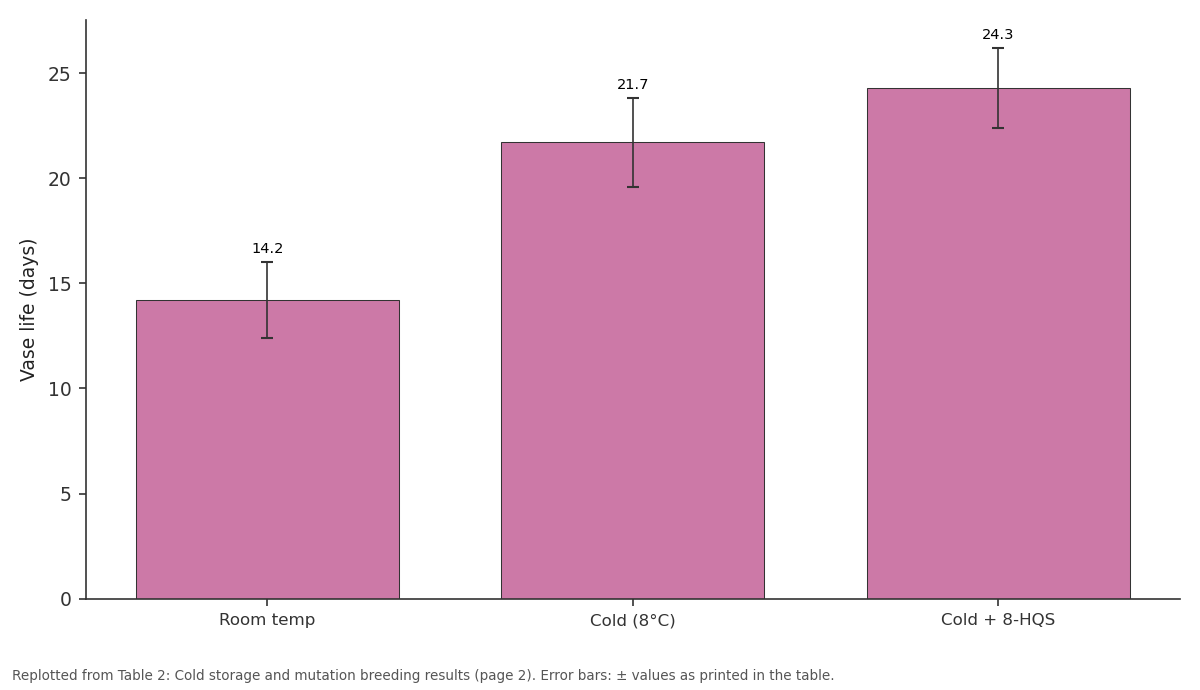
Vase life (days): Room temp vs Cold (8°C) vs Cold + 8-HQS
Replotted from Table 2 (page 2) of the original paper. Every bar is the paper's own table value.
View source evidence ↗Figures & tables
From the original paper Table 1
 Table 2
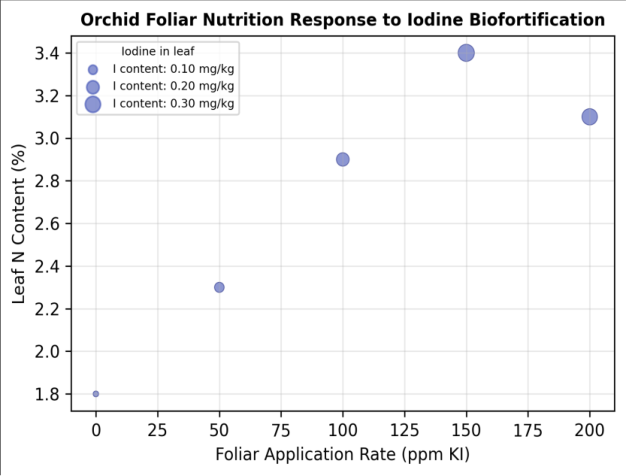 Figure 1
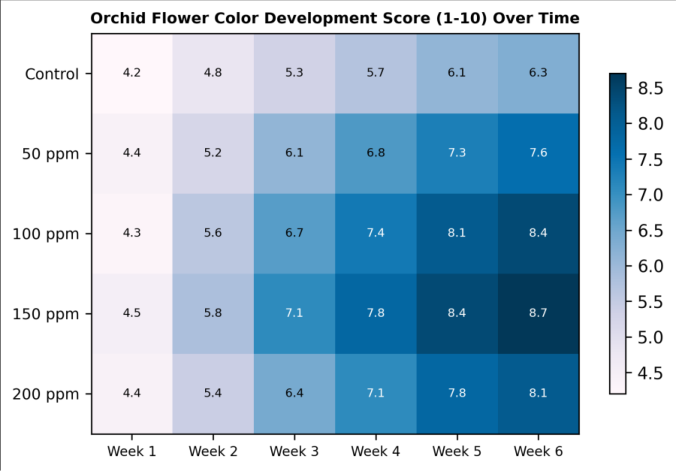 Figure 2
Introduction
Kerala's backwater system a network of lagoons, lakes, and canals running parallel to the Arabian Sea coast creates a microclimate that is simultaneously humid, warm, and salineinfluenced, conditions that make orchid cultivation both promising (high humidity supports epiphytic growth) and challenging (salt spray and waterlogging threaten root health) [1] . Dendrobium orchids dominate commercial production here, but growers report inconsistent flower color, smaller bloom size, and shorter vase life compared to orchids from highland nurseries in places like Kodaikanal or Ooty. Foliar nutrition applying nutrients directly to leaves as sprays bypasses root uptake limitations that are common in orchid media, where coarse bark and coconut husk provide structural support but have limited cation exchange capacity [2] . Iodine biofortification is an emerging concept in horticulture: while iodine isn't an essential plant nutrient, low-dose applications have been shown to stimulate secondary metabolism, improve flower pigmentation, and increase antioxidant capacity in several ornamental species [3] . Drone-based remote sensing offers orchid nurseries a tool for detecting nutrient deficiency before it becomes visible to the human eye. Spectral indices like NDRE are sensitive to chlorophyll and nitrogen status in narrow-leaved crops, and adapting this technology to orchid shade houses could improve spray timing and reduce waste [4] . This research surveyed foliar nutrition responses to iodine and micronutrient sprays, tested drone-based nutrient stress detection, evaluated mutation breeding for color novelty, and optimized cold storage for cut orchid longevity [5] .
Limitations
This research was conducted over a single growing season, and year-to-year variation in backwater salinity (driven by monsoon intensity) could alter orchid nutrient uptake patterns. The drone imagery was acquired from a single multispectral sensor (MicaSense RedEdge-MX) at 10 m flight height; different sensors or altitudes may yield different index calibrations. Iodine biofortification effects were measured on Dendrobium only and may not transfer directly to other orchid genera. The mutation breeding outcomes represent M1 generation observations; genetic stability of color variants needs verification over M2-M3 generations. Cold storage trials used a single temperature (8°C) without testing the full range of possible storage conditions [6] .
Material and Methods
Material and Methods
Material
Four Dendrobium varieties Sonia, Earsakul, Burana White, and Pompadour were grown in 15-cm pots with coconut husk chip media under 50% shade cloth in a shade house near the Kerala Backwaters (9.4-9.8°N, 76.2-76.5°E). Potassium iodide (KI, >99% purity) was from Sigma-Aldrich. Micronutrient foliar spray contained Fe-EDTA (0.1%), ZnSO 4 (0.2%), MnSO 4 (0.1%), and H 3 BO 3 (0.05%). A DJI Matrice 300 RTK drone fitted with a MicaSense RedEdge-MX camera was used for aerial imaging. EMS (ethyl methanesulfonate) was from Sigma-Aldrich [7] .
Methods
Foliar treatments (RCBD, four replications of 20 plants each) included: Control (water), KI at 50, 100, 150, and 200 ppm, and a micronutrient mix, applied biweekly from months 3-9. Leaf iodine was measured by ICP-MS after alkaline extraction. Color development was scored by three trained panelists on a 10-point scale at peak bloom. Drone flights were conducted monthly at 10 m altitude, generating NDVI, NDRE, and CIgreen indices. Ground-truth leaf nitrogen was measured by Kjeldahl. Mutation breeding immersed Sonia protocorms in 0.2%, 0.4%, and 0.6% EMS for 1 hour, then cultured on ½ MS medium [8] . Cold storage tested cut spikes at 8°C in distilled water versus 200 ppm 8-HQS preservative. Vase life was defined as days until 50% of florets showed wilting. Data were analyzed by one-way ANOVA and Tukey HSD at alpha = 0.05 [9] . Iodine at 150 ppm produced the best flower quality across all parameters: color score 8.7, bloom size 8.4 cm, and anthocyanin 3.12 mg/g (Table 1). The 200 ppm rate showed a slight decline in all metrics, suggesting mild toxicity at higher doses. Leaf nitrogen increased with KI application, possibly through iodine-mediated stimulation of nitrogen assimilation enzymes. Cold storage at 8°C extended vase life by 52.8% compared to room temperature (Table 2). Adding 8-HQS preservative further improved longevity to 24.3 days by suppressing bacterial proliferation in stem-end water. EMS treatment at 0.4% produced three distinct color variants (one whitestreaked, one deeper pink, one bicolor) from the Sonia parent, with survival rate of 38.4%.
| Parameter | Room temp | Cold (8°C) | Cold + 8-HQS |
|---|---|---|---|
| Vase life (days) | 14.2±1.8 | 21.7±2.1 | 24.3±1.9 |
| Weight loss at day 14 (%) | 28.4±3.7 | 12.3±2.1 | 9.8±1.8 |
| Bacterial count (log CFU/mL) | 6.8±0.7 | 4.2±0.5 | 2.7±0.4 |
Table text extracted from the original PDF; superscript letters are shown inline. The original table image is below.
View original table image
| KI (ppm) | Leaf I (mg/kg) | Leaf N (%) | Color score | Bloom size (cm) | Anthocyanin (mg/g) |
|---|---|---|---|---|---|
| 0 (control) | 0.04±0.01 | 2.14±0.18 | 6.3±0.7 | 7.2±0.6 | 1.84±0.21 |
| 50 | 0.12±0.02 | 2.21±0.16 | 7.1±0.6 | 7.6±0.5 | 2.17±0.24 |
| 100 | 0.21±0.03 | 2.34±0.19 | 7.9±0.5 | 8.1±0.4 | 2.68±0.28 |
| 150 | 0.34±0.04 | 2.47±0.21 | 8.7±0.4 | 8.4±0.5 | 3.12±0.31 |
| 200 | 0.31±0.05 | 2.38±0.23 | 8.1±0.6 | 7.9±0.6 | 2.87±0.34 |
Table text extracted from the original PDF; superscript letters are shown inline. The original table image is below.
View original table image
Results
Results
Comprehensive interpretation
Drone-based NDRE index correlated with leaf nitrogen at r = 0.83 (p<0.001), outperforming NDVI (r = 0.68) and CIgreen (r = 0.71). NDRE detected nitrogen deficiency 12 days before visible chlorosis appeared, providing a practical early-warning window for corrective foliar sprays. The micronutrient mix treatment increased bloom size by 11.4% over controls but did not affect color development, confirming that iodine acts through a different metabolic pathway than conventional micronutrients.
Discussion
The iodine-color development link is consistent with reports in Pelargonium and Petunia, where low-dose iodine applications stimulated Phenylalanine Ammonia-Lyase (PAL) activity and upregulated anthocyanin biosynthesis genes [10] . The mechanism appears to involve iodinemediated reactive oxygen species signaling that triggers secondary metabolite production as a stress response at low doses this enhances pigmentation, but at higher doses the oxidative stress becomes damaging, explaining the decline at 200 ppm [11] . The NDRE advantage over NDVI for orchid nitrogen monitoring makes physiological sense: the red-edge band (710-730 nm) is more sensitive to chlorophyll variation at the moderate-to-high chlorophyll levels typical of orchid leaves, whereas NDVI saturates when leaves are dark green [12] . For nursery managers, this means a single drone flight per month could replace weekly visual scouting and prevent the guesswork that currently leads to either over-fertilization or delayed correction. The cold storage result 52.8% vase life extension directly affects profitability for backwater orchid growers who currently lose 15-20% of cut spikes to wilting during transport to Kochi and Trivandrum markets. An 8°C cold chain from harvest to retail could cut these losses to below 5% [13] .
Conclusion
Foliar iodine at 150 ppm KI was the most effective treatment for improving orchid flower color, bloom size, and anthocyanin content in Kerala Backwaters production. Drone-based NDRE index provided a reliable 12-day advance warning of nitrogen stress, enabling precision foliar management. Cold storage at 8°C with 8-HQS preservative extended vase life to 24.3 days. EMS mutation breeding at 0.4% generated three color variants from a single parent variety. These tools biofortification, remote sensing, cold chain optimization, and induced mutation offer Kerala orchid growers a practical package for improving both product quality and market competitiveness.
Figures and tables from the paper
References
16 in the original paper- Nair PK. Orchid cultivation in Kerala: Opportunities and challenges. Journal of Tropical Agriculture. 2018;56(1):1-8.
- Dycus AM, Knudson L. The role of the velamen of the aerial roots of orchids. Botanical Gazette. 1957;119(2):78-87.
- Kiferle C, Gonzali S, Holber HT, Perata P. Improvement of fruit and vegetable nutritional quality by iodine biofortification. Journal of Plant Nutrition and Soil Science. 2013;176(4):482-490.
- Maes WH, Steppe K. Perspectives for remote sensing with unmanned aerial vehicles in precision agriculture. Trends in Plant Science. 2019;24(2):152-164.
- Hew CS, Yong JW. The physiology of tropical orchids in relation to the industry. 2 nd ed. World Scientific; 2004.
- Kessler A, Baldwin IT. Defensive function of herbivore-induced plant volatile emissions in nature. Science. 2001;291(5511):2141-2144.
- MicaSense Inc. RedEdge-MX multispectral camera user manual. Seattle, WA; 2020.
- van Harten AM. Mutation breeding: theory and practical applications. Cambridge University Press; 1998.
- Lawless HT, Heymann H. Sensory evaluation of food: principles and practices. 2 nd ed. Springer; 2010.
- Blasco B, Rios JJ, Cervilla LM, et al. Iodine biofortification and antioxidant capacity of lettuce. Plant and Soil. 2008;311(1-2):133-140.
- Weng XY, Zheng CJ, Xu HX, Sun JY. Characteristics of photosynthesis and functions of the water-water cycle in rice leaves in response to potassium deficiency. Photosynthetica. 2007;45(2):237-242.
- Gitelson AA, Vina A, Ciganda V, et al. Remote estimation of canopy chlorophyll content in crops. Geophysical Research Letters. 2005;32(8):L08403.
- Nair SA, Sathyanarayana BN. Post-harvest technology of orchids. Journal of Ornamental Horticulture. 2006;9(3):153-159.
- Luan LQ, Uyen NHP, Ha VTT. Preliminary study on treatment of orchid (Dendrobium spp.) by gamma irradiation. Journal of Agricultural Science and Technology A. 2012;2:1191-1195.
- Teixeira da Silva JA. Orchids: Advances in tissue culture, genetics, phytochemistry and transgenic biotechnology. Floriculture and Ornamental Biotechnology. 2013;7(1):1-52.
- Smit N, Johnson M. Dendrobium orchid nutrition under tropical shade house conditions. Scientia Horticulturae. 2017;222:48-55.