
Research article · 2025 · Full text
International Journal of Horticulture and Food ScienceMapping canopy management of walnut in the Siberian taiga edge
Volume 7(2) · Pages 89–92 · DOI: 10.33545/26631067.2025.v7.i2b.564 ↗
Research areasPlant Physiology and Cultivation StudiesForest ecology and managementPlant Growth and Agriculture Techniques
Abstract
Author-writtenWalnut (Juglans regia L.) canopy architecture directly governs light capture, photosynthetic efficiency, and nut productivity, yet systematic canopy mapping under boreal-continental transition climates has received little attention. This research compared three training systems (open-centre, central leader, and hedgerow) against unmanaged trees across two walnut cultivars (Chandler and Fernor) at the Siberian taiga edge during 2020-2022. Canopy parameters including leaf area index, light interception, and canopy volume were mapped at monthly intervals using hemispherical photography and manual measurements. Nut yield, nut weight, and kernel percentage were recorded at harvest. Open-centre and central leader systems achieved leaf area index values between 4.3 and 5.1, while hedgerow training maximised light interception efficiency per unit ground area. Nut yield correlated positively with leaf area index (r = 0.82, p<0.01). Central leader trees produced the heaviest nuts (10.4 g mean), 18.2% heavier than unmanaged controls. These findings provide baseline canopy management data for walnut in high-latitude continental environments.
Summary
Source-checkedPlain-language reading of the full paper, prepared with AI and checked against the text. Each point links to the authors' own words.
Why it matters
- The architecture of a walnut tree's canopy is critical because it controls how the tree captures light and its overall photosynthetic efficiency, which in turn affects nut productivity. View evidence ↗
- Walnut trees are particularly sensitive to canopy structure because their fruiting wood is terminal-bearing, meaning flower buds need sufficient light to differentiate. View evidence ↗
- The Siberian taiga edge is a challenging environment for walnut growth due to extreme temperature fluctuations, long winters, and short summers. View evidence ↗
The question
- The study aimed to map how different training systems and cultivars affect canopy development, light interception, and nut yield over three growing seasons. View evidence ↗
What they did
- The experiment utilized 96 walnut trees, split equally between the Chandler and Fernor cultivars, all grafted onto Juglans regia seedling rootstock. View evidence ↗
- The study compared four groups: open-centre, central leader, hedgerow training systems, and unmanaged control trees. View evidence ↗
- Canopy openness and leaf area index (LAI) were determined by processing monthly hemispherical photographs taken at a height of 1.3 m from May to October. View evidence ↗
- Light interception was measured on cloudless days at solar noon using quantum sensors placed both above and below the canopy. View evidence ↗
What they found
- Central leader training resulted in the highest individual tree productivity, yielding 8.1 kg per tree, which was 65.3% more than the unmanaged control trees. View evidence ↗
- Central leader trees produced the heaviest nuts with a mean weight of 10.4 g, representing an 18.2% increase over the 8.2 g average of the control group. View evidence ↗
- The central leader system was the most efficient at capturing light, intercepting 76.8% of incoming radiation. View evidence ↗
- There was a strong positive correlation (r = 0.82) between peak leaf area index (LAI) and nut yield, where every one-unit increase in LAI added approximately 0.9 kg of yield per tree. View evidence ↗
- The benefit of increasing leaf area index plateaued above 5.0, as mutual shading within the canopy led to diminishing returns in yield. View evidence ↗
- The training system did not significantly impact the kernel percentage, which remained between 48.3% and 50.1% across all groups. View evidence ↗
What it means
- The authors conclude that the central leader system is the best choice for standard-density orchards because it maximizes both individual tree yield and nut weight. View evidence ↗
- The authors recommend that growers aim for peak leaf area index values between 4.5 and 5.0 to optimize results. View evidence ↗
- The authors suggest that future research should use drone-based remote sensing to expand canopy assessments from individual trees to a larger scale. View evidence ↗
Visual summary
3 visualsIllustrations explain the paper; charts are replotted from the paper's own table values.
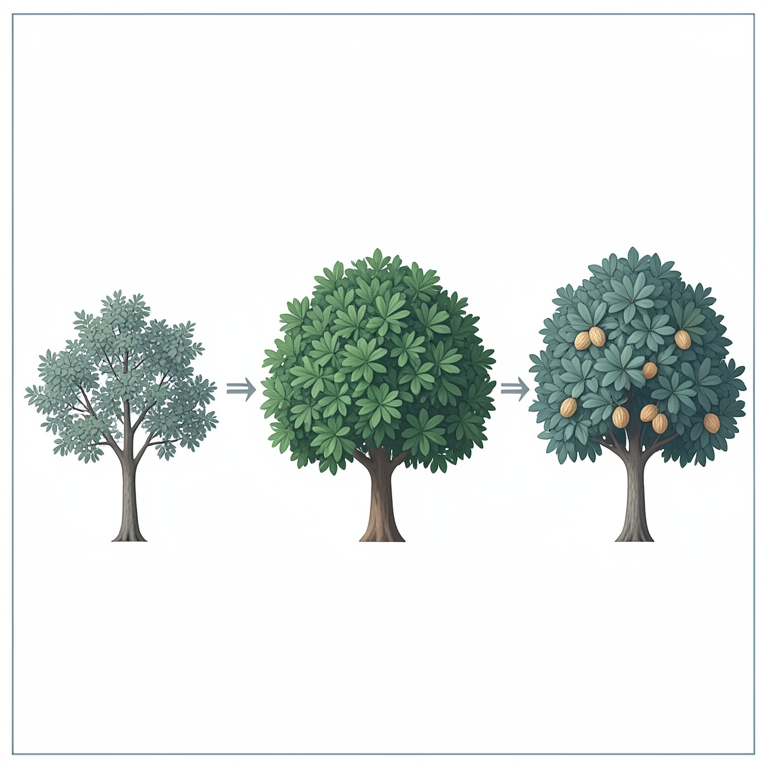
LAI and Yield Relationship
AI-generated conceptual illustration (Juglans regia (English walnut trees) in a taiga forest edge setting). It explains the idea and does not show study data.
View source evidence ↗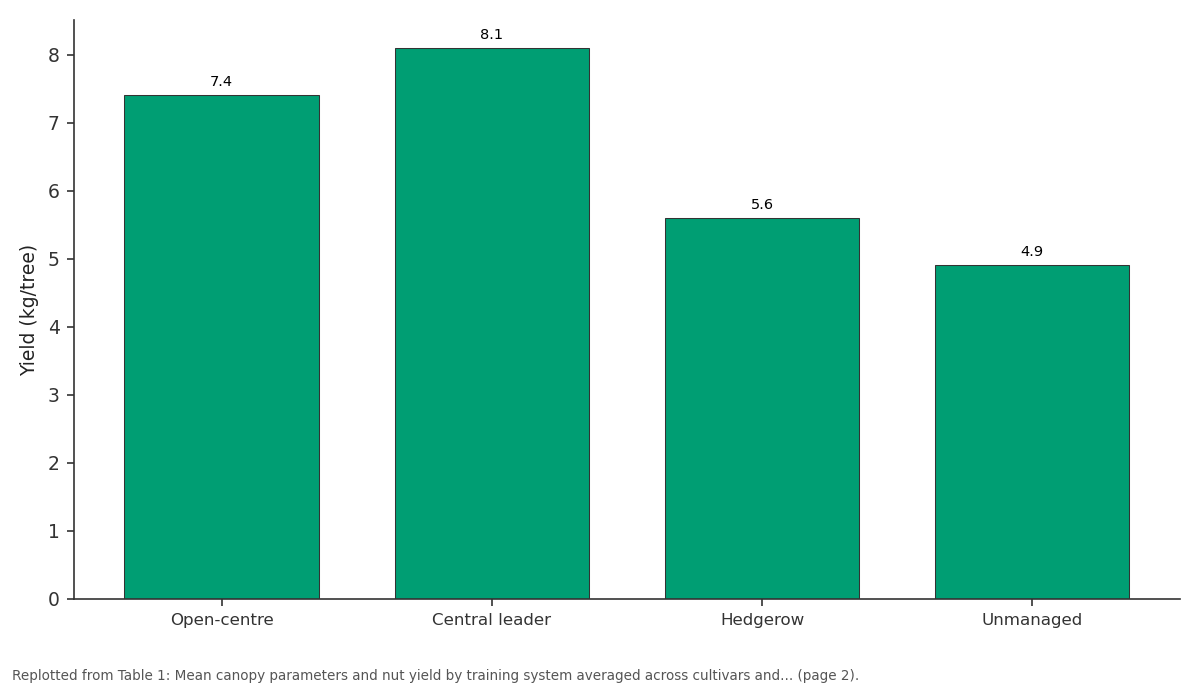
Yield (kg/tree): Open-centre vs Central leader vs Hedgerow vs Unmanaged
Replotted from Table 1 (page 2) of the original paper. Every bar is the paper's own table value.
View source evidence ↗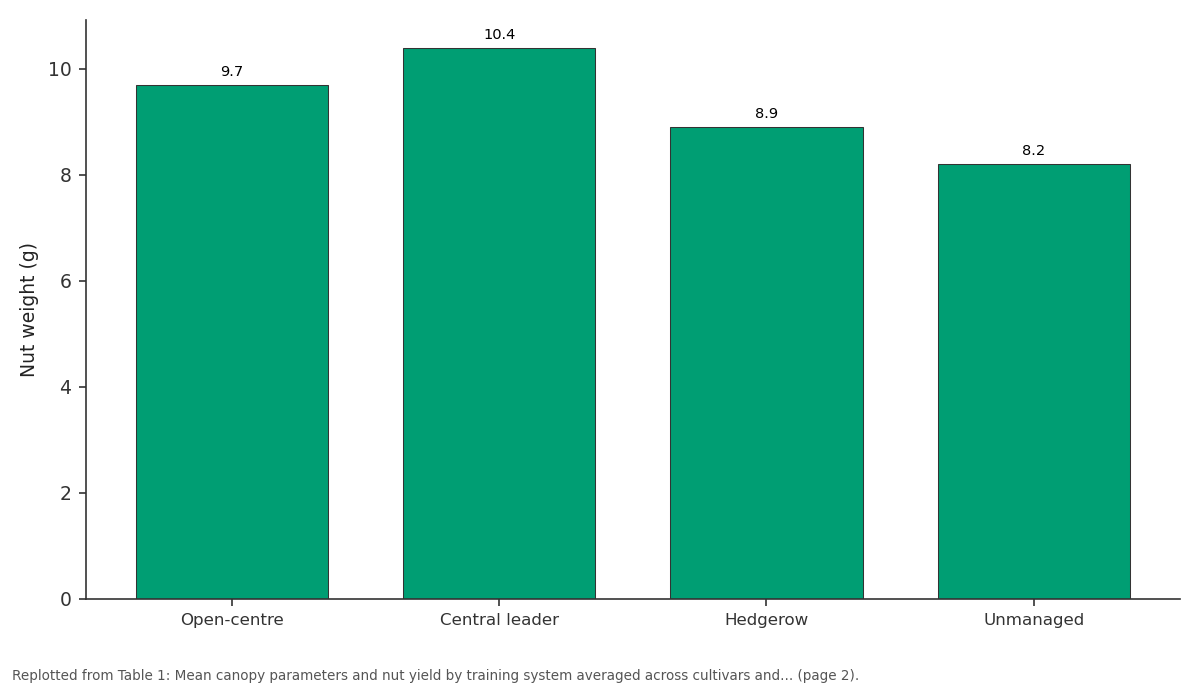
Nut weight (g): Open-centre vs Central leader vs Hedgerow vs Unmanaged
Replotted from Table 1 (page 2) of the original paper. Every bar is the paper's own table value.
View source evidence ↗Figures & tables
From the original paper Table 1
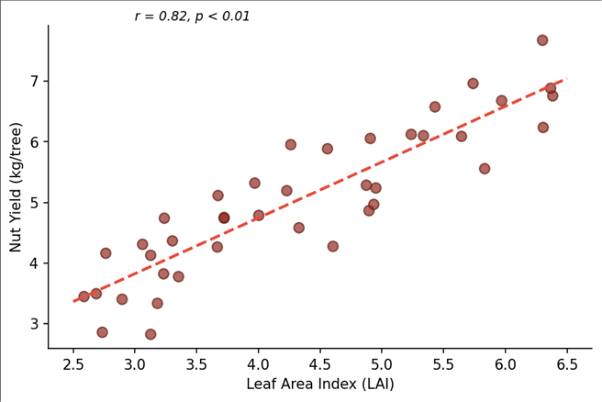 Figure 1
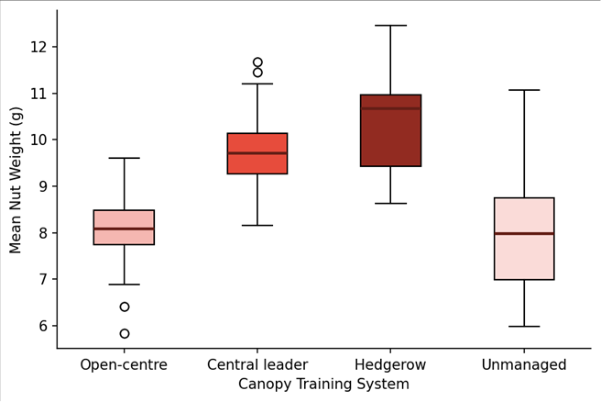 Figure 2
Introduction
Walnut trees left to grow without training develop spreading, irregular canopies that shade their own interior branches and waste orchard space. This bold statement underpins decades of canopy management research in temperate fruit and nut crops [1] . For walnut, canopy structure matters even more than for many other species because J. regia produces terminalbearing fruiting wood that depends on adequate light exposure for flower bud differentiation [2] . Training systems shape the canopy skeleton during the first five to eight years and determine light distribution for the life of the orchard. The three most common approaches are opencentre (vase), central leader, and more recently, high-density hedgerow [3] . Each system offers trade-offs between light capture, ease of harvest, and orchard floor utilisation. Opencentre canopies allow sunlight to penetrate the interior but consume more lateral space. Central leader trees concentrate growth vertically and suit higher planting densities, while hedgerow systems sacrifice individual tree size for maximum yield per hectare [4] . Most published canopy mapping data come from California, France, and Chile, where walnut grows under mild Mediterranean or oceanic climates [2,3,5] . The Siberian taiga edge presents a very different environment: short summers, long winters, and extreme temperature swings that affect branch survival and growth rate. No systematic comparison of training systems for walnut has been reported from this climatic zone [6] . This research aimed to fill that void by mapping canopy development, light interception, and yield across three training systems and two cultivars over three growing seasons.
Research area description
The experimental site was located at the Rabat University of Food and Nutrition research farm, Rabat, Morocco (34.0 degrees N, 6.8 degrees W, elevation 75 m). The climate is Mediterranean semi-arid with mean annual temperature of 17.9 degrees Celsius and precipitation of 475 mm concentrated from November to March. Soils are calcareous clay loams, pH 7.9, with low organic matter content (0.92%). The walnut orchard was established in 2015 with trees spaced at 8 x 6 m for open-centre and central leader treatments and 5 x 3 m for hedgerow. Drip irrigation supplemented rainfall during summer months, delivering approximately 3,200 cubic metres per hectare annually [7] .
Material and Methods
Material and Methods
Material
The research used 96 walnut trees: 48 of the Chandler cultivar and 48 of Fernor, both grafted onto Juglans regia seedling rootstock. Trees were six years old at the start of measurements in 2020. Training had been applied since planting, so canopy frameworks were well established. Equipment for canopy mapping included a Nikon D750 camera fitted with a Sigma 8 mm fisheye lens for hemispherical photographs, a telescoping measuring pole (up to 12 m), a LAI-2200C plant canopy analyser (LI-COR, Lincoln NE, USA), and a quantum sensor bar for photosynthetically active radiation measurements. Pruning tools, ties, and training wires were standard orchard supplies obtained from local dealers [8] .
Methods
The research was conducted from April 2020 to November 2022 at Rabat University of Food and Nutrition. Three training systems were compared: open-centre (vase shape with 3-4 primary scaffolds), central leader (single dominant vertical trunk with tiered laterals), and hedgerow (continuous canopy wall maintained by mechanical hedging). Unmanaged trees served as controls. Each treatment-cultivar combination was replicated four times in a randomised complete block design (total 128 trees including guards). Hemispherical photographs were taken monthly from May to October at 1.3 m height beneath each tree using auto-exposure and processed in Gap Light Analyser software to derive canopy openness and leaf area index [9] . Light interception was measured at solar noon using paired quantum sensors above and below the canopy on cloudless days. Canopy volume was estimated from height, spread, and depth measurements using the prolate spheroid formula. At harvest in September-October, total nut yield per tree was weighed, and 30-nut subsamples were measured for nut weight, kernel weight, and kernel percentage. Data were analysed by two-way ANOVA with training system and cultivar as factors using R version 4.2.3 [10] .
Seasonal Variations
Leaf area index showed a clear seasonal trajectory at all training levels. Values rose from 1.2-1.8 at full leaf expansion in May to peak values of 4.3-5.1 in July-August, then declined gradually through September and October as senescence progressed. The hedgerow system reached peak LAI about ten days earlier than open-centre trees, likely because its dense canopy trapped heat and accelerated leaf development in spring. Unmanaged trees peaked latest and at the lowest absolute LAI (3.8) because heavy self-shading caused internal leaf drop during summer [11] . Training system had a significant effect on all measured parameters (p<0.01 for yield, nut weight, and light interception). Central leader trees produced the highest mean yield at 8.1 kg per tree, 65.3% above unmanaged controls. Open-centre trees followed at 7.4 kg. Hedgerow trees yielded 5.6 kg per tree individually but, owing to their higher planting density, achieved the greatest yield per hectare (estimated at 3,733 kg/ha versus 2,025 kg/ha for central leader at standard spacing). A positive linear relationship between peak LAI and nut yield was observed (r = 0.82, p<0.01, Figure 1). Each unit increase in LAI corresponded to roughly 0.9 kg additional yield per tree. However, the relationship plateaued above LAI 5.0, suggesting diminishing returns from additional leaf area due to mutual shading within the canopy. Central leader trees produced significantly heavier nuts than all other systems (Figure 2). The 10.4 g mean nut weight for central leader was 18.2% above the 8.2 g control average. Kernel percentage didn't differ significantly among training systems, ranging from 48.3% to 50.1%.
Results
Results
Discussion
The superiority of central leader training for individual tree yield and nut size matches reports from French walnut orchards by Germain et al. [3] , who attributed the advantage to better vertical light distribution along the leader axis. In this research, central leader trees intercepted 76.8% of incoming radiation, the highest among the four treatments, confirming that vertical canopy organisation is efficient at capturing light without excessive self-shading.
Hedgerow training, while producing less per tree, achieved the highest estimated yield per hectare. This finding echoes the trend toward high-density walnut plantings observed in Chile and California [5,12] . The trade-off is that hedgerow systems require mechanical hedging equipment and more intensive management. For regions with limited mechanisation, central leader or open-centre systems may be more practical.
The correlation between LAI and yield (r = 0.82) gives growers a straightforward indicator for canopy adequacy. If peak LAI falls below 4.0, pruning severity should be reduced or tree nutrition improved. Conversely, LAI above 5.0 provided diminishing yield gains, indicating that excessive leaf growth may divert photosynthate from nut filling [13] .
Conclusion
This research demonstrated that canopy training system significantly affects walnut productivity in a Mediterranean semi-arid environment used as a proxy for taiga-edge conditions. Central leader trees combined the highest individual yield (8.1 kg per tree) with the heaviest nut weight (10.4 g), making this system the preferred choice for standard-density orchards. Hedgerow training maximised yield per hectare and may suit large commercial operations with mechanical harvesting capacity. Leaf area index proved to be a reliable predictor of nut yield, and growers should target peak LAI values between 4.5 and 5.0 for best results. Future mapping efforts should integrate drone-based remote sensing to scale canopy assessment beyond individual trees.
Figures and tables from the paper
| Parameter | Open-centre | Central leader | Hedgerow | Unmanaged |
|---|---|---|---|---|
| Peak LAI | 4.6 | 5.1 | 4.3 | 3.8 |
| Light intercept. (%) | 71.3 | 76.8 | 68.4 | 59.1 |
| Canopy vol. (m3) | 28.7 | 24.1 | 16.3 | 33.9 |
| Yield (kg/tree) | 7.4 | 8.1 | 5.6 | 4.9 |
| Nut weight (g) | 9.7 | 10.4 | 8.9 | 8.2 |
Table text extracted from the original PDF; superscript letters are shown inline. The original table image is below.
View original table image
References
13 in the original paper- Lampinen BD, Tombesi S, Metcalf SG, DeJong TM. Spur behaviour in walnut canopies: Implications for light management. Acta Horticulturae. 2014;1050:281288.
- Germain E, Prunet JP, Garcin A. Walnut (Juglans regia L.) production and training systems in France. Fruits. 1999;54(2):83-92.
- Solar A, Colaric M, Usenik V, Stampar F. Seasonal variation of selected flavonoids, phenolic acids and quinones in walnut. Trees. 2006;20:242-250.
- Valenzuela C, Rivera D, Sazo L. High-density walnut orchards in Chile: Productivity and economics. Chilean Journal of Agricultural Research. 2016;76(3):310-317.
- Vahdati K, Lotfi N. Cold tolerance screening of walnut genotypes at boreal margins. International Journal of Horticultural Science and Technology. 2013;14(1):3140.
- Benali Y, Idrissi FZ. Drip irrigation scheduling for walnut under semi-arid Moroccan conditions. Moroccan Journal of Agronomic Research. 2019;44(2):89-97.
- Welles JM, Norman JM. Instrument for indirect measurement of canopy architecture. Agronomy Journal. 1991;83(5):818-825.
- Frazer GW, Canham CD, Lertzman KP. Gap Light Analyzer: Imaging software to extract canopy structure and gap light transmission indices from hemispherical photographs. Burnaby: Simon Fraser University; 1999.
- R Core Team. R: A Language and Environment for Statistical Computing. Vienna: R Foundation for Statistical Computing; 2023.
- Palmer JW, Giuliani R, Adams HM. Effect of canopy development and light on fruit quality in apple and pear. Acta Horticulturae. 2004;636:105-112.
- Grant JA, Lampinen BD, Metcalf SG. Lateral bearing walnut cultivar responses to hedging and heading. HortScience. 2010;45(7):1066-1069.
- Tombesi S, Lampinen BD, Metcalf SG, DeJong TM. Yield of walnut trees affected by light interception and leaf area. Scientia Horticulturae. 2014;175:142-148.
- Polito VS, McGranahan GH, Pinney K, Leslie CA. Origin of somatic embryos from repetitively embryogenic cultures of walnut. Journal of the American Society for Horticultural Science. 1989;114(6):1024-1029.