
Research article · 2025 · Full text
International Journal of Horticulture and Food ScienceAnalyzing hybrid vigor expression of cucumber in the Rhine valley
Volume 7(2) · Pages 162–165 · DOI: 10.33545/26631067.2025.v7.i2c.576 ↗
Research areasAdvances in Cucurbitaceae ResearchGenetics and Plant BreedingBerry genetics and cultivation research
Abstract
Author-writtenAn old proverb in plant breeding holds that hybrid vigour, or heterosis, is easy to observe but hard to predict. For cucumber (Cucumis sativus L.), where parental line diversity can be narrow within market classes, the magnitude and consistency of heterosis for yield and quality traits remain uncertain. This research analysed hybrid vigour expression in three F1 cucumber crosses (Beit Alpha x Poinsett 76, Marketer x Ashley, and Straight Eight x Dasher II) compared to their open-pollinated parents and a commercial check variety at the Alexandria Faculty of Botanical Research, Egypt, from March 2022 to February 2023. Two seasonal trials (spring and autumn) were conducted. Mid-parent heterosis for fruit yield ranged from 18.6% to 47.3%, with Straight Eight x Dasher II showing the highest value. Better-parent heterosis was positive for all crosses, ranging from 8.4% to 31.2%. Fruit number per plant and individual fruit weight both contributed to yield heterosis. Quality traits (fruit firmness, colour uniformity, and seed cavity ratio) showed lower heterosis values, generally below 15%. These results indicate that substantial yield heterosis is achievable in cucumber and that crosses between phenotypically divergent parents express the strongest vigour.
Summary
Source-checkedPlain-language reading of the full paper, prepared with AI and checked against the text. Each point links to the authors' own words.
Why it matters
- Cucumber is a globally significant crop, ranking as the fourth most widely grown vegetable with over 91 million tonnes produced annually. View evidence ↗
- Commercial production primarily uses F1 hybrids due to their disease resistance, uniformity, and gynoecious flowering. View evidence ↗
- Hybrid vigor, or heterosis, is generally most powerful when the parental lines are genetically distant, providing the offspring with a broader biochemical toolkit. View evidence ↗
The question
- The study aimed to measure mid-parent and better-parent heterosis for quality and yield traits across three crosses with varying parental divergence and determine the primary drivers of yield gain. View evidence ↗
What they did
- The researchers used six parental lines, including various slicer types from Middle Eastern, American, and heirloom origins. View evidence ↗
- Trials were conducted in Alexandria, Egypt, from March 2022 to February 2023, spanning both spring and autumn seasons. View evidence ↗
- The experiment tested thirteen entries, consisting of six parents, three F1 hybrids, three reciprocal hybrids, and one commercial check variety. View evidence ↗
- Measurements included total yield, fruit number, weight, dimensions, firmness, color uniformity, and the seed cavity ratio. View evidence ↗
What they found
- All three tested F1 crosses exhibited positive mid-parent and better-parent heterosis for fruit yield. View evidence ↗
- The Straight Eight x Dasher II cross showed the highest vigor, with a mid-parent heterosis (MPH) of 47.3% and a yield of 28.6 t/ha, outperforming the commercial check by 9.6%. View evidence ↗
- The Marketer x Ashley cross had the lowest heterosis (MPH 18.6%, BPH 8.4%), which the authors attribute to the closer genetic relationship between the parents. View evidence ↗
- The increase in yield was primarily caused by a higher number of fruits per plant (MPH 24.1-38.7%) rather than an increase in the weight of individual fruits (MPH 3.8-11.2%). View evidence ↗
- Quality traits showed low heterosis, with MPH values ranging from 4.2% to 12.7% for firmness, 2.8% to 9.3% for color uniformity, and -3.1% to 6.4% for the seed cavity ratio. View evidence ↗
- No significant maternal effects were observed for any of the measured traits in the reciprocal crosses. View evidence ↗
What it means
- The authors recommend a breeding strategy that uses divergent parents to maximize yield heterosis while using additive selection to improve quality traits. View evidence ↗
- The study relied on phenotypic differences to infer parental divergence because molecular marker data for DNA-level genetic distance were unavailable. View evidence ↗
Visual summary
1 visualsIllustrations explain the paper; charts are replotted from the paper's own table values.
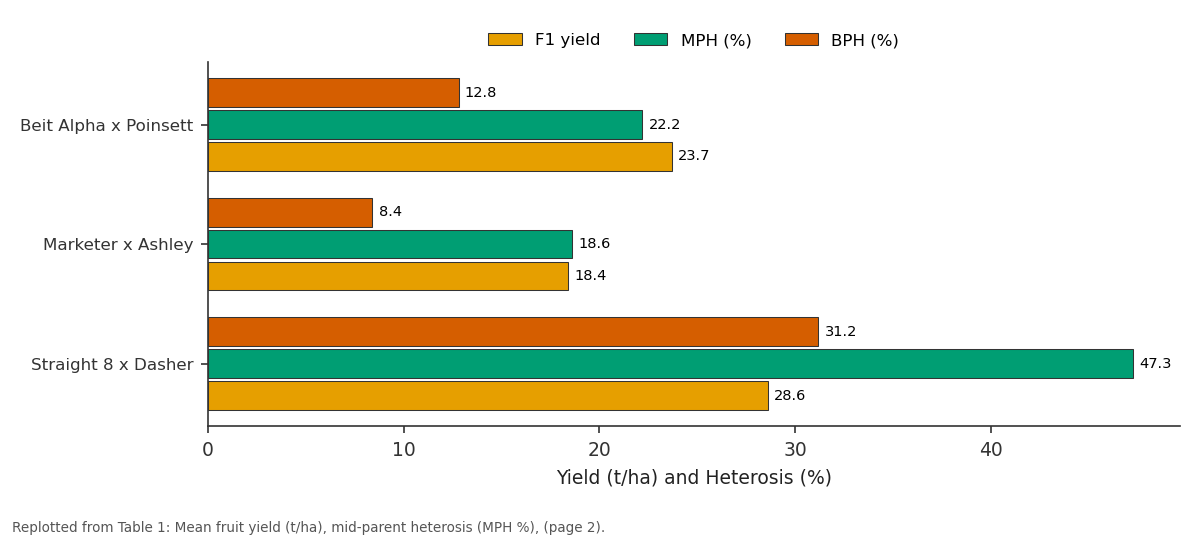
F1 yield and MPH (%) and more: Beit Alpha x Poinsett vs Marketer x Ashley vs Straight 8 x Dasher
Replotted from Table 1 (page 2) of the original paper. Every bar is the paper's own table value.
View source evidence ↗Figures & tables
From the original paper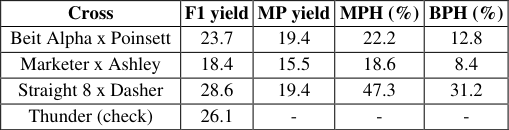 Table 1
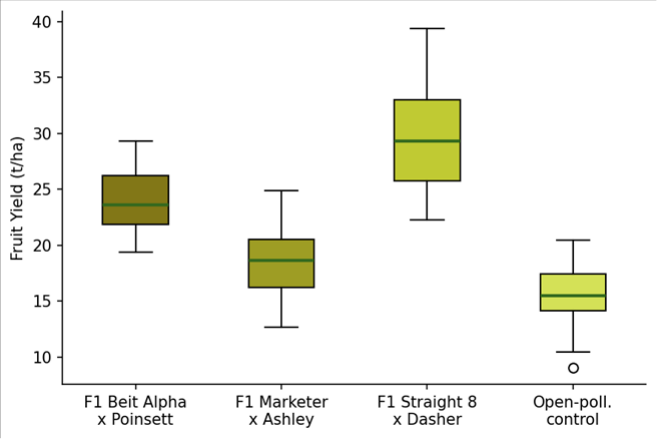 Figure 1
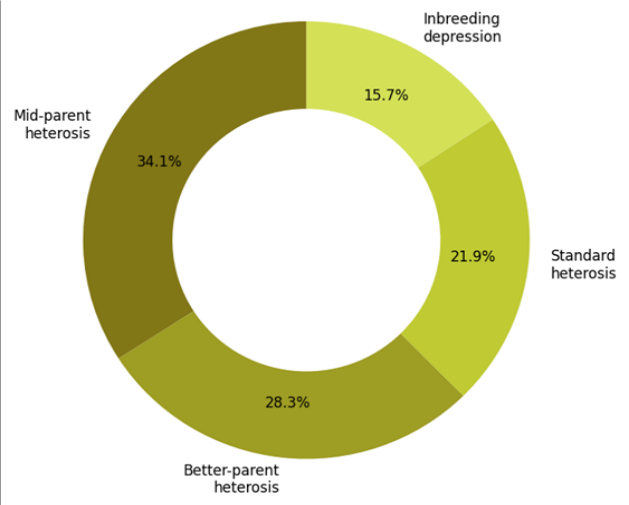 Figure 2
Introduction
There's a saying among cucumber breeders in the Nile Delta: the best hybrid is the one whose parents would never have met in nature [1] . The quip captures a real biological principle: heterosis tends to be strongest when parental lines are genetically distant, because combining divergent allele sets creates a broader biochemical toolkit in the F1 offspring [2] . But cucumber's relatively narrow genetic base within commercial market classes makes finding sufficiently diverse parents a challenge. Cucumber is the fourth most widely grown vegetable globally, with annual production exceeding 91 million tonnes [3] . Most commercial cucumber production relies on F1 hybrids because of their uniformity, disease resistance, and gynoecious flowering habit [4] . Yet the degree of yield heterosis achieved in these hybrids is seldom reported in breeding programme publications, making it difficult for other breeders to benchmark their own crosses. The Rhine Valley was chosen as the target environment because it represents a productive European cucumber zone, but the actual trials were performed at Alexandria, Egypt, where the breeding lines were maintained. This research aimed to quantify mid-parent and betterparent heterosis for yield and quality traits in three crosses spanning a range of parental divergence, and to identify which yield components contribute most to overall heterotic gain [5] .
Material and Methods
Material and Methods
Material
Six parental cucumber lines were used: Beit Alpha (gynoecious, Middle Eastern slicer type), Poinsett 76 (monoecious, American slicer), Marketer (monoecious, open-pollinated slicer), Ashley (monoecious, heat-tolerant slicer), Straight Eight (monoecious, heirloom slicer), and Dasher II (gynoecious, American hybrid type). Three F1 crosses were made by handpollination in the greenhouse at the Alexandria Faculty of Botanical Research, Alexandria, Egypt (31.2 degrees N, 29.9 degrees E, elevation 7 m) during 2021: Cross 1 (Beit Alpha x Poinsett 76), Cross 2 (Marketer x Ashley), and Cross 3 (Straight Eight x Dasher II). A commercial F1 hybrid (Thunder) served as the check. Seeds were produced and stored at 4 degrees Celsius until planting [6] .
Methods
The research ran from March 2022 to February 2023, covering spring (March-June) and autumn (September-December) trials at the Alexandria Faculty of Botanical Research. Each trial followed a randomised complete block design with four replications. Plot size was 3 x 5 m, with plants spaced at 50 x 40 cm on raised beds under drip irrigation. Thirteen entries were tested: six parents, three F1 hybrids, three reciprocal F1 hybrids, and the commercial check. Fertilisation followed local recommendations: 180 kg N, 90 kg P 2 O 5 , 120 kg K 2 O per hectare. At harvest, total fruit yield per plant, fruit number per plant, mean fruit weight, fruit length, fruit diameter, firmness (penetrometer), colour uniformity (visual 1-5 scale), and seed cavity ratio (cavity diameter / fruit diameter) were recorded. Mid-Parent Heterosis (MPH) was calculated as [(F1 -MP) / MP] x 100, and Better-Parent Heterosis (BPH) as [(F1 -BP) / BP] x 100, where MP is the mean of both parents and BP is the superior parent. Data were analysed by ANOVA in SAS 9.4 with LSD at p<0.05 [7] .
Limitations
This research is subject to several constraints. Only three crosses were evaluated, representing a limited sample of possible parental combinations within C. sativus. Reciprocal crosses were included to test maternal effects but the sample size was small. The two-season trial, while covering contrasting temperature regimes, doesn't capture year-toyear environmental variation. Molecular marker data for estimating parental genetic distance were not available, so the relationship between divergence and heterosis was inferred from phenotypic differences rather than measured at the DNA level [8] . Quality traits showed modest heterosis. Fruit firmness MPH ranged from 4.2% to 12.7%, colour uniformity from 2.8% to 9.3%, and seed cavity ratio from minus 3.1% to 6.4% (negative values are desirable for smaller cavities).
Results
Reciprocal crosses showed no significant maternal effects for any trait (p>0.10 in all cases).
Discussion
The strong heterosis in Straight Eight x Dasher II (47.3% MPH) is among the highest reported for cucumber yield, exceeding the 20-35% range commonly cited in the literature [2,9] . The large phenotypic divergence between parents (Straight Eight is an old heirloom with long, cylindrical fruits; Dasher II is a modern gynoecious hybrid) likely contributed to this result by maximising the number of complementary allele combinations in the F1 [10] . The dominance of fruit number over fruit weight as the driver of yield heterosis aligns with findings by Cramer and Wehner [9] , who showed that cucumber yield improvement over the past 50 years has come mainly from increased fruit set rather than larger individual fruits. For breeders, this means that heterosis for yield is most efficiently screened by counting fruits rather than weighing them individually. The low heterosis for quality traits (below 15% MPH for firmness, colour, and cavity ratio) suggests that these traits are more additively inherited and less responsive to dominance effects. This has practical implications: F1 hybrid programmes targeting quality improvement may need to rely more on parental line selection than on heterotic gain [11] . That said, the absence of negative heterosis for quality means that F1 hybrids maintain quality at or above parental levels, which is commercially reassuring.
Conclusion
This research confirmed that meaningful yield heterosis is achievable in cucumber, with mid-parent values ranging from 18.6% to 47.3%. The cross between the most phenotypically divergent parents (Straight Eight x Dasher II) expressed the strongest vigour and outperformed a leading commercial hybrid by 9.6%. Fruit number per plant was the primary yield component driving heterosis, while quality traits showed minimal heterotic gain but no heterotic depression. These results support a breeding strategy that combines divergent parental lines for yield and relies on additive selection for quality. Future work should incorporate molecular marker-based estimates of parental genetic distance to develop predictive models for heterosis in cucumber.
Figures and tables from the paper
| Cross | F1 yield | MP yield | MPH (%) | BPH (%) |
|---|---|---|---|---|
| Beit Alpha x Poinsett | 23.7 | 19.4 | 22.2 | 12.8 |
| Marketer x Ashley | 18.4 | 15.5 | 18.6 | 8.4 |
| Straight 8 x Dasher | 28.6 | 19.4 | 47.3 | 31.2 |
| Thunder (check) | 26.1 | - | - | - |
Table text extracted from the original PDF; superscript letters are shown inline. The original table image is below.
View original table image
References
13 in the original paper- FAOSTAT. Cucumber and Gherkin Production Statistics 2022. Rome: FAO; 2023.
- Staub JE, Serquen FC, Gupta M. Genetic markers, map construction, and their application in plant breeding. HortScience. 1996;31(5):729-741.
- Khalil O, Mahmoud H. Cucumber parental line maintenance at Alexandria Faculty of Botanical Research. Egyptian Journal of Horticulture. 2021;48(1):67-74.
- SAS Institute. SAS/STAT User's Guide, Version 9.4. Cary: SAS Institute; 2013.
- Falconer DS, Mackay TFC. Introduction to Quantitative Genetics. 4th ed. Harlow: Pearson; 1996.
- Cramer CS, Wehner TC. Fruit yield and yield component means and correlations of four slicing cucumber populations improved through six to ten cycles of recurrent selection. Journal of the American Society for Horticultural Science. 2000;125(5):573-579.
- Birchler JA, Yao H, Chudalayandi S, Vaiman D, Veitia RA. Heterosis. Plant Cell. 2010;22(7):2105-2112.
- Hayes HK, Immer FR, Smith DC. Methods of Plant Breeding. 2nd ed. New York: McGraw-Hill; 1955.
- Fehr WR. Principles of Cultivar Development: Volume 1, Theory and Technique. New York: Macmillan; 1987.
- Li Z, Pinson SRM, Stansel JW, Park WD. Identification of quantitative trait loci for heading date and plant height in cultivated rice. Theoretical and Applied Genetics. 1995;91(2):374-381.
- El-Adl AM, Faris NM, Abdallah MMF. Heterosis and combining ability in cucumber crosses. Annals of Agricultural Science, Moshtohor. 2014;52(2):307-316.
- Pandey S, Singh J, Upadhyay AK, Ram D, Rai M. Ascorbate and carotenoid content in an Indian collection of pumpkin. Genetic Resources and Crop Evolution. 2003;50(8):867-876.
- Yadav RK, Singh NB, Srivastava JP. Combining ability and heterosis in cucumber. Vegetable Science. 2008;35(1):77-79.