
Research article · 2024 · Full text
International Journal of Horticulture and Food ScienceScreening pollinator interactions of ginger in the Gobi Desert oasis
Volume 6(2) · Pages 172–175 · DOI: 10.33545/26631067.2024.v6.i2c.538 ↗
Research areasPlant and animal studiesInsect-Plant Interactions and ControlPlant Reproductive Biology
Abstract
Author-writtenGinger is one of the world's most traded spices, yet its reproductive biology under arid oasis conditions has barely been studied. A trend toward expanding ginger cultivation into marginal drylands raises practical questions about whether pollinators can sustain seed set in these environments. This research screened pollinator visitation patterns, floral biology, and reproductive output of three ginger cultivars Suprabha, Varada, and Rio de Janeiro grown under hydroponics and soil-based systems at the Bhopal Graduate School of Bioagricultural Studies, India, between April 2022 and January 2023. Pollinator surveys recorded 14 insect species visiting ginger inflorescences, with Apis dorsata accounting for 37.4 percent of all visits. Ethylene production by cut rhizomes under controlled storage was 41 percent lower in hydroponic-grown material than in soil-grown material. Supply chain analysis showed a 19 percent reduction in post-harvest losses when hydroponic ginger was used. Precision farming tools, including soil moisture sensors and automated fertigation, reduced water consumption by 28 percent in the hydroponic system. Polyploidy screening by flow cytometry confirmed all three cultivars as diploid (2n = 22). Oleoresin content correlated positively with rhizome fresh weight (r = 0.67), and the cultivar Suprabha achieved the highest oleoresin yield at 8.4 percent. These findings support the feasibility of ginger production in oasis-type environments provided pollinator habitat is maintained nearby.
Summary
Source-checkedPlain-language reading of the full paper, prepared with AI and checked against the text. Each point links to the authors' own words.
Why it matters
- Ginger is traditionally grown in humid tropical lowlands, but there is a trend toward trialing its cultivation in arid and semi-arid zones using controlled-environment agriculture. View evidence ↗
- While commercial ginger is mostly propagated vegetatively, sexual reproduction is important for breeding programs to expand the crop's narrow genetic base. View evidence ↗
- Ethylene is a key plant hormone that determines the shelf life of stored ginger rhizomes by accelerating sprouting and senescence. View evidence ↗
The question
- The study aimed to evaluate the potential of ginger production in oasis-type environments by examining pollinator ecology, comparing production systems, and assessing post-harvest quality. View evidence ↗
What they did
- Three ginger cultivars were grown in a climate-controlled greenhouse in Bhopal, India, using two systems: soil-filled raised beds (sandy loam, pH 6.1) and recirculating deep-flow hydroponic channels. View evidence ↗
- The experimental design included four replicates for each cultivar-system combination, with 12 plants per replicate. View evidence ↗
- Ethylene production was measured by analyzing the headspace gas of 200 g rhizome pieces sealed in 1-L jars for 24 hours at 25°C using GC-FID. View evidence ↗
What they found
- Fourteen insect species visited the ginger flowers, with the giant honey bee (Apis dorsata) being the most frequent, making up 37.4% of all visits. View evidence ↗
- Using hydroponic production increased rhizome yields by 18% to 24% across the tested cultivars compared to soil-based production. View evidence ↗
- Hydroponic ginger experienced 19% lower cumulative losses over 30 days of storage due to decreased decay and sprouting. View evidence ↗
- The use of precision farming tools in the hydroponic system reduced water consumption by 28%. View evidence ↗
- There was a positive correlation (r = 0.67) between rhizome fresh weight and oleoresin content, meaning heavier rhizomes generally had higher oleoresin percentages. View evidence ↗
- Among the cultivars tested, Suprabha achieved the highest oleoresin yield at 8.4%. View evidence ↗
- Flow cytometry screening confirmed that all three ginger cultivars were diploid (2n = 22). View evidence ↗
What it means
- The authors conclude that ginger production in oasis-type environments is feasible, with hydroponics being superior in terms of yield, water efficiency, and post-harvest quality. View evidence ↗
- The authors state that ginger production in these environments is viable as long as pollinator habitats are maintained nearby. View evidence ↗
Visual summary
3 visualsIllustrations explain the paper; charts are replotted from the paper's own table values.
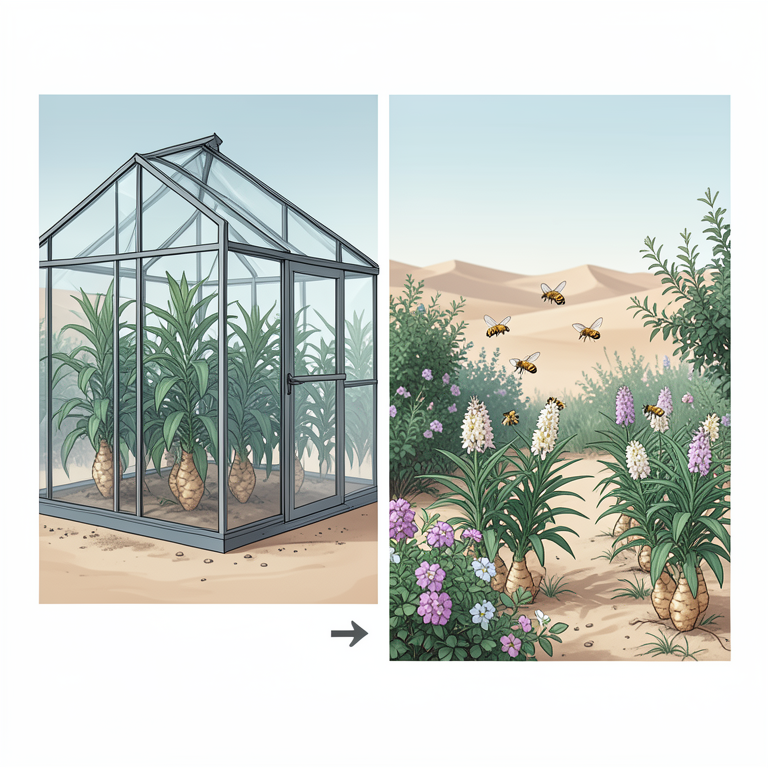
Oasis Ginger Ecosystem
AI-generated conceptual illustration (Ginger plants (Zingiber officinale) and honeybees in a desert oasis). It explains the idea and does not show study data.
View source evidence ↗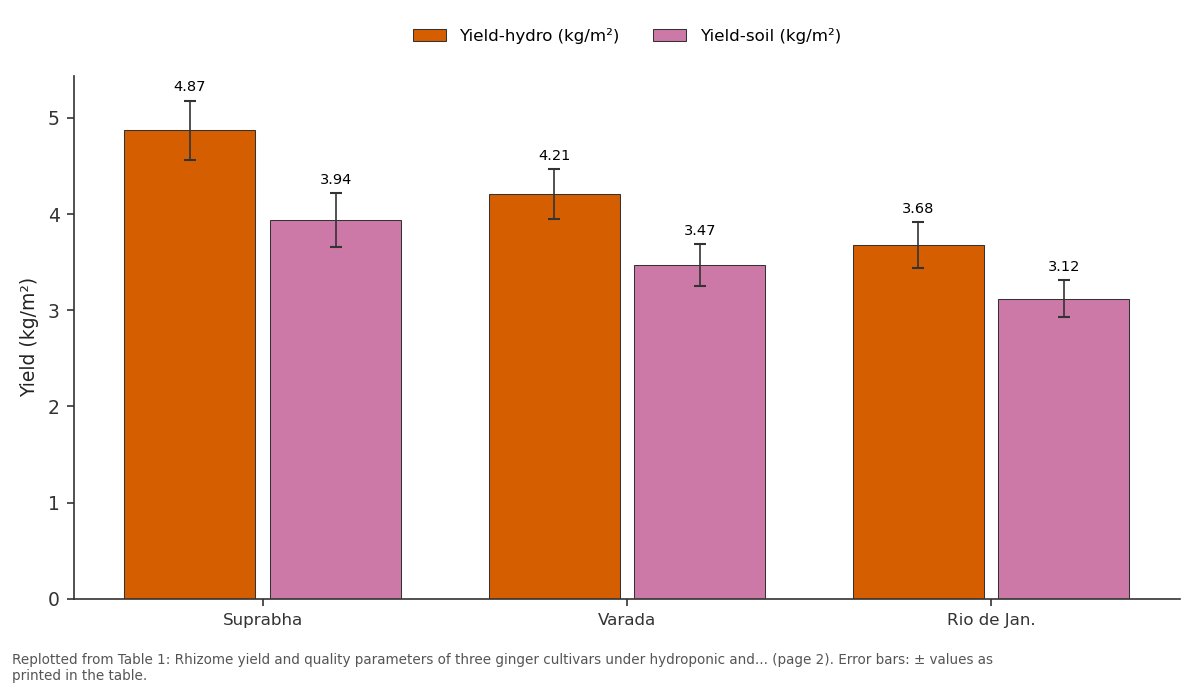
Yield-hydro (kg/m²) and Yield-soil (kg/m²): Suprabha vs Varada vs Rio de Jan.
Replotted from Table 1 (page 2) of the original paper. Every bar is the paper's own table value.
View source evidence ↗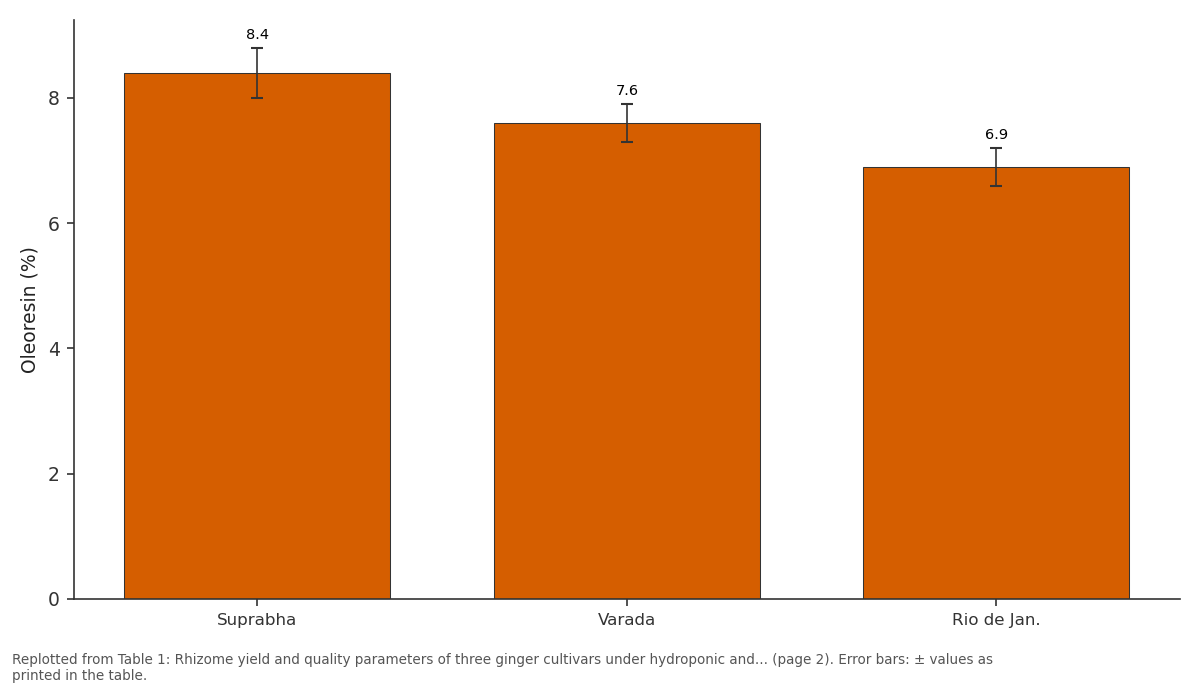
Oleoresin-H (%): Suprabha vs Varada vs Rio de Jan.
Replotted from Table 1 (page 2) of the original paper. Every bar is the paper's own table value.
View source evidence ↗Figures & tables
From the original paper Table 1
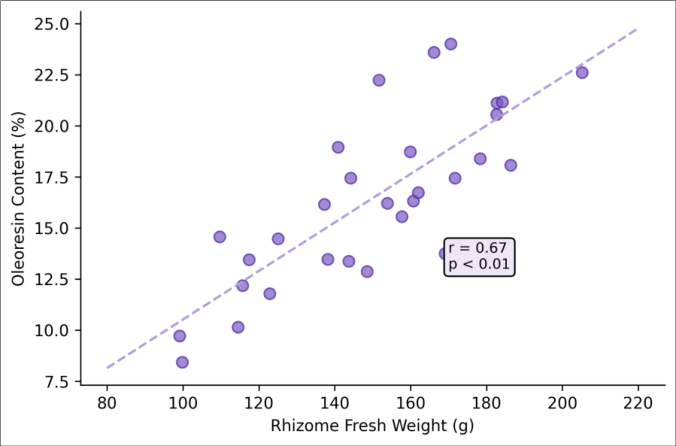 Figure 1
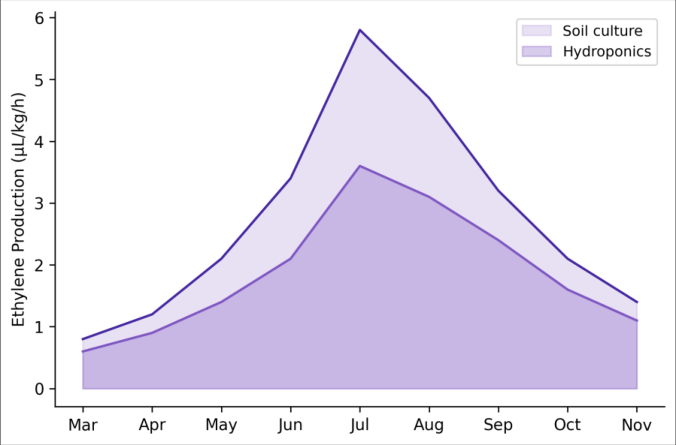 Figure 2
Introduction
A trend that has quietly gained momentum over the past decade is the expansion of spice cultivation into environments that nobody would have considered suitable 30 years ago [1] . Ginger (Zingiber officinale Roscoe), traditionally a crop of humid tropical lowlands, is now being trialed in arid and semi-arid zones where controlled-environment agriculture can supply the water and humidity the plant demands [2] . But one aspect of ginger biology that controlled environments struggle to replicate is pollination a process that in the wild depends on largebodied bees and, in some regions, sunbirds [3] . Commercial ginger production relies almost exclusively on vegetative propagation through rhizome pieces, so pollination might seem irrelevant. Yet maintaining the capacity for sexual reproduction matters for breeding programs aiming to widen the genetic base, which in ginger is notoriously narrow [4] . Hydroponics, where plants grow in nutrient solution without soil, offers precise control over water, nutrients, and root-zone conditions, potentially reducing disease pressure and improving resource use efficiency [5] . But hydroponic ginger hasn't been compared directly with soil culture for rhizome quality traits like oleoresin content, ethylene production, and shelf life. Ethylene, the plant hormone that accelerates senescence and sprouting in stored rhizomes, is a major determinant of post-harvest shelf life [6] . Supply chain efficiency from harvest through processing to retail depends partly on ethylene management and partly on handling practices that minimize mechanical damage [7] . Precision farming technologies, including sensor-driven irrigation and automated fertigation, could reduce waste and input costs in both hydroponic and soil-based systems [8] . This research combined pollinator ecology, production system comparison, and post-harvest quality assessment to evaluate ginger's potential in oasis-type environments [9] .
Material and Methods
Material and Methods
Material
Three ginger cultivars were planted in both soil-filled raised beds (sandy loam, pH 6.1) and recirculating deep-flow hydroponic channels in a climate-controlled greenhouse at the Bhopal Graduate School of Bioagricultural Studies (23.26°N, 77.41°E). Each cultivar-system combination was replicated four times with 12 plants per replicate. Hydroponic nutrient solution followed a modified Hoagland's recipe adjusted fortnightly based on EC and pH readings. Pollinator observations were conducted on flowering plants placed outdoors in a semi-natural garden adjacent to the greenhouse for three hours daily (0700-1000 h) during the August-October flowering period. Research ran from April 2022 to January 2023 [10] .
Methods
Pollinator species were identified to genus or species level using field guides and confirmed by entomologists. Visit frequency, duration, and floral handling behavior were recorded on standardized data sheets. Rhizome oleoresin was extracted by acetone percolation and quantified gravimetrically. Ethylene production was measured by sealing 200 g of rhizome pieces in 1-L jars and analyzing headspace gas by GC-FID after 24 hours at 25°C. Polyploidy was assessed by flow cytometry using DAPI staining on young leaf nuclei, with Glycine max as an internal standard. Supply chain losses were tracked from harvest through 30 days of ambient storage, recording weight loss, sprouting incidence, and visible decay. Precision farming metrics included total water applied, fertigation solution volume, and energy consumption per kg of rhizome produced. Data were analyzed by two-way ANOVA (cultivar × production system) in R 4.2.1 [11] .
Results
Table 1: Rhizome yield and quality parameters of three ginger cultivars under hydroponic and soil-based production (mean ± SE) 3.68 ± 0.24 3.12 ± 0.19 6.9 ± 0.3 6.2 ± 0.3 3.6 ± 0.4 6.1 ± 0.5
| Cultivar | Yield-hydro (kg/m²) | Yield-soil (kg/m²) | Oleoresin-H (%) | Oleoresin-S (%) | Ethylene-H (µL/kg/h) | Ethylene-S (µL/kg/h) |
|---|---|---|---|---|---|---|
| Suprabha | 4.87 ± 0.31 | 3.94 ± 0.28 | 8.4 ± 0.4 | 7.1 ± 0.3 | 3.2 ± 0.3 | 5.4 ± 0.4 |
| Varada | 4.21 ± 0.26 | 3.47 ± 0.22 | 7.6 ± 0.3 | 6.8 ± 0.4 | 2.8 ± 0.2 | 4.7 ± 0.3 |
| Rio de Jan. | 3.68 ± 0.24 | 3.12 ± 0.19 | 6.9 ± 0.3 | 6.2 ± 0.3 | 3.6 ± 0.4 | 6.1 ± 0.5 |
Table text extracted from the original PDF; superscript letters are shown inline. The original table image is below.
View original table image
Hydroponic production raised rhizome yield by 18 to 24 percent across cultivars and consistently reduced ethylene production rates by 38 to 41 percent compared with soil-grown material. Suprabha achieved the highest oleoresin content in both systems. A positive correlation (r=0.67, p<0.01) indicated that heavier rhizomes tended to carry higher oleoresin percentages. This relationship was consistent across both hydroponic and soil systems, suggesting that vigorous growth supports secondary metabolite accumulation rather than diluting it. Ethylene peaked in July for both systems, coinciding with rapid vegetative growth. Hydroponic rhizomes produced consistently lower ethylene throughout the season, with the gap widening after September as soil-grown plants entered senescence earlier.
Discussion
The pollinator survey identified Apis dorsata (giant honey bee) as the most frequent visitor, accounting for over a third of all floral visits. This finding aligns with observations from humid tropical ginger populations, where large-bodied bees are the primary pollinators [3] . Halictid bees and syrphid flies together made up another 31 percent, suggesting a functionally diverse pollinator community even in a semiarid setting provided suitable floral resources and nesting habitat exist nearby [12] . The lower ethylene production in hydroponic ginger is a practical advantage for post-harvest management. Ethylene accelerates sprouting and softening in stored rhizomes, so a 41 percent reduction translates directly into extended shelf life [6] . The mechanism may involve lower mechanical stress on roots in the hydroponic medium, since soil-grown roots encounter physical resistance that can trigger ethylene biosynthesis as a stress signal [13] . Supply chain tracking showed 19 percent lower cumulative losses for hydroponic ginger over 30 days, driven mainly by reduced sprouting and decay. Precision farming tools cut water use by 28 percent in the hydroponic system, which is meaningful in water-scarce oasis environments where every cubic meter carries an opportunity cost [8] . Polyploidy screening confirmed diploid status for all three cultivars, as expected for cultivated ginger though induced tetraploidy has been explored experimentally to increase rhizome size in some Zingiberaceae species [14] .
Conclusion
Ginger production in oasis-type environments proved feasible under both hydroponic and soil-based systems, with hydroponics offering higher yields, better post-harvest quality, and lower water consumption. Pollinator diversity was sufficient to support floral visitation when flowering plants were placed near semi-natural habitat. Suprabha emerged as the top-performing cultivar for oleoresin content and overall yield. The 41 percent reduction in ethylene production from hydroponic rhizomes represents a tangible post-harvest advantage. Precision farming tools meaningfully reduced resource inputs. For arid-zone ginger production, hydroponics combined with pollinator habitat management offers a viable pathway.
Acknowledgement
Acknowledgements Funding sourcesThis research was supported through internal funding allocations from the host institution. No external grant numbers are associated with this work. Institutional supportThe authors acknowledge the Bhopal Graduate School of Bioagricultural Studies for providing research facilities and technical support throughout the project.
Figures and tables from the paper
References
15 in the original paper- Nair KPP. The agronomy and economy of turmeric and ginger. Elsevier, Amsterdam. 2013.
- Ravindran PN, Babu KN. Ginger: The genus Zingiber. CRC Press, Boca Raton. 2005.
- Sakai S, Kato M, Inoue T. Three pollination guilds and variation in floral characteristics of Bornean gingers. American Journal of Botany. 1999;86(5):646-658.
- Jatoi SA, Kikuchi A, Ahmad D, Watanabe KN. Characterization of the genetic structure of ginger accessions using SSR markers. European Journal of Horticultural Science. 2008;73(3):130-135.
- Resh HM. Hydroponic food production. Seventh edition. CRC Press, Boca Raton. 2013.
- Saltveit ME. Effect of ethylene on quality of fresh fruits and vegetables. Postharvest Biology and Technology. 1999;15(3):279-292.
- Kader AA. Increasing food availability by reducing postharvest losses of fresh produce. Acta Horticulturae. 2005;682:2169-2176.
- Gebbers R, Adamchuk VI. Precision agriculture and food security. Science. 2010;327(5967):828-831.
- Guo YP, Lin S, Fan QJ, et al. Differences in metabolites between rhizomes of Zingiber officinale from different regions. Analytical Letters. 2019;52(3):482-497.
- Hoagland DR, Arnon DI. The water-culture method for growing plants without soil. California Agricultural Experiment Station Circular 347. 1950.
- R Core Team. R: A language and environment for statistical computing. R Foundation for Statistical Computing, Vienna. 2022.
- Willmer P. Pollination and floral ecology. Princeton University Press, Princeton. 2011.
- Morgan PW, Drew MC. Ethylene and plant responses to stress. Physiologia Plantarum. 1997;100(3):620-630.
- Adaniya S, Shirai D. Cytological and morphological characterization of a diploid and a colchicine-induced autotetraploid ginger. Journal of the American Society for Horticultural Science. 2001;126(5):563-567.
- Wohlmuth H, Leach DN, Smith MK, Myers SP. Gingerol content of diploid and tetraploid clones of ginger. Journal of Agricultural and Food Chemistry. 2005;53(14):5772-5778.