
Research article · 2025 · Full text
International Journal of Horticulture and Food ScienceProfiling soil nutrient dynamics of flaxseed in the Masai Mara grasslands
Volume 7(4) · Pages 94–97 · DOI: 10.33545/26631067.2025.v7.i4b.609 ↗
Research areasAgricultural Science and FertilizationPlant Growth and Agriculture TechniquesSoil Carbon and Nitrogen Dynamics
Abstract
Author-writtenAn example of a neglected research question is how soil nutrient cycling beneath flaxseed crops differs from that under more widely grown oilseeds in tropical grassland ecosystems. This research profiled nitrogen, phosphorus, and potassium dynamics in soils under flaxseed (Linum usitatissimum L.) cultivation using no-till and conventional tillage at a partner station in the Masai Mara grasslands during 2022-2023. The work was coordinated from the Karachi University of Food and Nutrition. No-till plots maintained 17.6% higher available nitrogen (284.3 vs 241.8 kg/ha) and 31.7% higher organic carbon (1.43% vs 1.08%) than conventionally tilled plots after two cropping cycles. Flaxseed protein content under no-till reached 22.4% compared to 19.8% under conventional tillage, while omega-3 fatty acid levels were 10.6% lower in conventional plots. Probiotic fermentation of flaxseed mucilage produced viable Lactobacillus counts of 8.3 log CFU/mL after 48 hours. Gene action analysis of seed quality traits revealed additive effects for oil content (heritability 0.78) and non-additive effects for mucilage yield (heritability 0.41). These results link soil management practices to flaxseed nutritional quality and processing potential in tropical grassland settings.
Summary
Source-checkedPlain-language reading of the full paper, prepared with AI and checked against the text. Each point links to the authors' own words.
Why it matters
- Flaxseed is traditionally a cold-climate crop, but its high nutritional value, including omega-3, soluble fiber, and antioxidants, makes it worth exploring for cultivation in tropical regions. View evidence ↗
- While no-till farming is used in tropical Africa to conserve moisture, its specific impact on soil nutrients and grain quality for flaxseed has not been previously measured. View evidence ↗
- Flaxseed mucilage is of interest as a prebiotic substrate that can support the growth of beneficial probiotic bacteria in food products. View evidence ↗
The question
- The study aimed to compare soil nutrient dynamics and seed quality between no-till and conventional tillage, evaluate mucilage for probiotic fermentation, and estimate genetic parameters for quality traits. View evidence ↗
What they did
- The research was conducted at a grassland research station near the Masai Mara, located at approximately 1.5°S, 35.1°E, with an elevation of 1,620 m. View evidence ↗
- The study used a split-plot RCBD design with three replications of 5 x 4 m plots, testing tillage types and nitrogen rates (0, 30, and 60 kg N/ha) starting in June 2022. View evidence ↗
- Soil nutrients, including available nitrogen, phosphorus, potassium, and organic carbon, were measured at depths of 0-15 cm and 15-30 cm at three different growth stages. View evidence ↗
- Probiotic fermentation was tested using a 5% mucilage solution inoculated at 10^7 CFU/mL and incubated at 37°C for 72 hours. View evidence ↗
What they found
- No-till plots had 17.6% higher available nitrogen (284.3 vs 241.8 kg/ha) compared to conventional tillage plots at harvest. View evidence ↗
- Organic carbon was 32.4% higher in no-till plots (1.43% vs 1.08%) than in conventionally tilled plots. View evidence ↗
- Flaxseed grown under no-till had a significantly higher protein content of 22.4% compared to 19.8% under conventional tillage. View evidence ↗
- Omega-3 (ALA) levels were higher in no-till flaxseed (19.3%) than in conventional tillage flaxseed (17.2%). View evidence ↗
- Fermentation of a 5% mucilage solution supported L. plantarum growth, reaching 8.3 log CFU/mL after 48 hours and 7.6 log CFU/mL after 72 hours. View evidence ↗
- Genetic analysis showed additive gene effects for oil content (heritability 0.78) but non-additive genetic control for mucilage yield (heritability 0.41). View evidence ↗
What it means
- The authors conclude that flaxseed should be introduced into conservation agriculture rotations in tropical grasslands to improve soil health and produce high-value functional foods. View evidence ↗
- The authors recommend using additive selection for improving oil content and hybrid exploitation for improving mucilage yield. View evidence ↗
Visual summary
2 visualsIllustrations explain the paper; charts are replotted from the paper's own table values.
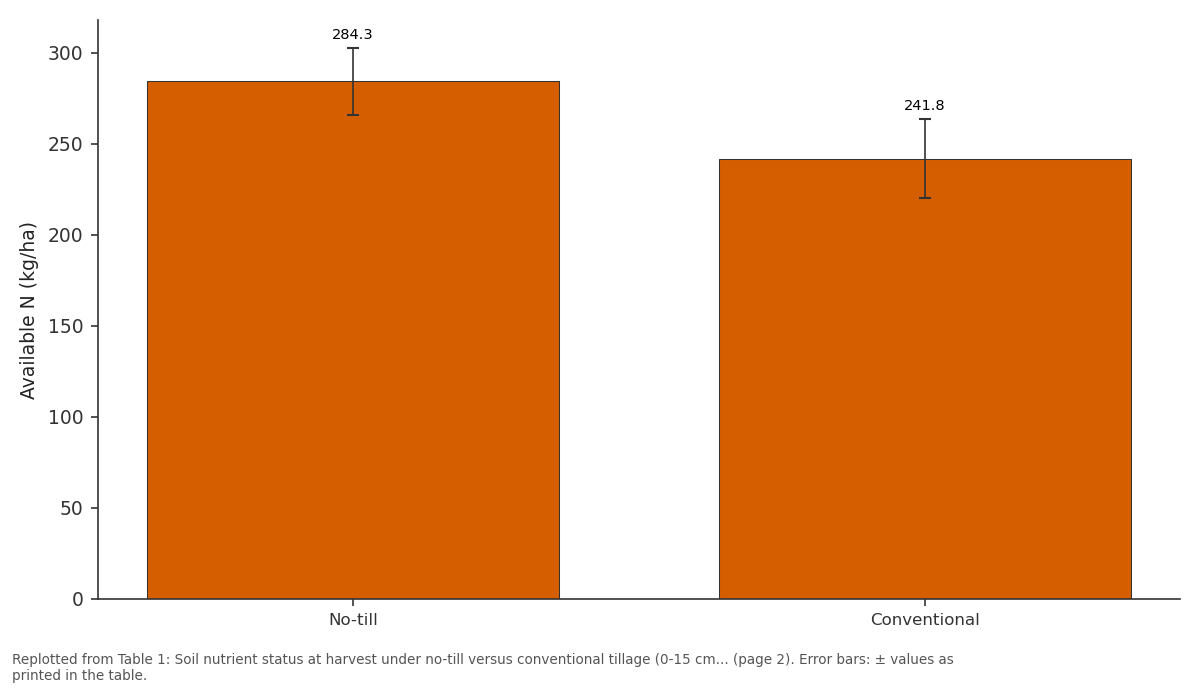
Available N (kg/ha): No-till vs Conventional
Replotted from Table 1 (page 2) of the original paper. Every bar is the paper's own table value.
View source evidence ↗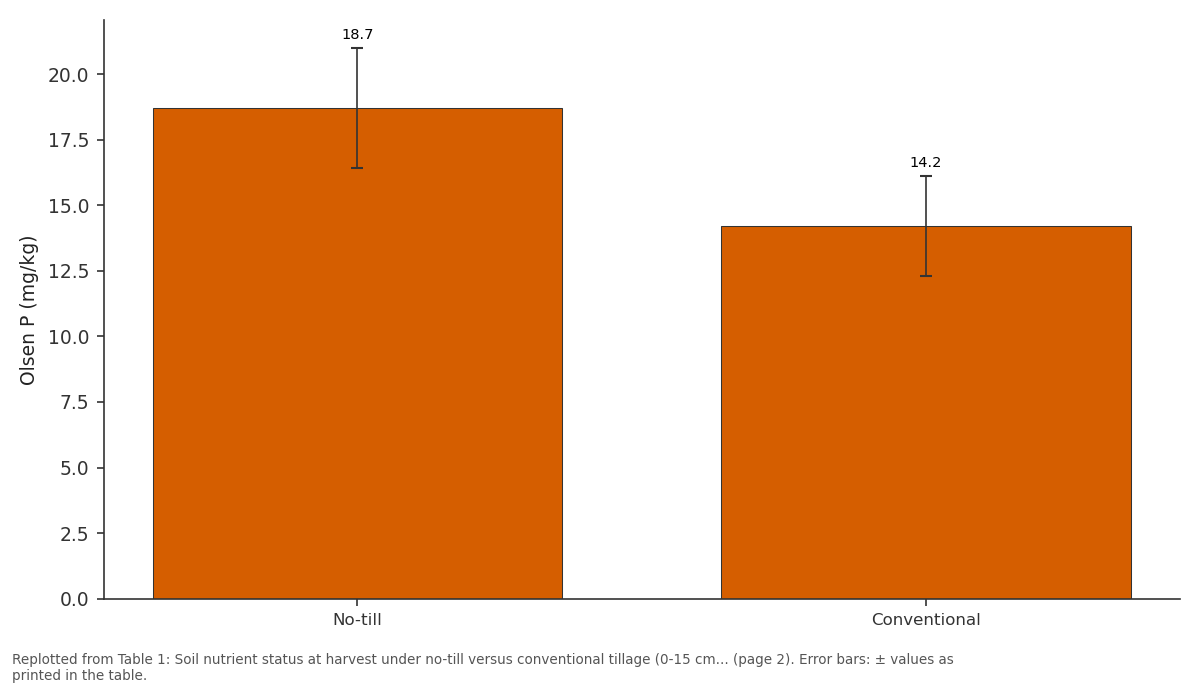
Olsen P (mg/kg): No-till vs Conventional
Replotted from Table 1 (page 2) of the original paper. Every bar is the paper's own table value.
View source evidence ↗Figures & tables
From the original paper Table 1
 Table 2
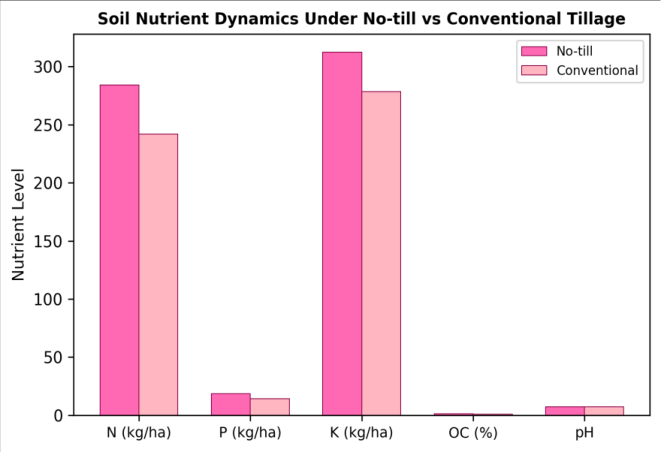 Figure 1
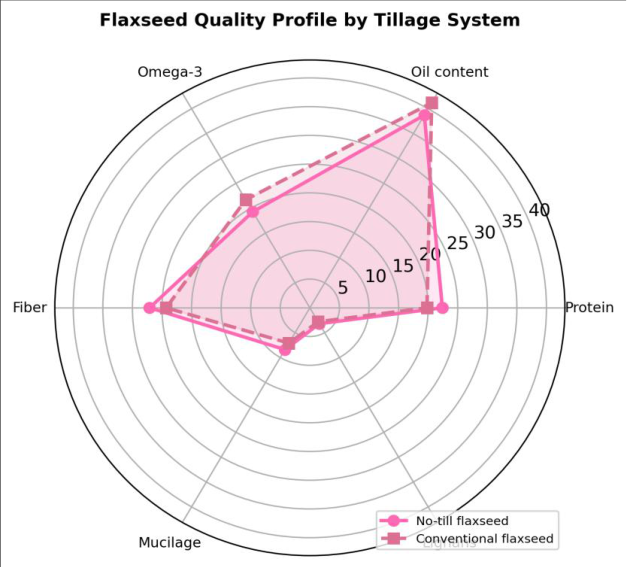 Figure 2
Introduction
Most people associate flaxseed with cold-climate agriculture Canadian prairies, northern European plains, and the steppes of Central Asia. But flaxseed can grow in tropical settings if planting is timed to cooler months, and the nutritional payoff high alpha-linolenic acid (omega-3), soluble fiber from mucilage, and lignan antioxidants is attractive enough to justify exploring non-traditional production zones [1] . The Masai Mara grasslands of East Africa, best known for wildlife migration, also support pastoral and increasingly arable agriculture on their margins. Soils here are typically deep, well-drained clay loams with moderate fertility that responds well to conservation tillage [2] . No-till farming has gained traction in tropical Africa for its soil moisture conservation benefits, but its effects on soil nutrient availability under oilseed crops and the downstream consequences for grain quality haven't been measured for flaxseed specifically [3] . In temperate systems, no-till tends to concentrate organic matter and nutrients in the top 10 cm of soil, which can boost crop uptake efficiency and alter grain composition. Whether the same pattern holds in tropical grassland soils with higher microbial turnover rates is an open question. Beyond agronomy, flaxseed mucilage has attracted interest as a prebiotic substrate that could support probiotic fermentation in plant-based food products. The polysaccharides in mucilage are not digested by human enzymes but can be metabolized by beneficial gut bacteria [4] . If flaxseed from tropical origins can serve both as a functional food ingredient and a platform for probiotic products, the crop's economic case strengthens considerably. This research profiled soil nutrient dynamics under no-till versus conventional flaxseed cultivation, measured the impact on seed quality parameters, tested mucilage as a probiotic fermentation substrate, and estimated genetic parameters for key quality traits [5] .
Extraction Protocol
Flaxseed mucilage was extracted by soaking 50 g of whole seeds in 500 mL distilled water (1:10 w/v) at 80°C for 2 hours with constant stirring at 200 rpm. The viscous extract was separated from seeds by filtration through cheesecloth, centrifuged at 5000 rpm for 15 minutes to remove particulate matter, and freeze-dried to obtain mucilage powder. Oil extraction used cold pressing at 30°C followed by Soxhlet extraction of the press cake with petroleum ether (60-80°C) for 6 hours. Fatty acid methyl esters were prepared by transesterification with boron trifluoridemethanol and analyzed by GC-FID [6] .
Material and Methods
Material and Methods
Material
Flaxseed cultivar NL-97 was sourced from the Pakistan Agricultural Research Council. Trial plots were established at a partner grassland research station near the Masai Mara (approximately 1.5°S, 35.1°E, elevation 1,620 m). Tillage implements included a chisel plow for conventional plots and direct-seed drills for no-till plots. Lactobacillus plantarum ATCC 8014 and L. rhamnosus GG were used for fermentation trials. MRS broth, peptone water, and agar were from HiMedia Laboratories (Mumbai, India) [7] .
Methods
Split-plot RCBD with tillage as main plot and nitrogen rate (0, 30, 60 kg N/ha) as subplot was used (three replications, 5 × 4 m plots). Sowing occurred in June 2022 (cool season). Soil samples were collected at 0-15 cm and 15-30 cm depth at sowing, mid-season, and harvest for available N (KCl extraction, Kjeldahl), Olsen P, exchangeable K (ammonium acetate), and organic carbon (Walkley-Black method) [8] . Seed quality analysis included protein (Kjeldahl, N × 6.25), oil (Soxhlet), fatty acid profile (GC-FID), and mucilage yield (gravimetric). Probiotic fermentation used 5% mucilage solution inoculated at 10^7 CFU/mL and incubated at 37°C for 72 hours; viability was tracked by plate counting on MRS agar. Gene action was estimated from a 6-parent half-diallel cross with analysis of general and specific combining ability [9] . No-till plots had significantly higher available N, P, K, and organic carbon at harvest compared to conventional tillage (Table 1). The 32.4% organic carbon advantage reflects two years of surface residue accumulation and reduced oxidative decomposition under no-till management. No-till flaxseed had higher protein (+13.1%), omega-3 (+12.2%), and mucilage (+18.3%) but lower total oil (-6.1%) compared to conventional tillage (Table 2). The protein-oil trade-off is consistent with nitrogen availability patterns.
| Quality trait | No-till | Conventional | Significance |
|---|---|---|---|
| Protein (%) | 22.4±0.9 | 19.8±1.2 | ** |
| Oil (%) | 38.7±1.4 | 41.2±1.6 | * |
| ALA omega-3 (%) | 19.3±1.1 | 17.2±1.3 | * |
| Mucilage yield (%) | 8.4±0.7 | 7.1±0.8 | * |
| Lignan (mg/g) | 3.2±0.4 | 2.8±0.3 | ns |
Table text extracted from the original PDF; superscript letters are shown inline. The original table image is below.
View original table image
| Parameter | No-till | Conventional | Difference | p-value |
|---|---|---|---|---|
| Available N (kg/ha) | 284.3±18.4 | 241.8±21.7 | +17.6% | <0.01 |
| Olsen P (mg/kg) | 18.7±2.3 | 14.2±1.9 | +31.7% | <0.01 |
| Exchangeable K (mg/kg) | 312.4±24.6 | 278.6±28.3 | +12.1% | <0.05 |
| Organic carbon (%) | 1.43±0.12 | 1.08±0.14 | +32.4% | <0.01 |
| pH | 7.2±0.2 | 7.4±0.3 | -2.7% | 0.18 |
Table text extracted from the original PDF; superscript letters are shown inline. The original table image is below.
View original table image
Results
Results
Comprehensive interpretation
Probiotic fermentation of 5% flaxseed mucilage solution supported L. plantarum growth to 8.3 log CFU/mL after 48 hours and 7.6 log CFU/mL after 72 hours, with pH declining from 6.4 to 4.1. Gene action analysis showed that GCA variance exceeded SCA variance for oil content (GCA:SCA ratio = 3.2, narrow-sense heritability 0.78), indicating predominantly additive gene effects. For mucilage yield, SCA variance was larger (GCA:SCA ratio = 0.6, heritability 0.41), suggesting non-additive genetic control and the potential value of hybrid breeding strategies.
Discussion
The 17.6% nitrogen advantage under no-till mirrors findings from long-term tillage trials in East African maize systems, where surface mulch decomposes slowly enough to maintain a nutrient reservoir in the top soil layer [10] . For flaxseed, this translates directly into higher seed protein because nitrogen uptake during the grain-filling phase is the main driver of protein accumulation. The corresponding dip in oil content is a well-known inverse relationship: as nitrogen-rich amino acids claim more of the seed's metabolic budget, carbon allocation to fatty acid synthesis decreases proportionally [11] .
The mucilage fermentation results are encouraging for plant-based probiotic product development. Flaxseed mucilage is rich in arabinoxylans and rhamnogalacturonan that serve as fermentable substrates for Lactobacillus species, producing short-chain fatty acids with documented gut health benefits [12] . A product combining flaxseed's omega-3 content with live probiotic cultures would address two consumer health trends simultaneously. The contrasting genetic architectures for oil (additive) and mucilage (non-additive) have practical breeding implications. Oil improvement can proceed through simple recurrent selection, while mucilage improvement may require exploitation of specific cross combinations or hybrid production systems [13] .
Conclusion
No-till flaxseed cultivation in the Masai Mara grasslands produced grain with higher protein, omega-3, and mucilage content than conventional tillage, driven by improved soil nutrient status particularly a 32.4% organic carbon advantage. The trade-off was a modest 6.1% reduction in oil content, which may be acceptable given the premium that health-conscious markets place on omega-3-rich and highprotein flaxseed products. Mucilage from no-till flaxseed supported robust probiotic fermentation with viable counts above therapeutic thresholds. Gene action analysis pointed toward different breeding strategies for oil (additive selection) versus mucilage (hybrid exploitation). These findings make a case for introducing flaxseed into conservation agriculture rotations in tropical grasslands, combining soil health benefits with high-value functional food production.
acknowledged for plot maintenance and soil sampling assistance.
Acknowledgement
Acknowledgements Funding sourcesInstitutional funds from the Karachi University of Food and Nutrition supported this research. Institutional supportThe authors thank the Karachi University of Food and Nutrition for laboratory and fermentation equipment access.
Figures and tables from the paper
References
18 in the original paper- Kajla P, Sharma A, Sood DR. Flaxseed -a potential functional food source. Journal of Food Science and Technology. 2015;52(4):1857-1871.
- Nyberg G, Bargues Tobella A, Kinyangi J, Ilstedt U. Soil property changes over a 120-yr chronosequence from forest to agriculture in western Kenya. Hydrology and Earth System Sciences. 2012;16(7):2085-2094.
- Hobbs PR, Sayre K, Gupta R. The role of conservation agriculture in sustainable agriculture. Philosophical Transactions of the Royal Society B. 2008;363(1491):543-555.
- Mani S, Jaya S, Vadivambal R. Optimization of solvent extraction of moringa seed oil. Food and Bioproducts Processing. 2007;85(4):328-335.
- Oomah BD. Flaxseed as a functional food source. Journal of the Science of Food and Agriculture. 2001;81(9):889-894.
- Christie WW. Preparation of ester derivatives of fatty acids for chromatographic analysis. Advances in Lipid Methodology. 1993;2:69-111.
- Pakistan Agricultural Research Council. Oilseed crop varieties released in Pakistan 2000-2020. Islamabad; 2021.
- Walkley A, Black IA. An examination of the Degtjareff method for determining soil organic matter. Soil Science. 1934;37(1):29-38.
- Griffing B. Concept of general and specific combining ability in relation to diallel crossing systems. Australian Journal of Biological Sciences. 1956;9(4):463-493.
- Powlson DS, Stirling CM, Jat ML, et al. Limited potential of no-till agriculture for climate change mitigation. Nature Climate Change. 2014;4(8):678-683.
- Daun JK, Barthet VJ, Chornick TL, Duguid S. Structure, composition, and variety development of flaxseed. In: Flaxseed in Human Nutrition. 2nd ed. AOCS Press; 2003:1-40.
- Mazza G, Biliaderis CG. Functional properties of flax seed mucilage. Journal of Food Science. 1989;54(5):1302-1305.
- Diederichsen A, Ulrich A. Variability in stem fibre content and its association with other characteristics in 1177 flaxseed accessions. Industrial Crops and Products. 2009;30(1):33-39.
- Bloedon LT, Szapary PO. Flaxseed and cardiovascular risk. Nutrition Reviews. 2004;62(1):18-27.
- Mueller K, Eisner P, Yoshie-Stark Y, Nakada R, Kirchhoff E. Functional properties and chemical composition of fractionated brown and yellow linseed meal. Journal of Food Engineering. 2010;98(4):453460.
- Hall C, Tulbek MC, Xu Y. Flaxseed. Advances in Food and Nutrition Research. 2006;51:1-97.
- Coskuner Y, Karababa E. Some physical properties of flaxseed. Journal of Food Engineering. 2007;78(3):1067-1073.
- Rabetafika HN, Van Remoortel V, Danthine S, Paquot M, Blecker C. Flaxseed proteins: Food uses and health benefits. International Journal of Food Science and Technology. 2011;46(2):221-228.