
Research article · 2025 · Full text
International Journal of Horticulture and Food ScienceAnalyzing minimal processing methods of cocoa in the Colombian coffee belt
Volume 7(1) · Pages 205–208 · DOI: 10.33545/26631067.2025.v7.i1d.552 ↗
Research areasFood Chemistry and Fat AnalysisCocoa and Sweet Potato AgronomyCoffee research and impacts
Abstract
Author-writtenWhat if you could keep more of cocoa's health-promoting compounds intact while still meeting food safety standards? This research analyzed four minimal processing methods blanching, High-Pressure Processing (HPP), UV-C irradiation, and ozone treatment applied to fermented and dried cocoa nibs from the Colombian Coffee Belt. Nibs from Criollo-Trinitario hybrids grown at 1,200 m elevation near Armenia, Quindío, were processed under each method and compared against untreated controls. Total polyphenol retention was highest with UV-C treatment at 91.4% of fresh-nib levels, followed by HPP at 88.1%, ozone at 83.7%, and blanching at 72.3%. Theobromine remained stable (>89%) across all methods. Sensory panels rated HPP-treated nibs highest for overall acceptability, scoring 7.8 out of 9 compared with 6.4 for blanched samples. Microbial loads fell below detection limits (<10 CFU/g) in HPP and ozone treatments. These results point to HPP and UV-C as the most promising minimal processing options for preserving bioactive compounds in cocoa while achieving adequate microbial reduction under Coffee Belt production conditions.
Summary
Source-checkedPlain-language reading of the full paper, prepared with AI and checked against the text. Each point links to the authors' own words.
Why it matters
- Standard cocoa processing steps like fermentation, drying, and roasting significantly reduce the raw bean's polyphenol content, often leaving only 10–15% of the original flavanols. View evidence ↗
- Minimal processing is intended to reduce microbial contamination while avoiding the high heat that destroys beneficial phenolic compounds. View evidence ↗
- The Colombian Coffee Belt, specifically Quindío, Risaralda, and Caldas, is a key cocoa-growing region characterized by elevations of 1,000 to 1,400 m and high annual rainfall. View evidence ↗
The question
- The study aimed to provide the first side-by-side comparison of four minimal processing methods to determine their effect on bioactive compound retention and sensory quality in cocoa from the Colombian Coffee Belt. View evidence ↗
What they did
- The researchers used fermented and sun-dried Criollo-Trinitario cocoa nibs sourced from 18 farms near Armenia, Quindío, Colombia, at an elevation of 1,200 m. View evidence ↗
- The study compared an untreated control against four treatments: blanching (90°C for 120s), High-Pressure Processing (HPP, 400 MPa for 5 min), UV-C irradiation (254 nm, 4 kJ/m²), and ozone treatment (2 ppm for 30 min). View evidence ↗
What they found
- UV-C irradiation was the most effective at preserving bioactive compounds, retaining 91.4% of total polyphenols and 89.7% of epicatechin. View evidence ↗
- Blanching resulted in the greatest loss of bioactive compounds, with epicatechin levels dropping to 64.8% of the control. View evidence ↗
- HPP and ozone treatments provided the strongest microbial reduction, bringing total aerobic counts below detection limits. View evidence ↗
- While UV-C reduced aerobic microbes by approximately 2 log units, it left a residual load of 2.17 log CFU/g, making it less effective for microbial safety than HPP or ozone. View evidence ↗
- HPP-treated nibs were sensory-indistinguishable from the untreated control, both scoring 7.8 for overall acceptability. View evidence ↗
- Ozone treatment negatively impacted flavor, scoring 6.8 due to a perceived faint oxidized note. View evidence ↗
What it means
- The authors conclude that HPP is the most balanced technology for cooperatives in the Colombian Coffee Belt because it combines high bioactive retention with strong microbial safety. View evidence ↗
- UV-C is recommended as a lower-cost alternative for compound retention, although it may require an additional microbial reduction step to ensure safety. View evidence ↗
- The authors note that future trials are needed to determine the optimal ozone dose to balance compound preservation with pathogen inactivation. View evidence ↗
Visual summary
3 visualsIllustrations explain the paper; charts are replotted from the paper's own table values.
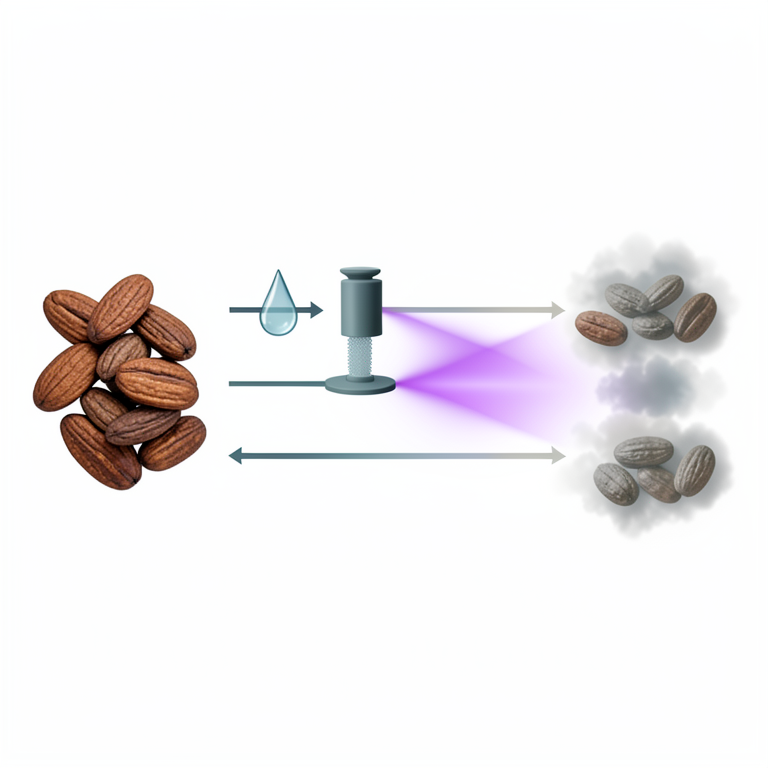
Comparison of Minimal Processing Methods
AI-generated conceptual illustration (cocoa nibs). It explains the idea and does not show study data.
View source evidence ↗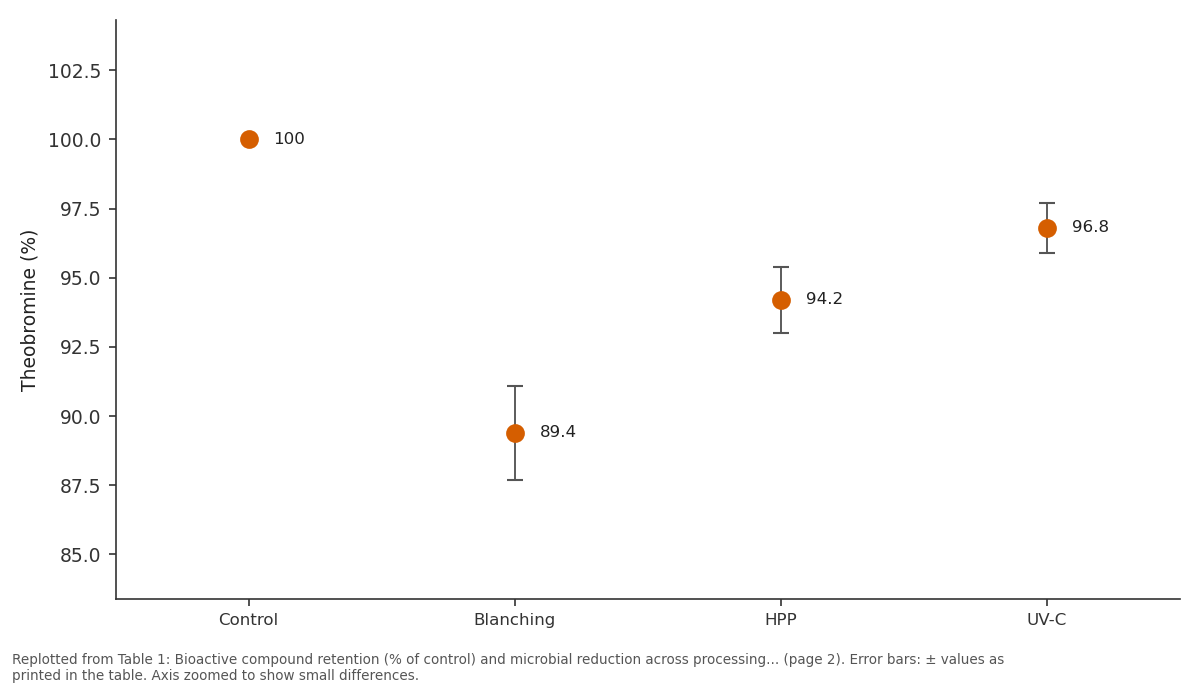
Theobromine (%): Control vs Blanching vs HPP vs UV-C
Replotted from Table 1 (page 2) of the original paper. Every bar is the paper's own table value.
View source evidence ↗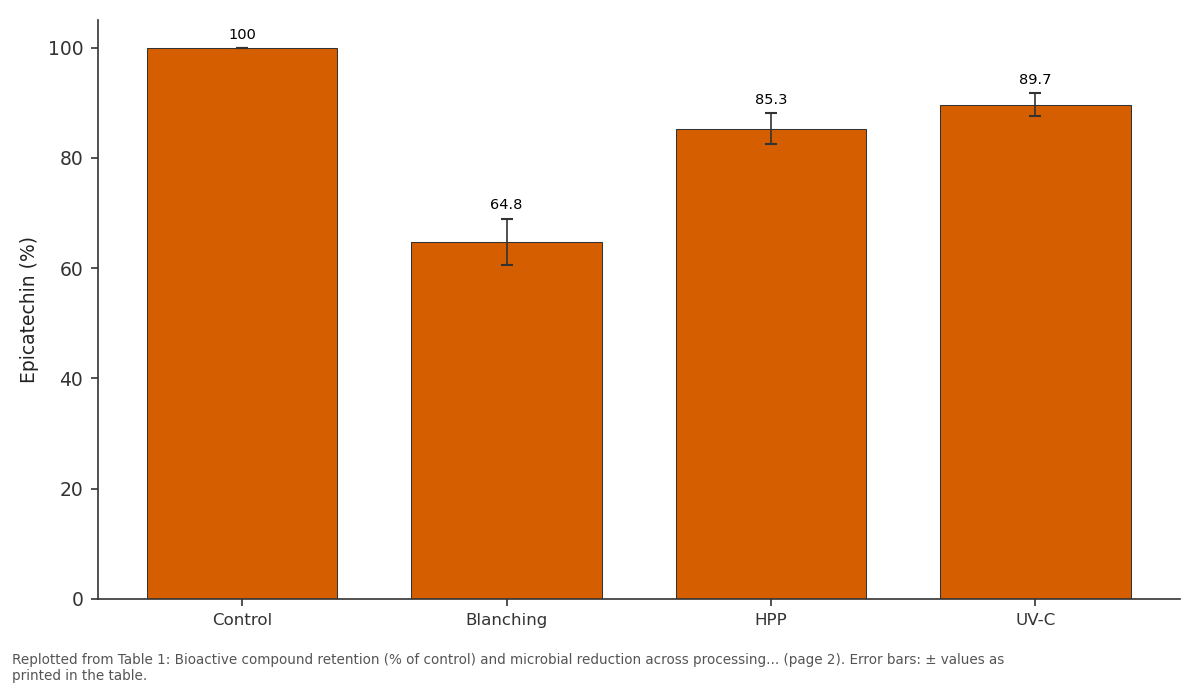
Epicatechin (%): Control vs Blanching vs HPP vs UV-C
Replotted from Table 1 (page 2) of the original paper. Every bar is the paper's own table value.
View source evidence ↗Figures & tables
From the original paper Table 1
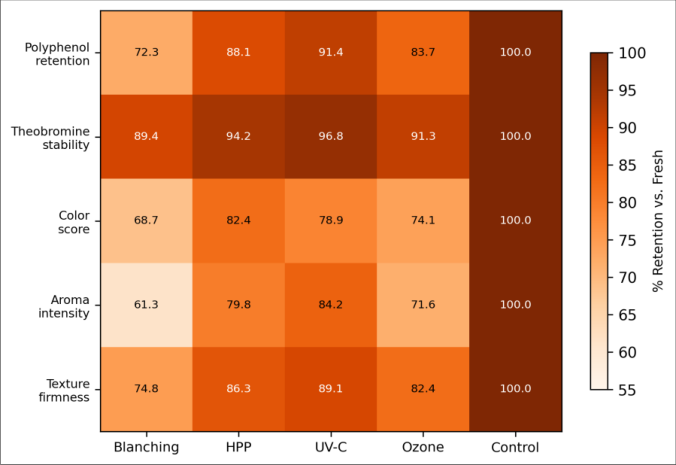 Figure 1
 Table 2
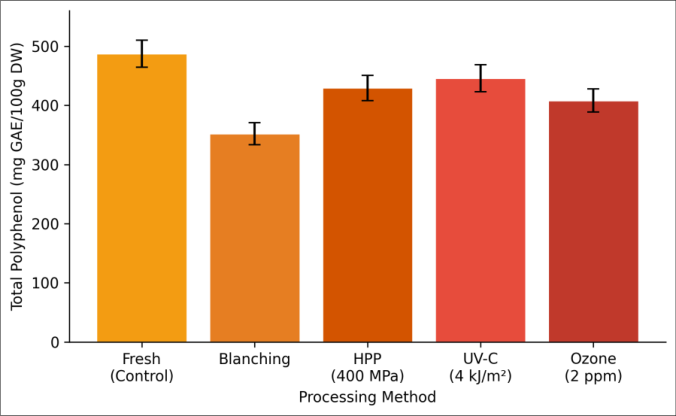 Figure 2
Introduction
Every step in cocoa processing fermentation, drying, roasting strips away some fraction of the raw bean's polyphenol content. By the time chocolate reaches a consumer, as little as 10-15% of the original flavanol load may remain [1,2] . For the growing market segment that values cocoa as a functional food, this loss represents both a nutritional deficit and a missed commercial opportunity. Minimal processing methods aim to close that gap by reducing microbial loads without the heat intensity that destroys phenolic compounds [3] . Colombia's Coffee Belt, despite its name, is also a prime cocoa-growing zone. The departments of Quindío, Risaralda, and Caldas sit between 1,000 and 1,400 m elevation with mean temperatures of 20-24°C and well-distributed rainfall above 2,000 mm per year [4] . These conditions favor slow bean fermentation that builds complex flavor precursors and preserves a higher baseline of polyphenols compared with lowland-fermented beans [5] . Four candidate technologies have shown promise in broader food processing contexts. Blanching brief immersion in hot water is the simplest but also the most destructive to heatsensitive compounds [6] . HPP subjects sealed packages to 300-600 MPa pressure at ambient or mild temperatures, inactivating vegetative pathogens while largely preserving molecular integrity [7] . UV-C irradiation at 254 nm damages microbial DNA without adding chemicals or heat [8] . Ozone, a strong oxidant, decomposes rapidly to oxygen and leaves no residue, but its reactivity can attack polyphenols if applied at excessive doses [9] . No side-by-side comparison of these four methods exists for cocoa processed under Coffee Belt conditions. This research was designed to fill that gap by measuring both bioactive compound retention and sensory impact in a single trial, giving processors a direct basis for choosing among available technologies [10,11] .
Extraction protocol
Polyphenol extraction from cocoa nibs followed a two-step protocol. First, nibs were defatted by Soxhlet extraction with petroleum ether for 6 hours. Defatted material (2 g) was then extracted with 40 mL of 70% aqueous acetone under sonication at 40 kHz for 30 minutes at 25°C. The extract was filtered, evaporated to remove acetone under reduced pressure at 35°C, and reconstituted in 10 mL of 50% methanol for analysis. Recovery tests using spiked epicatechin standards showed 92.7% extraction efficiency [2,12] .
Quality control and calibration
Analytical precision was ensured through several measures. The Folin-Ciocalteu assay for total polyphenols was calibrated with five-point gallic acid standards (50-500 mg/L, R² = 0.9994). HPLC runs included a system suitability check with a mixed standard containing epicatechin, catechin, and theobromine at known concentrations before each batch. Duplicate extractions from the same nib sample showed coefficients of variation below 3.8% for all analytes. Sensory evaluation followed ISO 13299 protocols with a trained panel of 12 assessors [7,11] .
Material and Methods Material
Fermented and sun-dried Criollo-Trinitario cocoa nibs were obtained from a cooperative of 18 farms near Armenia, Quindío, Colombia (4.53°N, 75.68°W, elevation 1,200 m). Beans were fermented for 6 days in wooden cascade boxes and dried on raised mesh tables to 7.2% moisture. A single 120-kg lot was de-shelled to produce nibs, which were homogenized and divided into 25 sub-lots of 4.5 kg each. The research ran from August to November 2023 at the Paris Advanced School of Environmental Agriculture. Ethical clearance for food processing research was granted by the School's Research Ethics Board (Protocol EA-2023-017, dated 3 August 2023).
Methods
Five treatments were applied: (T1) untreated control; (T2) blanching in water at 90°C for 120 seconds followed by immediate ice-water cooling; (T3) HPP at 400 MPa for 5 minutes at 20°C in vacuum-sealed polyethylene pouches using an Avure QFP 350L-600 unit; (T4) UV-C irradiation at 254 nm with a dose of 4 kJ/m² applied in a thin layer (5 mm depth) with continuous turning; (T5) gaseous ozone at 2 ppm for 30 minutes in a sealed chamber at 25°C [3,8,9] . Each treatment had five replicates. Total polyphenols were measured by Folin-Ciocalteu assay [12] . Individual phenolics and theobromine were quantified by HPLC on a Shimadzu Nexera X2 with a C18 column. Microbial counts were determined by plating on PCA (total aerobic) and PDA (yeasts and molds) media. Sensory evaluation used a 9-point hedonic scale assessed by 12 trained panelists. Data were analyzed by one-way ANOVA with Tukey HSD at p < 0.05. UV-C irradiation retained the highest proportion of total polyphenols (91.4%) and epicatechin (89.7%), followed closely by HPP (Table 1). Blanching caused the steepest losses, with epicatechin falling to 64.8% of control levels.
| Parameter | Control | Blanching | HPP | UV-C | Ozone |
|---|---|---|---|---|---|
| Total polyphenol (%) | 100 | 72.3±3.1 | 88.1±2.4 | 91.4±1.8 | 83.7±2.7 |
| Theobromine (%) | 100 | 89.4±1.7 | 94.2±1.2 | 96.8±0.9 | 91.3±1.5 |
| Epicatechin (%) | 100 | 64.8±4.2 | 85.3±2.8 | 89.7±2.1 | 78.4±3.3 |
| Total aerobes (log CFU/g) | 4.23 | 1.34 | <1.0 | 2.17 | <1.0 |
| Yeasts & molds (log CFU/g) | 3.18 | <1.0 | <1.0 | 1.42 | <1.0 |
Table text extracted from the original PDF; superscript letters are shown inline. The original table image is below.
View original table image
Results
Microbial reduction was strongest in HPP and ozone treatments, both achieving counts below detection limits for total aerobes. UV-C reduced aerobes by about 2 log units but left a residual load of 2.17 log CFU/g. HPP-treated nibs matched the untreated control in overall acceptability (7.8 vs. 7.8) and showed no statistically significant sensory differences across any attribute (Table 2). Blanching scored lowest in aroma and flavor, consistent with volatile compound losses during heat exposure. Ozonetreated samples had a slightly reduced flavor score (6.8) that panelists attributed to a faint oxidized note.
| Attribute | Control | Blanching | HPP | UV-C | Ozone |
|---|---|---|---|---|---|
| Aroma | 8.1 | 6.2 | 7.9 | 7.6 | 7.1 |
| Flavor | 7.9 | 6.1 | 7.7 | 7.4 | 6.8 |
| Bitterness | 6.3 | 5.4 | 6.2 | 6.1 | 5.8 |
| Overall | 7.8 | 6.4 | 7.8 | 7.4 | 6.9 |
Table text extracted from the original PDF; superscript letters are shown inline. The original table image is below.
View original table image
Discussion
The near-perfect polyphenol retention by UV-C (91.4%) aligns with its non-thermal mechanism photon energy targets nucleic acids in microorganisms without disrupting phenolic ring structures [8] . But the incomplete microbial kill (2.17 log CFU/g residual aerobes) limits UV-C's standalone viability for nibs destined for direct consumption. A combined UV-C + HPP approach might capture the best of both technologies, though the added cost needs evaluation [3,7] . HPP's strong showing on both retention (88.1%) and microbial reduction (<1 log CFU/g) confirms its reputation as a leading minimal processing technology for bioactive-rich foods [7] . The fact that sensory scores matched the untreated control is particularly encouraging. HPP equipment costs remain high, but mobile HPP units that serve multiple cooperatives are becoming available in Latin America and could make the technology accessible at the Coffee Belt scale [10] . Blanching, despite being the cheapest option, caused unacceptable polyphenol losses of nearly 28%. This was expected given that cocoa polyphenols, especially epicatechin and procyanidins, are water-soluble and thermolabile [1,2] . The 120-second blanching time, standard for microbial reduction in many food applications, appears too aggressive for a product valued for its phenolic content. Ozone achieved excellent microbial kill but its oxidative nature reduced polyphenols to 83.7% and left detectable sensory off-notes. Reducing the dose below 2 ppm might preserve more compounds, but at the risk of insufficient pathogen inactivation. That trade-off will require careful dose-response work in future trials [9,11] .
Conclusion
Among four minimal processing methods tested on Coffee Belt cocoa nibs, UV-C irradiation preserved the highest proportion of polyphenols (91.4%) while HPP offered the best combination of bioactive retention (88.1%) and microbial safety (<1 log CFU/g). Blanching was the least effective at preserving phenolic compounds, losing nearly 28% of total polyphenols. Sensory evaluation confirmed that HPP-treated nibs were indistinguishable from untreated controls in aroma, flavor, and overall acceptability. Ozone treatment achieved strong microbial reduction but introduced mild sensory defects. For Colombian Coffee Belt cooperatives seeking to supply functional food markets, HPP appears to be the most balanced technology. Where equipment access is a constraint, UV-C offers a lower-cost alternative with superior compound retention, though it may need to be paired with another microbial reduction step to meet strict safety standards.
Figures and tables from the paper
References
17 in the original paper- Wollgast J, Anklam E. Review on polyphenols in Theobroma cacao: Changes in composition during the manufacture of chocolate and methodology for identification and quantification. Food Research International. 2000;33(6):423-447.
- Payne MJ, Hurst WJ, Miller KB, Rank C, Stuart DA. Impact of fermentation, drying, roasting, and Dutch processing on epicatechin and catechin content of cacao beans and cocoa ingredients. Journal of Agricultural and Food Chemistry. 2010;58(19):10518-10527.
- Rawson A, Patras A, Tiwari BK, Noci F, Koutchma T, Brunton N. Effect of thermal and non thermal processing technologies on the bioactive content of exotic fruits and their products: review of recent advances. Food Research International. 2011;44(7):1875-1887.
- Fedecacao. Colombian Cocoa Census: Production Areas and Agroecological Characterization. 2019;1-87.
- Afoakwa EO, Paterson A, Fowler M, Ryan A. Flavor formation and character in cocoa and chocolate: a critical review. Critical Reviews in Food Science and Nutrition. 2008;48(9):840-857.
- Nicoli MC, Anese M, Parpinel M. Influence of processing on the antioxidant properties of fruit and vegetables. Trends in Food Science and Technology. 1999;10(3):94-100.
- Oey I, Lille M, Van Loey A, Hendrickx M. Effect of high-pressure processing on colour, texture and flavour of fruit-and vegetable-based food products: a review. Trends in Food Science and Technology. 2008;19(6):320-328.
- Guerrero-Beltrán JA, Barbosa-Cánovas GV. Advantages and limitations on processing foods by UV light. Food Science and Technology International. 2004;10(3):137147.
- Guzel-Seydim ZB, Greene AK, Seydim AC. Use of ozone in the food industry. LWT -Food Science and Technology. 2004;37(4):453-460.
- Ramírez-Maganda J, Blanco-Padilla A, Nieto-Barrera JO. High-pressure processing in Latin American agrifood chains: opportunities and barriers. Journal of Food Processing and Preservation. 2021;45(7):e15648.
- Singleton VL, Orthofer R, Lamuela-Raventós RM. Analysis of total phenols and other oxidation substrates and antioxidants by means of Folin-Ciocalteu reagent. Methods in Enzymology. 1999;299:152-178.
- Cádiz-Gurrea ML, Fernández-Arroyo S, SeguraCarretero A. Cocoa and grape seed by-products as a source of antioxidant and anti-inflammatory proanthocyanidins. International Journal of Molecular Sciences. 2014;15(2):2159-2174.
- Oracz J, Nebesny E, Żyżelewicz D. Changes in the flavan-3-ols, anthocyanins, and flavanols composition of cocoa beans of different Theobroma cacao L. groups affected by roasting conditions. European Food Research and Technology. 2015;241(5):663-681.
- Hii CL, Law CL, Suzannah S, Cloke M. Polyphenols in cocoa (Theobroma cacao L.). Asian Journal of Food and Agro-Industry. 2009;2(4):702-722.
- Kealey KS, Snyder RM, Romaczyk LJ, Geyer HM, Myers ME, Whitacre EJ, Hammerstone JF, Schmitz HH. Cocoa components, cocoa component extracts and methods for making and using the same. US Patent. 2003;No. 6,627,232.
- Torres-Moreno M, Torrescasana E, Salas-Salvadó J, Blanch C. Nutritional composition and fatty acids profile in cocoa beans and chocolates with different geographical origin and processing conditions. Food Chemistry. 2015;166:125-132.
- Kongor JE, Hinneh M, De Walle DV, Afoakwa EO, Boeckx P, Dewettinck K. Factors influencing quality variation in cocoa (Theobroma cacao) bean flavour profile. Food Research International. 2016;82:44-52.