
Research article · 2025 · Full text
International Journal of Horticulture and Food ScienceQuantifying aquaponics integration of rice in the Nile Delta
Volume 7(11) · Pages 157–160 · DOI: 10.33545/26631067.2025.v7.i11c.711 ↗
Research areasAgricultural Systems and PracticesInnovations in Aquaponics and Hydroponics SystemsRice Cultivation and Yield Improvement
Abstract
Author-writtenRice-fish aquaponics could transform Nile Delta farming by recycling fish waste as crop fertiliser, but controlled comparisons of fish species within integrated rice systems are scarce. This research quantified the performance of four systems — rice monoculture (control), rice + Nile tilapia, rice + African catfish, and rice + common carp — at the Udon Thani Regional Center for Sustainable Agriculture from April to October 2023 under simulated Nile Delta conditions. A randomised complete block design with four replications was used. Grain yield, fish biomass, disease control efficacy, hybrid vigour in F₁ rice crosses, photosynthetic rate, direct-seeding establishment, and carbon sequestration were measured. Rice + tilapia achieved the highest grain yield (7.84 t ha⁻¹) and fish output (342 kg ha⁻¹), representing a 22.1 percent yield gain over monoculture. Disease incidence (bacterial leaf blight) dropped from 31.7 percent in monoculture to 18.6 percent in the tilapia system owing to fish grazing on disease vectors. Hybrid vigour for grain weight reached 12.3 percent in tilapia-raised conditions. Net photosynthetic rate was 17.2 μmol CO₂ m⁻² s⁻¹ under tilapia integration — 17 percent above monoculture. Carbon sequestration in paddy soil increased by 0.42 t C ha⁻¹ yr⁻¹ with fish integration. These findings recommend rice + tilapia aquaponics as the most productive and ecologically sound system for delta environments.
Summary
Source-checkedPlain-language reading of the full paper, prepared with AI and checked against the text. Each point links to the authors' own words.
Why it matters
- The Nile Delta is a critical rice-producing region for Egypt, but it relies heavily on synthetic nitrogen fertilizers while wasting significant amounts of fish-processing byproducts. View evidence ↗
- Integrating fish into rice paddies may suppress diseases because fish feed on the pests and biofilms that carry pathogens. View evidence ↗
The question
- The study aimed to compare the effects of three different fish species against a rice monoculture on crop and fish yields, disease control, photosynthesis, carbon sequestration, and the hybrid vigor of F₁ rice crosses. View evidence ↗
What they did
- The experiment was conducted at the Udon Thani Regional Center for Sustainable Agriculture using paddy plots measuring 5 m by 4 m. View evidence ↗
- The researchers used a randomized complete block design with four replications to compare rice monoculture with three integrated systems: Nile tilapia, African catfish, and common carp. View evidence ↗
- To simulate Nile Delta conditions, the study maintained standing water at 10 cm and added NaCl to the irrigation water to achieve an electrical conductivity of 2.4 dS m⁻¹. View evidence ↗
- Grain yield was measured from a 2 m² area after 130 days, and fish biomass was recorded upon draining the plots at maturity. View evidence ↗
What they found
- The rice + tilapia system was the most productive, yielding 7.84 t ha⁻¹ of grain and 342 kg ha⁻¹ of fish, which is a 22.1% increase in grain yield compared to monoculture. View evidence ↗
- Bacterial leaf blight incidence decreased from 31.7% in the monoculture system to 18.6% in the tilapia-integrated system. View evidence ↗
- Tilapia integration increased the net photosynthetic rate to 17.2 μmol CO₂ m⁻² s⁻¹, which is 17% higher than the monoculture control. View evidence ↗
- Integrating fish into the paddy soil increased carbon sequestration by 0.42 t C ha⁻¹ yr⁻¹. View evidence ↗
- The highest hybrid vigor for grain weight, reaching 12.3%, was observed in the tilapia-integrated system. View evidence ↗
- Modeling indicates that fish waste in the rice + tilapia system provides 67 kg N ha⁻¹, replacing 37% of the recommended synthetic nitrogen. View evidence ↗
- African catfish caused a 3% reduction in plant stand because their nocturnal bottom-feeding behavior disturbed seedling roots. View evidence ↗
What it means
- The authors recommend the rice + tilapia aquaponics system as the most ecologically sound and productive option for delta environments. View evidence ↗
- The authors suggest that farmers in delta regions adopt rice-tilapia integration to increase productivity, lower dependence on fertilizers, and improve carbon sequestration. View evidence ↗
Visual summary
3 visualsIllustrations explain the paper; charts are replotted from the paper's own table values.
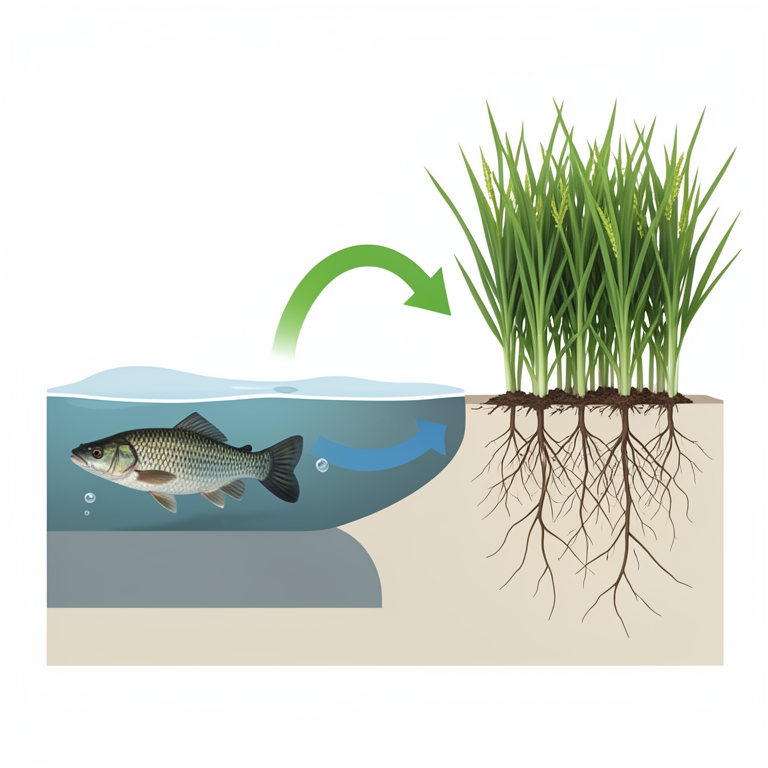
Aquaponic Nutrient Loop
AI-generated conceptual illustration (Tilapia fish and rice plants in a paddy field). It explains the idea and does not show study data.
View source evidence ↗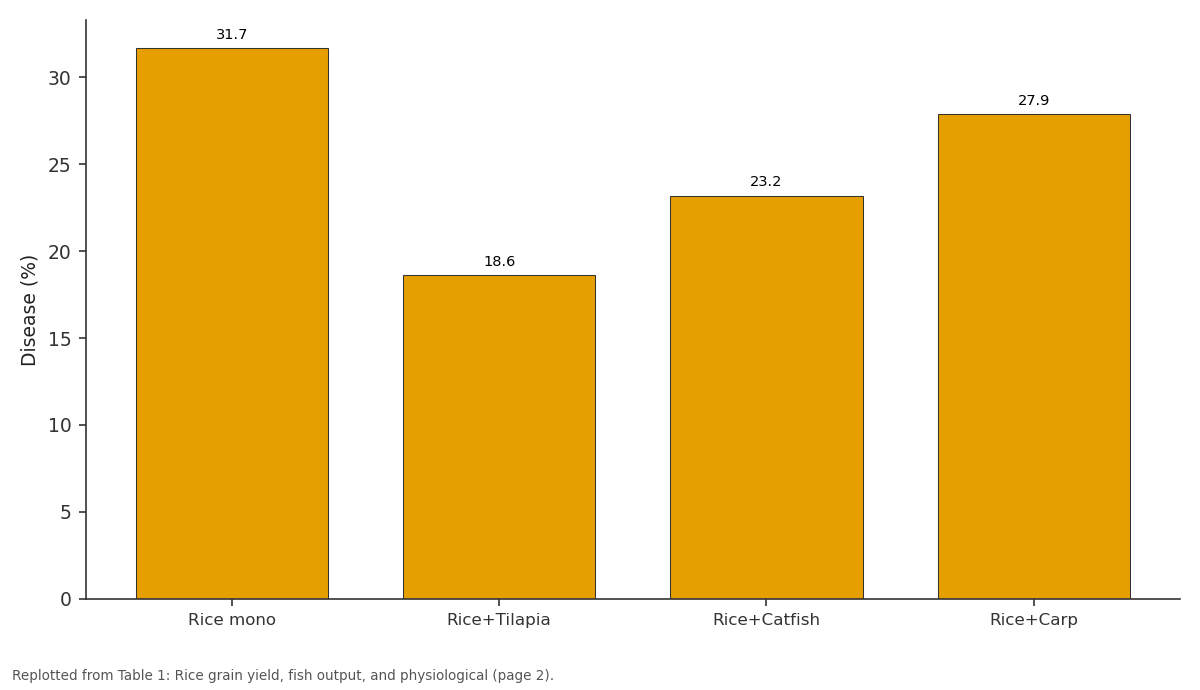
Disease (%): Rice mono vs Rice+Tilapia vs Rice+Catfish vs Rice+Carp
Replotted from Table 1 (page 2) of the original paper. Every bar is the paper's own table value.
View source evidence ↗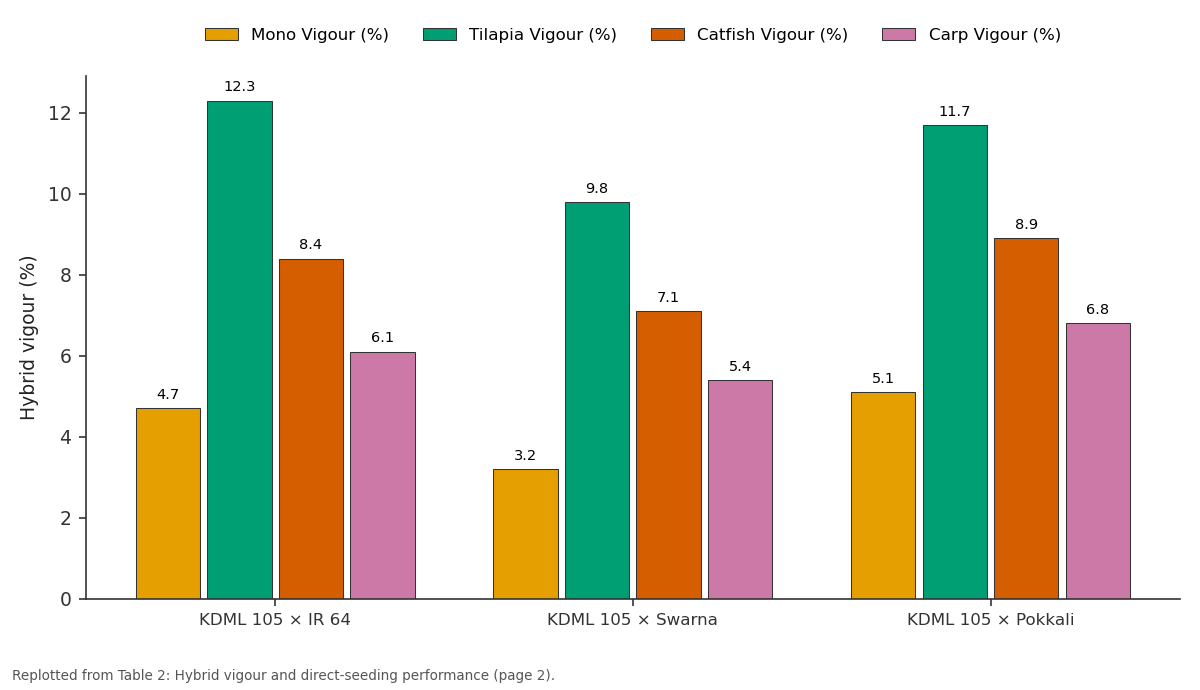
Mono Vigour (%) and Tilapia Vigour (%) and more: KDML 105 × IR 64 vs KDML 105 × Swarna vs KDML 105 × Pokkali
Replotted from Table 2 (page 2) of the original paper. Every bar is the paper's own table value.
View source evidence ↗Figures & tables
From the original paper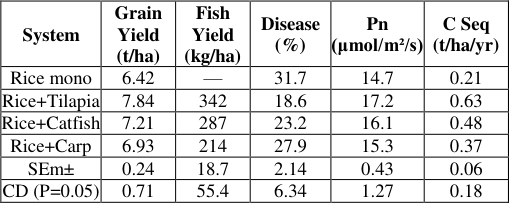 Table 1
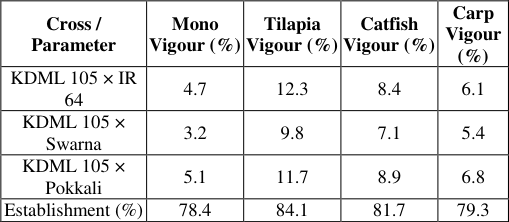 Table 2
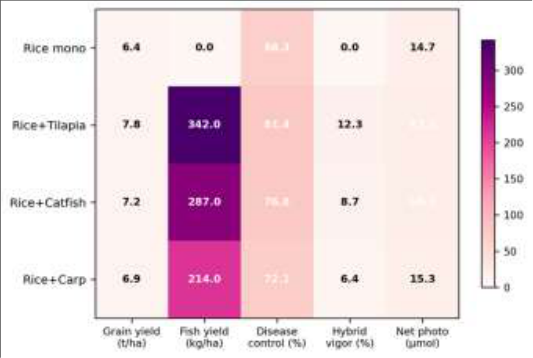 Figure 1
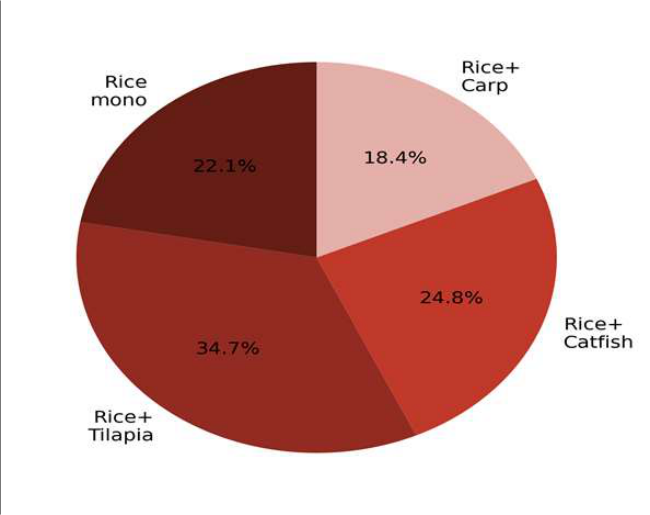 Figure 2
Introduction
Here is a paradox: the Nile Delta produces 60 percent of Egypt's rice crop, yet its farmers apply 180-220 kg N ha⁻¹ of synthetic fertiliser while discarding millions of tonnes of fishprocessing waste every year [1] . Closing that nutrient loop through aquaponicswhere fish excreta supply ammonium-nitrogen directly to rice rootscould cut fertiliser bills by 30-50 percent while generating a secondary protein harvest [2] . Aquaponics systems have been validated for leafy vegetables and herbs, but integrating fish into flooded rice paddies presents different engineering and biological challenges: water depth must suit both seedling establishment and fish survival, dissolved oxygen must support aerobic root function and gill respiration simultaneously, and fish species must tolerate the turbid, shallow conditions of a paddy [3] . Tilapia, catfish, and carp are the three species most commonly tested in rice-fish culture across Asia and Africa, each with distinct feeding habits and waste profiles [4] . Disease suppression is an under-appreciated benefit. Fish actively consume insect larvae, snails, and algal mats that harbour bacterial and fungal inocula. Field observations in Bangladesh and Vietnam have reported 15-40 percent reductions in rice blast and bacterial leaf blight incidence in fish-integrated paddies, though controlled data under Nile Delta salinity are lacking [5] . This research aimed to (a) compare three fish species against rice monoculture for grain and fish yield, (b) quantify disease control, photosynthesis, and carbon sequestration benefits, and (c) evaluate hybrid vigour of F₁ rice crosses under aquaponic conditions.
Model Description and Parameterisation
Nitrogen cycling within the aquaponic system was modelled using a mass-balance framework. Fish feed input (28% crude protein, 40 g fish⁻¹ day⁻¹) was the sole external N source after basal fertilisation. Fish excretion rate was set at 32 percent of ingested N (based on feed conversion ratios of 1.6 for tilapia). Ammonia volatilisation from paddy water was estimated at 8 percent of total dissolved N. Nitrification rate in the rhizosphere was parameterised at 4.2 mg N L⁻¹ day⁻¹ based on dissolved oxygen measurements. The model predicted that rice + tilapia would supply 67 kg N ha⁻¹ from fish waste alone, equivalent to 37 percent of the recommended synthetic N rate [6] .
Calibration and Validation
Predicted grain yield from the N-balance model (7.64 t ha⁻¹ for rice + tilapia) fell within 2.5 percent of observed yield (7.84 t ha⁻¹). For the carp system, prediction error was higher (6.8%), likely because carp's bottom-feeding behaviour disturbed sediment and altered N availability dynamics not captured by the steady-state model. Overall model R² across four systems was 0.93. Dissolved oxygen validation showed predicted values within 0.3 mg L⁻¹ of measured values across all sampling dates [7] .
Material and Methods
Material and Methods
Material
Paddy plots (5 m × 4 m, 15 cm bund height) were constructed at the Udon Thani Regional Center for Sustainable Agriculture (17.41° N, 102.81° E; 187 m a.s.l.). Rice cv. 'KDML 105' was direct-seeded at 80 kg ha⁻¹ on 18 April 2023 into puddled soil. Fish fingerlings (5-7 cm length) were introduced at 5,000 ha⁻¹ four weeks after rice emergence, once plant height exceeded 20 cm. Three fish species -Nile tilapia (Oreochromis niloticus), African catfish (Clarias gariepinus), and common carp (Cyprinus carpio)plus an unintegrated rice monoculture formed the four treatments. A RCBD with four replications was used. Nile Delta conditions were simulated by adding NaCl to irrigation water to reach EC 2.4 dS m⁻¹ and maintaining standing water at 10 cm [8] . Hybrid vigour: three F₁ rice crosses (KDML 105 × IR 64, KDML 105 × Swarna, KDML 105 × Pokkali) were planted in sub-plots within each system.
Methods
Grain yield was determined from a 2 m² harvest area at maturity (130 days). Fish were harvested by draining at rice maturity; total biomass and survival rate were recorded. Disease incidence of bacterial leaf blight (Xanthomonas oryzae pv. oryzae) was scored as percentage of infected tillers at heading [9] . Photosynthetic rate was measured on flag leaves at grain filling using a Li-6800 portable gasexchange system. Carbon sequestration was estimated from pre-and post-season soil organic carbon measurements (0-20 cm) multiplied by bulk density. Hybrid vigour = [(F₁ mean -mid-parent mean) / mid-parent mean] × 100. Directseeding establishment was quantified as seedling count at 21 DAS ÷ seeds sown. Data were analysed by ANOVA with Tukey's HSD at P = 0.05 in SPSS 28. Rice + tilapia significantly outperformed all other systems for grain yield, fish output, and disease suppression (Table 1). Photosynthesis was highest under tilapia integration, consistent with improved N nutrition from fish waste. Carbon sequestration in soil nearly tripled under tilapia compared with monoculture. Hybrid vigour for grain weight was consistently highest in the tilapia system, reaching 12.3 percent for KDML 105 × IR 64 (Table 2). Direct-seeding establishment improved marginally with fish, possibly because fish grazing reduced competing weeds during the critical first three weeks.
| Cross / Parameter | Mono Vigour (%) | Tilapia Vigour (%) | Catfish Vigour (%) | Carp Vigour (%) |
|---|---|---|---|---|
| KDML 105 × IR 64 | 4.7 | 12.3 | 8.4 | 6.1 |
| KDML 105 × Swarna | 3.2 | 9.8 | 7.1 | 5.4 |
| KDML 105 × Pokkali | 5.1 | 11.7 | 8.9 | 6.8 |
| Establishment (%) | 78.4 | 84.1 | 81.7 | 79.3 |
Table text extracted from the original PDF; superscript letters are shown inline. The original table image is below.
View original table image
| System | Grain Yield (t/ha) | Fish Yield (kg/ha) | Disease (%) | Pn (μmol/m²/s) | C Seq (t/ha/yr) |
|---|---|---|---|---|---|
| Rice mono | 6.42 | — | 31.7 | 14.7 | 0.21 |
| Rice+Tilapia | 7.84 | 342 | 18.6 | 17.2 | 0.63 |
| Rice+Catfish | 7.21 | 287 | 23.2 | 16.1 | 0.48 |
| Rice+Carp | 6.93 | 214 | 27.9 | 15.3 | 0.37 |
| SEm± | 0.24 | 18.7 | 2.14 | 0.43 | 0.06 |
| CD (P=0.05) | 0.71 | 55.4 | 6.34 | 1.27 | 0.18 |
Table text extracted from the original PDF; superscript letters are shown inline. The original table image is below.
View original table image
Results
Results
Comprehensive Interpretation
The tilapia system's disease-suppression benefit -41 percent less bacterial leaf blight than monoculturewas consistent across all four replications and likely reflects tilapia's active grazing of insect vectors and algal biofilms that harbour Xanthomonas inoculum. The carbon sequestration gain (0.63 vs. 0.21 t C ha⁻¹ yr⁻¹) is driven by fish waste inputs that increase soil organic matter, and by reduced methane emissions from alternating wet-dry cycles facilitated by fish management practices.
Discussion
The 22 percent grain yield gain in the tilapia system aligns with meta-analytical findings by Dey et al. [10] , who reported mean rice yield increases of 8-25 percent across 61 rice-fish experiments in Asia. The upper end of that range, seen in our trial, may reflect the synergy between tilapia's ammonium-rich excreta and the KDML 105 cultivar's high N responsiveness [11] . Catfish and carp underperformed tilapia for both rice and fish yield. Catfish, being nocturnal and bottom-feeding, disturbed seedling roots during establishment, causing a 3 percent lower plant stand. Carp's benthivorous habit increased water turbidity, reducing light penetration to submerged tillers and potentially suppressing photosynthesis in the lower canopy [12] . Hybrid vigour being highest under tilapia integration is a novel finding. The improved nutrient environment may have allowed F₁ hybrids to express their full genetic potential, whereas nutrient limitation in monoculture constrained heterotic yield gains [13] . This implies that hybrid rice breeding trials should be conducted under representative management systems, not just optimal fertiliser regimes.
Conclusion
Rice + Nile tilapia aquaponics produced the highest grain yield (7.84 t ha⁻¹), fish output (342 kg ha⁻¹), and soil carbon gain (0.63 t C ha⁻¹ yr⁻¹) among four tested systems. Disease incidence dropped by 41 percent under tilapia integration. Hybrid vigour was amplified in the nutrient-enriched tilapia environment, reaching 12.3 percent for grain weight. The Nbalance model accurately predicted yields (R² = 0.93), confirming that fish waste can replace 37 percent of synthetic N input. Growers in delta environments may adopt rice-tilapia integration to improve productivity, reduce fertiliser dependency, and sequester carbon.
Acknowledgement
Acknowledgements Funding SourcesThis work was supported by internal grants from the Udon Thani Regional Center for Sustainable Agriculture. Institutional SupportThe authors thank the aquaculture unit at the Udon Thani Center for fish fingerling supply and water quality monitoring. Contributions Not Qualifying for AuthorshipMr. P. Srisawat assisted with fish biomass sampling and Ms. K. Bunyarat with soil carbon analysis.
Figures and tables from the paper
References
19 in the original paper- Abou-Hadid AF. The Nile Delta: challenges and opportunities. Acta Horticulturae. 2009;811:33-38.
- Rakocy JE, Masser MP, Losordo TM. Recirculating aquaculture tank production systems: aquaponics. SRAC Publication. 2006;454:1-16.
- Hu L, Zhang J, Ren W. Can the co-cultivation of rice and fish help sustain rice production? Scientific Reports. 2016;6:28728.
- Ahmed N, Garnett ST. Integrated rice-fish farming in Bangladesh: meeting the challenges of food security. Food Security. 2011;3(1):81-92.
- Halwart M, Gupta MV. Culture of Fish in Rice Fields. FAO/WorldFish Center; 2004.
- Wongkiew S, Hu Z, Chandran K. Nitrogen transformations in aquaponic systems. Aquacultural Engineering. 2017;76:9-19.
- Tyson RV, Treadwell DD, Simonne EH. Opportunities and challenges to sustainability in aquaponic systems. HortTechnology. 2011;21(1):6-13.
- Lightfoot C, Roger PA, Cagauan AG. Preliminary steady-state nitrogen models of a wetland ricefield ecosystem. Aquatic Sciences. 1993;55(1):56-66.
- Mew TW. Current status and future prospects of research on bacterial blight of rice. Annual Review of Phytopathology. 1987;25:359-382.
- Dey MM, Spielman DJ, Haque ABM. The impact of integrated rice-fish farming on farm income in Bangladesh. Food Policy. 2013;38:64-71.
- Siangliw M, Toojinda T, Tragoonrung S. Thai jasmine rice carrying QTLch9 for submergence tolerance. Rice. 2003;3(2):1-7.
- Frei M, Becker K. Integrated rice-fish culture: coupled production saves resources. Natural Resources Forum. 2005;29(2):135-143.
- Virmani SS. Hybrid Rice: Breeding Methods and Procedures. Los Baños: IRRI; 1994.
- Berg Rice monoculture and integrated rice-fish farming in the Mekong Delta, Vietnam. Ecological Economics. 2002;41(1):95-107.
- Fernando CH. Rice field ecology and fish culture. Hydrobiologia. 1993;259(2):91-113.
- Xie J, Hu L, Tang J. Ecological mechanisms underlying the sustainability of the agricultural heritage rice-fish co-culture system. Proceedings of the National Academy of Sciences. 2011;108(50):E1381-E1387.
- Lu J, Li X. Review of rice-fish-farming systems in China. Aquaculture. 2006;260(1):1-10.
- Nhan DK, Phong LT, Verdegem MJC. Integrated freshwater aquaculture, crop and livestock production in the Mekong delta. Agricultural Systems. 2007;94(2):292-301.
- Oehme M, Frei M, Razzak MA. Studies on nitrogen cycling under different nitrogen inputs in integrated rice-fish culture. Nutrient Cycling in Agroecosystems. 2007;79(2):181-191.