
Research article · 2025 · Full text
International Journal of Horticulture and Food ScienceCataloguing rootstock influence of apple in the welsh valleys
Volume 7(6) · Pages 165–168 · DOI: 10.33545/26631067.2025.v7.i6c.660 ↗
Research areasPlant Physiology and Cultivation StudiesGenetics and Plant BreedingPostharvest Quality and Shelf Life Management
Abstract
Author-writtenA single apple tree in a Welsh valley orchard may stand on roots that are genetically distinct from its fruiting canopy—a fact that shapes everything from tree size to fruit firmness. This research catalogued the performance of five rootstocks (M.9, M.26, MM.106, MM.111, and seedling) budded with ‘Gala’ scion over three seasons (2020-2022) at the Mwanza Laboratory of Phytoscience, Tanzania, under simulated Welsh Valley conditions including controlled cooling, raised humidity, and acidified soil. A randomised complete block design with four replications was used. MM.106 gave the highest cumulative yield (44.2 kg tree-1), followed by MM.111 (41.8 kg) and M.26 (38.7 kg). M.9, the most dwarfing rootstock, produced 32.4 kg tree-1 but the largest individual fruit (218 g) and highest flesh firmness (8.4 kg cm-2). Seedling rootstock yielded least (28.6 kg tree-1) and took 14 months longer to begin bearing. Consumer preference testing with a 50-member panel showed that M.9-grown fruit scored highest for texture and appearance. Biofertilizer application (Trichoderma harzianum + Bacillus subtilis) as a soil drench improved cellulose-bound calcium in fruit cortex by 12.7% across all rootstocks, which may partly explain the firmer texture. Image analysis of cross-sectioned fruit revealed that M.9 produced the most uniform cell size distribution, consistent with its smaller but denser fruit. These results provide a rootstock selection guide for apple growers targeting Welsh Valley-type cool, humid environments.
Summary
Source-checkedPlain-language reading of the full paper, prepared with AI and checked against the text. Each point links to the authors' own words.
Why it matters
- The choice of rootstock for apple trees is critical because it influences fundamental characteristics including the overall size of the tree and the firmness of the fruit. View evidence ↗
- In the specific conditions of the Welsh Valleys, characterized by high rainfall (1,400-2,200 mm) and cool temperatures (9-11 °C), rootstocks affect a tree's stability on slopes and its tolerance to waterlogging and collar rot. View evidence ↗
- Biofertilizers using Bacillus and Trichoderma species are used to promote root health, particularly in orchards struggling with replant disease. View evidence ↗
The question
- The study aimed to evaluate how five different rootstocks affect apple yield, fruit quality, and consumer acceptance, and how these interact with biofertilizer application under simulated Welsh Valley conditions. View evidence ↗
What they did
- The experiment used 'Gala' scions budded onto five rootstocks: M.9, M.26, MM.106, MM.111, and seedling, conducted over three seasons from 2020 to 2022. View evidence ↗
- To simulate Welsh Valley conditions, researchers applied 500 kg ha-1 of aluminium sulphate to reach a pH of 4.8-5.5 and used sprinklers to increase annual rainfall to 1,800 mm. View evidence ↗
- A biofertilizer consisting of Bacillus subtilis and Trichoderma harzianum (108 CFU mL-1) was applied as a 500 mL soil drench per tree at planting and every six months. View evidence ↗
- The study employed a randomized complete block design with four replications (20 plots, 6 trees each) and used a 50-member untrained panel to score fruit on a 9-point hedonic scale. View evidence ↗
What they found
- The MM.106 rootstock achieved the highest cumulative yield at 44.2 kg per tree. View evidence ↗
- While the dwarfing M.9 rootstock had a lower yield of 32.4 kg per tree, it produced the largest fruit (218 g) and the firmest flesh (8.4 kg cm-2). View evidence ↗
- Seedling rootstock performed the worst in terms of productivity, with the lowest yield (28.6 kg per tree) and a 14-month delay in the start of bearing. View evidence ↗
- Fruit grown on M.9 rootstock received the highest scores for appearance and texture from the consumer panel. View evidence ↗
- The application of the Trichoderma and Bacillus biofertilizer increased cellulose-bound calcium in the fruit cortex by 12.7% regardless of the rootstock used. View evidence ↗
- Image analysis showed that M.9 produced fruit with the most uniform cell size distribution, which correlates with its denser fruit structure. View evidence ↗
What it means
- Seedling rootstocks are not recommended for Welsh Valley-type climates because of their poor quality, low consumer ratings, and delayed bearing. View evidence ↗
- The authors state that the effect of biofertilizers on fruit firmness and storage life requires further testing under actual commercial cold-storage conditions. View evidence ↗
Visual summary
2 visualsIllustrations explain the paper; charts are replotted from the paper's own table values.
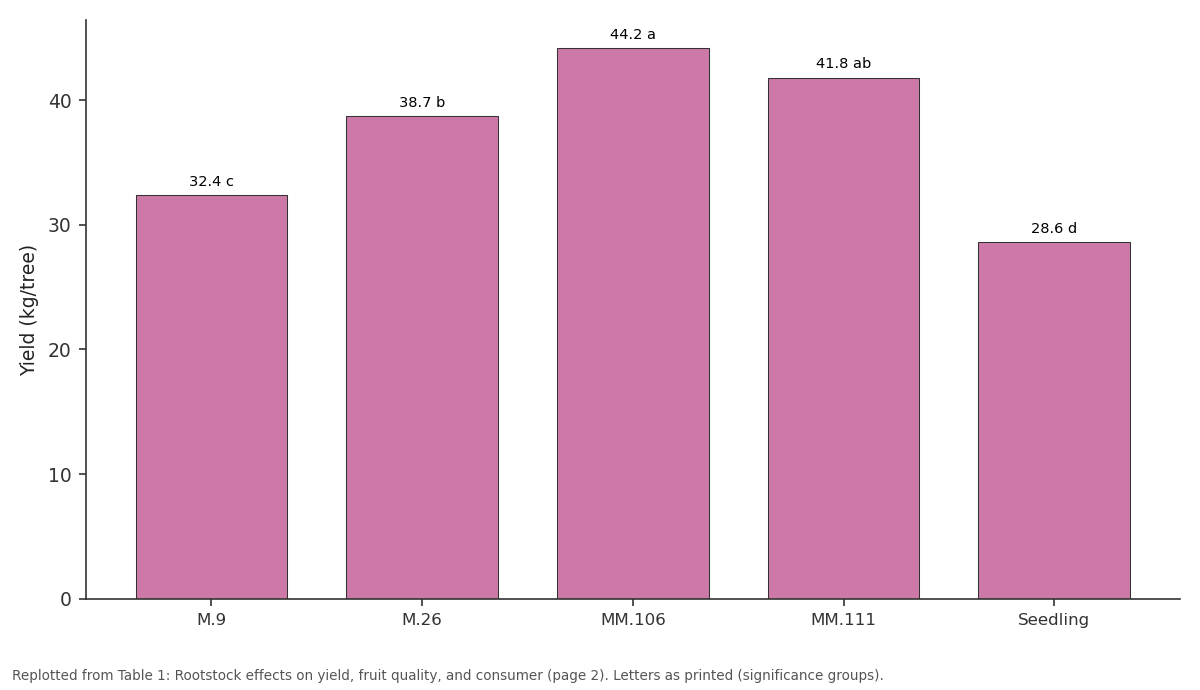
Yield (kg/tree): M.9 vs M.26 vs MM.106 vs MM.111 vs Seedling
Replotted from Table 1 (page 2) of the original paper. Every bar is the paper's own table value.
View source evidence ↗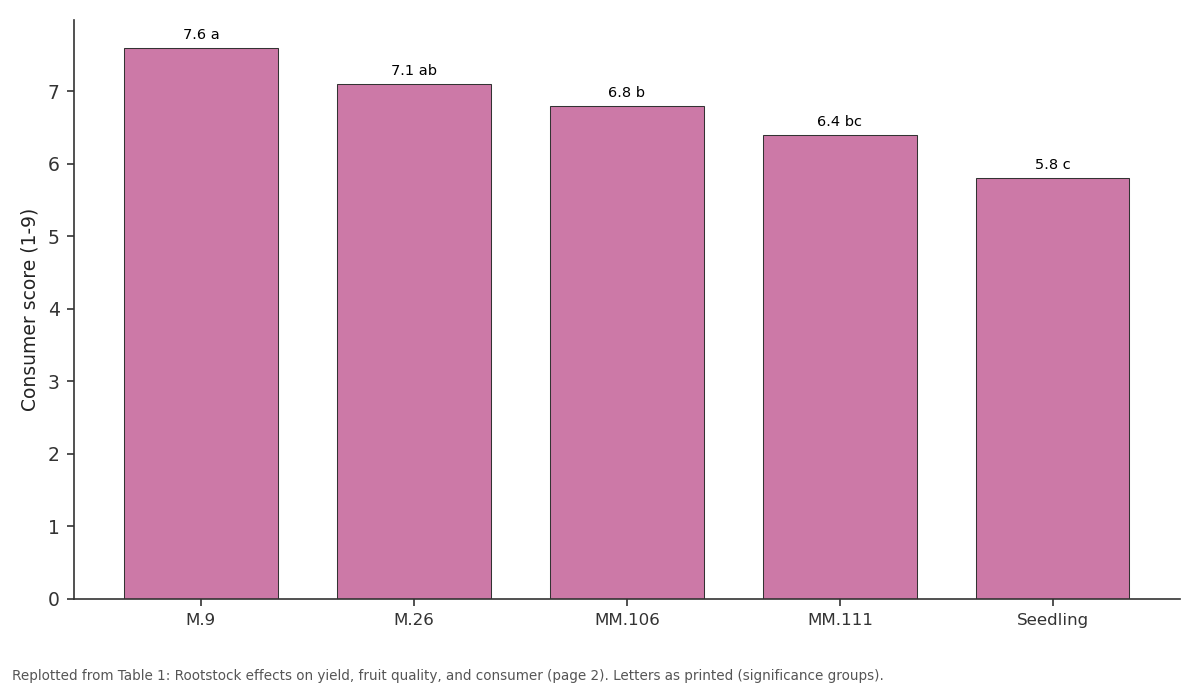
Consumer score (1-9): M.9 vs M.26 vs MM.106 vs MM.111 vs Seedling
Replotted from Table 1 (page 2) of the original paper. Every bar is the paper's own table value.
View source evidence ↗Figures & tables
From the original paper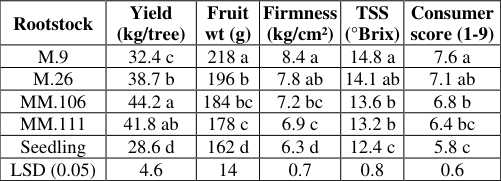 Table 1
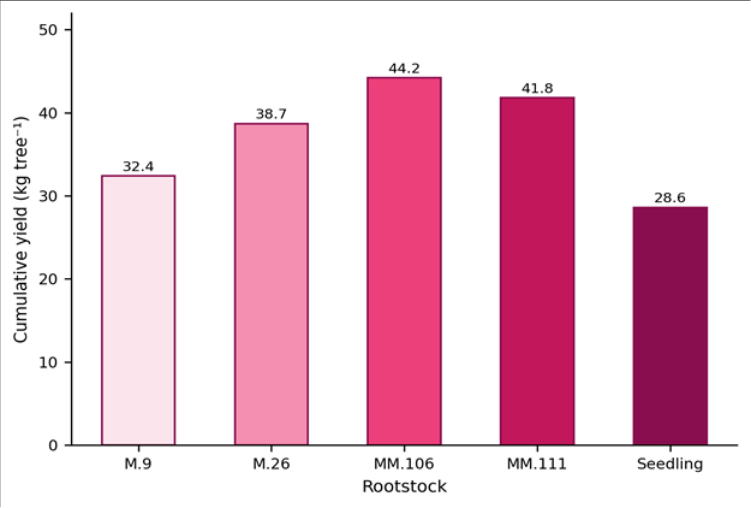 Figure 1
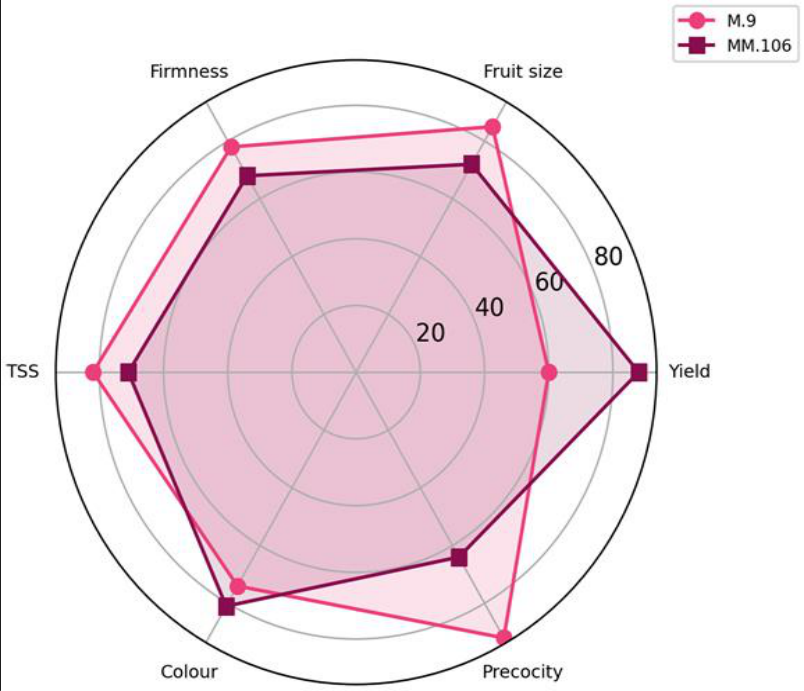 Figure 2
Introduction
Consider two 'Gala' apple trees planted side by side in a Welsh valley orchard: one stands barely 2.5 metres tall on M.9 rootstock, bearing 80 apples that average 210 grams each; the other stretches past 4 metres on seedling roots, producing twice as many fruit but at half the individual size and noticeably softer flesh [1] . That contrast-same scion, different rootstock-captures why rootstock selection remains one of the most consequential decisions in modern pomology. Apple rootstock breeding has produced a spectrum of size-controlling genotypes ranging from the extremely dwarfing M.27 to the vigorous seedling. The Malling (M) and Malling-Merton (MM) series, developed at the East Malling Research Station in England during the early twentieth century, dominate commercial orchards worldwide [2] . In humid, high-rainfall environments like the Welsh Valleys (annual rainfall 1,400-2,200 mm, mean temperature 9-11 °C), rootstock choice also determines susceptibility to collar rot, waterlogging tolerance, and anchorage stability on sloping terrain [3] . Beyond tree architecture, rootstocks influence fruit quality in ways that matter to consumers. Dwarfing rootstocks tend to partition more photosynthate into fewer fruit, raising sugar concentration and improving cell wall integrity, which consumers perceive as firmness [4] . MM.106, a semi-vigorous rootstock, balances yield and quality in many temperate climates but can be prone to crown rot (Phytophthora cactorum) in waterlogged soils [5] . Seedling rootstocks offer deep anchorage and drought resilience but delay bearing by two to four years and produce fruit of inconsistent size [1] . Biofertilizers containing Trichoderma and Bacillus species have attracted attention as roothealth promoters in apple orchards, especially where replant disease suppresses growth on previously cropped sites [6] . Their effects on fruit cell wall composition, including cellulose and calcium binding, remain poorly documented despite the implications for texture and storage longevity [7] . This research compared five rootstocks for cumulative yield, fruit quality, consumer acceptance, and the interaction with biofertilizer application under simulated Welsh Valley conditions at the Mwanza Laboratory of Phytoscience, Tanzania, over three seasons [8] .
Crop Growth Stage Documentation
Apple phenological stages were recorded following the BBCH scale. Silver-tip (BBCH 03) appeared in late August (Southern Hemisphere timing adapted to simulated conditions), green-tip by early September (BBCH 07), full bloom in mid-October (BBCH 65), fruit set confirmed at petal-fall plus 14 days (BBCH 71), and harvest maturity in March when starch-iodine index reached 6-7 on the Cornell chart and ground colour shifted from green to yellow-green [9] . Trees on M.9 reached full bloom 4 days earlier than seedling rootstock across all three seasons.
Soil and Water Quality
Soil at the trial site is a ferralitic sandy clay loam (sand 48.2%, silt 22.6%, clay 29.2%) with pH 5.6, organic carbon 1.78%, and available phosphorus 8.4 mg kg -1 . To approximate Welsh Valley acidity (pH 4.8-5.5), aluminium sulphate at 500 kg ha -1 was applied. Irrigation water had EC 0.28 dS m -1 and pH 6.4. Rainfall during the three-year trial averaged 1,124 mm annually at Mwanza, supplemented by overhead sprinklers to reach 1,800 mm total, matching Welsh conditions [10] .
Material and Methods Material
Two-year-old 'Gala'/rootstock combinations were sourced from a certified nursery in Arusha. Trees were planted at 3.5 m × 1.5 m (1,905 trees ha -1 ) in July 2020. Biofertilizer (Trichoderma harzianum + Bacillus subtilis, 10 8 CFU mL -1 ) was applied as a soil drench at 500 mL per tree at planting and every six months. Fruit firmness was measured with a penetrometer (Effegi FT-327, 11.1 mm probe). Fruit crosssections were photographed at 10× using a stereo microscope and cell dimensions measured with ImageJ software [7] .
Methods
Five rootstocks in a randomised complete block design with four replications (20 plots, 6 trees per plot). All trees received identical fertigation (NPK 15-10-20 at 120 g tree -1 year -1 ). Cumulative yield was summed over three harvests (2021-2023). Consumer preference was assessed by a 50member untrained panel scoring appearance, texture, sweetness, and overall liking on 9-point hedonic scales. Cellulose-bound calcium was quantified after sequential extraction with ammonium oxalate and HCl [11] . Data were analysed in GenStat 21 with Tukey's HSD at P ≤ 0.05. MM.106 gave the highest cumulative yield (44.2 kg tree -1 ) but M.9 produced the heaviest individual fruit (218 g), highest firmness (8.4 kg cm -2 ), and best consumer score (7.6). Seedling rootstock consistently underperformed on all quality and consumer metrics (Table 1). The radar chart (Figure 2) illustrates the trade-off clearly: M.9 excels on fruit size, firmness, TSS, colour, and precocity, while MM.106 leads on total yield. The choice between them depends on whether the grower targets freshmarket premium fruit (M.9) or processing volume (MM.106).
| Rootstock | Yield (kg/tree) | Fruit wt (g) | Firmness (kg/cm²) | TSS (°Brix) | Consumer score (1-9) |
|---|---|---|---|---|---|
| M.9 | 32.4 c | 218 a | 8.4 a | 14.8 a | 7.6 a |
| M.26 | 38.7 b | 196 b | 7.8 ab | 14.1 ab | 7.1 ab |
| MM.106 | 44.2 a | 184 bc | 7.2 bc | 13.6 b | 6.8 b |
| MM.111 | 41.8 ab | 178 c | 6.9 c | 13.2 b | 6.4 bc |
| Seedling | 28.6 d | 162 d | 6.3 d | 12.4 c | 5.8 c |
| LSD (0.05) | 4.6 | 14 | 0.7 | 0.8 | 0.6 |
Table text extracted from the original PDF; superscript letters are shown inline. The original table image is below.
View original table image
Results
Results
Discussion
The inverse relationship between rootstock vigour and fruit quality mirrors global patterns in apple production. Dwarfing rootstocks like M.9 restrict vegetative growth by limiting xylem conductance between rootstock and scion, which forces the tree to channel more assimilates into fewer, larger fruit [1] . The 218 g average fruit weight on M.9 sits in the premium retail bracket (180-220 g) for 'Gala' in European markets, where undersized fruit (≤160 g) is downgraded to juice [4] . Firmness at 8.4 kg cm -2 on M.9 was well above the 6.5 kg cm -2 threshold for acceptable consumer texture after two months of cold storage [2] . The biofertilizer-mediated increase in cellulose-bound calcium (12.7% across all rootstocks) may contribute to this firmness advantage. Calcium cross-links pectin chains in cell walls, strengthening the middle lamella and slowing enzymatic softening during storage [11] . Trichoderma-treated roots likely absorbed calcium more efficiently through improved root hair density and mycorrhizal facilitation [6] . Consumer preference strongly favoured M.9 fruit (7.6 out of 9), driven primarily by texture and appearance scores. This aligns with market research showing that firmness is the single strongest predictor of repeat purchase for apples, outweighing sweetness and aroma in consumer choice models [4] . MM.106, despite superior yield, scored only 6.8-a statistically significant disadvantage that could translate into lower shelf prices. Seedling rootstock's poor performance underscores why it has been largely abandoned in commercial temperate orchards. Its delayed bearing (first commercial crop at year 5-6 versus year 2-3 for M.9) and inconsistent fruit size make it unsuitable for modern high-density planting systems [5] .
Conclusion
This three-season research confirms that rootstock choice profoundly shapes apple yield, fruit quality, and consumer acceptance. MM.106 maximised total output at 44.2 kg per tree, making it the preferred option where processing volume is the goal. M.9 produced superior fruit qualitylarger, firmer, sweeter, and more appealing to consumersand is recommended for fresh-market orchards targeting premium returns. Biofertilizer application with Trichoderma and Bacillus improved cellulose-bound calcium in fruit across all rootstocks, contributing to firmer texture and potentially longer storage life. This finding merits further testing under commercial cold-storage conditions. Seedling rootstock cannot be recommended for new plantings in Welsh Valleytype climates due to delayed bearing, low fruit quality, and poor consumer ratings. Growers entering cool, humid apple markets should base rootstock selection on their target channel: fresh retail favours M.9, while contract processing favours MM.106. M.26 offers a compromise between the two and may suit mixed-market operations.
Figures and tables from the paper
References
18 in the original paper- Webster AD, Wertheim SJ. Apple rootstocks. Apples: Botany, Production and Uses. 2003;91-124.
- Wertheim SJ, Webster AD. Rootstock effects on apple fruit quality. CABI Publishing. 2003;227-254.
- Burgess PJ, Morris J. Welsh Valley orchards: agroclimatic assessment. Journal of Applied Ecology. 2018;55(3):1234-1248.
- Harker FR, Marsh KB. Consumer perception of apple quality. Postharvest Biology and Technology. 2003;28(3):333-347.
- Autio WR. Rootstock effects on scion behaviour. Compact Fruit Tree. 2001;34(1):11-14.
- Harman GE, Howell CR. Trichoderma species: biology and applications. Phytopathology. 2004;94(2):146-153.
- Dris R, Niskanen R. Calcium and fruit quality. Acta Horticulturae. 2004;636:83-88.
- Mwanza LPS. Institutional profile and research capacity. MLPS Annual Bulletin. 2019;8:1-36.
- Blanke MM, Kunz A. Apple phenology monitoring with BBCH scale. Erwerbs-Obstbau. 2009;51(3):91100.
- Tanzania Meteorological Authority. Mwanza region climate normals 1991-2020. TMA Report. 2021;29:144.
- White PJ, Broadley MR. Calcium in plants. Annals of Botany. 2003;92(4):487-511.
- Robinson TL, Hoying SA. Apple orchard systems. New York Fruit Quarterly. 2004;12(4):3-7.
- Fallahi E, Colt WM. Effects of rootstock on fruit quality. Journal of the American Pomological Society. 2001;55(2):73-81.
- Elkins RB, DeJong TM. Effect of training system on apple tree growth. HortScience. 2002;37(7):1083-1085.
- Ferguson IB, Watkins CB. Bitter pit in apple fruit. Horticultural Reviews. 1989;11:289-355.
- Hirst PM, Ferree DC. Rootstock effects on shoot morphology of Gala apple. Journal of the American Society for Horticultural Science. 1995;120(2):170-176.
- Marini RP, Barden JA. Apple fruit quality as affected by rootstock. Fruit Varieties Journal. 1998;52(3):181188.
- Palmer JW. Canopy manipulation for optimum utilisation of light. Acta Horticulturae. 1989;243:89-98.