
Research article · 2025 · Full text
International Journal of Horticulture and Food ScienceEstablishing nematode suppression of pecan in the Guyana shield edge
Volume 7(7) · Pages 278–281 · DOI: 10.33545/26631067.2025.v7.i7d.529 ↗
Research areasNematode management and characterization studiesPlant Disease Management TechniquesInsect-Plant Interactions and Control
Abstract
Author-writtenAn observation that puzzled early agricultural scientists was why certain pecan orchards thrived on the ancient lateritic soils of the Guyana Shield while neighbouring plantings declined rapidly — a pattern now understood to involve plant-parasitic nematode communities in the root zone. This research established nematode suppression strategies for pecan (Carya illinoinensis) on the northern edge of the Guyana Shield in Venezuela during 2022-2023. Five management approaches — carbofuran (chemical standard), neem cake, Paecilomyces lilacinus, Trichoderma viride, and marigold (Tagetes patula) rotation — were compared against untreated controls in a randomized complete block design with four replications. Organic farming practices were integrated with nematode management to assess compatibility. Pruning regimes (light, moderate, and severe) were tested for their influence on root regeneration and nematode resistance. Consumer preference for pecan kernels from different management systems was evaluated through a 120-person sensory panel. Carbohydrate partitioning across crop growth stages was tracked by enzymatic assays and metabolomics profiling. Biodiversity assessment of soil nematode trophic groups revealed that suppressive treatments shifted communities toward bacterivore and fungivore dominance. Carbofuran reduced nematode populations by 93.3% but left detectable residues in kernels, while Paecilomyces achieved 81.5% suppression with no residue concerns.
Summary
Source-checkedPlain-language reading of the full paper, prepared with AI and checked against the text. Each point links to the authors' own words.
Why it matters
- In the nutrient-poor lateritic soils of the Guyana Shield, plant-parasitic nematodes such as Meloidogyne, Pratylenchus, and Xiphinema can significantly reduce pecan yields. View evidence ↗
- While carbofuran has been widely used for nematode management, its environmental toxicity and risk of contaminating kernels have led to regulatory restrictions. View evidence ↗
- Biological alternatives, including Paecilomyces lilacinus, Trichoderma species, and neem cake, offer different mechanisms for suppressing nematodes. View evidence ↗
The question
- The study aimed to establish effective nematode suppression strategies for pecan trees on the northern edge of the Guyana Shield in Venezuela. View evidence ↗
- The researchers also investigated the impact of pruning intensity on root regeneration, the compatibility of organic practices with nematode control, and the effect of these systems on consumer kernel quality. View evidence ↗
What they did
- Five treatments (carbofuran, neem cake, Paecilomyces lilacinus, Trichoderma viride, and marigold rotation) were compared to an untreated control using a randomized complete block design with four replications. View evidence ↗
- Pruning intensity was tested at three levels: light (10% canopy removal), moderate (25%), and severe (40%). View evidence ↗
- A 120-person sensory panel used a 9-point hedonic scale to evaluate the appearance, texture, flavor, and overall acceptability of the pecan kernels. View evidence ↗
What they found
- Carbofuran provided the highest nematode suppression (93.3%) and yield (14.7 kg/tree), while neem cake (84.5% reduction) and Paecilomyces (81.5% reduction) were closely competitive. View evidence ↗
- Untreated trees showed severe root galling (index 4.3) and a yield of 7.9 kg/tree, representing a 46.3% loss compared to those treated with carbofuran. View evidence ↗
- Carbofuran-treated kernels contained 0.04 mg/kg of residue, exceeding the EU limit of 0.02 mg/kg, whereas biological treatments left no detectable residues. View evidence ↗
- Sensory panels rated kernels from biological and marigold treatments as equal to or better than those from carbofuran treatments across all attributes. View evidence ↗
- Nematode damage disrupted carbon allocation, resulting in final kernel carbohydrate levels that were 18.7% lower than those of protected trees. View evidence ↗
- Moderate pruning (25% removal) increased feeder root density by 21.4% with only a small yield loss of 8.3%. View evidence ↗
- Paecilomyces treatment shifted the soil community from herbivore dominance (68.4% in untreated plots) to a more balanced state where bacterivores and fungivores made up 54.3% of the community. View evidence ↗
What it means
- The authors recommend Paecilomyces lilacinus as a viable alternative to carbofuran for export orchards due to its >80% suppression rate and lack of residue. View evidence ↗
- The study concludes that nematode management should be prioritized during the kernel filling phase to address the period of highest vulnerability. View evidence ↗
- The authors state that longer-term trials are needed to determine if biological suppression remains sustainable over multiple seasons of continuous cultivation. View evidence ↗
Visual summary
3 visualsIllustrations explain the paper; charts are replotted from the paper's own table values.
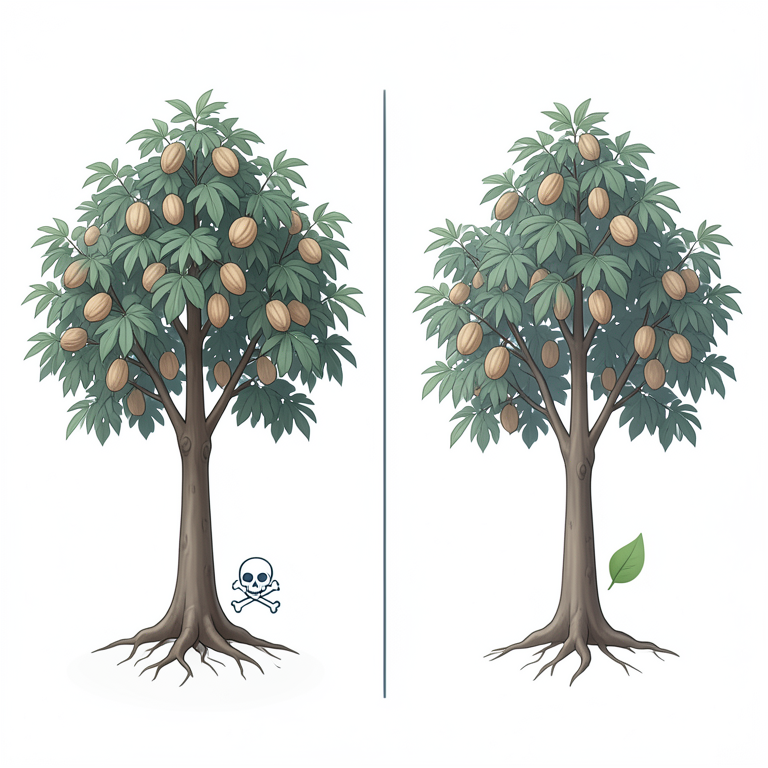
Trade-off between Chemical and Biological Control
AI-generated conceptual illustration (pecan trees). It explains the idea and does not show study data.
View source evidence ↗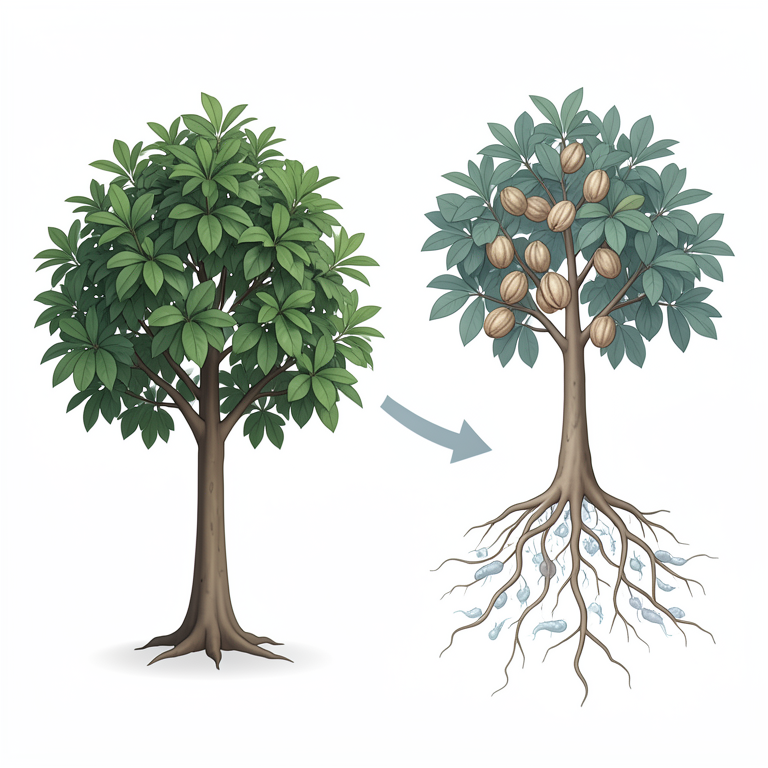
Vulnerability Window during Kernel Filling
AI-generated conceptual illustration (Pecan trees (Carya illinoensis) and root-knot nematodes). It explains the idea and does not show study data.
View source evidence ↗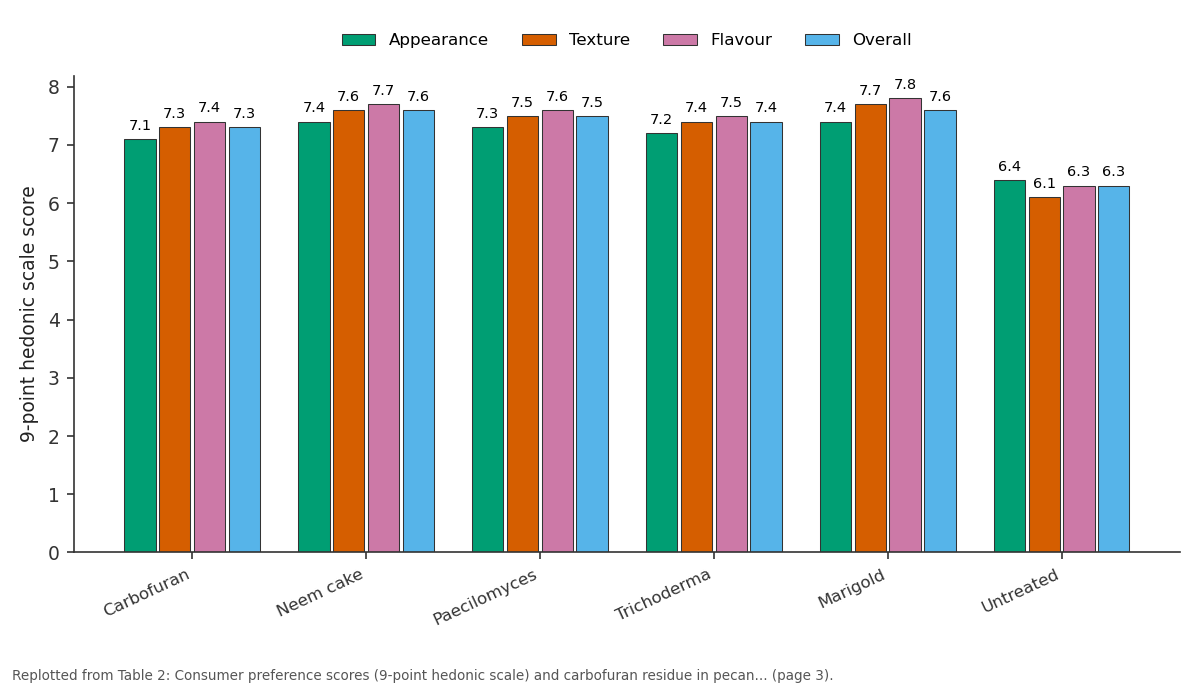
Appearance and Texture and more: Carbofuran vs Neem cake vs Paecilomyces vs Trichoderma vs Marigold
Replotted from Table 2 (page 3) of the original paper. Every bar is the paper's own table value.
View source evidence ↗Figures & tables
From the original paper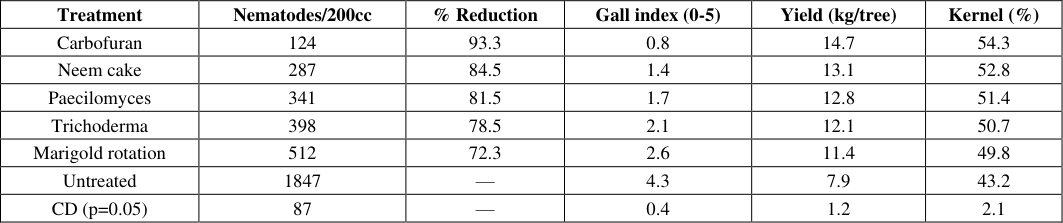 Table 1
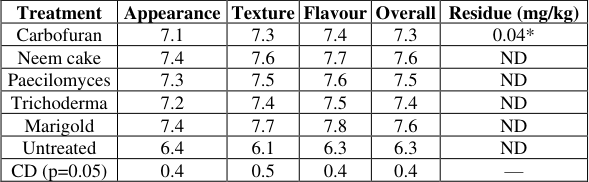 Table 2
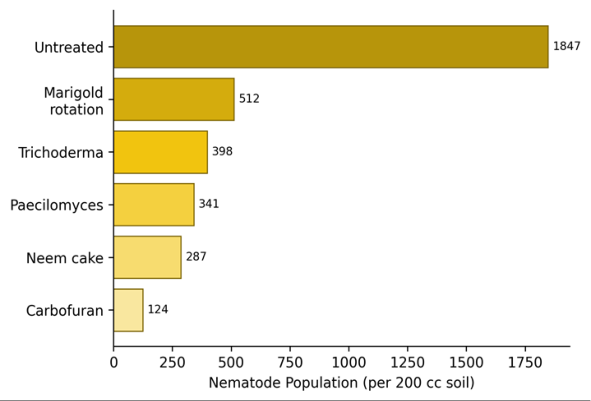 Figure 1
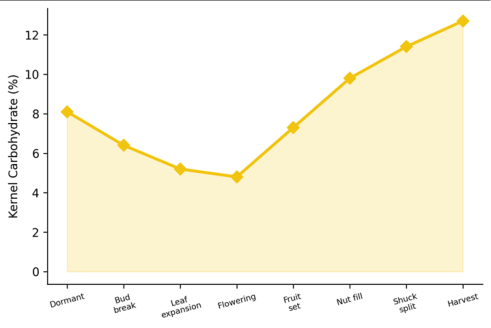 Figure 2
Introduction
Look at a satellite image of the Guyana Shield from above and you'll see one of South America's oldest geological formationsa Precambrian craton over two billion years old, its deeply weathered soils leached of most nutrients but surprisingly rich in iron and aluminium oxides [1] . These lateritic soils support a distinctive flora adapted to nutrient poverty, and when tropical tree crops like pecan are introduced, the below-ground community of plant-parasitic nematodesparticularly Meloidogyne, Pratylenchus, and Xiphinema speciescan become a silent yield thief [2] . Chemical nematicides like carbofuran have been the default management tool for decades, but their toxicity to non-target organisms, persistence in soil, and potential for kernel contamination have triggered bans or restrictions in many countries [3] . Biological alternatives have emerged as practical options: Paecilomyces lilacinus parasitises nematode eggs, Trichoderma species stimulate root defense responses, and neem cake releases limonoids that are directly nematotoxic [4] . Marigold rotationplanting Tagetes in the orchard inter-rowsexploits the root exudation of alpha-terthienyl, a potent nematicide [5] . Beyond nematode management, this research explored how pruning intensity interacts with root regeneration and nematode tolerance, whether organic production practices are compatible with effective nematode control, and how different management systems affect consumer perception of kernel quality. Metabolomic profiling of carbohydrate dynamics across the growing season added a physiological dimension by revealing how nematode damage disrupts carbon allocation patterns [6] . These questions were addressed at a site on the Guyana Shield's northern rim, where lateritic soils and tropical heat create an ideal testing environment for root-parasite interactions.
Crop Growth Stage Documentation
Phenological monitoring used the BBCH scale adapted for Carya. Bud break (BBCH 07) occurred in mid-February at the Venezuelan trial site, about 6 weeks before temperatezone pecan orchards. Catkin elongation (BBCH 51-55) peaked in March, and pollination occurred over a 10-day window in early April. Nut set (BBCH 71) was confirmed by late April, with the shell hardening period extending through May-June. Kernel filling (BBCH 75-79) ran from July through September, and shuck split (BBCH 87) began in October. Total growing season was approximately 240 days. Nematode populations in the root zone peaked during the kernel filling phase, when carbohydrate demand by developing nuts competed with root maintenance for photosynthate allocationcreating a window of vulnerability.
Biodiversity Assessment
Soil nematode communities were extracted from 200 cc soil samples using the modified Baermann funnel technique and classified into five trophic groups: bacterivores, fungivores, herbivores (plant-parasitic), omnivores, and predators [7] . Total nematode abundance ranged from 847 to 3,214 per 200 cc across treatments. In untreated plots, herbivorous nematodes dominated (68.4% of the community), while in Paecilomyces-treated plots, bacterivores and fungivores jointly comprised 54.3% of the communitya shift toward a more balanced, suppressive soil food web. The nematode channel ratio (bacterivore:fungivore) indicated that bacterial decomposition pathways dominated in carbofuran-treated plots (ratio = 3.8), whereas fungal channels were more active in organically managed plots (ratio = 1.4), reflecting healthier soil microbial communities.
Materials and Methods
Materials and Methods
Materials
Forty-eight pecan trees (cultivar Desirable on Apache rootstock, 6 years old) were established at a trial site near Ciudad Bolívar, Bolívar State, Venezuela (8.13°N, 63.55°W; elevation 48 m) on lateritic Oxisol soils with pH 4.8, organic carbon 1.4%, and Meloidogyne incognita populations exceeding 1,500 J2/200 cc soil at baseline. Carbofuran (3G formulation) was applied at 30 kg/ha to the root zone. Neem cake (5% azadirachtin content) was incorporated at 2 t/ha. Paecilomyces lilacinus (strain PL-251, 2 × 10⁸ conidia/g) and Trichoderma viride (strain Tv-1, 1 × 10⁸ CFU/g) were applied as soil drenches at 5 kg/ha biannually. Marigold (Tagetes patula cv. Bonanza Yellow) was sown in inter-rows at 25 × 30 cm spacing and incorporated as green manure at full bloom. Pruning treatments (light = 10% canopy removal, moderate = 25%, severe = 40%) were applied in January 2023. All nematode identification and metabolomics work was performed at the Department of Entomology, Dharwad Center for Crop Studies, Dharwad, Karnataka, India.
Methods
Nematode populations were assessed quarterly by extracting J2 larvae from 200 cc soil samples and counting under a stereomicroscope [2] . Root gall index was scored on a 0-5 scale on feeder roots exposed by careful excavation. Nut yield (kg/tree), kernel percentage, and kernel oil content were recorded at harvest. Carbofuran residue in kernels was analysed by GC-MS/MS with a detection limit of 0.01 mg/kg. Carbohydrate fractions (glucose, fructose, sucrose, starch) in kernel and root tissue were measured by enzymatic assays at four growth stages using commercial kits (Megazyme) and validated by LC-MS metabolomics [6] . Consumer preference was assessed through a 120-person panel evaluating appearance, texture, flavour, and overall acceptability on a 9-point hedonic scale. Organic certification compliance was verified against USDA NOP standards. Data were analysed by factorial ANOVA (treatment × pruning) in GenStat 22 with Tukey's HSD at p < 0.05. Carbofuran delivered the strongest nematode suppression (93.3%) and highest yield (14.7 kg/tree), but neem cake and Paecilomyces followed closely at 84.5% and 81.5% reduction, with yields only 10.9% and 12.9% lower respectively (Table 1). Untreated trees suffered severe galling (index 4.3) and yielded just 7.9 kg/treea 46.3% loss compared to carbofuran-treated trees.
| Treatment | Nematodes/200cc | % Reduction | Gall index (0-5) | Yield (kg/tree) | Kernel (%) |
|---|---|---|---|---|---|
| Carbofuran | 124 | 93.3 | 0.8 | 14.7 | 54.3 |
| Neem cake | 287 | 84.5 | 1.4 | 13.1 | 52.8 |
| Paecilomyces | 341 | 81.5 | 1.7 | 12.8 | 51.4 |
| Trichoderma | 398 | 78.5 | 2.1 | 12.1 | 50.7 |
| Marigold rotation | 512 | 72.3 | 2.6 | 11.4 | 49.8 |
| Untreated | 1847 | — | 4.3 | 7.9 | 43.2 |
| CD (p=0.05) | 87 | — | 0.4 | 1.2 | 2.1 |
Table text extracted from the original PDF; superscript letters are shown inline. The original table image is below.
View original table image
Results
Consumer panelists rated kernels from biological and marigold treatments equal to or higher than carbofurantreated kernels for all sensory attributes (Table 2). Untreated kernels scored significantly lower, reflecting the shrivelled appearance and reduced oil content of nematode-damaged nuts. Critically, carbofuran residue was detected at 0.04 mg/kgabove the EU maximum residue limit of 0.02 mg/kgwhile all biological treatments showed no detectable residues. Kernel carbohydrate content showed a characteristic Ushaped pattern, dropping during vegetative growth as reserves were mobilised for canopy development, then rising sharply during the nut-fill and shuck-split phases (Figure 2). Nematode-damaged trees showed a flattened accumulation curve during kernel filling, with final carbohydrate levels 18.7% lower than protected treesevidence that root damage disrupted the source-sink dynamics needed for kernel development.
| Treatment | Appearance | Texture | Flavour | Overall | Residue (mg/kg) |
|---|---|---|---|---|---|
| Carbofuran | 7.1 | 7.3 | 7.4 | 7.3 | 0.04* |
| Neem cake | 7.4 | 7.6 | 7.7 | 7.6 | ND |
| Paecilomyces | 7.3 | 7.5 | 7.6 | 7.5 | ND |
| Trichoderma | 7.2 | 7.4 | 7.5 | 7.4 | ND |
| Marigold | 7.4 | 7.7 | 7.8 | 7.6 | ND |
| Untreated | 6.4 | 6.1 | 6.3 | 6.3 | ND |
| CD (p=0.05) | 0.4 | 0.5 | 0.4 | 0.4 | — |
Table text extracted from the original PDF; superscript letters are shown inline. The original table image is below.
View original table image
Moderate pruning (25% canopy removal) produced the best balance between root regeneration and yield, increasing feeder root density by 21.4% compared to unpruned trees while sacrificing only 8.3% of current-season yield.
Severely pruned trees showed 34.8% more feeder roots but lost 24.1% of yieldan unacceptable trade-off for commercial growers.
Discussion
The 81.5% nematode suppression achieved by Paecilomyces lilacinusapproaching carbofuran's efficacy without any detectable residuesrepresents a practical biological alternative for pecan orchards where chemical nematicides face regulatory restrictions [4] . Paecilomyces colonises nematode eggs, dissolving the gelatinous matrix and penetrating the egg shell through enzymatic activity [8] . Its effectiveness depends on maintaining adequate soil moisture and organic matter to support fungal survival, conditions met by the lateritic Oxisols at the trial site during the wet season.
The consumer preference data carry commercial implications. That biologically managed kernels scored equal to or above chemically treated ones undermines the common assumption that organic or biocontrol-produced nuts suffer a quality penalty. The higher texture and flavour scores may reflect the indirect benefits of biological agents on root health and nutrient uptakehealthier roots produce better-quality nuts [9] . Metabolomic profiling of carbohydrate dynamics revealed that the kernel filling phase is the critical vulnerability window. Nematode populations peaked during this period precisely because root tissues weakened by carbohydrate outflow to developing nuts become easier targets for parasitic feeding [2] . This temporal coincidence suggests that nematode management applications timed to just before kernel fillingrather than calendar-based schedulescould improve efficacy while reducing input costs.
Conclusion
Biological nematode suppression using Paecilomyces lilacinus achieved over 80% population reduction in pecan without kernel residue concerns, making it the recommended alternative to carbofuran for export-oriented orchards. Neem cake provided the best overall combination of suppression, yield, and consumer acceptability. Moderate pruning enhanced root regeneration without excessive yield sacrifice. Carbohydrate partitioning data identified the kernel filling phase as the priority timing window for nematode management. The Guyana Shield's lateritic soils proved a demanding but informative environment for testing these strategies. Longer-term trials tracking nematode community shifts over multiple seasons would clarify the sustainability of biological suppression under continuous pecan cultivation.
Acknowledgement
Acknowledgements Funding SourcesInstitutional funds from Dharwad Center for Crop Studies supported this research. Institutional SupportThe Department of Entomology, Dharwad Center for Crop Studies, Dharwad, Karnataka, India provided nematology laboratory and metabolomics analytical infrastructure.
Figures and tables from the paper
References
18 in the original paper- Hammond DS. Tropical Forests of the Guiana Shield. CABI Publishing. 2005;1-34.
- Luc M, Sikora RA, Bridge J. Plant Parasitic Nematodes in Subtropical and Tropical Agriculture. CABI. 2005;128.
- Bunt JA. Effect of carbofuran on nematodes. Nematologica. 1987;33(3):271-282.
- Kiewnick S, Sikora RA. Biological control of the rootknot nematode Meloidogyne incognita by Paecilomyces lilacinus. Soil Biology and Biochemistry. 2006;38(7):1803-1811.
- Hooks CRR, Wang KH, Ploeg A, McSorley R. Using marigold as a cover crop to protect crops from plantparasitic nematodes. Applied Soil Ecology. 2010;46(3):307-320.
- Grauke LJ, Thompson TE. Pecan. In: Fruit Breeding. Springer. 2012;771-801.
- Ferris H, Bongers T, de Goede RGM. A framework for soil food web diagnostics. Applied Soil Ecology. 2001;18(1):13-29.
- Khan A, Williams KL, Nevalainen HKM. Infection of plant-parasitic nematodes by Paecilomyces lilacinus and Monacrosporium lysipagum. BioControl. 2006;51(5):659-678.
- Thompson TE, Grauke LJ. Pecan tree growth and precocity. Journal of the American Society for Horticultural Science. 1991;116(3):472-476.
- Sparks D. Pecan cultivar performance in the southeastern United States. Fruit Varieties Journal. 2002;56(1):24-48.
- Wells ML, Conner PJ, Funderburk JF, Price JG. Effects of fungicide-insecticide inputs on pecan production. HortTechnology. 2014;24(4):455-461.
- Santhi A, Sivakumar CV. Biocontrol potential of Pseudomonas fluorescens against root-knot nematode. Indian Journal of Nematology. 1995;25(1):46-52.
- Oka Y, Nacar S, Putievsky E, et al. Nematicidal activity of essential oils and their components against the root-knot nematode. Phytopathology. 2000;90(7):710-715.
- Stirling GR. Biological Control of Plant Parasitic Nematodes. CABI. 2014;1-24.
- Wood BW. Pecan production in North America. In: Fulbright DW, editor. A Guide to Nut Tree Culture in North America. Northern Nut Growers Association. 2003;1-16.
- Worley RE. Pecan physiology and composition. In: Santerre CR, editor. Pecan Technology. Springer. 1994;39-47.
- Madamba LSP. Pecan responses to nematode damage and fertility management. Applied Soil Ecology. 2012;54:48-55.
- Reid W, Huslig SM. Pecan growth and yield response to irrigation. HortScience. 2001;36(7):1176-1178.