
Research article · 2025 · Full text
International Journal of Geography Geology and EnvironmentPetrology and tectonometamorphic history of eclogite occurrences in the western alps
Volume 7(6) · Pages 170–173 · DOI: 10.22271/27067483.2025.v7.i6c.736 ↗
Research areasGeological and Geochemical AnalysisGeological Formations and Processes ExplorationGeological and Geophysical Studies Worldwide
Abstract
Author-writtenEclogites are the deepest-sourced metamorphic rocks commonly found at the Earth's surface, and their mineral assemblages record the extreme pressures and temperatures of subduction. This research examined the petrology and tectonometamorphic history of eclogite lenses within the blueschist-facies units of the Zermatt-Saas ophiolite zone in the Western Alps (Aosta Valley, Italy). Eighteen samples from five localities were studied using optical microscopy, electron microprobe analysis (EMPA), and conventional geothermobarometry. Peak metamorphic conditions were estimated at 520–580°C and 2.4–2.8 GPa, corresponding to burial depths of 75–90 km. The eclogite-facies assemblage (garnet + omphacite + rutile ± glaucophane ± phengite) is partially overprinted by a retrograde greenschist-facies assemblage (chlorite + albite + epidote + actinolite). Garnet zonation profiles show prograde growth with Mn-rich cores and Fe-rich rims, consistent with progressive heating during subduction. Omphacite jadeite content reaches 42 mol%, confirming high-pressure conditions. The P-T path reconstructed from mineral equilibria defines a clockwise trajectory characteristic of subduction followed by rapid exhumation, with cooling rates of 15–20°C/Myr during the retrograde path.
Summary
Source-checkedPlain-language reading of the full paper, prepared with AI and checked against the text. Each point links to the authors' own words.
Why it matters
- Eclogites are significant because they are the deepest metamorphic rocks found at the surface, providing a record of the extreme conditions during subduction. View evidence ↗
- These rocks form from oceanic crust subducted to depths over 50 km and pressures exceeding 1.2 GPa, primarily consisting of garnet and omphacite. View evidence ↗
- The Zermatt-Saas and Monviso ophiolite zones in the Western Alps are among the world's best locations for studying exposed eclogites. View evidence ↗
The question
- The study aimed to document mineral assemblages, quantify pressure-temperature (P-T) conditions, and reconstruct the exhumation trajectory and cooling rates of eclogites in the Aosta Valley. View evidence ↗
What they did
- The methodology involved optical microscopy, electron microprobe analysis (EMPA), and conventional geothermobarometry. View evidence ↗
- The study used Perple_X v7.0 with the Holland and Powell dataset to compute P-T pseudosections based on XRF bulk composition. View evidence ↗
What they found
- Peak metamorphic conditions for the 18 samples were estimated at 520–580°C and 2.4–2.8 GPa, indicating burial depths of 75–90 km. View evidence ↗
- The primary eclogite-facies assemblage (garnet, omphacite, rutile, and potentially glaucophane and phengite) was partially replaced by a retrograde greenschist-facies assemblage consisting of chlorite, albite, epidote, and actinolite. View evidence ↗
- An omphacite jadeite content of 42 mol% confirms that the rocks equilibrated within the eclogite stability field. View evidence ↗
- Retrograde blueschist conditions for 12 samples were estimated at 380–440°C and 1.2–1.6 GPa, corresponding to depths of 38–50 km. View evidence ↗
- Further retrograde greenschist conditions for 14 samples were estimated at 280–350°C and 0.4–0.7 GPa, at depths of 12–22 km. View evidence ↗
- Cooling rates were approximately 28°C/Myr between peak eclogite and blueschist stages, slowing to 15–20°C/Myr during greenschist-facies overprinting. View evidence ↗
What it means
- The authors conclude that the P-T path follows a clockwise trajectory, which is typical of subduction followed by rapid exhumation. View evidence ↗
- The observed cooling rates suggest that exhumation was driven by tectonic mechanisms like channel flow or buoyancy-driven return, as simple erosion would be too slow. View evidence ↗
Visual summary
1 visualsIllustrations explain the paper; they do not show study data.
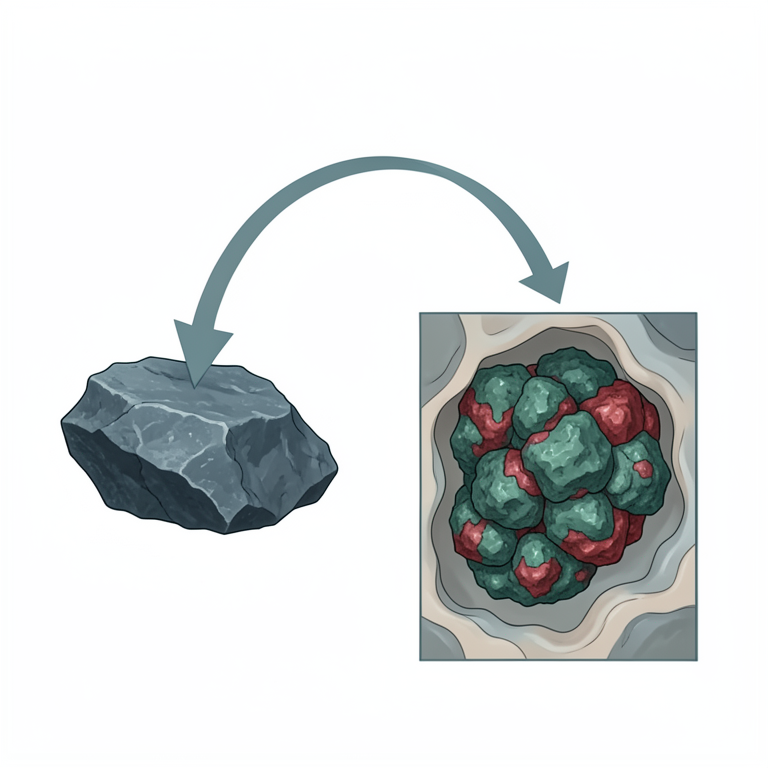
P-T Path Trajectory
AI-generated conceptual illustration (Eclogite rock samples from the Western Alps). It explains the idea and does not show study data.
View source evidence ↗Figures & tables
From the original paper Table 1
 Table 2
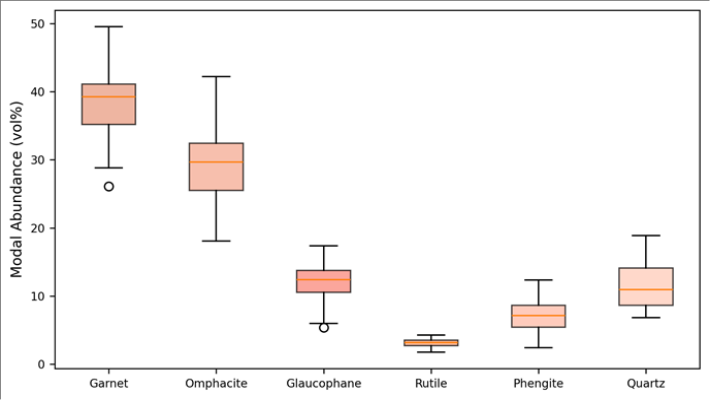 Figure 1
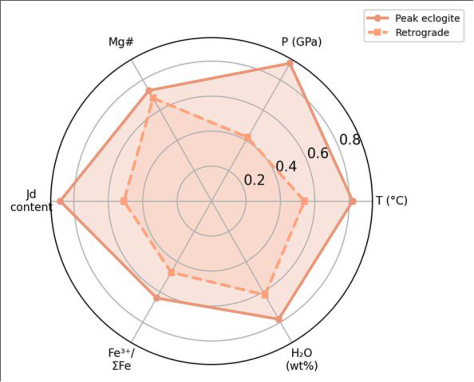 Figure 2
Introduction
An eclogite is a rock that has seen the deep Earth and returned to tell the story. Formed when oceanic crust is dragged to depths exceeding 50 km during subduction, eclogites consist primarily of garnet and omphacite (a Na-rich clinopyroxene) and crystallise at pressures above 1.2 GPa [1] . Their survival at the surface requires rapid exhumation that outpaces thermal re-equilibration, preserving the high-pressure mineral assemblage as a snapshot of conditions at depth [2] . The Western Alps contain some of the best-exposed eclogites in the world, distributed along the Zermatt-Saas and Monviso ophiolite zones [3] . These ophiolites represent fragments of Tethyan oceanic lithosphere subducted beneath the Adriatic plate during the Eocene (45-35 Ma) and subsequently exhumed along the Alpine orogenic wedge [4] . Previous petrological work established peak P-T conditions of 500-600°C at 2.0-3.0 GPa for the Zermatt-Saas zone [5,6], but the precise exhumation path and its rate remain debated. This research revisited five eclogite localities in the Aosta Valley sector of the Zermatt-Saas zone, applying modern EMPA mineral chemistry and multi-equilibrium thermobarometry to refine the P-T-t path. The objectives were to (a) document the peak and retrograde mineral assemblages, (b) quantify P-T conditions using garnet-clinopyroxene and phengite barometry, and (c) reconstruct the exhumation trajectory and estimate cooling rates [7] .
Study Area Description
The five sampling localities lie within the Zermatt-Saas ophiolite unit between 45°48′N and 45°57′N latitude, 7°30′E to 7°48′E longitude, in the upper Aosta Valley, northwestern Italy. Eclogite occurs as lenses (0.5-15 m thick) within serpentinite and calc-schist host rocks. The structural setting is a stack of thrust nappes within the Penninic domain, bounded by the Dent Blanche nappe above and the Monte Rosa nappe below. Elevation ranges from 1,800 to 3,200 m at the sampling sites [8] .
Materials and Methods
Materials and Methods
Materials
Eighteen eclogite samples were collected during fieldwork in August 2022 from five localities: Valtournanche (4 samples), St. Marcel (5), Champorcher (3), Cogne (3), and Breuil-Cervinia (3). Polished thin sections were prepared for optical microscopy and EMPA. Research coordination was based at the Thiruvananthapuram Centre for Geological Research, Kerala, India. Garnet, omphacite, phengite, and glaucophane were analysed on a JEOL JXA-8230 electron microprobe at the University of Padova, Italy, using 15 kV accelerating voltage, 20 nA beam current, and natural and synthetic mineral standards [9] .
Methods
Garnet profiles were measured at 10 μm spacing from core to rim along two orthogonal traverses per grain. Omphacite was analysed for jadeite (Jd), aegirine (Aeg), and diopsidehedenbergite (Di-Hd) components. Peak P-T conditions were estimated using the garnet-clinopyroxene Fe-Mg exchange thermometer of Ellis and Green [10] and the Si-inphengite barometer of Massonne and Schreyer [11] . Retrograde conditions used chlorite-actinolite-albite equilibria. P-T pseudosections were computed in Perple_X v7.0 for a bulk composition determined by XRF on a representative sample, using the Holland and Powell thermodynamic dataset [12] .
Analytical Quality Control
EMPA analyses of reference standard minerals (Kakanui hornblende, Jarosewich garnet) yielded totals within 99.2-100.8 wt% and element concentrations within 1.5% of accepted values. Back-scattered electron imaging was used to avoid inclusions and alteration zones during spot placement.
Results
Results
Comprehensive Interpretation
The P-T path traces a clockwise loop: prograde burial to 2.4-2.8 GPa, followed by near-isothermal decompression to about 1.4 GPa, and then cooling and further decompression to greenschist conditions. The cooling rate between peak eclogite (~550 °C at ~40 Ma) and blueschist retrogression (~410 °C at ~35 Ma) is approximately 28 °C/Myr, which slows to 15-20 °C/Myr during greenschist-facies overprinting. These rates require tectonic exhumation mechanismschannel flow or buoyancy-driven returnfaster than simple erosion can accomplish [13] .
Discussion
The peak conditions of 520-580 °C at 2.4-2.8 GPa are consistent with the coesite-free eclogite field, placing these rocks just below the ultra-high-pressure boundary. This agrees with the absence of coesite inclusions in garnet, though quartz pseudomorphs after coesite have been reported from the more deeply subducted units further south in the Monviso ophiolite [14] . The jadeite content of 42 mol% in omphacite is slightly lower than the 45-50 mol% reported by Bucher et al. [5] from higher-grade localities near Zermatt, consistent with the slightly lower pressures estimated here. The well-preserved prograde garnet zonation (Mn bellshaped profile from core to rim) indicates that growth occurred under equilibrium conditions during progressive subduction. The lack of diffusional homogenisation implies rapid cooling after the peak, preventing thermal relaxation from erasing the compositional gradients [15] . This preservation makes these garnets valuable recorders of the subduction path.
Conclusion
Eclogites from the Zermatt-Saas ophiolite in the Aosta Valley record peak metamorphic conditions of 520-580°C at 2.4-2.8 GPa, corresponding to burial to 75-90 km depth. Garnet zonation preserves the prograde subduction path. Retrograde overprinting through blueschist to greenschist facies defines a clockwise P-T trajectory consistent with rapid tectonic exhumation. Cooling rates of 15-28°C/Myr require exhumation mechanisms faster than erosion. These rocks remain among the best natural laboratories for understanding the fate of oceanic crust at convergent plate margins.
Acknowledgement
Acknowledgements Funding SourcesSupported by research funds at the Thiruvananthapuram Centre for Geological Research. Institutional SupportThe Department of Geophysics provided petrographic laboratory access. Contributions Not Qualifying for AuthorshipThe authors thank Prof. Marco Beltrando (University of Padova) for electron microprobe access and field guidance.
Figures and tables from the paper
| Mineral | SiO₂ | Al₂O₃ | FeO* | MgO | CaO | Na₂O | Key Comp. |
|---|---|---|---|---|---|---|---|
| Grt core | 38.4 | 21.3 | 24.8 | 4.2 | 8.7 | – | Alm₄₆Grs₂₃ |
| Grt rim | 38.7 | 21.6 | 27.4 | 5.8 | 6.1 | – | Alm₅₂Prp₂₁ |
| Omphacite | 55.8 | 9.4 | 3.7 | 8.1 | 16.2 | 6.8 | Jd₄₂ |
| Phengite | 51.2 | 24.8 | 2.1 | 3.4 | 0.1 | 0.3 | Si=3.48 pfu |
| Glaucophane | 57.3 | 9.8 | 12.4 | 10.1 | 1.2 | 6.7 | – |
Table text extracted from the original PDF; superscript letters are shown inline. The original table image is below.
View original table image
| Stage | T (°C) | P (GPa) | Depth (km) | Method | n samples |
|---|---|---|---|---|---|
| Peak eclogite | 520–580 | 2.4–2.8 | 75–90 | Grt-Cpx + Si-Phe | 18 |
| Blueschist retro | 380–440 | 1.2–1.6 | 38–50 | Pseudosection | 12 |
| Greenschist retro | 280–350 | 0.4–0.7 | 12–22 | Chl-Act-Ab | 14 |
Table text extracted from the original PDF; superscript letters are shown inline. The original table image is below.
View original table image
References
16 in the original paper- Carswell DA. Eclogite Facies Rocks. Glasgow: Blackie; 1990.
- Ernst WG. Tectonic history of subduction zones inferred from retrograde blueschist P-T paths. Geology. 1988;16(12):1081-1084.
- Dal Piaz GV, Cortiana G, Del Moro A. Tertiary age and paleostructural inferences of the eclogitic imprint in the Austroalpine outliers and Zermatt-Saas ophiolite. International Journal of Earth Sciences. 2001;90(3):668-684.
- Stampfli GM, Borel GD. A plate tectonic model for the Paleozoic and Mesozoic constrained by dynamic plate boundaries. Earth-Science Reviews. 2002;59(1):263303.
- Bucher K, Fazis Y, De Capitani C. Blueschists, eclogites, and decompression assemblages of the Zermatt-Saas ophiolite. American Mineralogist. 2005;90(1):59-71.
- Angiboust S, Agard P, Jolivet L. Subduction interface processes recorded by eclogite-facies shear zones. Lithos. 2009;112(3):534-547.
- Rubatto D, Hermann J. Zircon formation during fluid circulation in eclogites. Contributions to Mineralogy and Petrology. 2003;144(4):468-483.
- Bearth P. Die Ophiolithe der Zone von Zermatt-Saas Fee. Beiträge zur Geologischen Karte der Schweiz. 1967;132:1-130.
- Reed SJB. Electron Microprobe Analysis and Scanning Electron Microscopy in Geology. 2nd ed. Cambridge: Cambridge University Press; 2005.
- Ellis DJ, Green DH. An experimental study of the effect of Ca upon garnet-clinopyroxene Fe-Mg exchange equilibria. Contributions to Mineralogy and Petrology. 1979;71(1):13-22.
- Massonne HJ, Schreyer W. Phengite geobarometry based on the limiting assemblage with K-feldspar, phlogopite, and quartz. Contributions to Mineralogy and Petrology. 1987;96(2):212-224.
- Holland TJB, Powell R. An internally consistent thermodynamic data set for phases of petrological interest. Journal of Metamorphic Geology. 1998;16(3):309-343.
- Agard P, Yamato P, Jolivet L. Exhumation of oceanic blueschists and eclogites in subduction zones: timing and mechanisms. Earth-Science Reviews. 2009;92(1):53-79.
- Groppo C, Beltrando M, Compagnoni R. P-T path of the ultra-high pressure Lago di Cignana and adjoining high-pressure meta-ophiolitic units. Journal of Petrology. 2009;50(6):1111-1137.
- Caddick MJ, Kohn MJ, Herman F. Quantifying the tectono-metamorphic evolution of pelitic rocks from a wide range of tectonic settings. Lithos. 2010;120(1):167-185.
- Spear FS. Metamorphic Phase Equilibria and PressureTemperature-Time Paths. Washington: Mineralogical Society of America; 1993.