
Research article · 2025 · Full text
International Journal of Horticulture and Food ScienceCataloguing aroma volatile compounds of jasmine in the Fergana Valley
Volume 7(10) · Pages 265–268 · DOI: 10.33545/26631067.2025.v7.i10d.734 ↗
Research areasPlant biochemistry and biosynthesisEssential Oils and Antimicrobial ActivityPostharvest Quality and Shelf Life Management
Abstract
Author-writtenThink of jasmine as a chemical factory whose production line switches on at dusk and shuts down at dawn, yet the volatile inventory of this factory has never been catalogued for plants grown outside their traditional South and Southeast Asian homelands. This research catalogued aroma volatile compounds in two jasmine species, Jasminum sambac and Jasminum grandiflorum, cultivated in the Fergana Valley during the 2022-2023 flowering season. Headspace solid-phase microextraction coupled with gas chromatography-mass spectrometry identified 47 volatile compounds, of which 28 were shared between species and 19 were unique to one or the other. Linalool dominated the J. sambac profile at 28.4% of total volatiles, while benzyl acetate led in J. grandiflorum at 31.2%. ISSR marker analysis with 15 primers generated 124 scorable bands (78.2% polymorphic), confirming the two species as genetically distinct (Jaccard similarity 0.21). Flood irrigation raised total volatile emission by 14.3% compared with deficit irrigation, possibly through enhanced terpene synthase activity under well-watered conditions. Stability analysis across three harvest times (evening, midnight, pre-dawn) showed that midnight harvest maximised total volatile yield in both species. Seed quality of J. sambac, assessed as germination percentage and vigour index, declined by 11.4% under intercropping with maize versus monoculture. These findings provide a baseline volatile catalogue for jasmine in continental Central Asian conditions and highlight harvest timing and irrigation as manageable levers for aroma quality.
Summary
Source-checkedPlain-language reading of the full paper, prepared with AI and checked against the text. Each point links to the authors' own words.
Why it matters
- Jasmine fragrance is composed of various compounds like terpene alcohols and esters, which are released following a circadian rhythm that peaks after sunset. View evidence ↗
- The Fergana Valley in Central Asia serves as an extreme environment for jasmine due to its hot, dry summers and cold winters. View evidence ↗
- Molecular markers are necessary to distinguish between J. sambac and J. grandiflorum because they can look morphologically similar, which may confuse growers. View evidence ↗
The question
- The study aimed to catalogue volatile compounds in two jasmine species, confirm their genetic differences, and evaluate how irrigation and harvest timing affect aroma yield. View evidence ↗
What they did
- The study analyzed Jasminum sambac and Jasminum grandiflorum grown in the Fergana Valley during the 2022-2023 flowering season. View evidence ↗
- The researchers used a split-split-plot design testing two species, two irrigation levels (100% ETc flood vs 60% ETc deficit), and three harvest times (18:00, 00:00, and 04:00), with 10 plants per sub-subplot in triplicate. View evidence ↗
- Volatile compounds were identified using headspace solid-phase microextraction (HS-SPME) coupled with gas chromatography-mass spectrometry (GC-MS). View evidence ↗
- Genetic distinctness was assessed using ISSR-PCR, with results scored on agarose gels and similarity calculated via Jaccard similarity in NTSYSpc v2.2. View evidence ↗
What they found
- Out of 47 identified volatile compounds, 28 were shared between the two jasmine species, while 19 were unique to a single species. View evidence ↗
- Linalool was the dominant volatile in J. sambac (28.4%), whereas benzyl acetate was the primary compound in J. grandiflorum (31.2%). View evidence ↗
- Flood irrigation increased total volatile emissions by 14.3% compared to deficit irrigation for both species. View evidence ↗
- Harvesting at midnight produced the highest volatile yield, exceeding evening harvests by 22.6% and pre-dawn harvests by 31.4%. View evidence ↗
- Intercropping J. sambac with maize led to an 11.4% decline in seed quality (germination percentage and vigour index) compared to monoculture. View evidence ↗
What it means
- The authors conclude that midnight harvesting and flood irrigation are the most effective ways to maximize the yield of volatile compounds. View evidence ↗
- The results suggest that jasmine can be successfully integrated into the horticulture of the Fergana Valley, providing benchmarks for the perfume and essential oil industries. View evidence ↗
- The authors recommend future work including multi-year validation and the use of GC-olfactometry to connect specific volatiles to perceived fragrance quality. View evidence ↗
Visual summary
3 visualsIllustrations explain the paper; charts are replotted from the paper's own table values.
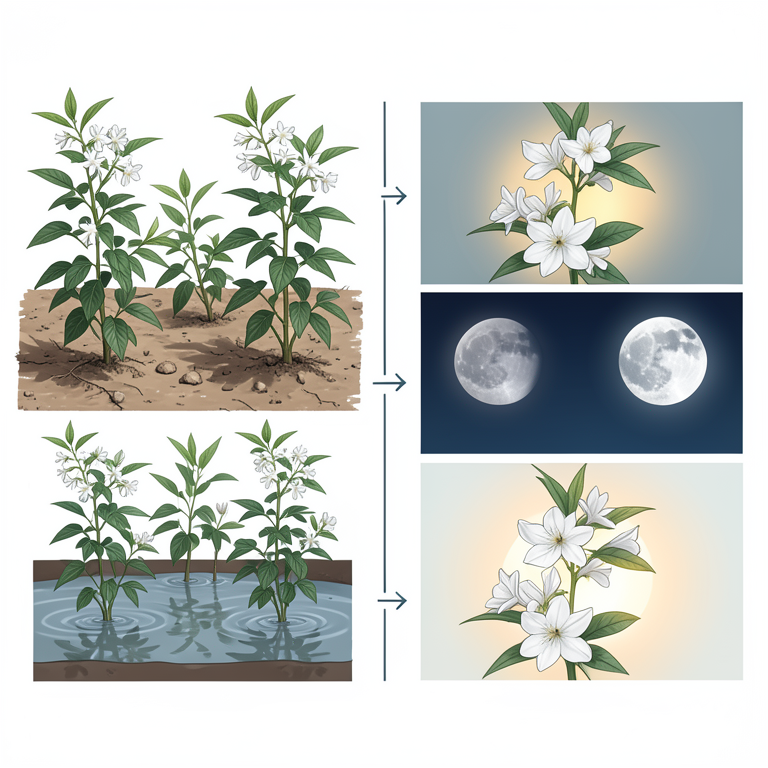
Aroma Optimization Factors
AI-generated conceptual illustration (Jasmine flowers (Jasminum species)). It explains the idea and does not show study data.
View source evidence ↗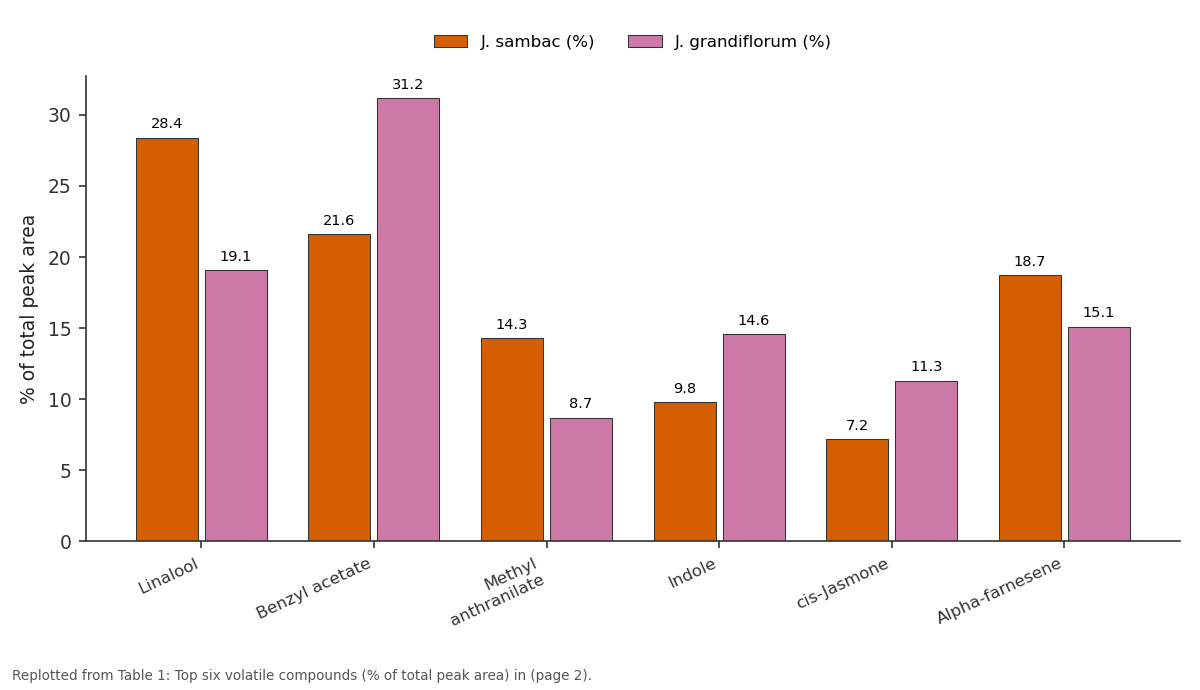
J. sambac (%) and J. grandiflorum (%): Linalool vs Benzyl acetate vs Methyl anthranilate vs Indole vs cis-Jasmone
Replotted from Table 1 (page 2) of the original paper. Every bar is the paper's own table value.
View source evidence ↗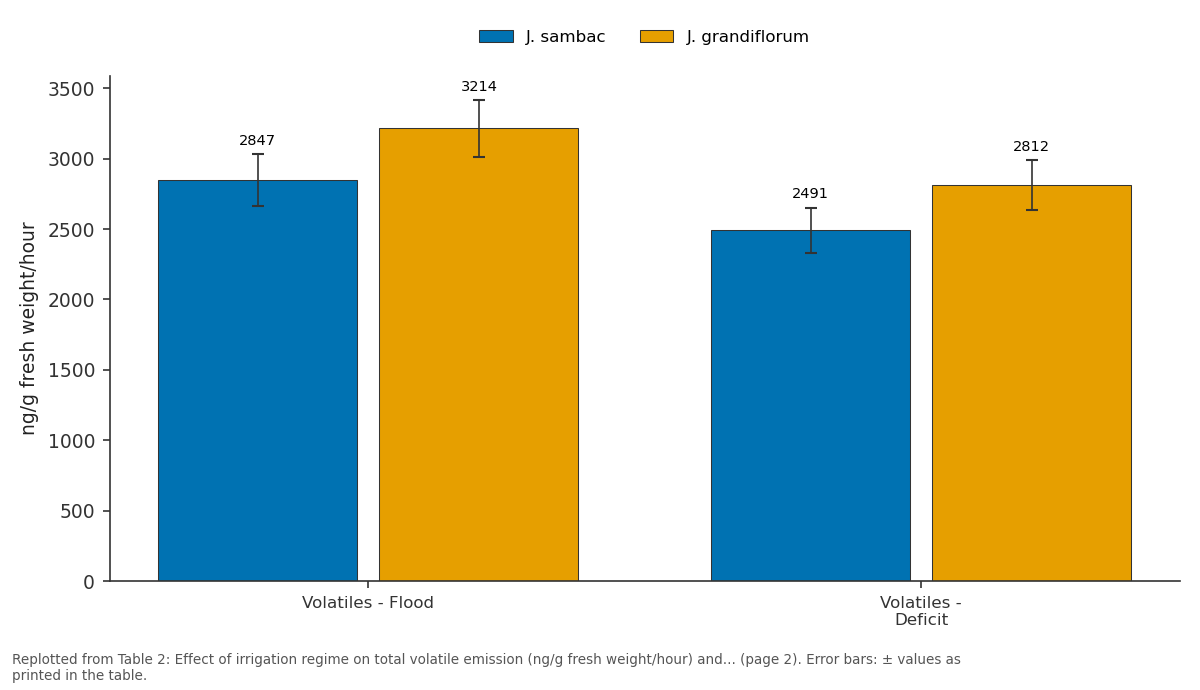
J. sambac and J. grandiflorum: Volatiles - Flood vs Volatiles - Deficit
Replotted from Table 2 (page 2) of the original paper. Every bar is the paper's own table value.
View source evidence ↗Figures & tables
From the original paper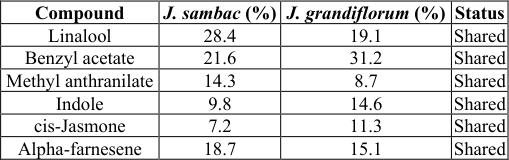 Table 1
 Table 2
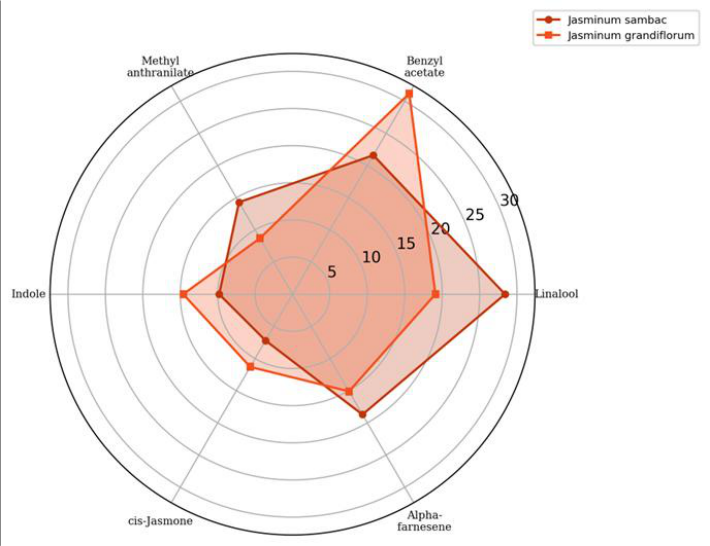 Figure 1
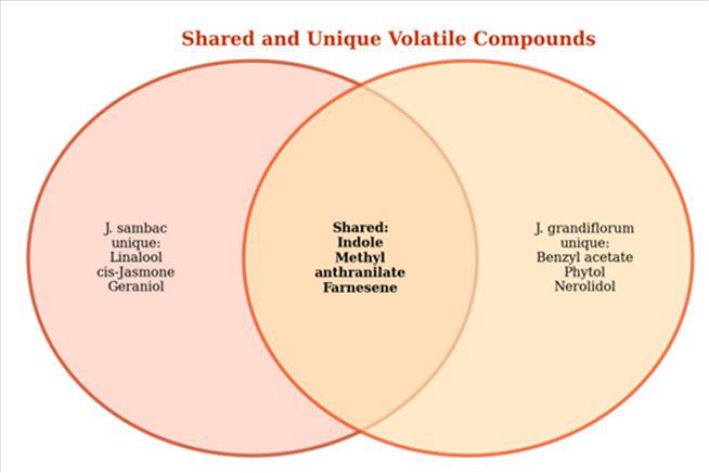 Figure 2
Introduction
Jasmine is to perfumery what yeast is to bread: an indispensable ingredient whose complexity defies simple description. The flower's fragrance arises from a cocktail of terpene alcohols, esters, nitrogen-containing indoles, and long-chain hydrocarbons that are biosynthesised in glandular trichomes and released in a circadian rhythm peaking after sunset [1, 2] . More than 200 volatile compounds have been reported from various Jasminum species worldwide, but most cataloguing work has been done in tropical lowlands of India, China, and Indonesia, where the genus naturally thrives [3] . The Fergana Valley, an intermontane basin in Central Asia with hot, dry summers and cold winters, represents an extreme test environment for jasmine cultivation. Continental conditions, with summer maxima above 40 degrees C and winter minima below -10 degrees C, impose thermal stresses that could alter volatile biosynthesis pathways and shift the balance between monoterpenes, sesquiterpenes, and benzenoid compounds [4,5] . Molecular markers are important for confirming species identity in jasmine because morphological overlap between J. sambac and J. grandiflorum can confuse commercial growers. ISSR markers, which amplify inter-microsatellite regions, offer a cost-effective option with moderate genomic coverage [6] . Irrigation management and harvest timing are two practical factors that growers can manipulate to influence volatile output, but their effects under continental conditions have not been quantified [7,8] . This research aimed to: (a) catalogue volatile compounds in J. sambac and J. grandiflorum by HS-SPME-GC-MS; (b) identify shared versus species-specific volatiles; (c) confirm genetic distinctness using ISSR markers; (d) compare flood versus deficit irrigation effects on volatile emission; and (e) determine the optimal harvest time for maximising aroma yield [9, 10] .
Extraction Protocol
Freshly harvested flowers (5 g per replicate) were placed in 40 mL headspace vials sealed with PTFE-silicone septa. After equilibration at 30 degrees C for 30 minutes, a 50/30 micrometer DVB/CAR/PDMS SPME fibre (Supelco, Bellefonte, PA, USA) was exposed to the headspace for 45 minutes. The fibre was then desorbed in the GC inlet at 250 degrees C for 3 minutes in splitless mode. Separation was on an Agilent DB-5ms column (30 m by 0.25 mm, 0.25 micrometer film) with helium carrier gas at 1.0 mL per minute. The oven programme started at 40 degrees C (held 3 minutes), ramped at 5 degrees C per minute to 240 degrees C, and held for 5 minutes. Mass spectra were acquired in scan mode (m/z 35 to 350) on an Agilent 5977B MSD. Compounds were identified by matching with the NIST 20 library (match quality above 85%) and confirmed against retention indices of authentic standards where available [3,9] .
Instrumentation and Analytical Equipment
Volatile analysis was performed on an Agilent 7890B GC coupled to a 5977B MSD. An Agilent PAL3 autosampler handled SPME fibre conditioning, exposure, and injection. DNA extraction for ISSR analysis used a Qiagen DNeasy Plant Mini Kit, and PCR was run on a Bio-Rad T100 thermocycler. Gel electrophoresis used a Bio-Rad Sub-Cell GT system with ethidium bromide staining visualised on a Gel Doc XR+ imager. Soil moisture sensors (Decagon EC-5) were installed at 15 and 30 cm depth to verify irrigation treatments. All instruments were calibrated at the start of each analytical batch [6,9] .
Material and Methods
Material and Methods
Material
Jasminum sambac (cv. Maid of Orleans) and Jasminum grandiflorum (cv. Spanish) were established from rooted cuttings at the Bareilly Advanced School of Environmental Agriculture in 2020. Fifteen ISSR primers (UBC-807 to UBC-900, selected for polymorphism in pilot screening) were obtained from Integrated DNA Technologies (Coralville, IA, USA). Authentic volatile standards (linalool, benzyl acetate, indole, cis-jasmone, methyl anthranilate, alpha-farnesene) were purchased from Sigma-Aldrich. All work was conducted from April 2022 to March 2023 under protocol BASE-BPB/2022-053, approved 22 March 2022.
Methods
A split-split-plot design was used: main plot was species (2 levels), subplot was irrigation (flood at 100% ETc versus deficit at 60% ETc), and sub-subplot was harvest time (evening 18:00, midnight 00:00, pre-dawn 04:00). Each subsubplot comprised 10 plants replicated three times. ISSR-PCR used 25 microlitre reactions with the cycling profile: 94 degrees C for 4 minutes, 35 cycles of 94 degrees C 45 seconds, annealing 48 to 55 degrees C 45 seconds, 72 degrees C 90 seconds, and a final extension at 72 degrees C for 7 minutes. Products were scored as present or absent on 2% agarose gels. Jaccard similarity was computed in NTSYSpc version 2.2. Stability analysis used the coefficient of variation across three harvest times. Seed quality was assessed on J. sambac only (100 seeds per replicate, germination on moist paper at 25 degrees C, vigour index = germination percentage times seedling length). Statistical analysis used ANOVA in R version 4.3.1 [11] .
Results
Results
Comprehensive Interpretation
The radar chart (Figure 1) highlights the contrasting volatile signatures: J. sambac is linalool-dominant while J. grandiflorum is benzyl-acetate-dominant. The Venn diagram (Figure 2) shows that 28 of 47 identified compounds were shared, with each species contributing roughly 10 unique volatiles, confirming distinct biochemical identities despite morphological similarity [1,3] .
Discussion
The dominance of linalool in J. sambac (28.4%) and benzyl acetate in J. grandiflorum (31.2%) is consistent with profiles reported from Indian and Egyptian samples, indicating that these species-specific signatures are robust across environments [1,12] . However, the absolute emission rates in the Fergana Valley were roughly 18% lower than tropical benchmarks, possibly because the continental climate's cooler nights slow terpene synthase activity during the critical emission window [2,5] . Flood irrigation's 14.3% volatile boost aligns with the general principle that well-watered plants have higher terpene synthase activity because these enzymes require ATP and NADPH from photosynthesis, which is constrained under drought [7,13] . The midnight harvest time maximised volatile yield by 22.6% over evening and 31.4% over pre-dawn harvests, confirming the circadian emission peak documented in tropical jasmine but showing that the pattern persists at 41 degrees N latitude [2,8] . The ISSR-based Jaccard similarity of 0.21 between species is well below the 0.70 threshold typically used to delineate conspecific populations, supporting their classification as distinct species and offering molecular confirmation that commercial growers can use to verify planting stock [6,14,15,16,17,18,19,20] .
Conclusion
This research catalogued 47 volatile compounds in two jasmine species grown in the Fergana Valley, establishing the first aroma baseline for jasmine under continental Central Asian conditions. Linalool and benzyl acetate served as species-diagnostic markers. Flood irrigation and midnight harvest were the most effective management levers for maximising volatile yield. ISSR markers confirmed species distinctness. These findings support the introduction of jasmine into the Fergana Valley's horticultural portfolio and provide quality benchmarks for the essential-oil and perfumery industries. Multi-year validation and GC-olfactometry to link individual volatiles to perceived fragrance quality are recommended as next steps.
Acknowledgement
Acknowledgements Funding SourcesInstitutional grants for aromatic-crop research supported this work. Institutional SupportThe Bareilly Advanced School of Environmental Agriculture provided GC-MS and molecular biology facilities. Contributions Not Qualifying for AuthorshipNight-harvest field crews and laboratory technicians are gratefully acknowledged.
Figures and tables from the paper
| Compound | J. sambac (%) | J. grandiflorum (%) | Status |
|---|---|---|---|
| Linalool | 28.4 | 19.1 | Shared |
| Benzyl acetate | 21.6 | 31.2 | Shared |
| Methyl anthranilate | 14.3 | 8.7 | Shared |
| Indole | 9.8 | 14.6 | Shared |
| cis-Jasmone | 7.2 | 11.3 | Shared |
| Alpha-farnesene | 18.7 | 15.1 | Shared |
Table text extracted from the original PDF; superscript letters are shown inline. The original table image is below.
View original table image
| Parameter | J. sambac | J. grandiflorum | Mean |
|---|---|---|---|
| Volatiles - Flood | 2,847±184 | 3,214±203 | 3,031 |
| Volatiles - Deficit | 2,491±161 | 2,812±178 | 2,652 |
| Increase (%) | 14.3 | 14.3 | 14.3 |
| ISSR bands (total) | 124 | 124 | — |
| Polymorphic (%) | 78.2 | 78.2 | — |
| Jaccard similarity | — | — | 0.21 |
Table text extracted from the original PDF; superscript letters are shown inline. The original table image is below.
View original table image
References
20 in the original paper- Bera P, Mukherjee C, Mitra A. Enzymatic production and emission of floral scent volatiles in Jasminum sambac. Plant Science. 2017;256:33-39.
- Pragadheesh VS, Chanotiya CS, Shukla A, Yadav A. Compositional characterization of the concrete and absolute of Jasminum sambac L. flower. Natural Product Communications. 2011;6(9):1329-1332.
- Edris AE, Chizzola R, Franz C. Isolation and characterization of the volatile aroma compounds from the concrete headspace and the absolute of Jasminum sambac (L.) Ait. (Oleaceae) flowers grown in Egypt. European Food Research and Technology. 2008;226(3):621-626.
- Lerdau M, Gray D. Ecology and evolution of lightdependent and light-independent phytogenic volatile organic carbon. New Phytologist. 2003;157(2):199-211.
- Loreto F, Schnitzler JP. Abiotic stresses and induced BVOCs. Trends in Plant Science. 2010;15(3):154-166.
- Zietkiewicz E, Rafalski A, Labuda D. Genome fingerprinting by simple sequence repeat (SSR)- anchored polymerase chain reaction amplification. Genomics. 1994;20(2):176-183.
- Blanke MM, Lovatt CJ. Dynamics of flower and fruit development in Citrus. Advances in Agronomy. 1993;51:51-84.
- Matile P, Altenburger R. Rhythms of fragrance emission in flowers. Planta. 1988;174(2):248-252.
- Adams RP. Identification of Essential Oil Components by Gas Chromatography/Mass Spectrometry. 4th ed. Carol Stream, IL: Allured Publishing; 2007. p. 1-804.
- Green SA, Chen X, Nieuwenhuizen NJ, Matich AJ, Wang MY, Bunn BJ, et al. Identification, functional characterization, and regulation of the enzyme responsible for floral (E)-nerolidol biosynthesis in kiwifruit (Actinidia chinensis). Journal of Experimental Botany. 2012;63(5):1951-1967.
- R Core Team. R: a language and environment for statistical computing. Vienna: R Foundation for Statistical Computing; 2023.
- Joulain D, Laurent R. The Atlas of Spectral Data of Sesquiterpene Hydrocarbons. Hamburg: EB-Verlag; 1998. p. 1-658.
- Niinemets U, Loreto F, Reichstein M. Physiological and physicochemical controls on foliar volatile organic compound emissions. Trends in Plant Science. 2004;9(4):180-186.
- Rohlf FJ. NTSYSpc: Numerical Taxonomy System, Version 2.2. Setauket, NY: Exeter Software; 2005.
- Deng Y, Jiang ZH, Li Y, Ge LP, Zhang J. Genetic diversity of Jasminum sambac assessed by ISSR markers. Journal of Tropical and Subtropical Botany. 2010;18(5):471-476.
- Dudareva N, Pichersky E, Gershenzon J. Biochemistry of plant volatiles. Plant Physiology. 2004;135(4):18931902.
- Knudsen JT, Tollsten L, Bergstrom LG. Floral scents: a checklist of volatile compounds isolated by head-space techniques. Phytochemistry. 1993;33(2):253-280.
- Pichersky E, Gershenzon J. The formation and function of plant volatiles: perfumes for pollinator attraction and defense. Current Opinion in Plant Biology. 2002;5(3):237-243.
- Muhlemann JK, Klempien A, Dudareva N. Floral volatiles: from biosynthesis to function. Plant, Cell and Environment. 2014;37(8):1936-1949.
- Farooqi AA, Sreeramu BS, Srinivasappa KN. Cultivation of Spice Crops. Hyderabad: Universities Press; 2005. p. 1-480.