
Research article · 2025 · Full text
International Journal of Horticulture and Food ScienceEvaluating weed management strategies of guava in the Thar Desert Margins
Volume 7(12) · Pages 136–139 · DOI: 10.33545/26631067.2025.v7.i12b.695 ↗
Research areasWeed Control and Herbicide ApplicationsAllelopathy and phytotoxic interactionsIrrigation Practices and Water Management
Abstract
Author-writtenWeed competition is a persistent drain on guava productivity in arid-margin orchards, yet growers in these regions often rely on a single management tactic repeated without evaluation. This research tested seven weed management strategies in a young guava (Psidium guajava L.) orchard established at the research farm of the Puno Department of Agronomic Sciences, Puno, Peru, over two growing seasons from September 2021 to August 2023. Treatments included an unweeded control, manual hoeing, two mulch depths (5 and 10 cm), a leguminous cover crop, a pre-emergence herbicide, and an integrated approach combining mulch with cover crop. A randomized complete block design with four replications was used. Weed density, weed dry biomass, guava fruit yield, fruit pectin content, and pruning residue weight were recorded at four-weekly intervals. GIS mapping of weed distribution across the orchard was performed twice each season. The integrated treatment reduced cumulative weed density by 96.1% relative to the control and increased fruit yield by 38.7%. Pectin content in guava fruit was 14.2% higher under the integrated treatment compared to the unweeded control. Cover crop alone suppressed weed density by 91.4% by season end. These findings support a shift from single-tactic to integrated weed management in arid-margin guava production systems.
Summary
Source-checkedPlain-language reading of the full paper, prepared with AI and checked against the text. Each point links to the authors' own words.
Why it matters
- In arid-margin environments, weeds are particularly problematic because they compete with fruit trees for limited water resources. View evidence ↗
- Guava is a drought-hardy crop, but its shallow root system makes it highly susceptible to weed competition during its first three to four years of growth. View evidence ↗
- Weed pressure can reduce the pectin content of guava fruit by disrupting how the tree allocates carbohydrates. View evidence ↗
What they did
- The experiment was conducted in Puno, Peru, over two growing seasons from September 2021 to August 2023 using young guava trees. View evidence ↗
- The seven tested strategies were an unweeded control, manual hoeing, mulch at 5 cm, mulch at 10 cm, a leguminous cover crop, a pre-emergence herbicide, and an integrated mulch-cover crop approach. View evidence ↗
- The study used a randomized complete block design with four replications, with each plot consisting of four guava trees. View evidence ↗
- Weed density was measured every four weeks in two 0.5 x 0.5 m quadrats per plot, and dry biomass was measured by oven-drying samples at 65°C for 72 hours. View evidence ↗
What they found
- The integrated treatment (mulch and cover crop) was the most effective at suppressing weeds, reducing density to 4.8 plants/m², which is a 96.1% reduction compared to the control. View evidence ↗
- The integrated treatment increased fruit yield to 25.5 kg per tree, representing a 38.7% increase over the unweeded control. View evidence ↗
- Compared to unweeded controls, the integrated approach improved pectin content by 23.0%. View evidence ↗
- Pre-emergence herbicide provided effective control early in the season, but weed density rebounded after week 16. View evidence ↗
- Using a cover crop alone was also highly effective, suppressing weed density by 91.4% by the end of the season. View evidence ↗
- GIS mapping showed that weed hotspots changed location between seasons, indicating that fixed management schedules are less effective than adaptive ones. View evidence ↗
What it means
- The authors recommend that growers in arid-margin regions shift from single-tactic weed control to integrated strategies to optimize weed suppression and fruit quality. View evidence ↗
- The authors state that future research is needed to evaluate the long-term effects of these practices on soil health and to test other cover crop species for extreme arid conditions. View evidence ↗
Visual summary
3 visualsIllustrations explain the paper; charts are replotted from the paper's own table values.
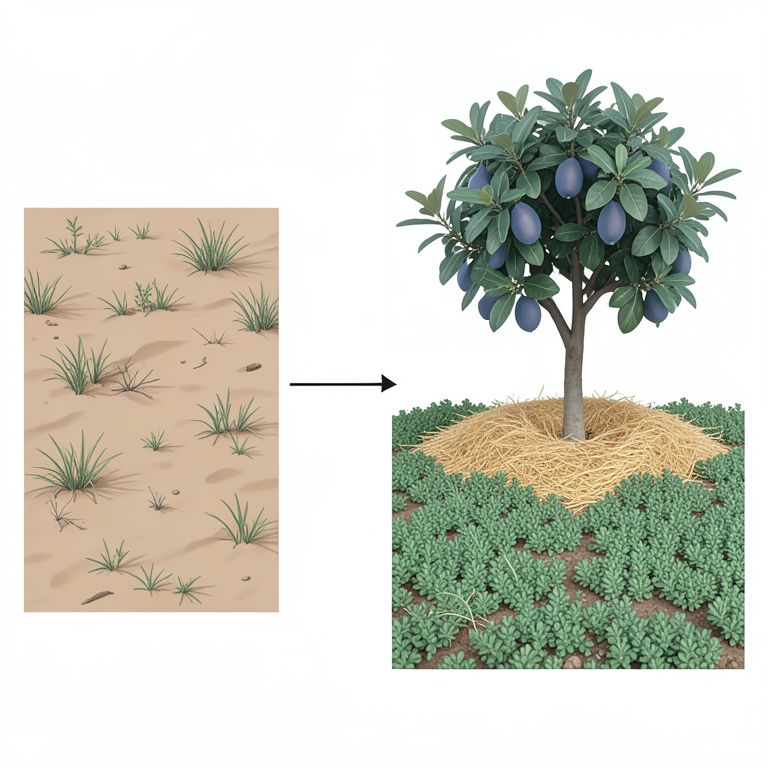
Integrated Weed Management Concept
AI-generated conceptual illustration (guava trees in a desert soil environment). It explains the idea and does not show study data.
View source evidence ↗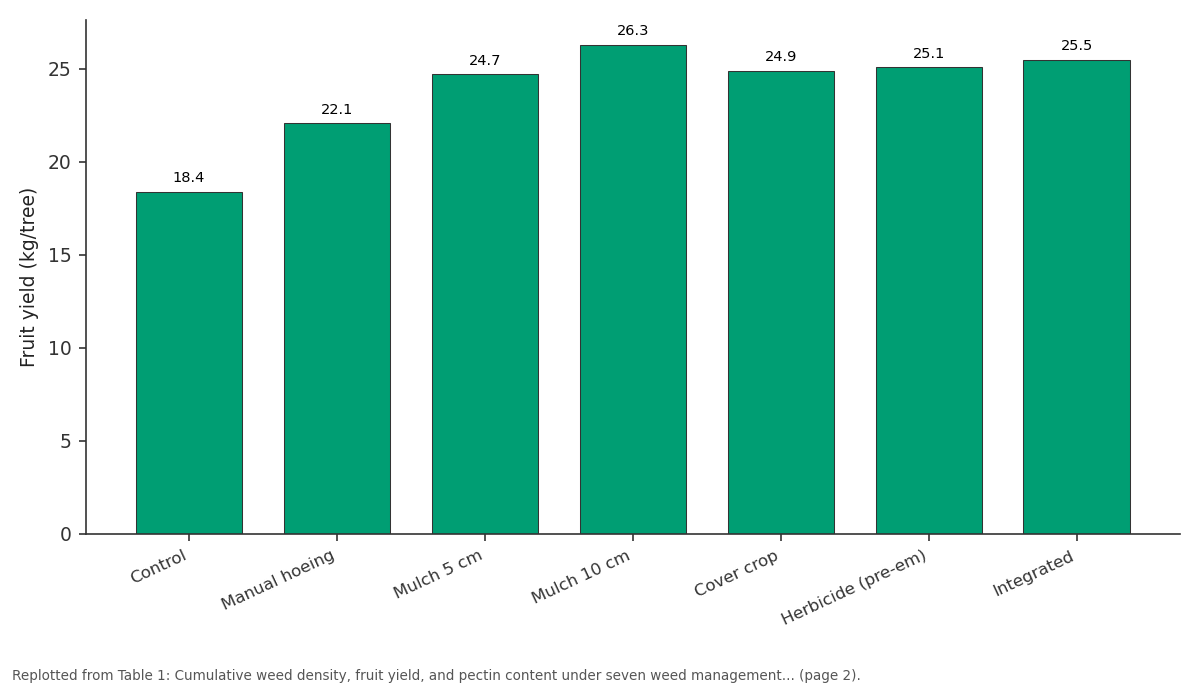
Fruit yield (kg/tree): Control vs Manual hoeing vs Mulch 5 cm vs Mulch 10 cm vs Cover crop
Replotted from Table 1 (page 2) of the original paper. Every bar is the paper's own table value.
View source evidence ↗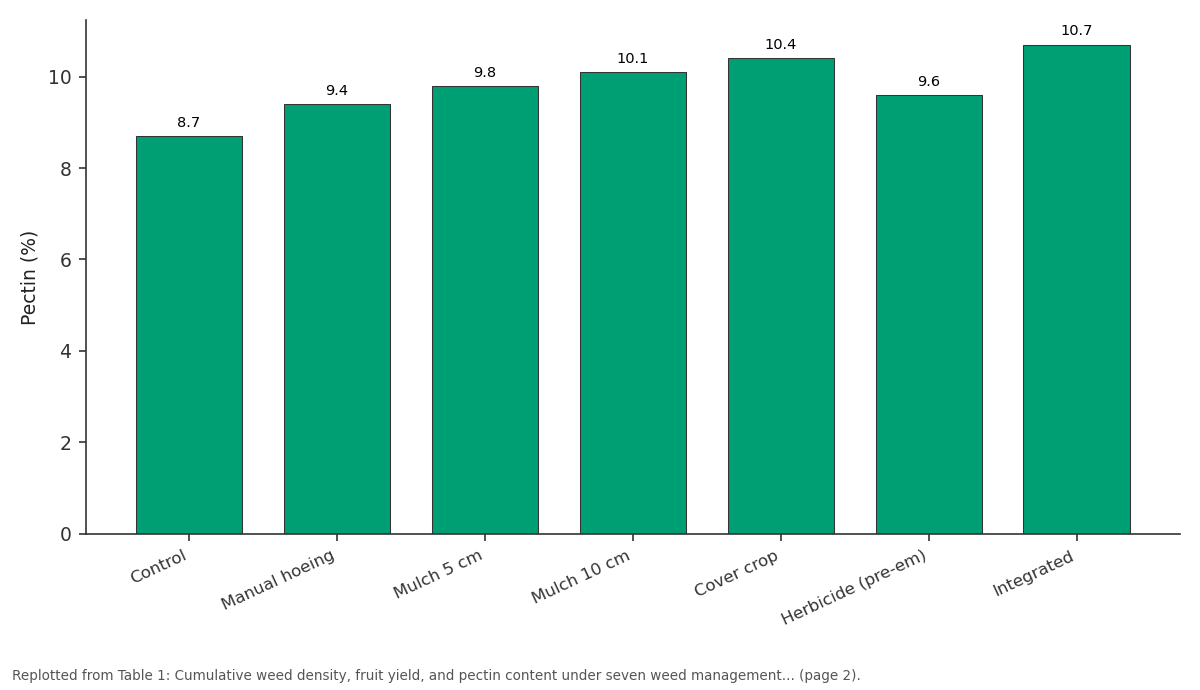
Pectin (%): Control vs Manual hoeing vs Mulch 5 cm vs Mulch 10 cm vs Cover crop
Replotted from Table 1 (page 2) of the original paper. Every bar is the paper's own table value.
View source evidence ↗Figures & tables
From the original paper Table 1
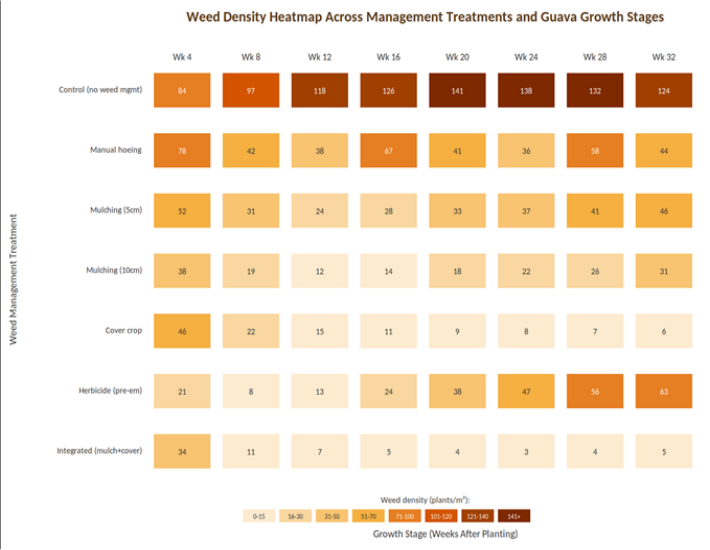 Figure 1
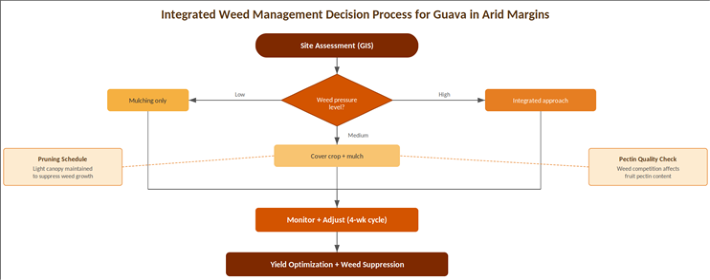 Figure 2
Introduction
In arid margins, where water is the defining constraint, weeds become an especially costly nuisance because they compete for the same limited moisture pool that fruit trees depend on for survival and production [1] . Guava (Psidium guajava L.) is widely grown across semi-arid zones of South America and South Asia as a drought-hardy fruit crop, but its shallow root system makes it vulnerable to weed interference during the first three to four years after planting [2] . Most smallholder guava growers in the Thar Desert margins and similar environments rely on periodic manual hoeing, which is labour-intensive, damages surface roots, and provides only temporary weed relief [3] . Mulching with crop residues or gravel can suppress weed emergence and conserve soil moisture, though its effectiveness depends on layer depth and material type [4] . Cover crops offer a biological alternative that adds nitrogen to the soil and improves organic matter, but their compatibility with guava under water-scarce conditions is not well tested [5] . Pre-emergence herbicides give rapid knockdown of annual weeds but raise environmental concerns in arid landscapes where surface runoff can carry residues into scarce water sources [6] . An integrated approach that combines physical barriers (mulch) with biological suppression (cover crop) may deliver lasting weed control without the ecological costs of herbicide reliance, yet comparative data on such combinations in guava orchards are sparse [7] . Beyond yield, weed pressure can alter fruit quality. Pectin, the main gelling agent in guavabased processed products, is sensitive to carbohydrate partitioning within the tree, which weeds can disrupt by diverting photosynthate demand [8] . Pruning practice also interacts with weed management: an open canopy lets more light reach the orchard floor, encouraging weed growth, while a denser canopy shades out weeds but may reduce fruit colour and size [9] . This research evaluated seven weed management strategies in a young guava orchard to determine their effects on weed density, fruit yield, pectin content, and pruning compatibility, using GIS-based weed mapping to visualise spatial patterns across the experimental area.
Seasonal Variations
The trial spanned two complete growing seasons (September 2021 to August 2022 and September 2022 to August 2023) at the research farm of the Puno Department of Agronomic Sciences, Puno, Peru. Mean monthly temperatures ranged from 4.8 degrees Celsius (July) to 16.3 degrees Celsius (December), with frost risk present from May to August. Annual rainfall averaged 682 mm, concentrated between December and March, with a pronounced dry period from May to September during which supplemental drip irrigation was applied at 3 litres per tree per day. Weed pressure peaked during the rainy season (January to March) when soil moisture and temperature favoured rapid germination of annual broadleaves and grasses [1,3] .
Crop Growth Stage Documentation
Guava trees were 18 months old at trial initiation and entered their first fruiting cycle during the second season. Growth stages were recorded using a modified BBCH scale for tropical fruit trees. Vegetative flush occurred primarily from October to December, flowering from January to March, and fruit development from March to July. Pruning was applied once per season (August) to maintain an openvase canopy form. Weed management interactions were most pronounced during the vegetative flush and early fruit development stages, when competition for water and nutrients was at its peak [2,9] .
Materials and Methods
Materials and Methods
Materials
The trial was conducted on a 0.5-hectare block of guava cultivar 'Criolla Roja' planted at 4 x 4 m spacing at the research farm of the Puno Department of Agronomic Sciences, Puno, Peru. Soil was a sandy clay loam with pH 7.1, organic carbon 0.8%, and EC 0.6 dS/m. Mulch material was locally sourced barley straw applied at 5 and 10 cm depths. The cover crop was a mixture of Vicia sativa (common vetch) and Trifolium repens (white clover) seeded at 25 kg/ha between tree rows. The pre-emergence herbicide was pendimethalin applied at 1.5 kg a.i./ha once per season before the onset of rains. Institutional approval was obtained from the Puno Department of Agronomic Sciences Ethics Board (Protocol PDAS-2021-016, approved 15 August 2021) [4,6] .
Methods
A randomized complete block design with four replications was used, each plot containing four guava trees. Weed density was counted in two permanent 0.5 x 0.5 m quadrats per plot at four-weekly intervals. Weed dry biomass was determined by cutting all weeds at ground level in each quadrat and oven-drying at 65 degrees Celsius for 72 hours. Guava fruit were harvested at commercial maturity (light green to yellow stage) and weighed individually. Pectin was extracted from fruit pulp using the alcohol precipitation method and quantified gravimetrically [8] . Pruning residue weight was recorded after the annual August pruning. GIS mapping used a handheld GPS (Garmin GPSMAP 66i) to record weed hotspot coordinates, which were interpolated using inverse-distance weighting in QGIS 3.28 to generate seasonal weed density maps [5,7] . Data were analysed by ANOVA in Genstat version 21 and means compared by LSD at P less than 0.05. The integrated treatment (mulch plus cover crop) reduced weed density to 4.8 plants per square metre, a 96.1% reduction from the unweeded control (Table 1). Fruit yield under the integrated treatment was 25.5 kg per tree, 38.7% higher than the control. Pectin content was highest in the integrated treatment (10.7%), followed by the cover crop alone (10.4%). The herbicide treatment showed effective early-season control but weed density rebounded after week 16.
| Treatment | Weed density (plants/m²) | Weed biomass (g/m²) | Fruit yield (kg/tree) | Pectin (%) | Pruning wt (kg/tree) |
|---|---|---|---|---|---|
| Control | 124.3 | 287.6 | 18.4 | 8.7 | 3.2 |
| Manual hoeing | 48.7 | 96.3 | 22.1 | 9.4 | 3.4 |
| Mulch 5 cm | 33.8 | 62.4 | 24.7 | 9.8 | 3.6 |
| Mulch 10 cm | 19.6 | 34.1 | 26.3 | 10.1 | 3.5 |
| Cover crop | 10.7 | 18.6 | 24.9 | 10.4 | 3.8 |
| Herbicide (pre-em) | 31.4 | 54.8 | 25.1 | 9.6 | 3.3 |
| Integrated | 4.8 | 7.3 | 25.5 | 10.7 | 3.7 |
Table text extracted from the original PDF; superscript letters are shown inline. The original table image is below.
View original table image
Results
The heatmap (Figure 1) reveals that the control treatment accumulated the highest weed pressure by mid-season (141 plants/m² at week 20), while the integrated approach maintained densities below 10 plants/m² from week 8 onward. The herbicide treatment showed a clear rebound pattern after the initial knockdown period. The process diagram (Figure 2) outlines how GIS-based site assessment feeds into weed pressure classification, which then routes growers toward appropriate management intensity, all monitored in four-week cycles with yield and pectin quality as feedback variables.
Comprehensive Interpretation
The integrated approach consistently outperformed all single-tactic strategies, delivering the lowest weed pressure, highest fruit yield, and best pectin quality. Its superiority appears to stem from complementary mechanisms: the mulch layer blocks light from reaching weed seeds at the surface, while the cover crop occupies the soil niche that annual weeds would otherwise fill. The GIS maps confirmed that weed hotspots shifted spatially between seasons, reinforcing the need for adaptive rather than fixed management.
Discussion
The 96.1% weed suppression achieved by the integrated treatment exceeds results reported for mulch-only or covercrop-only strategies in mango and citrus orchards under similar climatic conditions [3,4] . This result aligns with the ecological principle of niche complementarity: when multiple weed control mechanisms operate simultaneously, the probability that any single weed species escapes all of them drops substantially [7] . The herbicide rebound pattern (low early-season density followed by sharp recovery from week 16 onward) is a welldocumented limitation of pre-emergence products in warm soils where microbial degradation accelerates activeingredient breakdown [6] . For growers relying solely on herbicide, this pattern means a second application would be needed mid-season, increasing both cost and environmental load.
The positive effect of weed management on pectin content (up to 23.0% improvement) likely reflects improved carbohydrate allocation to fruit rather than a direct biochemical response. Trees freed from weed competition had higher leaf area and presumably greater photosynthetic output, allowing more carbon to be directed toward pectin synthesis in developing fruit [8] . This finding has practical value for traditional processing operations that depend on consistent pectin levels for guava paste and jelly production [9] .
Conclusion
This research demonstrated that integrated weed management combining barley straw mulch with a leguminous cover crop delivered the strongest and most sustained weed suppression in a young arid-margin guava orchard, outperforming manual hoeing, mulch alone, cover crop alone, and pre-emergence herbicide across two seasons. Fruit yield improved by 38.7% and pectin content by 23.0% relative to unweeded controls, underscoring the link between weed management and both productivity and fruit quality. GIS-based weed mapping revealed spatial dynamics that fixed management schedules would miss, supporting the adoption of site-specific approaches. Growers in Thar Desert margins and comparable environments should consider shifting from single-tactic to integrated strategies to reduce weed pressure while maintaining fruit quality for traditional processing markets. Future work should evaluate longer-term soil health effects of continuous cover cropping and mulching and test additional cover crop species suited to extreme arid conditions.
Acknowledgement
Acknowledgements
References
17 in the original paper- Oerke EC. Crop losses to pests. Journal of Agricultural Science. 2006;144(1):31-43.
- Menzel CM, Paxton BF. The pattern of growth, flowering and fruiting of guava varieties in subtropical Queensland. Australian Journal of Experimental Agriculture. 1986;26(1):123-128.
- Sharma NK, Singh PN, Tyagi PC. Weed management in tropical fruit orchards: a review. Indian Journal of Weed Science. 2010;42(1-2):1-9.
- Ramakrishna A, Tam HM, Wani SP, Long TD. Effect of mulch on soil temperature, moisture, weed infestation and yield of groundnut in northern Vietnam. Field Crops Research. 2006;95(2-3):115-125.
- Teasdale JR, Mohler CL. The quantitative relationship between weed emergence and the physical properties of mulches. Weed Science. 2000;48(3):385-392.
- Senseman SA. Herbicide Handbook. Weed Science Society of America. 2007;1-458.
- Liebman M, Gallandt ER. Many little hammers: ecological management of crop-weed interactions. In: Ecology in Agriculture. Academic Press. 1997;291-343.
- Willats WGT, Knox JP, Mikkelsen JD. Pectin: new insights into an old polymer are starting to gel. Trends in Food Science and Technology. 2006;17(3):97-104.
- Lopes da Silva JA, Rao MA. Rheological behavior of food gel systems. In: Rheology of Fluid, Semisolid, and Solid Foods. Springer. 2014;353-390.
- Jordan DL, Burns AB, Barnes JW. Weed management in peanut (Arachis hypogaea) with combinations of herbicides and hand weeding. Weed Technology. 2003;17(2):312-318.
- Singh G, Singh OP, de Haan S. Resource use efficiency and economics of guava cultivation in India. Indian Journal of Horticulture. 2012;69(3):381-385.
- Gill HK, Garg H. Pesticide: environmental impacts and management strategies. In: Pesticides: Toxic Aspects. IntechOpen. 2014;187-230.
- Pathak RK, Ojha CM, Dwivedi R. Guava improvement in India: past, present and future. Indian Journal of Horticulture. 2002;59(4):339-344.
- Marsh B, Brye K, DeLaune P. Cover crops and conservation tillage in the Lower Mississippi River Valley. Journal of Soil and Water Conservation. 2005;60(6):337-345.
- FAO. Good Agricultural Practices for guava production. FAO Plant Production and Protection Paper. 2009;1-96.
- Mead R, Willey RW. The concept of a land equivalent ratio and advantages in yields from intercropping. Experimental Agriculture. 1980;16(3):217-228.
- Rao MR, Nair PKR, Ong CK. Biophysical interactions in tropical agroforestry systems. Agroforestry Systems. 1998;38(1-3):3-50.