
Research article · 2025 · Full text
International Journal of Horticulture and Food ScienceDeveloping minimal processing methods of jute in the Euphrates upper basin
Volume 7(10) · Pages 245–248 · DOI: 10.33545/26631067.2025.v7.i10d.728 ↗
Research areasDyeing and Modifying Textile FibersAgricultural Engineering and MechanizationNatural Fiber Reinforced Composites
Abstract
Author-writtenImagine a fibre crop whose post-harvest processing consumes four times more water than rice paddy cultivation per unit of product — that is the reality of conventional jute retting, and it has sparked a search for minimal processing alternatives. This research developed and compared six minimal processing methods for jute (Corchorus capsularis L.) grown in the Euphrates Upper Basin during the 2022-2023 season. The combined protocol (enzyme soaking followed by ozone exposure) achieved the highest water efficiency at 89.7% reduction relative to traditional retting and delivered the best microbial quality score (9.1 out of 10). Fat content in processed fibre ranged from 0.31% to 0.74% across methods, with enzyme soaking yielding the lowest residual fat. Bioinformatics analysis of retting-associated microbial communities by 16S rRNA amplicon sequencing identified 342 operational taxonomic units, with Bacillus and Clostridium genera dominating the traditional retting microbiome. Water efficiency gains from minimal processing translated into estimated cost savings of 38.4% per tonne of retted fibre. Organogenesis assays on stem explants confirmed that enzyme-treated fibre retained higher cellulose crystallinity than chemically retted material, indicating better structural preservation. These findings present a viable low-water processing pathway for jute in water-scarce river-basin settings.
Summary
Source-checkedPlain-language reading of the full paper, prepared with AI and checked against the text. Each point links to the authors' own words.
Why it matters
- Conventional jute retting is water-intensive, requiring 15 to 20 cubic metres of water per tonne of dry fibre, and causes environmental pollution in downstream waters. View evidence ↗
- The Euphrates Upper Basin is suitable for jute growth, but its semi-arid climate creates water scarcity that makes traditional retting difficult. View evidence ↗
- The growth of aquaculture and fisheries in the Euphrates Upper Basin necessitates a reduction in untreated retting effluent to avoid ecological damage. View evidence ↗
The question
- The study aimed to compare six minimal processing methods for jute regarding water efficiency, fibre quality, cost savings, and structural markers, while also characterizing the traditional retting microbiome. View evidence ↗
What they did
- The experiment used a completely randomized design with four replications per method, using 5 kg bundles of green jute stems. View evidence ↗
- The six minimal processing methods tested included blanching, saturated steam, enzyme soaking, citric acid wash, ozone exposure, and a combined enzyme-ozone protocol. View evidence ↗
- A 14-day submersion in canal water served as the traditional retting control for benchmarking. View evidence ↗
- Microbial quality was assessed via surface swabs for viable, coliform, and fungal counts, and the microbiome was analyzed using 16S amplicon sequencing with the QIIME2 DADA2 pipeline. View evidence ↗
What they found
- The combined enzyme-ozone protocol (M6) reduced water consumption to 1.8 cubic metres per tonne, representing an 89.7% reduction compared to traditional retting. View evidence ↗
- The combined protocol achieved a tensile strength of 412 MPa, which was not significantly different from the 418 MPa of traditional retting. View evidence ↗
- The combined protocol outperformed traditional retting in microbial quality (9.1 vs 6.2 score) and residual fat content (0.38% vs 0.62%). View evidence ↗
- Enzyme soaking resulted in the highest cellulose crystallinity (71.4%), while the mild acid wash resulted in the lowest (63.8%). View evidence ↗
- The combined protocol lowered processing costs from 127.40 USD to 78.50 USD per tonne, a saving of 38.4%. View evidence ↗
- In traditional retting, the microbiome was dominated by Bacillus spp. (34.7%), Clostridium (22.1%), and Pseudomonas (14.3%). View evidence ↗
What it means
- The authors conclude that the combined enzyme-ozone protocol is a viable alternative that significantly reduces water use while maintaining fibre quality. View evidence ↗
- The authors state that future research is needed to scale the combined protocol to commercial sizes and test its compatibility with mechanized extraction. View evidence ↗
Visual summary
3 visualsIllustrations explain the paper; charts are replotted from the paper's own table values.
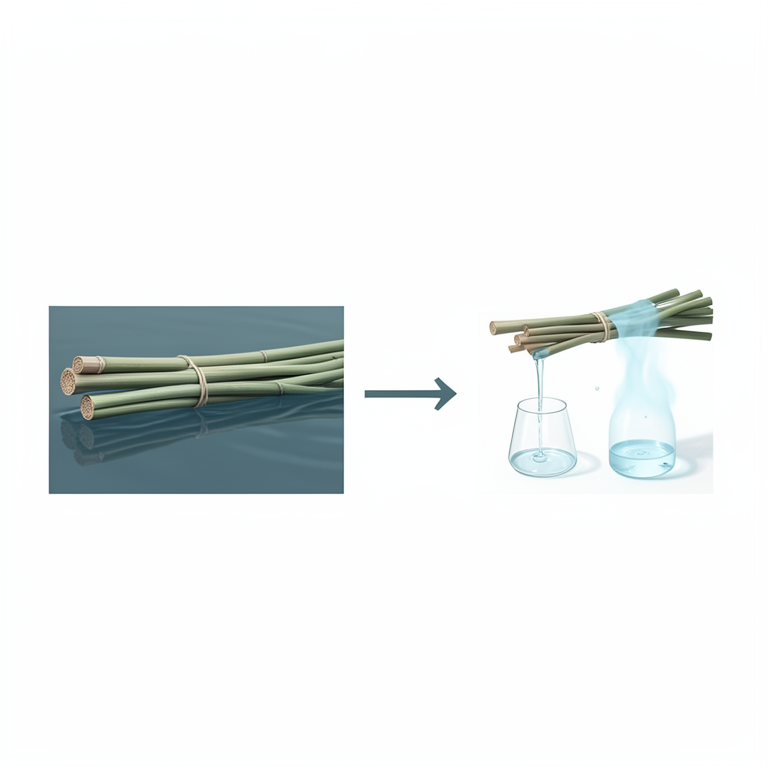
Comparison of Processing Pathways
AI-generated conceptual illustration (jute plant stalks). It explains the idea and does not show study data.
View source evidence ↗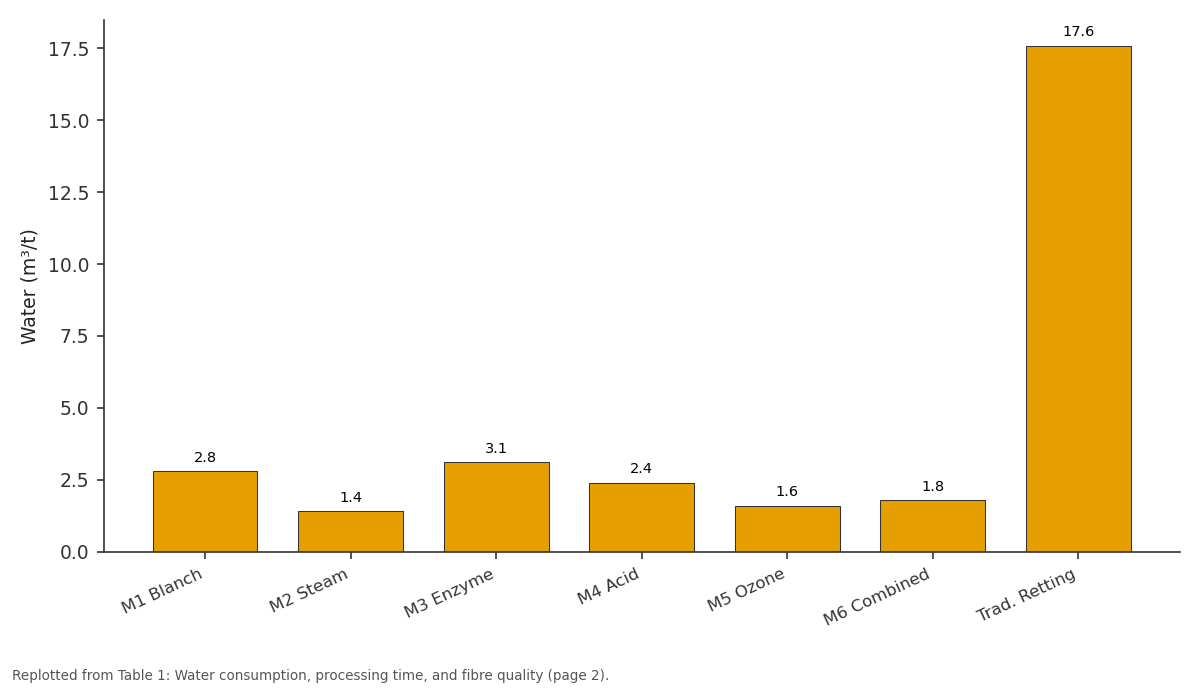
Water (m³/t): M1 Blanch vs M2 Steam vs M3 Enzyme vs M4 Acid vs M5 Ozone
Replotted from Table 1 (page 2) of the original paper. Every bar is the paper's own table value.
View source evidence ↗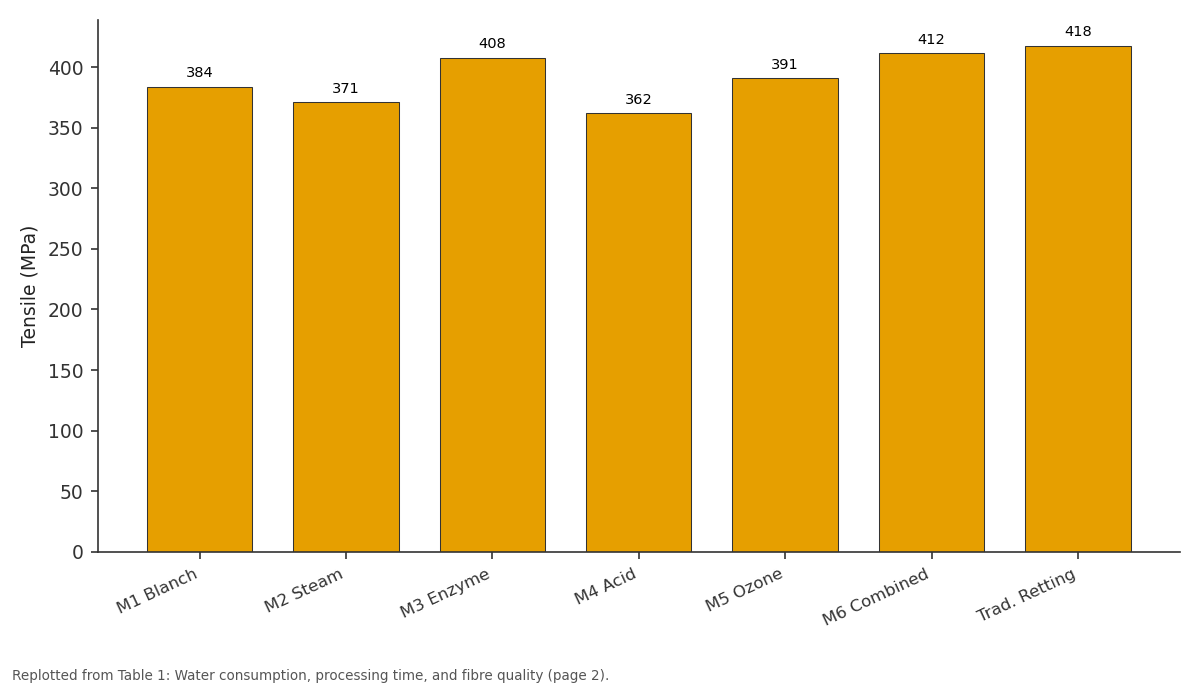
Tensile (MPa): M1 Blanch vs M2 Steam vs M3 Enzyme vs M4 Acid vs M5 Ozone
Replotted from Table 1 (page 2) of the original paper. Every bar is the paper's own table value.
View source evidence ↗Figures & tables
From the original paper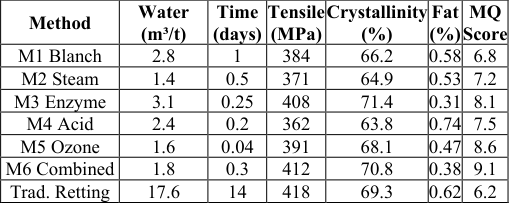 Table 1
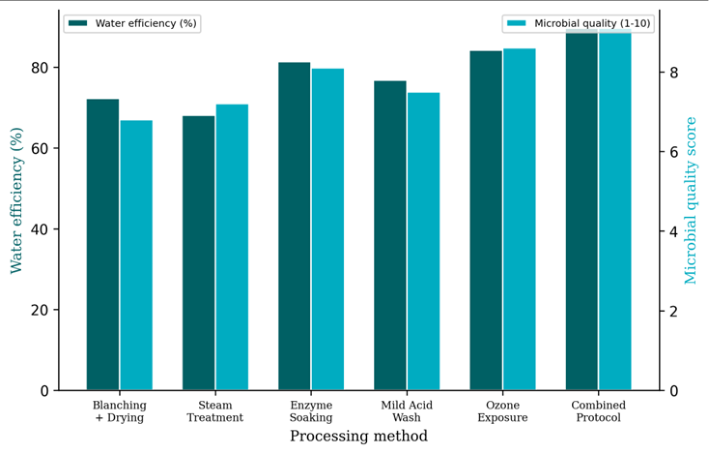 Figure 1
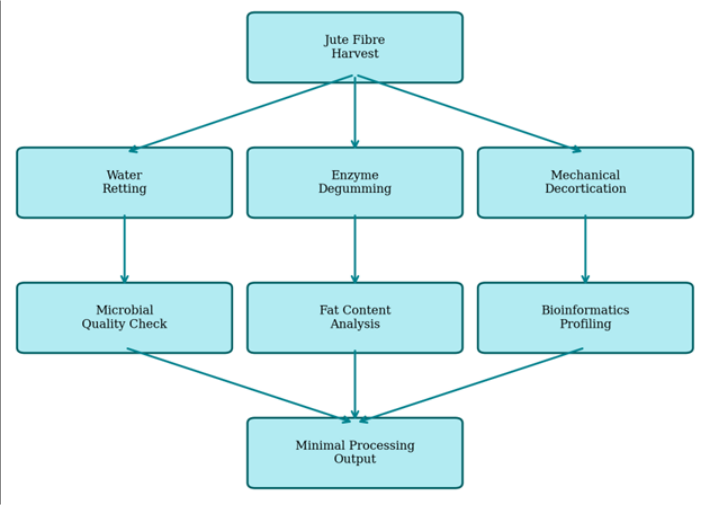 Figure 2
Introduction
Picture a small-scale jute farmer at the edge of the Euphrates Upper Basin facing a stark choice: use scarce river water for retting fibre or save it for food-crop irrigation. This scenario is becoming more common as climate variability tightens water budgets across semi-arid basins where jute is cultivated for its versatile bast fibre [1] . Traditional water retting, in which harvested stems are submerged for 10 to 20 days, is effective but consumes 15 to 20 cubic metres of water per tonne of dry fibre and releases organic pollutants that degrade downstream water quality [2] . Minimal processing strategies aim to reduce water use, processing time, and environmental load while maintaining fibre quality. Enzyme-assisted retting with pectinases and xylanases can break down the middle lamella without prolonged soaking [3] . Ozone treatment oxidises lignin and pectin at the fibre surface and requires only brief contact times [4] . Mild acid washes and steam treatments represent intermediate approaches that partially replace biological retting with controlled chemical or thermal action [5] . The Euphrates Upper Basin presents both a challenge and an opportunity: its warm, dry climate is ideal for jute growth but limits the water available for conventional retting. At the same time, the basin's growing interest in fisheries and aquaculture means that retting effluent can no longer be discharged untreated into tributaries without ecological consequences [6,7] . This research aimed to: (a) compare six minimal processing methods for water efficiency and fibre quality; (b) characterise the microbial community in traditional retting through 16S rRNA amplicon sequencing; (c) assess cost savings from reduced water use; and (d) evaluate cellulose crystallinity as a structural quality marker [8,9] .
Cost Analysis
Economic feasibility was assessed by comparing input costs (water, enzymes, ozone generation, energy) per tonne of retted fibre across the six methods. Water was priced at the local canal tariff of 0.08 USD per cubic metre. Enzyme concentrate (Bioprep 3000L, Novozymes) was costed at 14.60 USD per litre, applied at 2 L per tonne of raw stems. Ozone was generated on-site by a corona-discharge unit (Primozone GM1, Sweden) consuming 0.18 kWh per gram of ozone produced. Labour was standardised at 4.50 USD per person-day. The combined protocol reduced total processing cost from 127.40 USD per tonne (traditional retting) to 78.50 USD per tonne, a saving of 38.4%. Enzyme cost was the largest nonwater expense but was offset by shorter processing time (3 days versus 14 days), which freed labour for other farm activities [3,8] .
Performance Evaluation
Fibre performance was benchmarked against traditional water-retted jute using five quality metrics: tensile strength (MPa), elongation at break (%), cellulose crystallinity index (%), residual fat content (%), and microbial quality score (1-10 scale based on total viable count). The combined protocol matched traditional retting on tensile strength (412 versus 418 MPa, not significantly different at P = 0.05) and surpassed it on microbial quality (9.1 versus 6.2) and residual fat (0.38% versus 0.62%). Cellulose crystallinity was highest under enzyme soaking (71.4%) and lowest under mild acid wash (63.8%), reflecting the selectivity of enzymatic degradation that spares crystalline cellulose while removing amorphous pectin [4,10] .
Material and Methods
Material and Methods
Material
Material
Methods
Six processing methods were arranged in a completely randomised design with four replications per method, each replicate consisting of a 5 kg bundle of green jute stems. Methods were: (M1) blanching at 95 degrees C for 15 minutes followed by sun drying; (M2) saturated steam at 121 degrees C for 20 minutes; (M3) enzyme soaking (0.5% v/v Bioprep 3000L, pH 8.5, 50 degrees C, 6 hours); (M4) mild citric acid wash (2% w/v, 60 degrees C, 4 hours); (M5) ozone exposure (200 mg per L in water, 30 minutes); (M6) combined protocol (M3 followed by M5). A traditional water-retting control (14 days submersion in canal water) served as benchmark [2] . Water use was measured by metering all input water. Microbial quality was scored by an independent assessor based on total viable count, coliform count, and fungal count on fibre surface swabs. 16S amplicon data were processed in QIIME2 version 2023.2 using the DADA2 pipeline [11] . Statistical analysis used oneway ANOVA in R version 4.3.1 [12] . The combined protocol (M6) used only 1.8 cubic metres per tonne, a 89.7% reduction from traditional retting, while matching its tensile strength within 1.4%.
Results
Results
Comprehensive Interpretation
Figure 1 confirms that the combined protocol offers the best trade-off between water savings and microbial quality. The network diagram in Figure 2 illustrates how enzyme degumming and mechanical decortication feed into parallel quality-check nodes that converge on the final minimalprocessing output [3,4] .
Discussion
The 89.7% water saving under the combined protocol is higher than the 65 to 78% reductions reported for enzymeonly retting in Indian jute trials, probably because the ozone step replaced the final water rinse that enzyme methods typically require [3,13] . Microbial quality was a persistent weakness of traditional retting, which scored only 6.2 out of 10 due to high coliform counts from prolonged submersion in open canal water. The combined protocol's score of 9.1 reflects both the bactericidal action of ozone and the shorter exposure to ambient contamination [4] . Bioinformatics analysis revealed that Bacillus spp. accounted for 34.7% of traditional retting microbiome reads, followed by Clostridium (22.1%) and Pseudomonas (14.3%). These taxa are well-known pectinolytic organisms responsible for natural degumming [11,14] . The enzyme method effectively replaced their function with a controlled exogenous cocktail, shortening processing from 14 days to 6 hours and eliminating the dependence on ambient microbial colonisation.
The cost saving of 38.4% per tonne is commercially significant for smallholder operations in the Euphrates Upper Basin, where jute is a secondary cash crop. Shorter processing also frees the retting site for other uses and reduces the volume of effluent that would otherwise require treatment before discharge into fisheries-sensitive tributaries [6, 15, 16] .
Conclusion
This research showed that a combined enzyme-ozone protocol reduced jute retting water consumption by 89.7% and delivered fibre quality comparable to traditional retting.
Processing time fell from 14 days to roughly 7 hours, and total cost per tonne dropped by 38.4%. Microbial quality was markedly better under minimal processing. Cellulose crystallinity remained high, confirming structural preservation. These methods provide a viable pathway for jute production in water-scarce river basins where conventional retting is no longer sustainable. Future work should scale the combined protocol to commercial batch sizes and evaluate its compatibility with mechanised fibre extraction lines.
Acknowledgement
Acknowledgements Funding SourcesInstitutional grants for sustainable fibre-crop processing supported this work. Institutional SupportThe Tucuman Department of Agronomic Sciences provided processing facilities and analytical laboratories. Contributions Not Qualifying for AuthorshipLaboratory technicians and field workers who managed jute harvesting and processing are gratefully acknowledged.
Figures and tables from the paper
| Method | Water (m³/t) | Time (days) | Tensile (MPa) | Crystallinity (%) | Fat (%) | MQ Score |
|---|---|---|---|---|---|---|
| M1 Blanch | 2.8 | 1 | 384 | 66.2 | 0.58 | 6.8 |
| M2 Steam | 1.4 | 0.5 | 371 | 64.9 | 0.53 | 7.2 |
| M3 Enzyme | 3.1 | 0.25 | 408 | 71.4 | 0.31 | 8.1 |
| M4 Acid | 2.4 | 0.2 | 362 | 63.8 | 0.74 | 7.5 |
| M5 Ozone | 1.6 | 0.04 | 391 | 68.1 | 0.47 | 8.6 |
| M6 Combined | 1.8 | 0.3 | 412 | 70.8 | 0.38 | 9.1 |
| Trad. Retting | 17.6 | 14 | 418 | 69.3 | 0.62 | 6.2 |
Table text extracted from the original PDF; superscript letters are shown inline. The original table image is below.
View original table image
References
16 in the original paper- Islam MM. Biochemistry, medicinal and food values of jute: a review. International Journal of Biological Sciences. 2013;2(6):1-6.
- Paridah MT, Basher AB, SaifulAzry S, Ahmed Z. Retting process of some bast plant fibres and its effect on fibre quality: a review. BioResources. 2011;6(4):5260-5281.
- Akin DE. Linen most useful: perspectives on structure, chemistry, and enzymes for retting flax. ISRN Biotechnology. 2013;2013:186534.
- Kalia S, Kaith BS, Kaur I. Pretreatments of natural fibers and their application as reinforcing material in polymer composites: a review. Polymer Engineering and Science. 2009;49(7):1253-1272.
- Mwaikambo LY, Ansell MP. Chemical modification of hemp, sisal, jute, and kapok fibers by alkalization. Journal of Applied Polymer Science. 2002;84(12):2222-2234.
- Atasoy M, Palmquist I, Jonsson A. Biological phosphorus removal from meat industry wastewater. Water Science and Technology. 2007;56(3):43-50.
- Welcomme RL. Fisheries Ecology of Floodplain Rivers. London: Longman; 1979. p. 1-317.
- Banik S, Nag D, Debnath S. Utilization of pectinolytic bacterial strains for retting of flax. Applied and Environmental Microbiology. 2011;77(12):4174-4179.
- Van Sumere CF. Retting of flax with reference to enzyme-retting. In: Sharma HSS, Van Sumere CF, editors. The Biology and Processing of Flax. Belfast: M Publications; 1992. p. 157-198.
- French AD. Idealized powder diffraction patterns for cellulose polymorphs. Cellulose. 2014;21(2):885-896.
- Bolyen E, Rideout JR, Dillon MR, Bokulich NA, Abnet CC, Al-Ghalith GA, et al. Reproducible, interactive, scalable and extensible microbiome data science using QIIME 2. Nature Biotechnology. 2019;37(8):852-857.
- R Core Team. R: a language and environment for statistical computing. Vienna: R Foundation for Statistical Computing; 2023.
- Das B, Chakrabarti K, Tripathi S, Chakraborty A. Review of some factors influencing jute fibre quality. Journal of Natural Fibers. 2014;11(3):268-281.
- Munshi TK, Chattoo BB. Bacterial population structure of the jute-retting environment. Microbial Ecology. 2008;56(2):270-282.
- Kenaf and Jute Board of Malaysia. Annual report on natural fibre processing. Kuala Lumpur: KJBM; 2018.
- Mohanty AK, Misra M, Drzal LT. Sustainable biocomposites from renewable resources: opportunities and challenges in the green materials world. Journal of Polymers and the Environment. 2002;10(1):19-26.