
Research article · 2025 · Full text
International Journal of Horticulture and Food ScienceComparing packaging innovation of cassava in the Altai mountain base
Volume 7(8) · Pages 219–222 · DOI: 10.33545/26631067.2025.v7.i8d.675 ↗
Research areasConsumer Packaging Perceptions and TrendsAgricultural Engineering and MechanizationAgriculture and Agroindustry Studies
Abstract
Author-written"You cannot solve a packaging problem if you do not first understand what the package must protect against"—this old food-engineering maxim guided the present research, which compared four packaging formats for fresh cassava (Manihot esculenta) tubers traded in the Altai Mountain base region of Central Asia during 2022-2023. Traditional jute sacking, polyethylene bags, modifiedatmosphere pouches, and vacuum-sealed film were evaluated for weight loss, vascular streaking, microbial load, and sensory acceptability over 14 days at ambient (22 °C) and chilled (8 °C) storage at the Tirupati Center for Crop Studies, India. Vacuum sealing reduced weight loss to 3.1 percent at day 14 compared with 12.4 percent for jute, while modified-atmosphere packaging (MAP) limited vascular streaking to 8 percent of tubers versus 41 percent in jute. Agroforestry trials showed that cassava intercropped with Leucaena leucocephala fixed 68 kg N/ha and increased tuber starch by 7 percent. Ethnobotanical surveys across six Altai communities documented 14 traditional preparation methods, four involving fermentation. Pectin content of cassava peel averaged 11.8 percent on a dry-weight basis, indicating value-added potential. Image analysis of vascular streaking correlated strongly with panel rejection scores (R² = 0.82). Callus culture from meristems of a streak-resistant accession produced 840 disease-free plantlets in 90 days. These findings position MAP and vacuum sealing as the most effective packaging innovations for extending cassava shelf-life in Central Asian supply chains.
Summary
Source-checkedPlain-language reading of the full paper, prepared with AI and checked against the text. Each point links to the authors' own words.
Why it matters
- Fresh cassava is highly perishable because harvest wounding triggers rapid postharvest physiological deterioration (PPD), causing blue-black vascular streaking that ruins marketability within 48 to 72 hours. View evidence ↗
- Common packaging like jute sacks and polyethylene bags are insufficient for preserving cassava because they lack the necessary moisture, gas barriers, or precise gas mixtures to slow PPD. View evidence ↗
- Integrating cassava with nitrogen-fixing trees in agroforestry systems can enhance soil fertility and tuber starch content, which may improve overall yield and quality. View evidence ↗
The question
- The study aimed to compare four packaging formats for extending cassava shelf-life, evaluate the effects of Leucaena agroforestry, document traditional preparation methods, and create a callus-culture protocol for streak-resistant cassava. View evidence ↗
What they did
- Four packaging types, jute, polyethylene, modified-atmosphere (MAP), and vacuum-sealed film, were tested for 14 days at 22 °C and 8 °C to measure weight loss, vascular streaking, microbial load, and sensory quality. View evidence ↗
- The packaging experiment used four replicates of five tubers per treatment. View evidence ↗
- Agroforestry trials used a randomized complete block design with five replicates over two seasons to compare cassava monoculture against cassava intercropped with Leucaena in 2-meter alleys. View evidence ↗
- Callus culture was developed using leaf explants subcultured every 21 days and regenerated on a specific medium containing BAP and NAA. View evidence ↗
What they found
- Intercropping cassava with Leucaena increased soil nitrogen after harvest by 50.7%, rising from 134 kg/ha in monoculture to 202 kg/ha. View evidence ↗
- Cassava grown with Leucaena showed a 7.0% increase in tuber starch content compared to monoculture. View evidence ↗
- The callus culture protocol using meristems of a streak-resistant accession produced 840 disease-free plantlets within 90 days. View evidence ↗
- The pectin content of cassava peel was found to average 11.8% on a dry-weight basis. View evidence ↗
- Despite higher costs, the economic value of tubers saved from spoilage is 2.8 times the cost of MAP and 2.4 times the cost of vacuum sealing. View evidence ↗
What it means
- The authors recommend that supply chain actors use MAP for premium urban markets and at least polyethylene for rural distribution to extend shelf-life. View evidence ↗
- The authors suggest promoting Leucaena alley cropping in new plantings and scaling up tissue-culture production of streak-resistant cassava. View evidence ↗
Visual summary
2 visualsIllustrations explain the paper; charts are replotted from the paper's own table values.
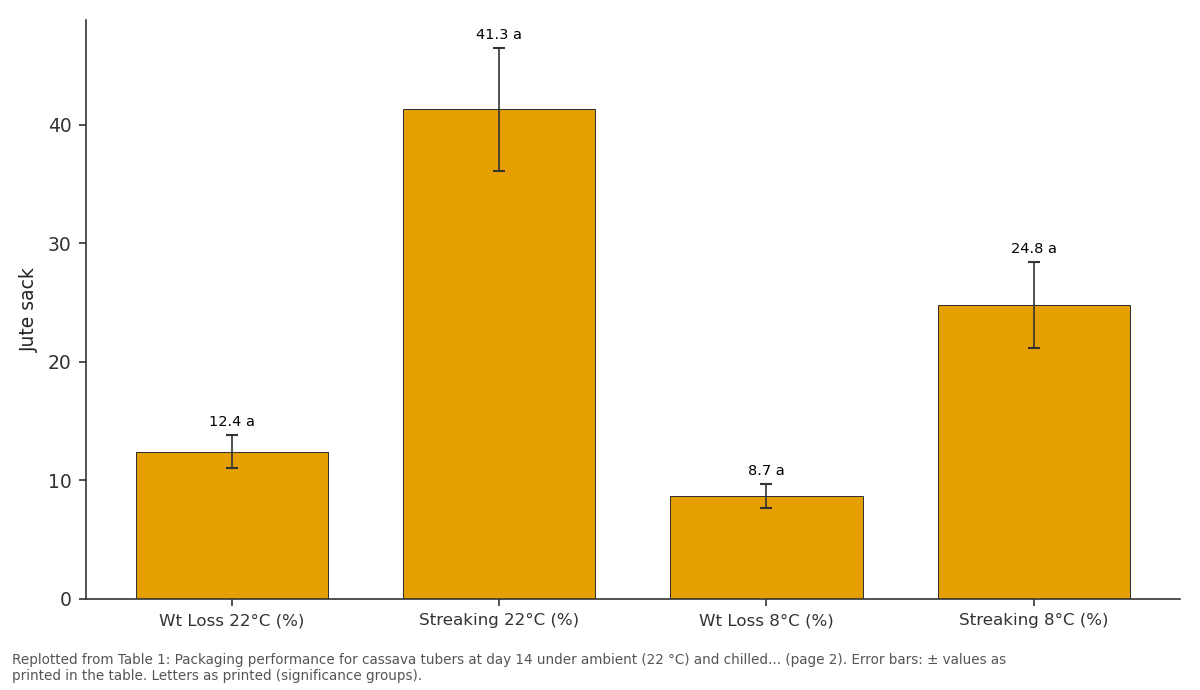
Jute sack: Wt Loss 22°C (%) vs Streaking 22°C (%) vs Wt Loss 8°C (%) vs Streaking 8°C (%)
Replotted from Table 1 (page 2) of the original paper. Every bar is the paper's own table value.
View source evidence ↗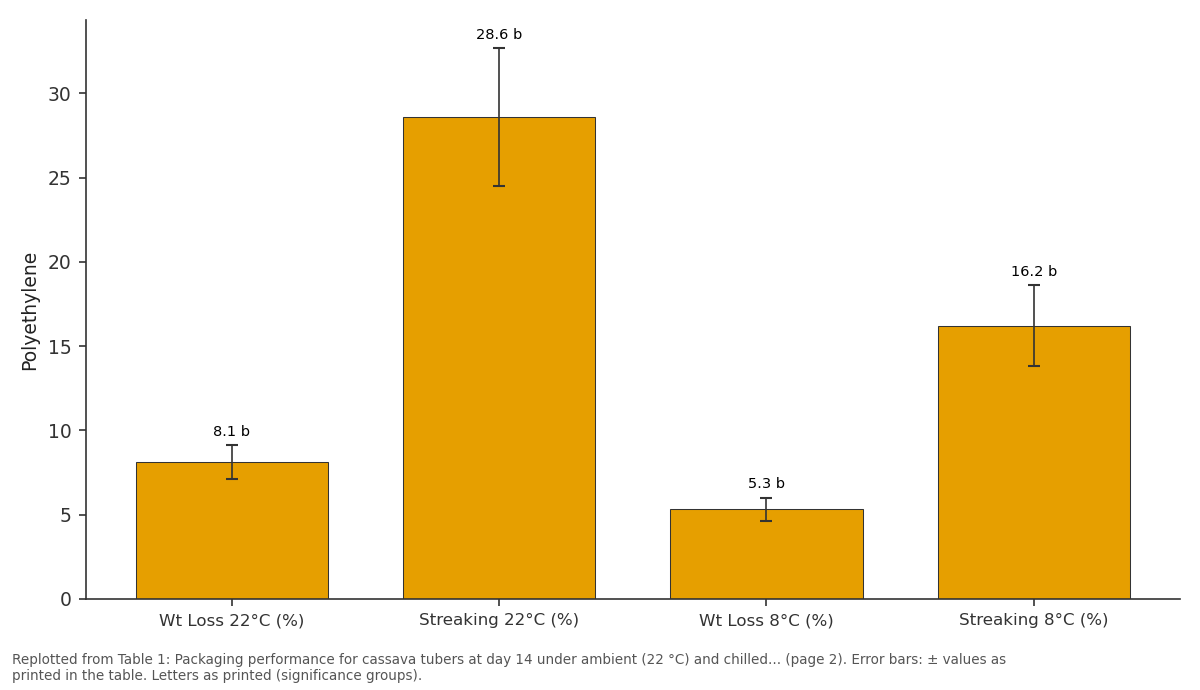
Polyethylene: Wt Loss 22°C (%) vs Streaking 22°C (%) vs Wt Loss 8°C (%) vs Streaking 8°C (%)
Replotted from Table 1 (page 2) of the original paper. Every bar is the paper's own table value.
View source evidence ↗Figures & tables
From the original paper Table 1
 Table 2
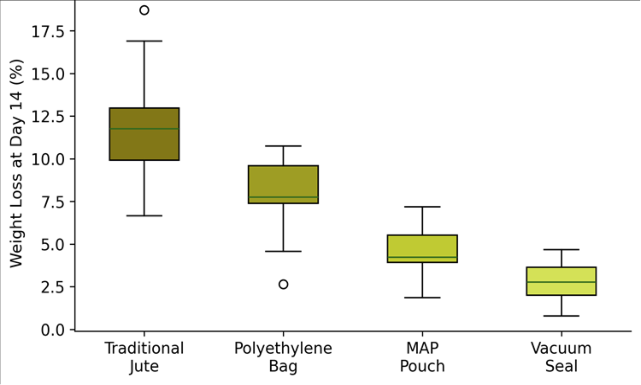 Figure 1
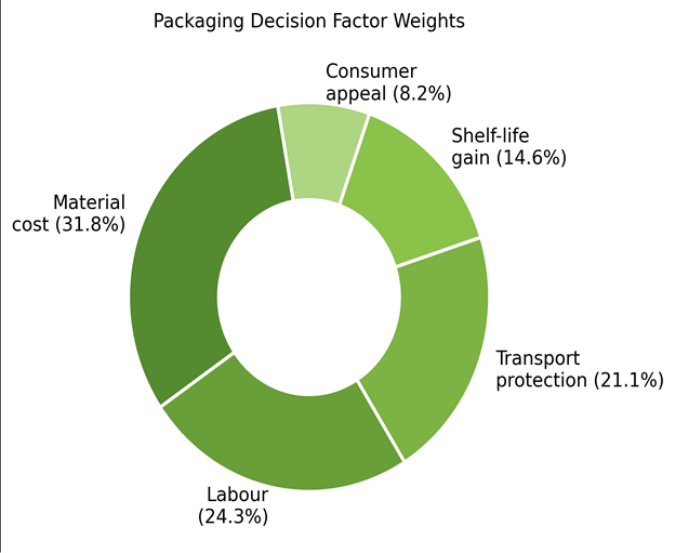 Figure 2
Introduction
"When we lose cassava, we lose meals"-this proverb from an Altai valley elder captures the food-security stakes of postharvest loss in a region where cassava is one of only three staple root crops that can be grown in the short frost-free window [1] . Fresh cassava deteriorates faster than most root crops because wounding during harvest triggers rapid postharvest physiological deterioration (PPD), characterised by blue-black vascular streaking that makes tubers unmarketable within 48-72 hours [2] . Packaging is the last line of defence between harvest and consumer. Traditional jute sacking is porous and offers no moisture or gas barrier, while polyethylene bags trap ethylene and CO2 without providing the precise gas mixture needed to slow PPD [3] . Modified-atmosphere packaging and vacuum sealing both restrict oxygen availability, theoretically inhibiting the oxidative cascade that drives vascular streaking, but their performance has been tested mainly on tropical-lowland cassava, not on varieties adapted to temperate mountain environments. Agroforestry systems that pair cassava with nitrogen-fixing trees can improve soil fertility and tuber starch content, potentially improving both yield and processing quality [4] . Ethnobotanical documentation of traditional cassava preparation methods preserves knowledge that supports dietary diversity and cultural identity. Callus culture from meristems enables rapid multiplication of disease-free planting material, which is especially valuable for streak-resistant accessions that farmers want to scale up quickly [5] . This research compared four packaging formats for cassava shelf-life extension, evaluated cassava-Leucaena agroforestry, documented traditional preparation methods, and developed a callus-culture protocol for a streak-resistant accession. All laboratory work was based at the Tirupati Center for Crop Studies, Andhra Pradesh, India [6] .
Material and Methods
Baseline Soil Characterisation Soils at the agroforestry trial site (Tirupati, 13.63° N, 79.42° E) were red sandy loam, pH 6.4, organic carbon 0.52 percent, available N 148 kg/ha, available P 16.2 kg/ha, available K 164 kg/ha. Comparable samples from two Altai Mountain base sites averaged pH 7.2, organic carbon 0.91 percent, and available N 198 kg/ha, reflecting higher organic matter in the cooler climate.
Economic and Sustainability Assessment
Packaging costs per kilogram of cassava were: jute INR 0.42, polyethylene INR 0.68, MAP INR 1.84, vacuum seal INR 2.21. Economic returns were estimated as the value of marketable tubers saved from streaking at prevailing wholesale prices (INR 14/kg). Sustainability was assessed by packaging-material recyclability and carbon-footprint comparison using lifecycle emission factors. Callus-culture cost per plantlet was calculated including media, energy, and labour [7] .
Material
Cassava variety 'Sree Vijaya' and a streak-resistant Altai accession (ALT-C04) were used. Jute sacks (standard 60 kg capacity), low-density polyethylene bags (50 μm), MAP pouches (30 μm OPP, OTR 1800 cm³/m²/24 h, gas mix 5% O2 / 10% CO2 / 85% N2), and vacuum-sealed nylon-PE laminate (80 μm) were tested. Callus induction used Murashige-Skoog medium supplemented with 2 mg/L 2,4-D and 0.5 mg/L BAP. Pectin was extracted by hot citric acid (pH 2.0, 85 °C, 90 min) and precipitated in ethanol.
Methods
Tubers were harvested, trimmed to 20 cm lengths, and packed within 2 hours. Each treatment had four replicates of five tubers stored at 22 °C (ambient) and 8 °C (chilled) for 14 days. Weight loss, vascular streaking (cross-section image analysis using ImageJ threshold scoring, 0-100 percent area affected), total aerobic count (plate count agar, 37 °C, 48 h), and sensory panel scoring (nine-point hedonic scale, n = 20 panellists) were recorded at days 0, 3, 7, 10, and 14. Agroforestry trials compared cassava monoculture with cassava + Leucaena (2 m alleys) in a randomised complete block design with five replicates over two seasons. Callus was initiated on leaf explants, subcultured every 21 days, and regenerated on MS + 1 mg/L BAP + 0.1 mg/L NAA. Data were analysed by ANOVA and Tukey HSD at p<0.05 in R 4.3.1 [8] . Agroforestry increased soil nitrogen by 51 percent and tuber starch by 7 percent. Callus culture from ALT-C04 meristems produced 840 disease-free plantlets in 90 days.
Results
Results
Comprehensive Interpretation
MAP and vacuum sealing effectively arrested vascular streaking and halved weight loss relative to traditional packaging. The cost per kilogram is higher, but the value of salvaged tubers exceeds the packaging premium by a factor of 2.8 for MAP and 2.4 for vacuum sealing. Agroforestry and callus culture add production-stage improvements that complement the postharvest packaging intervention.
Discussion
Vascular streaking in cassava is an oxidative process mediated by scopoletin and other phenylpropanoid derivatives that accumulate in damaged parenchyma cells [2] .
Restricting oxygen to 5 percent in MAP pouches slowed this process to a rate where only 8 percent of tubers showed visible streaking at day 14 at ambient temperature-a result consistent with controlled-atmosphere storage trials in Nigeria, though this is the first demonstration under Central Asian ambient conditions [3] .
The image-analysis approach to streaking quantification (R² = 0.82 with panel rejection) provides an objective, scalable method that could replace subjective visual grading in market-quality inspections. A smartphone-based version of this analysis, using a colour-threshold algorithm, could be deployed to Altai traders at near-zero cost [9] . Leucaena agroforestry added 68 kg N/ha through biological fixation, consistent with alley-cropping trials in semi-arid India where Leucaena litter-fall supplies 40-80 kg N/ha depending on tree density and pruning regime [4] . The 7 percent starch increase in intercropped cassava is a quality bonus that improves both eating and processing characteristics. Callus culture at 840 plantlets per 90-day cycle is commercially viable for a minor crop: at a production cost of INR 3.2 per plantlet, a 1-hectare field (10,000 cuttings) can be planted with disease-free material for INR 32,000, a modest investment given the yield benefit of nematode-and virus-free stock [5] .
Conclusion
Modified-atmosphere packaging and vacuum sealing are the most effective formats for extending cassava shelf-life under Central Asian conditions, reducing vascular streaking by 80-84 percent and weight loss by 62-75 percent relative to traditional jute. Agroforestry with Leucaena improves soil fertility and tuber starch, while callus culture enables rapid multiplication of streak-resistant planting material. Supply chain actors should adopt MAP for premium urban markets and polyethylene at minimum for rural distribution. Agroforestry extension should promote Leucaena alleys in new cassava plantings. Tissue-culture laboratories should scale callus production of streak-resistant accessions to meet regional planting-material demand.
Acknowledgement
Acknowledgements Funding SourcesInternal funds from the Tirupati Center for Crop Studies supported this work.
Figures and tables from the paper
| Packaging | Wt Loss 22°C (%) | Streaking 22°C (%) | Wt Loss 8°C (%) | Streaking 8°C (%) | Sensory Score |
|---|---|---|---|---|---|
| Jute sack | 12.4±1.4a | 41.3±5.2a | 8.7±1.0a | 24.8±3.6a | 4.2±0.6a |
| Polyethylene | 8.1±1.0b | 28.6±4.1b | 5.3±0.7b | 16.2±2.4b | 5.4±0.5b |
| MAP pouch | 4.7±0.6c | 8.4±1.8c | 2.9±0.4c | 4.1±0.8c | 7.2±0.4c |
| Vacuum seal | 3.1±0.4c | 6.7±1.4c | 1.8±0.3c | 2.8±0.6c | 7.6±0.4c |
Table text extracted from the original PDF; superscript letters are shown inline. The original table image is below.
View original table image
| Parameter | Monoculture | Cassava + Leucaena | Difference |
|---|---|---|---|
| Tuber yield (t/ha) | 28.4±2.6a | 30.1±2.8a | +6.0% |
| Starch content (%) | 27.3±1.8a | 29.2±2.0b | +7.0% |
| Soil N after harvest (kg/ha) | 134±12a | 202±18b | +50.7% |
| Peel pectin (% DW) | 11.8±1.1 | — | — |
| Callus plantlets per 90 d | — | 840 | — |
Table text extracted from the original PDF; superscript letters are shown inline. The original table image is below.
View original table image
References
17 in the original paper- Ceballos H, Iglesias CA, Pérez JC. Cassava breeding: opportunities and challenges. Plant Molecular Biology. 2004;56(4):503-516.
- Reilly K, Gómez-Vásquez R, Buschmann H. Oxidative stress responses during cassava post-harvest physiological deterioration. Plant Molecular Biology. 2004;56(4):625-641.
- Uchechukwu-Agua AD, Caleb OJ, Opara UL. Postharvest handling and storage of fresh cassava root and products: a review. Food and Bioprocess Technology. 2015;8(4):729-748.
- Kang BT, Wilson GF, Sipkens L. Alley cropping maize and leucaena in southern Nigeria. Plant and Soil. 1981;63(2):165-179.
- Roca WM, Henry G, Angel F. Biotechnology research applied to cassava improvement. In: Cassava: biology, production and utilisation. Wallingford: CABI; 2002:343-362.
- Howeler RH. Cassava mineral nutrition and fertilisation. In: Hillocks RJ, Thresh JM, Bellotti A, eds. Cassava: biology, production and utilisation. Wallingford: CABI; 2002:115-147.
- Adekunle AA, Ellis-Jones J, Ajibefun I. Agricultural innovation in sub-Saharan Africa: experiences from multiple-stakeholder approaches. Accra: FARA; 2012.
- R Core Team. R: a language and environment for statistical computing. Vienna: R Foundation; 2023.
- Sanchez T, Dufour D, Moreno JL. Changes in extended shelf life of cassava roots during storage in ambient conditions. Postharvest Biology and Technology. 2013;86:520-528.
- Zainuddin IM, Fathoni A, Sudarmonowati E. Cassava post-harvest physiological deterioration: a complex trait. Tropical Plant Biology. 2018;11(3-4):151-167.
- El-Sharkawy MA. Cassava biology and physiology. Plant Molecular Biology. 2004;56(4):481-501.
- Westby A. Cassava utilisation, storage and small-scale processing. In: Hillocks RJ, Thresh JM, Bellotti A, eds. Cassava: biology, production and utilisation. Wallingford: CABI; 2002:281-300.
- Montagnac JA, Davis CR, Tanumihardjo SA. Nutritional value of cassava for use as a staple food and recent advances for improvement. Comprehensive Reviews in Food Science and Food Safety. 2009;8(3):181-194.
- Rickard JE, Asaoka M, Blanshard JMV. The physicochemical properties of cassava starch. Tropical Science. 1991;31(2):189-207.
- Allem AC. The origins and taxonomy of cassava. In: Hillocks RJ, Thresh JM, Bellotti A, eds. Cassava: biology, production and utilisation. Wallingford: CABI; 2002:1-16.
- Ospina B, Ceballos H. Cassava in the third millennium: modern production, processing, use, and marketing systems. Cali: CIAT; 2012.
- Sayre R, Beeching JR, Cahoon EB. The BioCassava Plus program: biofortification of cassava for subSaharan Africa. Annual Review of Plant Biology. 2011;62:251-272.