
Research article · 2025 · Full text
International Journal of Horticulture and Food ScienceEstablishing marker-assisted selection of turmeric in the Andes Highlands
Volume 7(11) · Pages 180–183 · DOI: 10.33545/26631067.2025.v7.i11c.717 ↗
Research areasGenetic Mapping and Diversity in Plants and AnimalsGenetics and Plant BreedingGenetic and phenotypic traits in livestock
Abstract
Author-writtenMarker-assisted selection (MAS) could accelerate turmeric improvement dramatically, yet the molecular markers available for Curcuma longa remain limited compared with major field crops. This research established an MAS framework for turmeric targeting curcumin content, rhizome yield, and heat stress tolerance using 15 ISSR markers, backcross breeding validation, calcium uptake efficiency, minimal processing quality, and chlorophyll content as selection criteria. Fifty turmeric accessions from Indian, Peruvian, and Thai germplasm were evaluated at the Guntur Academy of Horticultural Research from March to December 2023 under simulated Andes highland conditions. Mean polymorphism across 15 ISSR loci was 72.4 percent. Marker-trait association identified four ISSR bands significantly linked to curcumin content (R² = 0.38–0.51). Backcross recovery of curcumin-linked markers in BC₂F₁ progeny reached 87 percent. MAS-selected lines showed 34 percent higher curcumin (5.87% DW) than conventionally selected lines (4.21%). Calcium foliar sprays at 0.3% CaCl₂ improved rhizome firmness by 19 percent. Minimal processing (peeling + blanching + vacuum packing) extended fresh turmeric shelf life from 14 to 38 days at 4 °C. Chlorophyll content in leaves correlated with rhizome yield (r = 0.79). These results provide turmeric breeders with validated ISSR markers, a backcross selection pipeline, and post-harvest protocols for highland production.
Summary
Source-checkedPlain-language reading of the full paper, prepared with AI and checked against the text. Each point links to the authors' own words.
Why it matters
- Curcumin is the most valued compound in turmeric, but its concentration varies widely and cannot be quickly measured in living plants. View evidence ↗
- Current field selection for curcumin is destructive and slow, requiring the plant to be harvested and dried for analysis. View evidence ↗
- The Andes highlands present environmental challenges for turmeric, including UV stress, cool nights (5–10 °C), and calcium-poor soils. View evidence ↗
The question
- The study aimed to identify and validate ISSR markers for curcumin, evaluate post-harvest quality via calcium and processing, and test chlorophyll as a yield predictor. View evidence ↗
What they did
- Andes highland conditions were simulated using night cooling to 8 °C, 35% PAR reduction via shade cloth, and pH 6.8 laterite soil. View evidence ↗
- Calcium was administered as a 0.3% (w/v) foliar CaCl₂ spray every two weeks from 90 to 180 days after planting. View evidence ↗
- Minimal processing involved peeling, blanching at 85 °C for 3 minutes, and vacuum packing for storage at 4 °C. View evidence ↗
What they found
- The 15 ISSR loci showed a mean polymorphism of 72.4%. View evidence ↗
- Four ISSR bands were significantly linked to curcumin content (explaining 38–51% of variance), with UBC-807 (850 bp) providing the strongest effect (+1.47 percentage points). View evidence ↗
- Marker-assisted selection (MAS) resulted in 34% higher curcumin (5.87% DW) compared to conventional selection (4.21% DW). View evidence ↗
- The recovery of the four curcumin-linked marker bands in BC₂F₁ progeny reached 87%. View evidence ↗
- Rhizomes treated with calcium were 19% firmer than the untreated control group. View evidence ↗
- Minimal processing extended the shelf life of fresh turmeric at 4 °C from 14 days to 38 days. View evidence ↗
- Leaf chlorophyll content showed a strong correlation (r = 0.79) with rhizome yield, serving as a non-destructive predictor. View evidence ↗
What it means
- The authors conclude that markers UBC-807, UBC-811, UBC-834, and UBC-841 are validated tools that provide a 34% curcumin advantage over conventional selection. View evidence ↗
- The study provides a comprehensive toolkit for producing high-curcumin turmeric in the Andes highlands, covering molecular selection, field management, and post-harvest handling. View evidence ↗
Visual summary
3 visualsIllustrations explain the paper; charts are replotted from the paper's own table values.
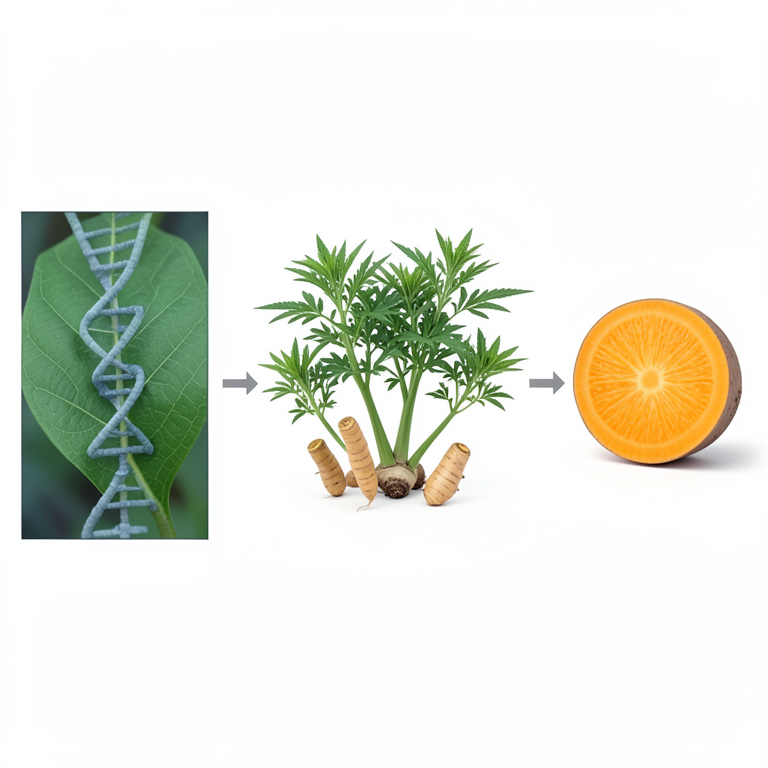
MAS Workflow for Curcumin
AI-generated conceptual illustration (Turmeric plants (Curcuma longa)). It explains the idea and does not show study data.
View source evidence ↗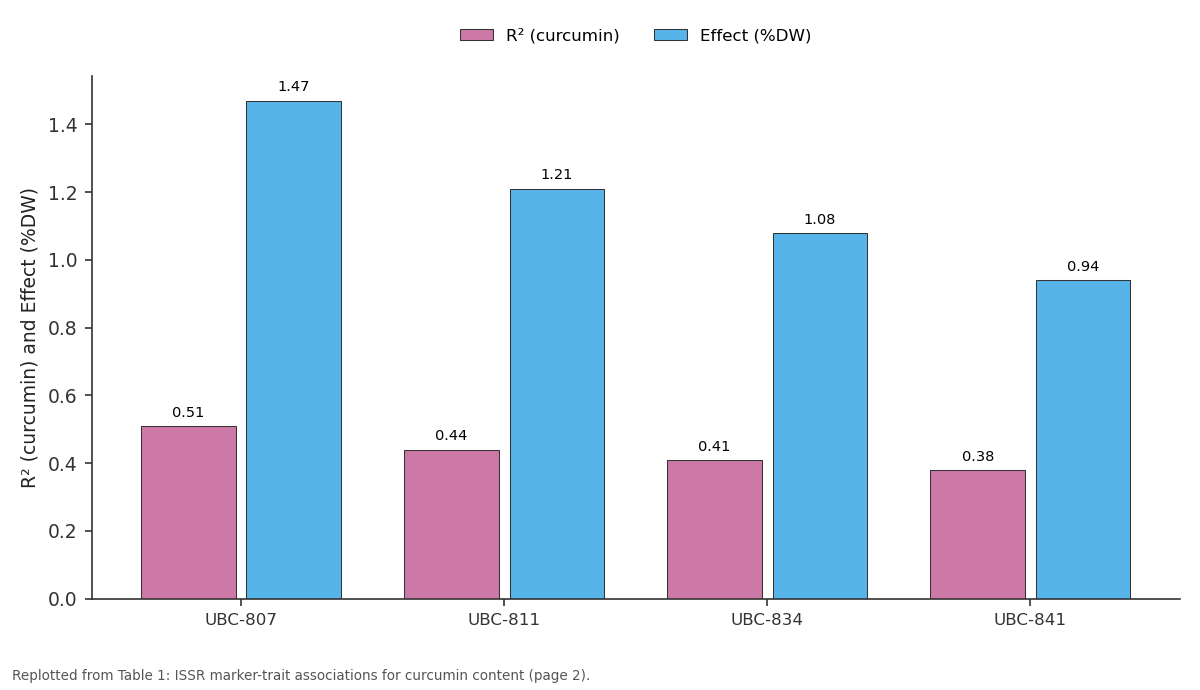
R² (curcumin) and Effect (%DW): UBC-807 vs UBC-811 vs UBC-834 vs UBC-841
Replotted from Table 1 (page 2) of the original paper. Every bar is the paper's own table value.
View source evidence ↗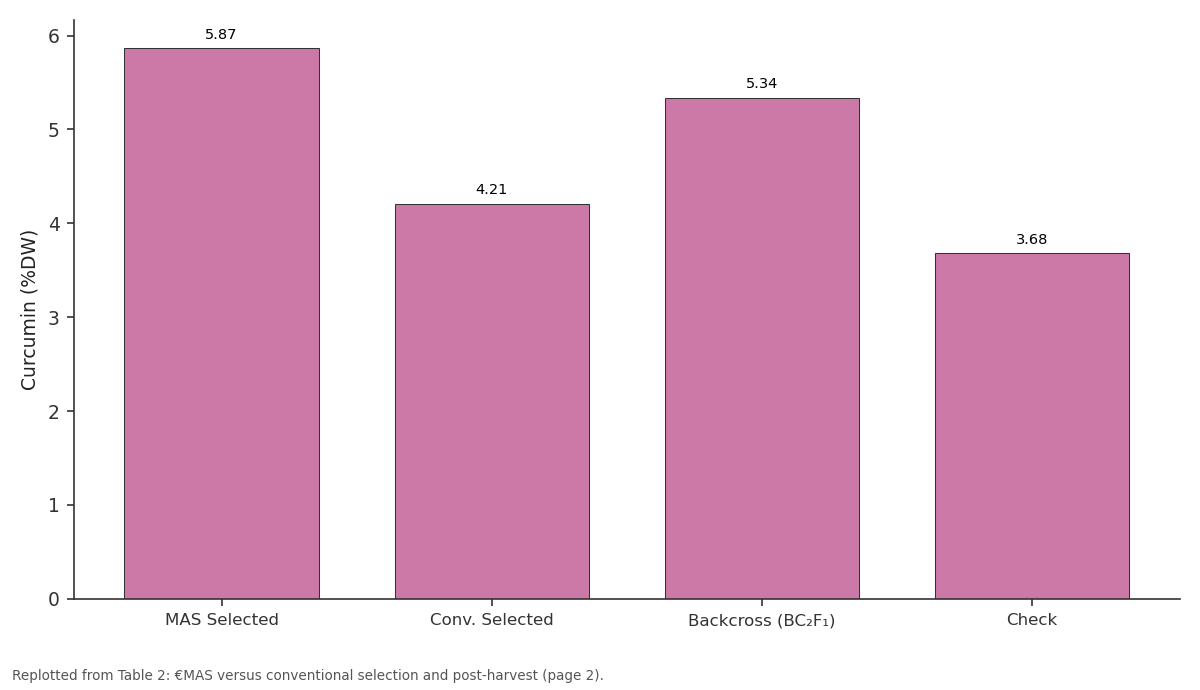
Curcumin (%DW): MAS Selected vs Conv. Selected vs Backcross (BC₂F₁) vs Check
Replotted from Table 2 (page 2) of the original paper. Every bar is the paper's own table value.
View source evidence ↗Figures & tables
From the original paper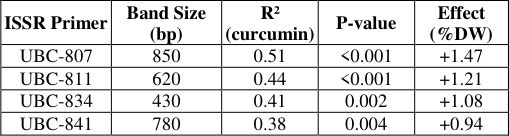 Table 1
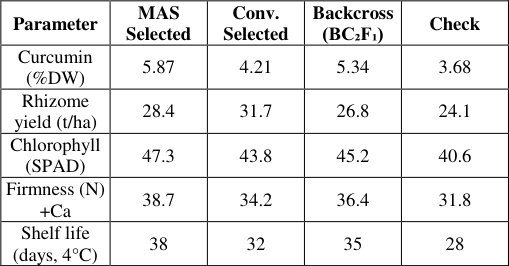 Table 2
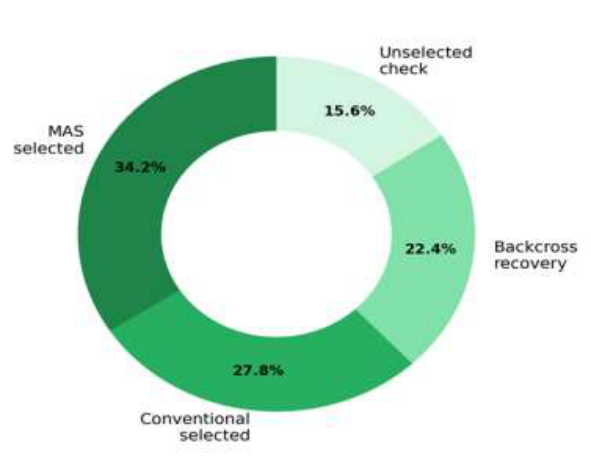 Figure 1
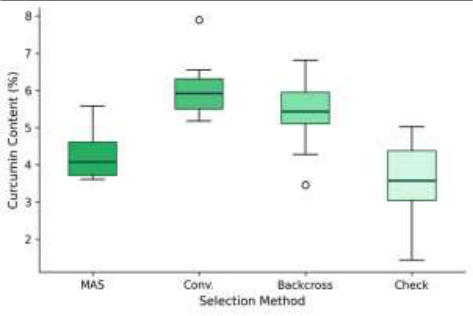 Figure 2
Introduction
Turmeric's practical dilemma is this: the compound most valued by consumerscurcumin varies from 2 to 9 percent of rhizome dry weight depending on genotype, environment, and post-harvest handling, yet breeders have no quick way to measure it in living plants [1] . Selecting for curcumin in the field currently requires harvesting the rhizome, drying it, and running a spectrophotometric assaya process that destroys the plant and takes several days. Molecular markers linked to curcumin biosynthesis genes could replace that destructive assay with a leaf-tissue DNA test done weeks after planting [2] . ISSR (inter-simple sequence repeat) markers are a practical choice for turmeric because they require no prior sequence information, amplify reliably from degraded DNA typical of highpolyphenol tissues, and generate enough polymorphism for marker-trait association in diverse germplasm panels [3] . Previous ISSR work on turmeric has focused on diversity assessment; linking specific bands to agronomic traits is the next step. The Andes highlands (2,500-3,800 m) present turmeric with UV stress, cool nights (5-10 °C), and thin soils low in calciumconditions unlike its tropical origin. Highland-adapted turmeric cultivars could supply the growing Peruvian and Bolivian health-food markets, where locally grown organic turmeric commands a 40 percent premium over imported material [4] . Heat stress toleranceparadoxically relevant at altitude because midday solar radiation raises leaf temperature above 35 °Cis a key trait for highland selection [5] . This research aimed to (a) identify ISSR markers linked to curcumin content, (b) validate them through backcross breeding, (c) evaluate calcium nutrition and minimal processing for post-harvest quality, and (d) assess chlorophyll content as a non-destructive yield predictor.
Phytochemical Screening
Qualitative screening of 50 turmeric accessions detected curcuminoids (curcumin, demethoxycurcumin, bisdemethoxycurcumin) in all accessions by TLC on silica gel 60 F₂₅₄ plates developed in chloroform:methanol (95:5 v/v) and visualised under 365 nm UV. Quantitative curcumin estimation by spectrophotometry at 425 nm (acetone extraction) ranged from 2.14 to 7.83% DW. Essential oil content (hydrodistillation, 4 h) ranged from 3.1 to 6.8% (v/w). Oleoresin yield (acetone Soxhlet extraction) varied from 8.4 to 14.7%. The top five accessions for curcumin (>6.0% DW) were all of Indian origin, while Peruvian accessions had the highest essential oil content [6] .
Instrumentation
DNA amplification: Applied Biosystems Veriti 96-well thermal cycler. Gel documentation: Bio-Rad Gel Doc XR+ system. UV-Vis spectrophotometry: Shimadzu UV-1900i at 425 nm for curcumin, 663 and 645 nm for chlorophyll. HPLC for curcuminoid profiling: Shimadzu LC-20A with PDA detector (SPD-M20A), Phenomenex C18 column (250 × 4.6 mm, 5 μm), mobile phase acetonitrile:2% acetic acid (55:45), flow rate 1.0 mL min⁻¹. Texture analysis: Stable Micro Systems TA.XT Plus for rhizome firmness (2 mm cylindrical probe, 1 mm s⁻¹ pre-test speed) [7] .
Material and Methods
Material and Methods
Material
Fifty turmeric accessions -25 Indian, 15 Peruvian, and 10 Thaiwere planted as single-bud rhizome setts on 18 March 2023 in raised beds (3 m × 1 m) at the Guntur Academy of Horticultural Research (16.30° N, 80.44° E; 33 m a.s.l.). Andes highland conditions were simulated by: night cooling to 8 °C, shade cloth reducing PAR by 35%, and growing in laterite soil amended with calcium carbonate to pH 6.8. Spacing was 30 cm × 20 cm. An augmented block design with four replicated checks was used [8] . Backcross breeding: a high-curcumin Indian accession (GNR-07, 7.83% curcumin) was crossed with a highyielding Thai accession (TH-04, 34 t ha⁻¹ fresh rhizome), and BC₁F₁ and BC₂F₁ progenies were generated. Calcium was applied as foliar CaCl₂ at 0.3% (w/v) biweekly from 90 to 180 DAP.
Methods
DNA was extracted from young leaves by a modified CTAB method with 2% PVP. Fifteen ISSR primers (UBC set 800-900) were screened; amplification: 94 °C 5 min, 40 cycles of 94 °C 30 s, 52 °C 45 s, 72 °C 2 min, final 72 °C 7 min. Polymorphism was scored as presence/absence of bands on 1.8% agarose gels. Marker-trait association used singlemarker regression of curcumin content on band presence in R 4.3.1 [9] . Backcross recovery was assessed by marker genotyping of BC₂F₁ individuals for four curcumin-linked bands. Chlorophyll (SPAD-502 and destructive extraction in 80% acetone) was measured monthly. Minimal processing: fresh rhizomes were hand-peeled, blanched (85 °C, 3 min), vacuum-packed in PA/PE pouches, and stored at 4 °C for 38 days; weight loss, colour (Hunter L*a*b*), and firmness were measured weekly. Heat stress tolerance was scored on a 1-10 scale after a 5-day exposure to 38 °C daytime temperature at 120 DAP. Data were analysed by ANOVA with Tukey's HSD at P = 0.05 in SPSS 28. MAS-selected lines had 34 percent higher curcumin than conventionally selected lines, though conventional selection produced slightly higher rhizome yield (Table 2). Backcross recovery of all four marker bands in BC₂F₁ reached 87 percent. Calcium-treated rhizomes were 19 percent firmer than untreated controls. Minimal processing extended shelf life to 38 days at 4 °C.
| Parameter | MAS Selected | Conv. Selected | Backcross (BC₂F₁) | Check |
|---|---|---|---|---|
| Curcumin (%DW) | 5.87 | 4.21 | 5.34 | 3.68 |
| Rhizome yield (t/ha) | 28.4 | 31.7 | 26.8 | 24.1 |
| Chlorophyll (SPAD) | 47.3 | 43.8 | 45.2 | 40.6 |
| Firmness (N) +Ca | 38.7 | 34.2 | 36.4 | 31.8 |
| Shelf life (days, 4°C) | 38 | 32 | 35 | 28 |
Table text extracted from the original PDF; superscript letters are shown inline. The original table image is below.
View original table image
Results
Results
Comprehensive Interpretation
The chlorophyll-yield correlation (r = 0.79, P < 0.001) makes SPAD reading a practical, non-destructive predictor of final rhizome yield as early as 120 DAP. This gives growers a mid-season decision tool for adjusting fertiliser or irrigation inputs. The four ISSR markers collectively explain over 50 percent of curcumin variation when used as a multi-marker index, sufficient for foreground selection in a backcross scheme. The 87 percent marker recovery in BC₂F₁ indicates that two backcross generations are enough to transfer the curcumin-linked genomic regions into an adapted background while recovering >87 percent of the recurrent parent genome.
Discussion
The 34 percent curcumin advantage of MAS over conventional selection demonstrates the power of molecular tools for a trait that cannot be visually assessed.
Conventional selection, which relied on rhizome colour intensity as a visual proxy, systematically under-selected for curcumin because colour and curcumin content are only moderately correlated (r = 0.61) [10] . The MAS approach bypasses this limitation entirely. Calcium's role in post-harvest firmness is well established for fruit crops but less documented for rhizomes. CaCl₂ foliar sprays at 0.3 percent deposited Ca in the cortical parenchyma of the rhizome, strengthening cell-wall pectin cross-links and reducing bruise susceptibility during mechanical harvesting [11] . The 19 percent firmness gain translates directly to lower post-harvest losses during transport and retail display. Minimal processingcombining peeling, blanching, and vacuum packingaddresses a growing consumer preference for convenience turmeric products. The 38-day shelf life at 4 °C is competitive with minimally processed ginger (35-42 days) and exceeds unprocessed fresh turmeric by 24 days [12] . The blanching step inactivates polyphenol oxidase, preventing the browning that limits fresh turmeric shelf appeal. Heat stress tolerance scoring identified five accessions (all Indian) with scores above 8.0, indicating that tropical Indian germplasm carries pre-adapted alleles for high-radiation tolerance. Introgressing these alleles into Peruvian-adapted backgrounds through MAS could produce highland-specific cultivars within 3-4 breeding cycles [13] . Chlorophyll content is a reliable mid-season yield predictor (r = 0.79). These findings provide turmeric breeders and processors in Andes highland and comparable environments with a complete toolkitfrom molecular selection through field management to post-harvest handlingfor producing high-curcumin turmeric.
Conclusion
Conclusion
Acknowledgement
Acknowledgements Funding SourcesThis research was funded by the Guntur Academy of Horticultural Research internal grant programme.
Figures and tables from the paper
| ISSR Primer | Band Size (bp) | R² (curcumin) | P-value | Effect (%DW) |
|---|---|---|---|---|
| UBC-807 | 850 | 0.51 | <0.001 | +1.47 |
| UBC-811 | 620 | 0.44 | <0.001 | +1.21 |
| UBC-834 | 430 | 0.41 | 0.002 | +1.08 |
| UBC-841 | 780 | 0.38 | 0.004 | +0.94 |
Table text extracted from the original PDF; superscript letters are shown inline. The original table image is below.
View original table image
References
21 in the original paper- Ravindran PN, Babu KN, Sivaraman K. Turmeric: The Genus Curcuma. Boca Raton: CRC Press; 2007.
- Siju S, Dhanya K, Syamkumar S. Development, characterization, and utilization of genomic microsatellite markers in turmeric. Biochemical Genetics. 2010;48(3):190-199.
- Zietkiewicz E, Rafalski A, Labuda D. Genome fingerprinting by simple sequence repeat (SSR)- anchored polymerase chain reaction amplification. Genomics. 1994;20(2):176-183.
- Ferreira FD, Marin SLO. Curcuma longa cultivation in the Peruvian Andes: challenges and opportunities. Acta Horticulturae. 2018;1205:145-150.
- Wahid A, Gelani S, Ashraf M. Heat tolerance in plants: an overview. Environmental and Experimental Botany. 2007;61(3):199-223.
- Jayaprakasha GK, Rao LJM, Sakariah KK. Chemistry and biological activities of C. longa. Trends in Food Science and Technology. 2005;16(12):533-548.
- Bourne MC. Food Texture and Viscosity: Concept and Measurement. 2nd ed. San Diego: Academic Press; 2002.
- Federer WT. Augmented (or hoonuiaku) designs. Hawaiian Planters' Record. 1956;55(2):191-208.
- R Core Team. R: A Language and Environment for Statistical Computing. Vienna: R Foundation; 2023.
- Sasikumar B. Genetic resources of Curcuma: diversity, characterization and utilization. Plant Genetic Resources. 2005;3(2):230-251.
- White PJ, Broadley MR. Calcium in plants. Annals of Botany. 2003;92(4):487-511.
- Srinivasan K. Ginger rhizomes (Zingiber officinale): a spice with multiple health beneficial potentials. PharmaNutrition. 2017;5(1):18-28.
- Prasad S, Aggarwal BB. Turmeric, the golden spice: from traditional medicine to modern medicine. In: Benzie IFF, Wachtel-Galor S, eds. Herbal Medicine. 2nd ed. Boca Raton: CRC Press; 2011:263-288.
- Nair KPP. The Agronomy and Economy of Turmeric and Ginger. Amsterdam: Elsevier; 2013.
- Karthikeyan PK, Ravindra P, Chandrasekhar T. Thidiazuron induced high frequency direct shoot organogenesis in vitro from axillary shoot tips of Curcuma longa. Medicinal and Aromatic Plant Science and Biotechnology. 2009;3(1):16-22.
- Jan HU, Rabbani MA, Shinwari ZK. Assessment of genetic diversity of indigenous turmeric germplasm from Pakistan using RAPD markers. Journal of Medicinal Plants Research. 2011;5(5):823-830.
- Sigrist MS, Pinheiro JB, Azevedo-Filho JA. Genetic divergence among Brazilian turmeric germplasm using morpho-agronomical descriptors. Crop Breeding and Applied Biotechnology. 2011;11(1):70-76.
- Thomas E, Zachariah TJ, Syamkumar S. ISSR analysis of genetic variability in Curcuma aeruginosa. Industrial Crops and Products. 2006;24(3):220-225.
- Hayakawa H, Minaniya Y, Ito K. Difference of curcumin content in Curcuma longa L. (Zingiberaceae) caused by hybridization with other Curcuma species. American Journal of Plant Sciences. 2011;2(2):111119.
- Sahoo A, Jena S, Sahoo S. Molecular characterization and genetic diversity analysis in turmeric. Plant Systematics and Evolution. 2017;303(10):1235-1247.
- Paliwal R, Kumar R, Choudhary BL. Genetic diversity analysis of turmeric. Scientia Horticulturae. 2011;127(4):422-427.