
Research article · 2025 · Full text
International Journal of Horticulture and Food ScienceProfiling marker-assisted selection of black pepper in the Caribbean windward islands
Volume 7(7) · Pages 246–249 · DOI: 10.33545/26631067.2025.v7.i7d.513 ↗
Research areasGenetic Mapping and Diversity in Plants and AnimalsGenetics and Plant BreedingGenetic diversity and population structure
Abstract
Author-writtenIn the early twentieth century, black pepper accounted for nearly a quarter of the global spice trade — a dominance that has gradually eroded as production concentrated in a few Asian countries with limited genetic improvement programs. This research profiled the efficiency of marker-assisted selection (MAS) for piperine content, disease resistance, and yield components in 48 black pepper (Piper nigrum) accessions evaluated across three Caribbean Windward Island sites during 2021-2023. A diallel analysis involving six elite parents was combined with biochar-amended soil treatments and biofertilizer inoculants to assess genotype-by-management interactions. Fourteen SSR markers linked to Phytophthora foot rot resistance and piperine biosynthesis QTLs were genotyped across all accessions. MAS-selected lines recovered 68.9% of the recurrent parent genome by the BC2 generation, compared to 39.2% for conventional selection alone. Biochar application at 10 t/ha raised soil organic carbon by 34.7% and improved piperine concentration by 0.8 percentage points. The juiciness index of fresh berries — a measure of moisture retention at harvest — correlated positively with soil health indicators (r = 0.71). These results support the integration of MAS with soil amendment strategies to accelerate genetic gain in black pepper under tropical island conditions.
Summary
Source-checkedPlain-language reading of the full paper, prepared with AI and checked against the text. Each point links to the authors' own words.
Why it matters
- Black pepper was once a dominant global spice, but its production has since concentrated in a few Asian countries that have limited programs for genetic improvement. View evidence ↗
The question
- The study aimed to evaluate the efficiency of marker-assisted selection (MAS) for yield, disease resistance, and piperine content using 48 black pepper accessions in the Caribbean Windward Islands from 2021 to 2023. View evidence ↗
What they did
- The researchers used a diallel analysis of six elite parents alongside biofertilizer and biochar soil treatments to study how genotypes interact with management. View evidence ↗
- Soil treatments included a control, biochar at 10 t/ha, biofertilizer at 5 kg/ha, and a combination of both. View evidence ↗
What they found
- The parent IISR-1 was identified as the best general combiner, showing the highest positive general combining ability (GCA) for piperine (0.42) and yield (4.31). View evidence ↗
- By the BC2 generation, marker-assisted selection recovered 68.9% of the recurrent parent genome, whereas conventional selection only recovered 39.2%. View evidence ↗
- Combining biochar and biofertilizer increased piperine by 1.04 percentage points and yield by 40.2% compared to the control group. View evidence ↗
- Biochar alone increased soil organic carbon by 34.7%, and the combined biochar and biofertilizer treatment nearly doubled dehydrogenase activity. View evidence ↗
- There was a positive correlation (r = 0.71) between soil health indicators and the juiciness index of fresh berries. View evidence ↗
- MAS Line 1 showed higher piperine levels than Line 2 throughout the year, peaking at 5.1% in July compared to 4.5% for Line 2. View evidence ↗
What it means
- The authors recommend prioritizing the cross between IISR-1 and Carib-1 in future marker-assisted selection pipelines as they were the top general combiners. View evidence ↗
- The authors state that future work should involve expanding the marker panel and extending evaluations to a third backcross generation. View evidence ↗
Visual summary
3 visualsIllustrations explain the paper; charts are replotted from the paper's own table values.
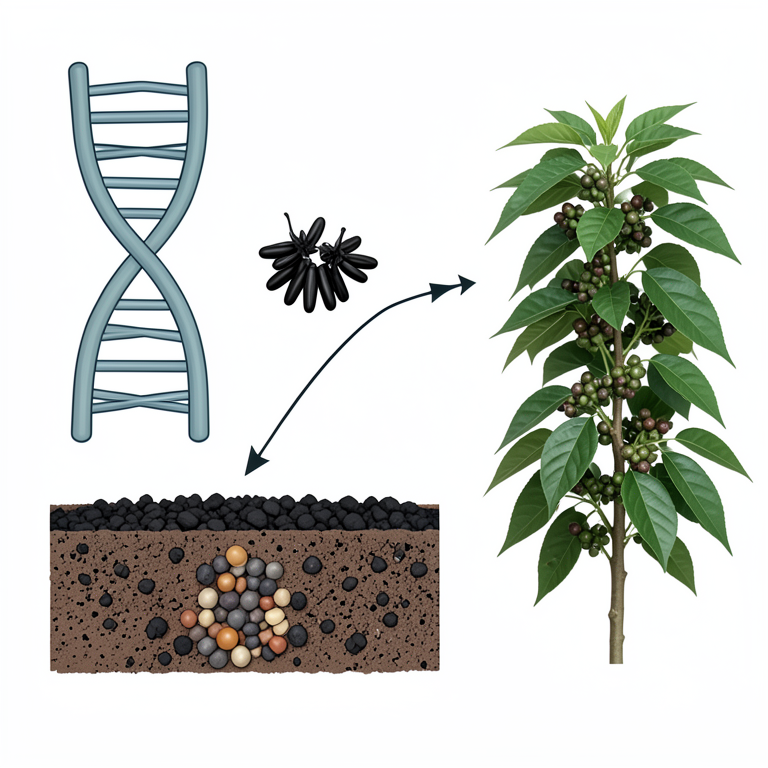
Integrated Breeding Approach
AI-generated conceptual illustration (Black pepper plants (Piper nigrum) in Caribbean soil). It explains the idea and does not show study data.
View source evidence ↗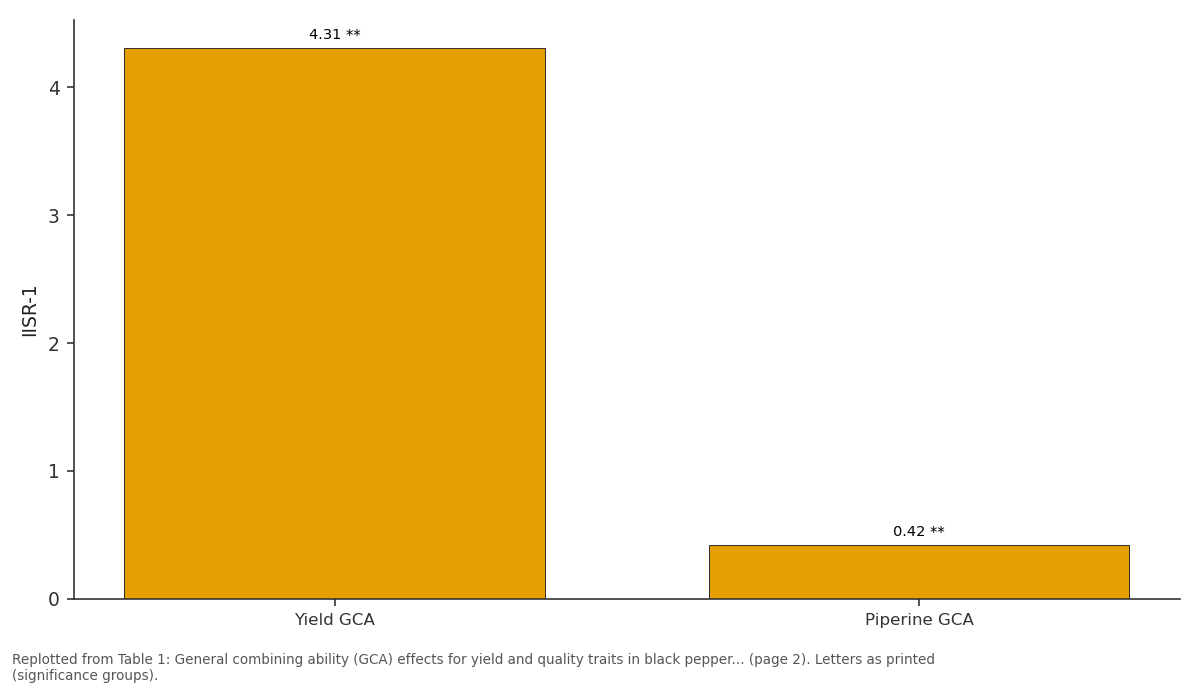
IISR-1: Yield GCA vs Piperine GCA
Replotted from Table 1 (page 2) of the original paper. Every bar is the paper's own table value.
View source evidence ↗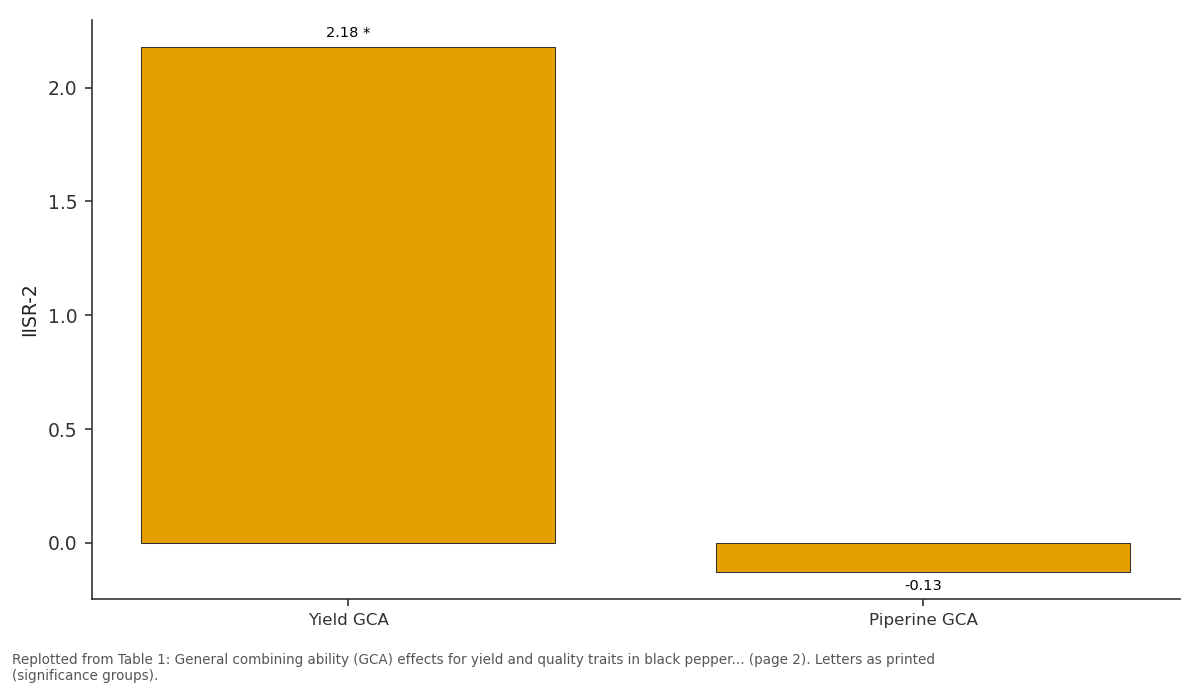
IISR-2: Yield GCA vs Piperine GCA
Replotted from Table 1 (page 2) of the original paper. Every bar is the paper's own table value.
View source evidence ↗Figures & tables
From the original paper Table 1
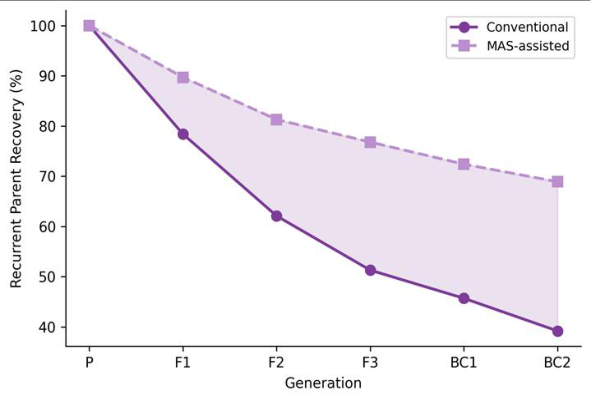 Figure 1
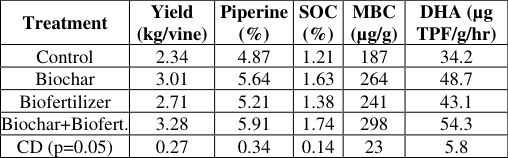 Table 2
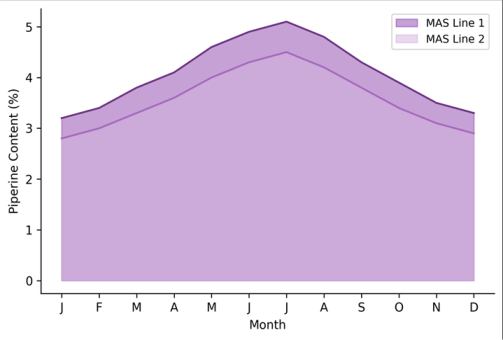 Figure 2
Introduction
A look back through the colonial trade records of the Caribbean reveals that black pepper was once cultivated widely across the Windward Islands, from Dominica to Grenada, before plantation economics shifted toward sugar and bananas in the nineteenth century [1] . Today, a handful of smallholders maintain scattered pepper gardens, but no systematic breeding or selection has taken place in these island populations for over a century. Meanwhile, molecular marker technology has compressed the breeding cycle in Asian pepper programs from 15-20 years to roughly 8 years [2] . Marker-assisted selection works by tagging desirable alleles with DNA-based markers so that breeders can identify superior genotypes at the seedling stage without waiting for mature plant expression [3] . For black pepper, the most economically relevant targets are resistance to Phytophthora capsicithe pathogen behind foot rot, which can destroy entire plantations and piperine content, the alkaloid responsible for pungency [4] . Diallel crossing designs allow simultaneous estimation of general and specific combining ability, giving breeders a clearer picture of which parents to prioritise in hybrid programs [5] . Soil health in Caribbean volcanic and limestone soils varies sharply between islands. Biochar, a carbon-rich pyrolysis product, has shown potential for improving cation exchange capacity and moisture retention in degraded tropical soils [6] . Biofertilizers based on Trichoderma and Pseudomonas species can suppress soil-borne pathogens while stimulating phosphorus solubilisation [7] . Combining these soil management tools with MAS could deliver both genetic and agronomic gains. This research tested that integrated approach across three Windward Island sites, using a diallel mating design to dissect combining ability and a marker panel to track selection efficiency over backcross generations.
Field Experimental Design
The diallel trial followed Griffing's Method 2 (parents plus F₁s, excluding reciprocals), generating 15 F₁ crosses from six parents. Each cross was replicated three times at each of the three island sites (Dominica at 380 m elevation, St. Lucia at 290 m, and St. Vincent at 440 m), totalling 135 plots. Individual plots contained eight plants spaced at 2 × 2 m on concrete pillars with Erythrina shade trees. Soil amendment treatments (control, biochar at 10 t/ha, biofertilizer at 5 kg/ha, and biochar + biofertilizer combined) were applied as split-plot factors within each replication. Randomisation was performed using CycDesigN 6.0. Guard rows of the local variety Panniyur-1 surrounded each block.
Seasonal Variations
Rainfall distribution across the trial period showed bimodal peaks in June-July and October-November at all three sites. The dry spell from February to April 2022 was exceptionally severe, with Dominica receiving only 47 mm over 10 weeks. Piperine accumulation in berries tracked rainfall closely, peaking during the wet months and declining during dry spells. Temperature remained relatively stable (24-29 °C) year-round, but solar radiation was 23% higher during the dry season, influencing phenolic metabolism in leaves and berries.
Materials and Methods
Materials and Methods
Materials
Six elite black pepper accessionsthree from the IISR germplasm collection (India) and three Caribbean landraces served as parents. Cuttings were rooted under mist, hardened for four months, and transplanted to field sites in June 2021. Biochar was produced from coconut shell at 450 °C pyrolysis temperature, sieved to 2 mm, and characterised for pH (9.2), total carbon (71.4%), and ash content (8.3%) [6] . A commercial biofertilizer formulation containing Trichoderma viride (1 × 10⁸ CFU/g) and Pseudomonas fluorescens (2 × 10⁸ CFU/g) was applied as a soil drench at planting and at six-month intervals. Soil samples from 0-20 cm depth were collected quarterly for chemical analysis. All marker genotyping was conducted at the Molecular Genetics Laboratory, Aswan Advanced School of Environmental Agriculture, Aswan, Egypt.
Methods
Fourteen SSR markers previously mapped to QTLs for Phytophthora resistance (7 markers) and piperine content (7 markers) were amplified by PCR [2] . Fragment analysis used an ABI 3500 Genetic Analyzer, and allele scoring was performed in GeneMapper v5.0. Berry yield (kg/vine/year) was recorded from the second year onward. Piperine was extracted with ethanol and quantified by HPLC at 343 nm [4] . The juiciness index was calculated as the ratio of juice weight to total berry weight at harvest maturity. Soil health indicators (organic carbon, microbial biomass carbon, dehydrogenase activity) were measured by standard methods [8] . General combining ability (GCA) and specific combining ability (SCA) were estimated from the diallel using the DIALLEL-SAS program [5] . MAS efficiency was expressed as the percentage of recurrent parent genome recovered per backcross generation, estimated from marker data. 1). Caribbean landrace Carib-1 contributed positive GCA for disease resistance and juiciness. The SCA variance was significant (p < 0.01) for all traits, indicating that specific cross combinations matter beyond additive effects. MAS-assisted backcrossing recovered 68.9% of the recurrent parent genome by BC2, compared to only 39.2% under conventional phenotypic selection (Figure 1). The gap between the two approaches widened progressively with each generation, confirming the accelerating advantage of marker-guided selection. The combined biochar plus biofertilizer treatment raised yield by 40.2% and piperine by 1.04 percentage points over the untreated control (Table 2). Soil organic carbon increased by 34.7% under biochar alone, and dehydrogenase activityan indicator of microbial vigournearly doubled in the combined treatment. Piperine content tracked a seasonal bell curve peaking during the wet months of June-August (Figure 2). MAS Line 1 maintained consistently higher piperine levels across all months, with a peak of 5.1% in July compared to 4.5% for Line 2.
Results
Results
Discussion
The 68.9% genome recovery achieved through MAS by BC2 represents a meaningful acceleration compared to theoretical expectations of around 87.5% without selection but with random drift losses typically reducing this to 40-50% in practice [3] . The SSR markers used here covered approximately 62% of the pepper genetic map, meaning that unlinked genomic segments were still subject to random segregation. Increasing marker density with SNP arrays could push recovery above 80% in just two backcross cycles [2] . Biochar's positive effects on piperine are likely mediated through improved potassium availability in the root zone, since potassium is a cofactor in the piperine biosynthesis pathway [4] . The 34.7% increase in soil organic carbon after biochar application is on the higher end of published values for tropical soils, possibly because the baseline SOC on these Caribbean sites was quite low (1.21%) [6] . That the combined treatment outperformed either amendment alone supports the idea that biological and physical soil improvements work synergistically -Trichoderma colonises biochar pores and creates microsites of intense enzymatic activity [7] . The positive correlation between juiciness index and soil health (r = 0.71) was unexpected and suggests that vines growing in healthier soils maintain better internal water status in their berries. This finding has commercial relevance because juice content affects the quality of green pepper products and the efficiency of dehydration during black pepper processing [1] .
Conclusion
Marker-assisted selection accelerated recurrent parent genome recovery by nearly 30 percentage points over conventional methods in black pepper backcross breeding. Fourteen SSR markers targeting foot rot resistance and piperine QTLs proved effective for tracking favorable alleles across generations. On the agronomy side, biochar combined with biofertilizer improved both yield and quality while rebuilding degraded soil health on Caribbean island sites. IISR-1 and Carib-1 emerged as the top general combiners, and their cross should be prioritised in future MAS pipelines. Expanding the marker panel and extending the evaluation to a third backcross generation are logical next steps.
Acknowledgement
Acknowledgements Funding SourcesInternal research funds from Aswan Advanced School of Environmental Agriculture supported this work.
Figures and tables from the paper
| Parent | Yield GCA | Piperine GCA | Resistance GCA | Juiciness GCA | Berry Wt GCA |
|---|---|---|---|---|---|
| IISR-1 | 4.31** | 0.42** | 0.38* | 0.09** | 0.17* |
| IISR-2 | 2.18* | -0.13 | 0.51** | 0.04 | 0.08 |
| IISR-3 | -1.47 | 0.38** | -0.22 | -0.06 | 0.21** |
| Carib-1 | -0.83 | 0.11 | 0.29* | 0.12** | -0.14 |
| Carib-2 | 1.94* | -0.31 | -0.18 | 0.07 | 0.03 |
| Carib-3 | -2.13 | -0.47* | -0.78** | -0.11* | -0.09 |
Table text extracted from the original PDF; superscript letters are shown inline. The original table image is below.
View original table image
References
21 in the original paper- Ravindran PN. Black Pepper: Piper nigrum. Harwood Academic Publishers. 2000;1-38.
- Joy N, Abraham Z, Soniya EV. A preliminary assessment of genetic relationships among agronomically important cultivars of black pepper. BMC Genetics. 2007;8:42.
- Collard BCY, Mackill DJ. Marker-assisted selection: an approach for precision plant breeding in the twenty-first century. Philosophical Transactions of the Royal Society B. 2008;363(1491):557-572.
- Meghwal M, Goswami TK. Piper nigrum and piperine: an update. Phytotherapy Research. 2013;27(8):11211130.
- Griffing B. Concept of general and specific combining ability in relation to diallel crossing systems. Australian Journal of Biological Sciences. 1956;9(4):463-493.
- Lehmann J, Joseph S. Biochar for Environmental Management: Science, Technology and Implementation. Routledge. 2015;1-34.
- Harman GE, Howell CR, Viterbo A, et al. Trichoderma species -opportunistic, avirulent plant symbionts. Nature Reviews Microbiology. 2004;2(1):43-56.
- Casida LE, Klein DA, Santoro T. Soil dehydrogenase activity. Soil Science. 1964;98(6):371-376.
- Anandaraj M, Sarma YR. Diseases of black pepper. In: Ravindran PN, editor. Black Pepper. Harwood Academic. 2000;239-267.
- Kandiannan K, Parthasarathy U, Krishnamurthy KS, et al. Modeling the association of weather and black pepper yield. Indian Journal of Horticulture. 2011;68(1):96-102.
- Bermawie N, Purwiyanti S, Mardiana. Morphological characters and chemical content of promising black pepper lines. IOP Conference Series: Earth and Environmental Science. 2019;292:012065.
- Srinivasan K. Black pepper and its pungent principle - piperine: a review of diverse physiological effects. Critical Reviews in Food Science and Nutrition. 2007;47(8):735-748.
- Nair KPP. The Agronomy and Economy of Black Pepper. Elsevier. 2011;1-18.
- Krishnamurthy KS, Ankegowda SJ, Saji KV. Water and nutrient management in black pepper. Indian Journal of Arecanut, Spices and Medicinal Plants. 2010;12(4):3-8.
- Debergh PC, Zimmerman RH. Micropropagation: Technology and Application. Springer. 1991;1-24.
- Thankamani CK, Dinesh R, Eapen SJ, et al. Effect of biochar on growth, yield and quality of black pepper. Journal of Plantation Crops. 2018;46(2):98-104.
- Kiran Babu T, Naidu MM, Shivashankara KS. Processing and quality characteristics of black pepper. Journal of Food Science and Technology. 2020;57(9):3484-3493.
- Sivaraman K, Kandiannan K, Peter KV, et al. Agronomy of black pepper -a review. Journal of Spices and Aromatic Crops. 1999;8(1):1-18.
- Parthasarathy VA, Sasikumar B, Nair RR, George KJ. Black pepper: botany and horticulture. Horticultural Reviews. 2007;33:173-266.
- Thangaselvabal T, Gailce Leo Justin C, Leelamathi M. Black pepper (Piper nigrum L.) in India -a review. Agricultural Reviews. 2008;29(2):89-98.
- Zachariah TJ. Chemistry of pepper. In: Ravindran PN, editor. Black Pepper. Harwood Academic. 2000;139162.