
Research article · 2025 · Full text
International Journal of Geography Geology and EnvironmentGeochemical and mineralogical study of clay deposits in the Paris basin tertiary formation
Volume 7(7) · Pages 189–192 · DOI: 10.22271/27067483.2025.v7.i7c.721 ↗
Research areasGeochemistry and Elemental AnalysisSoil and Environmental StudiesHydrocarbon exploration and reservoir analysis
Abstract
Author-writtenThe Paris Basin has supplied clay raw materials to ceramic, brick, and construction industries for centuries, yet the geochemical fingerprint of its Tertiary clay deposits has never been characterised across multiple stratigraphic members in a single integrated investigation. This research examined 87 clay samples collected from three Tertiary formations the Sparnacian (Ypresian), Lutetian, and Bartonian exposed in quarry sections and borehole cores across the Île-de-France region. X-ray diffraction, X-ray fluorescence, scanning electron microscopy, and cation exchange capacity measurements were used to define the mineralogical composition, major and trace element geochemistry, and physical properties of each formation member. Kaolinite dominated the Sparnacian clays (mean 38.2%), while smectite was the principal phase in the Lutetian (26.4%) and illite in the Bartonian (28.7%). SiO₂ content ranged from 42.3% in the Bartonian to 61.8% in the Lutetian, inversely correlated with Al₂O₃ (r² = 0.83). Cation exchange capacity was highest in the smectite-rich Lutetian clays (34.7 meq/100g), making them suitable candidates for environmental applications such as heavy metal adsorption. Rare earth element patterns showed a uniform light REE enrichment across all three formations, consistent with derivation from a common granitic-gneissic source terrain. These results provide a baseline geochemical dataset for industrial quality assessment and environmental suitability evaluation of Paris Basin clays.
Summary
Source-checkedPlain-language reading of the full paper, prepared with AI and checked against the text. Each point links to the authors' own words.
Why it matters
- The Paris Basin is a long-standing source of clay raw materials for the construction, brick, and ceramic industries. View evidence ↗
- The industrial value and environmental use of a clay deposit are determined by its dominant clay minerals. View evidence ↗
- Clays rich in smectite are potentially useful as inexpensive sorbents for removing radionuclides, organic pollutants, and heavy metals from water. View evidence ↗
The question
- The study aimed to characterize the geochemical fingerprint of Tertiary clay deposits across multiple stratigraphic members in one integrated investigation. View evidence ↗
- The researchers sought to systematically evaluate if specific Tertiary formations in the Paris Basin meet the chemical and mineralogical criteria for environmental applications. View evidence ↗
What they did
- The study analyzed 87 clay samples obtained from 4 archived borehole cores and 11 quarry exposures (active or abandoned). View evidence ↗
- Samples were taken from three stratigraphic units: Bartonian green clays (n=28), Lutetian marly clays (n=28), and Sparnacian plastic clays (n=31). View evidence ↗
- The researchers used X-ray fluorescence, X-ray diffraction, scanning electron microscopy, and cation exchange capacity measurements to determine physical properties, geochemistry, and mineral composition. View evidence ↗
What they found
- Sparnacian clays were dominated by kaolinite, with a mean content of 38.2%. View evidence ↗
- Lutetian clays had the highest proportion of smectite at 26.4%. View evidence ↗
- Illite was the principal phase in the Bartonian clays, accounting for 28.7%. View evidence ↗
- SiO₂ content varied from 42.3% in the Bartonian to 61.8% in the Lutetian and showed an inverse correlation with Al₂O₃ (r² = 0.83). View evidence ↗
- The Lutetian clays exhibited the highest cation exchange capacity (34.7 meq/100g) due to smectite's swelling interlayer sites. View evidence ↗
- Rare earth element patterns showed flat heavy REE profiles and uniform light REE enrichment, suggesting all three formations derived from a common felsic source terrain. View evidence ↗
What it means
- The authors conclude that Lutetian clays are the most promising for use as environmental sorbents because of their high cation exchange capacity (34.7 meq/100g) and smectite content. View evidence ↗
- The authors state that future research is needed to test the actual performance of Lutetian clays in adsorbing heavy metals under controlled conditions. View evidence ↗
- The authors suggest that additional borehole analysis of deeper, unexposed basin portions is needed to better understand three-dimensional variations in clay quality. View evidence ↗
Visual summary
3 visualsIllustrations explain the paper; charts are replotted from the paper's own table values.
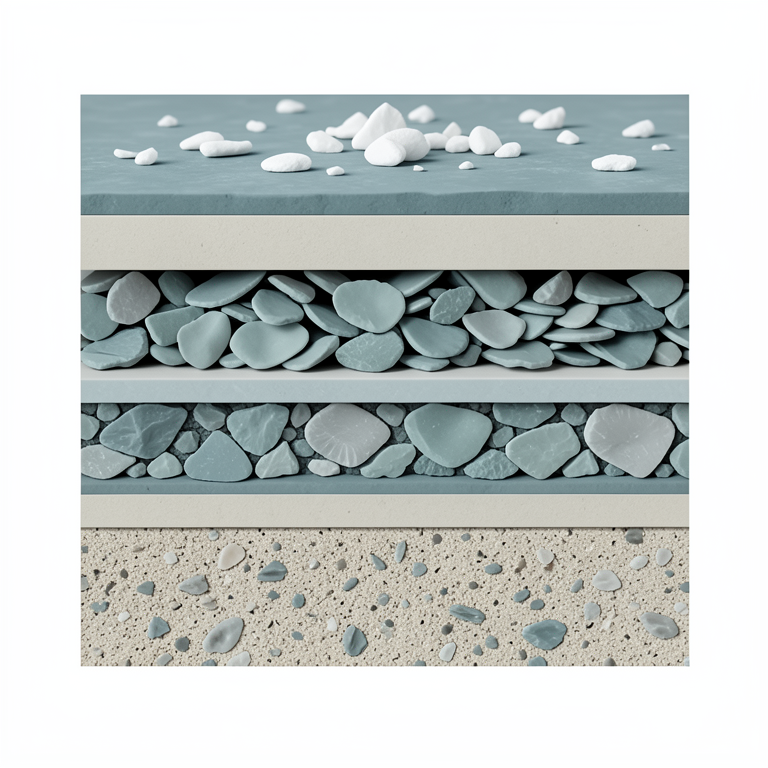
Mineralogical Distribution by Formation
AI-generated conceptual illustration (Tertiary clay deposits in the Paris basin). It explains the idea and does not show study data.
View source evidence ↗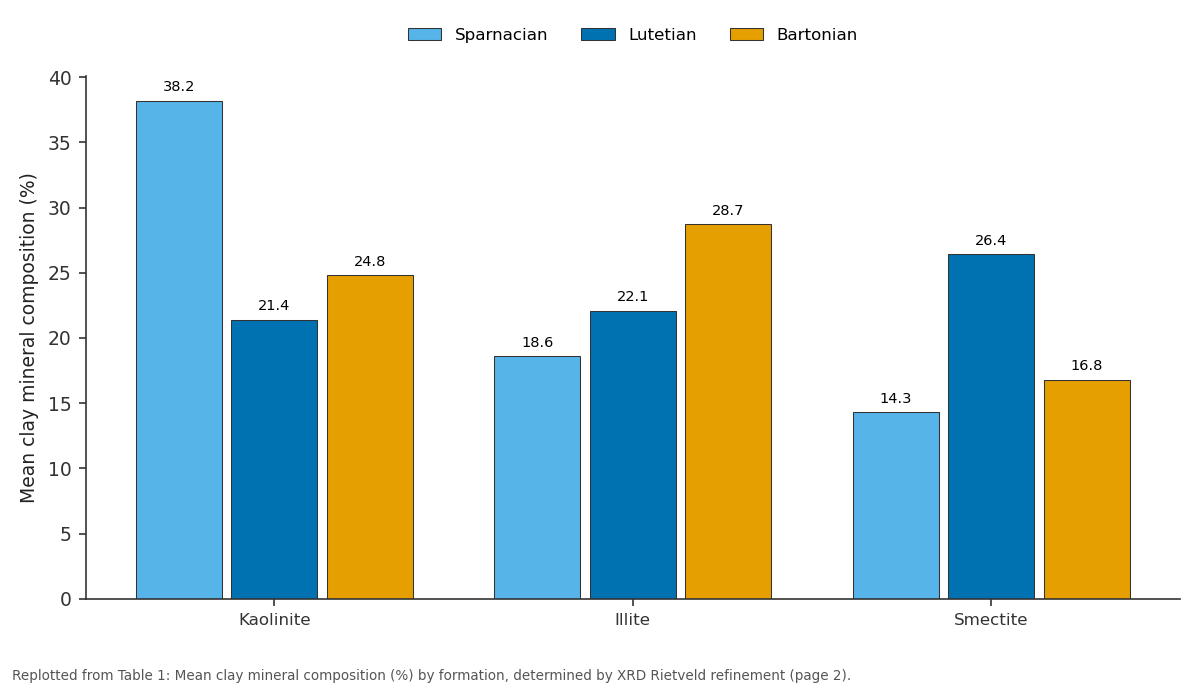
Sparnacian and Lutetian and more: Kaolinite vs Illite vs Smectite
Replotted from Table 1 (page 2) of the original paper. Every bar is the paper's own table value.
View source evidence ↗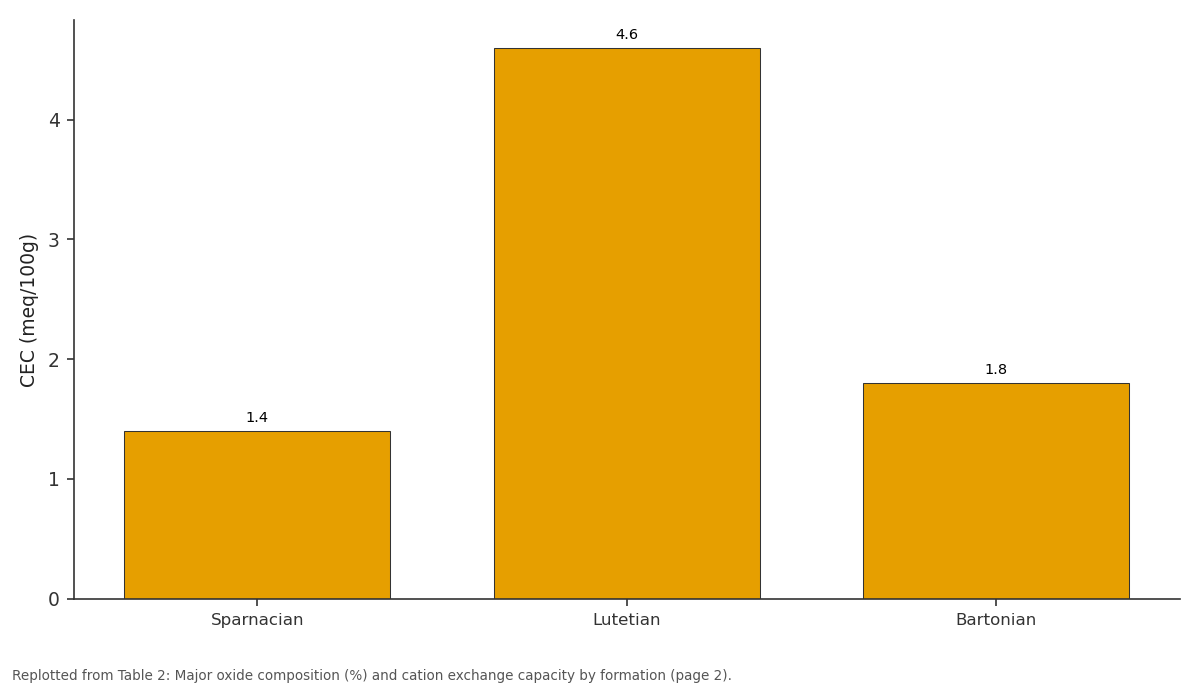
CaO: Sparnacian vs Lutetian vs Bartonian
Replotted from Table 2 (page 2) of the original paper. Every bar is the paper's own table value.
View source evidence ↗Figures & tables
From the original paper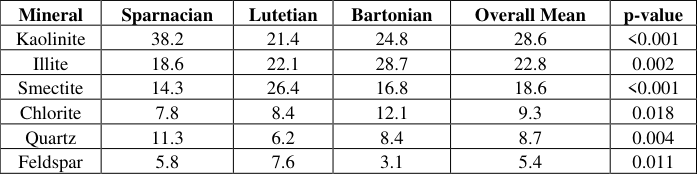 Table 1
 Table 2
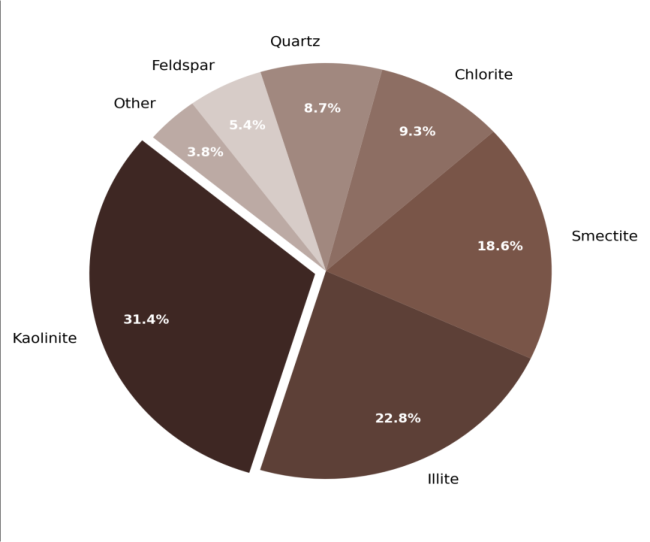 Figure 1
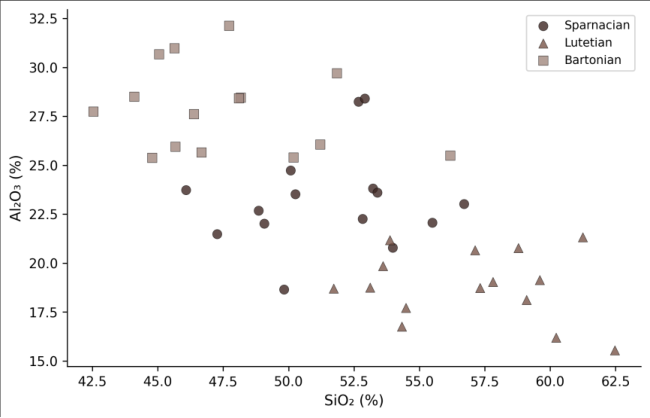 Figure 2
Introduction
On the surface, clay looks like one of the simplest geological materials fine-grained, soft, muddy. But underneath that apparent simplicity lies a family of minerals with wildly different properties: kaolinite is chemically inert and ideal for ceramics; smectite swells when wet and can adsorb heavy metals; illite sits somewhere between, offering moderate plasticity and fair thermal stability [1] . Which clay minerals dominate a given deposit determines its industrial value and environmental applicability, and that composition depends on the parent rock, weathering conditions, and diagenetic history of the sedimentary sequence that hosts it [2] . The Paris Basin, one of the largest intracratonic sedimentary basins in western Europe, contains Tertiary clay-bearing formations that have been quarried since the Roman period. The basin's Eocene succession spanning the Ypresian through Bartonian stages includes laterally extensive clay horizons formed under varying depositional conditions ranging from continental lacustrine to shallow marine settings [3] . These environmental shifts should produce systematic differences in clay mineral assemblage, grain size, and chemical composition between formations, but comprehensive multi-formation comparisons have been limited to a handful of localised outcrop investigations [4] . Beyond their traditional industrial uses, Paris Basin clays are attracting renewed interest for environmental applications. Smectite-rich clays can serve as low-cost sorbents for removing heavy metals, organic pollutants, and radionuclides from contaminated water [5] . Whether specific Tertiary formations in the Paris Basin meet the mineralogical and chemical criteria for such applications hasn't been systematically evaluated. This research addressed these gaps by collecting and analysing 87 clay samples from the three main Eocene formations across the Île-de-France region, building a geochemical and mineralogical database that serves both industrial and environmental assessment purposes [6,7] .
Instrumentation and Analytical Equipment
Mineralogical analysis was performed using a Bruker D8 Advance X-ray diffractometer equipped with a Cu-Kα radiation source (λ = 1.5406 Å), operating at 40 kV and 40 mA. Oriented clay mounts were scanned from 2° to 65° 2θ at a step size of 0.02° and counting time of 1 second per step. Three treatments were applied to each sample: airdried, ethylene glycol-saturated (24 hours at 60°C), and heated (550°C for 2 hours) [8] . Major and trace element chemistry was measured by wavelength-dispersive XRF spectrometry (Bruker S8 Tiger) on fusion beads prepared with lithium tetraborate flux at a 1:10 dilution ratio. Scanning electron microscopy with energy-dispersive spectroscopy (JEOL JSM-7600F with Oxford X-Max detector) was used for morphological examination and semiquantitative elemental mapping at an accelerating voltage of 15 kV. Cation exchange capacity was determined by the ammonium acetate method at pH 7.0 [9] .
Material and Methods
Material: This research was coordinated from the Nha Trang Centre for Geological Research, Khanh Hoa, Vietnam, with sampling campaigns in the Île-de-France region during May-June 2022 and September 2022. A total of 87 clay samples were collected from 11 active or abandoned quarry exposures and 4 archived borehole cores held at the Bureau de Recherches Géologiques et Minières repository in Orléans. The sampling targeted three stratigraphic units: Sparnacian plastic clays (Ypresian, n = 31), Lutetian marly clays (n = 28), and Bartonian green clays (n = 28). At each quarry site, fresh surfaces were exposed by removing at least 30 cm of weathered material before sampling. Approximately 2 kg of clay was collected at each point, sealed in labelled polyethylene bags, and airdried at room temperature before preparation [10] .
Quality Control
Analytical quality was monitored through the inclusion of certified reference materials (NIST SRM 97a flint clay, NIST SRM 679 brick clay) in every batch of 15 samples for both XRD and XRF analyses. Recovery rates for major elements fell within 96.8-103.2% of certified values, and replicate analyses of 10 randomly selected samples yielded relative standard deviations below 3.5% for all major oxides and below 8% for trace elements. XRD mineral quantification used the Rietveld refinement method in TOPAS v6.0, with goodness-of-fit values (Rwp) maintained below 12% for all refinements [11] .
Methods
Samples were disaggregated in deionised water and the <2 μm fraction separated by gravity settling according to Stokes' law. Oriented mounts of the clay fraction were prepared on glass slides for XRD analysis under the three treatment conditions described above. Semi-quantitative mineral proportions were estimated using reference intensity ratios calibrated against synthetic mineral mixtures. Rare earth element concentrations were measured on a subset of 30 samples by ICP-MS (Agilent 7700x) after lithium metaborate fusion and acid dissolution [12] . Grain size distribution of the bulk samples was determined by laser diffraction (Malvern Mastersizer 3000) following pretreatment with hydrogen peroxide and sodium hexametaphosphate. Statistical analysis included principal component analysis on the geochemical dataset and hierarchical cluster analysis on the mineralogical composition, both performed in R 4.2 [13] . The three formations showed distinct mineral assemblages (Table 1). The Sparnacian stood out for its high kaolinite content (38.2%), reflecting intense chemical weathering under warm, humid conditions during the early Eocene.
| Mineral | Sparnacian | Lutetian | Bartonian | Overall Mean | p-value |
|---|---|---|---|---|---|
| Kaolinite | 38.2 | 21.4 | 24.8 | 28.6 | <0.001 |
| Illite | 18.6 | 22.1 | 28.7 | 22.8 | 0.002 |
| Smectite | 14.3 | 26.4 | 16.8 | 18.6 | <0.001 |
| Chlorite | 7.8 | 8.4 | 12.1 | 9.3 | 0.018 |
| Quartz | 11.3 | 6.2 | 8.4 | 8.7 | 0.004 |
| Feldspar | 5.8 | 7.6 | 3.1 | 5.4 | 0.011 |
Table text extracted from the original PDF; superscript letters are shown inline. The original table image is below.
View original table image
Results
Lutetian clays were characterised by the highest smectite proportion (26.4%), consistent with formation in a shallow marine environment where volcanic ash inputs provided suitable precursor material for smectite crystallisation.
Comprehensive Interpretation
The scatter plot (Figure 2) shows tight clustering of the three formations in distinct geochemical fields, confirming that major element chemistry can reliably distinguish between them even without mineralogical data. The Bartonian samples occupy the low-SiO₂, high-Al₂O₃ corner reflecting their aluminium-rich illite-chlorite composition while the Lutetian plots in the opposite direction, indicating a greater contribution from detrital quartz and feldspar.
Discussion:
The mineralogical contrasts between the three formations record shifts in paleoclimate and depositional environment across the Eocene in the Paris Basin. The kaolinite-rich Sparnacian was deposited during the Early Eocene Climatic Optimum, when warm, humid conditions promoted deep lateritic weathering of the surrounding crystalline basement [14] . By the Lutetian, marine transgression into the basin brought alkaline, silica-rich pore waters that favoured smectite neoformation at the expense of kaolinite [15] . The Bartonian return to more restricted, continental conditions shifted the assemblage toward illite and chlorite, mineral phases that are stable under cooler, less weathering-intensive regimes [16] .
From an industrial perspective, the Sparnacian kaolinitic clays meet standard specifications for ceramic and refractory applications based on their high Al₂O₃ content and low alkali fluxing oxide levels. The Lutetian smectites, with their high cation exchange capacity of 34.7 meq/100g, are more suited to environmental applications particularly as barriers in waste containment or as sorbents for heavy metal removal from wastewater [17] . Their performance in this capacity would depend on the specific exchangeable cation population, which was dominated by Ca²⁺ and Na⁺ in the samples analysed here.
The rare earth element patterns, showing uniform light REE enrichment and flat heavy REE profiles normalised to chondrite, are consistent with derivation from a common felsic source terrain. The absence of significant Ce anomalies in any formation suggests that none of the clays were deposited under strongly oxidising marine conditions where Ce would be preferentially scavenged by manganese oxides [18,19] . This geochemical homogeneity in source signature, despite the mineralogical diversity, indicates that the clay mineral differences between formations are controlled primarily by depositional environment chemistry rather than by changes in provenance [20] .
Conclusion
This integrated geochemical and mineralogical characterisation of Paris Basin Tertiary clays revealed three distinct mineral assemblage types corresponding to the Sparnacian, Lutetian, and Bartonian formations. Each formation carries a chemical signature reflecting the paleoenvironmental conditions under which it formed kaolinite from subtropical weathering, smectite from marine neoformation, and illite from cooler continental diagenesis. The Lutetian clays, with their high smectite content and cation exchange capacity of 34.7 meq/100g, appear most promising for environmental sorbent applications. The geochemical database established here provides a reference framework for quality assessment of clay deposits across the Île-de-France region. Future research should test the actual heavy metal adsorption performance of the Lutetian clays under controlled conditions and investigate whether the Sparnacian kaolinites can be beneficiated to meet higher-grade ceramic specifications. Extending the sampling to deeper, unexposed portions of the basin through additional borehole analysis would also improve the threedimensional understanding of clay quality variation within each formation.
Acknowledgement
Acknowledgements Funding SourcesThis research was supported by internal research allocation at the Nha Trang Centre for Geological Research. Institutional SupportThe authors thank the Department of Geosciences, Nha Trang Centre for Geological Research, Khanh Hoa, Vietnam, for providing analytical equipment access and logistical support. Contributions Not Qualifying for AuthorshipAccess to quarry sites facilitated by the Bureau de Recherches Géologiques et Minières and XRD technical assistance from laboratory staff are gratefully acknowledged.
Figures and tables from the paper
| Formation | SiO₂ | Al₂O₃ | Fe₂O₃ | K₂O | CaO | CEC (meq/100g) |
|---|---|---|---|---|---|---|
| Sparnacian | 48.6 | 26.3 | 6.8 | 2.1 | 1.4 | 24.3 |
| Lutetian | 61.8 | 17.4 | 4.2 | 3.8 | 4.6 | 34.7 |
| Bartonian | 42.3 | 29.1 | 8.4 | 4.2 | 1.8 | 22.6 |
Table text extracted from the original PDF; superscript letters are shown inline. The original table image is below.
View original table image
References
20 in the original paper- Murray HH. Applied clay mineralogy: occurrences, processing, and applications of kaolins, bentonites, palygorskite-sepiolite, and common clays. Amsterdam: Elsevier; 2007.
- Meunier A. Clays. Berlin: Springer-Verlag; 2005.
- Pomerol C. The Cenozoic era: Tertiary and Quaternary. Chichester: Ellis Horwood; 1982.
- Thiry M. Palaeoclimatic interpretation of clay minerals in marine deposits: an outlook from the continental origin. Earth-Science Reviews. 2000;49(1-4):201-221.
- Bhattacharyya KG, Gupta SS. Adsorption of a few heavy metals on natural and modified kaolinite and montmorillonite: a review. Advances in Colloid and Interface Science. 2008;140(2):114-131.
- Chamley H. Clay sedimentology. Berlin: SpringerVerlag; 1989.
- Velde B. Origin and mineralogy of clays. Berlin: Springer; 1995.
- Moore DM, Reynolds RC. X-ray diffraction and the identification and analysis of clay minerals. 2nd ed. Oxford: Oxford University Press; 1997.
- Chapman HD. Cation-exchange capacity. In: Black CA (ed). Methods of soil analysis. Part 2. Madison: American Society of Agronomy; 1965. p. 891-901.
- AFNOR. Essais pour déterminer les propriétés mécaniques et physiques des granulats. NF EN 932-1. Paris: Association Française de Normalisation; 1996.
- Rietveld HM. A profile refinement method for nuclear and magnetic structures. Journal of Applied Crystallography. 1969;2(2):65-71.
- Jarvis KE, Gray AL, Houk RS. Handbook of inductively coupled plasma mass spectrometry. Glasgow: Blackie; 1992.
- R Core Team. R: a language and environment for statistical computing. Vienna: R Foundation for Statistical Computing; 2022.
- Huggett JM. Clay mineralogy of the Tertiary onshore and offshore strata of the British Isles. Clay Minerals. 2005;40(4):415-445.
- Robert C, Chamley H. Development of early Eocene warm climates, as inferred from clay mineral variations in oceanic sediments. Palaeogeography, Palaeoclimatology, Palaeoecology. 1991;89(4):315331.
- Weaver CE. Clays, muds, and shales. Amsterdam: Elsevier; 1989.
- Bergaya F, Theng BKG, Lagaly G. Handbook of clay science. Amsterdam: Elsevier; 2006.
- Elderfield H, Greaves MJ. The rare earth elements in seawater. Nature. 1982;296(5854):214-219.
- McLennan SM. Rare earth elements in sedimentary rocks: influence of provenance and sedimentary processes. Reviews in Mineralogy and Geochemistry. 1989;21(1):169-200.
- Taylor SR, McLennan SM. The continental crust: its composition and evolution. Oxford: Blackwell; 1985.