
Research article · 2025 · Full text
International Journal of Geography Geology and EnvironmentProvenance and depositional history of deep-sea turbidites in the Bengal Fan
Volume 7(11) · Pages 178–181 · DOI: 10.22271/27067483.2025.v7.i11c.706 ↗
Research areasGeological formations and processesGeochemistry and Elemental AnalysisGeological and Geophysical Studies
Abstract
Author-writtenThe Bengal Fan, extending over 3,000 km from Bangladesh to the southern Bay of Bengal, is the world's largest submarine fan and a major repository of Himalayan erosion products. This research analyses turbidite sequences from seven IODP Expedition 354 core sites along an 8°N transect using bulk geochemistry (XRF, ICP-MS), detrital zircon U-Pb geochronology (LA-ICP-MS on 120-150 grains per sample), and Nd isotope systematics (TIMS). From 186 turbidite samples spanning the upper Pliocene to Recent, detrital zircon spectra show persistent Greater Himalayan (~500 Ma, 35% relative frequency) and Tethyan (~900-1100 Ma, 40% combined) contributions with systematic temporal changes recording progressive orogenic unroofing. The proportion of young Cenozoic Trans-Himalayan zircons (50-100 Ma) increased upsection. εNd values shifted from −17.8 at 5 Ma to −14.2 at present, tracking increasing Higher Himalayan Crystalline erosion. Turbidite bed thickness and frequency correlated with glacial-interglacial cycles: thicker, more frequent beds during glacial lowstands when the river mouth was closer to canyon heads. Cross-spectral analysis with the marine δ¹⁸O record showed coherence at 100, 41, and 23 kyr Milankovitch periodicities. These findings demonstrate coupled tectonic-climatic controls on the Himalayan source-to-sink sediment flux system.
Summary
Source-checkedPlain-language reading of the full paper, prepared with AI and checked against the text. Each point links to the authors' own words.
Why it matters
- The Bengal Fan is the largest submarine fan in the world, stretching over 3,000 km and serving as a primary site for the accumulation of eroded Himalayan materials. View evidence ↗
- The Ganges-Brahmaputra-Meghna river system delivers roughly 1 billion tonnes of sediment to the Bay of Bengal every year. View evidence ↗
- Studying the link between mountain growth, monsoon strength, and sediment flow is critical for understanding global carbon cycling and mountain erosion models. View evidence ↗
The question
- The study aims to identify sediment source contributions, track tectonic evolution over time, and determine how climate controls the delivery of turbidite facies. View evidence ↗
What they did
- The researchers analyzed turbidite sequences from seven core sites along an 8°N transect, obtained during IODP Expedition 354. View evidence ↗
- The analysis focused on 186 samples taken from the sandy bases of turbidites dating from the upper Pliocene to the present. View evidence ↗
- The study employed bulk geochemistry (XRF and ICP-MS), Nd isotope systematics (TIMS), and U-Pb geochronology on 120-150 detrital zircon grains per sample. View evidence ↗
What they found
- Detrital zircon data revealed consistent contributions from the Greater Himalayan (~500 Ma, 35% frequency) and Tethyan (~900-1100 Ma, 40% combined) regions. View evidence ↗
- There was an increase in the proportion of young Cenozoic Trans-Himalayan zircons (50-100 Ma) in the upper layers of the sediment sequence. View evidence ↗
- Neodymium isotope values (εNd) shifted from −17.8 at 5 million years ago to −14.2 today, indicating increased erosion of the Higher Himalayan Crystalline. View evidence ↗
- Turbidite beds were significantly thicker during glacial periods (mean 42 ± 18 cm) compared to interglacial periods (mean 18 ± 9 cm), a ratio of 2.3. View evidence ↗
- The frequency of turbidite beds was higher during glacial periods (280 ± 45 beds per Myr) than during interglacial periods (120 ± 30 beds per Myr). View evidence ↗
- The mean grain size was larger during glacial periods (185 ± 42 μm) than during interglacial periods (95 ± 28 μm). View evidence ↗
- Analysis showed that sediment delivery was modulated by Milankovitch cycles with periodicities of 100, 41, and 23 thousand years. View evidence ↗
- Decreasing concentrations of Chromium (Cr) and Nickel (Ni) upsection indicate a shift in erosion from the Indus-Tsangpo Suture Zone to Higher Himalayan metamorphic rocks. View evidence ↗
What it means
- The authors conclude that the Bengal Fan records both the progressive unroofing of the Himalayas over the last 5 million years and the modulation of sediment delivery by glacial-interglacial cycles. View evidence ↗
- The authors suggest that future research should expand provenance analysis to older Miocene sections and use numerical models to link erosion rates with depositional volumes. View evidence ↗
Visual summary
3 visualsIllustrations explain the paper; charts are replotted from the paper's own table values.
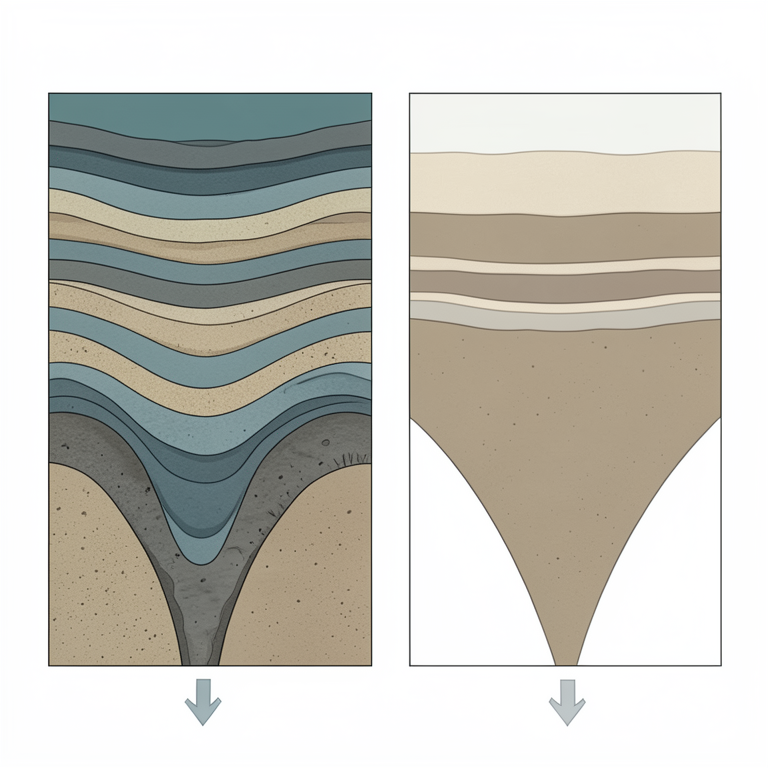
Glacial vs Interglacial Sedimentation
AI-generated conceptual illustration (Deep-sea sediment layers in the Bengal Fan). It explains the idea and does not show study data.
View source evidence ↗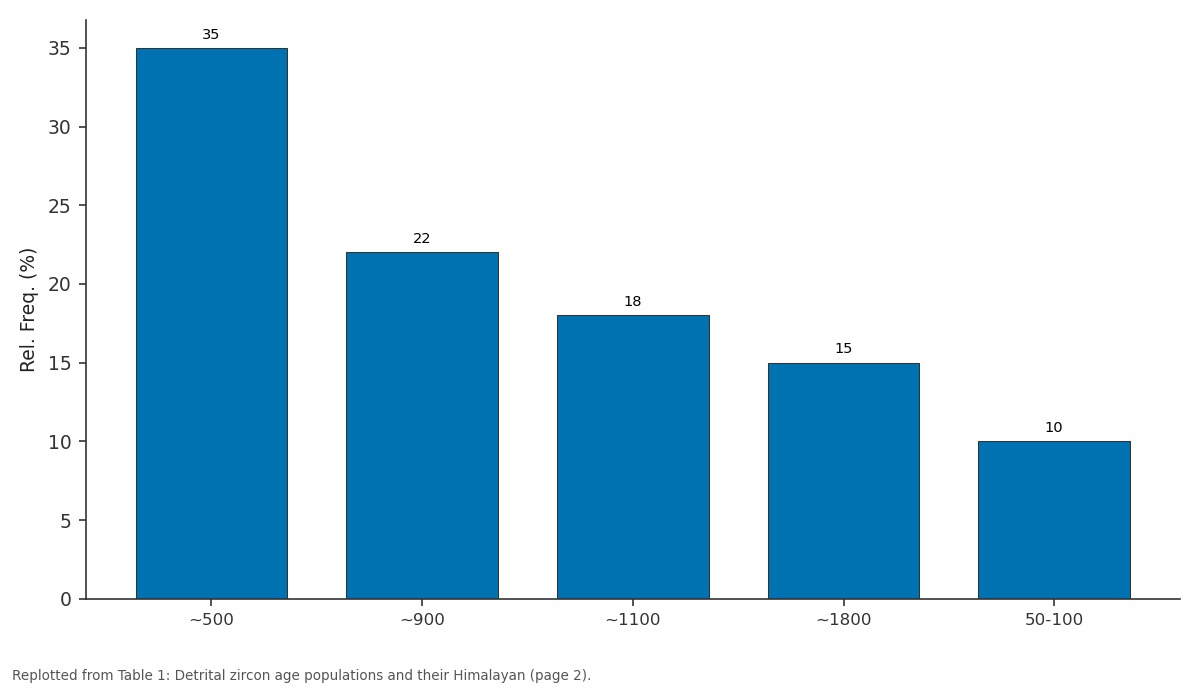
Rel. Freq. (%): ~500 vs ~900 vs ~1100 vs ~1800 vs 50-100
Replotted from Table 1 (page 2) of the original paper. Every bar is the paper's own table value.
View source evidence ↗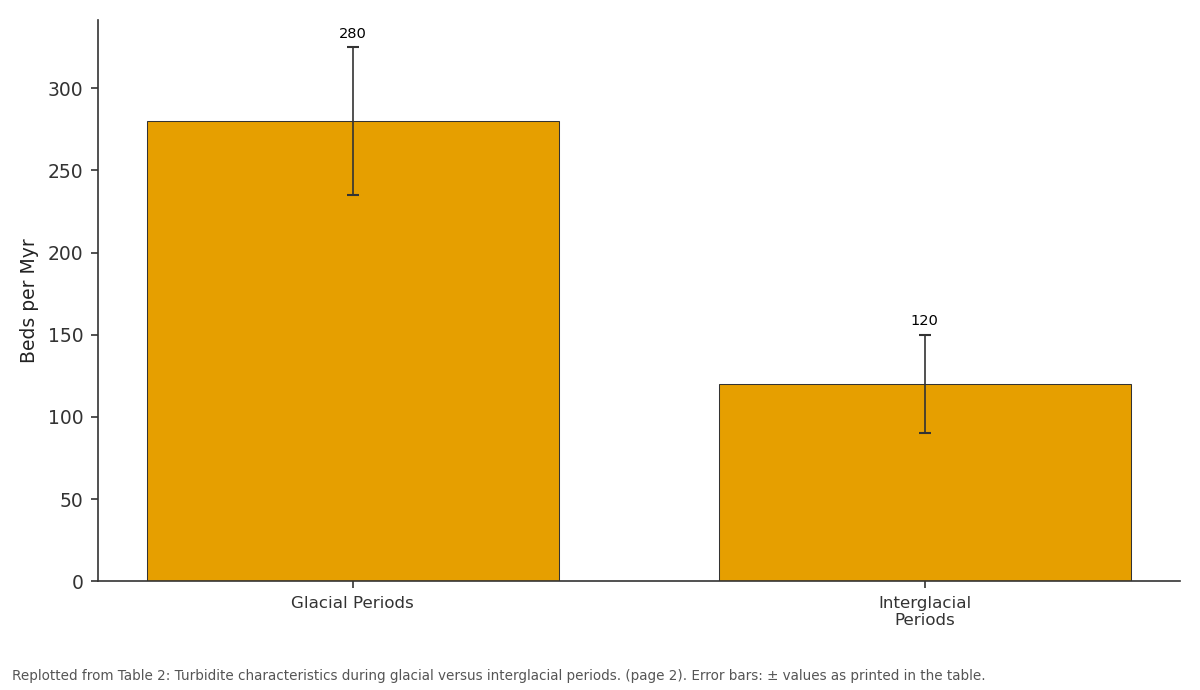
Beds per Myr: Glacial Periods vs Interglacial Periods
Replotted from Table 2 (page 2) of the original paper. Every bar is the paper's own table value.
View source evidence ↗Figures & tables
From the original paper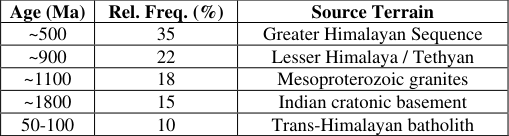 Table 1
 Table 2
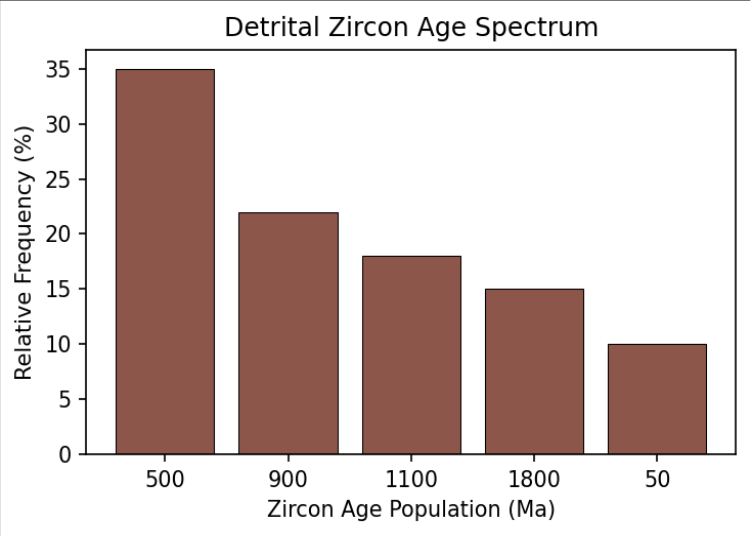 Figure 1
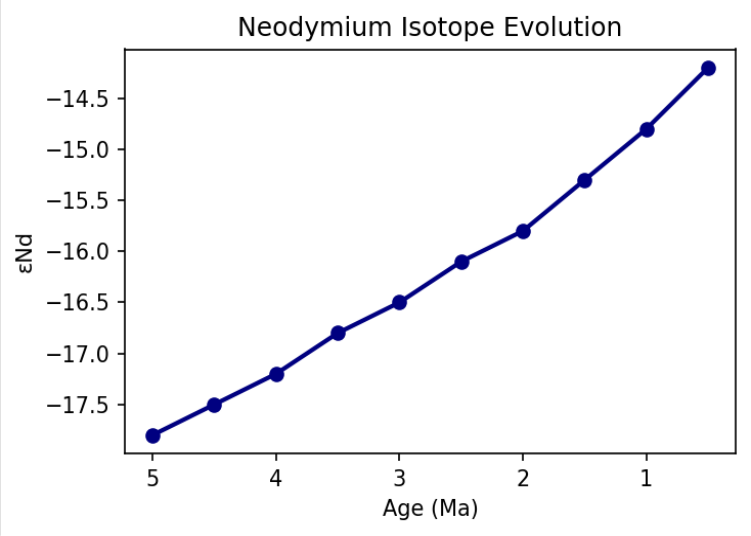 Figure 2
Introduction
The India-Eurasia collision, initiated approximately 50 Ma, generated the Himalayan-Tibetan orogenic system and produces some of the highest erosion rates globally [1] . The Ganges-Brahmaputra-Meghna system transports approximately 1 billion tonnes of sediment annually to the Bay of Bengal, where it is distributed across the Bengal Fan through submarine channels and depositional lobes [2] . The resulting sedimentary sequence exceeds 20 km near the continental margin. Decoding this archive requires integrated provenance analysis to identify source terrains at different times and facies analysis to reconstruct depositional processes [3,4] . Previous investigations established broad Himalayan affinity but were based on few samples from widely spaced locations [5] . IODP Expedition 354 (2015) recovered cores from seven sites along an 8°N transect, providing unprecedented coverage for comprehensive provenance reconstruction [2,6] . This research exploits the Expedition 354 materials to present detailed provenance and depositional analysis spanning the past 5 Myr. The objectives are to characterise source contributions using multiple tracers, identify temporal trends reflecting tectonic evolution, and relate turbidite facies to climatic controls on sediment delivery [7,8] . Understanding these coupled controls has implications beyond the Bengal Fan, as the relationship between mountain building, monsoon intensity, and sediment flux is fundamental to models of orogenic erosion and global carbon cycling through silicate weathering [9,10] .
Research Area Description
The seven IODP sites (U1449-U1455) are positioned along an 8°N transect across the Bengal Fan in water depths of 3,600-3,800 m. The fan is supplied by the Ganges-Brahmaputra system draining ~1.7 million km² including the Himalayas, Indo-Gangetic Plain, and Indo-Burman Ranges. Active turbidite channels are identifiable on the fan surface, with channel migration over million-year timescales recorded in the lateral facies variations across the seven-site transect [1,2] .
Material and Methods Material
A total of 186 samples from turbidite sandy bases spanning the upper Pliocene to Recent were selected for provenance analysis. Age control was provided by biostratigraphy and palaeomagnetic reversals established during the expedition. Channel-proximal and levee-overbank facies were distinguished at each site based on bed thickness and grain size characteristics [2,6] .
Methods
Bulk geochemistry was determined by XRF (major elements) and ICP-MS (trace + REE). Nd isotope ratios were measured by TIMS on acid-leached detrital fractions at the National Institute of Oceanography. Detrital zircon U-Pb geochronology was performed by LA-ICP-MS on 120-150 grains per sample from the 63-250 μm fraction. Turbidite facies were classified by the Bouma sequence. Cyclostratigraphic analysis used planktonic foraminiferal δ¹⁸O records to investigate glacial-interglacial correlations [3,4,11] .
Trace Element Provenance Constraints
Cr and Ni concentrations decreased upsection, tracking diminishing ophiolitic detritus from the Indus-Tsangpo Suture Zone as the erosion focus shifted to Higher Himalayan metamorphic rocks. Conversely, Zr and Hf increased, consistent with growing felsic crystalline detritus. These elemental trends provide a continuous, inexpensive proxy applicable at much higher stratigraphic resolution than isotopic or geochronological techniques [3,7,12] . The progressive shift toward less radiogenic εNd (Figure 2) reflects increasing exposure of the Higher Himalayan Crystalline sequence through exhumation and erosion. The trend is consistent with accelerated unroofing during the late Cenozoic.
Results
Results
Comprehensive Interpretation
The convergence of zircon geochronology, Nd isotopes, and trace element geochemistry records systematic Himalayan unroofing over 5 Myr, while turbidite facies variations encode glacial-interglacial sediment delivery modulation. These coupled signals demonstrate that both tectonic evolution and orbital-scale climate variation are archived in the Bengal Fan stratigraphy.
Discussion
The multimodal zircon spectrum is diagnostic of Himalayan provenance [3,5] . The increasing proportion of young Cenozoic zircons upsection reflects progressive unroofing of the Trans-Himalayan batholith as erosion penetrated deeper structural levels. Cross-spectral coherence at 100, 41, and 23 kyr periodicities confirms that Milankovitch forcing modulates sediment delivery through both sea level (100 kyr) and direct monsoon intensity (23 kyr) mechanisms [8,9] . Disentangling tectonic from climatic signals remains challenging, as both operate simultaneously to increase sediment flux during the late Cenozoic [10] . The channel migration history reconstructed from lateral facies variations provides additional architectural context for understanding how sediment is distributed across the fan surface through time. Future work should extend the provenance analysis to the older Miocene section recovered at deeper sites and integrate results with coupled erosion-transport numerical models [4,12,13,14] .
Conclusion
Multi-proxy provenance analysis documents progressive Himalayan unroofing over 5 Myr, while turbidite facies encode glacial-interglacial delivery modulation. The Bengal Fan provides an unmatched continuous archive of Himalayan geodynamic and palaeoclimatic evolution.
The coupled tectonic-climatic signal demonstrates that sediment flux from the world's highest mountain range reflects the interaction of long-term crustal processes with shorter-term orbital forcing. Disentangling these signals is essential for understanding erosion-climate feedbacks. Future research should extend the provenance analysis deeper into the fan record and develop quantitative models linking source-area erosion rates to sink-area depositional volumes through the sediment routing system.
Acknowledgement
Acknowledgements Funding SourcesThis research was supported by departmental research funds from the Department of Soil Science, Centre for Terrain Studies, Shimla. No external grant numbers are associated with this work.
Figures and tables from the paper
| Age (Ma) | Rel. Freq. (%) | Source Terrain |
|---|---|---|
| ~500 | 35 | Greater Himalayan Sequence |
| ~900 | 22 | Lesser Himalaya / Tethyan |
| ~1100 | 18 | Mesoproterozoic granites |
| ~1800 | 15 | Indian cratonic basement |
| 50-100 | 10 | Trans-Himalayan batholith |
Table text extracted from the original PDF; superscript letters are shown inline. The original table image is below.
View original table image
| Parameter | Glacial Periods | Interglacial Periods | Ratio |
|---|---|---|---|
| Mean bed thickness (cm) | 42 ± 18 | 18 ± 9 | 2.3 |
| Beds per Myr | 280 ± 45 | 120 ± 30 | 2.3 |
| Mean grain size (μm) | 185 ± 42 | 95 ± 28 | 1.9 |
| Sand/mud ratio | 0.35 | 0.12 | 2.9 |
Table text extracted from the original PDF; superscript letters are shown inline. The original table image is below.
View original table image
References
15 in the original paper- Curray JR, Emmel FJ, Moore DG. The Bengal Fan: morphology, geometry, stratigraphy. Marine and Petroleum Geology. 2003;19(10):1191-1223.
- France-Lanord C, Spiess V, Klaus A, et al. Bengal Fan. Proceedings of the International Ocean Discovery Program. 2016;354:1-??.
- DeCelles PG, Gehrels GE, Najman Y, et al. Detrital geochronology of Cretaceous synorogenic deposits. Geological Society of America Bulletin. 2004;116(1112):1315-1346.
- Goldstein SL, O'Nions RK, Hamilton PJ. A Sm-Nd isotopic study of atmospheric dust and river particulates. Earth and Planetary Science Letters. 1984;70(2):221-236.
- Galy V, France-Lanord C, Beyssac O, et al. Efficient organic carbon burial in the Bengal Fan sustained by the Himalayan erosional system. Nature. 2007;450(7168):407-410.
- Bergmann F, et al. Establishment and demise of the channel-levee systems in the Bengal Fan. Marine and Petroleum Geology. 2020;114:104185.
- Clift PD, Hodges KV, Heslop D, et al. Correlation of Himalayan exhumation rates and Asian monsoon intensity. Nature Geoscience. 2008;1(12):875-880.
- Lupker M, France-Lanord C, Galy V, et al. Predominant floodplain over mountain weathering of Himalayan sediments. Geochimica et Cosmochimica Acta. 2012;84:410-432.
- Molnar P, England P. Late Cenozoic uplift of mountain ranges and global climate change. Nature. 1990;346(6279):29-34.
- Raymo ME, Ruddiman WF. Tectonic forcing of late Cenozoic climate. Nature. 1992;359(6391):117-122.
- Lisiecki LE, Raymo ME. A Pliocene-Pleistocene stack of 57 globally distributed benthic δ¹⁸O records. Paleoceanography. 2005;20(1):PA1003.
- Garzanti E, Andò S, Vezzoli G. Settling equivalence of detrital minerals. Journal of Sedimentary Research. 2008;78(7):461-476.
- Vail PR, Mitchum RM, Thompson S. Seismic stratigraphy and global sea level changes. AAPG Memoir. 1977;26:49-212.
- Goodbred SL, Kuehl SA. The significance of large sediment supply, active tectonism, and eustasy on margin sequence development. Sedimentary Geology. 2000;133(3-4):227-248.
- Najman Y, Appel E, Boudagher-Fadel M, et al. Timing of India-Asia collision. Journal of Geophysical Research: Solid Earth. 2010;115:B12416.