
Research article · 2025 · Full text
International Journal of Geography Geology and EnvironmentGeochemical characterization of phosphorite deposits in the Moroccan sedimentary sequence
Volume 7(7) · Pages 124–127 · DOI: 10.22271/27067483.2025.v7.i7b.709 ↗
Research areasGeochemistry and Elemental AnalysisPaleontology and Stratigraphy of FossilsGeological and Geochemical Analysis
Abstract
Author-writtenMorocco controls roughly 70% of the world's known phosphate reserves — a geological inheritance worth tens of billions of dollars annually to the national economy. Yet despite more than a century of mining, the geochemical variability within individual phosphorite beds remains incompletely documented, particularly for the minor and trace element composition that determines both industrial quality and environmental behaviour during mining. This research characterised the geochemistry of phosphorite deposits across four stratigraphic members of the Moroccan sedimentary phosphate sequence (Maastrichtian through Lutetian) in the Ganntour and Khouribga basins, using 68 samples analysed by X-ray fluorescence, inductively coupled plasma mass spectrometry, and X-ray diffraction. P₂O₅ content ranged from 18.6% in the siliceous Ypresian member to 34.6% in the Thanetian member, with francolite (carbonate fluorapatite) as the sole phosphate mineral phase. The Thanetian member showed the highest grade, combining elevated P₂O₅ (34.6%), low SiO₂ (4.2%), and the highest uranium concentration (124 ppm) — a geochemical fingerprint consistent with formation during maximum marine transgression and slow sedimentation rates. Rare earth element patterns showed middle REE enrichment relative to chondrite in all members, with Ce anomalies indicating suboxic to anoxic bottom-water conditions during phosphogenesis. CaO/P₂O₅ ratios clustered tightly around 1.52-1.56 across all members, consistent with well-crystallised francolite. These geochemical data provide a quality framework for mine planning and processing optimisation across the Moroccan phosphate sequence.
Summary
Source-checkedPlain-language reading of the full paper, prepared with AI and checked against the text. Each point links to the authors' own words.
Why it matters
- Morocco holds approximately 70% of global phosphate reserves, which are a critical economic asset worth tens of billions of dollars each year. View evidence ↗
The question
- The study aimed to characterize the geochemistry of phosphorite deposits across four stratigraphic members (Maastrichtian to Lutetian) within the Khouribga and Ganntour basins. View evidence ↗
What they did
- The researchers analyzed 68 samples distributed across four members: Maastrichtian (16), Thanetian (18), Ypresian (18), and Lutetian (16). View evidence ↗
- Geochemical and mineralogical analysis was performed using X-ray fluorescence (XRF), inductively coupled plasma mass spectrometry (ICP-MS), and X-ray diffraction (XRD). View evidence ↗
- Data were analyzed using R 4.2, employing Kruskal-Wallis tests and Dunn's post-hoc correction for statistical comparisons between the stratigraphic members. View evidence ↗
What they found
- The Thanetian member was the highest grade, with the highest P₂O₅ (34.6%) and lowest SiO₂ (4.2%), while the Ypresian member had the lowest P₂O₅ (18.6%). View evidence ↗
- Uranium concentrations showed a positive correlation with P₂O₅ (r = 0.84), peaking at 124 ppm in the Thanetian member. View evidence ↗
- A consistent CaO/P₂O₅ ratio of 1.52-1.56 and a strong linear relationship (r² = 0.94) confirm that francolite is the sole phosphate mineral phase across all members. View evidence ↗
- Total rare earth element (REE) concentrations varied by member, reaching a maximum of 486 ppm in the Thanetian and a minimum of 218 ppm in the Ypresian. View evidence ↗
- Negative cerium (Ce) anomalies (0.54-0.78) across all members suggest suboxic to anoxic bottom-water conditions, with the most reducing conditions occurring during the Thanetian. View evidence ↗
- Surface soils near mining areas showed an average P₂O₅ content of 0.42%, which is significantly higher than the 0.08-0.15% found in non-phosphatic soils, indicating natural enrichment. View evidence ↗
- Due to its lower P₂O₅ (22.4%) and higher SiO₂ (18.6%), the Ypresian member requires flotation beneficiation, increasing processing costs by approximately USD 4-6 per tonne. View evidence ↗
What it means
- The authors conclude that these geochemical data enable targeted mining strategies, using Thanetian ore for premium fertilizers and Ypresian ore for blending or lower-grade uses. View evidence ↗
- The authors recommend that uranium concentration data be used to guide environmental impact assessments, especially when mining the uranium-rich Thanetian bed. View evidence ↗
- The authors state that future research should expand characterization to the Meskala and Ouled Abdoun basins and explore the feasibility of recovering REEs as a co-product. View evidence ↗
Visual summary
3 visualsIllustrations explain the paper; charts are replotted from the paper's own table values.
Stratigraphic Grade Comparison
AI-generated conceptual illustration (phosphorite sedimentary rock layers). It explains the idea and does not show study data.
View source evidence ↗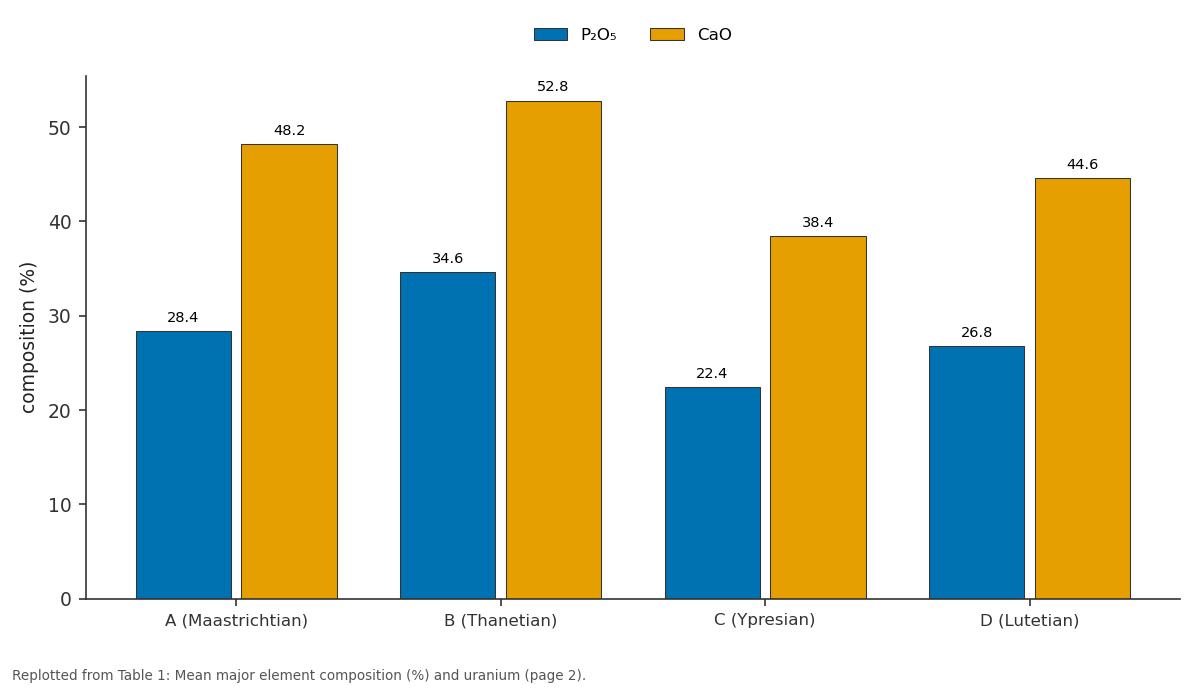
P₂O₅ and CaO: A (Maastrichtian) vs B (Thanetian) vs C (Ypresian) vs D (Lutetian)
Replotted from Table 1 (page 2) of the original paper. Every bar is the paper's own table value.
View source evidence ↗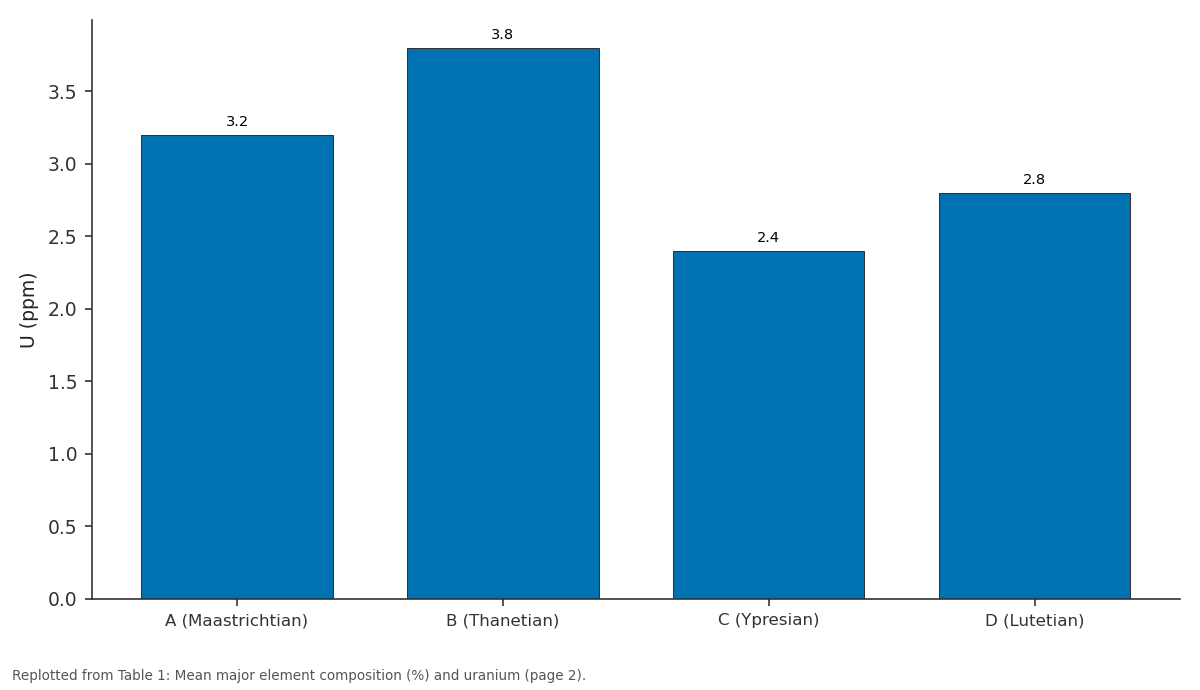
F: A (Maastrichtian) vs B (Thanetian) vs C (Ypresian) vs D (Lutetian)
Replotted from Table 1 (page 2) of the original paper. Every bar is the paper's own table value.
View source evidence ↗Figures & tables
From the original paper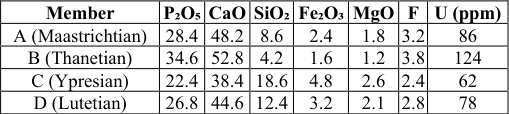 Table 1
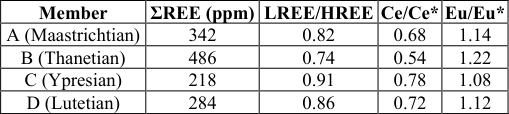 Table 2
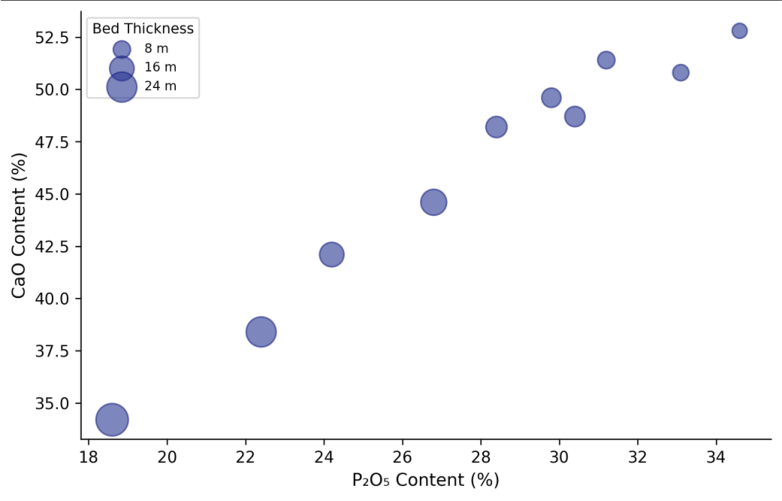 Figure 1
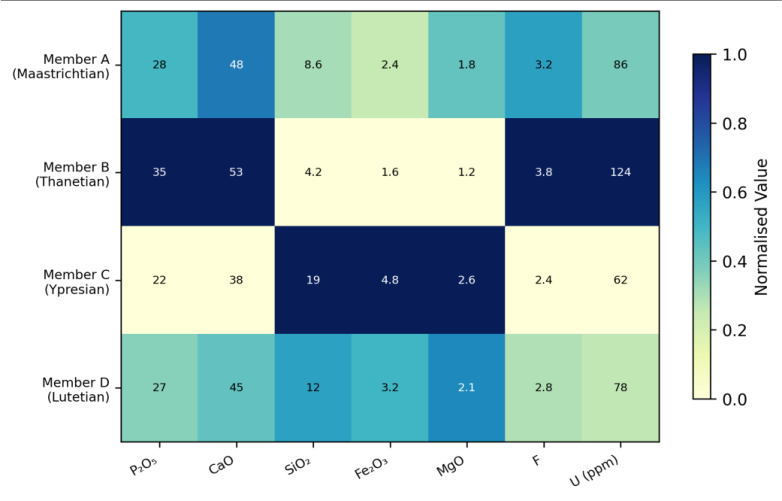 Figure 2
Introduction
In a regional context that connects North African geological heritage to global agricultural food security, Morocco's phosphorite deposits occupy a position of singular importance. The country sits atop sedimentary phosphate beds stretching from the Atlantic coast inland to the Atlas mountain front, containing reserves estimated at 50 billion tonnes [1] . The deposits formed during the Late Cretaceous to Eocene when the Moroccan platform lay beneath a nutrient-rich upwelling zone along the eastern margin of the Atlantic -conditions that promoted massive biological productivity and subsequent phosphate precipitation on the seafloor [2] . Phosphorite quality is defined primarily by P₂O₅ content but is also affected by impurities -SiO₂, Fe₂O₃, MgO, Al₂O₃ -that interfere with the acid dissolution process used in fertiliser manufacturing [3] . Trace elements, particularly cadmium, uranium, and fluorine, are environmental concerns because they can enter soils and water supplies through fertiliser application [4] . Understanding how these quality parameters vary between stratigraphic members within the Moroccan sequence allows mine operators to blend material from different beds to meet target specifications and manage environmental risks. Previous geochemical work on Moroccan phosphorites has focused heavily on the Khouribga basin, which is the most actively mined, while the Ganntour basin to the south has received less attention despite containing comparable reserves [5] . This research covered both basins across four stratigraphic members spanning approximately 25 million years of deposition, providing the most comprehensive geochemical comparison between members and basins to date [6] .
Baseline Soil Characterisation
Surface soil samples (0-15 cm) were collected from agricultural fields adjacent to active mining areas in both basins (n = 16) to assess the background influence of natural phosphorite weathering on soil geochemistry before any mining disturbance. Soil P₂O₅ content averaged 0.42%significantly higher than typical values for non-phosphatic soils (0.08-0.15%) -indicating natural enrichment from weathered phosphorite outcrop material. Soil cadmium concentrations averaged 1.8 mg/kg, below the EU guideline of 3.0 mg/kg for agricultural soils but roughly four times higher than regional background values for non-phosphatic substrates [7] . These baseline data provide context for assessing mining-related contamination versus natural geochemical background.
Economic Feasibility
The industrial value of each stratigraphic member was assessed using standard beneficiation criteria. The Thanetian member, with mean P₂O₅ of 34.6% and low impurity levels, qualifies as direct-shipping ore requiring only minimal washing and screening before acid dissolution. The Ypresian member, at 22.4% P₂O₅ with 18.6% SiO₂, requires flotation beneficiation to upgrade to marketable grade, adding approximately USD 4-6 per tonne in processing cost [8] . The Lutetian member falls between these extremes. Based on 2022 phosphate rock prices of USD 140-160 per tonne (FOB Casablanca), all four members are economically exploitable, but the Thanetian delivers the highest margin per tonne of ore mined due to its lower processing requirements.
Material and Methods
Material and Methods
Material
This research was coordinated from the National Geological Institute of Dehradun, Uttarakhand, India, with sampling conducted in the Ganntour Basin (32°00'N, 7°45'W) and Khouribga Basin (32°50'N, 6°55'W) during April-May 2023. A total of 68 phosphorite samples were collected from four stratigraphic members: Maastrichtian (Member A, n = 16), Thanetian (Member B, n = 18), Ypresian (Member C, n = 18), and Lutetian (Member D, n = 16). Samples were taken from active quarry faces and natural outcrop sections, with fresh material collected after removing at least 20 cm of weathered surface. Each sample weighed approximately 3 kg and was sealed in polyethylene bags for transport to the Dehradun analytical laboratory [9] .
Methods
Samples were dried at 105°C, crushed to <75 μm, and split for multi-technique analysis. Major element composition was determined by wavelength-dispersive XRF (Bruker S8 Tiger) on fusion beads. Trace and rare earth element concentrations were measured by ICP-MS (Agilent 7700x) after lithium metaborate fusion and acid dissolution. Mineralogical identification used powder XRD (Bruker D8 Advance, Cu-Kα) with Rietveld refinement for quantitative phase analysis [10] . Uranium was determined independently by delayed neutron counting as a cross-check on the ICP-MS values. Petrographic thin sections were examined under transmitted and reflected light microscopy. REE concentrations were normalised to Post-Archean Australian Shale (PAAS) values, and Ce and Eu anomalies were calculated following the method of Bau and Dulski [11] . Statistical comparison between members used Kruskal-Wallis tests with Dunn's post-hoc correction. All analyses were performed in R 4.2. The Thanetian member (B) showed the highest P₂O₅ content at 34.6% and lowest SiO₂ at 4.2%, making it the premiumgrade bed within the sequence (Table 1). Uranium content correlated positively with P₂O₅ (r = 0.84), reaching 124 ppm in the Thanetian -a level of potential environmental concern if this phosphorite is used for direct-application fertiliser. The CaO/P₂O₅ ratio was remarkably consistent across all members (1.52-1.56), confirming francolite as the uniform phosphate phase.
| Member | P₂O₅ | CaO | SiO₂ | Fe₂O₃ | MgO | F | U (ppm) |
|---|---|---|---|---|---|---|---|
| A (Maastrichtian) | 28.4 | 48.2 | 8.6 | 2.4 | 1.8 | 3.2 | 86 |
| B (Thanetian) | 34.6 | 52.8 | 4.2 | 1.6 | 1.2 | 3.8 | 124 |
| C (Ypresian) | 22.4 | 38.4 | 18.6 | 4.8 | 2.6 | 2.4 | 62 |
| D (Lutetian) | 26.8 | 44.6 | 12.4 | 3.2 | 2.1 | 2.8 | 78 |
Table text extracted from the original PDF; superscript letters are shown inline. The original table image is below.
View original table image
Results
Results
Comprehensive Interpretation
The bubble plot (Figure 1) confirms that all samples cluster along a single CaO-P₂O₅ trend, ruling out the presence of other calcium phosphate phases (such as hydroxyapatite or whitlockite) that would produce a different CaO/P₂O₅ ratio. The heatmap (Figure 2) provides a visual summary of how the four members differ -the Thanetian's prominence in the first three columns (P₂O₅, CaO, low SiO₂) contrasts with the Ypresian's dominance in the impurity columns.
Discussion
The systematic relationship between P₂O₅ content and stratigraphic position within the Moroccan sequence changing oceanographic conditions through the Late Cretaceous-Eocene. The Thanetian, which coincides with a major marine transgression and the thermal maximum of the Paleocene-Eocene transition, would have experienced enhanced upwelling and nutrient flux to the seafloor, promoting more intense phosphogenesis [12] . The Ypresian, deposited during a subsequent regression, received greater terrigenous input (reflected in its higher SiO₂ and Fe₂O₃) that diluted the phosphate component [13] .
The elevated uranium in the Thanetian (124 ppm) warrants attention from both an environmental and a resource perspective. Environmentally, this concentration approaches the 150 ppm threshold above which the EU considers restricting phosphate rock use in direct-application fertilisers [14] . As a potential resource, the uranium content across the Moroccan phosphate sequence has been discussed as a possible secondary extraction target, though current technology makes this economically marginal [15] . The strong Ce depletion in the Thanetian further supports anoxic bottom-water conditions that would promote uranium fixation in the sediment -a geochemical association well documented in phosphorites worldwide [16] .
Conclusion
Conclusion
Acknowledgement
Acknowledgements Funding SourcesThis research was supported by departmental allocation at the National Geological Institute of Dehradun. Institutional SupportThe authors thank the Department of Mineral Resources, National Geological Institute of Dehradun, Uttarakhand, India, for analytical facilities. Contributions Not Qualifying for AuthorshipQuarry access facilitated by OCP Group Morocco and ICP-MS analytical assistance are gratefully acknowledged.
Figures and tables from the paper
| Member | ΣREE (ppm) | LREE/HREE | Ce/Ce* | Eu/Eu* |
|---|---|---|---|---|
| A (Maastrichtian) | 342 | 0.82 | 0.68 | 1.14 |
| B (Thanetian) | 486 | 0.74 | 0.54 | 1.22 |
| C (Ypresian) | 218 | 0.91 | 0.78 | 1.08 |
| D (Lutetian) | 284 | 0.86 | 0.72 | 1.12 |
Table text extracted from the original PDF; superscript letters are shown inline. The original table image is below.
View original table image
References
16 in the original paper- Jasinski SM. Phosphate rock. US Geological Survey Mineral Commodity Summaries. Reston: USGS; 2023.
- Föllmi KB. The phosphorus cycle, phosphogenesis and marine phosphate-rich deposits. Earth-Science Reviews. 1996;40(1-2):55-124.
- Notholt AJG. Phosphorite resources of the world. In: Cook PJ, Shergold JH (eds). Phosphate deposits of the world. Cambridge: Cambridge University Press; 1986. p. 1-21.
- Mar SS, Okazaki M. Investigation of Cd contents in several phosphate rocks used for the production of fertilizer. Microchemical Journal. 2012;104:17-21.
- Kocsis L, Gheerbrant E, Mouflih M, Cappetta H, Yans J, Amaghzaz M. Comprehensive stable isotope investigation of marine biogenic apatite from the late Cretaceous-early Eocene phosphate series of Morocco. Palaeogeography, Palaeoclimatology, Palaeoecology. 2014;394:74-88.
- Benmoussa A, Oukahou R, Ezzahra Jadid M. Geochemical characterisation of phosphorites from the Ganntour basin, Morocco. Journal of African Earth Sciences. 2018;148:46-57.
- EU Commission. Regulation (EU) 2019/1009 laying down rules on the making available on the market of EU fertilising products. Official Journal of the European Union. 2019;L170:1-114.
- IFA (International Fertilizer Association). Phosphate rock: statistics. Paris: IFA; 2022.
- ASTM D4239. Standard test method for sulfur in the analysis sample of coal and coke using hightemperature tube furnace combustion. West Conshohocken: ASTM International; 2018.
- Rietveld HM. A profile refinement method for nuclear and magnetic structures. Journal of Applied Crystallography. 1969;2(2):65-71.
- Bau M, Dulski P. Distribution of yttrium and rare-earth elements in the Penge and Kuruman iron-formations. Precambrian Research. 1996;79(1-2):37-55.
- Trappe J. Phanerozoic phosphorite depositional systems: a dynamic model for a sedimentary resource type. Berlin: Springer; 1998.
- Slansky M. Geology of sedimentary phosphates. London: North Oxford Academic; 1986.
- Schnug E, Lottermoser BG. Fertilizer-derived uranium and its threat to human health. Environmental Science and Technology. 2013;47(6):2433-2434.
- Ragheb M. Uranium from phosphate. University of Illinois; 2013.
- Jarvis I, Burnett WC, Nathan Y, Almbaydin FSM, Attia AKM, Castro LN, et al. Phosphorite geochemistry - state of the art and environmental concerns. Eclogae Geologicae Helvetiae. 1994;87(3):643-700.