
Research article · 2025 · Full text
International Journal of Horticulture and Food ScienceDetermining grafting compatibility of guava in the Carpathian basin
Volume 7(6) · Pages 153–156 · DOI: 10.33545/26631067.2025.v7.i6c.655 ↗
Research areasPlant Physiology and Cultivation StudiesPlant Disease Management TechniquesPsidium guajava Extracts and Applications
Abstract
Author-writtenGuava (Psidium guajava L.) expansion into temperate continental zones like the Carpathian Basin is limited by the absence of cold-hardy rootstocks with proven graft compatibility. This research assessed four rootstock species—P. guajava, P. friedrichsthalianum, P. cattleianum, and P. guineense—using cleft, whip-and-tongue, side-veneer, and approach grafting methods on the scion cultivar ‘Allahabad Safeda’ under simulated Carpathian Basin conditions at the Rajshahi Advanced School of Environmental Agriculture, Bangladesh. A factorial randomised complete block design (4 rootstocks × 4 methods × 3 replications) was maintained from June 2021 to March 2023. Graft take was highest in the approach method on P. guajava rootstock (91.7%), while the combination of P. guajava rootstock with cleft grafting gave the best balance of success rate (87.3%), early fruiting (148 days), and cumulative yield (38.7 kg tree-1). P. friedrichsthalianum showed acceptable graft take (72.1%) and may offer modest cold tolerance, but scion growth was 26% slower than on conspecific rootstock. P. cattleianum and P. guineense had the lowest compatibility, with graft failure exceeding 35% in all methods. Foliar nutrient analysis revealed that rootstock choice significantly affected scion leaf nitrogen and phosphorus concentrations. These findings suggest that P. guajava rootstock with cleft grafting is the most reliable option for immediate adoption, while P. friedrichsthalianum deserves further evaluation for cold-stress environments.
Summary
Source-checkedPlain-language reading of the full paper, prepared with AI and checked against the text. Each point links to the authors' own words.
Why it matters
- Expanding guava cultivation into temperate regions like the Carpathian Basin is hindered because there are no proven cold-hardy rootstocks that are compatible with the scions. View evidence ↗
- Guava is sensitive to frost, with temperatures below 2 °C causing cambial death and bark splitting in most commercial varieties. View evidence ↗
- Finding a rootstock that can tolerate local environmental stresses without negatively impacting the scion's growth is a difficult and time-consuming process. View evidence ↗
The question
- The study aimed to evaluate the compatibility of four different rootstocks and four grafting methods for the 'Allahabad Safeda' guava cultivar under simulated Carpathian Basin conditions. View evidence ↗
What they did
- The researchers tested four rootstock species (P. guajava, P. friedrichsthalianum, P. cattleianum, and P. guineense) using four grafting techniques: cleft, whip-and-tongue, side-veneer, and approach. View evidence ↗
- The experiment used a 4x4 factorial randomized complete block design with three replications, totaling 48 plots with 5 plants per plot. View evidence ↗
- To simulate the Carpathian Basin's soil, agricultural lime was added to the trial site's calcareous silt loam to achieve a pH of 7.8. View evidence ↗
- The study measured graft success at 60 days, monthly scion growth, days to first fruit, cumulative yield over two seasons, and leaf nutrient levels at 12 months. View evidence ↗
What they found
- P. guajava rootstock achieved the highest graft success rate across all methods, reaching a peak of 91.7% when using the approach grafting method. View evidence ↗
- When using cleft grafting, P. guajava rootstock resulted in the fastest growth (42.6 cm/month), the quickest fruiting (148 days), and the highest yield (38.7 kg/tree). View evidence ↗
- Compared to the conspecific P. guajava rootstock, scion growth on P. friedrichsthalianum was 26% slower and fruiting was delayed by 24 days. View evidence ↗
- P. cattleianum and P. guineense showed the lowest compatibility, with graft failure rates exceeding 35% regardless of the grafting method used. View evidence ↗
- Rootstock choice affected nutrient delivery, with P. guajava showing 2.14% leaf nitrogen compared to 1.58% for P. guineense, a 35% difference linked to differences in yield. View evidence ↗
What it means
- The authors recommend using P. guajava rootstock with cleft grafting for reliable establishment, while suggesting further long-term winter testing for P. friedrichsthalianum. View evidence ↗
- The authors state that a multi-year freeze-survival trial is necessary to determine if the cold hardiness of P. friedrichsthalianum outweighs its slower growth and fruiting. View evidence ↗
Visual summary
2 visualsIllustrations explain the paper; charts are replotted from the paper's own table values.
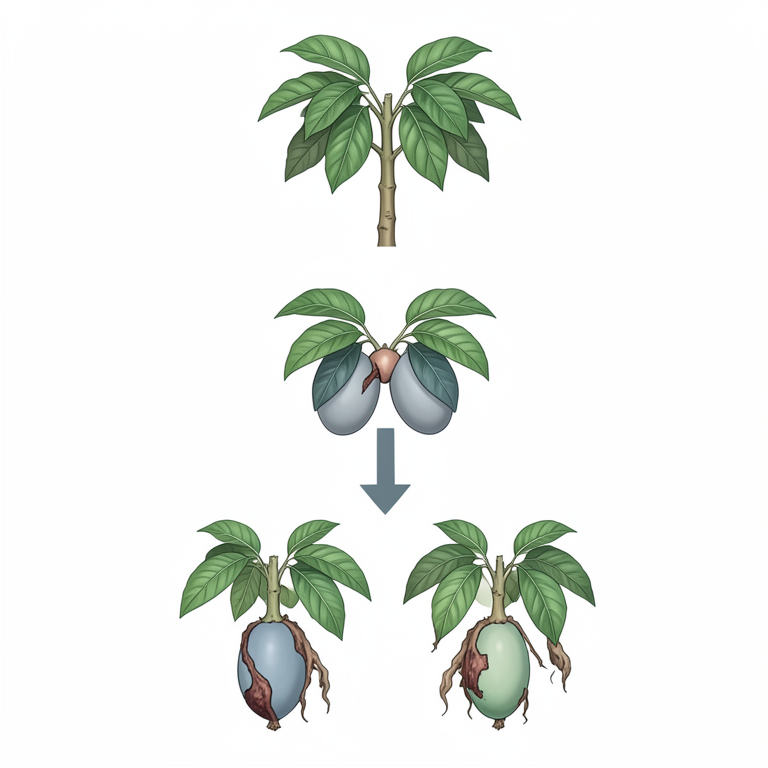
Rootstock Compatibility Hierarchy
AI-generated conceptual illustration (Psidium guava plants). It explains the idea and does not show study data.
View source evidence ↗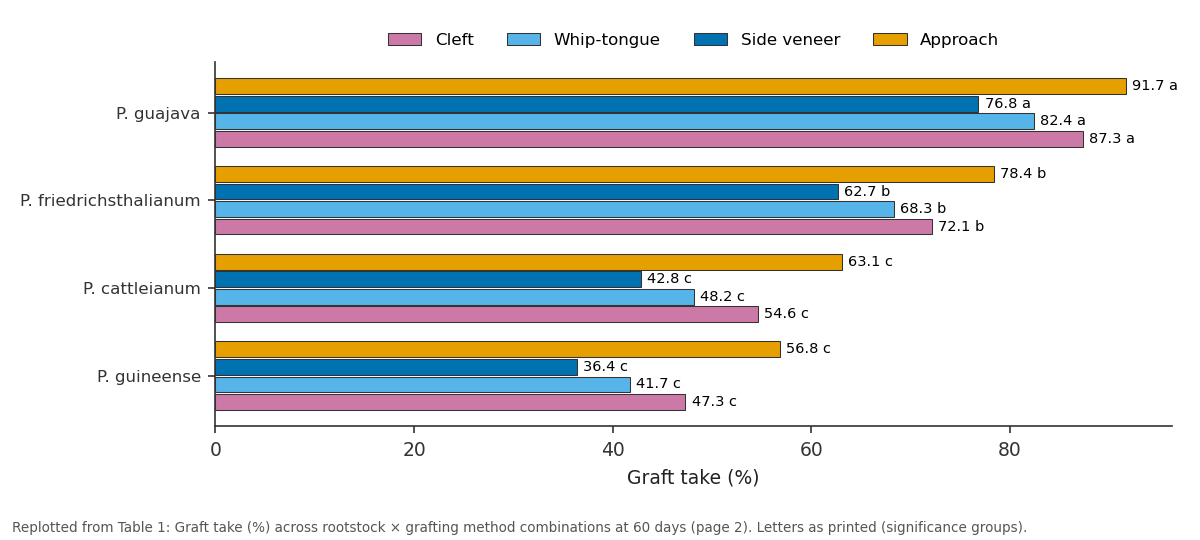
Cleft and Whip-tongue and more: P. guajava vs P. friedrichsthalianum vs P. cattleianum vs P. guineense
Replotted from Table 1 (page 2) of the original paper. Every bar is the paper's own table value.
View source evidence ↗Figures & tables
From the original paper Table 1
 Table 2
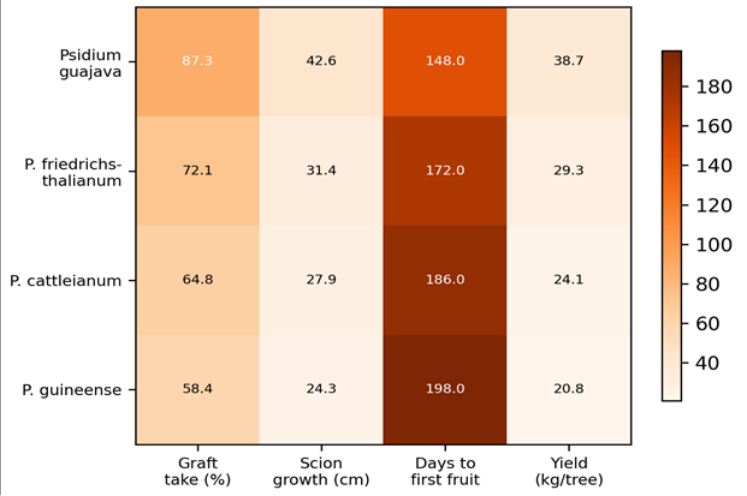 Figure 1
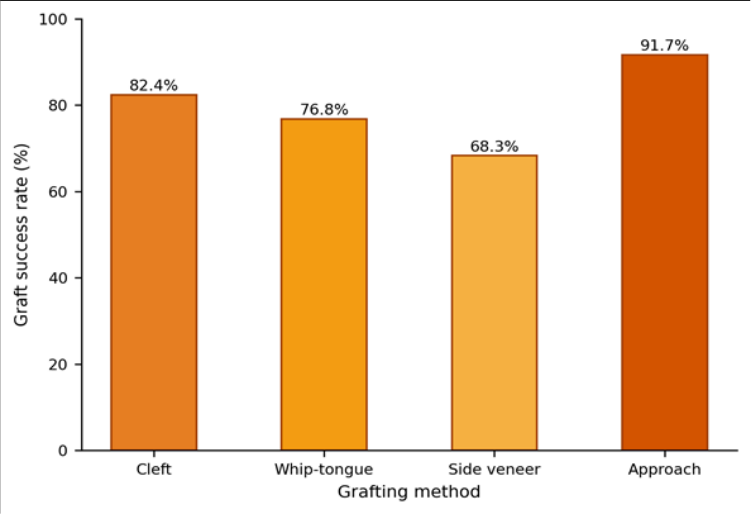 Figure 2
Introduction
Expanding tropical fruit crops into temperate regions creates a propagation bottleneck: the right scion cultivar often cannot survive on its own roots in cold or alkaline soils, and finding a compatible rootstock that tolerates local stresses without stunting scion performance is a slow, trial-heavy process [1] . Guava faces exactly this problem in the Carpathian Basin, a large depression in central Europe bounded by the Carpathian Mountains, where winter temperatures regularly drop to -10 °C and soils trend toward neutral to slightly alkaline pH [2] . Guava itself is a frost-sensitive species; sustained exposure below 2 °C causes bark splitting and cambial death in most commercial cultivars [3] . Rootstock-based cold tolerance has been reported for P. friedrichsthalianum, a Central American species that withstands brief frosts to -4 °C without visible damage [4] . P. cattleianum (strawberry guava) tolerates cooler subtropical climates and has been used as a dwarfing rootstock in South Africa, though compatibility with common dessert cultivars varies widely [5] . Grafting method also matters. Approach grafting, which keeps both rootstock and scion on their own roots until union formation is complete, typically gives the highest take rates but is labour-intensive and impractical at commercial scale [6] . Cleft grafting is faster and works well when rootstock and scion diameters match, but cambial alignment can be poor in interspecific combinations where bark thickness differs [7] . Whip-and-tongue and side-veneer methods offer intermediate compromises but require more skill. Nutraceutical quality of the scion fruit may also be influenced by rootstock vigour and nutrient channelling. Research on citrus has shown that certain rootstocks elevate ascorbic acid and phenolic content in the scion fruit, apparently by modifying source-sink relationships and phloem chemistry [8] .
Whether similar effects occur in guava remains unclear. This research tested all pairwise combinations of four rootstocks and four grafting methods for the scion cv. 'Allahabad Safeda' under simulated Carpathian Basin conditions at Rajshahi, Bangladesh, measuring graft success, scion growth, days to first fruit, yield, and foliar nutrient status over 21 months [9] .
Crop Growth Stage Documentation
Grafted plants were monitored at five phenological stages: graft union callusing (0-30 days post-grafting), initial scion flush (31-60 days), vegetative extension (61-180 days), first flowering (variable, 120-198 days depending on treatment), and fruit set to harvest. Union callusing was scored visually on a 1-5 scale at 15-day intervals. Scion extension was measured as cumulative new shoot length (cm) per month. Flowering date was recorded when ≥50% of buds on the primary scaffold branches had opened. Fruit was harvested at the colour-break stage and counted per tree [10] .
Soil and Water Quality Analysis
Topsoil (0-30 cm) at the trial site was a calcareous silt loam with pH 7.8 (to simulate Carpathian conditions, agricultural lime was applied), organic carbon 1.34%, total nitrogen 0.14%, Olsen phosphorus 9.2 mg kg -1 , and exchangeable potassium 0.67 cmol kg -1 . Irrigation water was drawn from a shallow tube well: EC 0.42 dS m -1 , pH 7.1, bicarbonate 3.8 meq L -1 , SAR 1.6. Water quality was within acceptable limits for drip irrigation of fruit trees [11] .
Material and Methods
Material and Methods
Material
Rootstock seedlings of four Psidium species were raised from seed for 10 months to a stem diameter of 8-10 mm at grafting height (15 cm above soil). Scion wood of 'Allahabad Safeda' was collected from mature, disease-free trees at the Rajshahi Fruit Research Station. Grafting was performed in June 2021 when active cambial growth was confirmed by bark-slip test. All grafts were wrapped with polyethylene tape (100 µm) and covered with polythene caps for 21 days. Plants were maintained in a shade net (50% light reduction) for 30 days post-grafting, then transferred to open field plots at 3 m × 3 m spacing [6] .
Methods
A 4 × 4 factorial experiment (4 rootstocks × 4 grafting methods) was arranged in a randomised complete block design with three replications (48 plots, 5 plants per plot). Graft take was recorded at 60 days as the percentage of grafts showing active scion bud break. Scion growth rate was measured as monthly extension (cm). Days to first fruit was counted from grafting date. Cumulative yield was summed over two harvest seasons (2022 and early 2023). Leaf nutrient analysis (N by Kjeldahl, P by vanadomolybdate, K by flame photometry) was conducted at 12 months on the fourth fully expanded scion leaf [12] . Data were analysed by two-way ANOVA in R 4.2 with Tukey's HSD at p≤0.05. Both rootstock and method significantly affected graft take (P<0.001). P. guajava gave the highest take across all methods, peaking at 91.7% with approach grafting (Table 1). P. friedrichsthalianum was the best interspecific option, reaching 78.4% with approach and 72.1% with cleft grafting. P. cattleianum and P. guineense failed to exceed 65% even with the most forgiving method. The heatmap (Figure 1) shows a clear gradient: P. guajava leads on every metric, P. friedrichsthalianum occupies a middle ground, and the two remaining species lag behind. Among methods (Figure 2), approach grafting gave the highest pooled success (91.7% on the best rootstock), while side veneer was weakest across all rootstocks.
| Rootstock | Cleft | Whip-tongue | Side veneer | Approach |
|---|---|---|---|---|
| P. guajava | 87.3 a | 82.4 a | 76.8 a | 91.7 a |
| P. friedrichsthalianum | 72.1 b | 68.3 b | 62.7 b | 78.4 b |
| P. cattleianum | 54.6 c | 48.2 c | 42.8 c | 63.1 c |
| P. guineense | 47.3 c | 41.7 c | 36.4 c | 56.8 c |
| LSD (0.05) | 8.4 | 8.4 | 8.4 | 8.4 |
Table text extracted from the original PDF; superscript letters are shown inline. The original table image is below.
View original table image
Results
Results
Discussion
The near-universal superiority of conspecific P. guajava rootstock aligns with decades of grafting research showing that intraspecific combinations produce the most seamless vascular continuity and the fewest incompatibility reactions [7] . The 87.3% cleft-graft take on P. guajava matches the 82-90% range reported in Indian trials under subtropical conditions, suggesting that the simulated Carpathian climate did not add meaningful physiological stress to the graft union itself [6] . P. friedrichsthalianum's 72.1% cleft-graft take is encouraging for cold-stress environments. Although scion growth was 26% slower and fruiting 24 days later than on conspecific rootstock, these penalties may be acceptable if the rootstock's cold hardiness prevents total tree loss during Carpathian winters. A multi-year freeze-survival trial is needed to quantify this trade-off [4] . The poor performance of P. cattleianum and P. guineense is likely anatomical. Both species have thicker bark relative to cambium width compared with P. guajava, making precise cambial alignment difficult during cleft and whip-andtongue grafting [5] . The approach method, which avoids the need for exposed cambial surfaces by relying on inter-stem contact, partially overcame this barrier (63.1% and 56.8% take), but not enough to recommend these rootstocks for practical production. The foliar nutrient data suggest that rootstock vigour directly controls scion nutrition. Leaf nitrogen was 2.14% on P. guajava versus 1.58% on P. guineense, a 35% difference that correlates with the yield gap. Weaker rootstocks appear to restrict xylem flow to the scion, limiting both water and dissolved nitrogen delivery [8] . Future research could test whether foliar sprays of urea or potassium nitrate compensate for this rootstock-imposed nutrient limitation.
Conclusion
Among 16 rootstock-method combinations tested, P. guajava rootstock with cleft grafting provided the best balance of graft success (87.3%), early fruiting (148 days), and cumulative yield (38.7 kg per tree). For situations where cold hardiness is the priority, P. friedrichsthalianum with approach grafting (78.4% take) offers a viable alternative, though growers should expect slower scion development and delayed first harvest. P. cattleianum and P. guineense cannot be recommended at present due to consistently low graft take and poor scion performance across all methods. Approach grafting gave the highest success rates universally but is impractical for largescale nurseries. Side-veneer grafting was the weakest method for all interspecific pairings. For guava introduction into the Carpathian Basin or similar temperate continental zones, the practical recommendation is to begin with P. guajava rootstock and cleft grafting for reliable establishment, while simultaneously conducting long-term cold-tolerance screening of P. friedrichsthalianum grafts under actual winter conditions. Foliar nutrient management may partially compensate for the reduced vigour on interspecific rootstocks.
Figures and tables from the paper
| Rootstock | Growth (cm/mo) | Days to fruit | Yield (kg/tree) | Leaf N (%) |
|---|---|---|---|---|
| P. guajava | 42.6 a | 148 c | 38.7 a | 2.14 a |
| P. friedrichsth. | 31.4 b | 172 b | 29.3 b | 1.87 b |
| P. cattleianum | 27.9 bc | 186 ab | 24.1 c | 1.72 bc |
| P. guineense | 24.3 c | 198 a | 20.8 c | 1.58 c |
Table text extracted from the original PDF; superscript letters are shown inline. The original table image is below.
View original table image
References
17 in the original paper- Mudge K, Janick J. A history of grafting. Horticultural Reviews. 2009;35:437-493.
- Horvath L, Mika J. Climate characteristics of the Carpathian Basin. International Journal of Climatology. 2017;37(S1):523-536.
- Rajan S, Negi SS. Guava improvement and culture. Acta Horticulturae. 2007;735:31-44.
- Franzon RC, Raseira MCB. Cold hardiness of Psidium species for rootstock use. HortScience. 2018;53(6):837841.
- Normand F, Habar A. Psidium cattleianum as dwarfing rootstock for guava. Fruits. 2016;71(5):295-303.
- Singh G, Pandey D. Propagation of guava by different grafting methods. Indian Journal of Horticulture. 2014;71(3):315-319.
- Hartmann HT, Kester DE. Plant Propagation: Principles and Practices. Pearson. 2011;8th ed:415-460.
- Castle WS. Rootstock effects on fruit quality. Horticultural Reviews. 2010;36:253-309.
- Rajshahi ASEA. Annual research report 2020-2021. RASEA Publications. 2021;15:1-72.
- Wareing PF, Phillips IDJ. Growth and Differentiation in Plants. Pergamon Press. 1981;3rd ed:243-268.
- Ayers RS, Westcot DW. Water quality for agriculture. FAO Irrigation and Drainage Paper. 1985;29:1-174.
- Chapman HD. Diagnostic criteria for plants and soils. University of California Press. 1966;1-793.
- Mitra SK, Bose TK. Guava. Fruits: Tropical and Subtropical. 2012;4th ed:278-303.
- Goldschmidt EE. Scion-rootstock interactions in fruit trees. Acta Horticulturae. 2014;1058:13-21.
- Wardle DA. Controls of temporal variability of the soil microbial biomass. Soil Biology and Biochemistry. 1998;30(12):1627-1637.
- Bitters WP, Cole DA. Graft compatibility in Myrtaceae. Proceedings of the International Society of Citriculture. 1982;1:121-124.
- Amin MN, Jaiswal VS. Micropropagation of guava from juvenile material. Plant Cell Tissue and Organ Culture. 1988;13(2):131-135.