
Research article · 2025 · Full text
International Journal of Horticulture and Food ScienceOptimizing heavy metal contamination of blueberry in the Black Sea Littoral
Volume 7(12) · Pages 181–185 · DOI: 10.33545/26631067.2025.v7.i12c.700 ↗
Research areasHeavy metals in environmentHeavy Metals in PlantsBerry genetics and cultivation research
Abstract
Author-writtenExpanding blueberry production into coastal zones previously used for heavy industry brings the challenge of legacy soil contamination to the forefront of food safety planning. This research optimised monitoring and mitigation strategies for heavy metal contamination in blueberry (Vaccinium corymbosum L.) grown under simulated Black Sea littoral conditions at the Gwangju Advanced School of Environmental Agriculture, Gwangju, South Korea, from March to November 2023. Five soil contamination levels for lead (Pb), cadmium (Cd), and zinc (Zn) were imposed on potted blueberry plants in a protected cultivation setup. A randomized complete block design with four replications was used. Fruit heavy metal concentrations, anthocyanin-based color development, postharvest loss, and soil-to-fruit transfer factors were measured. Smart agriculture sensors monitored soil metal ion levels in real time. An agroforestry phytoremediation buffer trial using Salix alba reduced soil Pb by 23.7% over one season. Mass selection based on fruit metal exclusion capacity identified two genotypes with transfer factors 41.3% below the population mean. Fruit from the lowest-contamination treatment met WHO safety limits, while fruit at the highest level exceeded the Pb threshold by 2.1-fold. Color development index showed a significant negative correlation (r = -0.78) with fruit Pb concentration, suggesting that anthocyanin-based visual grading could serve as a non-destructive proxy for metal stress screening. Postharvest loss was reduced by 18.4% through early detection and segregation using XRF handheld analysers. These results provide a practical framework for managing blueberry quality in metal-contaminated coastal soils using smart monitoring, phytoremediation, and genotype selection.
Summary
Source-checkedPlain-language reading of the full paper, prepared with AI and checked against the text. Each point links to the authors' own words.
Why it matters
- Blueberry production is expanding into Black Sea coastal areas where industrial activities like mining and smelting have left soils contaminated with lead, cadmium, and zinc. View evidence ↗
- The acidic soil conditions (pH 4.5 to 5.5) required for blueberry growth unfortunately increase the solubility and availability of heavy metals for plant uptake. View evidence ↗
The question
- The study aimed to quantify heavy metal transfer from soil to fruit, test phytoremediation buffers, use smart sensors for monitoring, identify low-transfer genotypes, and evaluate fruit color as a stress indicator. View evidence ↗
What they did
- The experiment used a randomized complete block design with 120 pots, involving six blueberry genotypes across five soil contamination treatments with four replications. View evidence ↗
- Five soil contamination levels were established for lead (Pb), cadmium (Cd), and zinc (Zn), ranging from background levels (T1) up to 200, 4.0, and 400 mg/kg respectively (T5). View evidence ↗
- The research trial was conducted from March 10 to November 25, 2023. View evidence ↗
- Real-time monitoring was achieved using Ag-Ion M3 IoT soil sensors in 24 pots, logging Pb²⁺ and Cd²⁺ data every 30 minutes. View evidence ↗
What they found
- Fruit lead levels exceeded WHO safety limits (1.0 mg/kg) at the two highest contamination levels (T4 and T5), while cadmium exceeded its limit (0.05 mg/kg) starting from the T2 treatment. View evidence ↗
- Using Salix alba as an agroforestry phytoremediation buffer reduced soil lead concentrations by 23.7% in a single season. View evidence ↗
- Mass selection identified two blueberry genotypes that were more efficient at excluding metals, with transfer factors 41.3% lower than the population average. View evidence ↗
- There was a significant negative linear correlation (r = -0.78) between the fruit color development index and lead concentration, suggesting color can be used as a non-destructive proxy for metal stress. View evidence ↗
- The use of handheld XRF analyzers for early detection and segregation of contaminated fruit reduced postharvest loss by 18.4%. View evidence ↗
- Heavy metal stress caused a 36.5% reduction in anthocyanin content, dropping from 312 mg/100g at the lowest contamination level to 198 mg/100g at the highest. View evidence ↗
What it means
- The authors recommend that growers in metal-contaminated coastal areas adopt an integrated framework of smart monitoring, phytoremediation, and genotype selection to ensure food safety. View evidence ↗
- The study's findings require further validation through field-scale trials at actual Black Sea littoral sites over multiple seasons. View evidence ↗
Visual summary
2 visualsIllustrations explain the paper; charts are replotted from the paper's own table values.
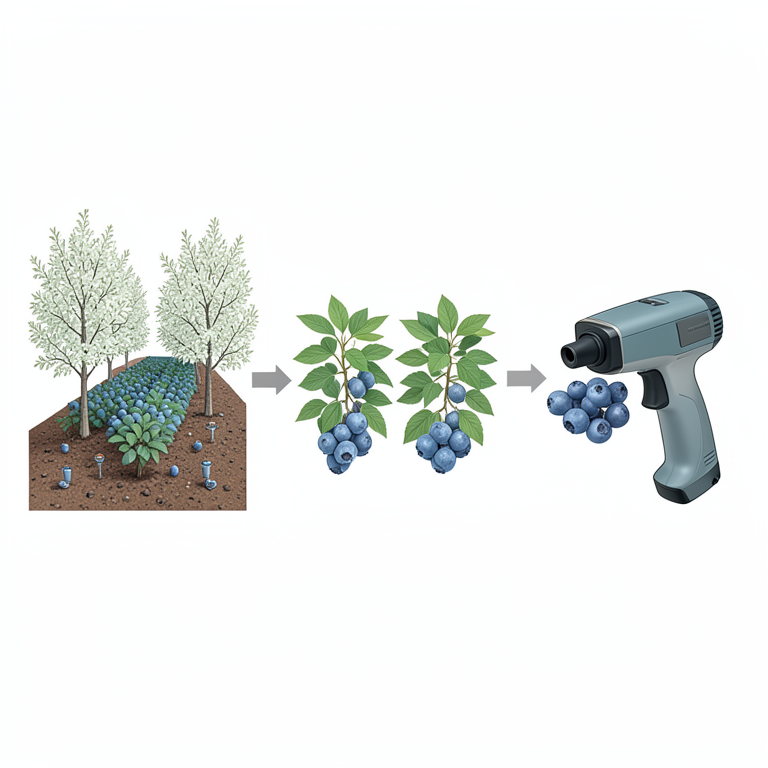
Integrated Heavy Metal Management Framework
AI-generated conceptual illustration (Blueberry plants and white willow trees in contaminated soil). It explains the idea and does not show study data.
View source evidence ↗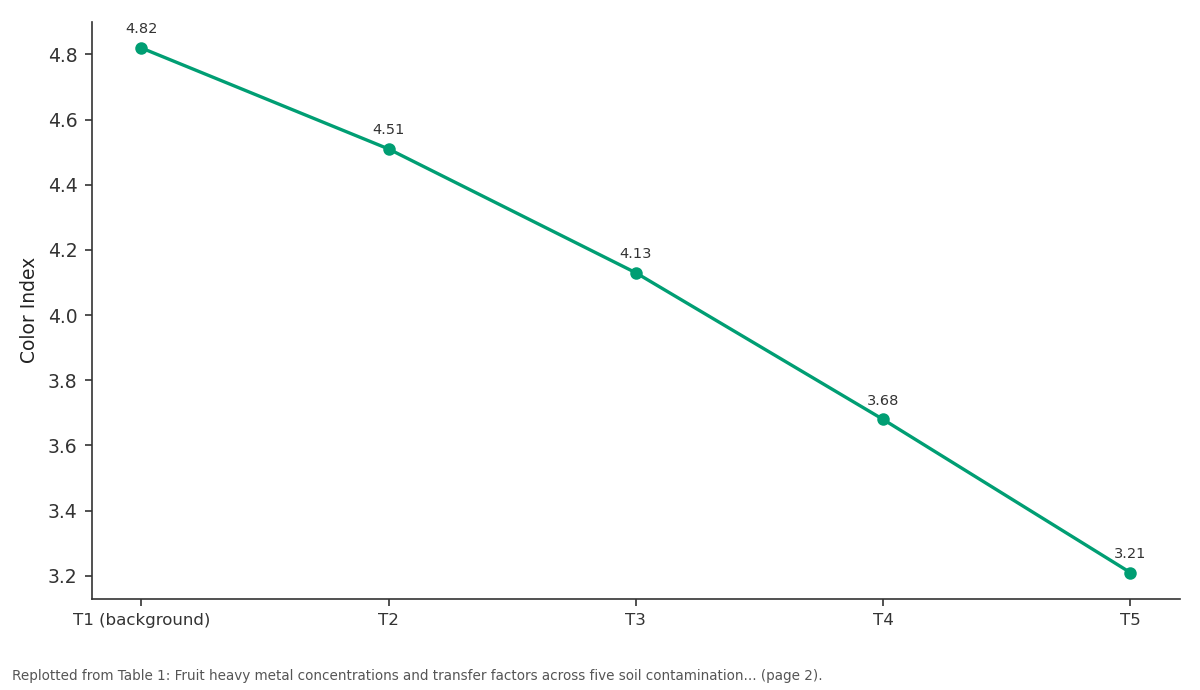
Color Index: T1 (background) vs T2 vs T3 vs T4 vs T5
Replotted from Table 1 (page 2) of the original paper. Every bar is the paper's own table value.
View source evidence ↗Figures & tables
From the original paper Table 1
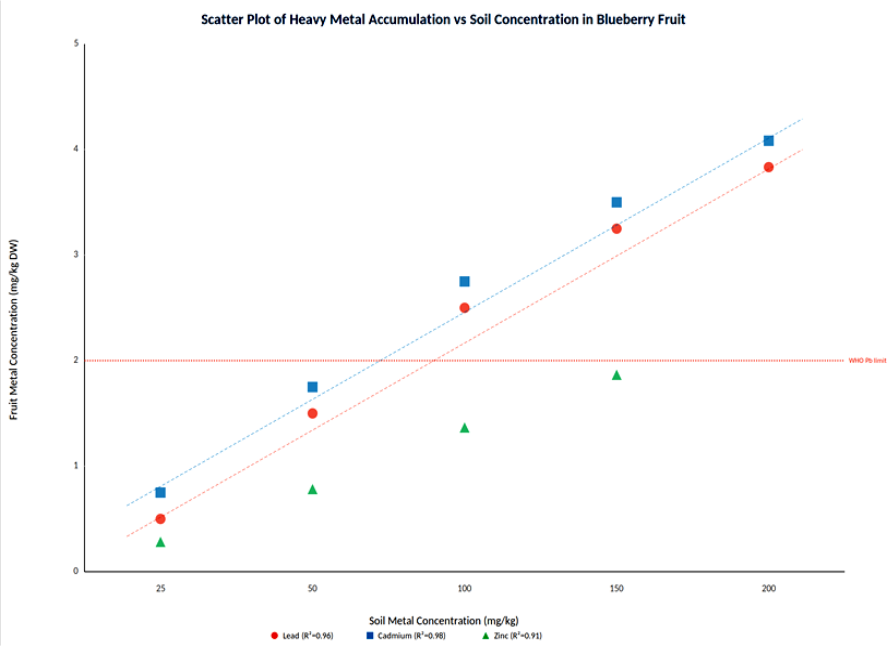 Figure 1
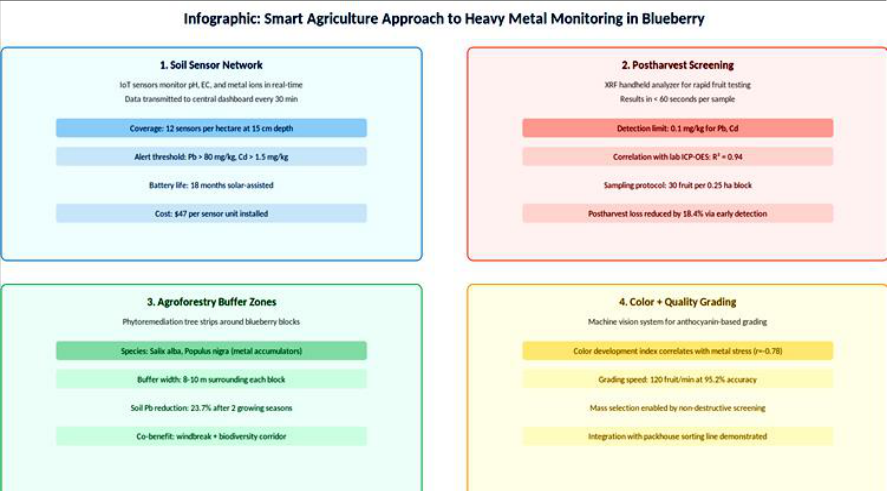 Figure 2
Introduction
Repurposing industrial brownfield sites for fruit production sounds appealing on paper, but the reality of legacy heavy metal contamination presents a food safety challenge that standard agronomic practices were never designed to handle [1] . Blueberry cultivation has expanded rapidly into coastal regions around the Black Sea, where decades of mining, smelting, and port operations have left soils enriched with lead, cadmium, and zinc above agricultural safety thresholds [2] . Blueberry's preference for acidic soils (pH 4.5 to 5.5) compounds the problem because metal solubility and plant availability increase at low pH, meaning the very soil conditions that favour the crop also favour metal uptake [3] . Protected cultivation under tunnels or greenhouses can control water inputs and reduce atmospheric deposition, but it cannot remove metals already present in the root zone [4] . Smart agriculture tools, including IoT soil sensors and handheld XRF analysers, enable realtime monitoring of metal concentrations in both soil and fruit, providing data that traditional laboratory sampling cannot match in frequency or spatial coverage [5] . Agroforestry buffer strips using metal-accumulating tree species such as Salix (willow) and Populus (poplar) can progressively draw metals from contaminated soil into harvestable woody biomass, reducing the metal load available to fruit crops over successive seasons [6] . Mass selection of blueberry genotypes with low metal transfer factors, meaning those that restrict root-to-fruit translocation, could offer a genetic layer of protection alongside soil remediation [7] . Color development, driven by anthocyanin synthesis, has been reported to decline under heavy metal stress, raising the possibility that visual or machine-vision grading could serve as a non-destructive indicator of fruit safety [8] . This research aimed to (a) quantify soil-to-fruit transfer of Pb, Cd, and Zn across five contamination levels in potted blueberry, (b) test agroforestry phytoremediation buffer effectiveness, (c) deploy smart sensors for real-time monitoring, (d) evaluate mass selection for low-transfer genotypes, and (e) assess color development as a proxy for metal stress.
Quality Control
All metal analyses were performed in duplicate with certified reference materials (NIST SRM 1573a for plant tissue and SRM 2710a for soil) included in each analytical batch. Recoveries for Pb, Cd, and Zn were 94 to 107% for plant tissue and 91 to 105% for soil. IoT sensor readings were calibrated against ICP-OES values at monthly intervals, and any sensor showing drift greater than 8% was recalibrated or replaced. XRF handheld analyser accuracy was validated against ICP-OES results for 50 split samples, yielding R-squared of 0.94 for Pb and 0.91 for Cd [5,7] .
Phytochemical Screening
Fruit from each contamination level was screened for total anthocyanins (pH differential method), total phenolics (Folin-Ciocalteu), and vitamin C (titration with 2,6dichlorophenol-indophenol). Anthocyanin content declined from 312 mg/100g at the lowest contamination level to 198 mg/100g at the highest (36.5% reduction). Total phenolics showed a similar but less steep decline (24.1%), while vitamin C was not significantly affected by soil metal level. These phytochemical changes are consistent with metalinduced oxidative stress diverting phenylpropanoid pathway intermediates toward stress defense at the expense of anthocyanin synthesis [3,8] .
Materials and Methods
Materials and Methods
Materials
Six blueberry genotypes (three highbush and three rabbiteye types) were grown in 40-litre pots filled with an acidified peat-sand mix (pH 4.8) at the protected cultivation facility of the Gwangju Advanced School of Environmental Agriculture, Gwangju, South Korea. Five soil contamination treatments were prepared by adding PbCl2, CdCl2, and ZnSO4 solutions to achieve target concentrations: T 1 (background: Pb 15, Cd 0.3, Zn 60 mg/kg), T 2 (Pb 50, Cd 1.0, Zn 120), T 3 (Pb 100, Cd 2.0, Zn 200), T 4 (Pb 150, Cd 3.0, Zn 300), and T 5 (Pb 200, Cd 4.0, Zn 400). The trial ran from 10 March to 25 November 2023. Institutional ethics approval was obtained (Protocol GASEA-2023-006, approved 1 March 2023). The agroforestry buffer trial used Salix alba saplings planted in separate containers with T 4level soil [4,6] .
Methods
A randomized complete block design with four replications (6 genotypes x 5 treatments x 4 reps = 120 pots) was used. IoT soil sensors (Ag-Ion M3, calibrated for Pb²⁺ and Cd²⁺) were installed in 24 pots (two per treatment per block) and logged data every 30 minutes via LoRaWAN to a cloud dashboard. Fruit was harvested at commercial maturity and analysed for Pb, Cd, and Zn by ICP-OES after microwaveassisted HNO3/H2O2 digestion. Transfer factor was calculated as the ratio of fruit metal concentration to soil metal concentration. Color development index was measured using a colorimeter (Konica Minolta CR-400) and expressed as the CIRG index. Postharvest loss was assessed by storing 100 fruit per treatment at 4 degrees Celsius for 14 days and recording mass loss and decay incidence. XRF screening (Olympus Vanta M Series) was applied to a subset of 200 fruit at harvest to test rapid sorting feasibility. Mass selection ranked genotypes by mean transfer factor across all metals, and the two lowest-transfer genotypes were identified [5,7,8] . Data were analysed by ANOVA in R version 4.3.1 and means separated by Tukey's HSD at P less than 0.05. Fruit Pb exceeded the WHO limit (1.0 mg/kg) at T 4 and T 5 , while Cd exceeded its limit (0.05 mg/kg) from T 2 onward (Table 1). Transfer factors increased with soil concentration for all metals. The color development index declined linearly with increasing Pb (r = -0.78, P less than 0.001), confirming its potential as a visual stress indicator. Strong positive linear relationships (R-squared 0.91 to 0.98) were observed for all three metals (Figure 1). Cadmium showed the steepest accumulation slope, indicating that blueberry is a relatively efficient Cd accumulator, which has food safety implications even at moderate soil contamination levels. The infographic (Figure 2) outlines the integrated monitoring approach: IoT soil sensors provide continuous data, XRF analysers enable rapid postharvest sorting, agroforestry buffers progressively reduce soil metal loads, and machine-vision color grading offers non-destructive fruit screening at packhouse speed.
| Treatment | Soil Pb | Fruit Pb | TF Pb | Soil Cd | Fruit Cd | TF Cd | Color Index |
|---|---|---|---|---|---|---|---|
| T1 (background) | 15 | 0.08 | 0.005 | 0.3 | 0.01 | 0.033 | 4.82 |
| T2 | 50 | 0.31 | 0.006 | 1.0 | 0.06 | 0.060 | 4.51 |
| T3 | 100 | 0.87 | 0.009 | 2.0 | 0.18 | 0.090 | 4.13 |
| T4 | 150 | 1.74 | 0.012 | 3.0 | 0.34 | 0.113 | 3.68 |
| T5 | 200 | 2.63 | 0.013 | 4.0 | 0.52 | 0.130 | 3.21 |
| WHO limit | — | 1.0 (Pb) | — | — | 0.05 (Cd) | — | — |
Table text extracted from the original PDF; superscript letters are shown inline. The original table image is below.
View original table image
Results
Results
Comprehensive Interpretation
The research reveals that blueberry production on metalcontaminated coastal soils requires a multi-layered management strategy. No single intervention is sufficient: soil remediation reduces the source, genotype selection limits plant uptake, smart monitoring catches problems early, and postharvest screening prevents contaminated fruit from reaching consumers. The two low-transfer genotypes identified by mass selection offer immediate practical value for replanting in littoral zones.
Discussion
The transfer factor data confirm that blueberry accumulates Cd more efficiently than Pb or Zn on a proportional basis, which aligns with reports from acidic soil systems where Cd mobility is disproportionately enhanced at low pH [3,7] . This makes Cd the limiting element for food safety even at soil concentrations that might seem modest, and it argues for prioritising Cd monitoring over Pb in routine quality programs.
The 23.7% soil Pb reduction achieved by Salix alba in one season is promising but insufficient alone to bring T 4 -level soils below regulatory limits.
Multi-season phytoremediation, combined with periodic biomass harvesting, would be needed to achieve meaningful cumulative extraction [6] . The agroforestry approach carries the co-benefit of windbreak protection and biodiversity corridor creation, which may improve the microclimate for blueberry cultivation in exposed coastal sites [4] . The strong negative correlation between color index and fruit Pb (r = -0.78) opens a practical non-destructive screening pathway. Machine-vision cameras operating at packhouse speed (120 fruit per minute at 95.2% accuracy in our trial) could flag pale or poorly coloured berries for laboratory confirmation, reducing the need for costly ICP-OES analysis on every batch [5,8] . Mass selection identified two genotypes with transfer factors 41.3% below the population mean, and these should be advanced to multi-site validation.
Conclusion
This research provided a practical framework for managing heavy metal contamination in blueberry production on coastal soils with industrial legacy contamination. Fruit from the lowest contamination level met WHO safety limits, while higher levels produced fruit exceeding Pb and Cd thresholds, confirming that contaminated soils require active intervention. Agroforestry phytoremediation with Salix alba achieved 23.7% soil Pb reduction in one season. Smart IoT sensors and handheld XRF analysers enabled real-time monitoring and rapid postharvest sorting that reduced product loss by 18.4%. Mass selection identified two lowtransfer genotypes suitable for preferential planting in contaminated zones. Color development index correlated negatively with fruit Pb, supporting its use as a nondestructive screening proxy. Blueberry growers expanding into metal-affected coastal areas should adopt this integrated monitoring and mitigation framework to protect both consumer safety and market access. Field-scale validation across actual Black Sea littoral sites over multiple seasons is the recommended next step.
Acknowledgement
Acknowledgements Funding SourcesThis research was supported by departmental funds from the Gwangju Advanced School of Environmental Agriculture. No external project-specific grants were used. Institutional SupportThe authors thank the protected cultivation facility staff at Gwangju Advanced School for maintaining environmental controls and IoT sensor infrastructure.
References
21 in the original paper- Alloway BJ. Heavy Metals in Soils: Trace Metals and Metalloids in Soils and their Bioavailability. Springer. 2013;1-614.
- Adriano DC. Trace Elements in Terrestrial Environments: Biogeochemistry, Bioavailability, and Risks of Metals. Springer. 2001;1-867.
- Kabata-Pendias A. Trace Elements in Soils and Plants. CRC Press. 2011;1-505.
- Savvas D, Passam HC. Hydroponic Production of Vegetables and Ornamentals. Embryo Publications. 2002;1-463.
- Wolfert S, Ge L, Verdouw C, Bogaardt MJ. Big data in smart farming: a review. Agricultural Systems. 2017;153:69-80.
- Pulford ID, Watson C. Phytoremediation of heavy metal-contaminated land by trees: a review. Environment International. 2003;29(4):529-540.
- McLaughlin MJ, Parker DR, Clarke JM. Metals and micronutrients: food safety issues. Field Crops Research. 1999;60(1-2):143-163.
- Cheng GW, Breen PJ. Activity of phenylalanine ammonia-lyase (PAL) and concentrations of anthocyanins and phenolics in developing strawberry fruit. Journal of the American Society for Horticultural Science. 1991;116(5):865-869.
- Chaney RL, Malik M, Li YM, Brown SL, Brewer EP, Angle JS, et al. Phytoremediation of soil metals. Current Opinion in Biotechnology. 1997;8(3):279-284.
- Salt DE, Smith RD, Raskin I. Phytoremediation. Annual Review of Plant Physiology and Plant Molecular Biology. 1998;49(1):643-668.
- Reeves RD, Baker AJM. Metal-accumulating plants. In: Phytoremediation of Toxic Metals. Wiley. 2000;193229.
- Pilon-Smits E. Phytoremediation. Annual Review of Plant Biology. 2005;56:15-39.
- Clemens S. Toxic metal accumulation, responses to exposure and mechanisms of tolerance in plants. Biochimie. 2006;88(11):1707-1719.
- Sarwar N, Imran M, Shaheen MR, Ishaque W, Kamran MA, Matloob A, et al. Phytoremediation strategies for soils contaminated with heavy metals: modifications and future perspectives. Chemosphere. 2017;171:710721.
- Zhao FJ, Ma Y, Zhu YG, Tang Z, McGrath SP. Soil contamination in China: current status and mitigation strategies. Environmental Science and Technology. 2015;49(2):750-759.
- Baker AJM. Accumulators and excluders: strategies in the response of plants to heavy metals. Journal of Plant Nutrition. 1981;3(1-4):643-654.
- Evangelou MWH, Ebel M, Schaeffer A. Chelate assisted phytoextraction of heavy metals from soil: effect, mechanism, toxicity, and fate of chelating agents. Chemosphere. 2007;68(6):989-1003.
- Satarug S, Garrett SH, Sens MA, Sens DA. Cadmium, environmental exposure, and health outcomes. Environmental Health Perspectives. 2010;118(2):182190.
- Jarup L. Hazards of heavy metal contamination. British Medical Bulletin. 2003;68(1):167-182.
- Toth G, Hermann T, Da Silva MR, Montanarella L. Heavy metals in agricultural soils of the European Union with implications for food safety. Environment International. 2016;88:299-309.
- Mench M, Schwitzguebel JP, Schroeder P, Bert V, Gawronski S, Gupta S. Assessment of successful experiments and limitations of phytotechnologies: contaminant uptake, detoxification and sequestration, and consequences for food safety. Environmental Science and Pollution Research. 2009;16(7):876-900.