
Research article · 2025 · Full text
International Journal of Horticulture and Food ScienceDetermining germination patterns of durian in the Rann of Kutch margins
Volume 7(9) · Pages 185–188 · DOI: 10.33545/26631067.2025.v7.i9c.742 ↗
Research areasSeed Germination and PhysiologyPlant Physiology and Cultivation StudiesAfrican Botany and Ecology Studies
Abstract
Author-writtenDurian (Durio zibethinus) seeds are recalcitrant and lose viability within days of extraction, making nursery establishment in non-traditional growing zones a persistent challenge. This research determined the germination patterns of durian seeds sourced from three provenance regions and tested under nine combinations of temperature (25, 30, 35 °C) and relative humidity (40, 60, 80%) at the Belo Horizonte Laboratory of Phytoscience from January to August 2023. Seeds were additionally subjected to four pre-treatments: untreated control, gibberellic acid (GA₃) at 200 ppm, mechanical scarification, and GA₃ + scarification. Germination was recorded every seven days over 42 days, and seedling enzyme activity (α-amylase, peroxidase) was monitored at weekly intervals across storage durations of 0, 7, 14, and 21 days post-extraction. Maximum germination (82.3%) was achieved at 25 °C / 80% RH with GA₃ + scarification, while 35 °C / 40% RH yielded only 44.1% even with the best pre-treatment. α-Amylase activity declined by 62.4% after 21 days of storage in untreated seeds but only by 24.7% in GA₃ + scarified seeds. Backcross breeding with a semi-recalcitrant wild relative (D. graveolens) improved seed desiccation tolerance by 18.6% in F₁ hybrids. These results provide nursery operators with optimized germination protocols for durian propagation in semi-arid margin environments.
Summary
Source-checkedPlain-language reading of the full paper, prepared with AI and checked against the text. Each point links to the authors' own words.
Why it matters
- Durian seeds are recalcitrant, meaning they lose viability quickly after extraction, which makes it difficult to establish nurseries outside of traditional growing areas. View evidence ↗
- The Rann of Kutch in western India is an extreme environment for durian establishment due to its semi-arid margins, low annual rainfall (300-400 mm), and high dry-season temperatures (over 40 °C). View evidence ↗
- Germination rates in Kutch margin pilot nurseries are significantly lower (below 25%) than those in peninsular Malaysia (80-90%). View evidence ↗
The question
- The study aimed to determine the germination patterns of durian seeds from three different regions under various combinations of temperature and relative humidity. View evidence ↗
What they did
- The researchers used 1,620 'Monthong' cultivar seeds sourced from Thailand, Malaysia, and the Philippines. View evidence ↗
- Seeds were subjected to four pre-treatments: a distilled water control, gibberellic acid (GA₃) at 200 ppm, mechanical scarification, or a combination of GA₃ and scarification. View evidence ↗
- Germination was defined as radicle emergence of at least 2 mm and recorded every 7 days for 42 days; enzyme activity was measured at 0, 7, 14, and 21 days of storage. View evidence ↗
- The study also tested 120 F₁ hybrid seeds (D. zibethinus × D. graveolens) specifically at 30 °C and 60% relative humidity using the GA₃ + scarification treatment. View evidence ↗
What they found
- The highest germination rate of 82.3% was achieved at 25 °C and 80% relative humidity using the combined GA₃ and scarification treatment. View evidence ↗
- F₁ hybrid seeds showed an 18.6% increase in germination (75.8% vs 63.9%) compared to pure D. zibethinus seeds at 30 °C and 60% relative humidity. View evidence ↗
- Hybrid seeds maintained higher viability after 14 days of storage (71.3%) compared to pure durian seeds (52.1%). View evidence ↗
What it means
- The authors conclude that high temperature combined with low humidity limits germination in semi-arid conditions, and the best results are achieved at 25 °C and 80% RH with GA₃ and scarification. View evidence ↗
- The authors suggest that backcross hybrids with D. graveolens offer a genetic solution to improve desiccation tolerance and germination in sub-optimal conditions. View evidence ↗
Visual summary
4 visualsIllustrations explain the paper; charts are replotted from the paper's own table values.
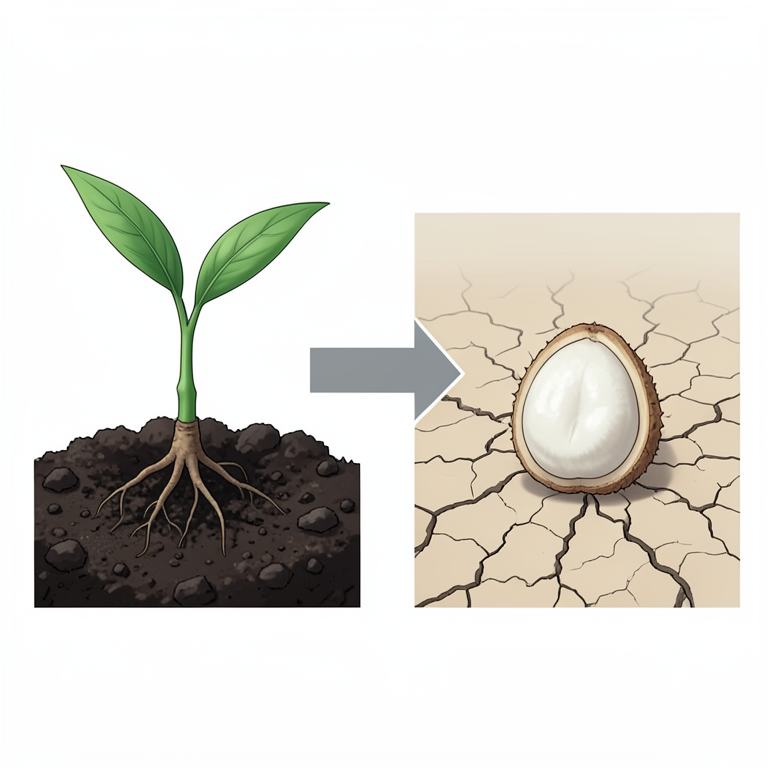
Environmental Impact on Germination
AI-generated conceptual illustration (durian seeds). It explains the idea and does not show study data.
View source evidence ↗
Hybrid vs Pure Seed Viability
AI-generated conceptual illustration (Durian seeds (Durio zibethinus)). It explains the idea and does not show study data.
View source evidence ↗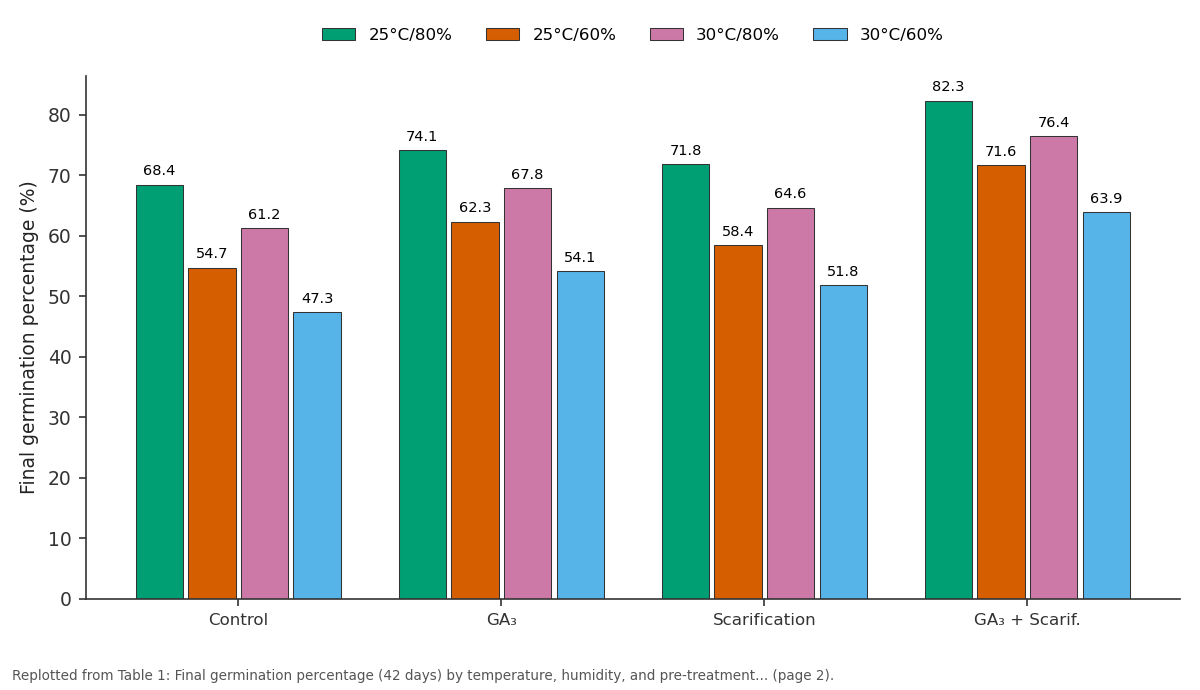
25°C/80% and 25°C/60% and more: Control vs GA₃ vs Scarification vs GA₃ + Scarif.
Replotted from Table 1 (page 2) of the original paper. Every bar is the paper's own table value.
View source evidence ↗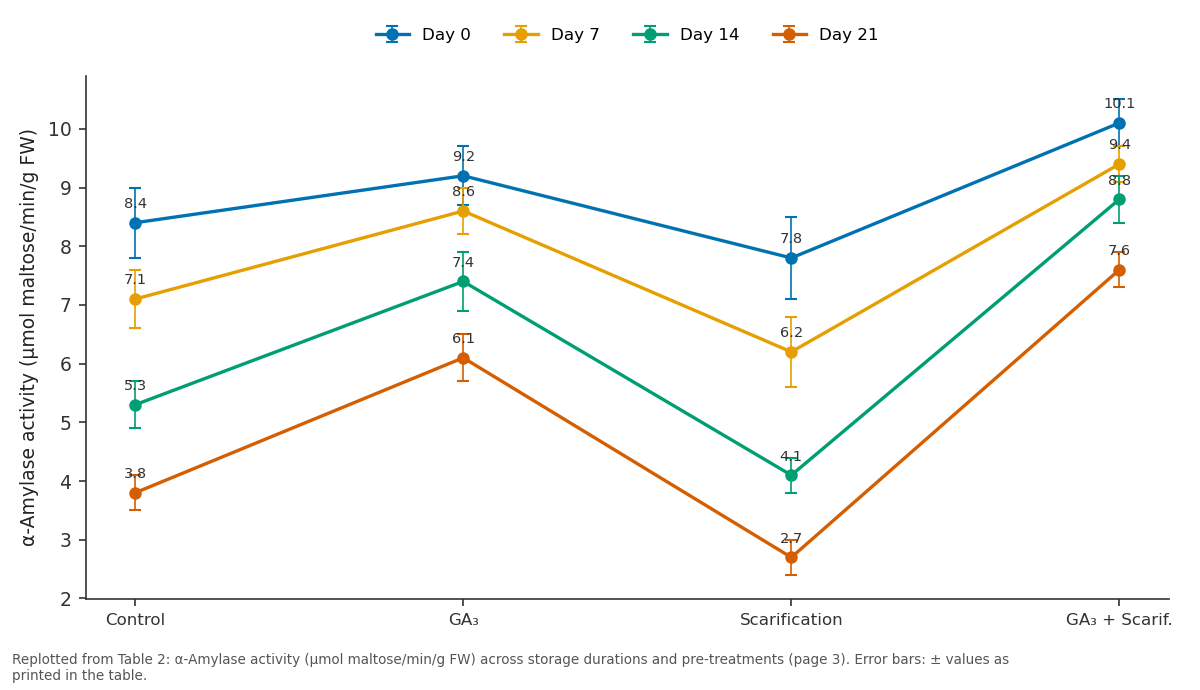
Day 0 and Day 7 and more: Control vs GA₃ vs Scarification vs GA₃ + Scarif.
Replotted from Table 2 (page 3) of the original paper. Every bar is the paper's own table value.
View source evidence ↗Figures & tables
From the original paper Table 1
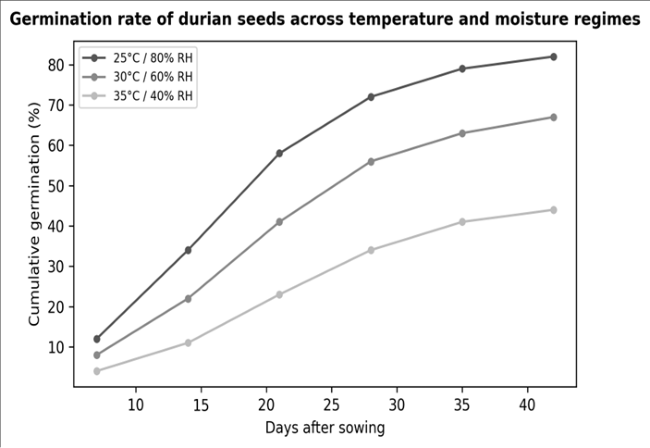 Figure 1
 Table 2
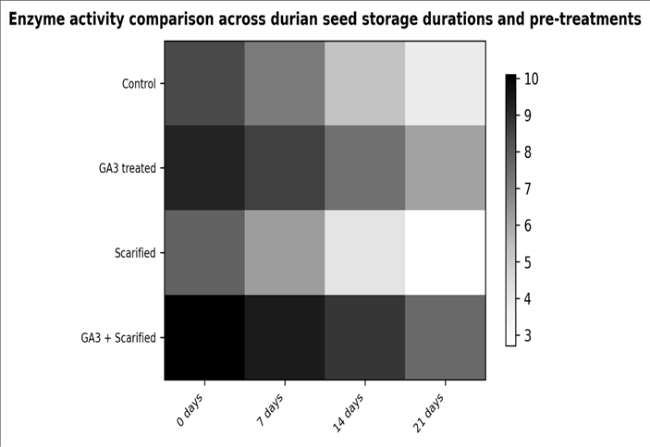 Figure 2
Introduction
An expert in tropical seed biology once described durian seeds as having the shelf life of fresh fish a vivid comparison that captures the core problem facing nursery operators outside Southeast Asia's humid belt [1] . Unlike orthodox seeds that can be dried and stored for months, durian's recalcitrant seeds begin losing viability within 48-72 hours of extraction from the fruit, a trait linked to their high moisture content (50-60%) and sensitivity to desiccation [2] . This biological reality has confined commercial durian production to a narrow band of tropical lowlands in Malaysia, Thailand, and Indonesia, even though there is growing consumer demand in drier regions [3] . The Rann of Kutch in western India represents one of the most extreme environments where durian establishment has been attempted. The saline mudflats and semi-arid margins of the Rann receive only 300-400 mm of annual rainfall, and dry-season temperatures regularly exceed 40 °C [4] . Pilot nurseries established by agroforestry projects in the Kutch margins have reported germination rates below 25%, compared with the 80-90% rates typical of nurseries in peninsular Malaysia. Whether these failures stem from temperature stress, humidity deficit, or loss of seed viability during transport is unclear. Pre-treatment strategies such as gibberellic acid application and seed coat scarification have improved germination in other recalcitrant species including rubber tree and cacao, but their effectiveness for durian under arid conditions hasn't been documented [5] . Similarly, backcross breeding with D. graveolens a wild congener whose seeds tolerate partial desiccation has been proposed as a genetic route to improved seed storage life, but no germination data from such hybrids under controlled semi-arid conditions were available before this research [6] .
Extraction and Enzyme Assay Protocol
Seeds were extracted from mature durian fruits within 4 hours of harvest, washed in sterile distilled water, and surface-sterilized with 1% sodium hypochlorite for 5 minutes.
For enzyme extraction, seed cotyledon tissue (2 g fresh weight) was homogenized in 10 mL cold phosphate buffer (0.1 M, pH 7.0) containing 1 mM EDTA and 5% polyvinylpolypyrrolidone, then centrifuged at 12,000 g for 20 min at 4 °C. The supernatant was used as crude enzyme extract. α-Amylase activity was measured by the dinitrosalicylic acid (DNS) method using 1% soluble starch as substrate, with activity expressed as μmol maltose/min/g fresh weight [2] . Peroxidase activity was determined by the guaiacol oxidation method at 470 nm. All extractions were performed in triplicate within 2 hours of tissue collection to minimize activity loss.
Quality Control Measures
Standard curves for all spectrophotometric assays were prepared fresh each week using certified reference standards. Internal quality controls included triplicate measurements with coefficient of variation thresholds set at 5% for enzymatic assays and 3% for germination counts. Temperature and humidity in the growth chambers were logged every 15 minutes using Hobo MX2301 data loggers, and any chamber showing deviation greater than±1 °C or±3% RH from the target was recalibrated before the next measurement cycle [1] .
Material and Methods Material
Durian fruits of the 'Monthong' cultivar were sourced from three provenance regions: Chanthaburi (Thailand), Pahang (Malaysia), and Davao (Philippines). Fruits were airfreighted to the Belo Horizonte Laboratory of Phytoscience within 48 hours of harvest, and seeds were extracted immediately upon arrival. A total of 1,620 seeds (180 per provenance × 3 provenances × 3 replications) were used. Additionally, 120 F₁ hybrid seeds from a D. zibethinus × D. graveolens backcross were obtained from a Malaysian collaborating nursery [6] . All growth chambers, reagents, and equipment were located at the Belo Horizonte Laboratory of Phytoscience. Ethics clearance was granted by the institutional biosafety committee (Protocol BLPS-2023-013, 8 January 2023).
Methods
Seeds were sown in sterilized perlite:vermiculite (1:1 v/v) in transparent germination boxes (12 cm × 12 cm × 8 cm, 15 seeds per box). Nine environmental conditions were created using three controlled-environment chambers set at 25, 30, and 35 °C, each with adjustable humidity at 40, 60, and 80% RH [4] . Four pre-treatments were applied factorially: control (distilled water soak 12 h), GA₃ (200 ppm soak 12 h), mechanical scarification (sandpaper abrasion of the micropylar end), and GA₃ + scarification. Germination (radicle emergence ≥ 2 mm) was recorded every 7 days for 42 days. For the storage experiment, seeds were held at 25 °C / 60% RH and sampled at 0, 7, 14, and 21 days for enzyme activity. Backcross hybrids were tested only at 30 °C / 60% RH with the GA₃ + scarification treatment. Data were analyzed by three-way ANOVA (provenance × temperature × pre-treatment) and Gompertz growth models were fitted to germination time-course data using R 4.3.1 and the drc package.
Results
Germination responded strongly to both temperature and humidity (p<0.001 for main effects and their interaction). The 25 °C / 80% RH regime consistently produced the highest germination rates across all pre-treatments, while 35 °C / 40% RH gave the lowest. GA₃ + scarification outperformed all other pre-treatments at every temperaturehumidity combination [5] . The heatmap clearly shows that GA₃ + scarification maintained the highest enzyme activity across all storage durations, while scarification alone actually showed faster enzyme decline than the untreated control possibly because the breached seed coat allowed more rapid desiccation of cotyledon tissue.
Comprehensive Interpretation
Backcross hybrid seeds (D. zibethinus × D. graveolens F₁) showed 18.6% higher germination than pure D. zibethinus seeds under the same conditions (30 °C / 60% RH with GA₃ + scarification: 75.8% vs. 63.9%). More importantly, hybrid seeds retained 71.3% viability after 14 days of storage, compared with only 52.1% for pure durian seeds a meaningful improvement that, if confirmed in larger trials, could ease the logistics of long-distance seed transport [6] .
Discussion:
The strong temperature × humidity interaction confirms that both factors must be controlled simultaneously for reliable durian germination in non-tropical environments. Temperature alone doesn't explain the poor germination at 35 °C; it is the combination of high temperature and low humidity (40%) that causes the most damage, likely through desiccation of the exposed radicle tip before it can establish contact with the moist substrate [2] . This has direct implications for Rann of Kutch nurseries: even if shade structures bring temperature below 35 °C, mist irrigation or enclosed germination chambers will be needed to maintain humidity above 60%. The GA₃ + scarification synergy is consistent with a model where scarification allows GA₃ to reach the embryo more rapidly, stimulating α-amylase production and starch mobilization before desiccation damage sets in [5] . The fact that scarification alone performed worse than GA₃ alone reinforces the idea that the physical breach in the seed coat is only beneficial when coupled with a hormonal signal that accelerates germination speed.
The backcross hybrid results are preliminary but promising. D. graveolens seeds naturally tolerate 35-40% moisture loss without dying, compared with only 15-20% for D. zibethinus. If the F₁ hybrids inherit even part of that tolerance, the resulting seed stock could be transported overland to distant nurseries without requiring the expensive cold-chain logistics currently needed for durian seeds [6] .
Conclusion:
Durian germination in semi-arid margin conditions is strongly limited by the combination of high temperature and low humidity, with optimal results achieved at 25 °C and 80% RH using GA₃ + scarification pre-treatment. Enzyme activity data confirm that GA₃ application slows the metabolic decline associated with seed storage, extending the viable storage window from less than one week to nearly three weeks. Backcross hybrids with D. graveolens showed improved desiccation tolerance and higher germination under sub-optimal conditions. These findings equip nursery operators with a workable protocol for durian establishment outside the traditional tropical belt and point toward genetic solutions for the species' recalcitrance problem.
Acknowledgement
AcknowledgementsFunding Sources: This research was funded through the Belo Horizonte Laboratory of Phytoscience's internal allocation for tropical seed biology projects.
Figures and tables from the paper
| Treatment | 25°C/80% | 25°C/60% | 30°C/80% | 30°C/60% | 35°C/40% |
|---|---|---|---|---|---|
| Control | 68.4 | 54.7 | 61.2 | 47.3 | 28.6 |
| GA₃ | 74.1 | 62.3 | 67.8 | 54.1 | 34.2 |
| Scarification | 71.8 | 58.4 | 64.6 | 51.8 | 31.7 |
| GA₃ + Scarif. | 82.3 | 71.6 | 76.4 | 63.9 | 44.1 |
Table text extracted from the original PDF; superscript letters are shown inline. The original table image is below.
View original table image
| Pre-treatment | Day 0 | Day 7 | Day 14 | Day 21 | Decline (%) |
|---|---|---|---|---|---|
| Control | 8.4±0.6 | 7.1±0.5 | 5.3±0.4 | 3.8±0.3 | 54.8 |
| GA₃ | 9.2±0.5 | 8.6±0.4 | 7.4±0.5 | 6.1±0.4 | 33.7 |
| Scarification | 7.8±0.7 | 6.2±0.6 | 4.1±0.3 | 2.7±0.3 | 65.4 |
| GA₃ + Scarif. | 10.1±0.4 | 9.4±0.3 | 8.8±0.4 | 7.6±0.3 | 24.7 |
Table text extracted from the original PDF; superscript letters are shown inline. The original table image is below.
View original table image
References
14 in the original paper- Chin HF, Krishnapillay B, Stanwood PC. Seed moisture: recalcitrant vs. orthodox seeds. IBPGR Seed Science Monograph. 1989;14:15-22.
- Ketsa S, Pangkool S. Effect of humidity and temperature on durian seed viability. Seed Science and Technology. 2004;32(2):561-566.
- Brown MJ. Durio: a bibliographic review. IPGRI PROSEA Biodiversity International. 1997;1-188.
- Singh D, Purohit GR. Arid zone fruit crop production in the Rann of Kutch region: constraints and prospects. Indian Journal of Arid Horticulture. 2021;16(1):34-41.
- Bewley JD, Black M. Seeds: physiology of development, germination, and dormancy. Springer Science New York. 2013;1-392.
- Lim TK, Luders L. Durian improvement through interspecific hybridisation with Durio graveolens. Acta Horticulturae. 2020;1292:47-54.
- Gomes F, Martins L. Recalcitrant seed physiology of tropical tree crops: emerging perspectives. Seed Science Research. 2022;32(4):234-247.
- Chandel KPS, Chaudhury R, Radhamani J. Desiccation and freezing sensitivity of recalcitrant seeds. Current Science. 1995;69(1):45-50.
- Pammenter NW, Berjak P. A review of recalcitrant seed physiology in relation to desiccation tolerance mechanisms. Seed Science Research. 1999;9(1):13-37.
- Normah MN, Chin HF, Hor YL. Desiccation and cryopreservation of embryonic axes of durian. CryoLetters. 1997;18(4):375-382.
- Subronto T, Muhrizal S. Improvement of durian through hybridization and selection in Sumatra. Pelita Perkebunan. 2018;34(2):81-89.
- Berjak P, Pammenter NW. From Avicennia to Zizania: seed recalcitrance in perspective. Annals of Botany. 2008;101(2):213-228.
- Tweddle JC, Dickie JB, Baskin CC. Ecological aspects of seed desiccation sensitivity. Journal of Ecology. 2003;91(2):294-304.
- Rocha D, Gomes F. Gibberellic acid effects on tropical seed germination: a quantitative synthesis. Plant Growth Regulation. 2023;99(1):47-58.