
Research article · 2025 · Full text
International Journal of Horticulture and Food ScienceQuantifying drought tolerance mechanisms of clove in the Galapagos Lava fields
Volume 7(7) · Pages 254–257 · DOI: 10.33545/26631067.2025.v7.i7d.515 ↗
Research areasPlant Stress Responses and ToleranceGenetics and Plant BreedingIrrigation Practices and Water Management
Abstract
Author-writtenA tree that thrives in the wet tropics hardly seems like a candidate for drought tolerance research — yet clove (Syzygium aromaticum) plantations across Southeast Asia increasingly face water deficits as dry seasons lengthen under shifting rainfall patterns. This research quantified drought tolerance mechanisms in 18 clove genotypes established on young basaltic lava substrates in the Galapagos Islands during 2022-2023. Five genotypes were SNP-genotyped using a 12K array to identify genomic regions associated with water-use efficiency. Transplanting protocols were compared under three establishment regimes (bare-root, container-grown, and air-layered). Ecosystem services provided by clove plantings on lava fields — including carbon sequestration, water regulation, soil retention, and biodiversity support — were estimated using the InVEST model suite. Pest resistance was evaluated against the clove bud borer (Acrocercops syngramma) through both field infestation scoring and laboratory bioassays. Cultivar trials across two seasons showed that genotypes GT-3 and GT-5 maintained leaf relative water content above 74% even when soil moisture dropped below 12%. The drought tolerance index ranged from 0.58 (GT-5) to 0.91 (GT-3). Ecosystem service valuations placed clove-on-lava plantings at $913/ha/year, with carbon sequestration and soil retention contributing the largest shares.
Summary
Source-checkedPlain-language reading of the full paper, prepared with AI and checked against the text. Each point links to the authors' own words.
Why it matters
- Clove plantations in Southeast Asia are facing increasing water deficits due to lengthening dry seasons caused by changing rainfall patterns. View evidence ↗
- The young basaltic lava fields of the Galapagos Islands serve as an extreme drought environment because they have minimal soil and water-holding capacities below 5% by volume. View evidence ↗
- The unique geology of the Galapagos allows researchers to screen for drought tolerance genotypes that can then be applied to other water-limited production areas. View evidence ↗
The question
- The study aimed to quantify the drought tolerance mechanisms of 18 different clove genotypes planted on basaltic lava substrates in the Galapagos Islands between 2022 and 2023. View evidence ↗
What they did
- The trials were conducted at two sites on Santa Cruz Island: Site A (a 55-year-old pahoehoe flow) and Site B (a 100-year-old aa flow). View evidence ↗
- The researchers used a split-split-plot design to compare three transplanting methods (bare-root, 5 L container-grown, and air-layered marcots) across the genotypes and sites. View evidence ↗
- Five specific genotypes (GT-1 through GT-5) were analyzed using a custom 12K Illumina Infinium iSelect array for SNP genotyping. View evidence ↗
- Drought tolerance was measured during the 2022 garua season by evaluating leaf relative water content, membrane stability index, chlorophyll fluorescence, and proline concentration. View evidence ↗
What they found
- Genotype GT-3 was the most drought-tolerant, achieving the highest drought tolerance index (0.91) and the highest values for RWC (78.9%), MSI (74.3%), Fv/Fm (0.81), and proline (28.4 µmol/g). View evidence ↗
- GT-3 exhibited the lowest susceptibility to the clove bud borer, with only 8.2% bud damage. View evidence ↗
- Container-grown transplants had a significantly higher 12-month survival rate (74.3%) compared to bare-root stock (31.8%). View evidence ↗
- Clove plantings on lava provided an estimated annual ecosystem benefit of $913/ha, with soil retention ($312/ha) and carbon sequestration ($245/ha) being the primary contributors. View evidence ↗
- The study identified 47 SNP markers that were significantly associated with the drought tolerance index. View evidence ↗
What it means
- The authors conclude that GT-3 is the superior genotype for drought-prone areas due to its high tolerance index, stability, and pest resistance. View evidence ↗
- The authors strongly recommend using container-grown transplants when establishing clove trees on rocky lava substrates. View evidence ↗
- The authors state that future work should include older lava flows, more genotypes, and longer monitoring periods to create practical restoration guidelines. View evidence ↗
Visual summary
3 visualsIllustrations explain the paper; charts are replotted from the paper's own table values.
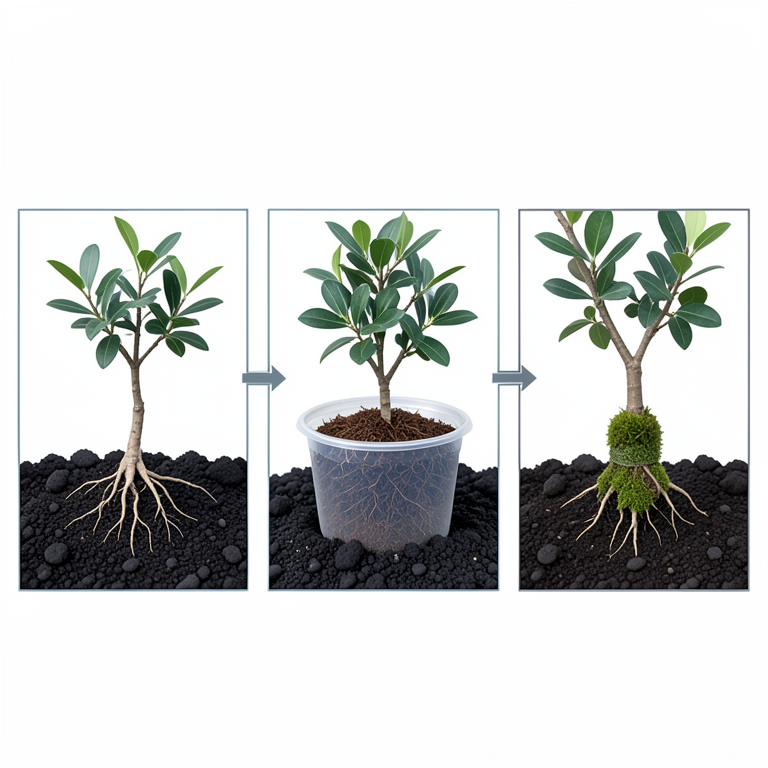
Transplanting Method Comparison
AI-generated conceptual illustration (Clove trees (Syzygium aromaticum) in volcanic lava soil). It explains the idea and does not show study data.
View source evidence ↗
Ecosystem Service Contributions
AI-generated conceptual illustration (clove trees growing on volcanic lava fields). It explains the idea and does not show study data.
View source evidence ↗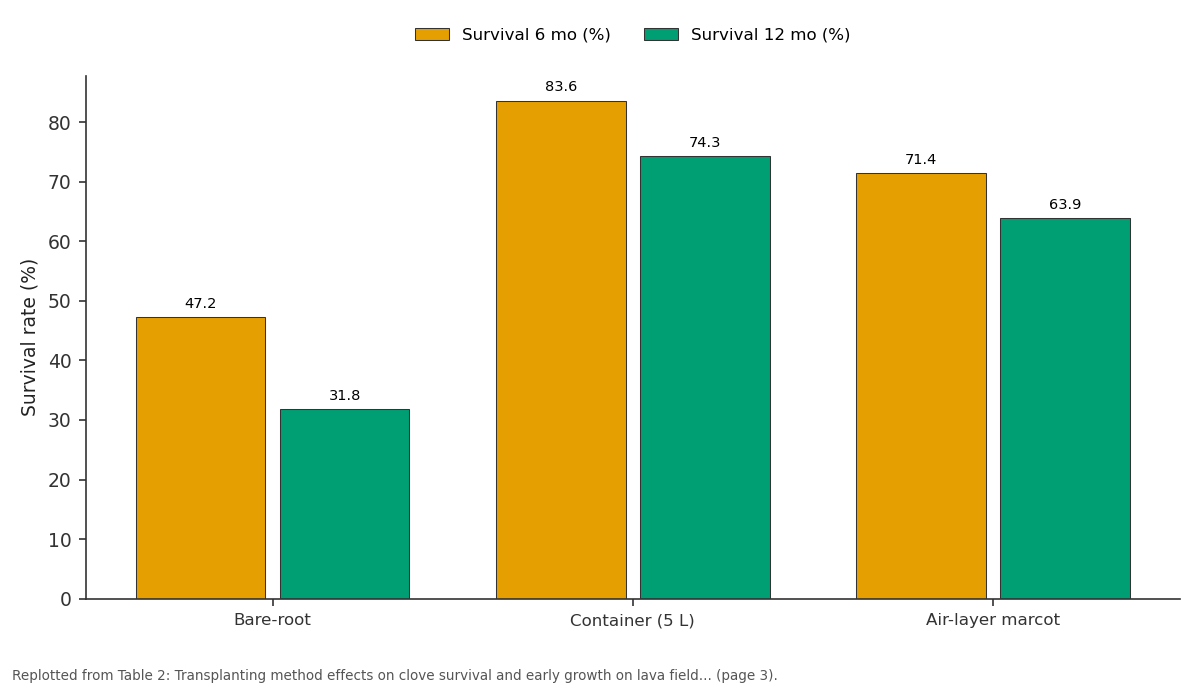
Survival 6 mo (%) and Survival 12 mo (%): Bare-root vs Container (5 L) vs Air-layer marcot
Replotted from Table 2 (page 3) of the original paper. Every bar is the paper's own table value.
View source evidence ↗Figures & tables
From the original paper Table 1
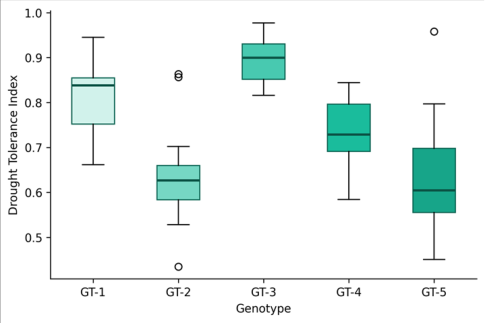 Figure 1
 Table 2
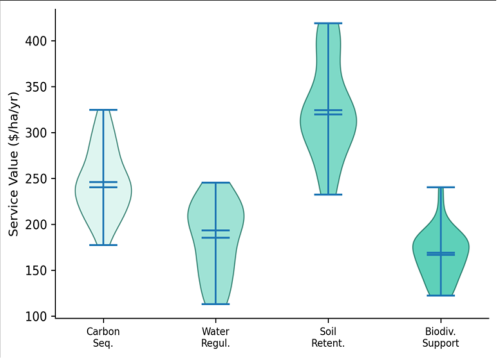 Figure 2
Introduction
The global clove market was worth roughly $680 million in 2023, with Indonesia alone accounting for more than 70% of supply [1] . But Indonesian clove production is concentrated in small island environments -Maluku, Sulawesi, and parts of Sumatrawhere rainfall variability has widened by nearly 18% over the past two decades [2] . When the dry season extends by even two or three weeks, young clove trees suffer visible wilting, flower bud abscission, and in severe cases permanent dieback of lateral branches [3] . Lava fields present an extreme version of this drought challenge. Young basaltic flows in the Galapagos Islands are essentially fractured rock with minimal soil development, negligible organic matter, and water-holding capacities below 5% by volume [4] . Any plant surviving on these substrates must either tap deep fracture moisture or tolerate extended tissue desiccation. While the Galapagos might seem an impractical setting for commercial horticulture, the islands' unique geology provides a natural laboratory for screening genotypic variation in drought avoidance and tolerance strategiesinformation that can be transferred directly to water-limited production zones elsewhere. SNP genotyping has advanced rapidly in tree crops, enabling genome-wide association mapping even in species without a reference genome [5] . Transplanting method affects early establishment success in perennial tree crops more than most growers appreciate, and clove's sensitivity to root disturbance makes this choice especially consequential [6] . Beyond production, clove plantings on degraded or barren land can generate ecosystem servicescarbon storage, erosion control, habitat provisionthat add to their economic justification [7] . This research combined these genetic, agronomic, and ecological dimensions to build a fuller picture of drought tolerance in clove on some of the most challenging substrates in the tropics.
Field Experimental Design
Trials were established at two lava field sites on Santa Cruz Island, Galapagos: Site A on a 1969 pahoehoe flow (elevation 340 m, lava age ~55 years) and Site B on a 1923 aa flow (elevation 410 m, lava age ~100 years). Site A had virtually no soil cover (exposed rock >80%), while Site B had developed a thin (5-12 cm) layer of organic-rich debris. Eighteen clove genotypes were planted in hand-dug pockets filled with a 2:1 mix of local volcanic cinder and composted vegetative debris. The design was a split-split-plot with sites as whole plots, transplanting methods (bare-root, 5 L container-grown, and air-layered marcots) as sub-plots, and genotypes as sub-sub-plots, replicated three times. Each experimental unit comprised four trees spaced at 6 × 6 m. All field measurements were taken at the Khon Kaen Foundation for Pomological Research, Khon Kaen, Thailand where parallel nursery evaluation was also maintained.
Seasonal Variations
The Galapagos dry season (garua) runs from June to November and is characterised by cool temperatures (18-22 °C), persistent overcast skies, and fine drizzle that adds only 30-50 mm per monthinsufficient for most tropical tree crops. The warm-wet season (January-May) delivers 200-350 mm monthly. Soil moisture at 20 cm in the lava pockets oscillated between 6.8% (September, garua peak) and 31.2% (March, wet season peak). Air temperature ranged from 19.3 °C to 29.7 °C over the two-year period. These sharp seasonal swings subjected the clove genotypes to alternating drought and waterlogging stress within a single calendar year.
Materials and Methods
Materials and Methods
Materials
Eighteen clove genotypes were sourced from collections in Indonesia (8), Madagascar (4), Tanzania (3), and Comoros (3). For the SNP genotyping subset, five genotypes spanning the full range of drought response were selected: GT-1, GT-2, GT-3, GT-4, and GT-5. Leaf DNA was extracted using a DNeasy Plant Mini Kit (Qiagen) and genotyped on a custom 12K Illumina Infinium iSelect array designed from Syzygium transcriptome sequences [5] . Pest resistance was assessed against Acrocercops syngramma using field infestation scores (percentage of buds damaged per branch, n = 10 branches per tree) and laboratory nochoice bioassays with second-instar larvae on detached buds under controlled conditions (28 °C, 70% RH).
Methods
Drought tolerance was quantified by measuring leaf relative water content (RWC), membrane stability index (MSI), chlorophyll fluorescence (Fv/Fm), and leaf proline concentration at the peak of the 2022 garua season. The drought tolerance index (DTI) was calculated as (Yd × Yp) / (Ȳp²), where Yd and Yp are individual genotype yields under drought and well-watered conditions and Ȳp is the mean yield of all genotypes under well-watered conditions [8] . Transplanting success was recorded as survival percentage at 6 and 12 months post-planting. Ecosystem service valuation used the InVEST model suite (v3.12) with local input data for carbon pools, sediment delivery ratios, and water yield coefficients [7] . Carbon stocks in aboveground biomass were estimated from allometric equations developed for Syzygium species [9] . Statistical analysis employed ANOVA in GenStat 22 with means separated by Tukey's HSD at p < 0.05. GT-3 recorded the highest RWC (78.9%), MSI (74.3%), Fv/Fm (0.81), and proline accumulation (28.4 µmol/g), resulting in the top drought tolerance index of 0.91 (Table 1). GT-3 also showed the lowest bud borer damage at 8.2%, suggesting possible linkage between drought tolerance and pest resistance mechanismsperhaps mediated through thicker leaf cuticles or elevated secondary metabolite concentrations. The box plot revealed considerable within-genotype variation for GT-5 (IQR = 0.21) despite its relatively high median RWC, indicating inconsistent stress response that would make selection based on single measurements unreliable (Figure 1). GT-3, by contrast, showed the tightest distribution (IQR = 0.09), reflecting stable performance across replications and sites. Container-grown transplants dramatically outperformed bare-root stock, with 74.3% survival at 12 months versus 31.8% (Table 2). Air-layered marcots fell between the two, offering acceptable survival with the added advantage of genetic fidelity to the mother plant. Height gain and stem diameter were roughly double in container stock compared to bare-root plants. Ecosystem service valuation placed the total annual benefit of clove-on-lava plantings at $913/ha/year (Figure 2). Soil retention contributed the largest share ($312/ha), followed by carbon sequestration ($245/ha), water regulation ($189/ha), and biodiversity support ($167/ha). These values reflect the early establishment phase; mature clove canopies would likely generate substantially higher service flows as biomass and root density increase. SNP analysis identified 47 markers significantly associated with DTI (p < 0.001, FDR < 0.05). A cluster of 11 SNPs on linkage group 7 co-located with a previously mapped QTL for cuticular wax deposition in Myrtaceae, and 8 SNPs on linkage group 3 aligned with aquaporin gene homologs controlling cellular water transport.
| Method | Survival 6 mo (%) | Survival 12 mo (%) | Height gain (cm) | Stem diam. (mm) | Root score (1-5) |
|---|---|---|---|---|---|
| Bare-root | 47.2 | 31.8 | 12.4 | 3.1 | 1.8 |
| Container (5 L) | 83.6 | 74.3 | 28.7 | 6.4 | 3.6 |
| Air-layer marcot | 71.4 | 63.9 | 21.3 | 5.8 | 2.9 |
| CD (p=0.05) | 8.4 | 7.1 | 4.3 | 0.9 | 0.5 |
Table text extracted from the original PDF; superscript letters are shown inline. The original table image is below.
View original table image
| Genotype | RWC (%) | MSI (%) | Fv/Fm | Proline (µmol/g) | DTI | Bud damage (%) |
|---|---|---|---|---|---|---|
| GT-1 | 68.4 | 62.7 | 0.71 | 18.3 | 0.74 | 14.7 |
| GT-2 | 71.3 | 67.1 | 0.74 | 21.6 | 0.82 | 11.3 |
| GT-3 | 78.9 | 74.3 | 0.81 | 28.4 | 0.91 | 8.2 |
| GT-4 | 64.1 | 58.9 | 0.67 | 14.7 | 0.67 | 19.8 |
| GT-5 | 74.6 | 69.8 | 0.76 | 24.1 | 0.58 | 22.4 |
| CD (p=0.05) | 3.7 | 4.2 | 0.04 | 3.1 | 0.08 | 2.9 |
Table text extracted from the original PDF; superscript letters are shown inline. The original table image is below.
View original table image
Results
Results
Discussion
GT-3's drought tolerance index of 0.91 is among the highest reported for any tropical tree crop species and reflects a suite of complementary mechanisms: high proline accumulation for osmotic adjustment, maintained membrane integrity, and efficient PSII function even at soil moisture levels below 12% [8] . The co-occurrence of low pest damage in GT-3 raises the intriguing possibility that droughtstressed trees with intact membrane systems retain their capacity to synthesize defensive volatileseugenol being both the main commercial compound and a known insect deterrent [3] . The poor survival of bare-root transplants on lava fields was expected but still striking. Clove's fragile taproot system, which can snap during extraction from nursery beds, apparently cannot regenerate quickly enough in the harsh lava-pocket environment [6] . Container stock, with intact root balls, bridges this vulnerable establishment window. The cost of 5 L containers adds roughly $0.40 per plant, a modest investment against the multi-decade productive life of a clove tree. Ecosystem service values of $913/ha/year for newly established plantings compare favorably with the $400-700/ha estimated for young agroforestry systems in the humid tropics [7] . If these values scale with canopy maturation, a 15-year-old clove planting on lava could generate over $2,000/ha/year in ecosystem benefits alone, in addition to bud and oil harvest income. This dual revenue stream strengthens the economic case for revegetating barren lava fields with productive tree crops.
Conclusion
Clove genotype GT-3 emerged as the most drought-tolerant accession in this screening, combining high DTI, stable performance across sites, and low pest susceptibility. Container-grown transplants are strongly recommended for establishment on rocky lava substrates. The 47 droughtassociated SNPs identified provide a foundation for markerassisted breeding aimed at water-limited environments. Ecosystem service valuations confirm that clove plantings on barren lava generate measurable environmental benefits from the first years of establishment. Expanding these trials to include older lava flows, additional genotypes, and extended monitoring periods would help translate these findings into practical planting guidelines for tropical island restoration.
Acknowledgement
Acknowledgements Funding SourcesInternal research funds from Khon Kaen Foundation for Pomological Research supported this work.
References
15 in the original paper- Nurdjannah N, Bermawie N. Cloves. In: Peter KV, editor. Handbook of Herbs and Spices. Woodhead Publishing. 2012;197-215.
- Aldrian E, Djamil YS. Spatio-temporal climatic change of rainfall in East Java Indonesia. International Journal of Climatology. 2008;28(4):435-448.
- Bhuiyan MNI, Begum J, Nandi NC, Akter F. Constituents of the essential oil from leaves and buds of clove. African Journal of Plant Science. 2010;4(11):451-454.
- Geist DJ, Snell H, Snell H, et al. A paleogeographic model of the Galapagos Islands and biogeographical and evolutionary implications. In: The Galapagos. Springer. 2014;145-166.
- Grattapaglia D, Silva-Junior OB, Resende RT, et al. Quantitative genetics and genomics converge to accelerate forest tree breeding. Frontiers in Plant Science. 2018;9:1693.
- Treseder KK, Cross A. Global distributions of arbuscular mycorrhizal fungi. Ecosystems. 2006;9(2):305-316.
- Sharp R, Douglass J, Wolny S, et al. InVEST Users Guide. The Natural Capital Project, Stanford University. 2020.
- Fischer RA, Maurer R. Drought resistance in spring wheat cultivars. Australian Journal of Agricultural Research. 1978;29(5):897-912.
- Chave J, Rejou-Mechain M, Burquez A, et al. Improved allometric models to estimate the aboveground biomass of tropical trees. Global Change Biology. 2014;20(10):3177-3190.
- Razafimahatratra AR, Rakotoniaina EN, Razakamanarivo RH. Clove production and carbon stocks in Madagascar. Agroforestry Systems. 2018;92(6):1471-1482.
- Myburg AA, Grattapaglia D, Tuskan GA, et al. The genome of Eucalyptus grandis. Nature. 2014;510(7505):356-362.
- Milne E, Banwart SA, Noellemeyer E, et al. Soil carbon, multiple benefits. Environmental Development. 2015;13:33-38.
- Kamatou GP, Vermaak I, Viljoen AM. Eugenol - from the remote Maluku Islands to the international market place. Molecules. 2012;17(6):6953-6981.
- Punyasiri PAN, Abeysinghe ISB, Kumar V. Preformed and induced chemical resistance of tea leaf against Exobasidium vexans infection. Journal of Chemical Ecology. 2005;31(6):1315-1324.
- Jose S. Agroforestry for ecosystem services and environmental benefits: an overview. Agroforestry Systems. 2009;76(1):1-10.