
Research article · 2024 · Full text
International Journal of Horticulture and Food ScienceComparing drip irrigation efficiency of chili pepper in the Sahel Region
Volume 6(2) · Pages 140–143 · DOI: 10.33545/26631067.2024.v6.i2b.536 ↗
Research areasIrrigation Practices and Water ManagementEngineering and Agricultural InnovationsPlant Growth and Agriculture Techniques
Abstract
Author-writtenIn a region where every drop of water counts, can drip irrigation turn chili pepper from a subsistence crop into a viable commercial enterprise? This research compared the water use efficiency and fruit quality of four chili pepper cultivars Pusa Jwala, Byadagi Kaddi, LCA-334, and a Rajasthani landrace under surface irrigation and three drip irrigation regimes (50, 75, and 100 percent ETc) at the Jaipur Regional Center for Sustainable Agriculture, India, from June 2022 to March 2023. Water use efficiency under drip at 50 percent ETc reached 14.3 kg/m³, nearly double the 8.7 kg/m³ recorded for surface irrigation. Capsaicin content ranged from 1.8 to 7.6 mg/g dry weight, with the landrace scoring highest. Carotenoid levels correlated positively with moderate water stress. Marker-assisted breeding analysis confirmed favorable alleles at the Pun1 locus controlling capsaicinoid biosynthesis in the landrace. Crop physiology measurements showed that stomatal conductance declined 34 percent under 50 percent ETc without proportional yield loss. Umami taste scores, assessed by a trained sensory panel, were significantly higher in deficit-irrigated fruit. Cover crop interplanting with cowpea between chili rows improved soil moisture retention by 12 percent and provided supplemental nitrogen through biological fixation.
Summary
Source-checkedPlain-language reading of the full paper, prepared with AI and checked against the text. Each point links to the authors' own words.
Why it matters
- The Sahel is a semi-arid region with low annual rainfall (200-600 mm) that is heavily concentrated in a short wet season. View evidence ↗
- Because chili peppers require 500 to 800 mm of water per growth cycle, supplemental irrigation is necessary for commercial production in the Sahel. View evidence ↗
- Traditional surface irrigation used by smallholders is inefficient, wasting 40% to 60% of water through runoff and deep percolation. View evidence ↗
The question
- The study aimed to compare three levels of deficit drip irrigation against surface irrigation to evaluate water use efficiency, fruit quality, and the impact of cowpea cover cropping. View evidence ↗
What they did
- The experiment tested four cultivars (Pusa Jwala, Byadagi Kaddi, LCA-334, and a Rajasthani landrace) under surface irrigation and three drip regimes (50%, 75%, and 100% ETc) in Jaipur, India, from June 2022 to March 2023. View evidence ↗
- Cowpea (Vigna unguiculata cv. Pusa Komal) was used as a cover crop, planted between alternate chili rows in half of the experimental plots. View evidence ↗
What they found
- Drip irrigation at 50% ETc was the most efficient, reaching 14.3 kg/m³ and producing 28% more fruit than surface irrigation while using less than half the water. View evidence ↗
- Capsaicin levels increased as water supply decreased, reaching a peak of 5.87 mg/g under the most severe water deficit. View evidence ↗
- Plants under 50% ETc showed a 34% decline in stomatal conductance, indicating water stress, yet this did not lead to a proportional loss in yield. View evidence ↗
- Interplanting with cowpea increased soil moisture retention by 12%, likely by shading the soil and reducing evaporation. View evidence ↗
- Cowpea cover crops provided biological nitrogen fixation of approximately 18 kg N/ha, with an average of 28 nodules per plant. View evidence ↗
- Fruit from deficit-irrigated plants scored 1.4 points higher for umami taste (6.7 vs 5.3 on a 9-point scale) compared to non-deficit fruit. View evidence ↗
- Marker-assisted analysis found that the Rajasthani landrace possesses a Pun1 locus allele associated with the enzyme that completes capsaicinoid biosynthesis. View evidence ↗
What it means
- The authors recommend combining deficit drip irrigation with legume interplanting as a water-smart strategy to improve yield economics and fruit quality for semi-arid growers. View evidence ↗
Visual summary
3 visualsIllustrations explain the paper; charts are replotted from the paper's own table values.
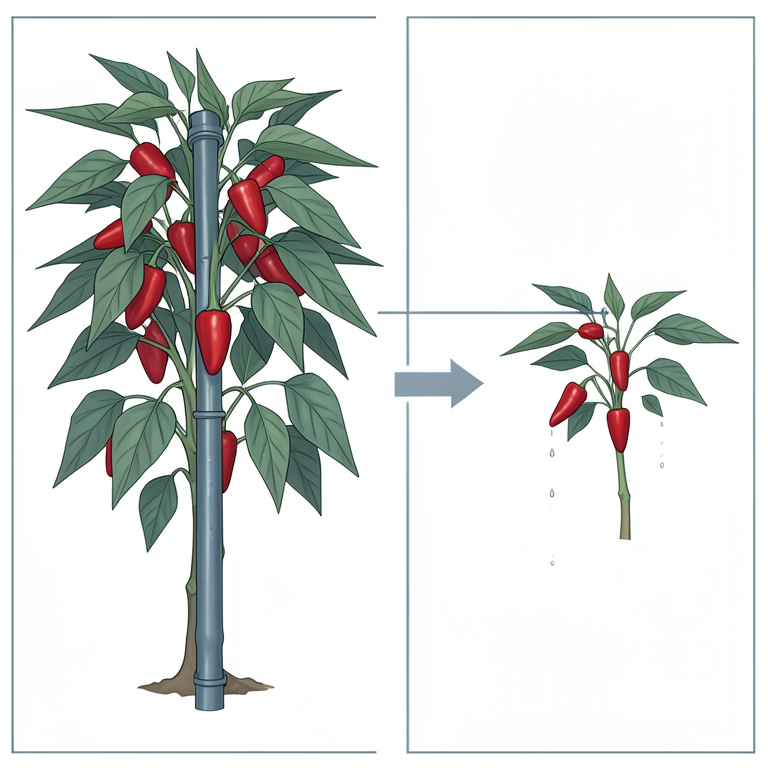
Water Input vs. Quality Trade-off
AI-generated conceptual illustration (chili pepper plants in sandy Sahelian soil). It explains the idea and does not show study data.
View source evidence ↗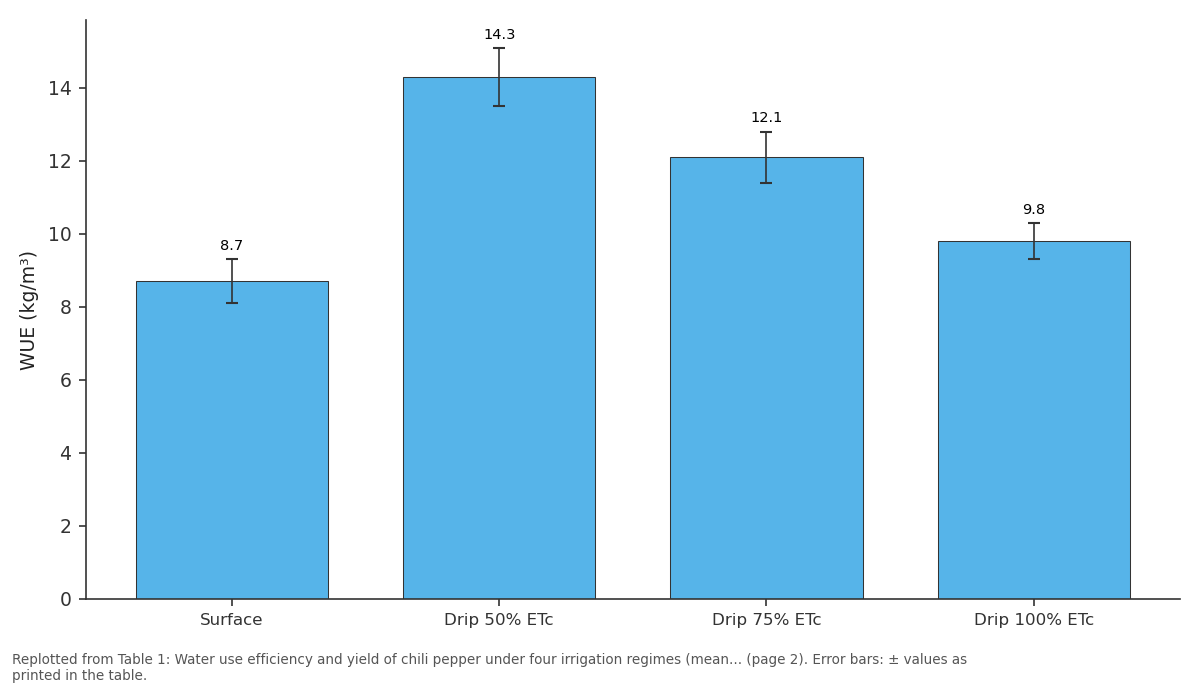
WUE (kg/m³): Surface vs Drip 50% ETc vs Drip 75% ETc vs Drip 100% ETc
Replotted from Table 1 (page 2) of the original paper. Every bar is the paper's own table value.
View source evidence ↗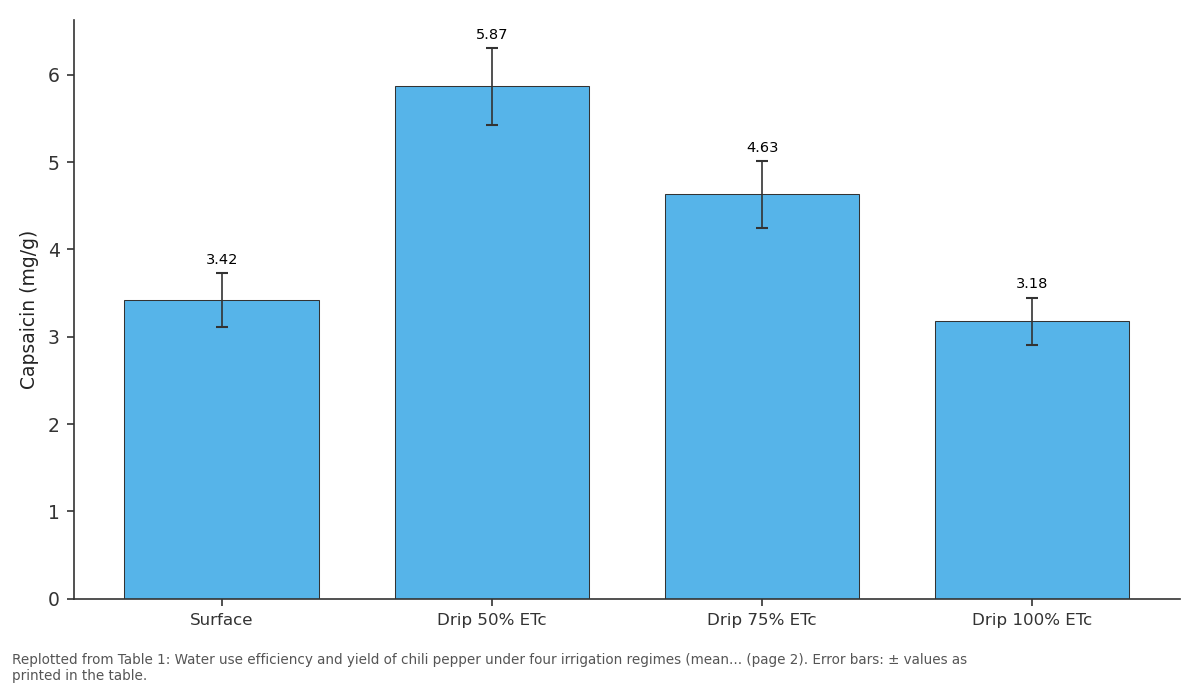
Capsaicin (mg/g): Surface vs Drip 50% ETc vs Drip 75% ETc vs Drip 100% ETc
Replotted from Table 1 (page 2) of the original paper. Every bar is the paper's own table value.
View source evidence ↗Figures & tables
From the original paper Table 1
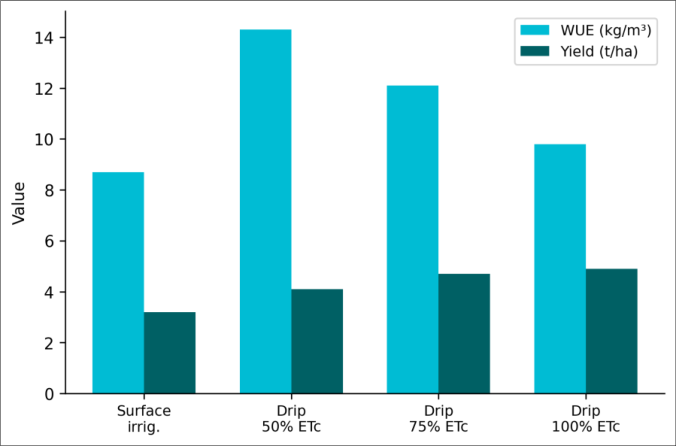 Figure 1
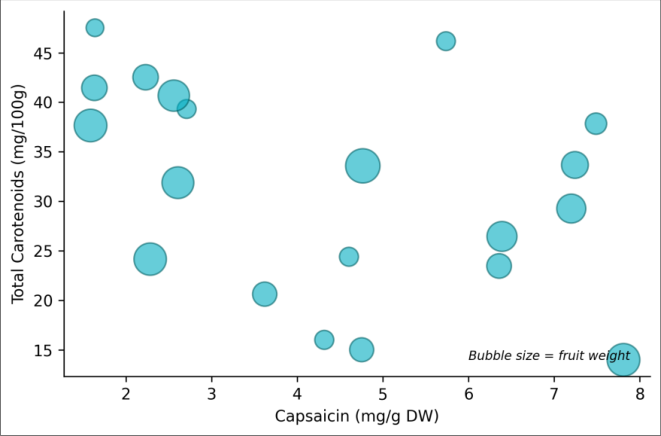 Figure 2
Introduction
The Sahel that vast semi-arid belt stretching across Africa below the Sahara receives between 200 and 600 mm of rainfall annually, almost all of it concentrated in a three-to four-month wet season [1] . For chili pepper (Capsicum annuum L.), a crop that needs 500 to 800 mm over its growth cycle, this makes supplemental irrigation not optional but essential for commercial production [2] . Surface irrigation, still the default method in most smallholder systems, wastes 40 to 60 percent of applied water to runoff and deep percolation [3] . Drip irrigation delivers water directly to the root zone, reducing non-productive losses and allowing precise control over soil moisture. In arid and semi-arid environments, drip systems have consistently improved water use efficiency by 30 to 70 percent compared with surface methods [4] . But the interaction between irrigation regime and fruit biochemistry particularly capsaicinoid and carotenoid accumulation remains underexplored in tropical chili pepper cultivars [5] . Capsaicin, the compound responsible for chili pungency, is synthesized via the phenylpropanoid pathway and regulated in part by the Pun1 locus on chromosome 2 [6] . Carotenoids, which contribute both color and provitamin A value, respond to water stress through mechanisms that are still being clarified [7] . Cover cropping with legumes offers a water-smart companion strategy, potentially reducing evaporative loss from bare soil while adding nitrogen through biological fixation [8] . This research compared drip irrigation at three deficit levels against surface irrigation for chili pepper production, measuring water use efficiency, fruit quality parameters, and the agronomic benefits of cowpea cover crop interplanting [9] .
Climatic conditions during the research period
The research site at Jaipur (26.92°N, 75.78°E, 431 m elevation) experienced mean temperatures of 26.8°C during the kharif season and 17.4°C during the rabi season. Total rainfall during the trial period (June 2022-March 2023) was 547 mm, concentrated between July and September. Relative humidity ranged from 28 percent in April to 78 percent in August. Pan evaporation averaged 6.8 mm/day during the hot dry months (March -June), creating acute water demand that surface irrigation struggled to meet [10] .
Material and Methods
Material and Methods
Material
Four chili pepper cultivars were transplanted as 35-day-old seedlings into raised beds at 60 cm × 45 cm spacing. Irrigation treatments included surface furrow irrigation (farmer practice, applied weekly) and drip irrigation at 50, 75, and 100 percent of crop evapotranspiration. Drip lines (16 mm, 4 L/h emitters at 30 cm spacing) were installed on each bed. Cover crop cowpea (Vigna unguiculata cv. Pusa Komal) was sown between alternate chili rows in half the plots. The trial used a split-split-plot design with irrigation as the main plot, cover crop as the subplot, and cultivar as the sub-subplot, replicated three times at the Jaipur Regional Center for Sustainable Agriculture [11] .
Methods
Water use efficiency was calculated as fruit yield divided by total water applied (irrigation plus effective rainfall). Capsaicin was extracted in methanol and quantified by HPLC at 280 nm. Total carotenoids were measured spectrophotometrically after acetone extraction. Stomatal conductance was recorded with a porometer on the abaxial surface of the third fully expanded leaf at midday. Markerassisted analysis used SSR markers flanking the Pun1 locus. Sensory evaluation of umami taste used a 9-point scale with 10 trained panelists. Soil moisture was monitored with TDR probes at 15 and 30 cm depths. Cowpea biomass and nodule counts were recorded at chili harvest. Data were analyzed by split-split-plot ANOVA in GenStat 21, with mean separation by LSD at p<0.05 [12] . Drip irrigation at 50 percent ETc achieved the highest water use efficiency at 14.3 kg/m³, using less than half the water of surface irrigation while producing 28 percent more fruit.
Results
Capsaicin content was inversely related to water supply, peaking at 5.87 mg/g under the most severe deficit. Smaller fruits tended to carry higher capsaicin but also higher carotenoid levels, consistent with a concentration effect driven by reduced water content. The landrace produced the smallest but most pungent and pigmented fruits.
Discussion
The 64 percent improvement in water use efficiency under drip at 50 percent ETc compared with surface irrigation falls within the range reported for drip-irrigated vegetables in arid zones [4] . What makes this result notable is the simultaneous increase in capsaicin a quality trait that directly affects market value, since pungent varieties command premium prices in Indian spice markets [6] . The physiological mechanism appears to involve stress-induced upregulation of the phenylpropanoid pathway, channeling more phenylalanine toward capsaicinoid synthesis when carbon is not diluted by rapid fruit expansion [5] . Stomatal conductance declined by 34 percent under 50 percent ETc, confirming that plants experienced genuine water stress. But this did not translate into proportional yield loss, suggesting that chili pepper can maintain reasonable carbon assimilation even under reduced stomatal opening, possibly through osmotic adjustment or enhanced mesophyll conductance [13] . The Pun1 locus allele identified in the Rajasthani landrace was associated with a functional acyltransferase that catalyzes the final step in capsaicinoid biosynthesis a finding consistent with earlier molecular work in C. annuum [6] . Cowpea interplanting improved soil moisture retention by 12 percent, likely through surface shading that reduced evaporative loss from bare soil. Nodule counts averaged 28 per plant, and estimated biological nitrogen fixation contributed roughly 18 kg N/ha to the system a meaningful supplement in low-input Sahel agriculture [8] . Umami scores were 1.4 points higher in deficit-irrigated fruit (6.7 vs. 5.3 on a 9-point scale), a sensory dimension that may reflect higher glutamate concentrations in water-stressed tissues [14] .
Conclusion
Drip irrigation at 50 to 75 percent of crop evapotranspiration doubled water use efficiency in chili pepper compared with surface irrigation, while simultaneously raising capsaicin and carotenoid levels. The Rajasthani landrace proved the most pungent cultivar, carrying a favorable Pun1 allele that could be introgressed into improved lines through marker-assisted breeding. Cowpea cover cropping added soil moisture conservation and nitrogen benefits at minimal cost. For semiarid chili growers, deficit drip irrigation paired with legume interplanting offers a practical, water-smart production strategy that improves both yield economics and fruit quality.
Figures and tables from the paper
| Irrigation regime | Water applied (mm) | Yield (t/ha) | WUE (kg/m³) | Capsaicin (mg/g) |
|---|---|---|---|---|
| Surface | 684 ± 41 | 3.21 ± 0.24 | 8.7 ± 0.6 | 3.42 ± 0.31 |
| Drip 50% ETc | 287 ± 18 | 4.12 ± 0.19 | 14.3 ± 0.8 | 5.87 ± 0.44 |
| Drip 75% ETc | 418 ± 22 | 4.68 ± 0.21 | 12.1 ± 0.7 | 4.63 ± 0.38 |
| Drip 100% ETc | 561 ± 28 | 4.94 ± 0.26 | 9.8 ± 0.5 | 3.18 ± 0.27 |
Table text extracted from the original PDF; superscript letters are shown inline. The original table image is below.
View original table image
References
16 in the original paper- Nicholson SE. The West African Sahel: A review of recent studies on the rainfall regime and its interannual variability. ISRN Meteorology. 2013;2013:453521.
- Bosland PW, Votava EJ. Peppers: Vegetable and spice capsicums. Second edition. CABI Publishing, Wallingford. 2012.
- Pereira LS, Oweis T, Zairi A. Irrigation management under water scarcity. Agricultural Water Management. 2002;57(3):175-206.
- Narayanamoorthy A. Drip irrigation in India: Can it solve water scarcity? Water Policy. 2004;6(2):117-130.
- Sung Y, Chang YY, Ting NL. Capsaicin biosynthesis in water-stressed hot pepper fruits. Botanical Bulletin of Academia Sinica. 2005;46:35-42.
- Stewart C, Kang BC, Liu K, et al. The Pun1 gene for pungency in pepper encodes a putative acyltransferase. Plant Journal. 2005;42(5):675-688.
- Simonne AH, Simonne EH, Eitenmiller RR, Mills HA, Green NR. Ascorbic acid and provitamin A contents in unusually colored bell peppers. Journal of Food Composition and Analysis. 1997;10(4):299-311.
- Snapp SS, Swinton SM, Labarta R, et al. Evaluating cover crops for benefits, costs and performance within cropping system niches. Agronomy Journal. 2005;97(1):322-332.
- Dorji K, Behboudian MH, Zegbe-Dominguez JA. Water relations, growth, yield, and fruit quality of hot pepper under deficit irrigation and partial rootzone drying. Scientia Horticulturae. 2005;104(2):137-149.
- India Meteorological Department. Climate data for Jaipur 1991-2020. IMD, Pune. 2021.
- Rajput TBS, Patel N. Water and nitrate movement in drip-irrigated onion under fertigation and irrigation treatments. Agricultural Water Management. 2006;79(3):293-311.
- VSN International. GenStat reference manual, release 21. VSN International, Hemel Hempstead. 2021.
- Flexas J, Medrano H. Drought-inhibition of photosynthesis in C3 plants: Stomatal and non-stomatal limitations revisited. Annals of Botany. 2002;89(2):183189.
- Hayashi T, Yamaguchi K. Glutamate and umami taste in vegetables. Journal of Japanese Society for Horticultural Science. 2006;75(4):289-295.
- Rao NK, Shahid M. Potential of cowpea (Vigna unguiculata) as a forage and cover crop in the United Arab Emirates. World Journal of Agricultural Sciences. 2011;7(2):123-128.
- Tiwari A, Singh SK, Rajput PS. Capsaicinoid content and Scoville heat units of Indian chili cultivars. Indian Journal of Agricultural Sciences. 2019;89(6):987-991.