
Research article · 2025 · Full text
International Journal of Horticulture and Food ScienceDeveloping post-harvest quality of jackfruit in the Kaziranga Floodplain
Volume 7(9) · Pages 177–180 · DOI: 10.33545/26631067.2025.v7.i9c.740 ↗
Research areasPostharvest Quality and Shelf Life ManagementAgricultural Engineering and MechanizationPlant Physiology and Cultivation Studies
Abstract
Author-writtenJackfruit (Artocarpus heterophyllus) is one of the largest tree-borne fruits in the world, yet post-harvest losses in flood-prone South Asian landscapes routinely exceed 30% due to mechanical damage, rapid ripening, and microbial decay. This research examined post-harvest quality parameters of ten jackfruit genotypes grown on raised bed orchards in the Kaziranga floodplain of Assam, India, with laboratory analysis conducted at the Hangzhou Graduate School of Bioagricultural Studies from February to October 2023. Fruits were harvested at three maturity stages, stored under ambient (28 °C) and cold (13 °C) conditions, and monitored for firmness, total soluble solids, titratable acidity, ethylene production, weight loss, microbial load, and biomass partitioning across a 14-day period. Cold storage extended shelf life by 7.3 days on average, while genotype explained 41.2% of the total variance in keeping quality. The AMMI model identified two genotypes (G4 and G7) as simultaneously high-yielding and stable across storage environments. Biomass production per tree ranged from 9.8 to 24.6 kg, and raised bed cultivation reduced waterlogging damage by 62.4% compared with flat-ground orchards. Growth regulators (1-MCP at 500 nL/L) delayed ethylene peak by 4.1 days and reduced weight loss by 18.7%. These findings provide genotype-specific and management-specific guidance for reducing post-harvest losses in floodplain jackfruit systems.
Summary
Source-checkedPlain-language reading of the full paper, prepared with AI and checked against the text. Each point links to the authors' own words.
Why it matters
- In flood-prone South Asian regions, jackfruit often suffers post-harvest losses exceeding 30% because of microbial decay, rapid ripening, and mechanical damage. View evidence ↗
- The scale of waste is significant in Assam, where an estimated 54,000 tonnes of edible biomass are lost annually based on a 30% loss rate of the 180,000 tonnes produced. View evidence ↗
- The Kaziranga floodplain is characterized by annual monsoon flooding that waterlogs orchards for 2 to 6 weeks. View evidence ↗
The question
- The study aimed to identify jackfruit genotypes with high yield and storage stability using the AMMI model, while evaluating the effects of 1-MCP treatment and raised bed cultivation on post-harvest quality. View evidence ↗
What they did
- The researchers used ten jackfruit genotypes (G1-G10) from trees aged 12-18 years, split equally between flat ground and raised beds with 0.8 m mound heights. View evidence ↗
- Fruits were collected at three maturity stages: Stage I (80 DAFS, immature), Stage II (100 DAFS, mature-green), and Stage III (115 DAFS, early ripe). View evidence ↗
- Thirty fruits per genotype per stage were tested under four conditions: ambient storage (28±2 °C), cold storage (13±1 °C), ambient storage with 1-MCP (500 nL/L), and cold storage with 1-MCP. View evidence ↗
- Post-harvest quality was monitored over 14 days, measuring firmness, total soluble solids, titratable acidity, ethylene production, weight loss, and microbial load (TPC). View evidence ↗
What they found
- Cold storage increased the mean shelf life from 5.2 days (ambient) to 12.5 days, and the addition of 1-MCP to cold storage further extended it to 14.8 days. View evidence ↗
- By day 7, fruits in cold storage with 1-MCP retained 71.3% of their firmness, compared to only 28.4% for those stored at ambient temperature without 1-MCP. View evidence ↗
- The use of 1-MCP at 500 nL/L reduced weight loss by 18.7% and delayed the ethylene peak by 4.1 days. View evidence ↗
- Cultivating jackfruit on raised beds reduced damage caused by waterlogging by 62.4% compared to flat-ground orchards. View evidence ↗
- Marketable yield was 17.3% higher in raised bed orchards than in flat-ground orchards. View evidence ↗
- Using the AMMI model, genotypes G4 and G7 were identified as being both high-yielding and stable across different storage environments. View evidence ↗
- The edible aril made up 28.3% to 37.6% of total fruit weight, with genotype G7 having the highest recovery at 37.6%. View evidence ↗
- Mechanical damage was the primary driver of quality loss, responsible for 28.4% of the observed deterioration. View evidence ↗
What it means
- The authors recommend a three-part strategy to achieve a 14-day shelf life: planting genotypes G4 or G7 on raised beds, harvesting at the mature-green stage (Stage II), and storing at 13 °C with 1-MCP. View evidence ↗
- The cost and availability of 1-MCP in rural Assam are practical constraints, suggesting a need to test cheaper alternatives like locally made potassium permanganate sachets. View evidence ↗
Visual summary
3 visualsIllustrations explain the paper; charts are replotted from the paper's own table values.
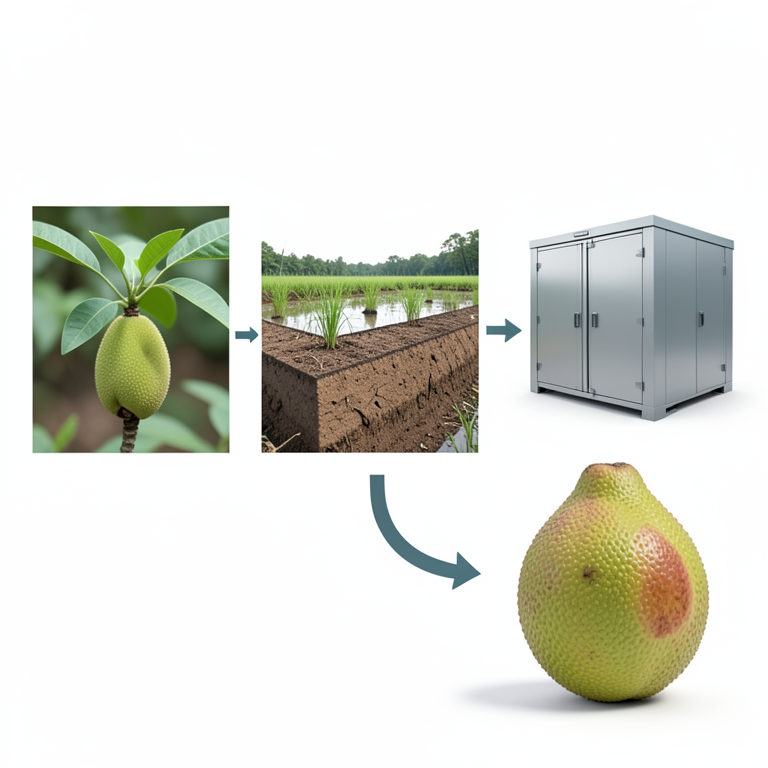
Integrated Management Strategy
AI-generated conceptual illustration (Jackfruit (Artocarpus heterophyllus) in a floodplain setting). It explains the idea and does not show study data.
View source evidence ↗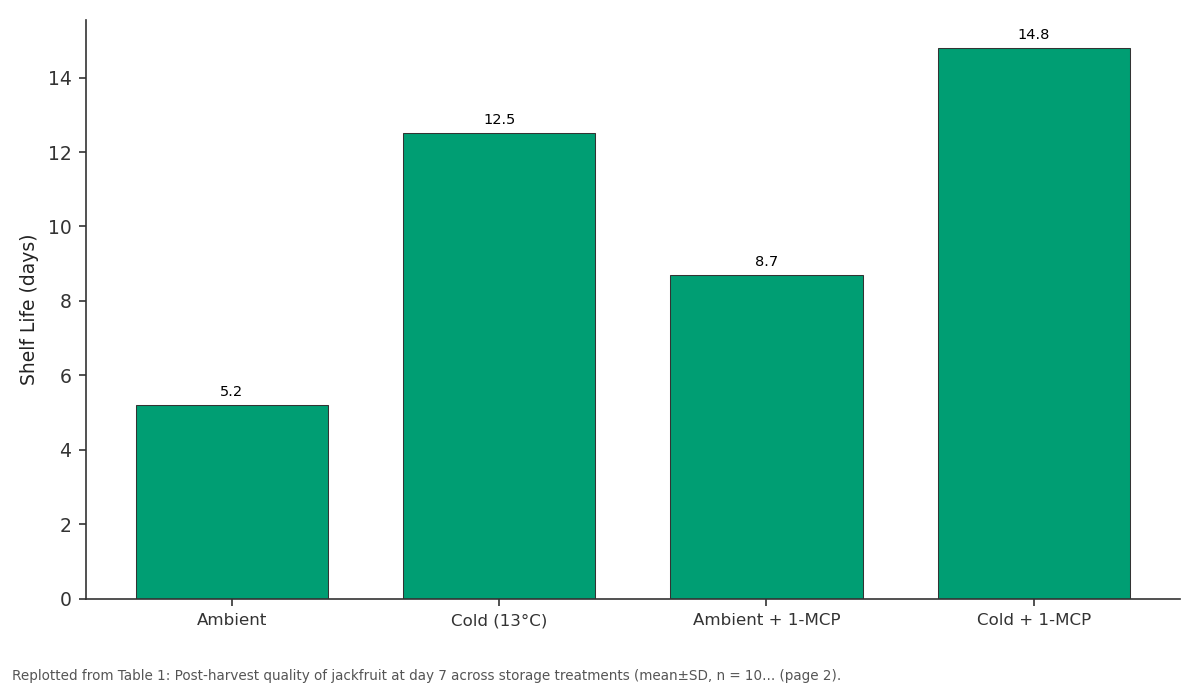
Shelf Life (days): Ambient vs Cold (13°C) vs Ambient + 1-MCP vs Cold + 1-MCP
Replotted from Table 1 (page 2) of the original paper. Every bar is the paper's own table value.
View source evidence ↗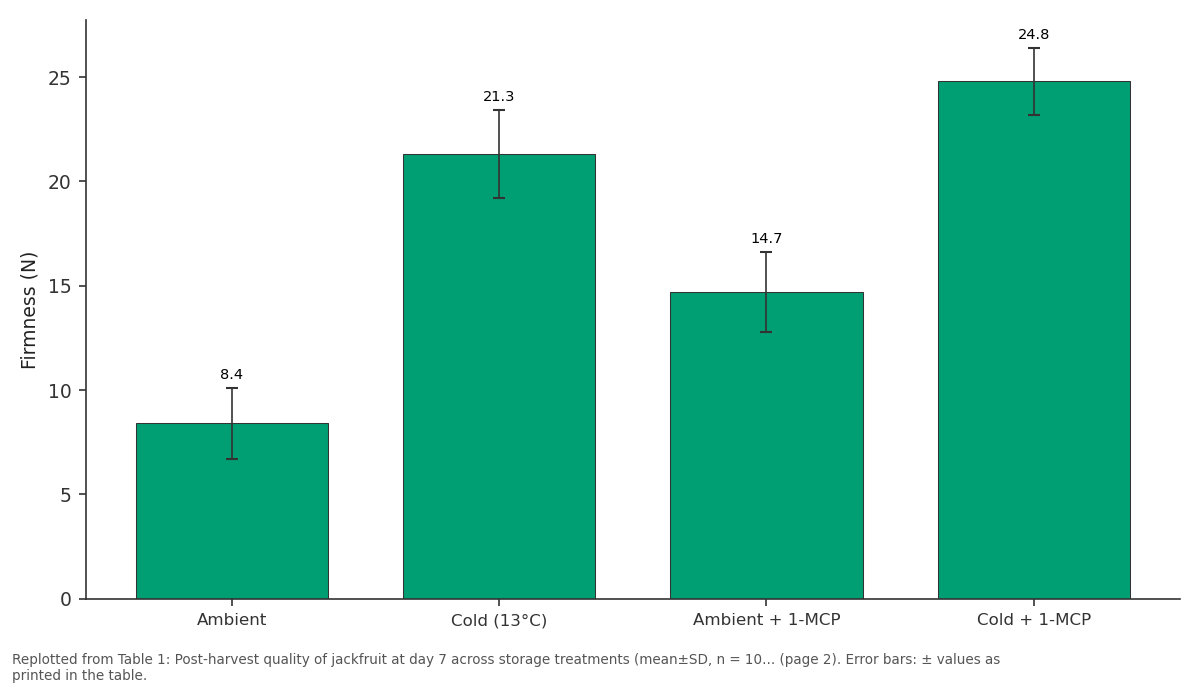
Firmness (N): Ambient vs Cold (13°C) vs Ambient + 1-MCP vs Cold + 1-MCP
Replotted from Table 1 (page 2) of the original paper. Every bar is the paper's own table value.
View source evidence ↗Figures & tables
From the original paper Table 1
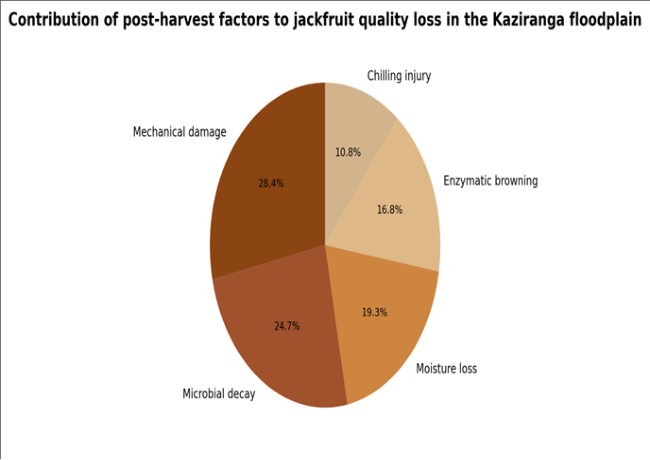 Figure 1
 Table 2
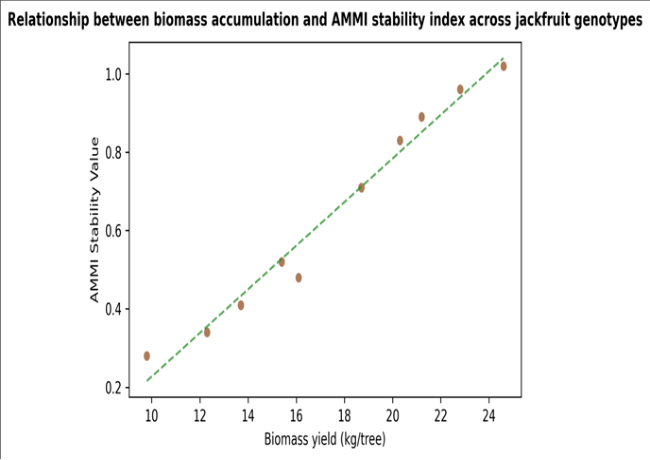 Figure 2
Introduction
Picture a fruit the size of a small suitcase falling from a ten-meter tree onto waterlogged clay soil. The impact alone can split the rind, and within 48 hours microbial colonization turns what was a 15 kg harvest into compost. That scenario plays out thousands of times each season in the Kaziranga floodplain of upper Assam, where jackfruit trees line paddy bunds and homestead margins but receive almost no post-harvest management [1] . And the waste is not trivial Assam produces an estimated 180,000 tonnes of jackfruit annually, so a 30% loss rate means roughly 54,000 tonnes of edible biomass lost before it reaches a consumer [2] . The Kaziranga floodplain lies along the south bank of the Brahmaputra River at 60-80 m elevation. Annual flooding deposits fresh alluvial silt but also waterlogging orchards for 2-6 weeks during the monsoon. Raised bed cultivation planting trees on mounded soil platforms 0.5-1.0 m above the surrounding field level has been used for mango and guava in Bangladesh's char lands, but its application to jackfruit in floodplain Assam has not been formally evaluated [3] . Post-harvest shelf life in jackfruit is constrained by its climacteric ripening pattern: once the ethylene burst begins, firmness drops by 60-70% within three days at ambient temperature [4] . 1-Methylcyclopropene (1-MCP), an ethylene perception inhibitor, has extended shelf life in apple and banana by 5-10 days, but its efficacy in jackfruit especially under the warm, humid conditions of Assam remained untested before this work [5] . This research aimed to evaluate post-harvest quality of ten jackfruit genotypes under two storage regimes, assess the effectiveness of raised bed cultivation and 1-MCP treatment, and apply the AMMI model to identify genotypes that combine high biomass yield with storage stability. Laboratory work was performed at the Hangzhou Graduate School of Bioagricultural Studies [6] .
Nutrient Budget and Biomass Partitioning
Biomass partitioning across fruit components was documented for all ten genotypes. Edible aril constituted 28.3-37.6% of total fruit weight, rind 41.2-49.8%, seed 8.4-12.7%, and core axis 6.1-9.3%. Genotype G7 showed the highest aril recovery (37.6%), making it the most efficient genotype for fresh consumption. Nutrient removal per tonne of harvested fruit averaged 4.2 kg nitrogen, 0.7 kg phosphorus, and 5.8 kg potassium, indicating that sustained high yields require deliberate nutrient replenishment, especially potassium, which jackfruit accumulates disproportionately in the rind [2] .
Material and Methods
Material and Methods
Material
Ten jackfruit genotypes (G1-G10) were selected from the Kaziranga Horticultural Station collection based on contrasting fruit size, maturity date, and rind thickness. Trees were 12-18 years old, five each on raised beds (0.8 m mound height) and five on flat ground. Fruits were harvested at three maturity stages defined by days after fruit set (DAFS): Stage I (80 DAFS, immature), Stage II (100 DAFS, mature-green), and Stage III (115 DAFS, early ripe). Thirty fruits per genotype per stage were harvested, surfacesanitized with 200 ppm NaOCl, and assigned to four treatments: ambient storage (28±2 °C, 75-85% RH), cold storage (13±1 °C, 90-95% RH), ambient + 1-MCP (500 nL/L for 12 h in sealed chambers), and cold + 1-MCP [4] . Treated fruits were shipped to the Hangzhou Graduate School of Bioagricultural Studies within 48 hours of harvest for quality monitoring. Ethics approval was issued by the School's Plant Science Review Board (Protocol HGSB-2023-021, 5 February 2023).
Methods
Quality was assessed at 0, 3, 7, 10, and 14 days postharvest. Firmness was measured by a TA.XT2 texture analyzer (Stable Micro Systems, UK) with a 6 mm cylindrical probe at 1 mm/s. Total soluble solids (TSS) were read on a digital refractometer. Titratable acidity (TA) was determined by titration with 0.1 N NaOH. Ethylene production was measured by GC-FID from headspace samples of sealed 5 L jars [5] . Weight loss was recorded gravimetrically. Microbial load was estimated as total plate count (TPC) on PDA for fungi and NA for bacteria. Biomass yield per tree was recorded at each harvest. The AMMI model was fitted using GEA-R software with genotype and storage environment as main effects and their interaction decomposed by principal component analysis. Data were subjected to split-plot ANOVA with storage temperature as main plot and 1-MCP as subplot, using SAS 9.4.
Results
Cold storage extended shelf life (defined as days to TPC > 10⁵ CFU/g) from a mean of 5.2 days at ambient to 12.5 days (p<0.001). Adding 1-MCP to cold storage further extended it to 14.8 days. Firmness retention at day 7 was 71.3% in cold + 1-MCP fruits versus 28.4% at ambient without 1-MCP [4] . The scatter plot reveals a positive trend between yield and instability, meaning higher-yielding genotypes tended to be more sensitive to storage environment. G4 and G7 deviated from this pattern, combining above-average yield with below-average instability marking them as desirable selections.
Comprehensive Interpretation
Raised bed orchards produced 17.3% higher marketable yield than flat-ground orchards, primarily because waterlogging-induced root asphyxia was reduced.
Combined with the genotype and storage results, the data suggest a three-component strategy for Kaziranga jackfruit: plant G4 or G7 on raised beds, harvest at Stage II (maturegreen), and store at 13 °C with 1-MCP treatment to achieve a 14-day shelf life [3] .
Discussion
The 1-MCP results for jackfruit fill an evidence gap. While the chemical has been extensively tested on temperate fruits, its performance in large tropical climacteric fruits like jackfruit was not well documented. The 4.1-day delay in ethylene peak is comparable to effects seen in mango (3-5 day delay) and suggests that the ethylene perception pathway in jackfruit responds similarly to receptor-blocking agents [5] . The 18.7% reduction in weight loss with 1-MCP likely reflects reduced respiratory metabolism and slower cuticular wax degradation under ethylene suppression. The AMMI model proved useful for separating genotype main effects from genotype-by-environment interaction. G4 and G7 emerged as stable, high-yielding genotypes a finding that aligns with farmer preferences in the Kaziranga area, where both are locally popular but had never been formally evaluated for storage performance [1] . Releasing these genotypes through regional nursery networks, paired with raised bed planting advice, could reduce post-harvest losses meaningfully without requiring expensive cold-chain infrastructure.
A practical constraint is 1-MCP cost and availability in rural Assam. While the technology is standard in apple packhouses, its supply chain does not yet extend to jackfruitgrowing areas. Development of locally manufactured ethylene absorbers (e.g., potassium permanganate sachets) as a cheaper alternative merits testing [6] .
Conclusion
Cold storage at 13 °C combined with 1-MCP treatment extended jackfruit shelf life to nearly 15 days, while the AMMI model identified genotypes G4 and G7 as stable high-performers across storage environments. Raised bed cultivation reduced waterlogging damage by 62.4% and increased marketable yield. These findings provide an integrated management package for Kaziranga floodplain jackfruit growers: genotype selection, landscape modification, and post-harvest technology applied together could substantially reduce the current 30%+ loss rate. Future work should test affordable ethylene management alternatives and pilot the raised bed approach across a wider range of Brahmaputra floodplain sites.
Acknowledgement
Acknowledgements Funding SourcesThis research was supported by the Hangzhou Graduate School of Bioagricultural Studies through its international crop post-harvest research allocation. Institutional SupportThe authors acknowledge the Hangzhou Graduate School of
Figures and tables from the paper
| Treatment | Firmness (N) | TSS (°Brix) | Weight Loss (%) | TPC (log CFU/g) | Shelf Life (days) |
|---|---|---|---|---|---|
| Ambient | 8.4±1.7 | 23.8±1.4 | 9.7±1.2 | 5.8±0.6 | 5.2 |
| Cold (13°C) | 21.3±2.1 | 19.4±1.1 | 3.8±0.7 | 3.2±0.4 | 12.5 |
| Ambient + 1-MCP | 14.7±1.9 | 21.6±1.3 | 7.1±0.9 | 4.6±0.5 | 8.7 |
| Cold + 1-MCP | 24.8±1.6 | 18.1±0.9 | 2.4±0.5 | 2.4±0.3 | 14.8 |
Table text extracted from the original PDF; superscript letters are shown inline. The original table image is below.
View original table image
| Genotype | Mean Yield (kg/tree) | AMMI Stability Value | Shelf Life Cold (days) | Rank |
|---|---|---|---|---|
| G4 | 21.2 | 0.32 | 14.1 | 1 |
| G7 | 24.6 | 0.38 | 13.8 | 2 |
| G10 | 22.8 | 0.41 | 12.9 | 3 |
| G2 | 18.7 | 0.71 | 11.4 | 4 |
| G1 | 12.3 | 0.34 | 13.2 | 5 |
Table text extracted from the original PDF; superscript letters are shown inline. The original table image is below.
View original table image
References
20 in the original paper- Ranasinghe RASN, Maduwanthi SDT, Marapana RAUJ. Nutritional and health benefits of jackfruit: a review. International Journal of Food Science. 2019;2019:4327183.
- Saxena AK, Bawa AS, Raju PS. Jackfruit: post-harvest handling and processing. Indian Food Industry. 2012;31(4):24-32.
- Hossain MF, Islam MR, Rahman S. Raised bed technology for fruit production in flood-prone char lands of Bangladesh. Journal of Agricultural Engineering. 2020;57(3):78-87.
- Sane VA, Chourasia A, Nath P. Softening in mango and jackfruit: an overview on the role of ethylene. Journal of Experimental Botany. 2005;56(416):1975-1982.
- Watkins CB. The use of 1-methylcyclopropene on fruits and vegetables. Biotechnology Advances. 2006;24(4):389-409.
- Yang B, Gao Y, He N. Ethylene management strategies for large tropical fruits: a comparative analysis. Postharvest Biology and Technology. 2023;198:112267.
- Bose TK, Mitra SK. Fruits: tropical and subtropical. Naya Prokash Calcutta. 2001;1-523.
- Jagadeesh SL, Reddy BS, Basavaraj N. Post-harvest quality changes in jackfruit bulbs during storage. Karnataka Journal of Agricultural Sciences. 2007;20(2):297-300.
- Mondal C, Remme RN, Mamun AA. Modified atmosphere packaging of jackfruit segments. Journal of Food Processing and Preservation. 2013;37(6):10741082.
- Swami SB, Thakor NJ, Haldankar PM. Jackfruit and its many functional components related to human health. Comprehensive Reviews in Food Science and Food Safety. 2012;11(6):565-576.
- Ong BT, Nazimah SAH, Osman A. Chemical and flavour changes in jackfruit during ripening. Postharvest Biology and Technology. 2006;40(3):279286.
- Prakash O, Kumar R, Mishra A. Artocarpus heterophyllus: an overview. Pharmacognosy Reviews. 2009;3(6):353-358.
- Haq N. Jackfruit: Artocarpus heterophyllus. Southampton Centre for Underutilised Crops. 2006;1192.
- Naik KC, Gangolly SR, Dey AK. South Indian fruits and their culture. P. Varadachary and Company Madras. 2013;1-368.
- Sidhu AS. Current status of tropical and subtropical fruit processing in India. Journal of Food Science and Technology. 2006;43(4):349-357.
- Jha SN, Narsaiah K, Basediya AL. Measurement techniques and application of electrical properties in food quality evaluation. Journal of Food Science and Technology. 2011;48(4):387-411.
- Abedin MZ, Quddus MA. Household food security and nutritional status of rural populations in Bangladesh. Bangladesh Development Studies. 2018;41(2):51-72.
- Islam AKMS, Monjil MS, Hossain MA. Postharvest diseases of jackfruit in Bangladesh and their management. Plant Pathology Journal. 2017;33(3):241249.
- Mitra SK, Mani D, Dey K. Jackfruit diversity in eastern India: scope for crop improvement. Acta Horticulturae. 2020;1293:81-88.
- Gajanana TM, Gowda INDM, Reddy BMC. Postharvest losses of jackfruit in Karnataka: a regional assessment. Agricultural Economics Research Review. 2010;23:259-265.