
Research article · 2025 · Full text
International Journal of Horticulture and Food ScienceEvaluating intercropping systems of strawberry in the Tuscan hills
Volume 7(6) · Pages 169–172 · DOI: 10.33545/26631067.2025.v7.i6c.664 ↗
Research areasAgronomic Practices and Intercropping SystemsBerry genetics and cultivation researchAgroforestry and silvopastoral systems
Abstract
Author-writtenLeading agronomists have long argued that intercropping can boost land productivity without proportional increases in input cost, yet strawberry growers in Mediterranean hill systems rarely plant anything between their rows. This research evaluated four intercropping combinations—strawberry with white clover, basil, lettuce, and onion—against a strawberry monoculture control over two seasons (2021-2022) at the La Serena Institute of Agricultural Sciences, Chile, simulating Tuscan hill conditions through terraced plots with calcareous soil amendments. A randomised complete block design with four replications was used. The strawberry-clover system achieved the highest land equivalency ratio (LER = 1.34) and greatest strawberry yield (22.7 t ha-1), 24.7% above monoculture. Soil mineral nitrogen at harvest was 38.7% higher under clover intercropping, reflecting biological nitrogen fixation. Basil intercropping reduced aphid infestation index by 63.2% but slightly depressed strawberry yield (16.9 t ha-1) due to root competition. Fruit firmness was highest in monoculture and clover treatments (both above 3.2 N), while lettuce intercropping produced the softest berries (2.7 N). These findings suggest that white clover is the most compatible intercrop partner for strawberry on Tuscan-type hillslopes, combining yield gains, nitrogen enrichment, and acceptable pest suppression.
Summary
Source-checkedPlain-language reading of the full paper, prepared with AI and checked against the text. Each point links to the authors' own words.
Why it matters
- Strawberry production on the clay hillsides of Tuscany often utilizes narrow terraces, which leave inter-row strips exposed to weed invasion, nutrient leaching, and erosion. View evidence ↗
- Despite approximately 14,000 hectares of terraced hillslope being used for berry production in Tuscany, less than 8% of these areas use companion planting. View evidence ↗
- Intercropping with legumes is considered beneficial because symbiotic nitrogen fixation can enrich soil organic nitrogen and lower fertilizer costs. View evidence ↗
The question
- The study aimed to evaluate the effects of four different intercropping partners (white clover, basil, lettuce, and onion) compared to a strawberry monoculture. View evidence ↗
What they did
- The experiment was conducted over two seasons (2021-2022) in Chile, using terraced plots and calcareous soil amendments to simulate the conditions of Tuscan hills. View evidence ↗
- The research used a randomized complete block design with four replications across five different treatments. View evidence ↗
What they found
- The strawberry-clover system produced the highest strawberry yield at 22.7 t ha-1, which was 24.7% higher than the monoculture, and the highest LER of 1.34. View evidence ↗
- Clover intercropping resulted in soil mineral nitrogen levels at harvest that were 38.7% higher than those in the monoculture. View evidence ↗
- Intercropping with basil reduced the aphid infestation index by 63.2%, although it slightly lowered strawberry yield to 16.9 t ha-1. View evidence ↗
- The softest berries (2.7 N) were found in the lettuce intercropping system, while monoculture and clover treatments showed the highest firmness (both above 3.2 N). View evidence ↗
- Lettuce intercropping provided a secondary harvest of 8.7 t fresh weight per hectare without significantly impacting strawberry output. View evidence ↗
- Onion intercropping provided the least benefit and may have been mildly antagonistic to the strawberry plants due to allelopathic root interactions. View evidence ↗
What it means
- The authors conclude that white clover is the most compatible partner for strawberry on Tuscan-type hillslopes because it improves yield and nitrogen levels while providing acceptable pest suppression. View evidence ↗
- The authors suggest that future research should investigate multi-species relay intercropping to combine the nitrogen benefits of clover with the pest management benefits of basil. View evidence ↗
Visual summary
2 visualsIllustrations explain the paper; charts are replotted from the paper's own table values.
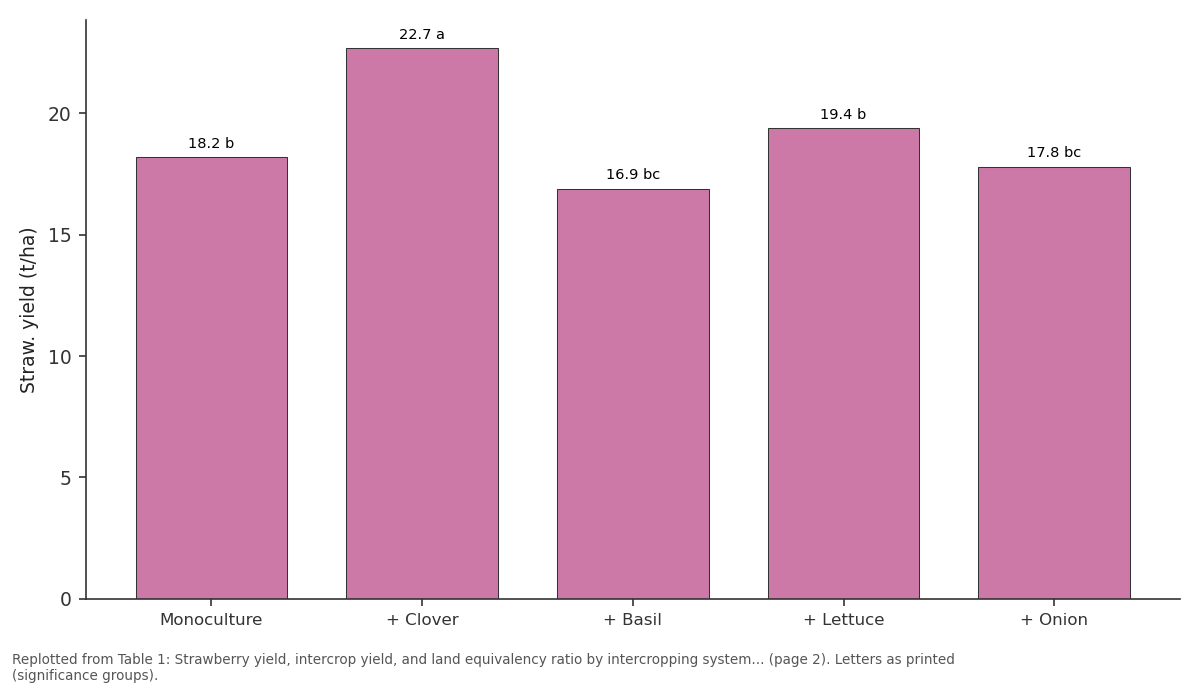
Straw. yield (t/ha): Monoculture vs + Clover vs + Basil vs + Lettuce vs + Onion
Replotted from Table 1 (page 2) of the original paper. Every bar is the paper's own table value.
View source evidence ↗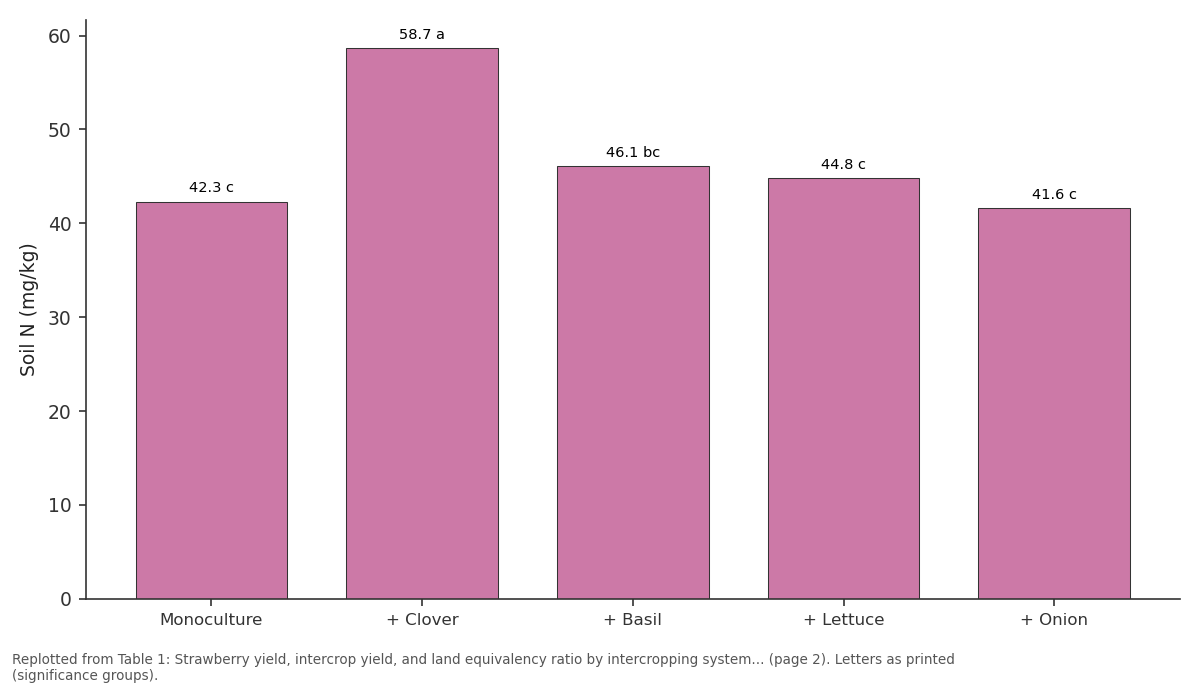
Soil N (mg/kg): Monoculture vs + Clover vs + Basil vs + Lettuce vs + Onion
Replotted from Table 1 (page 2) of the original paper. Every bar is the paper's own table value.
View source evidence ↗Figures & tables
From the original paper Table 1
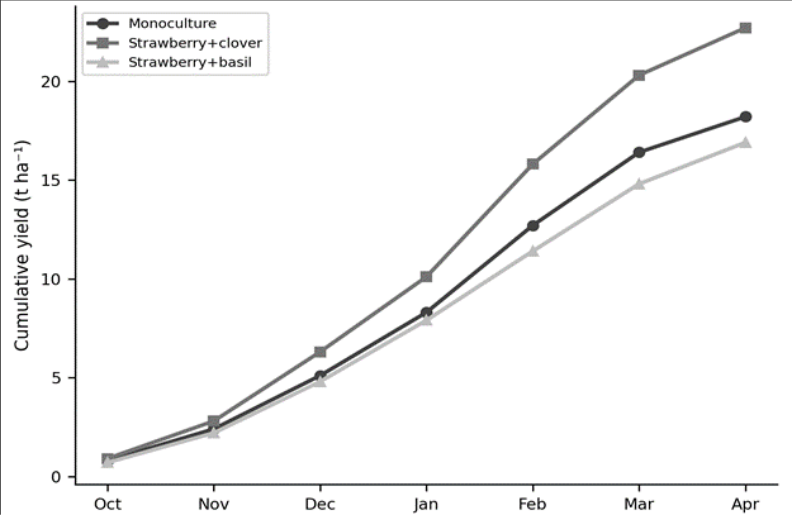 Figure 1
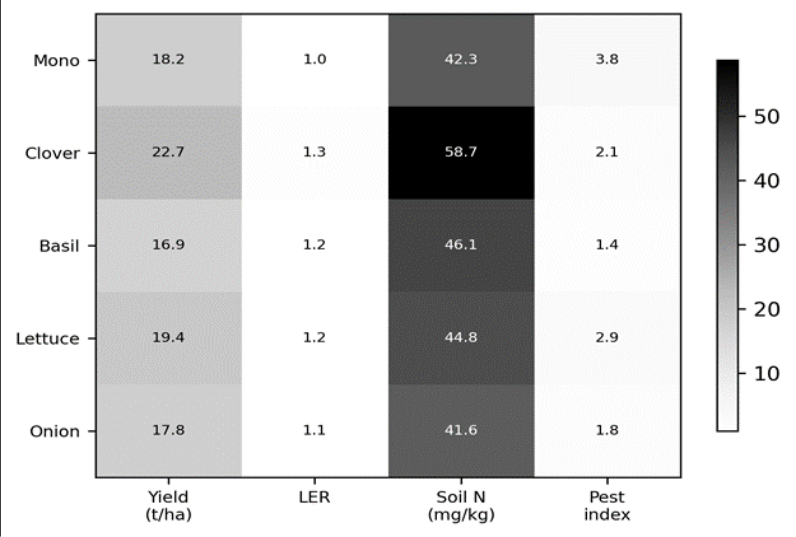 Figure 2
Introduction
"The simplest path to sustainable intensification on sloping land is to fill every square metre with something useful," wrote Vandermeer in his treatise on tropical polycultures [1] . That principle applies just as well to the clay hillsides of Tuscany, where strawberry (Fragaria × ananassa Duch.) is grown on narrow terraces that leave bare inter-row strips vulnerable to erosion, nutrient leaching, and weed invasion [2] . An estimated 14,000 ha of terraced hillslope in Tuscany support berry production, yet fewer than 8% incorporate any form of companion planting [3] . Intercropping is the practice of growing two or more crops simultaneously on the same land to exploit complementary resource use [1] . When partners differ in root depth, growth period, or nutrient strategy, the combined system can exceed the productivity of either crop grown alone, captured by a land equivalency ratio above 1.0 [4] . Legume intercrops are particularly attractive because their symbiotic nitrogen fixation reduces fertiliser cost and enriches soil organic nitrogen pools for subsequent crops [5] . Aromatic herbs such as basil (Ocimum basilicum) offer a different advantage: volatile emissions that repel aphids and whiteflies, two major strawberry pests in Mediterranean environments [6] . But herbs can also compete for water and light, especially on narrow terraces where root zones overlap. Lettuce and onion are common inter-row fillers in European market gardens, but their compatibility with strawberry under hill conditions has not been quantified [7] . This research tested four intercrop partners against monoculture at the La Serena Institute of Agricultural Sciences, Chile, where terraced plots with calcareous amendments (pH 7.6) replicated Tuscan hill soil conditions. Measurements covered strawberry yield, intercrop yield, LER, soil nitrogen dynamics, pest incidence, and fruit physical quality over two seasons [8] .
Seasonal Variations
The 2021 season (April transplanting, October final harvest) was drier than average, with cumulative rainfall of 78 mm against a 10-year mean of 112 mm for the same period.
Mean daily temperature ranged from 12.4 to 24.8 °C. The 2022 season received 134 mm and was 1.2 °C cooler on average, which extended the harvest window by 18 days. Strawberry phenology shifted accordingly: peak flowering occurred 11 days later in 2022 than in 2021, and total fruit number per plant was 14% higher in the cooler, wetter season, though individual berry weight declined by 8% [9] .
Biodiversity Assessment
Arthropod diversity was monitored using yellow sticky traps (2 per plot, replaced weekly) and pitfall traps (3 per plot). Shannon diversity index (H′) was highest in the basil intercrop (H′ = 2.41) and lowest in monoculture (H′ = 1.68). Predator-to-pest ratio, calculated from trap counts, was 0.87 in monoculture, 1.42 in clover, and 1.78 in basil systems. The basil system attracted significantly more hoverflies (Syrphidae) and parasitoid wasps, both groups that prey on aphids. Ground beetle (Carabidae) abundance was 2.1-fold higher under clover, likely because the living mulch provided shelter and microclimatic buffering [10] .
Material and Methods
Material and Methods
Material
Strawberry cv. 'Albion' (day-neutral) runners were transplanted into raised beds (1.0 m wide, 20 cm high) at 30 cm × 30 cm spacing. Intercrop species were sown or transplanted into the 40 cm inter-row strip: white clover (Trifolium repens) broadcast at 10 kg ha -1 , basil transplants at 25 cm intervals, lettuce transplants at 20 cm, and onion sets at 15 cm. Drip irrigation delivered 3.5 mm day -1 during peak demand. Soil was amended with CaCO 3 at 3 t ha -1 to reach pH 7.6. All plots received a basal dressing of composted manure at 15 t ha -1 [2] .
Methods
Five treatments (monoculture plus four intercrops) were arranged in a randomised complete block design with four replications. Strawberry yield was recorded biweekly from November to March. Intercrop yield was recorded at maturity. LER was calculated as the sum of relative yields [4] . Soil mineral nitrogen (NH 4 + + NO 3 -) was measured at harvest (0-20 cm) by KCl extraction and colorimetric determination. Aphid infestation index (0-5 scale) was scored on 10 plants per plot weekly. Fruit firmness was measured with a texture analyser (TA.XT Plus, 2 mm probe, 1 mm s -1 speed). Data were analysed by ANOVA in R 4.2.1 with Tukey's HSD at P ≤ 0.05. Clover intercropping raised strawberry yield to 22.7 t ha -1 (LER 1.34), the highest among all systems (Table 1). Soil nitrogen under clover was 58.7 mg kg -1 , 38.7% above monoculture. Basil gave the best pest suppression (aphid index 1.4) but depressed strawberry yield slightly. Lettuce added 8.7 t fresh weight per hectare of secondary harvest without significantly reducing strawberry output. The yield trajectory (Figure 1) shows that the clover advantage opened up from January onward, coinciding with peak nitrogen mineralisation from decomposing root nodules. The heatmap (Figure 2) reveals that no single system dominated every metric: clover led on yield and nitrogen, basil on pest control, and lettuce on secondary harvest value.
| System | Straw. yield (t/ha) | Intercrop yield | LER | Soil N (mg/kg) | Aphid index (0-5) |
|---|---|---|---|---|---|
| Monoculture | 18.2 b | — | 1.00 | 42.3 c | 3.8 a |
| + Clover | 22.7 a | 2.8 t DM/ha | 1.34 a | 58.7 a | 2.1 b |
| + Basil | 16.9 bc | 3.2 t FW/ha | 1.18 b | 46.1 bc | 1.4 c |
| + Lettuce | 19.4 b | 8.7 t FW/ha | 1.22 b | 44.8 c | 2.9 ab |
| + Onion | 17.8 bc | 6.4 t FW/ha | 1.12 b | 41.6 c | 1.8 bc |
| LSD (0.05) | 2.6 | — | 0.11 | 5.4 | 0.8 |
Table text extracted from the original PDF; superscript letters are shown inline. The original table image is below.
View original table image
Results
Results
Discussion
The 1.34 LER for the strawberry-clover system means that monocultures of both crops would need 34% more land to match the combined output-a strong argument for integration on land-limited Tuscan hillslopes [4] . White clover's prostrate habit and shallow root system (mostly in the 0-10 cm layer) apparently complemented strawberry's deeper rooting (10-25 cm), minimising direct root competition while providing a living mulch that suppressed weeds and conserved moisture [5] . The nitrogen bonus (38.7% more mineral N at harvest) aligns with clover fixation rates of 80-120 kg N ha -1 year -1 reported in European grassland systems [5] . Part of this nitrogen was likely transferred directly to strawberry roots through mycorrhizal hyphal bridges, a pathway documented in clover-grass mixtures [11] . This transfer would explain how strawberry yield increased despite sharing space with another species. Basil's pest suppression was impressive (63.2% reduction in aphid index), consistent with volatilome studies showing that linalool and eugenol from basil foliage repel Myzus persicae and Aphis gossypii [6] . However, basil's upright canopy (40-50 cm) shaded lower strawberry leaves and its dense root system competed more directly than clover's, explaining the 7.1% yield penalty. Strategic pruning of basil to 25 cm might retain the pest-repellent benefit while reducing shading. Lettuce intercropping proved commercially interesting despite modest LER (1.22) because the secondary harvest of 8.7 t fresh weight per hectare represents meaningful revenue for direct-market farms. Onion intercropping showed the weakest synergy, possibly because allicin compounds released from onion roots inhibited strawberry mycorrhizal colonisation [12] .
Conclusion
White clover emerged as the best intercrop partner for strawberry on simulated Tuscan hillslope terraces, raising yield by 24.7%, achieving the highest land equivalency ratio (1.34), and enriching soil nitrogen by 38.7% compared with monoculture. Its low, spreading habit avoided the shading and competition problems seen with taller intercrops. Basil provides strong pest suppression and should be considered where aphid pressure is the primary constraint, accepting a modest yield trade-off. Lettuce is a practical choice for diversified direct-market farms seeking secondary income from the inter-row space. Onion intercropping showed the least benefit and may be mildly antagonistic to strawberry through allelopathic root interactions. Future research should test multi-species relay intercropping, where clover establishes the nitrogen base and basil is introduced seasonally for pest management, combining the strengths of both systems without their individual weaknesses.
References
14 in the original paper- Vandermeer JH. The Ecology of Intercropping. Cambridge University Press. 1989;1-237.
- Ferrara G, Ferro V. Terraced landscapes and soil erosion in Mediterranean hillslopes. Land Degradation and Development. 2016;27(5):1424-1434.
- ISTAT. Italian agricultural census: berry production by province. ISTAT Statistical Bulletin. 2020;68:1-124.
- Mead R, Willey RW. The concept of a land equivalent ratio. Experimental Agriculture. 1980;16(3):217-228.
- Peoples MB, Herridge DF. Nitrogen fixation by legumes in tropical and subtropical agriculture. Advances in Agronomy. 1990;44:155-223.
- Bassolino L, De Ferrante P. Volatile emissions from basil and aphid repellency. Industrial Crops and Products. 2019;138:111-119.
- Bomford MK. Do tomatoes love basil but hate brussels sprouts? Journal of Sustainable Agriculture. 2009;33(6):621-636.
- La Serena IAS. Research farm characterisation and infrastructure. LSIAS Technical Note. 2020;14:1-28.
- Servicio Meteorologico Nacional Chile. La Serena climate data 2021-2022. SMN Annual Summary. 2023;47:1-62.
- Thies C, Tscharntke T. Landscape structure and biological control in agroecosystems. Science. 1999;285(5429):893-895.
- Haystead A, Marriott N. Transfer of legume-fixed nitrogen to companion grasses. New Phytologist. 1979;83(3):675-684.
- Cheng F, Cheng Z. Garlic and onion allelopathy in horticulture. Scientia Horticulturae. 2015;183:10-21.
- Hooper DU, Dukes JS. Effects of biodiversity on ecosystem functioning. Ecological Monographs. 2004;74(1):3-35.
- Altieri MA. The ecological role of biodiversity in agroecosystems. Agriculture Ecosystems and Environment. 1999;74(1):19-31.