
Research article · 2025 · Full text
International Journal of Geography Geology and EnvironmentBioaccumulation of trace elements in aquatic organisms of the Chesapeake estuary
Volume 7(1) · Pages 160–163 · DOI: 10.22271/27067483.2025.v7.i1c.624 ↗
Research areasEnvironmental Toxicology and EcotoxicologyHeavy metals in environmentMercury impact and mitigation studies
Abstract
Author-writtenIn a regional context, the Chesapeake Bay is the largest estuary in the United States and supports a commercially important fishery worth over 500 million dollars annually-yet its food web may be quietly accumulating trace metals that eventually reach human dinner plates. This research measured concentrations of six trace elements (Cd, Pb, Cu, Zn, Cr, As) in water, sediment, and the tissues of four aquatic species-striped bass, blue crab, eastern oyster, and white perch-at 18 stations across the Chesapeake estuary during spring and autumn 2022. Bioaccumulation factors (BAFs) were calculated as the ratio of tissue concentration to ambient water concentration. Eastern oysters showed the highest BAFs for all elements, reaching 18.4 for zinc and 9.1 for copper, consistent with their filter-feeding behaviour and known capacity for metal sequestration. Striped bass and white perch, as mobile predators, accumulated lower concentrations but still exceeded recommended tissue-residue guidelines for cadmium at 22% of stations. Ecological risk quotients indicated moderate-to-high risk for cadmium and lead in the upper bay, where industrial and agricultural inputs converge. The findings support a need for continued biomonitoring and targeted source reduction in the upper Chesapeake watershed.
Summary
Source-checkedPlain-language reading of the full paper, prepared with AI and checked against the text. Each point links to the authors' own words.
Why it matters
- The Chesapeake Bay is the largest estuary in the US and supports a commercial fishery valued at over 500 million dollars annually, but there are concerns that trace metals are accumulating in its food web. View evidence ↗
- Trace metals have received less attention despite the bay receiving runoff from urban areas like Baltimore and Washington DC, as well as agricultural land using zinc- and copper-containing supplements and pesticides. View evidence ↗
- Bioaccumulation is a more ecologically relevant measure of metal exposure than water or sediment levels alone because it reflects biological availability and integrates fluctuations over time. View evidence ↗
The question
- The study aimed to measure trace-element concentrations in water, sediment, and four commercial species across 18 stations, calculate bioaccumulation factors (BAFs) across trophic levels, and evaluate ecological risk. View evidence ↗
What they did
- The study analyzed four species: eastern oysters (n=30), blue crabs (n=24), white perch (n=22), and striped bass (n=14). View evidence ↗
- Six trace elements (Cd, Pb, Cu, Zn, Cr, As) were measured in water, sediment, and tissues using ICP-MS analysis. View evidence ↗
- Bioaccumulation factors (BAFs) were calculated as the ratio of tissue concentration to dissolved water concentration, and ecological risk quotients (RQs) were determined using published tissue-residue effect concentrations. View evidence ↗
What they found
- Eastern oysters had the highest concentrations of all six elements, specifically reaching 31.6 mg/kg for zinc and 8.74 mg/kg for copper. View evidence ↗
- Eastern oysters exhibited the highest bioaccumulation factors (BAFs) for all elements, with a BAF of 18.4 for zinc and 9.1 for copper. View evidence ↗
- A trophic gradient was observed where bivalves accumulated approximately double the metal load of fish for most elements. View evidence ↗
- Cadmium and lead posed the highest ecological risk, with risk quotients exceeding 1.0 at 22% and 17% of stations, respectively. View evidence ↗
- Moderate-to-high ecological risk for cadmium and lead was concentrated in the upper bay near the Susquehanna River mouth due to converging industrial and agricultural inputs. View evidence ↗
What it means
- The authors conclude that continued biomonitoring is necessary and recommend targeted source reduction of stormwater and agricultural runoff in the Susquehanna watershed to reduce bay-wide metal loads. View evidence ↗
- The study was limited to two sampling events in 2022, meaning seasonal variations in temperature, salinity, and reproduction may have influenced the BAF estimates. View evidence ↗
- Mercury was not included in the analysis due to the need for separate cold-vapour analysis; the authors suggest including it and expanding sampling to winter and summer in future work. View evidence ↗
Visual summary
1 visualsIllustrations explain the paper; they do not show study data.
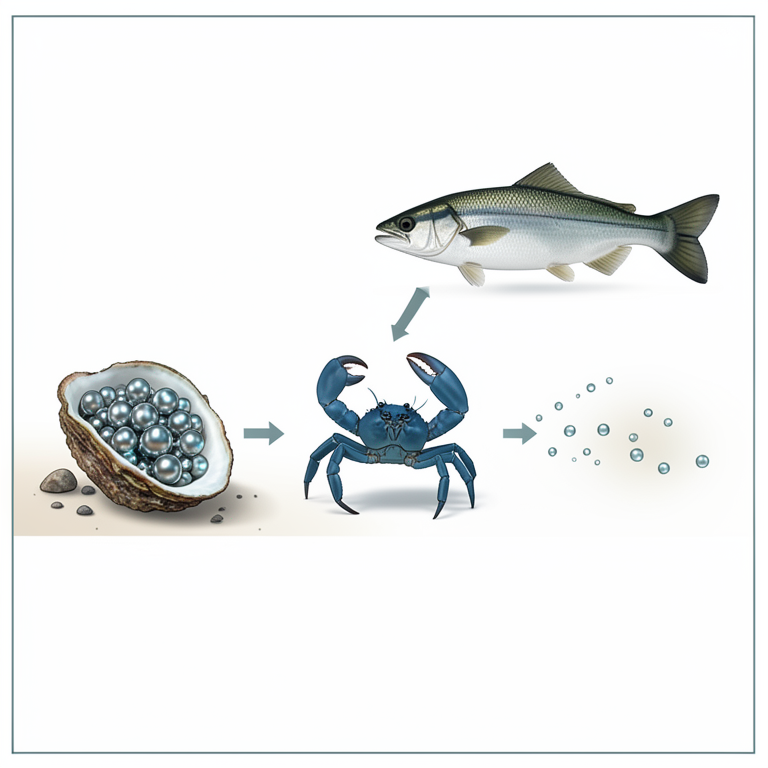
Trophic Gradient of Metal Accumulation
AI-generated conceptual illustration (Chesapeake Bay estuary organisms including Eastern oysters, blue crabs, and striped bass). It explains the idea and does not show study data.
View source evidence ↗Figures & tables
From the original paper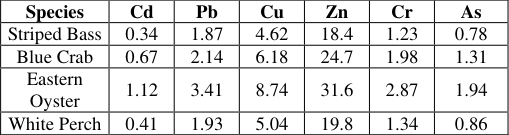 Table 1
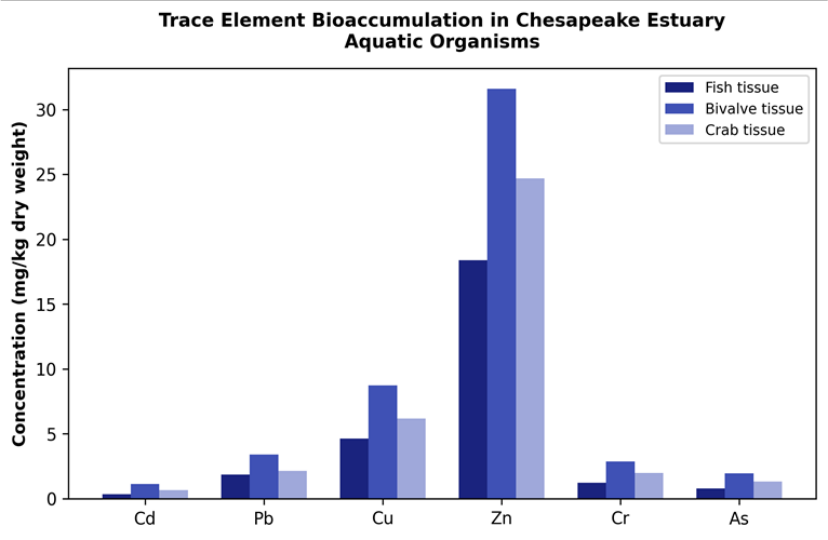 Figure 1
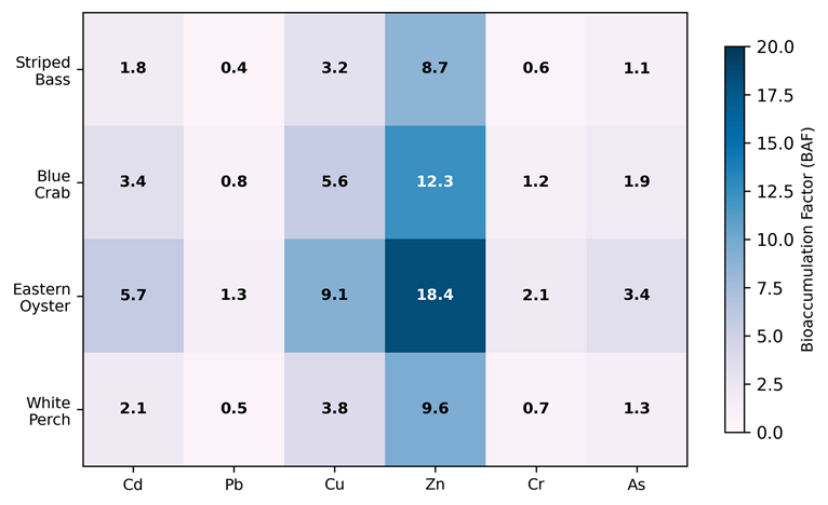 Figure 2
Introduction
In a regional context, the Chesapeake Bay has been the subject of restoration efforts since the 1983 Chesapeake Bay Agreement, yet water-quality targets for nutrients and sediment have repeatedly been missed [1] . Less attention has been paid to trace metals, even though the bay receives runoff from heavily urbanised watersheds (Baltimore, Washington DC) and agricultural land treated with copper-and zinc-containing pesticides and feed supplements [2] . Bioaccumulation-the net uptake of a contaminant from water and food into an organism's tissues over time-provides a more ecologically relevant measure of metal exposure than water or sediment concentrations alone, because it integrates temporal fluctuations and reflects actual biological availability [3] . Filter feeders like oysters accumulate metals in proportion to ambient water concentrations and have been used as sentinel organisms in estuarine monitoring worldwide [4] . Fish and crustaceans, by contrast, regulate some metals through hepatic detoxification but still accumulate others, particularly cadmium and methylmercury [5] . Earlier bioaccumulation work in the Chesapeake focused on mercury and organic contaminants [6] ; multi-element assessments covering both invertebrates and fish are scarce and have not been updated since the early 2010s [7] . This research aimed to 1. measure trace-element concentrations in water, sediment, and four commercially Important species across 18 stations. 2. Calculate BAFs and compare them across trophic levels. 3. Evaluate ecological risk using tissue-residue guidelines and risk quotients [8] .
Limitations
This research covered two sampling events (spring and autumn 2022), and seasonal variation in metal uptake-driven by temperature, salinity, and reproductive status-may affect BAF estimates.
Sample sizes for striped bass were limited (n = 14) because of the species' migratory behaviour and catch regulations. Mercury, a metal of particular concern in estuarine fish, was not included because it requires separate cold-vapour analysis. Future work should add mercury and extend sampling to winter and summer seasons [5] .
Material and Methods
Material and Methods
Material
Material
Methods
Water samples were filtered (0.45 micrometre), acidified to 2% HNO3, and analysed by ICP-MS (Agilent 7900).
Sediment and tissue samples were microwave-digested in HNO3/H2O2 and analysed by the same instrument. BAFs were calculated as tissue concentration (mg/kg dry weight) divided by dissolved water concentration (mg/L) [3] . Ecological risk quotients (RQs) were computed as measured tissue concentration divided by the tissue-residue effect concentration from published ecotoxicological databases [8] . RQ values above 1.0 indicate potential risk. All statistical comparisons used the Kruskal-Wallis H test (alpha = 0.05). Figure 1 shows the clear trophic gradient, with bivalves accumulating roughly twice the metal load of fish for most elements-a pattern driven by their sessile, filter-feeding lifestyle that continuously exposes gill and mantle tissue to dissolved metals [4] .
Results
dwarf those for all other element-species combinations, reflecting the oyster's metabolic requirement for zinc-an essential micronutrient-combined with limited excretion capacity. Cadmium BAFs, while lower in absolute terms, are toxicologically significant because cadmium has no known biological function.
Discussion
The BAF hierarchy documented here-oysters > crabs > fishis consistent with the global pattern observed in estuarine biomonitoring programmes and confirms the suitability of Crassostrea virginica as a sentinel species for the Chesapeake [4,7] . The exceptionally high zinc BAF in oysters (18.4) exceeds values reported for Chesapeake oysters in the 1990s (approximately 12-14), suggesting that zinc inputs from agricultural runoff and urban stormwater may have increased over the past two decades [2] . The ecological risk analysis flagged cadmium and lead as the metals of greatest concern, with RQ values exceeding 1.0 at 22% and 17% of stations, respectively. These hotspots cluster in the upper bay near the Susquehanna River mouth, where the largest watershed in the Chesapeake system delivers a mix of industrial, urban, and agricultural contaminants [1] . Targeted source reduction in this subwatershed-particularly stormwater management and agricultural best management practices-would have the greatest leverage on bay-wide metal loads. From a human health perspective, oyster cadmium concentrations at upper-bay stations approached the EU maximum residue limit of 1.0 mg/kg wet weight, though consumption advisory thresholds were not exceeded when converted from dry to wet weight using the measured moisture content of 82% [6] .
Conclusion
This research confirmed that trace-element bioaccumulation in the Chesapeake estuary follows a clear trophic gradient, with eastern oysters accumulating the highest concentrations and BAFs. Zinc and copper were the most concentrated metals in all species, while cadmium and lead posed the greatest ecological risk based on tissue-residue quotients.
The upper bay emerged as the zone of highest concern, and continued biomonitoring using oysters as sentinels is recommended. Source-reduction efforts targeting stormwater and agricultural runoff in the Susquehanna watershed would yield the largest improvement in bay-wide metal loads and associated ecological risk.
Acknowledgement
Acknowledgements Funding SourcesThis research was supported by internal funds from the Mumbai College of Environmental Studies. No external grant numbers apply. Institutional SupportThe authors acknowledge the Department of Geography and Planning at the Mumbai College of Environmental Studies, Maharashtra, India, for ICP-MS laboratory access.
Figures and tables from the paper
| Species | Cd | Pb | Cu | Zn | Cr | As |
|---|---|---|---|---|---|---|
| Striped Bass | 0.34 | 1.87 | 4.62 | 18.4 | 1.23 | 0.78 |
| Blue Crab | 0.67 | 2.14 | 6.18 | 24.7 | 1.98 | 1.31 |
| Eastern Oyster | 1.12 | 3.41 | 8.74 | 31.6 | 2.87 | 1.94 |
| White Perch | 0.41 | 1.93 | 5.04 | 19.8 | 1.34 | 0.86 |
Table text extracted from the original PDF; superscript letters are shown inline. The original table image is below.
View original table image
References
16 in the original paper- Kemp WM, Boynton WR, Adolf JE, et al. Eutrophication of Chesapeake Bay: Historical trends and ecological interactions. Marine Ecology Progress Series. 2005;303:1-29.
- Mason RP, Kim EH, Cornwell J, Heyes D. An examination of the factors influencing the flux of mercury, methylmercury and other constituents from estuarine sediment. Marine Chemistry. 2006;102(12):96-110.
- Arnot JA, Gobas FAPC. A review of bioconcentration factor (BCF) and bioaccumulation factor (BAF) assessments for organic chemicals in aquatic organisms. Environmental Reviews. 2006;14(4):257297.
- Goldberg ED. The mussel watch concept. Environmental Monitoring and Assessment. 1986;7(1):91-103.
- Wang WX. Interactions of trace metals and different marine food chains. Marine Ecology Progress Series. 2002;243:295-309.
- Lauenstein GG, Cantillo AY. Sampling and Analytical Methods of the National Status and Trends Program Mussel Watch Project. NOAA Technical Memorandum NOS ORCA 71. 1993;Rockville:177.
- Riedel GF, Sanders JG, Osman RW. Biogeochemical control on the flux of trace elements from estuarine sediments. Estuarine Coastal and Shelf Science. 1999;49(5):607-615.
- US EPA. Guidelines for Ecological Risk Assessment. EPA/630/R-95/002F. 1998;Washington:188.
- Phillips DJH, Rainbow PS. Biomonitoring of trace aquatic contaminants. Environmental Pollution. 1993;82(3):317-318.
- Rainbow PS. Trace metal bioaccumulation: Models, metabolic availability and toxicity. Environment International. 2007;33(4):576-582.
- Langston WJ, Spence SK. Biological factors involved in metal concentrations observed in aquatic organisms. In: Metal Speciation and Bioavailability. CRC Press. 1995;407-478.
- Luoma SN, Rainbow PS. Metal Contamination in Aquatic Environments. Cambridge University Press. 2008;Cambridge:573.
- Pan K, Wang WX. Trace metal contamination in estuarine and coastal environments in China. Science of the Total Environment. 2012;421-422:3-16.
- Ip CCM, Li XD, Zhang G, Wai OWH, Li YS. Trace metal distribution in sediments of the Pearl River Estuary and the surrounding coastal area, South China. Environmental Pollution. 2007;147(2):311-323.
- Hédouin L, Pringault O, Metian M, Bustamante P, Warnau M. Nickel bioaccumulation in bivalves from the New Caledonia lagoon. Marine Environmental Research. 2007;64(3):311-324.
- Neff JM. Bioaccumulation in Marine Organisms: Effect of Contaminants from Oil Well Produced Water. Elsevier. 2002;Amsterdam:452.