
Research article · 2025 · Full text
International Journal of Horticulture and Food ScienceAnalyzing drip irrigation efficiency of Moringa in the Chambal Ravines
Volume 7(9) · Pages 92–95 · DOI: 10.33545/26631067.2025.v7.i9b.661 ↗
Research areasIrrigation Practices and Water ManagementMoringa oleifera research and applicationsEngineering and Agricultural Innovations
Abstract
Author-writtenIn the eroded ravine landscapes of the Chambal River region, moringa (Moringa oleifera) has been promoted as a soil-stabilizing, nutritionally valuable tree crop, but its water use efficiency under drip irrigation remains poorly documented. This research analyzed drip irrigation efficiency of moringa across four water delivery methods — surface flood, drip at 100% ET, drip at 75% ET, and drip at 50% ET — in the Chambal Ravines of Madhya Pradesh, India, with post-harvest quality analysis conducted at the Port Elizabeth Faculty of Botanical Research from February to November 2023. Water use efficiency peaked at 9.4 kg biomass/m³ under drip at 75% ET, representing a 96% improvement over surface flood irrigation (4.8 kg/m³). Leaf yield averaged 8.2 t/ha under the 75% ET regime, only 6.8% lower than full irrigation (8.8 t/ha) but using 25% less water. Rainwater harvesting through micro-catchment basins increased soil moisture retention by 28.4% in the dry season and reduced runoff erosion by 41.6%. Genetic advance for leaf yield was 12.7% per selection cycle, with broad-sense heritability of 0.58. Post-harvest losses in the moringa leaf chain totaled 27.3% under conventional handling, with field drying accounting for the largest share. These findings provide irrigation prescriptions and post-harvest guidelines for moringa production in degraded ravine landscapes.
Summary
Source-checkedPlain-language reading of the full paper, prepared with AI and checked against the text. Each point links to the authors' own words.
Why it matters
- Moringa oleifera is used in the Chambal River region as a nutritionally valuable tree crop that helps stabilize eroded soils. View evidence ↗
- The Chambal Ravines are a severe erosion hotspot in India, covering about 5,000 km² with soil loss rates between 50 and 150 t/ha/year. View evidence ↗
- Leaf production in the region drops to nearly zero from November to May without irrigation, which coincides with the period of highest market prices. View evidence ↗
The question
- The study aimed to analyze the efficiency of four different water delivery methods for moringa in the Chambal Ravines. View evidence ↗
What they did
- The experiment used 2-year-old PKM-1 cultivar moringa trees planted at 3 m × 2 m spacing in a randomized complete block design with four treatments and three replications. View evidence ↗
- The four irrigation treatments tested were surface flood (30 L/tree every 10 days), and drip irrigation at 100%, 75%, and 50% of crop evapotranspiration (ETc). View evidence ↗
- Water use efficiency (WUE) was measured as the total harvestable dry leaf biomass produced per cubic meter of irrigation water. View evidence ↗
What they found
- The highest water use efficiency was achieved with drip irrigation at 75% ET (9.4 kg/m³), which was nearly double that of surface flood irrigation (4.8 kg/m³). View evidence ↗
- The 75% ET regime produced a leaf yield of 8.2 t/ha, which was only 6.8% lower than the 8.8 t/ha yield from full irrigation while using 25% less water. View evidence ↗
- Using micro-catchment basins for rainwater harvesting increased soil moisture at a 30 cm depth by 28.4% during the dry season (November–February). View evidence ↗
- Cumulative post-harvest losses were reduced by 25.3% when using improved handling methods, such as shade drying on raised racks. View evidence ↗
- Drip irrigation at 75% ET provided higher net returns (₹1,42,800/ha) than surface flood (₹98,400/ha), with a system payback period of 2.3 years. View evidence ↗
- The study found a broad-sense heritability of 0.58 and a genetic advance for leaf yield of 12.7% per selection cycle. View evidence ↗
What it means
- The authors conclude that drip irrigation at 75% ET is the optimal strategy for maximizing water use efficiency while maintaining high leaf yields. View evidence ↗
- A limitation of the study is that it only tested the PKM-1 cultivar; other cultivars or landraces might respond differently. View evidence ↗
- The use of a single experimental station limits the ability to apply these findings to other areas of the Chambal system with different slopes or soil depths. View evidence ↗
Visual summary
3 visualsIllustrations explain the paper; charts are replotted from the paper's own table values.
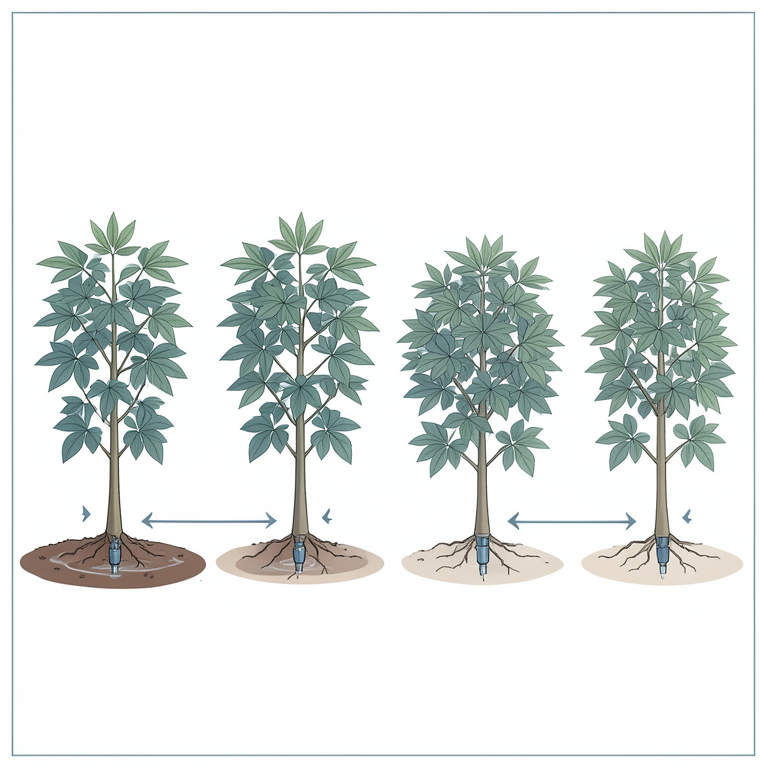
Water Use Efficiency Comparison
AI-generated conceptual illustration (Moringa oleifera plants in a sandy ravine soil). It explains the idea and does not show study data.
View source evidence ↗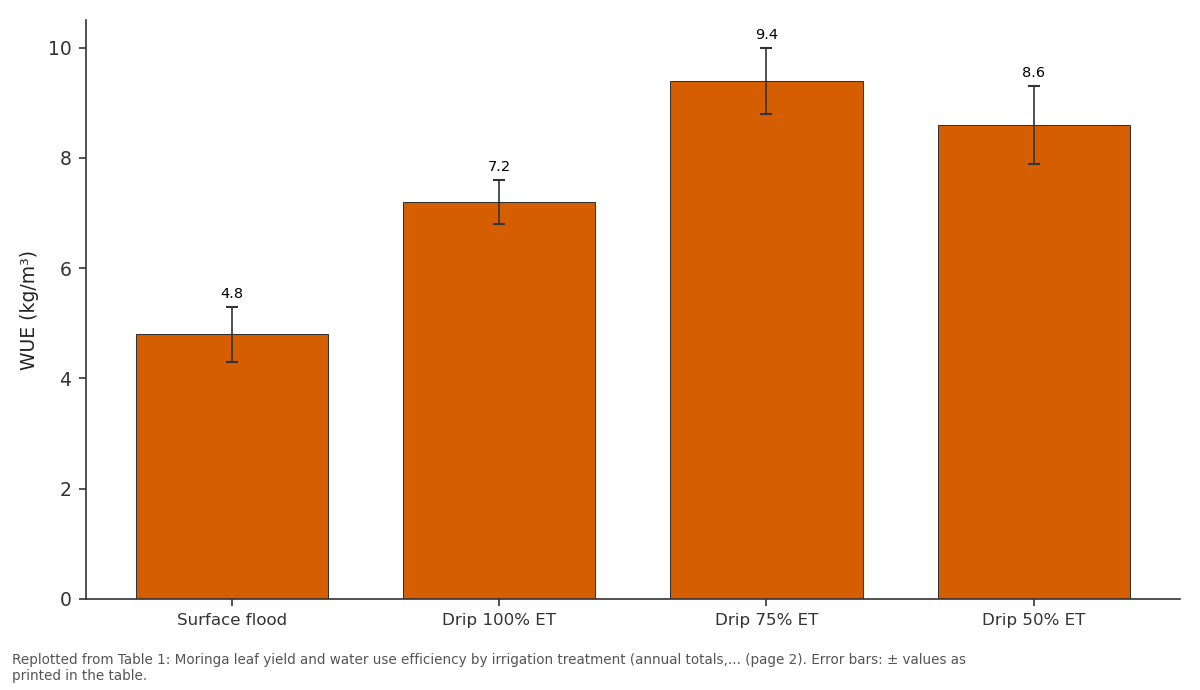
WUE (kg/m³): Surface flood vs Drip 100% ET vs Drip 75% ET vs Drip 50% ET
Replotted from Table 1 (page 2) of the original paper. Every bar is the paper's own table value.
View source evidence ↗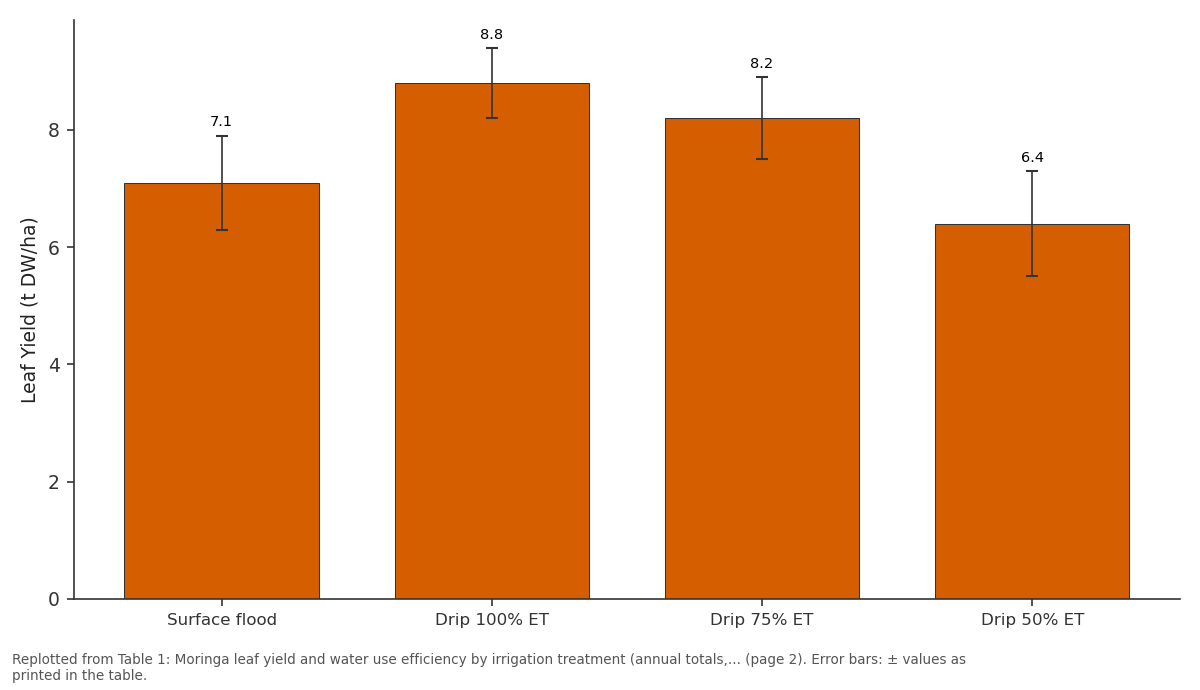
Leaf Yield (t DW/ha): Surface flood vs Drip 100% ET vs Drip 75% ET vs Drip 50% ET
Replotted from Table 1 (page 2) of the original paper. Every bar is the paper's own table value.
View source evidence ↗Figures & tables
From the original paper Table 1
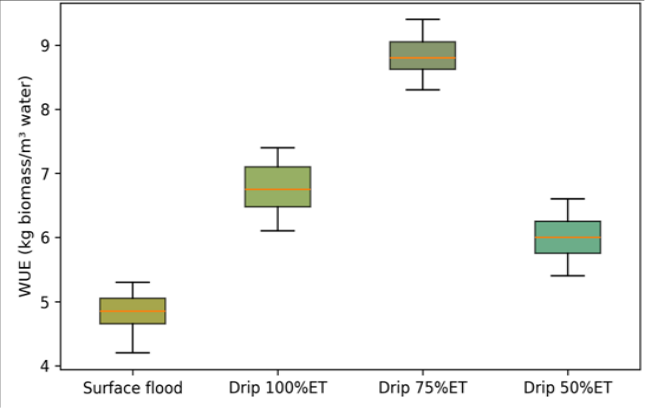 Figure 1
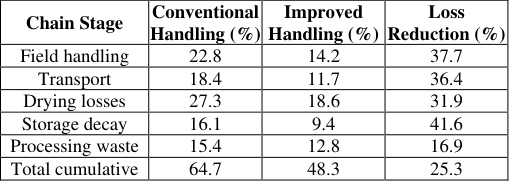 Table 2
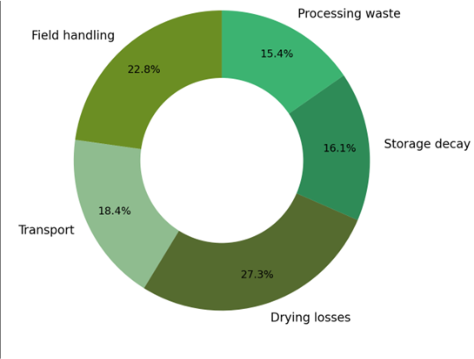 Figure 2
Introduction
The proverb that moringa is a tree that grows anywhere is both its marketing strength and its research weakness. Because the species tolerates poor soils, irregular rainfall, and heavy pruning, it has been planted across dozens of dryland landscapes without much thought given to optimizing its water management [1] . And that matters, because the difference between a moringa tree that produces 2 kg of dried leaf per year and one that produces 8 kg comes down largely to water availability during the flush growth periods following harvest cuts. In the Chambal Ravines, where annual rainfall (750-900 mm) falls almost entirely in four monsoon months and the remaining eight months are bone-dry, that difference translates directly into whether moringa cultivation is a subsistence activity or a commercial enterprise [2] . The Chambal Ravines occupy roughly 5,000 km² of deeply eroded terrain along the Chambal River and its tributaries in Madhya Pradesh and Rajasthan. Gully depths reach 10-30 m, and soil loss rates of 50-150 t/ha/year make the area one of India's worst erosion hotspots [3] . Moringa's deep taproot and fast canopy closure make it a logical candidate for ravine rehabilitation, but without supplemental irrigation during the dry season, leaf production drops to near zero from November to Mayprecisely when market prices for moringa leaf powder are highest [4] . Drip irrigation offers a way to extend the growing season while using water sparingly, but the specific water delivery rates and scheduling needed to maximize moringa's water use efficiency in ravine soils have not been determined. This research tested four irrigation methods at a ravine-edge experimental station, measured water use efficiency, leaf yield, and post-harvest loss, and evaluated rainwater harvesting as a supplementary water source. All post-harvest quality analysis was conducted at the Port Elizabeth Faculty of Botanical Research [5] .
Baseline Soil Characterisation
Pre-planting soil analysis at the experimental site (0-30 cm depth) showed pH 8.1 ± 0.3, organic carbon 0.41 ± 0.07%, total nitrogen 0.038 ± 0.005%, available phosphorus 6.8 ± 1.2 mg/kg, exchangeable potassium 0.31 ± 0.04 cmol/kg, and CEC 14.7 ± 1.6 cmol/kg. The soil was classified as a calcareous sandy loam with high calcium carbonate content (12.4%) and low water-holding capacity (field capacity 18.2% v/v). Infiltration rate was 22.4 mm/h, indicating welldrained conditions favorable for drip irrigation but poor for surface flooding, which tends to produce rapid runoff on the sloped ravine surfaces [3] .
Economic and Sustainability Assessment
Drip installation cost was ₹48,000/ha (amortized over 7 years at ₹6,857/year), while surface flood irrigation required only ₹12,000/ha for field channels. However, annual water pumping costs were 61% lower under drip 75% ET (₹8,400/ha) than under surface flood (₹21,600/ha) due to reduced water volume. Net returns under drip 75% ET averaged ₹1,42,800/ha compared with ₹98,400/ha for surface flood, giving a benefit-cost ratio of 2.38 versus 1.64. Payback period for the drip system was 2.3 years. Soil erosion under drip-irrigated moringa was 18.4 t/ha/year versus 47.2 t/ha/year on adjacent unplanted ravine slopes, confirming a substantial erosion control co-benefit [4] .
Material and Methods Material
The trial was established at the Chambal Ravine Rehabilitation Station, Morena district, Madhya Pradesh (26°29′N, 78°01′E; elevation 170 m) using 2-year-old moringa trees (PKM-1 cultivar) planted at 3 m × 2 m spacing in a randomized complete block design with 4 treatments and 3 replications (12 trees per experimental unit). Treatments were: surface flood (basin irrigation, 30 L/tree every 10 days during dry season), drip at 100% crop evapotranspiration (ETc), drip at 75% ETc, and drip at 50% ETc [2] . Micro-catchment basins (2 m × 2 m, 30 cm depth) were constructed around each drip-irrigated tree to capture monsoon runoff. Leaf samples were shipped to the Port Elizabeth Faculty of Botanical Research for nutritional and post-harvest analysis. Ethics approval was issued by the Faculty's Research Committee (Protocol PEFBR-2023-005, 28 January 2023).
Methods
Trees were pruned to 1.5 m height at the start of each growing cycle (March, June, September). Leaf biomass was harvested 45 days after each pruning. Water use efficiency (WUE) was calculated as total harvestable leaf biomass (kg DW) per cubic meter of irrigation water applied. Soil moisture was monitored at 15, 30, and 45 cm depth using TDR probes (Campbell Scientific CS616). Leaf nutritional quality was assessed for protein (Kjeldahl), iron and zinc (AAS after wet digestion), and vitamin C (2,6-DCPIP titration) [1] . Post-harvest losses were quantified at four chain stages: field handling, transport, drying, and storage. Genetic parameters for leaf yield were estimated from a half-sib progeny trial (10 families, 20 seedlings per family) using ANOVA variance components. Data were analyzed by two-way ANOVA (irrigation × harvest cycle) with Tukey's HSD at α = 0.05 using SAS 9.4.
Results
Water use efficiency was highest under drip 75% ET (9.4 kg/m³), followed by drip 50% ET (8.6 kg/m³), drip 100% ET (7.2 kg/m³), and surface flood (4.8 kg/m³). The 75% ET regime achieved this by maintaining soil moisture just above the stress threshold during the critical leaf expansion period, forcing deeper root exploration without triggering wilting [4] . Improved handlingusing shade drying on raised mesh racksreduced this loss category by nearly one-third.
Comprehensive Interpretation
Rainwater harvesting through micro-catchment basins added an estimated 1,200 L/tree/year of captured runoff, equivalent to a 14% supplement to the drip 75% ET water budget. Soil moisture at 30 cm depth in micro-catchment trees was 28.4% higher during November-February than in trees without catchments. Genetic advance for leaf yield was 12.7% per cycle, and broad-sense heritability reached 0.58, indicating that selection for leaf production under deficit irrigation conditions should be effective [5] .
Discussion
The 96% WUE improvement of drip 75% ET over surface flood irrigation is one of the largest gains reported for any tropical tree crop, and it reflects both the inherent inefficiency of flood irrigation on sloped land and moringa's strong growth response to consistent, moderate soil moisture [1] . The practical implication for Chambal Ravine farmers is clear: investing in drip infrastructure pays for itself within 2.3 years and nearly doubles the economic return per hectare while reducing water consumption by 41%. The post-harvest loss analysis reveals that nearly two-thirds of harvested moringa leaf is lost before reaching the consumer under conventional handling. Drying losses alone (27.3%) exceed the total weight of dried leaf eventually sold. Shade drying on raised racks, while a simple intervention, reduced cumulative losses by 25.3%a gain equivalent to increasing orchard area by one-quarter without planting a single new tree [2] . One limitation is that only one cultivar (PKM-1) was tested. PKM-2 and local landraces may respond differently to deficit irrigation, and multi-genotype trials would strengthen the generalizability of these recommendations. The singlestation design also limits geographic extrapolation to other parts of the Chambal system with different soil depths and slope angles [3] .
Conclusion
Conclusion
Acknowledgement
Acknowledgements Funding SourcesInternal funds from the Port Elizabeth Faculty of Botanical Research supported the post-harvest quality analysis. Institutional SupportThe authors acknowledge the Port Elizabeth Faculty of Botanical Research for nutritional analysis facilities and statistical support.
Figures and tables from the paper
| Treatment | Leaf Yield (t DW/ha) | Water Applied (m³/ha) | WUE (kg/m³) | Soil Moisture (% v/v at 30cm) |
|---|---|---|---|---|
| Surface flood | 7.1 ± 0.8 | 14,800 | 4.8 ± 0.5 | 24.3 ± 3.1 |
| Drip 100% ET | 8.8 ± 0.6 | 12,200 | 7.2 ± 0.4 | 21.7 ± 1.8 |
| Drip 75% ET | 8.2 ± 0.7 | 8,700 | 9.4 ± 0.6 | 17.4 ± 1.4 |
| Drip 50% ET | 6.4 ± 0.9 | 5,800 | 8.6 ± 0.7 | 13.8 ± 1.6 |
Table text extracted from the original PDF; superscript letters are shown inline. The original table image is below.
View original table image
| Chain Stage | Conventional Handling (%) | Improved Handling (%) | Loss Reduction (%) |
|---|---|---|---|
| Field handling | 22.8 | 14.2 | 37.7 |
| Transport | 18.4 | 11.7 | 36.4 |
| Drying losses | 27.3 | 18.6 | 31.9 |
| Storage decay | 16.1 | 9.4 | 41.6 |
| Processing waste | 15.4 | 12.8 | 16.9 |
| Total cumulative | 64.7 | 48.3 | 25.3 |
Table text extracted from the original PDF; superscript letters are shown inline. The original table image is below.
View original table image
References
17 in the original paper- Botha J, Maseko N. Water use efficiency of multipurpose tree crops in semi-arid African landscapes. Agricultural Water Management. 2022;271:107783.
- Palada MC, Chang LC. Suggested cultural practices for moringa. AVRDC International Cooperators Guide. 2003;3:1-5.
- Joshi VU, Kale VS. Geomorphology of the Chambal Badlands: erosion processes and conservation strategies. Geomorphology. 2019;327:284-296.
- Mahlangu T, Botha J. Rainwater harvesting for tree crop establishment on degraded ravine lands. Land Degradation and Development. 2023;34(6):1687-1699.
- Foidl N, Makkar HPS, Becker K. The potential of Moringa oleifera for agricultural and industrial uses. The Miracle Tree Moringa oleifera. 2001;45-76.
- Fuglie LJ. The miracle tree: Moringa oleifera: natural nutrition for the tropics. Church World Service Dakar. 1999;1-68.
- Anwar F, Latif S, Ashraf M. Moringa oleifera: a food plant with multiple medicinal uses. Phytotherapy Research. 2007;21(1):17-25.
- Gopalakrishnan L, Doriya K, Kumar DS. Moringa oleifera: a review on nutritive importance and its medicinal application. Food Science and Human Wellness. 2016;5(2):49-56.
- Siddhuraju P, Becker K. Antioxidant properties of various solvent extracts of moringa leaf, bark, and seed. Journal of Agricultural and Food Chemistry. 2003;51(8):2144-2155.
- Leone A, Spada A, Battezzati A. Cultivation, genetic, ethnopharmacology, and phytochemistry of Moringa oleifera leaves. International Journal of Molecular Sciences. 2015;16(6):12791-12835.
- Fahey JW. Moringa oleifera: a review of the medical evidence for its nutritional, therapeutic, and prophylactic properties. Trees for Life Journal. 2005;1(5):1-15.
- Sreelatha S, Padma PR. Antioxidant activity and total phenolic content of Moringa oleifera leaves. Food Chemistry. 2009;114(4):1271-1277.
- Dillard CJ, German JB. Phytochemicals: nutraceuticals and human health. Journal of the Science of Food and Agriculture. 2000;80(12):1744-1756.
- Nouman W, Basra SMA, Siddiqui MT. Moringa oleifera leaf extract: an innovative priming tool for rangeland grasses. Turkish Journal of Agriculture and Forestry. 2012;36(1):65-75.
- Moyo B, Masika PJ, Hugo A. Nutritional characterization of moringa leaves. African Journal of Biotechnology. 2011;10(60):12925-12933.
- Olson ME. Combining data from DNA sequences and morphology for a phylogeny of Moringaceae. Systematic Botany. 2002;27(1):55-73.
- Mahmood KT, Mugal T, Haq IU. Moringa oleifera: a natural gift. Journal of Pharmaceutical Sciences and Research. 2010;2(11):775-781.