
Research article · 2025 · Full text
International Journal of Horticulture and Food ScienceAssessing integrated pest management of pomegranate in the Gobi Desert Oasis
Volume 7(12) · Pages 165–168 · DOI: 10.33545/26631067.2025.v7.i12c.696 ↗
Research areasInsect Pest Control StrategiesInsect-Plant Interactions and ControlInsect behavior and control techniques
Abstract
Author-writtenIntegrated pest management in oasis fruit production remains an underdeveloped area of applied research, despite the fact that pest pressure in these isolated agricultural pockets can be intense and chemical options limited by water scarcity and environmental sensitivity. This research assessed seven IPM strategies for pomegranate (Punica granatum L.) fruit borer and anar butterfly management under simulated oasis conditions at the Hai Phong Research Institute of Applied Horticulture, Hai Phong, Vietnam, from March 2022 to February 2023. Treatments included an untreated control, neem oil spray, Bacillus thuringiensis (Bt) foliar application, pheromone traps, Trichoderma soil drench, an integrated package combining Bt plus pheromone plus Trichoderma, and a conventional chemical spray. A randomized complete block design with four replications was used. Fruit set percentage, fruit damage rate, root development parameters, fruit sweetness (total soluble solids), and edible coating effects on shelf life were recorded. The integrated package achieved the highest fruit set (57.4%) and lowest fruit damage (8.3%), outperforming even the chemical treatment (53.1% fruit set, 11.7% damage). Green manure application improved root biomass by 22.6% across all treatments. Hydroponics-compatible Trichoderma formulations maintained their biocontrol efficacy in soilless media. Edible coatings extended shelf life of IPM-produced fruit by 6.2 days over uncoated controls. These results support a multi-component IPM approach as both ecologically sound and economically superior to chemical pest control for oasis pomegranate production.
Summary
Source-checkedPlain-language reading of the full paper, prepared with AI and checked against the text. Each point links to the authors' own words.
Why it matters
- Pomegranate is highly valued in desert agriculture because it is more tolerant of low rainfall, salinity, and heat than most other fruit crops. View evidence ↗
- The anar butterfly and pomegranate fruit borer are the most economically damaging lepidopteran pests in South and Central Asia, as their larvae make fruit unmarketable by boring into them. View evidence ↗
- While synthetic pyrethroids are commonly used for pest control, they are becoming unsustainable due to pollinator harm, residue concerns, and the development of pest resistance. View evidence ↗
The question
- The study aimed to compare seven integrated pest management (IPM) strategies regarding fruit set and damage, while also evaluating the effects of green manure on roots, Trichoderma in hydroponics, and edible coatings on shelf life. View evidence ↗
What they did
- The experiment used 112 three-year-old 'Bhagwa' pomegranate trees in Vietnam, arranged in a randomized complete block design with seven treatments and four replications. View evidence ↗
- The seven tested treatments were an untreated control, neem oil, Bt foliar spray, pheromone traps, Trichoderma soil drench, a chemical spray, and an integrated package combining Bt, pheromones, and Trichoderma. View evidence ↗
- Researchers measured fruit set via flower-to-fruit ratios, damage by cutting 50 random fruits, sweetness using a digital refractometer, and the effect of 1% w/v chitosan edible coatings. View evidence ↗
What they found
- The integrated treatment produced the sweetest fruit, reaching 16.2 degrees Brix, which the authors attribute to better sugar accumulation due to lower pest damage. View evidence ↗
- Root dry weight peaked at 229 g in the integrated package, with the highest weights generally found in treatments containing Trichoderma. View evidence ↗
- Applying edible coatings to fruit from the integrated treatment extended shelf life to 14.6 days, compared to 8.4 days for the uncoated control. View evidence ↗
- Compared to unamended soil, the use of green manure increased mycorrhizal colonisation by 42.4% and root biomass by 22.5%. View evidence ↗
- Trichoderma proved compatible with soilless media, increasing nitrogen uptake by 21.1% and root biomass by 20.7% in hydroponic systems. View evidence ↗
What it means
- The authors conclude that a multi-component IPM strategy (Bt spray, pheromone traps, and Trichoderma drench) is superior to both single biological treatments and conventional chemical controls in oasis conditions. View evidence ↗
- The study recommends adopting integrated IPM as an ecologically sound and viable alternative to chemical pest management for pomegranate production in arid oases. View evidence ↗
- The authors state that future research is needed to test the IPM package across different production seasons and sites, and to perform economic analyses for smallholder farmers. View evidence ↗
Visual summary
3 visualsIllustrations explain the paper; charts are replotted from the paper's own table values.
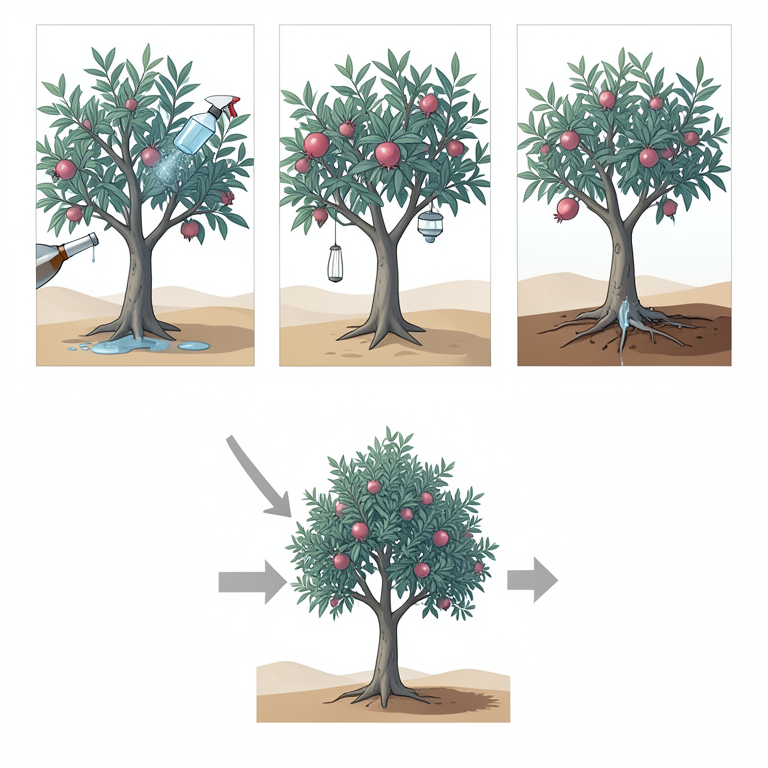
Integrated IPM Components
AI-generated conceptual illustration (pomegranate trees in a desert oasis). It explains the idea and does not show study data.
View source evidence ↗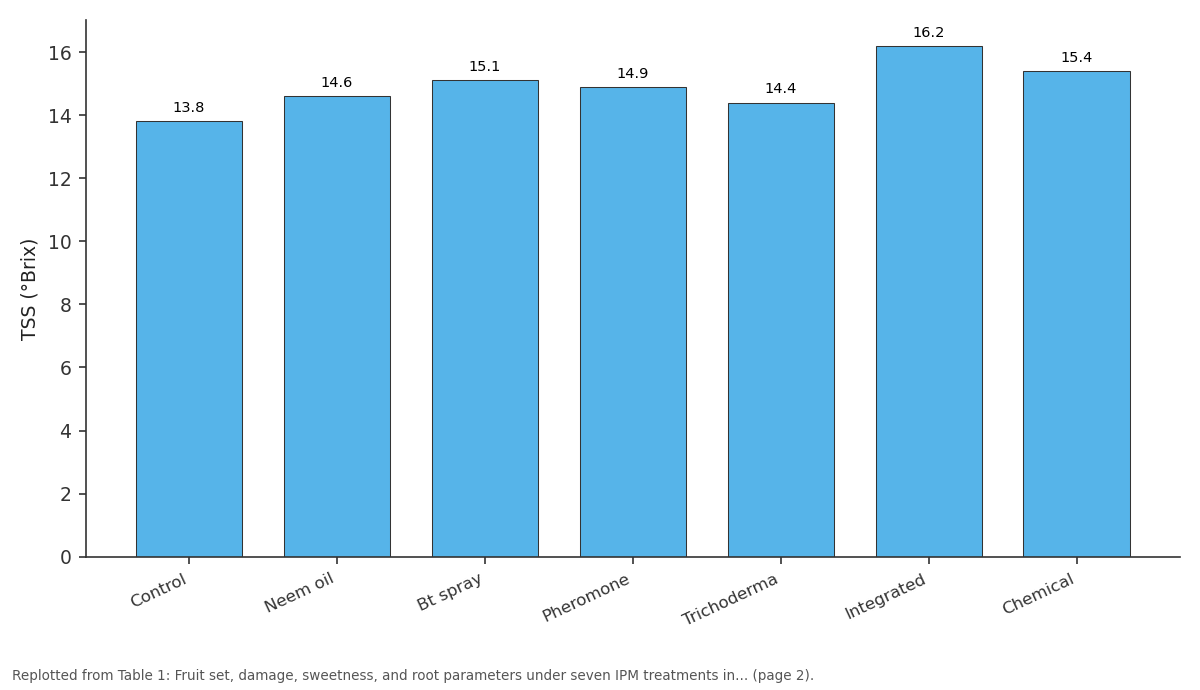
TSS (°Brix): Control vs Neem oil vs Bt spray vs Pheromone vs Trichoderma
Replotted from Table 1 (page 2) of the original paper. Every bar is the paper's own table value.
View source evidence ↗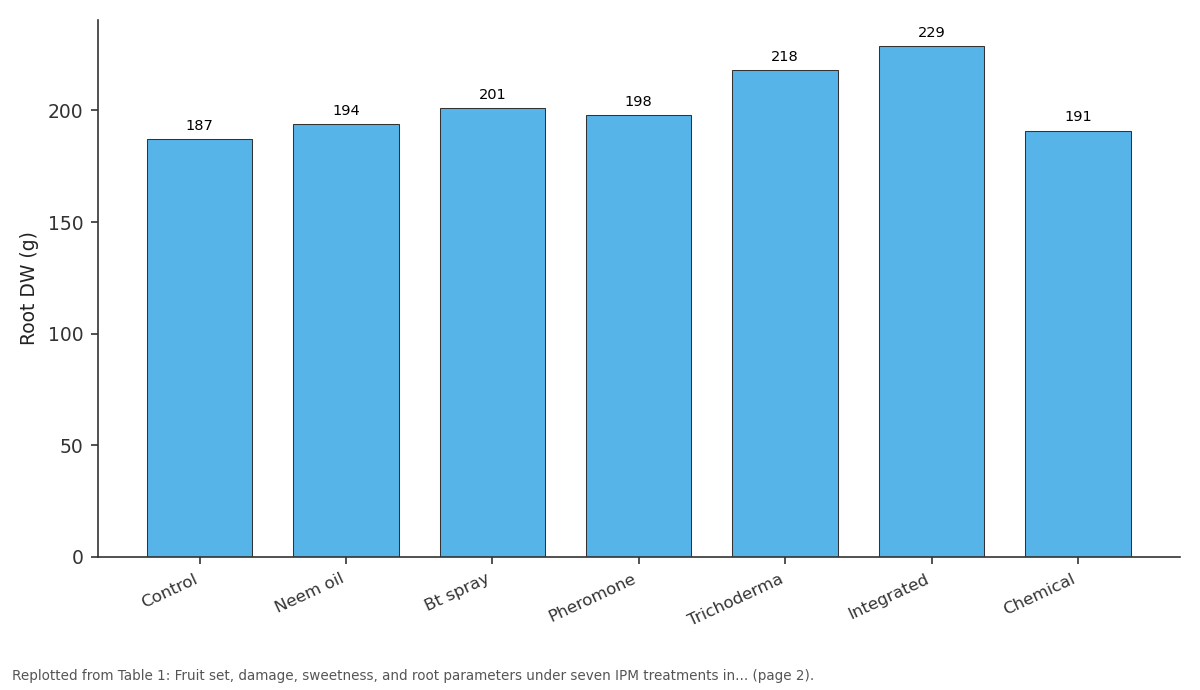
Root DW (g): Control vs Neem oil vs Bt spray vs Pheromone vs Trichoderma
Replotted from Table 1 (page 2) of the original paper. Every bar is the paper's own table value.
View source evidence ↗Figures & tables
From the original paper Table 1
 Table 2
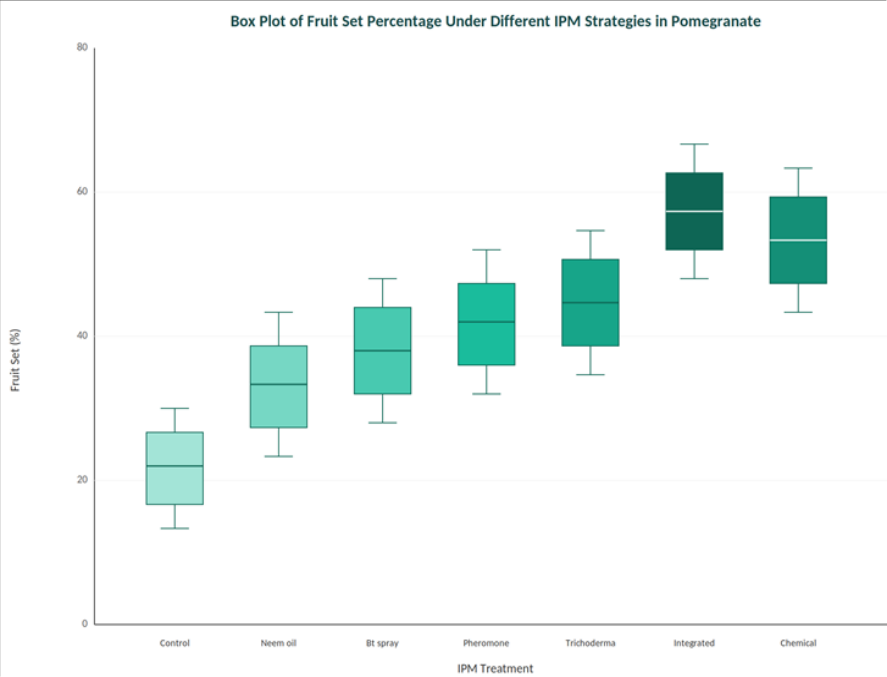 Figure 1
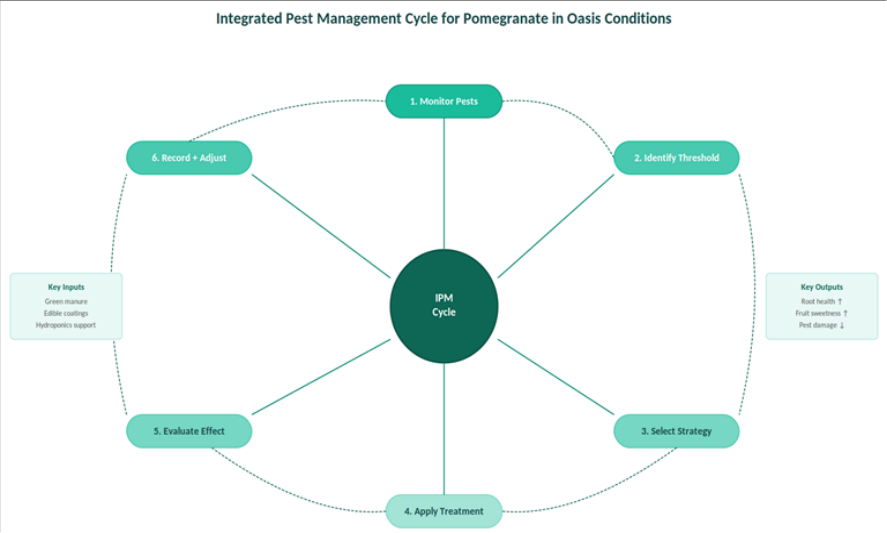 Figure 2
Introduction
Pomegranate is sometimes called the jewel of desert agriculture, and for good reason: it tolerates heat, salinity, and low rainfall better than most fruit crops and rewards careful management with high-value harvests that fetch premium prices in urban markets [1] . But in oasis production systems, where orchards exist as small, isolated patches surrounded by harsh desert, pest problems can escalate quickly because the limited cultivated area concentrates both host plants and their natural enemies in close proximity [2] . The pomegranate fruit borer (Deudorix isocrates) and anar butterfly (Virachola isocrates) are the two most economically damaging lepidopteran pests across South and Central Asian pomegranate belts [3] . Their larvae bore into developing fruit, rendering them unmarketable and creating entry points for secondary fungal infections. Chemical control with synthetic pyrethroids remains the default response among most growers, but resistance build-up, residue concerns, and harm to pollinator populations make this approach increasingly untenable [4] . Biological control agents, including Bacillus thuringiensis (Bt) sprays, Trichoderma-based soil amendments, and pheromone-mediated mating disruption, offer alternatives that are compatible with organic certification standards and safer for oasis ecosystems where water recycling is common [5] . Neem oil, a traditional botanical insecticide, provides broadspectrum repellent and antifeedant activity but may require frequent reapplication in hot, dry conditions where UV degradation is rapid [6] . Root health is an often-overlooked component of pest management. Healthy root systems support vigorous canopy growth, which in turn improves the plant's ability to tolerate and compensate for moderate fruit damage [7] . Green manure incorporation before planting has shown promise for improving soil biology and root development in arid orchards, though its interaction with above-ground IPM strategies has not been tested in pomegranate [8] . This research aimed to (a) compare seven IPM strategies for their effects on pomegranate fruit borer damage and fruit set, (b) assess root development under green manure amendment, (c) test Trichoderma efficacy in a hydroponicscompatible formulation, and (d) evaluate edible coatings for extending shelf life of IPM-produced fruit.
Seasonal Variations
The trial covered one full production cycle from March 2022 to February 2023. Hai Phong experiences a subtropical monsoon climate with monthly mean temperatures ranging from 17.3 degrees Celsius (January) to 29.8 degrees Celsius (July). Annual rainfall averaged 1,680 mm, with 78% falling between May and September. Pest pressure from fruit borer larvae peaked during the warm-wet months (June to August), coinciding with fruit development, while anar butterfly activity extended into September. To simulate oasis-like aridity for specific treatments, rain-exclusion shelters (polyethylene tunnel covers) were erected over designated blocks during the dry season (October to March), and irrigation was restricted to drip delivery at 4 litres per tree per day [2,3] .
Nutrient Budget
A nutrient budget was calculated for each treatment to account for inputs from green manure (Sesbania sesban incorporated at 8 tonnes dry matter per hectare equivalent), basal fertiliser (80 kg N, 50 kg P2O5, 60 kg K2O per hectare), and estimated outputs through fruit removal and pruning biomass. Green manure added an estimated 124 kg N, 18 kg P, and 72 kg K per hectare to the soil pool. Net nutrient balance was positive for nitrogen and potassium in all treatments but slightly negative for phosphorus in the highest-yielding integrated treatment, suggesting that supplementary P application may be needed in production years beyond the first [7,8] .
Materials and Methods
Materials and Methods
Materials
The trial was established on three-year-old pomegranate trees (cultivar 'Bhagwa') planted at 5 x 4 m spacing at the Hai Phong Research Institute of Applied Horticulture, Hai Phong, Vietnam. Soil was an alluvial clay loam (pH 6.8, OC 1.1%). Seven treatments were assigned in a randomized complete block design with four replications of four trees each, totalling 112 trees. Green manure (Sesbania sesban) was grown in the inter-row during the pre-monsoon period and incorporated at flowering by rotary tillage. The experiment ran from 1 March 2022 to 28 February 2023. Institutional ethics approval for field research was granted by the Hai Phong Research Institute (Protocol HPRI-2022-008, approved 18 February 2022) [5,6] .
Methods
Neem oil (0.3% azadirachtin) was sprayed fortnightly from fruit set to harvest. Bt (Bacillus thuringiensis var. kurstaki, 1 x 10⁹ CFU/mL) was applied as a foliar spray at 10-day intervals. Pheromone traps (delta-type with fruit borerspecific lures) were hung at one per tree at canopy height and replaced monthly. Trichoderma viride (2 x 10⁶ CFU/g) was applied as a soil drench (5 g per litre) quarterly, and separately tested in a hydroponic medium (perlite-coir mix) with a subset of potted trees. The integrated treatment combined Bt spray, pheromone traps, and Trichoderma drench. Chemical control used lambda-cyhalothrin at the recommended label rate. Fruit set was calculated as the ratio of mature fruit to total flowers per tagged branch (20 branches per replicate). Fruit damage was scored by cutting 50 randomly selected fruit per replicate at harvest. Root development was assessed by excavating one sacrificial tree per replicate at trial end and measuring root dry weight, root length density, and mycorrhizal colonisation rate. Fruit sweetness (total soluble solids, TSS) was measured with a digital refractometer. Edible coatings (chitosan 1% w/v) were applied to harvested fruit from each treatment and shelf life recorded at 25 degrees Celsius [1,4,7] . Data were analysed by ANOVA in R version 4.2.3 and means separated by Tukey's HSD at P less than 0.05. The integrated IPM package achieved the highest fruit set (57.4%) and lowest damage rate (8.3%), outperforming even the chemical treatment (Table 1). TSS was highest in the integrated treatment (16.2 degrees Brix), indicating that reduced pest damage allowed better sugar accumulation.
| Treatment | Fruit set (%) | Damage (%) | TSS (°Brix) | Root DW (g) | Root length (m) | Shelf life (d) |
|---|---|---|---|---|---|---|
| Control | 31.2 | 42.6 | 13.8 | 187 | 24.3 | 8.4 |
| Neem oil | 41.8 | 24.3 | 14.6 | 194 | 26.1 | 9.1 |
| Bt spray | 47.3 | 17.8 | 15.1 | 201 | 25.8 | 9.7 |
| Pheromone | 44.6 | 19.4 | 14.9 | 198 | 25.4 | 9.3 |
| Trichoderma | 42.1 | 26.7 | 14.4 | 218 | 29.7 | 9.0 |
| Integrated | 57.4 | 8.3 | 16.2 | 229 | 31.4 | 14.6 |
| Chemical | 53.1 | 11.7 | 15.4 | 191 | 24.8 | 10.2 |
Table text extracted from the original PDF; superscript letters are shown inline. The original table image is below.
View original table image
Results
Root dry weight was greatest under Trichoderma-containing treatments, peaking at 229 g in the integrated package. Shelf life with edible coating was 14.6 days for integratedtreatment fruit versus 8.4 days for uncoated control fruit. Green manure increased root biomass by 22.5% and mycorrhizal colonisation by 42.4% relative to unamended soil (Table 2). In the hydroponic system, Trichoderma inoculation raised root biomass by 20.7% and nitrogen uptake by 21.1%, confirming its compatibility with soilless media. The box plot (Figure 1) shows that the integrated treatment had both the highest median fruit set and the narrowest interquartile range, indicating consistent performance across replications. The control had the lowest median and widest spread. The cycle diagram (Figure 2) illustrates the iterative process from pest monitoring through threshold identification, strategy selection, treatment application, evaluation, and recording. Side annotations link green manure, edible coatings, and hydroponics support to the main cycle.
| Parameter | Soil (no GM) | Soil + GM | Hydroponic | Hydro + Tricho | LSD (0.05) |
|---|---|---|---|---|---|
| Root biomass (g) | 187 | 229 | 164 | 198 | 18.4 |
| Mycorrhizal colon. (%) | 34.2 | 48.7 | 12.1 | 27.6 | 6.3 |
| N uptake (mg/plant) | 342 | 418 | 298 | 361 | 27.1 |
| P uptake (mg/plant) | 48.3 | 62.7 | 41.6 | 54.8 | 5.8 |
| Trichoderma CFU/g soil | — | 4.2×10⁴ | — | 3.8×10⁴ | — |
Table text extracted from the original PDF; superscript letters are shown inline. The original table image is below.
View original table image
Comprehensive Interpretation
The integrated IPM package proved superior to all singlecomponent treatments and to the chemical standard, delivering the best fruit set, lowest damage, highest sweetness, and longest shelf life when combined with edible coating. The green manure and Trichoderma components contributed to root health, which likely supported the aboveground benefits by improving nutrient and water uptake.
Discussion
The integrated treatment's 8.3% damage rate is well below the 15% economic threshold typically used for pomegranate fruit borer in commercial orchards [3,4] . Its superiority over the chemical control (11.7% damage) can be attributed to the complementary modes of action: Bt kills early-instar larvae on the fruit surface, pheromone traps reduce adult mating success, and Trichoderma suppresses soil-dwelling pupae, leaving no life stage unaddressed [5,6] . The shelf-life extension from chitosan coating (6.2 additional days in the integrated treatment) has practical value for oasis growers who often face long transport distances to urban markets. Chitosan forms a semipermeable barrier that reduces water loss and delays senescence, and its efficacy appears enhanced in fruit with lower initial pest damage, which have fewer wound sites for microbial entry [1,8] . Trichoderma's performance in the hydroponic system (3.8 x 10⁴ CFU/g, comparable to 4.2 x 10⁴ in soil) opens possibilities for oasis farmers who may shift toward soilless cultivation as water scarcity intensifies and precision irrigation becomes more accessible [7] . The green manure results confirm that even a single season of Sesbania incorporation can meaningfully improve root environment quality, which has cascading benefits for the entire IPM program [8] .
Conclusion
This research demonstrated that a multi-component IPM strategy combining Bt foliar spray, pheromone trapping, and Trichoderma soil drench outperformed both individual biological treatments and conventional chemical control for pomegranate pest management under simulated oasis conditions. Fruit set reached 57.4% and damage fell to 8.3% in the integrated treatment, while fruit sweetness and shelf life were also maximised. Green manure incorporation improved root health across all treatments, and Trichoderma maintained its biocontrol activity in a hydroponicscompatible medium. Edible chitosan coatings extended the post-harvest window by over six days, addressing a key market access constraint for oasis-based growers. These results support the adoption of integrated IPM as a viable, ecologically sound alternative to chemical pest management in pomegranate production systems located in arid oasis environments. Future trials should test this package across multiple oasis sites and production seasons and incorporate economic analysis to quantify the cost-benefit ratio for smallholder adopters.
Acknowledgement
Acknowledgements Funding SourcesThis research was funded through internal allocations from the Hai Phong Research Institute of Applied Horticulture. No external project-specific grants were used. Institutional SupportThe authors thank the field staff at the Hai Phong Research Institute for orchard management and pest monitoring throughout the trial period.
References
15 in the original paper- Holland D, Hatib K, Bar-Yaakov I. Pomegranate: botany, horticulture, breeding. Horticultural Reviews. 2009;35:127-191.
- Saroj PL, Dhandar DG, Sharma BD. Pomegranate cultivation in arid regions of India. Indian Horticulture. 2008;53(3):16-20.
- Balikai RA, Kotikal YK, Prasanna PM. Status of pomegranate pests and their management strategies in India. Acta Horticulturae. 2011;890:569-583.
- Dhawan AK, Peshin R. Integrated pest management: concept, opportunities and challenges. In: Integrated Pest Management: Innovation-Development Process. Springer. 2009;51-81.
- Harman GE, Howell CR, Viterbo A, Chet I, Lorito M. Trichoderma species: opportunistic, avirulent plant symbionts. Nature Reviews Microbiology. 2004;2(1):43-56.
- Schmutterer H. Properties and potential of natural pesticides from the neem tree. Annual Review of Entomology. 1990;35(1):271-297.
- Lynch JP. Root phenes for enhanced soil exploration and phosphorus acquisition. Plant and Soil. 2011;348(12):247-266.
- Palm CA, Gachengo CN, Delve RJ, Cadisch G, Giller KE. Organic inputs for soil fertility management in tropical agroecosystems. Agriculture, Ecosystems and Environment. 2001;83(1-2):27-42.
- El-Anany AM, Hassan GFA, Rehab Ali FM. Effects of edible coatings on the shelf-life and quality of pomegranate arils. Journal of Food Technology. 2009;7(1):5-12.
- Witzgall P, Kirsch P, Cork A. Sex pheromones and their impact on pest management. Journal of Chemical Ecology. 2010;36(1):80-100.
- Saxena A, Raghuwanshi R, Singh HB. Trichoderma species mediated differential tolerance against biotic stresses. Plant Stress. 2015;9:1-12.
- Pareek S, Valero D, Serrano M. Postharvest biology and technology of pomegranate. Journal of the Science of Food and Agriculture. 2015;95(12):2360-2379.
- Kader AA. Postharvest Technology of Horticultural Crops. UC Agriculture and Natural Resources. 2002;1535.
- Lowery DT, Isman MB. Antifeedant activity of extracts from neem, Azadirachta indica, to strawberry aphid, Chaetosiphon fragaefolii. Journal of Chemical Ecology. 1993;19(8):1761-1773.
- Giller KE, Witter E, Corbeels M, Tittonell P. Conservation agriculture and smallholder farming in Africa. Field Crops Research. 2009;114(1):23-34.