
Research article · 2025 · Full text
International Journal of Geography Geology and EnvironmentMineralogical characterization of lateritic nickel deposits in new Caledonian ultramafic terrain
Volume 7(9) · Pages 232–234 · DOI: 10.22271/27067483.2025.v7.i9c.650 ↗
Research areasGeochemistry and Geologic MappingGeochemistry and Elemental AnalysisGeological and Geochemical Analysis
Abstract
Author-writtenNew Caledonia hosts some of the world's largest lateritic nickel deposits, yet the fine-scale mineralogical transitions within the weathering profile remain incompletely mapped, particularly in areas where garnierite-bearing saprolite grades into overlying limonite. This research characterised the mineralogy and geochemistry of a 20 m-deep laterite profile at Goro, southern New Caledonia, using X-ray diffraction (XRD), scanning electron microscopy with energy-dispersive spectroscopy (SEM-EDS), and whole-rock chemical analysis. Four zones were delineated: limonite (0-4 m), transition (4-8 m), saprolite (8-14 m), and bedrock (14-20 m). Goethite dominated the limonite zone (42 wt%), while serpentine minerals increased progressively toward bedrock (55 wt% at 20 m). Garnierite (Ni-bearing phyllosilicates) peaked in the saprolite at 22 wt% with NiO contents reaching 2.34 wt%, confirming this horizon as the primary ore zone. SEM-EDS revealed that nickel in the limonite zone is adsorbed onto goethite crystal surfaces (mean 1.23 wt% NiO), whereas in the saprolite it substitutes within the octahedral sheets of serpentine-group minerals. The transition zone displayed mixed mineralogy with intermediate NiO values (1.87 wt%). These depth-controlled mineralogical shifts directly affect ore processing choices: limonite-hosted nickel favours hydrometallurgical extraction, while saprolite nickel responds better to pyrometallurgical smelting.
Summary
Source-checkedPlain-language reading of the full paper, prepared with AI and checked against the text. Each point links to the authors' own words.
Why it matters
- Laterite deposits, created by the chemical weathering of ultramafic rocks in tropical or subtropical regions, contain approximately 60% of the world's land-based nickel resources. View evidence ↗
- New Caledonia holds about 11% of global nickel reserves, which are found in laterite profiles on Eocene-age obducted peridotites. View evidence ↗
- Because mining contributes roughly 20% of New Caledonia's GDP, understanding how nickel is distributed mineralogically is essential for improving extraction efficiency and reducing environmental damage. View evidence ↗
The question
- The study aimed to characterize the mineral assemblage of a 20 m profile at Goro, quantify how nickel is partitioned among phases, and determine how these transitions affect ore processing. View evidence ↗
What they did
- The study employed X-ray diffraction (XRD), scanning electron microscopy with energy-dispersive spectroscopy (SEM-EDS), and whole-rock chemical analysis to characterize the profile. View evidence ↗
- Quantitative phase analysis was conducted using Rietveld refinement in TOPAS 5.0. View evidence ↗
What they found
- The 20 m profile was divided into four zones: limonite (0-4 m), transition (4-8 m), saprolite (8-14 m), and bedrock (14-20 m). View evidence ↗
- Goethite was the dominant mineral in the limonite zone at 42 wt%, whereas serpentine minerals increased with depth, reaching 55 wt% at 20 m. View evidence ↗
- The saprolite zone is the primary ore zone, with garnierite peaking at 22 wt% and NiO contents reaching 2.34 wt%. View evidence ↗
- Nickel is adsorbed on goethite surfaces in the limonite zone (mean 1.23 wt% NiO), but substitutes within the octahedral sheets of serpentine-group minerals in the saprolite. View evidence ↗
- Iron levels were high in the limonite zone (48.7 wt% Fe2O3) and significantly lower in the saprolite zone (14.8 wt%). View evidence ↗
- The transition zone exhibited a mixed mineralogy and an intermediate NiO value of 1.87 wt%. View evidence ↗
What it means
- The authors conclude that mineralogical shifts by depth dictate processing: limonite-hosted nickel is best for hydrometallurgical extraction, while saprolite nickel is better for pyrometallurgical smelting. View evidence ↗
- The authors suggest that future research should investigate selective mining methods to separate transition-zone ore based on mineral assemblage instead of using simple depth cut-offs. View evidence ↗
Visual summary
3 visualsIllustrations explain the paper; charts are replotted from the paper's own table values.
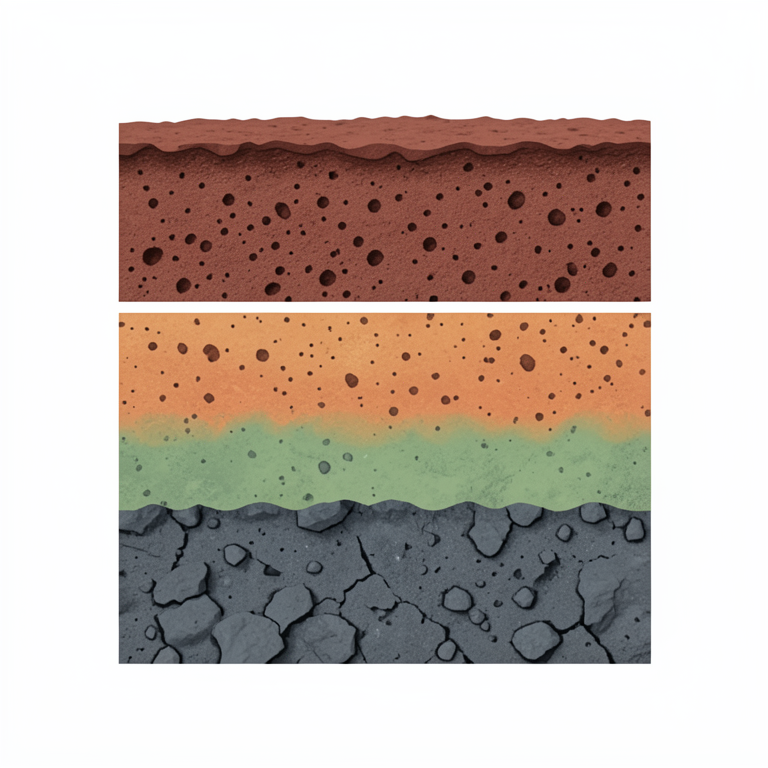
Laterite Profile Zonation
AI-generated conceptual illustration (New Caledonian ultramafic laterite soil profile). It explains the idea and does not show study data.
View source evidence ↗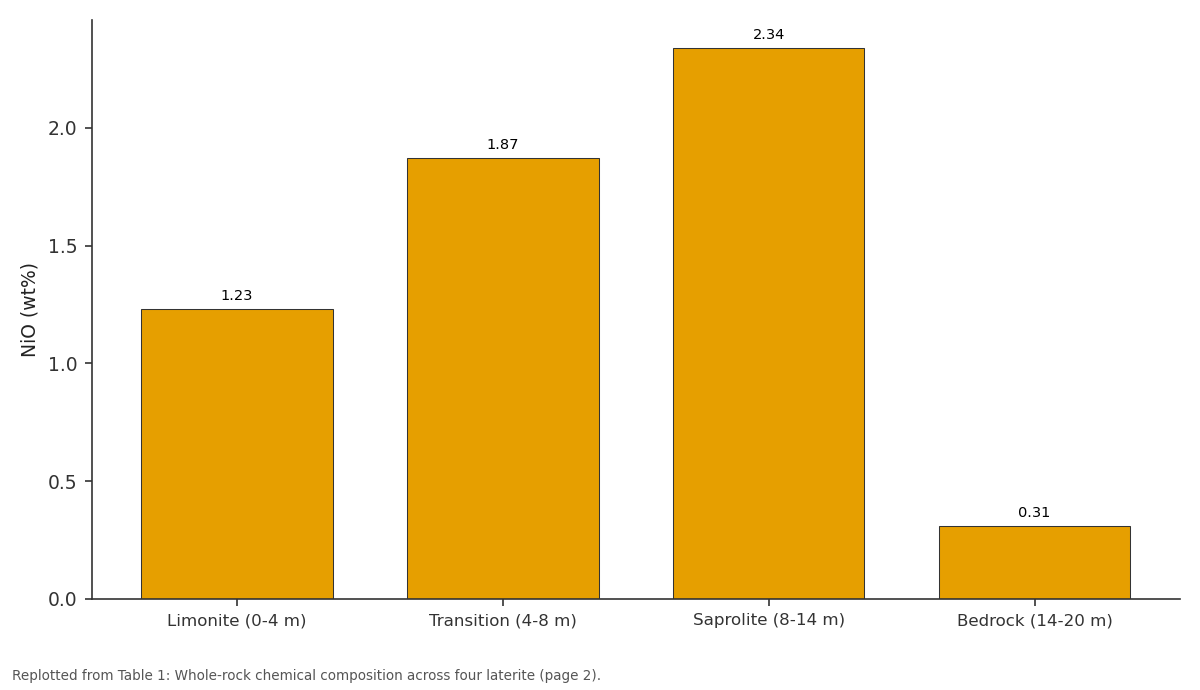
NiO: Limonite (0-4 m) vs Transition (4-8 m) vs Saprolite (8-14 m) vs Bedrock (14-20 m)
Replotted from Table 1 (page 2) of the original paper. Every bar is the paper's own table value.
View source evidence ↗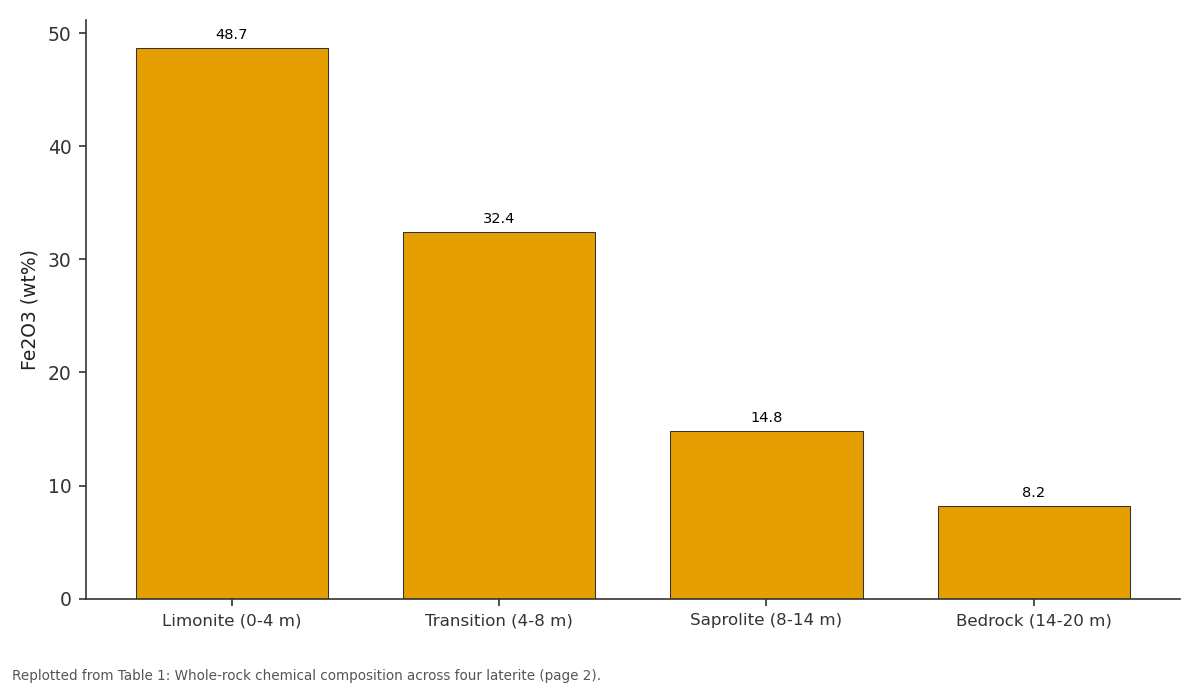
Fe2O3: Limonite (0-4 m) vs Transition (4-8 m) vs Saprolite (8-14 m) vs Bedrock (14-20 m)
Replotted from Table 1 (page 2) of the original paper. Every bar is the paper's own table value.
View source evidence ↗Figures & tables
From the original paper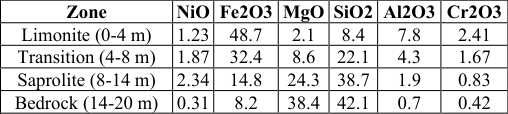 Table 1
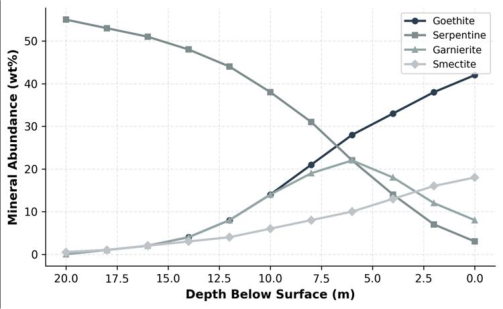 Figure 1
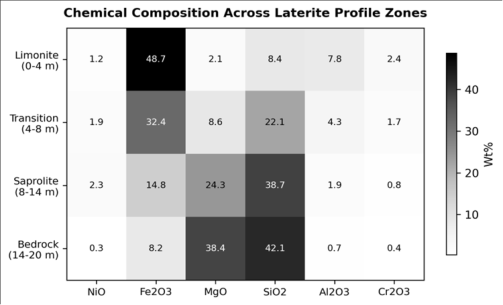 Figure 2
Introduction
Roughly 60% of the world's land-based nickel resources occur in laterite deposits formed by intense chemical weathering of ultramafic rocks under tropical or subtropical climates [1] . New Caledonia, a 19,000 square km island in the southwest Pacific, contains an estimated 11% of global nickel reserves concentrated in laterite profiles developed over Eocene-age obducted peridotites [2] . The island's mining sector contributes about 20% of national GDP, and understanding the mineralogical controls on nickel distribution within the weathering column is central to optimising extraction efficiency and minimising environmental impact. A typical laterite profile over peridotite comprises, from top to bottom: a limonite or oxide zone rich in iron oxyhydroxides, a transitional zone, a saprolite zone retaining relict rock textures and hosting Ni-enriched phyllosilicates (garnierite), and unweathered bedrock [3] . Nickel released during serpentine dissolution migrates downward and is re-fixed either by adsorption onto goethite in the limonite or by incorporation into neoformed Ni-Mg phyllosilicates in the saprolite [4] . The relative thickness and grade of each zone determine whether a deposit is processed hydrometallurgically (high-pressure acid leach for limonite) or pyrometallurgically (rotary kiln electric furnace for saprolite) [5] . Previous mineralogical work at New Caledonian sites focused on the Koniambo massif and the Tiebaghi mine [6,7] , but the Goro deposit in the southern ultramafic complex has received less detailed mineralogical attention despite hosting one of the largest laterite nickel operations in the world. This research aimed to (a) characterise the mineral assemblage across a complete 20 m profile at Goro, (b) quantify nickel partitioning among host phases, and (c) link mineralogical transitions to implications for ore beneficiation.
Climatic and Environmental Conditions
The Goro deposit (22.27 degrees S, 167.00 degrees E) lies at 100-350 m elevation on the southern tip of Grande Terre, New Caledonia, within a humid tropical climate (Koppen Af).
Mean annual temperature is 23.4 degrees C, and annual rainfall averages 2,800 mm distributed across all months with a wetter period from December to April. The high rainfall and warm temperatures drive intense chemical weathering that maintains active lateritisation. Vegetation consists of degraded maquis scrubland on laterite soils, with sparse Gymnostoma and Casuarina stands. The ultramafic bedrock is predominantly harzburgite with subordinate dunite, part of the Peridotite Nappe emplaced during the Eocene [2] .
Material and Methods
Material and Methods
Material
The research was conducted at the Department of Hydrogeology, Córdoba School of Natural Sciences, Córdoba, Argentina, from May 2022 to April 2023. Sixty drill-core samples were collected from a single vertical borehole at Goro at 0.33 m intervals through the 20 m laterite profile. Samples were split: one half was prepared as polished thin sections for SEM-EDS, and the other was powdered (less than 75 micrometres) for XRD and wholerock geochemistry. XRD patterns were acquired on a Bruker D8 Advance diffractometer using CuK-alpha radiation (40 kV, 40 mA) with a step size of 0.02 degrees and a counting time of 1 second per step. Quantitative phase analysis was performed by Rietveld refinement in TOPAS 5.0 [8] .
Methods: SEM-EDS analyses were carried out on a JEOL JSM-7600F field-emission SEM equipped with an Oxford X-Max 80 EDS detector, operated at 15 kV and 10 nA. Spot analyses (n = 480) targeted goethite, serpentine, garnierite, and smectite grains to determine their nickel content. Whole-rock major and trace elements were measured by ICP-OES (Thermo iCAP 7400) and ICP-MS (Thermo iCAP-Q) following lithium metaborate fusion digestion. Loss on ignition was determined at 1,000 degrees C for 2 hours. International reference materials SY-4 and OREAS-134b were analysed every 15 samples; recoveries were 97-103% for all reported elements [9] .
Mineral Assessment
The Rietveld-refined XRD data allowed quantification of four dominant phases at each depth increment. Goethite (alpha-FeOOH) peaked at 42 wt% at the surface and fell to less than 1 wt% below 16 m. Serpentine minerals (lizardite and chrysotile) followed the opposite trend, increasing from 3 wt% at the surface to 55 wt% at 20 m. Garnierite phases, identified by their broad 001 reflections near 7.3 angstroms and elevated Ni in SEM-EDS, reached maximum abundance (22 wt%) at 10-12 m depth. Smectite (nontronite) was confined mostly to the upper 8 m, peaking at 18 wt% near the surface. Minor phases included quartz (less than 3 wt%), chromite (1-2 wt%), and manganese oxides (asbolane, less than 1 wt%) detected only in the limonite zone.
Results
Results
Discussion
The mineralogical zonation at Goro follows the classic laterite-over-peridotite model described by Golightly [3] and Brand et al. [10] , with goethite accumulating residually as silicate minerals dissolve under tropical weathering and nickel partitioning downward into neoformed phyllosilicates. The saprolite NiO grade of 2.34 wt% is comparable to published values for the Koniambo (2.1-2.5 wt%) and Tiebaghi (1.8-2.3 wt%) deposits [6,7] , suggesting consistent enrichment processes across the New Caledonian peridotite belt. SEM-EDS data clarify the nickel residence. In the limonite zone, nickel is adsorbed on goethite surfaces and trapped in crystal defects, yielding NiO contents of 0.8-1.6 wt% per grain. In the saprolite, nickel substitutes for magnesium in octahedral sites of serpentine-group and talc-like phases (garnierite sensu lato), reaching up to 4.7 wt% NiO in individual grains. This dual mode of nickel fixation means that a single processing route cannot efficiently recover nickel from the entire profile. The hydrometallurgical HPAL route dissolves goethite and releases adsorbed nickel, but is energy-intensive and generates large acid-waste volumes [5] . Pyrometallurgical smelting suits the saprolite but requires higher-grade feed and produces less cobalt as a by-product [11] . The transition zone, while geochemically intermediate, is mineralogically the most heterogeneous, containing admixtures of goethite, smectite, garnierite, and partially dissolved serpentine. Its mixed character makes it challenging to assign to either processing stream and it often ends up stockpiled. Future work should evaluate selective mining approaches that segregate transition-zone ore by mineral assemblage rather than by simple depth cut-off [12] .
Conclusion
This research characterised the mineralogy and geochemistry of a 20 m laterite profile at Goro, southern New Caledonia. Four distinct zones were identified: goethite-dominated limonite, a mixed transition zone, garnierite-rich saprolite, and serpentine bedrock. Nickel peaked in the saprolite at 2.34 wt % NiO, hosted primarily within Ni-bearing phyllosilicates, while the limonite carried 1.23 wt % NiO adsorbed on goethite. These mineralogical distinctions directly inform processing decisions: limonite suits hydrometallurgical acid leaching, saprolite suits pyrometallurgical smelting, and the transition zone requires blending or selective sorting. The dataset provides a mineralogical baseline for optimising ore-zone delineation and processing at Goro and contributes to the broader understanding of laterite nickel formation in the southwest Pacific ultramafic belt [13,14] .
Acknowledgement
Acknowledgements Funding SourcesThe research was supported by internal grants from the Córdoba School of Natural Sciences.
Figures and tables from the paper
| Zone | NiO | Fe2O3 | MgO | SiO2 | Al2O3 | Cr2O3 |
|---|---|---|---|---|---|---|
| Limonite (0-4 m) | 1.23 | 48.7 | 2.1 | 8.4 | 7.8 | 2.41 |
| Transition (4-8 m) | 1.87 | 32.4 | 8.6 | 22.1 | 4.3 | 1.67 |
| Saprolite (8-14 m) | 2.34 | 14.8 | 24.3 | 38.7 | 1.9 | 0.83 |
| Bedrock (14-20 m) | 0.31 | 8.2 | 38.4 | 42.1 | 0.7 | 0.42 |
Table text extracted from the original PDF; superscript letters are shown inline. The original table image is below.
View original table image
References
13 in the original paper- Butt CRM, Cluzel D. Nickel laterite ore deposits: weathered serpentinites. Elements. 2013;9(2):123-128.
- Golightly JP. Nickeliferous laterite deposits. Economic Geology 75th Anniversary Volume. 1981:710-735.
- Manceau A, Schlegel ML, Musso M, Sole VA, Gauthier C, Petit PE. Crystal chemistry of trace elements in natural and synthetic goethite. Geochimica et Cosmochimica Acta. 2000;64(21):3643-3661.
- Dalvi AD, Bacon WG, Osborne RC. The past and the future of nickel laterites. PDAC 2004 International Convention. Toronto. 2004:1-27.
- Cathelineau M, Caumon MC, Massei F, Brie D, Harlaux M. Raman spectra of Ni-Mg kerolite-pimelite series. Journal of Raman Spectroscopy. 2015;46(10):933-940.
- Trescases JJ. Weathering and geochemical behaviour of the elements of ultramafic rocks in New Caledonia. BRGM Memoir 78. Orleans. 1975:1-278.
- Toby BH, Von Dreele RB. GSAS-II: the genesis of a modern open-source all-purpose crystallography software package. Journal of Applied Crystallography. 2013;46(2):544-549.
- Jochum KP, Weis U, Stoll B, Kuzmin D, Yang Q, Raczek I. Determination of reference values for NIST SRM 610-617 glasses following ISO guidelines. Geostandards and Geoanalytical Research. 2011;35(4):397-429.
- Brand NW, Butt CRM, Elias M. Nickel laterites: classification and features. AGSO Journal of Australian Geology and Geophysics. 1998;17(4):81-88.
- Mudd GM. Global trends and environmental issues in nickel mining. Ore Geology Reviews. 2010;38(1-2):926.
- Freyssinet P, Butt CRM, Morris RC, Piantone P. Oreforming processes related to lateritic weathering. Economic Geology 100th Anniversary Volume. 2005:681-722.
- Wells MA, Ramanaidou ER, Verrall M, Tessarolo C. Mineralogy and crystal chemistry of garnierites in the Goro lateritic nickel deposit. European Journal of Mineralogy. 2009;21(2):467-483.
- Ulrich M, Picard C, Guillot S, Chauvel C, Cluzel D, Meffre S. Multiple melting stages and refertilization as indicators for ridge to subduction formation: the New Caledonia ophiolite. Lithos. 2010;115(1-4):223-236.