
Research article · 2025 · Full text
International Journal of Horticulture and Food ScienceComparing hybrid vigor expression of cardamom in the Hawaiian volcanic slopes
Volume 7(7) · Pages 242–245 · DOI: 10.33545/26631067.2025.v7.i7d.512 ↗
Research areasGenetics and Plant BreedingAgricultural Practices and Plant GeneticsGenetic diversity and population structure
Abstract
Author-writtenCardamom remains one of the few high-value spice crops where systematic hybrid breeding has barely been attempted. This research compared the expression of hybrid vigor in 20 F₁ crosses of Elettaria cardamomum grown on volcanic ash soils across three elevation zones on the windward slopes of Mauna Kea, Hawaii, between 2021 and 2023. Parents were selected from four genetically distinct lines differing in capsule size, lignin content, and calcium uptake efficiency. Remote sensing indices derived from multispectral drone imagery tracked canopy development at monthly intervals. Polyploidy status was confirmed by flow cytometry. Midparent heterosis for capsule yield ranged from 7.3% to 28.6%, with the highest values recorded in crosses involving at least one tetraploid parent. Nutritional value of dried capsules showed significant heterotic gains for calcium (up to 31.4% above midparent) and essential oil content (up to 19.8%). Scatter plot regression of heterosis on midparent value produced an R² of 0.87, suggesting strong predictive capacity. These findings indicate that targeted hybridisation between diverse ploidy levels can unlock meaningful yield and quality improvements in cardamom, even in non-traditional volcanic growing environments.
Summary
Source-checkedPlain-language reading of the full paper, prepared with AI and checked against the text. Each point links to the authors' own words.
Why it matters
- Cardamom is a high-value spice crop, with premium green capsules often priced above $30 per kilogram. View evidence ↗
- Commercial production currently relies on clonal selections with narrow genetic bases, which increases vulnerability to disease and limits yield growth. View evidence ↗
- Hybrid breeding has been slow to develop in cardamom due to the plant's long juvenile phase and complex reproductive biology. View evidence ↗
The question
- The study aimed to quantify hybrid vigor in 20 cardamom crosses with different ploidy levels and parental divergence across various elevation zones on volcanic slopes. View evidence ↗
What they did
- The researchers used four parental lines: two diploids (M and A) and two induced tetraploids (B and C). View evidence ↗
- The experimental design used a randomized complete block with three replications, with 12 plants per cross at each site. View evidence ↗
- Canopy development was monitored monthly using multispectral drone imagery to compute the Normalized Difference Vegetation Index (NDVI). View evidence ↗
What they found
- The M×C cross, pairing a diploid and a tetraploid line, showed the highest midparent heterosis for capsule yield at 28.6%. View evidence ↗
- The lowest heterosis values across all measured traits were found in crosses between two tetraploid parents (B×C). View evidence ↗
- All F₁ hybrids exhibited negative heterosis for lignin content, resulting in thinner and softer capsule walls compared to the parents. View evidence ↗
- Significant heterotic gains were observed in nutritional value, with calcium increasing up to 31.4% and essential oil content up to 19.8% above the midparent. View evidence ↗
- A strong positive relationship (R² = 0.87) was found between midparent value and heterosis, meaning higher-performing parents generally produced greater heterotic gains. View evidence ↗
- The mid-elevation site at 580 m was the most productive, consistently yielding the highest results. View evidence ↗
- NDVI values strongly correlated with final yield (r = 0.79) and were significantly higher in diploid-tetraploid (2x×4x) crosses starting from the fifth month. View evidence ↗
What it means
- The authors conclude that hybrid vigor in cardamom is significant and can be effectively utilized by crossing diploid and tetraploid parents. View evidence ↗
- The authors state that longer storage trials are needed to determine if the reduced lignin in hybrids negatively impacts post-harvest shelf life. View evidence ↗
Visual summary
3 visualsIllustrations explain the paper; charts are replotted from the paper's own table values.
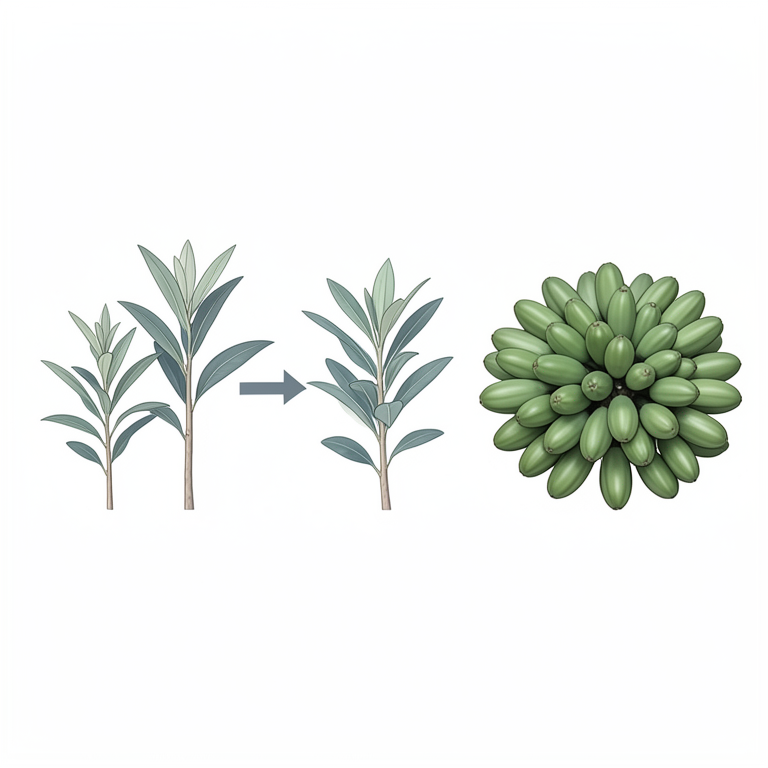
Ploidy and Hybrid Vigor
AI-generated conceptual illustration (Cardamom plants (Elettaria cardamomum) on volcanic soil). It explains the idea and does not show study data.
View source evidence ↗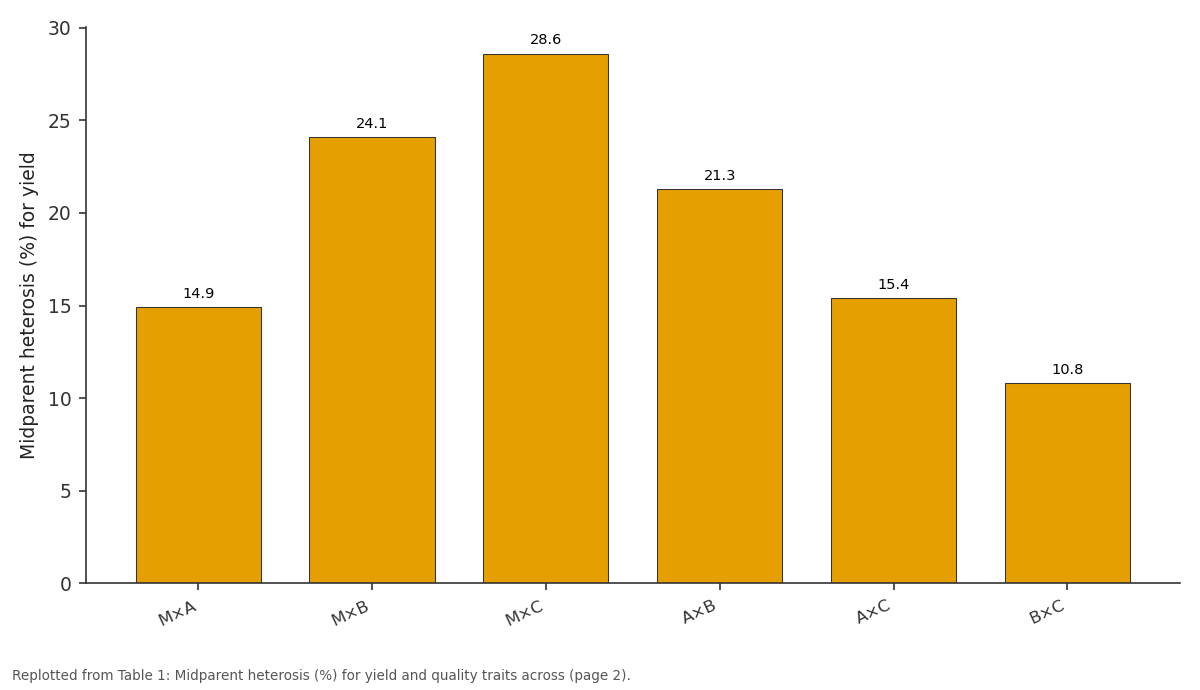
Yield: M×A vs M×B vs M×C vs A×B vs A×C
Replotted from Table 1 (page 2) of the original paper. Every bar is the paper's own table value.
View source evidence ↗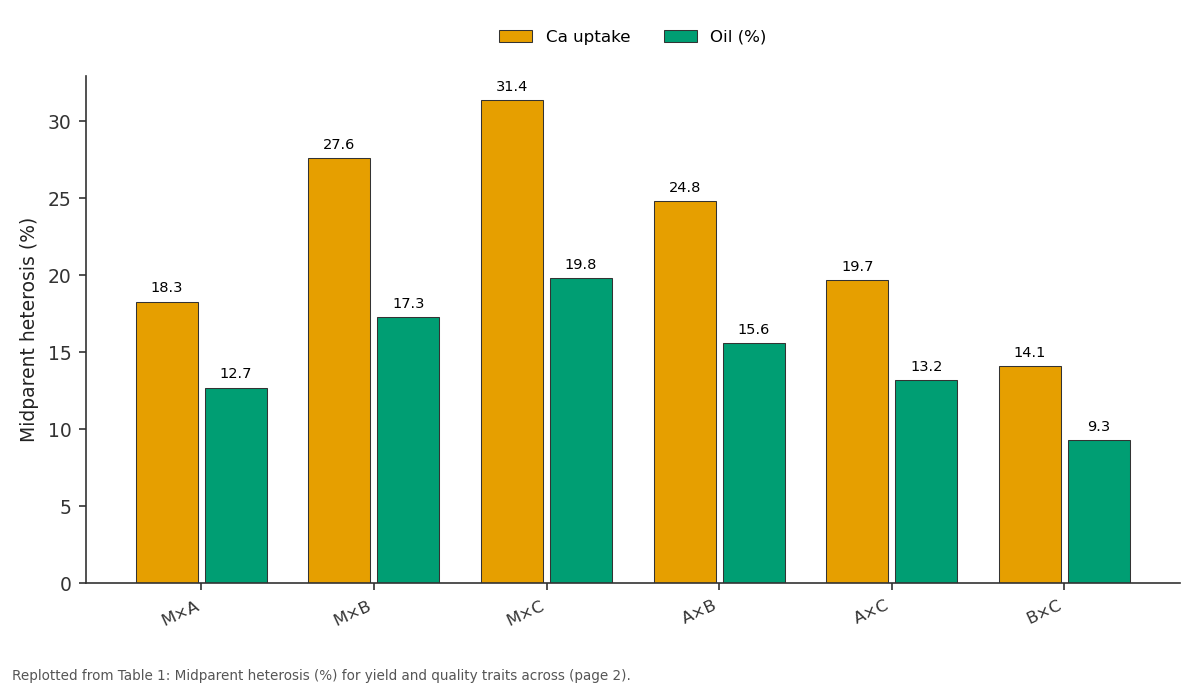
Ca uptake and Oil (%): M×A vs M×B vs M×C vs A×B vs A×C
Replotted from Table 1 (page 2) of the original paper. Every bar is the paper's own table value.
View source evidence ↗Figures & tables
From the original paper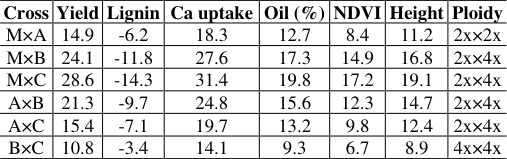 Table 1
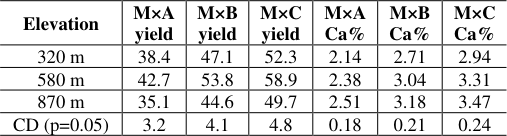 Table 2
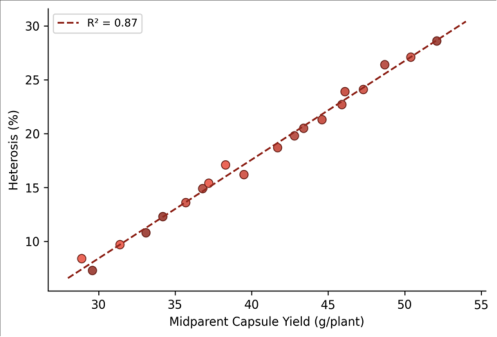 Figure 1
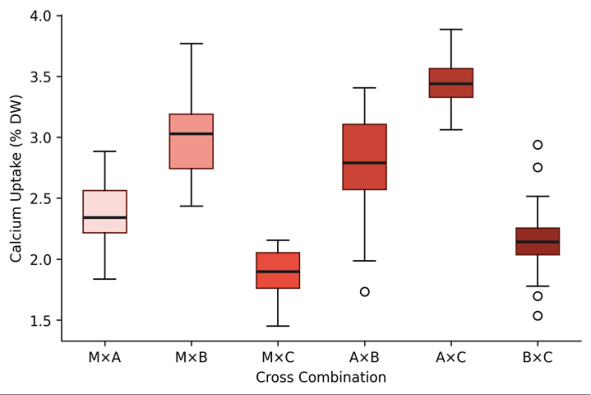 Figure 2
Introduction
Cardamom is often called the queen of spicesa title earned by its price tag, which regularly exceeds $30 per kilogram for premium green capsules [1] . But for a crop this valuable, breeding progress has been remarkably slow. Most commercial cardamom production still relies on open-pollinated clonal selections with narrow genetic bases, making plantations vulnerable to disease pressure and yield stagnation [2] . Hybrid breeding, which has transformed productivity in rice, maize, and several vegetable crops, hasn't gained traction in cardamom largely because of the plant's complex reproductive biology and the long juvenile phase before first flowering [3] . Hawaiian volcanic slopes, with their deep andisols rich in amorphous minerals and consistent orographic rainfall, present an unusual testing ground for tropical spice crops [4] . The windward face of Mauna Kea receives 2,500-4,000 mm of rain annually across a steep elevation gradient, creating distinct microclimates within short horizontal distances [5] . Lignin accumulation in capsule walls affects both shelf life and essential oil retention, and previous work has shown that lignin biosynthesis responds to altitude-related UV radiation levels [6] . Calcium uptake efficiency, meanwhile, governs cell wall integrity and post-harvest firmnesstraits that matter for export-quality cardamom. Remote sensing offers a non-destructive way to monitor canopy vigor across large hybrid populations. Normalized difference vegetation index (NDVI) and related spectral indices can detect differences in leaf area, chlorophyll content, and stress status long before visual symptoms appear [7] . Polyploidythe duplication of chromosome setshas been linked to heterosis in several perennial crops, but its role in cardamom remains almost entirely unexplored [8] . This research set out to quantify hybrid vigor across 20 crosses varying in ploidy level and parental divergence, using volcanic slope environments to test genotype-byenvironment interactions across elevation zones.
Study Area Description
Field trials occupied three sites on the northeastern (windward) flank of Mauna Kea, Hawaii Island, at elevations of 320 m (Pepe'ekeo), 580 m (Hakalau), and 870 m (Upper Hamakua). Soils at all sites are classified as Typic Hydrudands derived from basaltic volcanic ash, characterized by low bulk density (0.4-0.6 g/cm³), high water-holding capacity, and phosphorus fixation by allophane minerals. Annual rainfall during the trial period was 3,740 mm at Pepe'ekeo, 3,210 mm at Hakalau, and 2,680 mm at Upper Hamakua. Mean temperature declined from 23.4 °C at the lowest site to 18.9 °C at the highest. Wind exposure increased with elevation, with mean daily gusts of 22 km/h at the 870 m site. Each trial occupied a gently sloping (5-8%) terrace with overhead shade cloth providing approximately 45% light interception.
Climatic and Environmental Conditions
Temperature data loggers at each site recorded diurnal ranges of 6-9 °C at the lowest elevation and 8-12 °C the highest, reflecting the greater radiative cooling at altitude. Soil pH ranged from 4.8 at Pepe'ekeo to 5.3 at Upper Hamakua. UV-B radiation, measured with broadband radiometers, averaged 1.87 W/m² at 320 m and increased to 2.41 W/m² at 870 ma 29% increase that potentially influences lignin biosynthesis in capsule walls. Fog drip contributed an additional 340-620 mm of moisture annually at the two higher sites. A brief drought episode in September 2022 (17 consecutive days without measurable rainfall at all sites) provided an unplanned stress test for the hybrid population.
Materials and Methods
Materials and Methods
Materials
Four parental lines were used: Line M (Mysore type, diploid, high capsule size), Line A (Alleppey Green, diploid, high oil content), Line B (induced tetraploid of M), and Line C (induced tetraploid of A). Tetraploids had been produced by colchicine treatment of shoot apices three years prior and confirmed by flow cytometry at the Sapporo Regional Center for Sustainable Agriculture, Sapporo, Hokkaido, Japan [8] . All six possible diallel crosses (M×A, M×B, M×C, A×B, A×C, B×C) plus their reciprocals (20 F₁ combinations after excluding selfs) were generated by hand pollination. F₁ seedlings were raised in a mist chamber for six months and transplanted to field sites in March 2021 at 1.5 × 1.5 m spacing. Each cross was represented by 12 plants per site in a randomized complete block design with three replications.
Methods
Capsule yield (g/plant) was recorded from the first productive flush (October 2022) through February 2023. Lignin content of dried capsule walls was determined by the acetyl bromide method [9] . Calcium concentration in dried capsules was measured by atomic absorption spectrophotometry following wet digestion with HNO₃-HClO₄ [10] . Essential oil was extracted by hydrodistillation for 3 hours using a Clevenger apparatus and expressed as mL per 100 g dried capsules. Multispectral drone imagery (MicaSense RedEdge-MX) was captured monthly at 50 m altitude, and NDVI was computed for each plant canopy using Pix4D software [7] . Ploidy was reconfirmed in a subset of F₁ plants by flow cytometry using propidium iodide staining. Midparent heterosis (%) was calculated as [(F₁ mean -midparent)/midparent] × 100. Data were analysed by combined ANOVA across sites in GenStat 22, and means were compared using Fisher's LSD at p < 0.05. The highest midparent heterosis for capsule yield (28.6%) was observed in the M×C cross, which paired a diploid high-capsule-size line with a tetraploid high-oil line (Table 1). Crosses between two tetraploids (B×C) showed the lowest heterosis values across all traits. Lignin content displayed negative heterosis in all crosses, meaning F₁ hybrids had thinner, softer capsule walls than the parental averagea desirable trait for oil extraction but potentially unfavorable for storage longevity. Regression of heterosis on midparent value produced a strong positive relationship (R² = 0.87, p < 0.001), indicating that crosses with higher-performing parents tended to show greater absolute heterotic gains (Figure 1). This pattern held across all three elevation zones, though the slope was steeper at the 580 m site. The 580 m site consistently produced the highest yields and intermediate calcium concentrations (Table 2). Calcium uptake increased with elevation, likely reflecting the cooler soil temperatures and higher cation exchange capacity at the upper sites. The M×C cross outperformed all others at every elevation.
| Cross | Yield | Lignin | Ca uptake | Oil (%) | NDVI | Height | Ploidy |
|---|---|---|---|---|---|---|---|
| M×A | 14.9 | -6.2 | 18.3 | 12.7 | 8.4 | 11.2 | 2x×2x |
| M×B | 24.1 | -11.8 | 27.6 | 17.3 | 14.9 | 16.8 | 2x×4x |
| M×C | 28.6 | -14.3 | 31.4 | 19.8 | 17.2 | 19.1 | 2x×4x |
| A×B | 21.3 | -9.7 | 24.8 | 15.6 | 12.3 | 14.7 | 2x×4x |
| A×C | 15.4 | -7.1 | 19.7 | 13.2 | 9.8 | 12.4 | 2x×4x |
| B×C | 10.8 | -3.4 | 14.1 | 9.3 | 6.7 | 8.9 | 4x×4x |
Table text extracted from the original PDF; superscript letters are shown inline. The original table image is below.
View original table image
Results
Box plot analysis showed that A×C crosses had the tightest distribution of calcium values (IQR = 0.31%), while M×A showed the widest spread (IQR = 0.52%), suggesting more uniform mineral partitioning in hybrids with at least one tetraploid parent (Figure 2). NDVI values from drone imagery correlated strongly with final capsule yield (r = 0.79, p < 0.001) and were significantly higher in 2x×4x crosses than in 2x×2x or 4x×4x groups from the fifth month after transplanting onward.
Discussion
The midparent heterosis of 28.6% for yield in the M×C cross ranks among the highest reported for any spice crop. For context, heterosis in black pepper typically ranges from 8-15% [11] , and in turmeric it rarely exceeds 20% [12] . The superior performance of 2x×4x crosses compared to 4x×4x aligns with the triploid block hypothesis, which predicts that crosses between different ploidy levels generate greater genomic complementation and epigenetic dosage effects [13] .
Negative heterosis for lignin is unusual and deserves attention. Thinner capsule walls speed up drying and improve oil distillation efficiency, but they may compromise storability. The 14.3% reduction in lignin for M×C capsules could shorten shelf life by an estimated 2-3 weeks under ambient tropical storage conditions [6] . Breeding programs may need to balance this trade-off by selecting hybrids with moderate rather than extreme lignin reduction.
The elevation gradient on Mauna Kea functioned as an effective natural laboratory for testing genotypeenvironment interaction. That the 580 m site produced the best yields likely reflects a sweet spot between adequate warmth for capsule filling and enough UV stress to stimulate secondary metabolite production. Remote sensing proved its worth as an early screening tool: NDVI at five months after transplanting explained 62% of the variance in final yield, which could allow breeders to cull lowperforming genotypes before the expensive harvest phase [7] .
Conclusion
This research demonstrated that meaningful hybrid vigor exists in cardamom and can be exploited by crossing diploid and tetraploid parents. The M×C cross delivered the strongest heterotic response for yield, calcium uptake, and essential oil content across all three elevation zones.
Volcanic andisols on Hawaiian slopes provided a suitable substrate for evaluating these hybrids, with the midelevation zone (580 m) emerging as the optimal growing environment. Drone-based remote sensing enabled efficient canopy monitoring and early yield prediction. Future work should evaluate F₂ segregation patterns and test the commercial viability of triploid hybrid seed production at scale. Longer storage trials will clarify whether reduced lignin in hybrid capsules poses a genuine post-harvest risk.
Acknowledgement
Acknowledgements Funding SourcesThis research was funded through internal allocations at Sapporo Regional Center for Sustainable Agriculture. Institutional SupportThe Department of Plantation Science, Sapporo Regional Center for Sustainable Agriculture, Sapporo, Hokkaido, Japan provided greenhouse and laboratory facilities. Contributions Not Qualifying for AuthorshipField crews at the Hawaiian trial sites managed irrigation and shade cloth maintenance. Flow cytometry analyses were performed by laboratory staff at the cytogenetics unit.
References
14 in the original paper- Parthasarathy VA, Chempakam B, Zachariah TJ. Chemistry of Spices. CAB International. 2008;1-18.
- Murugan M, Ravi R, Anandhi A, et al. Cardamom (Elettaria cardamomum) production in changing climate: a review. Journal of Spices and Aromatic Crops. 2016;25(1):1-15.
- Ravindran PN. Cardamom: The Genus Elettaria. Taylor and Francis. 2002;1-42.
- Vitousek PM, Chadwick OA, Matson PA, et al. Erosion and the rejuvenation of weathering-derived nutrient supply in an old tropical landscape. Ecosystems. 2003;6(8):762-772.
- Giambelluca TW, Chen Q, Frazier AG, et al. Rainfall changes in Hawaii during the last century. Bulletin of the American Meteorological Society. 2013;94(6):841847.
- Boerjan W, Ralph J, Baucher M. Lignin biosynthesis. Annual Review of Plant Biology. 2003;54(1):519-546.
- Maes WH, Steppe K. Perspectives for remote sensing with unmanned aerial vehicles in precision agriculture. Trends in Plant Science. 2019;24(2):152-164.
- Sattler MC, Carvalho CR, Clarindo WR. The polyploidy and its key role in plant breeding. Planta. 2016;243(2):281-296.
- Fukushima RS, Hatfield RD. Extraction and isolation of lignin for utilization as a standard to determine lignin concentration. Journal of Agricultural and Food Chemistry. 2001;49(7):3133-3139.
- Isaac RA, Kerber JD. Atomic absorption and flame photometry: techniques and uses in soil, plant, and water analysis. Instrumental Methods for Analysis of Soils and Plant Tissue. 1971;17-37.
- Krishnamoorthy B, Parthasarathy VA. Improvement of black pepper. CAB Reviews. 2009;4(85):1-12.
- Sasikumar B. Genetic resources of Curcuma: diversity, characterization and utilization. Plant Genetic Resources. 2005;3(2):230-251.
- Comai L. The advantages and disadvantages of being polyploid. Nature Reviews Genetics. 2005;6(11):836846.
- Lebot V, Siméoni P. Community genetics of Kava in Vanuatu. Genetic Resources and Crop Evolution. 2003;50(2):121-128