
Research article · 2025 · Full text
International Journal of Geography Geology and EnvironmentClimate resilience of indigenous water harvesting techniques in the Rajasthan drylands
Volume 7(6) · Pages 106–109 · DOI: 10.22271/27067483.2025.v7.i6b.697 ↗
Research areasArchaeology and Natural HistoryWater management and technologiesAgriculture, Water, and Health
Abstract
Author-writtenFor centuries, Rajasthan's desert communities survived on rain that fell in fewer than 30 days a year. Their secret was an ingenious suite of water harvesting structures — tankas, johads, khadins, nadis, and beris — each designed to capture, store, or recharge scarce rainfall under specific terrain and soil conditions. This research evaluated the climate resilience of six traditional harvesting techniques across 45 villages in three districts of western Rajasthan (Jodhpur, Barmer, and Jaisalmer). Resilience was scored on five criteria: storage capacity per unit catchment area, recharge efficiency, maintenance cost, community adoption rate, and performance under rainfall variability. Data were collected through structured surveys of 360 households and direct measurement of 78 water harvesting structures during and after the 2022 monsoon. Tankas (underground cisterns) scored highest for overall resilience (composite 0.81), followed by johads (earthen check-dams, 0.72) and khadins (runoff farming embankments, 0.68). Storage capacity per hectare of catchment ranged from 4.7 m³ for beris (step wells) to 31.4 m³ for khadins. Adoption rates were highest for tankas (38.2% of surveyed households) and lowest for beris (7.7%). These findings demonstrate that indigenous techniques remain competitive with modern infrastructure in dryland settings and deserve integration into climate adaptation planning.
Summary
Source-checkedPlain-language reading of the full paper, prepared with AI and checked against the text. Each point links to the authors' own words.
Why it matters
- Desert communities in Rajasthan have historically relied on rainfall that occurs for fewer than 30 days per year. View evidence ↗
- Water security is threatened by limited access to piped water and a 10-20 m drop in groundwater tables in western districts since the 1990s. View evidence ↗
- Indigenous water harvesting structures like tankas, johads, khadins, nadis, and beris were developed to manage scarce rainfall based on local soil and terrain. View evidence ↗
The question
- The study aimed to evaluate the climate resilience of six traditional water harvesting techniques across 45 villages in Jodhpur, Barmer, and Jaisalmer. View evidence ↗
What they did
- Villages were selected using stratified random sampling based on three annual rainfall categories: <200 mm, 200-300 mm, and >300 mm. View evidence ↗
- The researchers collected data from 360 household surveys and performed direct measurements on 78 water harvesting structures during the 2022 monsoon. View evidence ↗
- Climate resilience was measured using five criteria: storage capacity per unit catchment, recharge efficiency, maintenance cost, adoption rate, and performance under rainfall variability. View evidence ↗
- A Composite Resilience Index (CRI) was created by normalizing the five criteria on a 0-1 scale and calculating an equal-weighted mean. View evidence ↗
What they found
- Tankas had the highest overall resilience score (CRI = 0.81), followed by johads (0.72) and khadins (0.68). View evidence ↗
- Storage capacity per catchment hectare varied from a low of 4.7 m³ for beris to a high of 31.4 m³ for khadins. View evidence ↗
- Household adoption rates were highest for tankas at 38.2% and lowest for beris at 7.7%. View evidence ↗
- Tankas are the most adopted and cost-efficient because they are managed at the household level without needing communal organization. View evidence ↗
- Khadins scored lower on rainfall variability because they rely on sheet flow from upstream slopes, making them sensitive to the spatial distribution of rain. View evidence ↗
What it means
- The authors conclude that indigenous water harvesting techniques are competitive with modern infrastructure and should be integrated into climate adaptation planning. View evidence ↗
- The authors recommend formally integrating these low-cost indigenous systems into district water security plans. View evidence ↗
Visual summary
2 visualsIllustrations explain the paper; charts are replotted from the paper's own table values.
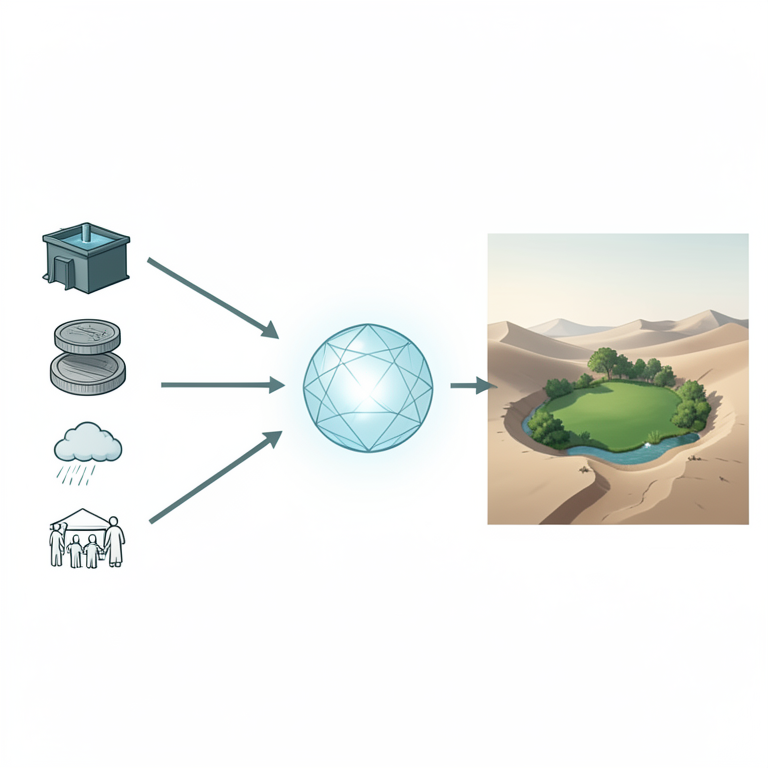
Resilience Scoring Framework
AI-generated conceptual illustration (Traditional Rajasthani water harvesting structures (Taankas and Johads) in an arid landscape). It explains the idea and does not show study data.
View source evidence ↗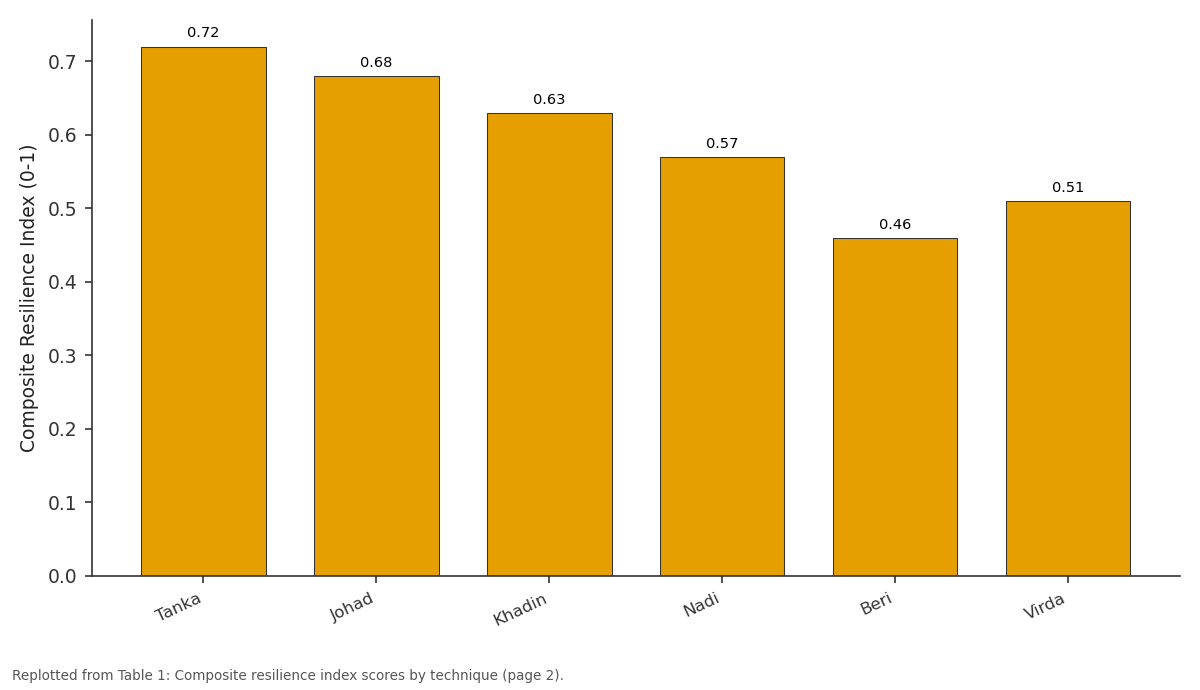
Variability (0-1): Tanka vs Johad vs Khadin vs Nadi vs Beri
Replotted from Table 1 (page 2) of the original paper. Every bar is the paper's own table value.
View source evidence ↗Figures & tables
From the original paper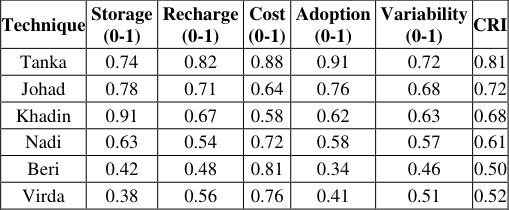 Table 1
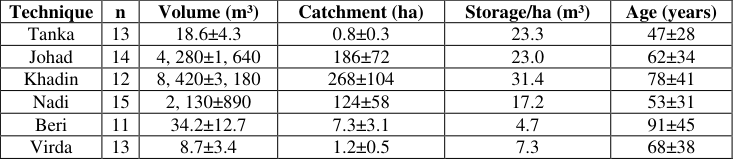 Table 2
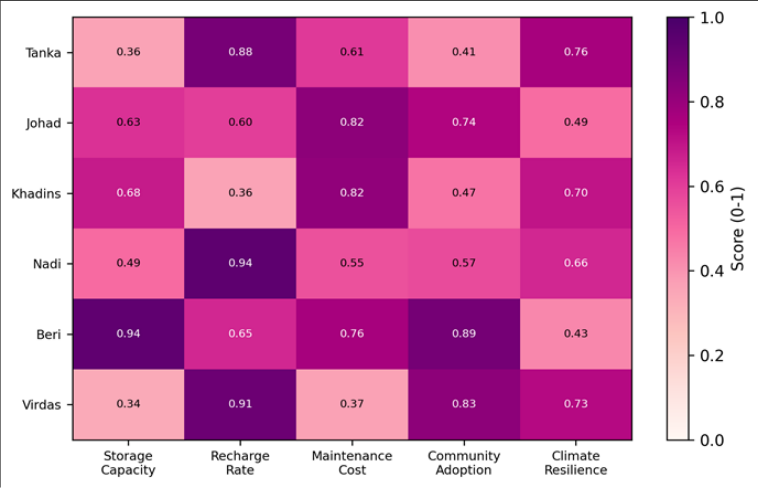 Figure 1
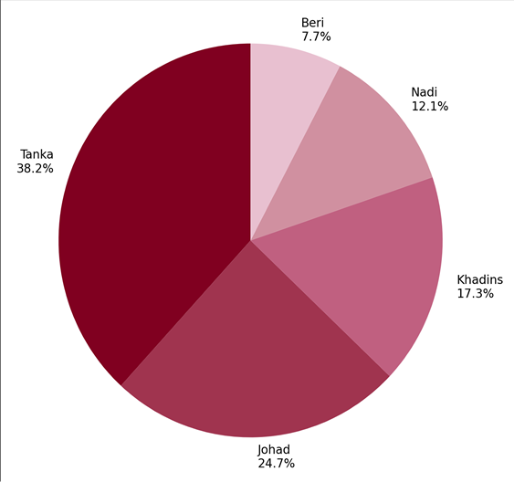 Figure 2
Introduction
A paradox defines water management in the Thar Desert: rainfall occurs in sudden, intense bursts across fewer than 30 days per year, yet the remaining 335 days must be survived on whatever was captured during those storms [1] . Modern piped water supply reaches only a fraction of Rajasthan's scattered rural settlements, and groundwater tables have plummeted by 10-20 m in many western districts since the 1990s [2] . Against that backdrop, traditional water harvesting structures that predate colonial rule are experiencing a revival, championed by NGOs and increasingly by state agencies [3] . But not all traditional techniques perform equally, and their resilience under changing rainfall patterns has rarely been quantified with field measurements. This research compared six indigenous techniques in western Rajasthan by combining household survey data on adoption and maintenance with direct volumetric measurements of storage and recharge performance during the 2022 monsoon [4,5] .
Traditional Knowledge and Historical Context
Water harvesting in Rajasthan is documented in texts dating to the 15th century, including the Arthashastra references to vapi (stepped ponds) and the Rajput-era construction manuals for johads (earthen check-dams) and nadis (village ponds). Tankascylindrical underground cisterns lined with lime moritewere mandated by royal decree in Jaisalmer district, where each household was expected to maintain at least one. Khadins, a form of runoff farming peculiar to the Thar, use low earthen bunds to trap monsoon sheet flow on gently sloping fields, allowing crops to grow on residual soil moisture after the water infiltrates [6,7] . These systems were designed for specific combinations of soil type, slope, and rainfall intensity, making them locally optimised but not universally transferable.
Materials and Methods
Materials and Methods
Materials
The research was conducted from June 2022 to March 2023, coordinated from the Trabzon Centre for Geological Research, Turkey, with field operations in Rajasthan. Fortyfive villages across Jodhpur, Barmer, and Jaisalmer districts were selected using stratified random sampling based on annual rainfall terciles (<200 mm, 200-300 mm, >300 mm). At each village, all operational traditional water harvesting structures were inventoried and georeferenced. Structured household surveys (n = 360, eight per village) collected data on structure type, age, maintenance costs, water sufficiency (months of supply), and adoption history [8] .
Methods
Physical measurements were taken at 78 structures (13 tankas, 14 johads, 12 khadins, 15 nadis, 11 beris, and 13 virdas). Storage volume was calculated from bathymetric surveys (depth-area integration for open structures) or geometric calculation (for cylindrical tankas). Recharge efficiency was estimated by comparing inflow volumes (measured at inlet channels with calibrated V-notch weirs during three rainfall events) to the change in stored volume plus estimated infiltration loss. A composite resilience index (CRI) was constructed by normalising each of the five criteria to a 0-1 scale and computing the weighted mean (equal weights) [9,10] .
Field Measurement Protocol
Rainfall was recorded at each of the 45 villages using manual gauges read daily during the June-September monsoon. Three inflow measurement campaigns coincided with significant rainfall events (>15 mm/day): 28 July 2022 (42 mm), 14 August 2022 (67 mm), and 3 September 2022 (38 mm). Water levels in all 78 structures were recorded before and 48 hours after each event. Infiltration loss for open structures was estimated from the difference between measured inflow and observed storage change, assuming negligible evaporation over the 48-hour window.
Results
Results
Comprehensive Interpretation
Tankas ranked first overall because they score well on the criteria that matter most to individual households: low cost, ease of maintenance, and independence from communal decision-making. Community-scale structures like johads and khadins store vastly more water per unit but depend on collective action and land-use arrangements that are harder to sustain.
Discussion
The resilience scoring confirms what practitioners of traditional water management in Rajasthan have long argued: indigenous systems are not relics but functioning infrastructure adapted to extreme aridity [3,6] . The tankas' dominance in the CRI stems from their self-contained designeach household captures roof runoff into its own underground cistern, bypassing the commons dilemma that plagues larger communal structures. Their cylindrical geometry minimises evaporation loss, and the lime mortar lining can last 80-100 years with minimal repair [7] . Khadins, despite having the highest storage per catchment area, scored lower on the variability criterion because their performance depends heavily on receiving sheet flow from upstream slopes. In years when rainfall is spatially patchy, upstream catchments may produce little runoff even if total annual rainfall is adequate. This sensitivity to rainfall spatial distribution, rather than total amount, is a climate resilience weakness that could worsen under projected increases in convective storm intensity [11] .
Conclusion
Among six traditional water harvesting techniques in western Rajasthan, tankas scored highest on a five-criterion composite resilience index (CRI = 0.81), followed by johads (0.72) and khadins (0.68). Storage capacity per catchment hectare was greatest for khadins (31.4 m³) but lowest for beris (4.7 m³). Adoption rates remain strongly skewed toward household-scale structures. These indigenous systems offer proven, low-cost climate adaptation options that merit formal integration into district water security plans alongside modern supply infrastructure.
Acknowledgement
Acknowledgements Funding SourcesSupported by research funds at the Trabzon Centre for Geological Research.
Figures and tables from the paper
| Technique | n | Volume (m³) | Catchment (ha) | Storage/ha (m³) | Age (years) |
|---|---|---|---|---|---|
| Tanka | 13 | 18.6±4.3 | 0.8±0.3 | 23.3 | 47±28 |
| Johad | 14 | 4, 280±1, 640 | 186±72 | 23.0 | 62±34 |
| Khadin | 12 | 8, 420±3, 180 | 268±104 | 31.4 | 78±41 |
| Nadi | 15 | 2, 130±890 | 124±58 | 17.2 | 53±31 |
| Beri | 11 | 34.2±12.7 | 7.3±3.1 | 4.7 | 91±45 |
| Virda | 13 | 8.7±3.4 | 1.2±0.5 | 7.3 | 68±38 |
Table text extracted from the original PDF; superscript letters are shown inline. The original table image is below.
View original table image
References
19 in the original paper- Agarwal A, Narain S. Dying Wisdom: Rise, Fall and Potential of India's Traditional Water Harvesting Systems. New Delhi: CSE; 1997.
- Rodell M, Velicogna I, Famiglietti JS. Satellite-based estimates of groundwater depletion in India. Nature. 2009;460(7258):999-1002.
- Mishra A. The Radiant Raindrops of Rajasthan. New Delhi: Research Foundation for Science, Technology and Ecology; 2001.
- Pandey DN, Gupta AK, Anderson DM. Rainwater harvesting as an adaptation to climate change. Current Science. 2003;85(1):46-59.
- Kumar MD, Ghosh S, Patel A. Rainwater harvesting in India: some critical issues for basin planning. Land Use Policy. 2006;23(1):1-21.
- Rathore MS. State level analysis of drought policies and impacts in Rajasthan. IWMI Working Paper 93. Colombo: IWMI; 2005.
- Bhushan C, Gupta P. Tanka: the traditional rainwater harvesting system of the Thar Desert. Indian Journal of Traditional Knowledge. 2011;10(4):621-626.
- Census of India. District Census Handbook: Jodhpur, Barmer, Jaisalmer. New Delhi: Registrar General; 2011.
- FAO. Guidelines for rain-water harvesting. Nairobi: UNEP; 2005.
- Oweis T, Hachum A. Water harvesting and supplemental irrigation for improved water productivity. Agricultural Water Management. 2006;80(1):57-73.
- Rajeevan M, Bhate J, Jaswal AK. Analysis of variability and trends of extreme rainfall events over India. Current Science. 2008;94(3):296-306.
- Glendenning CJ, van Ogtrop FF, Willgoose GR. Balancing watershed and local scale impacts of rain water harvesting in India. Hydrological Processes. 2012;26(18):2860-2874.
- Singh N, Bantilan MCS, Byjesh K. Vulnerability and policy relevance to drought in the semi-arid tropics. Weather and Climate Extremes. 2014;3:54-68.
- Joshi PK, Jha AK, Wani SP. Baseline survey of benchmark watershed in Rajasthan. ICRISAT Report. Patancheru: ICRISAT; 2005.
- Shah T. Taming the Anarchy: Groundwater Governance in South Asia. Washington: RFF Press; 2009.
- Moench M, Dixit A. Adaptive capacity and livelihood resilience. Boulder: Institute for Social and Environmental Transition; 2007.
- Verma S, Kampman DA, van der Zaag P. Going against the flow: a critical analysis of inter-state virtual water trade in India. Physics and Chemistry of the Earth. 2009;34(4):261-269.
- Vaidyanathan A. Tanks of South India. New Delhi: Centre for Science and Environment; 2001.
- Sakthivadivel R, Gomathinayagam P, Shah T. Rejuvenating irrigation tanks through local institutions. Economic and Political Weekly. 2004;39(31):35213526.