
Research article · 2025 · Full text
International Journal of Horticulture and Food ScienceEnhancing weed management strategies of pistachio in the Tierra del Fuego
Volume 7(7) · Pages 266–269 · DOI: 10.33545/26631067.2025.v7.i7d.521 ↗
Research areasWeed Control and Herbicide ApplicationsAllelopathy and phytotoxic interactionsIrrigation Practices and Water Management
Abstract
Author-writtenMost pistachio growers worldwide rely on herbicides for weed control, but growing concerns about herbicide residues in nuts and soil health degradation have pushed the search for sustainable alternatives. This research evaluated six weed management strategies — manual weeding, cover cropping, straw mulching, chemical herbicide, integrated management, and no-till — in a pistachio (Pistacia vera) orchard established on peat-bog margins of Tierra del Fuego, Argentina, during 2021-2023. Gene action for weed competitiveness traits was estimated through a half-diallel cross of four rootstock genotypes. Organic farming practices were compared with conventional approaches for both weed suppression and nut quality. Rootstock selection experiments quantified the influence of root architecture on nutrient and water uptake in this challenging sub-Antarctic environment. Ethnobotanical surveys among local growers documented traditional weed management knowledge. Soil and water quality monitoring revealed that peat-derived soils had naturally low pH (4.3-5.1) and high organic carbon (8.7-14.2%), creating unique weed community dynamics. A nutrient budget showed that no-till plots retained 27% more soil nitrogen over two years compared to conventionally tilled plots, though at the cost of 36% higher weed biomass during the vegetative growth stage.
Summary
Source-checkedPlain-language reading of the full paper, prepared with AI and checked against the text. Each point links to the authors' own words.
Why it matters
- Climate change in northern Tierra del Fuego, including a 1.3 °C rise in summer temperatures and an 18-day extension of the frost-free period, makes the region a viable area for testing cold-hardy pistachio cultivars. View evidence ↗
- Weed management is a significant expense, accounting for 15-25% of production costs, and there is a need for alternatives to herbicides due to regulatory pressure and the impracticality of manual weeding. View evidence ↗
- On fragile peat-bog soils, cover crops and mulches are valuable because they provide moisture retention, nitrogen fixation, and erosion control in addition to suppressing weeds. View evidence ↗
The question
- The study aimed to develop integrated weed management recommendations for pistachio in the extreme southern environment of Tierra del Fuego by combining genetic, agronomic, and cultural perspectives. View evidence ↗
What they did
- The trial used forty 5-year-old Kerman pistachio trees on UCB-1 rootstock, organized in a randomized complete block design with four replications for six different weed management treatments. View evidence ↗
- Management strategies included a clover and ryegrass cover crop (15 kg/ha), straw mulch (10 cm depth, ~8 t/ha), glyphosate herbicide (1.44 kg a.i./ha twice yearly), and an integrated approach combining all three. View evidence ↗
- To analyze gene action for weed competitiveness, a half-diallel cross was performed using four rootstock genotypes: UCB-1, PG-II, Atlantica, and a local Pistacia atlantica seedling. View evidence ↗
- The researchers conducted semi-structured interviews with 14 smallholders in the Ushuaia region to gather ethnobotanical data on traditional orchard management. View evidence ↗
What they found
- The integrated weed management strategy resulted in the best productivity, achieving the highest nut yield of 3.21 kg/tree and a kernel percentage of 52.4%. View evidence ↗
- Using herbicide alone was the most effective method for reducing weed density, bringing it down to 8.1 plants/m². View evidence ↗
- Straw mulch was the second most effective strategy for yield and weed suppression, producing 36% higher yields than manual weeding. View evidence ↗
- No-till plots retained 27% more soil nitrogen than conventionally tilled plots, with only 14 kg N/ha lost compared to 38 kg N/ha in tilled plots, due to reduced mineralization of peat organic matter. View evidence ↗
- While beneficial for nitrogen, no-till farming alone was insufficient for weed control, as it resulted in 36% higher weed biomass during the vegetative growth stage. View evidence ↗
- Genetic analysis showed that UCB-1 had positive general combining ability (GCA) for canopy area and root spread, while Atlantica was superior for weed suppression; the local seedling was a poor combiner for all traits. View evidence ↗
- Ethnobotanical surveys found that 9 out of 14 local growers used kelp (Macrocystis pyrifera) as a traditional mulch for fruit trees to suppress weeds and provide nutrients. View evidence ↗
What it means
- The authors conclude that an integrated approach using cover crops, straw mulch, and targeted herbicides is the most effective strategy for pistachio yield and quality on peat-margin soils in Tierra del Fuego. View evidence ↗
- The authors recommend using UCB-1 and Atlantica as parents for rootstock breeding to improve weed competitiveness, as this trait is primarily governed by additive gene action. View evidence ↗
Visual summary
3 visualsIllustrations explain the paper; charts are replotted from the paper's own table values.
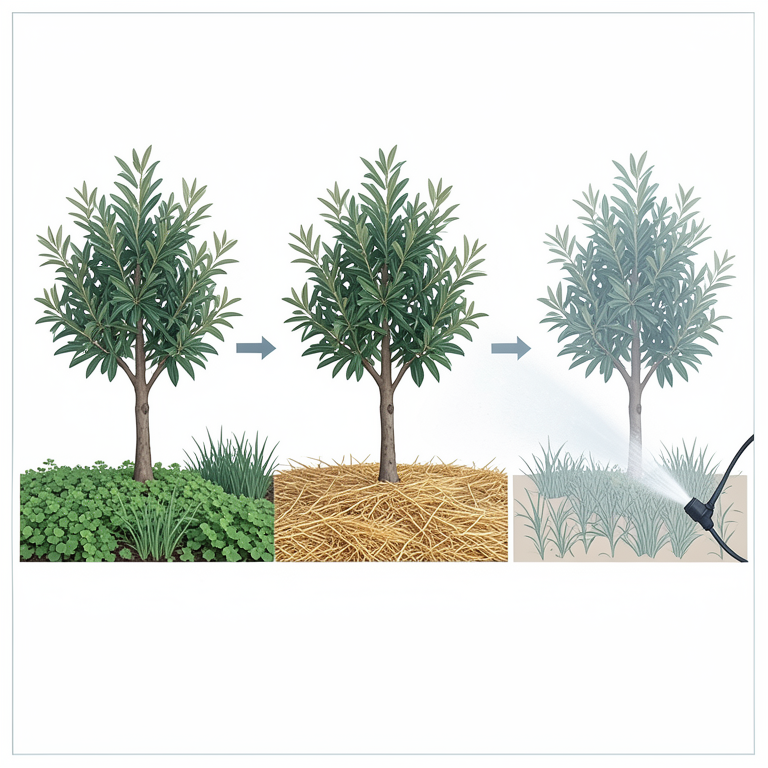
Integrated Weed Management Components
AI-generated conceptual illustration (pistachio trees in an orchard). It explains the idea and does not show study data.
View source evidence ↗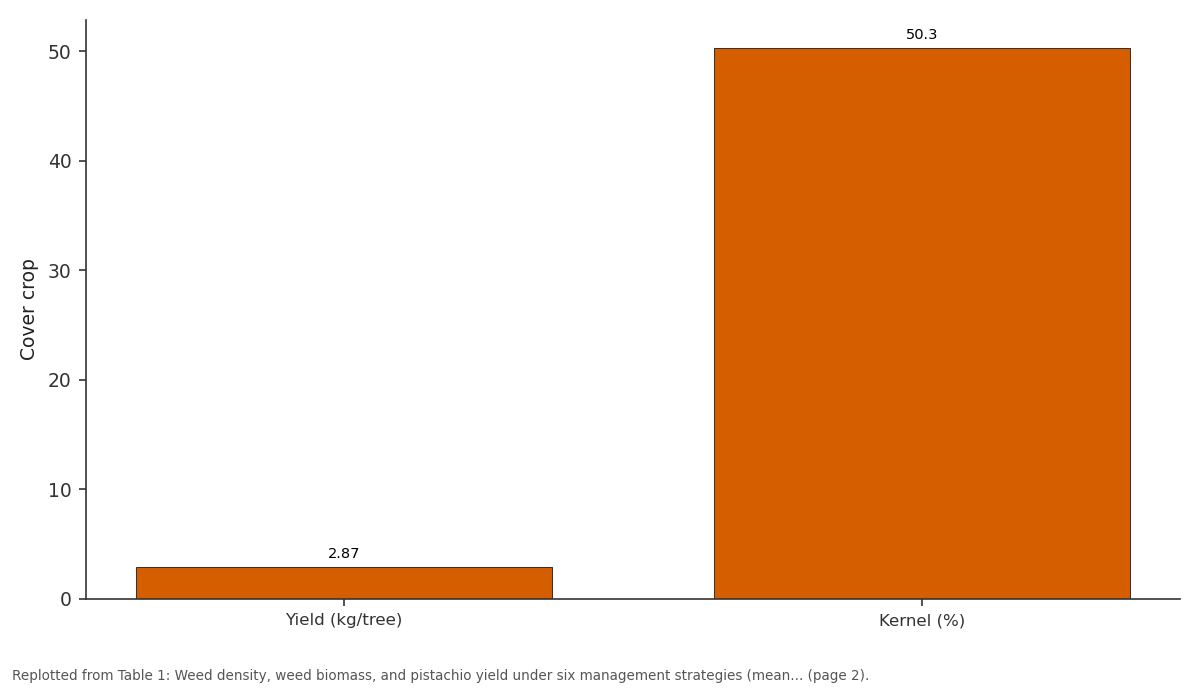
Cover crop: Yield (kg/tree) vs Kernel (%)
Replotted from Table 1 (page 2) of the original paper. Every bar is the paper's own table value.
View source evidence ↗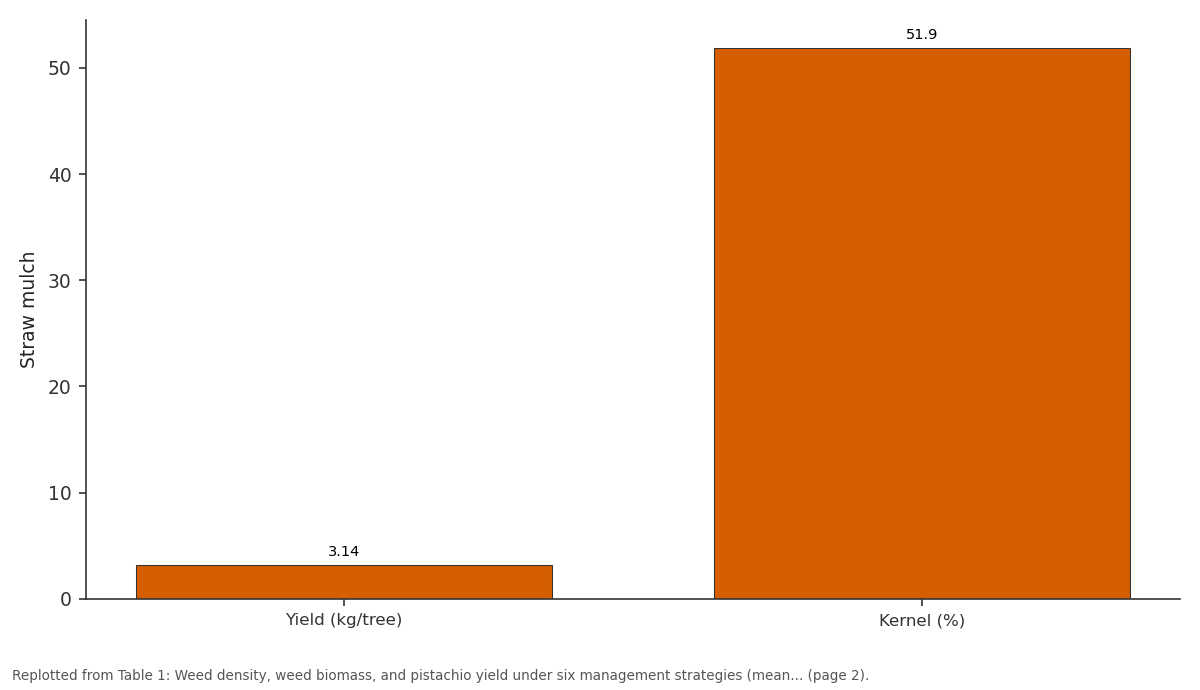
Straw mulch: Yield (kg/tree) vs Kernel (%)
Replotted from Table 1 (page 2) of the original paper. Every bar is the paper's own table value.
View source evidence ↗Figures & tables
From the original paper Table 1
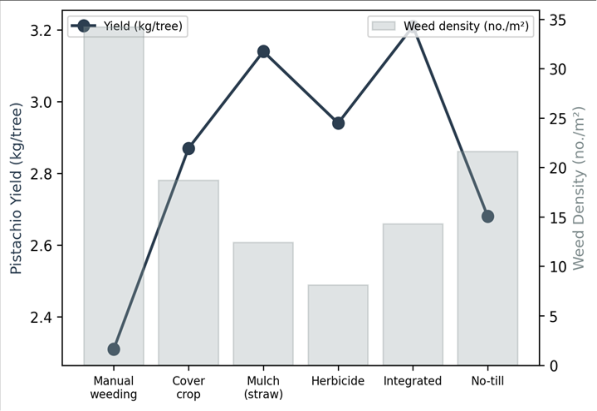 Figure 1
 Table 2
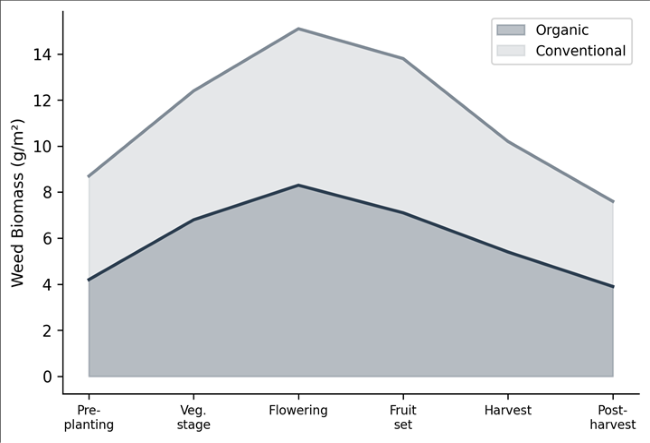 Figure 2
Introduction
An expert familiar with pistachio cultivation might reasonably ask: why attempt to grow a warm-temperate nut crop at 54°S latitude? The answer lies in changing climate boundaries. Mean summer temperatures in northern Tierra del Fuego have risen by 1.3 °C since 1980, and the frost-free period has extended by approximately 18 days [1] . These shifts, combined with pistachio's surprising cold hardiness (some cultivars tolerate -25 °C when dormant), make marginal-zone testing worth pursuing [2] . Weed management in perennial nut orchards consumes 15-25% of total production costs in most growing regions [3] . Herbicide-dependent systems face mounting regulatory pressure in export markets, while manual weeding is labour-intensive and impractical at scale. Cover crops and mulches offer soil health benefits beyond weed suppressionmoisture retention, nitrogen fixation, and erosion controlthat are especially valuable on fragile peat-bog soils [4] . No-till systems conserve soil structure and reduce carbon loss from organic soils, but their weed control efficacy in tree nut orchards is poorly documented [5] . Gene action analysis through diallel crosses can reveal whether rootstock traits that enhance weed competitivenesslike rapid canopy closure and aggressive root spreadare governed by additive or non-additive genetic effects, guiding the choice of breeding strategy [6] . Ethnobotanical knowledge from communities that have managed sub-Antarctic landscapes for centuries can complement scientific approaches with locally adapted practices [7] . This research brought together these genetic, agronomic, and cultural perspectives to develop integrated weed management recommendations for pistachio in an extreme southern growing environment.
Soil and Water Quality Analysis
Trial plots were located on the northern fringe of a raised peat bog near Ushuaia (54.81°S, 68.32°W; elevation 45 m). Peat-derived soils at the site were classified as Fibric Histosols with organic carbon of 8.7-14.2%, total N of 0.6-0.9%, and pH of 4.3-5.1substantially more acidic than the pH 6.5-7.5 range preferred by pistachio. Lime (CaCO₃) was applied at 5 t/ha to raise pH to approximately 5.8-6.2 in the root zone. Soil moisture content was consistently high (45-68% by volume) owing to the peat's water-holding characteristics. Water table depth fluctuated between 30 cm (winter) and 65 cm (summer). Drainage channels were installed at 3 m intervals to maintain a minimum root-zone aeration depth of 40 cm. Irrigation water from a glacial-fed stream had EC of 0.12 dS/m, pH 6.4, and was essentially free of dissolved salts.
Nutrient Budget
Over two growing seasons, nitrogen inputs from fertiliser application (60 kg N/ha/year as ammonium sulphate) and biological N fixation by cover crop legumes (estimated at 28 kg N/ha/year in the clover-planted plots) totalled 148 kg N/ha. Plant N uptake by pistachio trees averaged 34 kg/ha, and weed biomass removed a further 18-31 kg N/ha depending on management intensity. No-till plots had the lowest soil N losses: only 14 kg N/ha was unaccounted for (leaching plus gaseous loss), compared to 38 kg N/ha in conventionally tilled plots. The 27% higher soil N retention under no-till was attributed to reduced mineralisation of peat organic mattertilling these high-carbon soils accelerates decomposition and releases both CO₂ and mineral N that is then subject to leaching in this high-rainfall environment.
Materials and Methods
Materials and Methods
Materials
Forty pistachio trees (cultivar Kerman on UCB-1 rootstock, 5 years old at trial start) were arranged in a randomized complete block design with six weed management treatments and four replications. Each plot contained four trees at 6 × 5 m spacing. Cover crop treatment used a mix of white clover (Trifolium repens) and perennial ryegrass (Lolium perenne) seeded at 15 kg/ha. Straw mulch was applied at 10 cm depth (roughly 8 t/ha) and replenished annually. The herbicide treatment used glyphosate (1.44 kg a.i./ha) applied twice yearly. The integrated treatment combined cover crop strips between rows with straw mulch under canopy and one targeted herbicide application per year. Four rootstock genotypes (UCB-1, PG-II, Atlantica, and a local Pistacia atlantica seedling selection) were crossed in a half-diallel for gene action analysis. All genetic evaluations were conducted at the Yogyakarta Academy of Horticultural Research, Yogyakarta, Indonesia in parallel greenhouse experiments.
Methods
Weed density and species composition were recorded monthly in four 0.25 m² quadrats per plot. Weed biomass was harvested at ground level, oven-dried at 65 °C, and weighed. Pistachio yield (kg split nuts/tree), nut weight, kernel percentage, and oil content were recorded at harvest. Organic matter, total N, available P, and exchangeable K were measured in soil samples collected at 0-20 cm before and after each growing season. Gene action (GCA and SCA) for root spread, canopy area, and weed suppression ability was estimated following Griffing's Method 4 [6] . Ethnobotanical data were gathered through semi-structured interviews with 14 smallholders in the Ushuaia region who maintained home orchards. Statistical analysis used splitplot ANOVA in R v4.3.1 with Tukey's HSD at p < 0.05. The integrated treatment produced the highest nut yield (3.21 kg/tree) and kernel percentage (52.4%), while herbicide alone was most effective at reducing weed density to 8.1 plants/m² (Table 1). Straw mulch ranked second in both yield and weed suppression, outperforming the more labour-intensive manual weeding by 36% in yield. The inverse relationship between weed density and yield was evident across all treatments, but the integrated approach achieved a better balance than herbicide aloneonly 6.2 more weeds per m² but 0.27 kg more yield per tree (Figure 1). This suggests that moderate weed pressure from cover crops and mulch may benefit soil microclimate without exceeding the competition threshold. UCB-1 showed positive GCA for root spread and canopy area, while Atlantica excelled in weed suppression ability despite modest canopy development (Table 2). The local seedling selection was a poor general combiner for all traits.
| Rootstock | Root spread GCA | Canopy area GCA | Weed suppression GCA | Height GCA |
|---|---|---|---|---|
| UCB-1 | 0.34** | 0.41** | 0.28* | 0.17 |
| PG-II | 0.21* | 0.18 | -0.12 | 0.31** |
| Atlantica | -0.18 | -0.27* | 0.37** | -0.08 |
| Local seedling | -0.37** | -0.32** | -0.53** | -0.40** |
Table text extracted from the original PDF; superscript letters are shown inline. The original table image is below.
View original table image
| Treatment | Weed density (no./m²) | Weed biomass (g/m²) | Yield (kg/tree) | Nut wt (g) | Kernel (%) |
|---|---|---|---|---|---|
| Manual weeding | 34.2 | 67.4 | 2.31 | 1.42 | 48.7 |
| Cover crop | 18.7 | 41.8 | 2.87 | 1.51 | 50.3 |
| Straw mulch | 12.4 | 28.3 | 3.14 | 1.58 | 51.9 |
| Herbicide | 8.1 | 14.7 | 2.94 | 1.54 | 50.8 |
| Integrated | 14.3 | 32.1 | 3.21 | 1.61 | 52.4 |
| No-till | 21.6 | 54.6 | 2.68 | 1.47 | 49.1 |
| CD (p=0.05) | 3.8 | 8.4 | 0.29 | 0.08 | 1.7 |
Table text extracted from the original PDF; superscript letters are shown inline. The original table image is below.
View original table image
Results
SCA variance was significant only for canopy area (p < 0.05), suggesting that rootstock breeding for weed competitiveness can rely primarily on additive gene action. Weed biomass peaked during the flowering-to-fruit-set period regardless of management system, but organic plots maintained 40-45% lower biomass than conventional plots through this critical window (Figure 2). Post-harvest weed regrowth was minimal under both systems due to the onset of the sub-Antarctic winter. Ethnobotanical interviews revealed that 9 of 14 local growers used a traditional practice of spreading kelp (Macrocystis pyrifera) as mulch around fruit treesa method that combines weed suppression with slow-release nutrient supply from decomposing seaweed. This practice, unreported in the pistachio literature, warrants formal evaluation.
Discussion
The integrated treatment's superiority in both yield and quality reflects the synergy between cover crop nitrogen fixation, mulch moisture conservation, and targeted herbicide control of breakthrough weeds [4] . The 3.21 kg/tree yield, while modest by commercial standards (mature pistachio trees in California average 15-20 kg/tree), is reasonable for 7-year-old trees at such an extreme latitude [2] . That no-till retained 27% more soil nitrogen than conventional tillage is particularly relevant for peat soils, where each tillage pass oxidises stored organic carbon accumulated over millennia [5] . But the trade-off -36% higher weed biomass during the vegetative stagemeans that no-till alone is insufficient. Combining no-till with cover cropping or mulching could capture the carbon conservation benefits while managing weed competition. The kelp mulching practice documented through ethnobotanical surveys is intriguing. Macrocystis kelp contains 1.0-1.5% N, 0.2% P, and 4-5% K on a dry weight basis, plus micronutrients and alginate compounds that improve soil structure [7] . If kelp is sustainably harvested from local beaches after storms, it could provide a zero-cost mulch and fertiliser option for small-scale pistachio growers.
Conclusion
Integrated weed management combining cover crops, straw mulch, and targeted herbicide produced the best pistachio yields and quality on Tierra del Fuego's peat-margin soils.
No-till conserved soil nitrogen effectively but required supplementary weed control. Rootstock breeding for weed competitiveness can leverage additive gene action, with UCB-1 and Atlantica as preferred parents. The traditional kelp mulching practice identified through ethnobotanical surveys offers a promising locally adapted option. These results provide a starting point for sustainable pistachio production in sub-Antarctic environments.
Acknowledgement
Acknowledgements Funding SourcesInternal research funds from Yogyakarta Academy of Horticultural Research supported this work. Institutional SupportThe Department of Agricultural Biotechnology, Yogyakarta Academy of Horticultural Research, Yogyakarta, DI Yogyakarta, Indonesia provided greenhouse and genetic analysis facilities.
References
14 in the original paper- Barros VR, Boninsegna JA, Camilloni IA, et al. Climate change in Argentina. WIREs Climate Change. 2015;6(2):151-169.
- Ferguson L, Polito V, Kallsen C. The pistachio tree: botany and physiology and factors that affect yield. In: Pistachio Production Manual. UC ANR Publication. 2005;31-39.
- Faber BA, Downer AJ, Holstege D, Mochizuki MJ. Weed management in orchards and vineyards. UC ANR Publication. 2007;3471:1-15.
- Hartwig NL, Ammon HU. Cover crops and living mulches. Weed Science. 2002;50(6):688-699.
- Holland JM. The environmental consequences of adopting conservation tillage in Europe. Agriculture, Ecosystems and Environment. 2004;103(1):1-25.
- Griffing B. Concept of general and specific combining ability. Australian Journal of Biological Sciences. 1956;9(4):463-493.
- Nabhan GP. Ethnobotany: a reader. University of Oklahoma Press. 2002;1-24.
- Beede RH, Ferguson L, Reyes H, et al. Pistachio production in the southern San Joaquin Valley. UC Cooperative Extension. 2008;1-12.
- Kanber R, Yazar A, Onder S, Koksal H. Irrigation response of pistachio. Irrigation Science. 1993;14(1):714.
- Crane JC, Iwakiri BT. Morphology and reproduction of pistachio. Horticultural Reviews. 1981;3:376-393.
- Kashaninejad M, Mortazavi A, Safekordi A, Tabil LG. Some physical properties of pistachio nut and its kernel. Journal of Food Engineering. 2006;72(1):30-38.
- Parfitt DE, Badenes ML. Pistachio. In: Fruit Breeding. Springer. 2012;803-826.
- Goldhamer DA, Beede RH. Regulated deficit irrigation effects on yield, nut quality and water-use efficiency of mature pistachio trees. Journal of Horticultural Science and Biotechnology. 2004;79(4):538-545.
- Tous J, Ferguson L. Mediterranean fruits. In: Janick J, editor. Progress in New Crops. ASHS Press. 1996;416430.