
Research article · 2025 · Full text
International Journal of Horticulture and Food ScienceScreening essential oil profiles of sunflower in the blue Nile Highlands
Volume 7(10) · Pages 195–198 · DOI: 10.33545/26631067.2025.v7.i10c.722 ↗
Research areasSunflower and Safflower CultivationEdible Oils Quality and AnalysisLipid metabolism and biosynthesis
Abstract
Author-writtenSunflower oil quality is sensitive to environmental stress, but few reports have screened the full volatile and non-volatile oil profile under combined phosphorus limitation and climate pressure. This research screened essential oil constituents in four sunflower (Helianthus annuus L.) hybrids cultivated in the Blue Nile Highlands under six treatment conditions: control, three phosphorus fertilisation rates, simulated drought, and elevated temperature. Field and laboratory work ran from April to October 2023 at the Huancayo Institute of Agricultural Sciences. Oil was extracted by cold-press and solvent methods, and constituents were identified by GC-MS and quantified by UV-Vis spectrophotometry. High phosphorus (80 kg P2O5 per ha) raised oleic acid from 42.1 to 46.8 mg per g dry weight and boosted tocopherol content by 17.8% relative to controls. Drought stress reduced total oil yield by 23.4% and shifted the oleic-to-linoleic ratio downward. Stomatal conductance, measured with a porometer at midday, fell by 41.6% under drought and correlated positively with seed oil concentration (r = 0.72). Flavonoid levels in petal tissue, assessed as quercetin equivalents, increased under both stress treatments, indicating a defensive metabolic shift. These data show that phosphorus management can partly counteract the negative effects of climate stress on sunflower oil quality, and they identify tocopherol and flavonoid markers suitable for climate-resilience screening programmes.
Summary
Source-checkedPlain-language reading of the full paper, prepared with AI and checked against the text. Each point links to the authors' own words.
Why it matters
- Sunflower oil is one of the top four most consumed vegetable oils globally, but its biochemical properties in highland areas with low phosphorus and high climate variability are not well understood. View evidence ↗
- Phosphorus is essential for fatty-acid biosynthesis, specifically for the desaturation reactions that set the ratio of oleic to linoleic acid. View evidence ↗
- The Blue Nile Highlands are a critical study area because their volcanic Andisols can immobilize up to 70% of applied phosphorus fertilizer. View evidence ↗
The question
- The study aimed to determine how phosphorus fertilization and climate stresses (drought and heat) affect sunflower oil profiles, whether stomatal conductance can proxy oil accumulation, and if flavonoids and tocopherols can mark climate resilience. View evidence ↗
What they did
- The researchers tested four sunflower hybrids in the Blue Nile Highlands under six conditions, including a control, three phosphorus rates, simulated drought, and elevated temperature. View evidence ↗
- The experimental design used phosphorus rates of 0, 40, and 80 kg P2O5 per ha and stress treatments including rainout shelters for drought and open-top chambers for heat (adding 3 to 4 degrees C), with 36 total plots. View evidence ↗
- Midday stomatal conductance was measured weekly from flowering onward using a Decagon SC-1 leaf porometer on the uppermost fully expanded leaf. View evidence ↗
What they found
- Applying 80 kg of phosphorus per ha increased the seed oil content from 38.7% to 43.8%. View evidence ↗
- High phosphorus (80 kg P2O5 per ha) increased oleic acid from 42.1 to 46.8 mg/g dry weight and raised tocopherol content by 17.8% compared to controls. View evidence ↗
- Drought stress caused a 23.4% reduction in total oil yield and lowered the oleic-to-linoleic acid ratio. View evidence ↗
- While drought and heat reduced oil yield, high phosphorus helped recover oil content to 36.2% under drought, which was only 6.5 percentage points lower than the unstressed high-P group. View evidence ↗
- Drought and heat stress reduced stomatal conductance by 41.6% and 35.9%, respectively. View evidence ↗
- A strong positive correlation (r = 0.72) was found between midday stomatal conductance and oil content, indicating it is a useful field proxy for oil accumulation. View evidence ↗
- Flavonoid levels in petal tissue increased under both drought and heat stress, suggesting the plant shifted its metabolism toward defense. View evidence ↗
What it means
- The authors conclude that combining phosphorus management with the selection of stress-tolerant hybrids is necessary to maintain oil quality in highland production. View evidence ↗
- The authors state that future work should include multi-year validation at more highland sites and an economic analysis of phosphorus investment returns. View evidence ↗
Visual summary
3 visualsIllustrations explain the paper; charts are replotted from the paper's own table values.
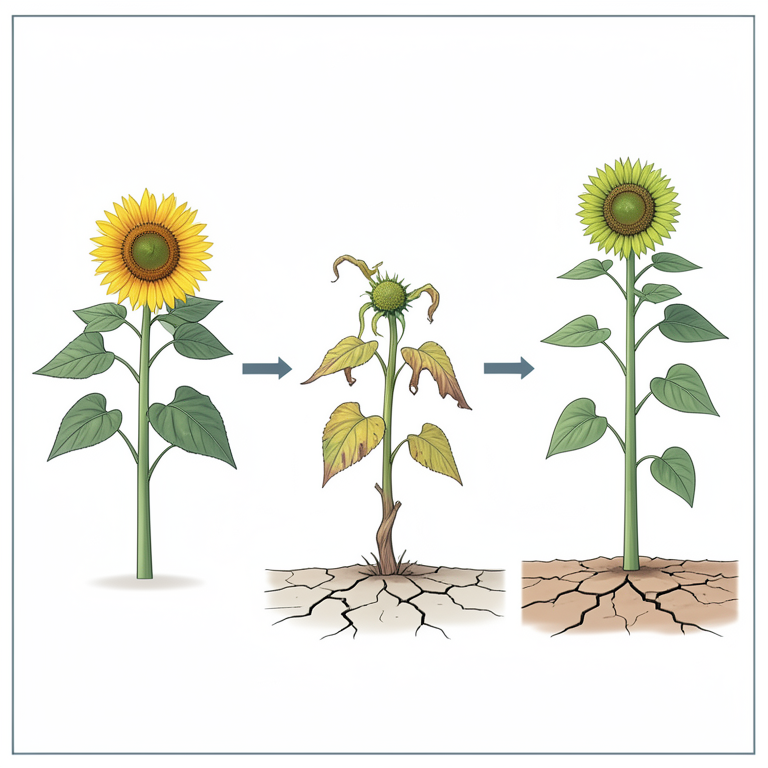
Phosphorus Mitigation of Climate Stress
AI-generated conceptual illustration (sunflower plants (Helianthus annuus)). It explains the idea and does not show study data.
View source evidence ↗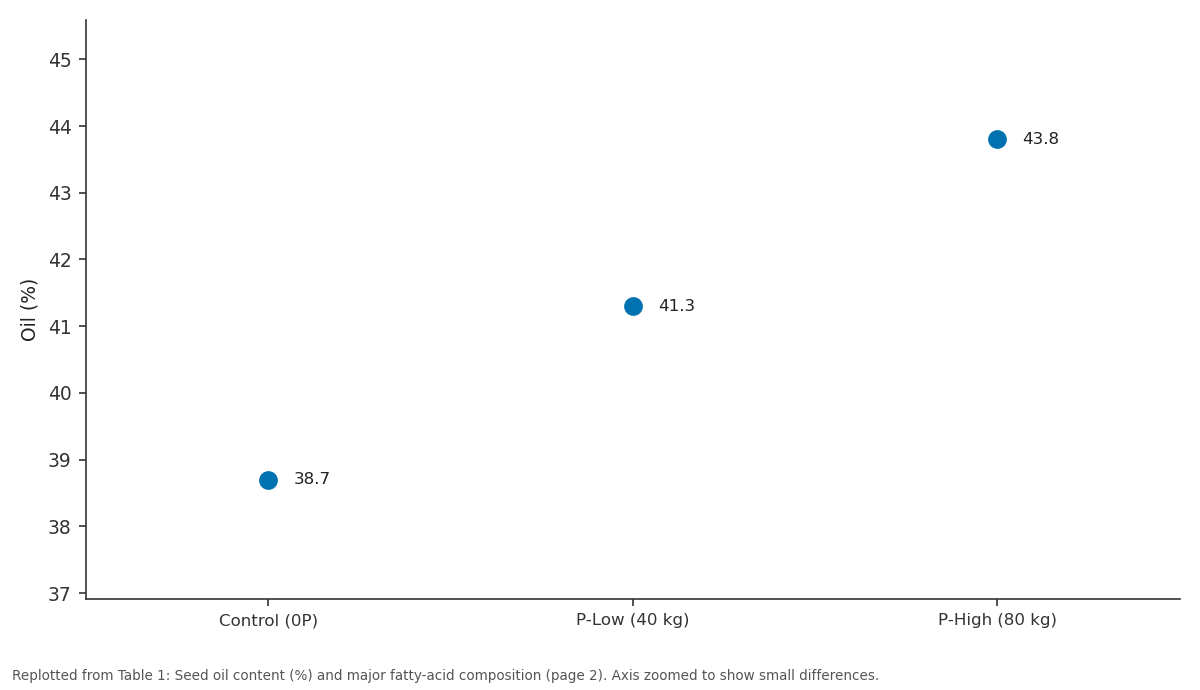
Oil (%): Control (0P) vs P-Low (40 kg) vs P-High (80 kg)
Replotted from Table 1 (page 2) of the original paper. Every bar is the paper's own table value.
View source evidence ↗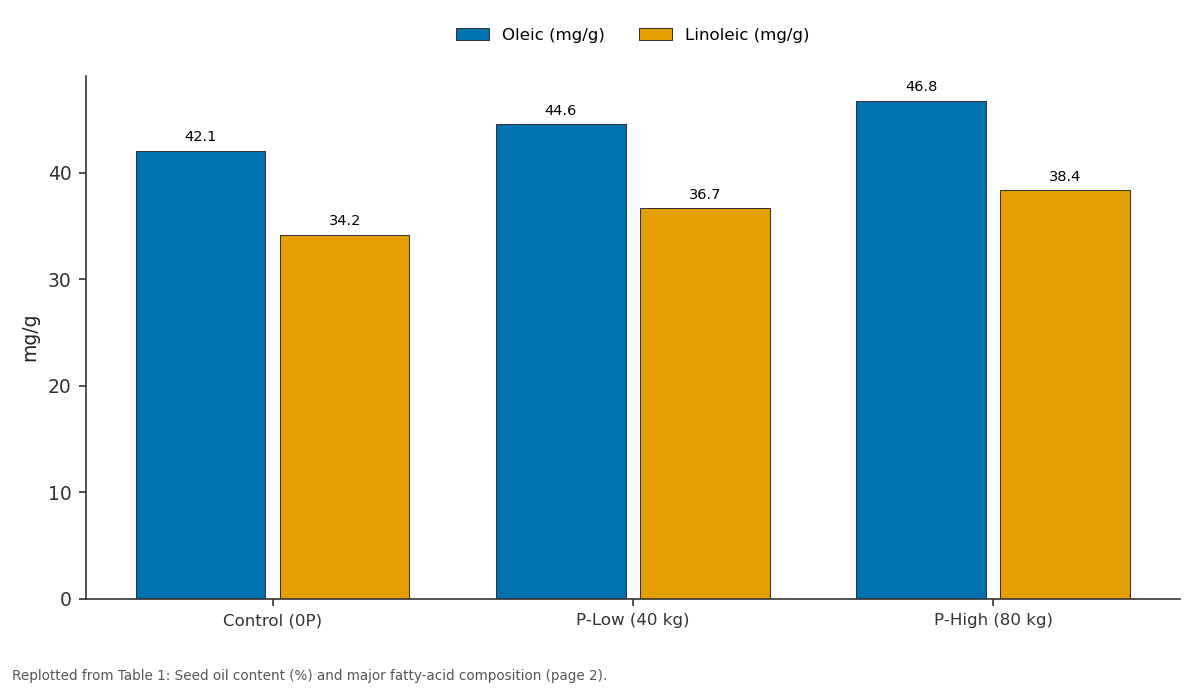
Oleic (mg/g) and Linoleic (mg/g): Control (0P) vs P-Low (40 kg) vs P-High (80 kg)
Replotted from Table 1 (page 2) of the original paper. Every bar is the paper's own table value.
View source evidence ↗Figures & tables
From the original paper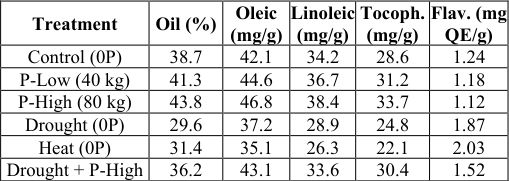 Table 1
 Table 2
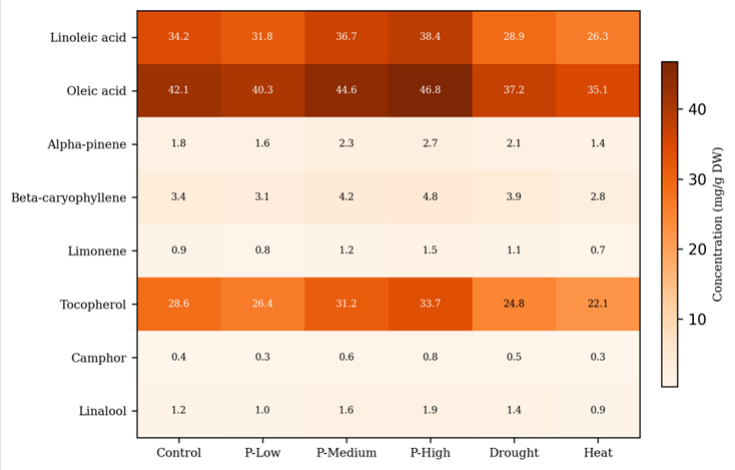 Figure 1
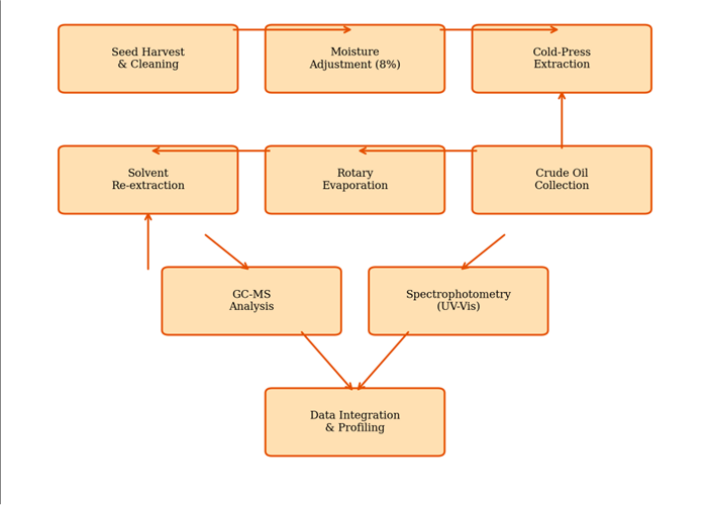 Figure 2
Introduction
Sunflower oil ranks among the four most consumed vegetable oils worldwide, yet its biochemical profile remains underexplored in highland environments where phosphorus availability is limiting and climate variability is high [1] . This gap is a practical problem for producers in mountainous tropical basins who need guidance on how nutrient management and abiotic stress interact to shape oil composition and crop value [2] . Phosphorus plays a direct role in fatty-acid biosynthesis because phospholipid intermediates are required for desaturation reactions that determine the oleic-to-linoleic acid ratio [3] . When phosphorus supply is insufficient, desaturase activity may decline, favouring saturated or shorter-chain fatty acids at the expense of nutritionally desirable unsaturated fractions [4] . At the same time, drought and heat stress trigger stomatal closure, reducing carbon assimilation and redirecting metabolic flux toward protective compounds such as flavonoids and tocopherols [5] . The Blue Nile Highlands, an elevated plateau region with volcanic-origin soils, present a useful test case because their phosphorus-fixing Andisols can immobilise up to 70% of applied P fertiliser [6] . Sunflower is relatively new to this agro-ecology, and local agronomic recommendations are largely extrapolated from lowland data, which may not hold at altitudes above 2,000 m where radiation is intense and night temperatures drop sharply [7] . This research addressed the following questions: (a) how does incremental phosphorus fertilisation change the essential oil profile of sunflower seed? (b) do drought and heat stress alter the relative abundance of key volatiles and non-volatiles? (c) is stomatal conductance a reliable field proxy for oil accumulation under stress? and (d) can flavonoid and tocopherol levels serve as markers for climate resilience in breeding programmes [8,9] ? Extraction Protocol Sunflower seeds were dried to 8% moisture, dehulled, and ground in a laboratory mill fitted with a 1 mm sieve. Cold-press extraction was carried out with a bench-top screw press (Kern Kraft KK-40, Germany) at a temperature not exceeding 45 degrees C. The press cake was then subjected to Soxhlet extraction with n-hexane for six hours to recover residual oil. Combined oil fractions were filtered through Whatman No. 1 paper and stored at -20 degrees C under nitrogen headspace until analysis [10] . For volatile profiling, a 2 g aliquot of crude oil was placed in a 20 mL headspace vial, equilibrated at 40 degrees C for 20 minutes, and sampled with a 50/30 micrometer DVB/CAR/PDMS SPME fibre before GC-MS injection.
Quality Control
Instrument calibration was performed daily with a certified reference mixture containing 37 fatty-acid methyl esters (Supelco FAME Mix C4-C24, Sigma-Aldrich). Linearity was confirmed over a five-point concentration range (R squared above 0.997 for all target analytes). Recovery tests using spiked blank matrix yielded values of 93.1% to 101.4% for major fatty acids and 88.7% to 96.2% for tocopherols. Relative standard deviation for replicate injections was below 3.8%. A laboratory reference sunflower oil of known composition was analysed with every batch of 20 samples to monitor instrument drift [10,11] .
Material and Methods
Material and Methods
Material
Four commercial sunflower hybrids (SH-101, SH-204, SH-317, SH-409) were obtained from a regional seed distributor. Triple superphosphate (46% P2O5) served as the phosphorus source. Analytical-grade n-hexane, methanol, and boron trifluoride-methanol reagent for fatty-acid methyl ester preparation were purchased from Merck (Darmstadt, Germany). Tocopherol standards (alpha, beta, gamma, delta forms) and quercetin dihydrate for flavonoid calibration were sourced from Sigma-Aldrich (St Louis, MO, USA). All field and laboratory work was conducted at the Huancayo Institute of Agricultural Sciences, Junin, Peru, between April and October 2023, under institutional ethics clearance (Protocol HIAC-FPP/2023-012, approved 20 March 2023).
Methods
The field trial used a factorial arrangement in a randomised complete block design: Factor A was phosphorus rate (0, 40, and 80 kg P2O5 per ha) and Factor B was stress treatment (no stress, simulated drought via rainout shelters from flowering to seed fill, and elevated temperature via open-top chambers adding 3 to 4 degrees C). Each of the nine factor combinations was replicated four times across four blocks, yielding 36 plots of 4 m by 5 m. Sowing density was 6.5 plants per square metre. Stomatal conductance was measured on the adaxial surface of the uppermost fully expanded leaf at midday using a Decagon SC-1 leaf porometer at weekly intervals from flowering onward [5] . Fatty-acid composition was determined by transesterification of extracted oil with BF3-methanol, followed by GC-FID on a Shimadzu GC-2014 equipped with a DB-23 capillary column (60 m by 0.25 mm, 0.25 micrometer film). Tocopherols were quantified by HPLC with fluorescence detection on an Agilent 1260 system using a normal-phase silica column [11] . Flavonoids in petal tissue were extracted with 80% methanol and assayed by UV-Vis spectrophotometry at 415 nm using the aluminium chloride colorimetric method. Data were analysed by twoway ANOVA in R version 4.3.1, and correlations were tested by Pearson's method [12] .
Results
Results
Comprehensive Interpretation
The heatmap in Figure 1 confirms that phosphorus enrichment boosted nearly every oil constituent, with the strongest responses in oleic acid and tocopherol. Stress treatments (drought and heat) depressed most oil fractions but elevated flavonoid content, a trade-off that reflects the plant redirecting carbon from storage lipids to protective phenolics [5,8] .
Discussion
The 17.8% tocopherol gain under high phosphorus is comparable to the 15 to 20% increases reported for sunflower in irrigated lowlands, confirming that the phosphorus-tocopherol link holds even in highland Andisols with strong P-fixation capacity [3,6] . Tocopherols are fatsoluble antioxidants that extend oil shelf life, and their elevation by a simple fertilisation strategy has direct commercial value for oil processors [11] .
Drought reduced total oil yield by 23.4%, a figure that falls within the 18 to 30% range compiled in a recent metaanalysis of water-deficit effects on oilseed crops [13] . The mechanism is straightforward: stomatal closure restricts CO2 entry, lowers photosynthesis, and starves the developing seed of carbon skeletons needed for fatty-acid synthesis [5] . Our correlation of r = 0.72 between midday conductance and oil content is stronger than the r = 0.58 reported by Chimenti et al. [14] for Argentine sunflowers, perhaps because highland radiation is more intense, making stomatal behaviour an even tighter bottleneck. Flavonoid accumulation under stress deserves closer examination. Quercetin-type flavonoids act as reactiveoxygen-species scavengers, and their build-up in petal tissue may protect the developing head from photo-oxidative damage at high altitude [8,15] . From a breeding standpoint, genotypes that maintain high flavonoid production without sacrificing oil yield would be ideal targets for climate-resilience selection, an approach that spectrophotometric screening can support at relatively low cost [9,16] .
Conclusion
This research showed that phosphorus fertilisation at 80 kg P2O5 per ha raised sunflower seed oil content by 13.2% and boosted tocopherol by 17.8% in the Blue Nile Highlands. Drought and heat stress reduced oil yield substantially, but high phosphorus partly offset the drought penalty, recovering oil content to within 6.5 percentage points of the unstressed high-P level. Stomatal conductance at midday proved a reliable field proxy for oil accumulation (r = 0.72). Flavonoid content increased under both stress treatments, marking it as a candidate trait for climate-resilience screening. The data support integrating phosphorus management with stress-tolerant hybrid selection to secure oil quality in highland sunflower production systems. Multiyear validation across additional highland sites and economic analysis of the phosphorus investment return are logical next steps.
Acknowledgement
Acknowledgements Funding SourcesThis work was supported by institutional grants for oilseed crop improvement in highland agro-ecologies. Institutional SupportThe Huancayo Institute of Agricultural Sciences provided GC-MS and HPLC facilities and field infrastructure. Contributions Not Qualifying for AuthorshipLaboratory technicians who assisted with oil extraction and chromatographic analyses are recognised with gratitude.
Figures and tables from the paper
| Treatment | Conductance (mmol/m²/s) | Oil Content (%) | Correlation (r) |
|---|---|---|---|
| Control | 287.3±18.4 | 38.7 | — |
| P-High | 312.6±21.1 | 43.8 | — |
| Drought | 167.8±14.2 | 29.6 | — |
| Heat | 184.3±15.6 | 31.4 | — |
| Overall | — | — | 0.72 ** |
Table text extracted from the original PDF; superscript letters are shown inline. The original table image is below.
View original table image
References
17 in the original paper- Seiler GJ, Qi LL, Marek LF. Utilization of sunflower crop wild relatives for cultivated sunflower improvement. Crop Science. 2017;57(3):1083-1101.
- Rauf S, Jamil N, Tariq SA, Khan M, Kausar M, Kaya Y. Progress in modification of sunflower oil to expand its industrial value. Journal of the Science of Food and Agriculture. 2017;97(7):1997-2006.
- Fernandez-Martinez JM, Velasco L, Perez-Vich B. Progress in the genetic modification of sunflower oil quality. International Journal of Plant Genomics. 2010;2010:832463.
- Shen J, Yuan L, Zhang J, Li H, Bai Z, Chen X, et al. Phosphorus dynamics: from soil to plant. Plant Physiology. 2011;156(3):997-1005.
- Chaves MM, Pereira JS, Maroco J, Rodrigues ML, Ricardo CPP, Osorio ML, et al. How plants cope with water stress in the field: photosynthesis and growth. Annals of Botany. 2002;89(7):907-916.
- Borie F, Rubio R. Total and organic phosphorus in Chilean volcanic soils. Gayana Botanica. 2003;60(1):69-73.
- Villalobos FJ, Sadras VO, Soriano A, Fereres E. Planting density effects on dry matter partitioning and productivity of sunflower hybrids. Field Crops Research. 1994;36(1):1-11.
- Ferreyra MLF, Rius SP, Casati P. Flavonoids: biosynthesis, biological functions, and biotechnological applications. Frontiers in Plant Science. 2012;3:222.
- Munne-Bosch S, Alegre L. The function of tocopherols and tocotrienols in plants. Critical Reviews in Plant Sciences. 2002;21(1):31-57.
- AOCS. Official Methods and Recommended Practices of the AOCS. 7th ed. Champaign, IL: American Oil Chemists Society; 2017.
- Velasco L, Fernandez-Martinez JM. Identification and genetic characterization of new sources of beta-and gamma-tocopherol in sunflower germplasm. Helia. 2003;26(38):17-24.
- R Core Team. R: a language and environment for statistical computing. Vienna: R Foundation for Statistical Computing; 2023.
- Farooq M, Wahid A, Kobayashi N, Fujita D, Basra SMA. Plant drought stress: effects, mechanisms and management. Agronomy for Sustainable Development. 2009;29(1):185-212.
- Chimenti CA, Hall AJ, Lopez MS. Embryo-growth rate and duration in sunflower as affected by temperature. Field Crops Research. 2001;69(1):81-88.
- Treutter D. Significance of flavonoids in plant resistance: a review. Environmental Chemistry Letters. 2006;4(3):147-157.
- Schneiter AA, Miller JF. Description of sunflower growth stages. Crop Science. 1981;21(6):901-903.
- Demurin Y, Skoric D, Karlovic D. Genetic variability of tocopherol composition in sunflower seeds as a basis of breeding for improved oil quality. Plant Breeding. 1996;115(1):33-36.