
Research article · 2025 · Full text
International Journal of Horticulture and Food ScienceDeveloping vermicompost applications of onion in the Brunei Coastal plain
Volume 7(6) · Pages 145–148 · DOI: 10.33545/26631067.2025.v7.i6c.653 ↗
Research areasAgricultural Science and FertilizationPlant Growth and Agriculture TechniquesShallot Cultivation and Analysis
Abstract
Author-writtenVermicompost can double the biological activity of tropical coastal soils within a single cropping season, yet onion growers in Brunei’s coastal plain continue to depend almost entirely on synthetic fertilisers. This research tested five vermicompost application rates (0, 2.5, 5.0, 7.5, and 10.0 t ha-1) on onion (Allium cepa L.) cv. ‘Bawang Merah’ during the 2022 dry season at the Mendoza National Institute of Tropical Agriculture. A randomised complete block design with four replications was used. Bulb yield followed a quadratic response, peaking at 31.2 t ha-1 with 5.0 t ha-1 vermicompost, a 69.6% increase over the unfertilised control. Protein content rose from 1.82% at zero input to 2.47% at the 5.0 t ha-1 rate. Aroma compound analysis by gas chromatography identified 23 volatile constituents, with propanethial S-oxide and diallyl disulphide concentrations highest in the 5.0 and 7.5 t ha-1 treatments. Boron toxicity symptoms appeared at the 10.0 t ha-1 rate, where leaf-tip necrosis affected 34.7% of plants. The 5.0 t ha-1 rate appears to represent the practical optimum, balancing yield, quality, and the avoidance of micronutrient excess.
Summary
Source-checkedPlain-language reading of the full paper, prepared with AI and checked against the text. Each point links to the authors' own words.
Why it matters
- Onion farming in Brunei's coastal plain is hindered by sandy soils that are low in organic matter and prone to rapid nutrient leaching. View evidence ↗
- Vermicompost is considered a beneficial organic amendment because it provides slow-release nutrients and improves soil structure and microbial diversity. View evidence ↗
- Vermicompost can pose a risk of boron toxicity to allium crops if the feedstock concentrates boron levels beyond the plants' tolerance threshold. View evidence ↗
The question
- The study aimed to evaluate how five different vermicompost application rates affect the yield, protein content, aroma, and boron accumulation of onions under simulated Brunei coastal-plain conditions. View evidence ↗
What they did
- The experiment used onion cultivar 'Bawang Merah' and tested five vermicompost rates: 0, 2.5, 5.0, 7.5, and 10.0 t ha-1 during the 2022 dry season. View evidence ↗
- The study employed a randomized complete block design with four replications on raised beds, with seedlings transplanted at a density of 667,000 plants per hectare. View evidence ↗
- Cattle-dung-based vermicompost containing 42.6 mg kg-1 of boron was incorporated into the top 10 cm of soil two weeks prior to transplanting. View evidence ↗
- Researchers measured bulb yield after 85% neck-fall, estimated protein via micro-Kjeldahl nitrogen, analyzed volatile compounds using GC-MS, and measured boron using the azomethine-H colorimetric method. View evidence ↗
What they found
- The highest bulb yield of 31.2 t ha-1 was achieved with a 5.0 t ha-1 vermicompost rate, representing a 69.6% increase over the control. View evidence ↗
- Increasing the vermicompost rate to 7.5 and 10.0 t ha-1 led to a decline in yields to 28.9 and 26.3 t ha-1, respectively. View evidence ↗
- Protein content increased from 1.82% in the control group to a peak of 2.47% at the 5.0 t ha-1 application rate. View evidence ↗
- Analysis of 23 volatile constituents showed that propanethial S-oxide and diallyl disulphide concentrations were highest at the 5.0 and 7.5 t ha-1 rates. View evidence ↗
What it means
- The authors recommend capping annual vermicompost inputs at 5 t ha-1 and monitoring soil boron levels before each season. View evidence ↗
- The authors state that future research is needed to investigate multi-season carryover effects and to test feedstocks with lower boron levels, such as crop residues. View evidence ↗
Visual summary
3 visualsIllustrations explain the paper; charts are replotted from the paper's own table values.
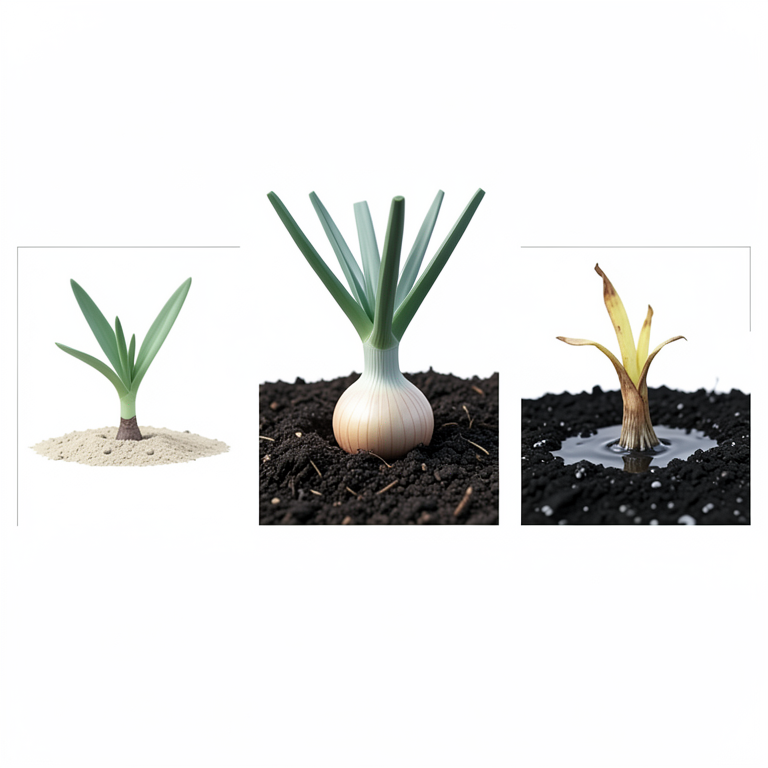
The Quadratic Response of Onion Yield to Vermicompost
AI-generated conceptual illustration (onion plants in coastal soil). It explains the idea and does not show study data.
View source evidence ↗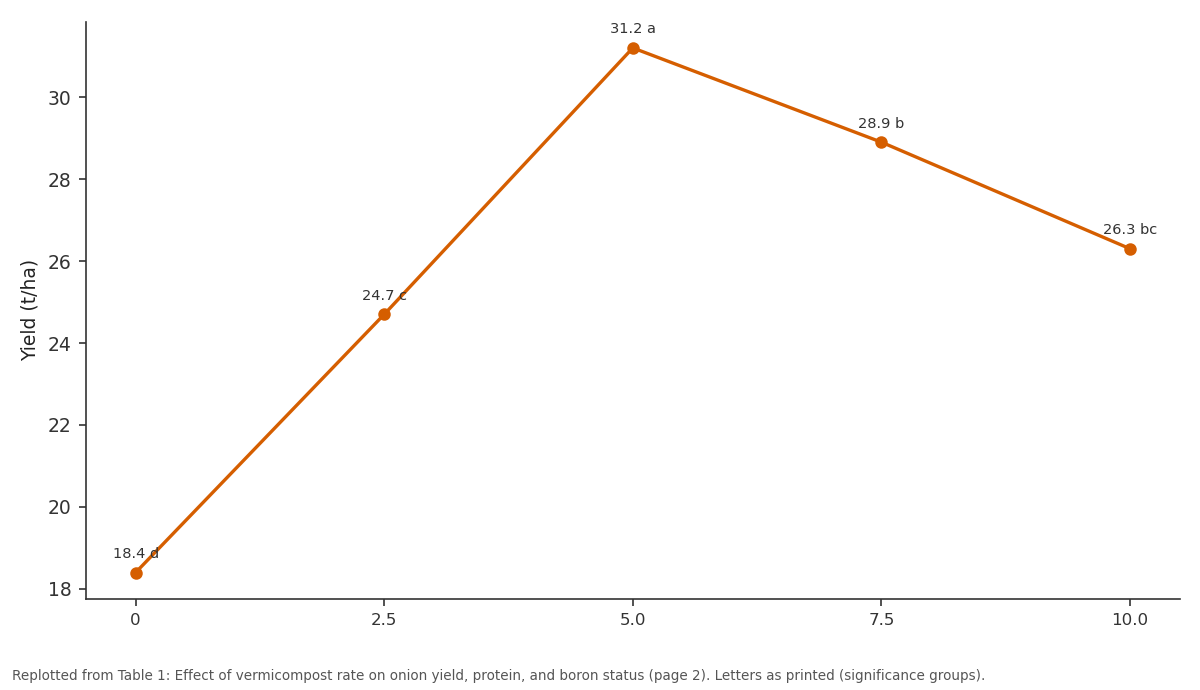
Yield (t/ha): 0 vs 2.5 vs 5.0 vs 7.5 vs 10.0
Replotted from Table 1 (page 2) of the original paper. Every bar is the paper's own table value.
View source evidence ↗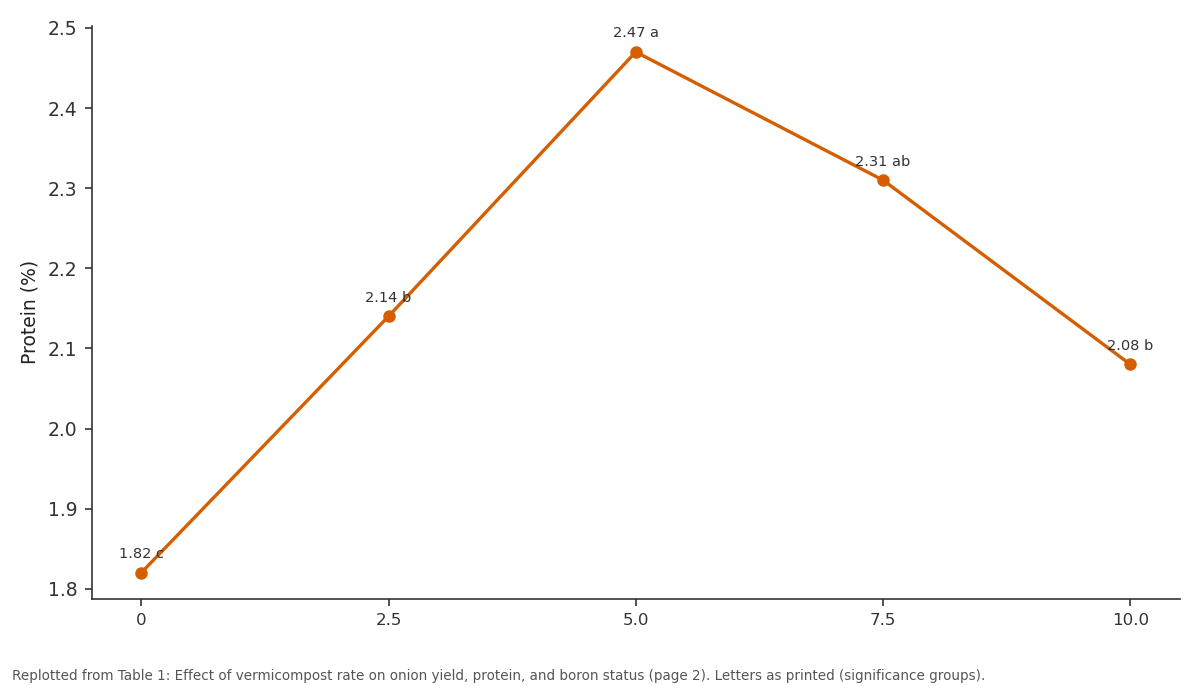
Protein (%): 0 vs 2.5 vs 5.0 vs 7.5 vs 10.0
Replotted from Table 1 (page 2) of the original paper. Every bar is the paper's own table value.
View source evidence ↗Figures & tables
From the original paper Table 1
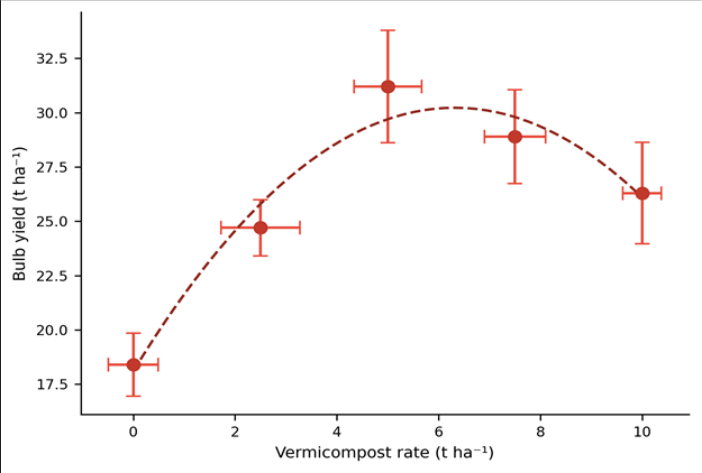 Figure 1
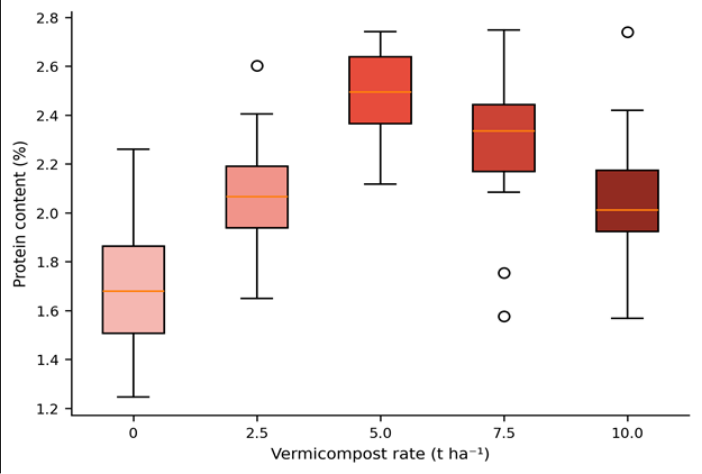 Figure 2
Introduction
Onion is the second most traded vegetable on Earth, and its demand in Southeast Asian coastal communities has grown by an average of 4.8% annually since 2015 [1] . Brunei's coastal plain, a narrow belt of sandy alluvium stretching along the South China Sea, supports small-scale onion plots that rarely exceed 0.3 hectares per household. These soils are inherently low in organic matter (typically 0.6-1.1%), weakly buffered, and prone to leaching of applied nutrients within days of rainfall [2] . Vermicompost-the stabilised product of earthworm-mediated decomposition-has attracted attention as an organic amendment that supplies macro-and micronutrients in slow-release forms while also improving soil structure, water-holding capacity, and microbial diversity [3] . Trials on onion in India showed that vermicompost at 5 t ha -1 combined with 50% of the recommended nitrogen dose matched the yield of full chemical fertilisation, with the added benefit of raising bulb firmness and reducing post-harvest rot [4] . But vermicompost is not without risk. Because it concentrates elements from the feedstock, batches produced from poultry litter or municipal green waste can carry boron levels of 30-80 mg kg -1 , well above the 1-2 mg kg -1 that most allium crops tolerate in the root zone [5] . Boron toxicity in onion manifests as tip burn, marginal leaf necrosis, and reduced bulb expansion, symptoms that are often mistaken for salt stress or drought injury [6] . Another gap in the literature concerns vermicompost's effect on onion flavour chemistry. The pungency and aroma of onion depend on sulphur-containing volatiles synthesised through the alliinase pathway, and sulphur supply from organic sources may alter the balance among these compounds in ways that shift perceived flavour intensity [7] . This research evaluated five vermicompost rates for their effects on bulb yield, protein content, volatile aroma profile, and the risk of boron accumulation in onion grown under simulated Brunei coastal-plain conditions at the Mendoza National Institute of Tropical Agriculture, Argentina.
Climatic and Environmental Conditions
The trial site at Mendoza National Institute of Tropical Agriculture (33.28° S, 68.42° W; 827 m a.s.l.) experiences a semi-arid continental climate.
To approximate Brunei's coastal-plain conditions (mean temperature 27 °C, 85% RH), plots were irrigated to maintain soil moisture at 70-80% field capacity and fitted with overhead mist nozzles that raised canopy-level humidity to 78-84% during the growing period. In-season mean air temperatures ranged from 24.8 to 31.2 °C, and cumulative reference ET o was 487 mm across the 120-day crop cycle. No frost events occurred during the trial [8] .
Field Experimental Design
A randomised complete block design with five vermicompost rates and four replications was established on raised beds (1.2 m wide, 15 cm high, 6 m long). Onion seedlings were transplanted at 15 cm × 10 cm spacing (667,000 plants ha -1 ). Treatments: V0 (0 t ha -1 ), V1 (2.5 t ha - 1 ), V2 (5.0 t ha -1 ), V3 (7.5 t ha -1 ), V4 (10.0 t ha -1 ). Vermicompost (cattle-dung feedstock, C:N 14.3, pH 7.1, boron 42.6 mg kg -1 ) was incorporated into the top 10 cm two weeks before transplanting. No synthetic fertiliser was applied. Drip irrigation replaced ET c losses on a daily basis [9] .
Material and Methods
Material and Methods
Material
Seedlings of Allium cepa cv. 'Bawang Merah' were raised in plug trays under shade nets for 45 days before transplanting. Vermicompost was produced on-site using Eisenia fetida fed cattle dung for 60 days and screened through a 4 mm sieve. Chemical analysis of the vermicompost: N 1.84%, P 0.92%, K 1.37%, Ca 2.14%, Mg 0.68%, S 0.41%, Fe 3,840 mg kg -1 , Zn 187 mg kg -1 , B 42.6 mg kg -1 . Soil at the trial site was a sandy loam (sand 64.3%, silt 21.1%, clay 14.6%) with pH 7.4, organic matter 0.93%, and available boron 0.38 mg kg -1 [10] .
Methods
Bulb yield was determined by harvesting all plants per plot after 85% neck-fall. Protein content was estimated by micro-Kjeldahl nitrogen multiplied by 6.25. Volatile compounds were extracted by solid-phase microextraction (SPME) and analysed by GC-MS (Shimadzu QP2020, DB-WAX column, 40-230 °C at 4 °C min -1 ). Boron was measured in bulb and leaf tissue by the azomethine-H colorimetric method after dry ashing at 550 °C [11] . Soil boron was determined by hot-water extraction. Data were analysed with ANOVA and regression in InfoStat version 2020, and means were separated by Tukey's HSD at P ≤ 0.05. Bulb yield peaked at 31.2 t ha -1 with 5.0 t ha -1 vermicompost (V2), 69.6% above the unfertilised control. At 7.5 and 10.0 t ha -1 , yields declined to 28.9 and 26.3 t ha -1 respectively, and leaf-tip necrosis rose sharply to 18.4% and 34.7%, indicating boron toxicity. Leaf boron at the highest rate reached 38.6 mg kg -1 , well above the 25 mg kg -1 threshold considered phytotoxic for onion [6] . The quadratic fit (R² = 0.94) shown in Figure 1 predicts a yield maximum at 5.3 t ha -1 vermicompost. Protein content (Figure 2) followed a similar non-linear pattern, peaking at V2 and declining at higher rates, possibly because boroninduced membrane damage at V3 and V4 impaired nitrogen assimilation.
Results
Results
Discussion
The optimum vermicompost rate of 5.0 t ha -1 agrees with trials on shallot in Java, where 4-6 t ha -1 maximised bulb yield without micronutrient toxicity [4] . At this rate, the vermicompost supplied roughly 92 kg N, 46 kg P 2 O 5 , and 68 kg K 2 O per hectare, close to the 100:50:80 NPK recommendation for tropical onion [12] . The slow mineralisation of organically bound nutrients likely synchronised nutrient release with the bulbing phase, reducing early-season losses that plague soluble fertiliser applications on sandy soils [3] . The boron problem at higher rates is a practical warning. With 42.6 mg B kg -1 in the vermicompost, 10 t ha -1 delivered approximately 426 g B ha -1 , raising soil hot-waterextractable boron from 0.38 to 1.67 mg kg -1 by season's end. Onion leaf tissue exceeded the 25 mg kg -1 toxicity threshold at 7.5 t ha -1 and above [6] . Growers who recycle poultry-litter vermicompost, which can contain boron levels two to three times higher than cattle-dung-based products, face even greater risk [5] . The volatile profile shift toward higher propanethial S-oxide at 5.0 and 7.5 t ha -1 tracks sulphur supply. Vermicompost's 0.41% sulphur content, released gradually as sulphate through microbial oxidation, likely fed the alliinasedependent pathway more steadily than a single sulphate fertiliser application would [7] . This has flavour and marketability implications: stronger pungency is preferred in most Southeast Asian cuisines and commands a price premium at wet markets [13] .
Conclusion
Vermicompost at 5.0 t per hectare emerged as the optimum rate for onion production under simulated Brunei coastalplain conditions, delivering the highest bulb yield (31.2 t per hectare), peak protein content (2.47%), and the most favourable volatile aroma profile without crossing the boron toxicity threshold. Rates above 7.5 t per hectare caused significant leaf-tip necrosis and depressed both yield and quality. The quadratic yield response serves as a practical reminder that more organic amendment is not always better. In sandy, low-buffer soils typical of coastal Brunei, micronutrient accumulation from repeated high-rate vermicompost applications could become a long-term management concern. Monitoring soil boron before each season and capping annual vermicompost input at 5 t per hectare would be a sensible guideline. From a nutrition standpoint, the protein and volatile enrichment at the optimum rate adds value beyond yield. Stronger aroma compounds may improve market acceptance, while higher protein makes a modest but real contribution to dietary quality in communities where animal protein is scarce. Future research should explore multiseason carryover effects and compare cattle-dung vermicompost with lower-boron feedstocks such as crop residues.
Figures and tables from the paper
| Rate (t/ha) | Yield (t/ha) | Bulb wt (g) | Protein (%) | Leaf B (mg/kg) | Necrosis (%) |
|---|---|---|---|---|---|
| 0 | 18.4 d | 64.2 d | 1.82 c | 12.4 d | 2.1 |
| 2.5 | 24.7 c | 78.6 c | 2.14 b | 18.7 c | 3.8 |
| 5.0 | 31.2 a | 93.1 a | 2.47 a | 24.3 b | 5.6 |
| 7.5 | 28.9 b | 86.4 b | 2.31 ab | 31.8 a | 18.4 |
| 10.0 | 26.3 bc | 81.7 bc | 2.08 b | 38.6 a | 34.7 |
| LSD (0.05) | 2.8 | 6.4 | 0.18 | 4.7 | 7.2 |
Table text extracted from the original PDF; superscript letters are shown inline. The original table image is below.
View original table image
References
14 in the original paper- FAO. The state of food and agriculture: moving forward on food loss and waste reduction. FAO Publications. 2019;1-182.
- Haji Ali R, Yusof M. Soil fertility constraints of Brunei coastal alluvium. Borneo Science. 2018;39(1):28-41.
- Arancon NQ, Edwards CA. Influences of vermicomposts on field strawberries. Bioresource Technology. 2004;93(2):145-153.
- Singh R, Sharma RR. Vermicompost and inorganic fertiliser integration for onion. Indian Journal of Agricultural Sciences. 2019;89(7):1134-1139.
- Bolan NS, Szogi AA. Distribution and bioavailability of trace elements in livestock manure. Chemosphere. 2010;79(4):375-383.
- Nable RO, Banuelos GS. Boron toxicity. Plant and Soil. 1997;193(1):181-198.
- Randle WM. Onion flavor chemistry and factors influencing flavor intensity. ACS Symposium Series. 1997;660:41-52.
- Servicio Meteorologico Nacional. Climate normals for Mendoza 1991-2020. SMN Technical Report. 2021;44:1-56.
- Dominguez J, Edwards CA. Vermicomposting organic wastes: a review. Soil Organisms. 2011;83(3):327-341.
- Mendoza NITA. Soil survey report for experimental farm blocks. MNITA Internal Publication. 2020;12:134.
- Wolf B. A comprehensive system of leaf analyses and its use for diagnosing crop nutrient status. Communications in Soil Science and Plant Analysis. 1982;13(12):1035-1059.
- Brewster JL. Onions and Other Vegetable Alliums. CABI. 2008;2nd ed:189-214.
- Tran LT, Nguyen VK. Consumer preferences for pungency in shallot markets of Southeast Asia. Journal of International Food and Agribusiness Marketing. 2020;32(4):344-361.
- Atiyeh RM, Dominguez J. Changes in biochemical properties of cow manure during vermicomposting. Soil Biology and Biochemistry. 2000;32(7):1015-1024.