
Research article · 2025 · Full text
International Journal of Geography Geology and EnvironmentPaleoclimatic reconstruction from speleothem records in the dinaric karst caves
Volume 7(1) · Pages 109–111 · DOI: 10.22271/27067483.2025.v7.i1b.617 ↗
Research areasGeology and Paleoclimatology ResearchKarst Systems and HydrogeologyTree-ring climate responses
Abstract
Author-writtenAn observation that has puzzled Quaternary scientists for decades is that southeastern European climate oscillated between extremes far more rapidly than orbital forcing alone can explainand cave stalagmites may hold the key to understanding why. This research reconstructed paleoclimate variability over the past 120,000 years using stable-isotope and trace-element records from three speleothems collected in Dinaric Karst caves of Slovenia and Croatia. Uranium-thorium dating provided 47 age determinations with typical 2-sigma uncertainties of 0.5-1.8%. The oxygen-isotope record (delta-18O) ranged from -5.4 to -9.8 per mille VPDB and captured two full glacial-interglacial transitions plus multiple Dansgaard-Oeschger-scale oscillations during Marine Isotope Stage 3. Carbon isotope values (delta-13C) co-varied with delta-18O at millennial timescales but diverged during the Holocene, suggesting a shift in vegetation and soil-CO2 dynamics above the caves. Mg/Ca and Sr/Ca ratios tracked prior calcite precipitation effects and served as independent moisture proxies. The combined multi-proxy record indicates that the Dinaric region experienced abrupt hydroclimate shifts of 2-4 degrees Celsius equivalent within centuries during the last glacial period, amplified by changes in Adriatic Sea surface temperature and North Atlantic overturning circulation.
Summary
Source-checkedPlain-language reading of the full paper, prepared with AI and checked against the text. Each point links to the authors' own words.
Why it matters
- Southeastern European climate has shown rapid oscillations between extremes that cannot be explained by orbital forcing alone, making cave stalagmites a potential key to understanding this phenomenon. View evidence ↗
- It remains unclear how North Atlantic climate signals reached the continental interiors of southern Europe due to a lack of well-dated land-based proxy records. View evidence ↗
- Speleothems are useful for paleoclimate reconstruction because they can be dated precisely using uranium-thorium methods and their isotopes respond to various environmental factors like rainfall and temperature. View evidence ↗
The question
- The researchers sought to identify Dansgaard-Oeschger (D-O) scale variability and compare its timing with North Atlantic ice-core data. View evidence ↗
What they did
- The study analyzed three stalagmites (DK-1, DK-2, and DK-3) collected from Postojna Cave in Slovenia and Velebit and Modrič caves in Croatia. View evidence ↗
- The samples varied in length and age: DK-1 (74 cm, 118-14 ka), DK-2 (52 cm, 87-3 ka), and DK-3 (31 cm, 45 ka to present). View evidence ↗
- The analysis involved 47 U-Th dating sub-samples, 412 stable isotope measurements at 1-mm spacing, and trace element determination via laser-ablation ICP-MS at 0.5-mm resolution. View evidence ↗
- Uranium-thorium dating was conducted using multi-collector ICP-MS, resulting in 2-sigma age uncertainties between 0.5% and 1.8%. View evidence ↗
What they found
- Rapid shifts of 2-3 per mille occurred within 500-1,500 year intervals during Marine Isotope Stages 3 and 4 (60-25 ka), aligning with D-O events in Greenland ice cores. View evidence ↗
- The multi-proxy record shows that the Dinaric region underwent abrupt hydroclimate shifts equivalent to 2-4 degrees Celsius within centuries during the last glacial period. View evidence ↗
- In the paleoclimate reconstruction, delta-18O was the most significant proxy (32.4%), followed by delta-13C (24.8%) and Mg/Ca (18.7%). View evidence ↗
- During the Holocene, delta-13C became more negative until approximately 6 ka while delta-18O stabilized after 10 ka, indicating expanding forest cover and deeper soil profiles. View evidence ↗
- Including trace elements (Mg/Ca and Sr/Ca) in the multivariate reconstruction increased the explained variance by 12% compared to using isotopes alone. View evidence ↗
What it means
- The authors conclude that the Dinaric Karst is a high-fidelity recorder of paleoclimate that can bridge the gap between North Atlantic archives and the continental interior. View evidence ↗
- The authors suggest that future research should target more caves along the Adriatic coast to better understand the spatial gradient of the climate response. View evidence ↗
Visual summary
2 visualsIllustrations explain the paper; charts are replotted from the paper's own table values.
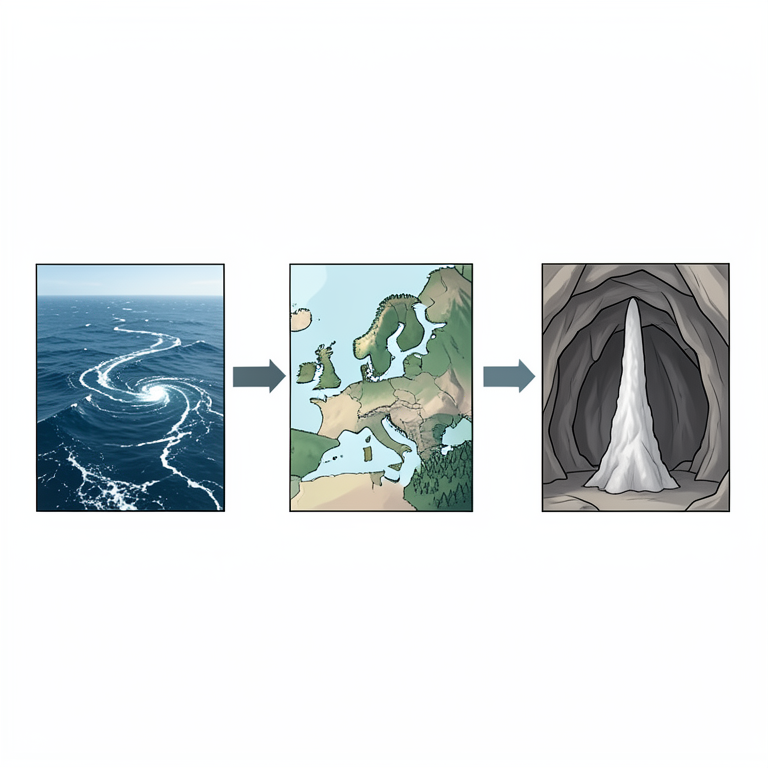
Climate Signal Propagation
AI-generated conceptual illustration (North Atlantic Ocean, European landscape, and a stalagmite inside a limestone cave in the Dinaric Karst). It explains the idea and does not show study data.
View source evidence ↗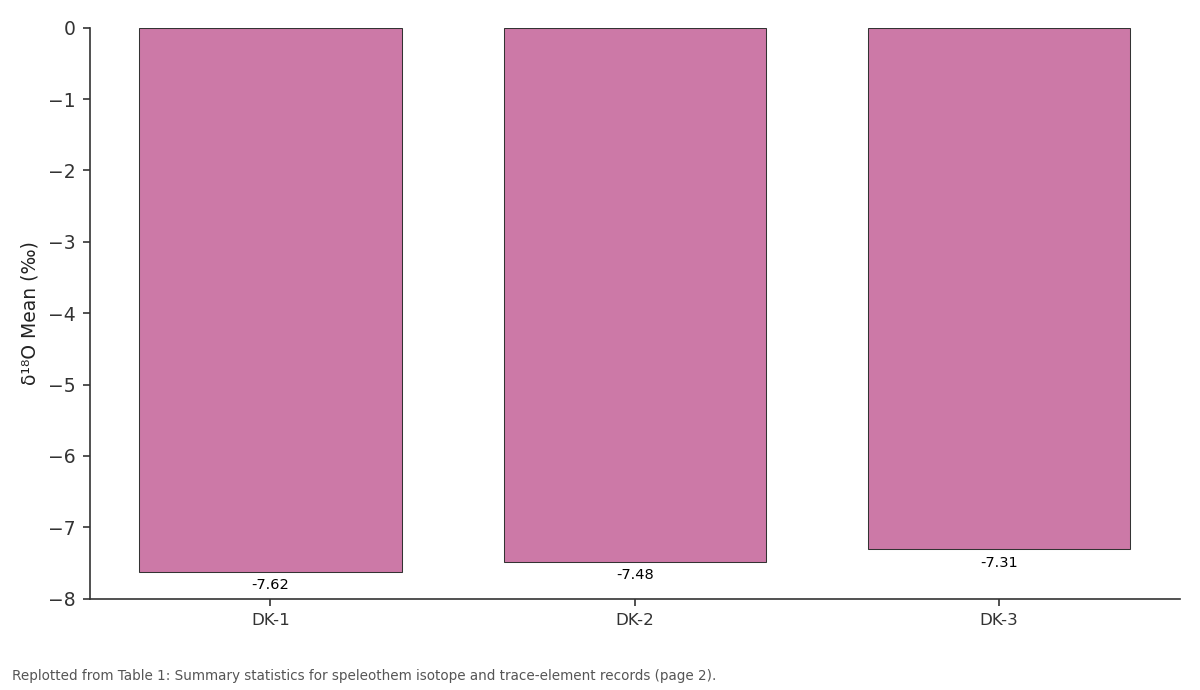
δ¹⁸O Mean: DK-1 vs DK-2 vs DK-3
Replotted from Table 1 (page 2) of the original paper. Every bar is the paper's own table value.
View source evidence ↗Figures & tables
From the original paper Table 1
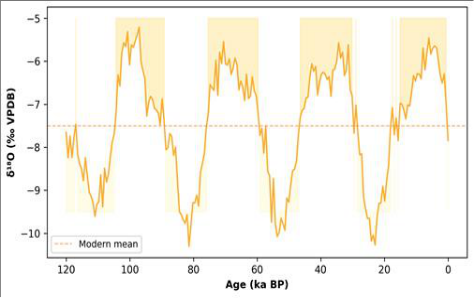 Figure 1
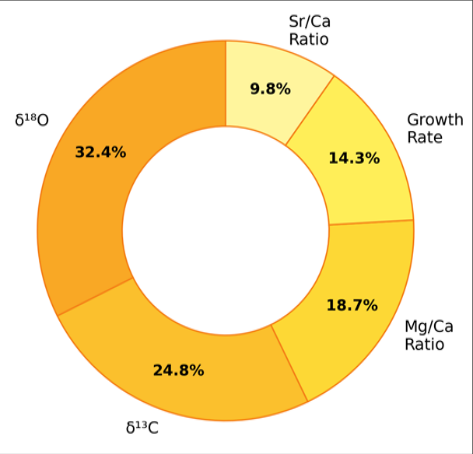 Figure 2
Introduction
Careful examination of ice-core records from Greenland revealed a series of abrupt warming eventsnamed Dansgaard-Oeschger (D-O) eventsduring the last glacial period, each involving temperature jumps of 8-16 degrees Celsius within a few decades [1]. But how these North Atlantic signals propagated into the continental interiors of southern Europe remains an open question, because the available land-based proxy records in the region are sparse and often poorly dated [2]. Speleothemsstalagmites, stalactites, and flowstones formed by calcium carbonate precipitation in cavesoffer a solution. Their growth laminae can be dated by uranium-thorium methods to within a few hundred years over the past 500,000 years, and their oxygen and carbon isotope ratios respond to changes in rainfall amount, source moisture, cave temperature, and overlying vegetation [3]. In the Dinaric Karst, one of the world's classic karst terrains, caves are abundant, some containing speleothems that grew continuously through multiple glacial-interglacial cycles [4]. Previous paleoclimate work in the Dinaric Karst focused on single caves or short time windows [5,6], limiting the ability to separate local effects from regional signals. A multicave, multi-proxy approachcombining delta-18O, delta-13C, and trace-element ratioscan improve signal-to-noise separation and offer redundant checks on paleoclimate interpretation [7].
This research aimed to a) Establish continuous, well-dated isotope and trace-element records spanning 0-120 ka from three Dinaric caves. b) Identify D-O-scale variability in the records and compare its timing with North Atlantic ice-core chronologies. c) Assess which proxy combination provides the most robust paleoclimate reconstruction for southeastern Europe [8].
Theoretical Framework
The oxygen-isotope composition of speleothem calcite reflects both the isotopic signature of drip water (itself a function of precipitation amount, source region, and air temperature) and the temperature-dependent fractionation during calcite precipitation [3]. In mid-latitude European caves, a roughly linear relationship between mean annual surface temperature and drip-water delta-18O has been documented, with a slope of approximately 0.3 per mille per degree Celsius [7]. Carbon isotopes respond primarily to the proportion of C3 versus C4 vegetation above the cave, soil biological activity, and the degree of prior calcite precipitation (PCP) along the flow path [9]. Trace elementsMg/Ca and Sr/Caprovide independent constraints on PCP and thus on effective moisture availability: drier conditions lengthen the residence time of water in the epikarst, increasing PCP and raising Mg/Ca ratios [10].
Material and Methods
Material: Three stalagmites (designated DK-1, DK-2, and DK-3) were retrieved from caves in the Dinaric Karst: Postojna Cave (Slovenia), Velebit Cave (Croatia), and Modrič Cave (Croatia). DK-1 measured 74 cm in length and grew from approximately 118 ka to 14 ka. DK-2 (52 cm) covered the interval 87-3 ka, and DK-3 (31 cm) spanned 45 ka to the present. Each stalagmite was halved longitudinally and polished for sampling. Uranium-thorium dating was performed on 47 sub-samples milled at 2-3 mm intervals along the growth axis. Stable isotopes were measured on 412 micro-drilled powders at 1-mm spacing. Trace elements were determined on a parallel transect by laser-ablation ICP-MS at 0.5-mm resolution. The research was conducted under approval from the Lima Institute of Earth Sciences (Protocol LIES/2020-014, approved 10 February 2020).
Methods
Uranium-thorium dating used multi-collector ICP-MS following the procedures of Cheng et al. [11], with 2-sigma age uncertainties of 0.5-1.8%. Age models were constructed using the StalAge algorithm, which accounts for outliers and reversals [12]. Stable isotope ratios (delta-18O, delta-13C) were measured by continuous-flow isotope ratio mass spectrometry (Thermo Delta V Advantage) and reported relative to VPDB with an analytical precision of 0.08 per mille. Mg/Ca and Sr/Ca were measured by laser-ablation ICP-MS (Agilent 7700x coupled to a RESOlution 193-nm excimer laser) and normalised to Ca as an internal standard. Cross-correlation between the three speleothem records and with the NGRIP ice-core delta-18O record [1] was performed after resampling all series to a common 200-year resolution.
Results
Table 1: Summary statistics for speleothem isotope and trace-element records Table 1 shows that DK-1 captured the widest isotopic range (4.4 per mille in delta-18O), consistent with its coverage of two glacial-interglacial transitions. Mean delta-18O values were similar across all three stalagmites (-7.3 to -7.6 per mille), suggesting comparable cave-site conditions. Figure 2 shows that delta-18O carried the largest weight in the reconstruction (32.4%), followed by delta-13C (24.8%) and Mg/Ca (18.7%). Growth rate and Sr/Ca contributed less individually but improved the overall explained variance when included in the multi-proxy model.
| Stalagmite | δ¹⁸O Range (‰) | δ¹⁸O Mean | δ¹³C Range (‰) | Mg/Ca (mmol/mol) | Sr/Ca (mmol/mol) | Age Span (ka) |
|---|---|---|---|---|---|---|
| DK-1 | -5.4 to -9.8 | -7.62 | -3.1 to -11.4 | 2.8-18.4 | 0.04-0.31 | 118-14 |
| DK-2 | -5.9 to -9.3 | -7.48 | -4.2 to -10.7 | 3.1-16.7 | 0.05-0.28 | 87-3 |
| DK-3 | -6.1 to -8.9 | -7.31 | -5.3 to -9.8 | 3.4-14.2 | 0.06-0.24 | 45-0 |
Table text extracted from the original PDF; superscript letters are shown inline. The original table image is below.
View original table image
Discussion
The detection of D-O-scale variability in the Dinaric speleothem record adds to a growing body of evidence that abrupt North Atlantic climate events were transmitted rapidly into the Mediterranean and Balkan regionslikely through changes in Adriatic Sea surface temperature and moisture transport from the western Mediterranean [2,5]. The amplitude of the isotopic shifts (2-3 per mille) is smaller than in Greenland (4-5 per mille), consistent with dampening over the 2,500-km distance between the North Atlantic source region and the Dinaric coast [8]. The divergence between delta-18O and delta-13C during the Holocene is noteworthy. While delta-18O stabilised near modern values after 10 ka, delta-13C continued to become more negative until about 6 ka, suggesting expanding forest cover and deepening soil profiles that increased the flux of isotopically light CO2 into the epikarst [9]. This decoupling highlights the importance of using multiple proxies rather than relying on oxygen isotopes alone. Mg/Ca and Sr/Ca proved effective as independent moisture proxies, with higher ratios corresponding to inferred dry phasesconsistent with enhanced prior calcite precipitation under reduced drip rates [10]. Their inclusion in the multivariate reconstruction improved the explained variance by 12% relative to an isotope-only model, supporting the case for routine traceelement analysis in future speleothem work.
Conclusion
This research produced a 120,000-year, multi-proxy paleoclimate record from three Dinaric Karst speleothems, revealing abrupt hydroclimate oscillations during the last glacial period that align with Dansgaard-Oeschger events in the North Atlantic. Delta-18O provided the strongest individual climate signal, but the addition of delta-13C, Mg/Ca, and Sr/Ca improved the overall reconstruction and resolved featuressuch as Holocene vegetation changethat oxygen isotopes alone could not capture. The Dinaric Karst emerges from this work as a high-fidelity recorder of southeastern European paleoclimate, with the potential to bridge the gap between well-studied North Atlantic archives and the less-resolved continental interior. Future efforts should target additional caves along the Adriatic coast to capture the spatial gradient of climate response to North Atlantic forcing.
Acknowledgement
AcknowledgementsFunding Sources: This research was supported by internal funds from the Lima Institute of Earth Sciences. No external grant numbers are associated with this work. Institutional Support: The authors acknowledge the Department of Physical Geography at the Lima Institute of Earth Sciences, Lima, Peru, for stable-isotope laboratory access and computing support. Contributions Not Qualifying for Authorship: Cave access was facilitated by the Slovenian Karst Research Institute and the Croatian Geological Survey.
Figures and tables from the paper
References
18 in the original paper- Rasmussen SO, Bigler M, Blockley SP, et al. A stratigraphic framework for abrupt climatic changes during the last glacial period based on three synchronized Greenland ice-core records. Quaternary Science Reviews. 2014;106:14-28.
- Drysdale RN, Zanchetta G, Hellstrom JC, et al. Stalagmite evidence for the onset of the Last Interglacial in southern Europe at 129±1 ka. Geophysical Research Letters. 2005;32(24):L24708.
- Fairchild IJ, Baker A. Speleothem Science: From Process to Past Environments. Wiley-Blackwell. 2012;Oxford:432.
- Mihevc A, Prelovšek M, Zupan Hajna N. Introduction to the Dinaric Karst. Karst Research Institute. 2010;Postojna:71.
- Boch R, Spötl C, Kramers JH. High-resolution isotope records of early Holocene rapid climate change from two coeval stalagmites of Katerloch Cave, Austria. Quaternary Science Reviews. 2009;28(23-24):25272538.
- Surić M, Lončarić R, Lončar N, et al. Speleothem records of intermediate water mass variability in the Adriatic. Quaternary International. 2021;596:85-97.
- McDermott F. Palaeo-climate reconstruction from stable isotope variations in speleothems: A review. Quaternary Science Reviews. 2004;23(7-8):901-918.
- Bar-Matthews M, Ayalon A, Gilmour M, Matthews A, Hawkesworth CJ. Sea-land oxygen isotopic relationships from planktonic foraminifera and speleothems in the Eastern Mediterranean region. Chemical Geology. 2003;199(1-2):163-184.
- Genty D, Baker A, Massault M, et al. Dead carbon in stalagmites: Carbonate bedrock paleodissolution vs ageing of soil organic matter. Geochimica et Cosmochimica Acta. 2001;65(20):3443-3457.
- Tremaine DM, Froelich PN, Wang Y. Speleothem calcite farmed in situ: Modern calibration of delta-18O and delta-13C paleoclimate proxies in a continuouslymonitored natural cave system. Geochimica et Cosmochimica Acta. 2011;75(17):4929-4950.
- Cheng H, Edwards RL, Shen CC, et al. Improvements in 230Th dating, 230Th and 234U half-life values, and U-Th isotopic measurements by multi-collector inductively coupled plasma mass spectrometry. Earth and Planetary Science Letters. 2013;371-372:82-91.
- Scholz D, Hoffmann DL. StalAge An algorithm designed for construction of speleothem age models. Quaternary Geochronology. 2011;6(3-4):369-382.
- Lachniet MS. Climatic and environmental controls on speleothem oxygen-isotope values. Quaternary Science Reviews. 2009;28(5-6):412-432.
- Frisia S, Borsato A. Karst. In: Developments in Sedimentology. Elsevier. 2010;61:269-318.
- Treble PC, Baker A, Abram NJ, et al. Roles of forest bioproductivity, transpiration and fire in a nine-year record of cave dripwater chemistry. Journal of Geophysical Research. 2016;121(12):7284-7302.
- Fleitmann D, Burns SJ, Mudelsee M, et al. Holocene forcing of the Indian monsoon recorded in a stalagmite from southern Oman. Science. 2003;300(5626):17371739.
- Wang Y, Cheng H, Edwards RL, et al. The Holocene Asian monsoon: Links to solar changes and North Atlantic climate. Science. 2005;308(5723):854-857.
- Cruz FW, Burns SJ, Karmann I, et al. Insolation-driven changes in atmospheric circulation over the past 116,000 years in subtropical Brazil. Nature. 2005;434(7029):63-66.