
Research article · 2024 · Full text
International Journal of Horticulture and Food ScienceOptimizing fruit yield parameters of rice in the Mount Kilimanjaro Foothills
Volume 6(2) · Pages 120–123 · DOI: 10.33545/26631067.2024.v6.i2b.524 ↗
Research areasRice Cultivation and Yield ImprovementAgricultural Science and FertilizationCrop Yield and Soil Fertility
Abstract
Author-writtenRice yields across tropical highland margins have stagnated over the past decade despite advances in cultivar development, raising questions about whether management factors particularly nutrient delivery and disease control hold the key to closing existing yield gaps. This research was designed to examine how fertilizer regimes and fungal disease pressure interact to shape grain yield and yield-component traits in two rice cultivars grown under conditions mimicking the volcanic soils of the Mount Kilimanjaro foothills. Experiments were conducted in controlled greenhouse bays at the Sao Paulo Faculty of Botanical Research, Brazil, between March 2022 and January 2023. Four fertility treatments unfertilized control, NPK at 120 kg N/ha, NPK at 180 kg N/ha, and organic compost were applied to cultivars NERICA-4 and IR64 arranged in a split-plot layout with four replications. Grain yield ranged from 3.2 to 5.4 t/ha depending on cultivar-treatment combination. Disease severity of blast (Pyricularia oryzae) increased sharply at the flowering stage, reaching 31.8 percent incidence in susceptible plots. Lignin content of stems correlated negatively with lodging incidence (r = −0.63). Remote sensing indices derived from handheld NDVI sensors tracked canopy nitrogen status with moderate accuracy. Polyploidy screening confirmed both cultivars as diploid, ruling out ploidy-level effects on yield differences. Economic viability analysis showed that the 180 kg N treatment returned the highest net benefit despite higher input costs, provided disease was managed.
Summary
Source-checkedPlain-language reading of the full paper, prepared with AI and checked against the text. Each point links to the authors' own words.
Why it matters
- Rice is a critical global crop, providing about half of all cereal consumption, meaning small yield increases in marginal areas significantly impact food security. View evidence ↗
- Farmers in the Mount Kilimanjaro foothills face specific challenges including mineral-rich but nitrogen-poor volcanic soils, erratic rain, and fungal diseases. View evidence ↗
- While nitrogen is essential for productivity, too much of it can increase the risk of rice blast, the world's most destructive rice fungal pathogen. View evidence ↗
The question
- The study aimed to investigate how different fertilizer regimes and fungal disease pressure affect the grain yield and traits of two rice cultivars in simulated volcanic soil conditions. View evidence ↗
What they did
- The experiment used two cultivars, NERICA-4 (moderate blast resistance) and IR64 (blast-susceptible), grown in 20-liter pots of volcanic Andosol. View evidence ↗
- Four fertility treatments were tested: an unfertilized control, NPK at 120 kg N/ha, NPK at 180 kg N/ha, and cattle manure compost at 10 t/ha. View evidence ↗
- The study took place in greenhouse bays at the Sao Paulo Faculty of Botanical Research from March 2022 to January 2023. View evidence ↗
- The researchers used a split-plot design with four replications, treating fertility as the main plot and cultivar as the subplot. View evidence ↗
What they found
- The 180 kg N treatment resulted in the highest yields for both cultivars, with IR64 reaching 5.38 t/ha and NERICA-4 reaching 5.14 t/ha. View evidence ↗
- Blast disease incidence peaked at 48.3% and severity reached 31.8% during the grain-filling stage. View evidence ↗
- There was a negative correlation (r = -0.63) between stem lignin content and lodging incidence, suggesting more lignified stems are more resistant to bending. View evidence ↗
- Handheld NDVI sensors tracked canopy nitrogen status with moderate accuracy (R² = 0.58), although this accuracy decreased after the flowering stage. View evidence ↗
- When blast disease was managed, the 180 kg N treatment was the most economically viable, providing a net benefit 34% higher than the unfertilized control. View evidence ↗
- Both rice cultivars were confirmed to be diploid, meaning differences in yield were not caused by ploidy levels. View evidence ↗
What it means
- The authors conclude that highland rice growers should use an integrated strategy combining appropriate fertilizer rates, cultivar selection, and disease management. View evidence ↗
- The authors note that handheld NDVI sensors require further refinement to be effective for monitoring after the flowering stage. View evidence ↗
Visual summary
2 visualsIllustrations explain the paper; charts are replotted from the paper's own table values.
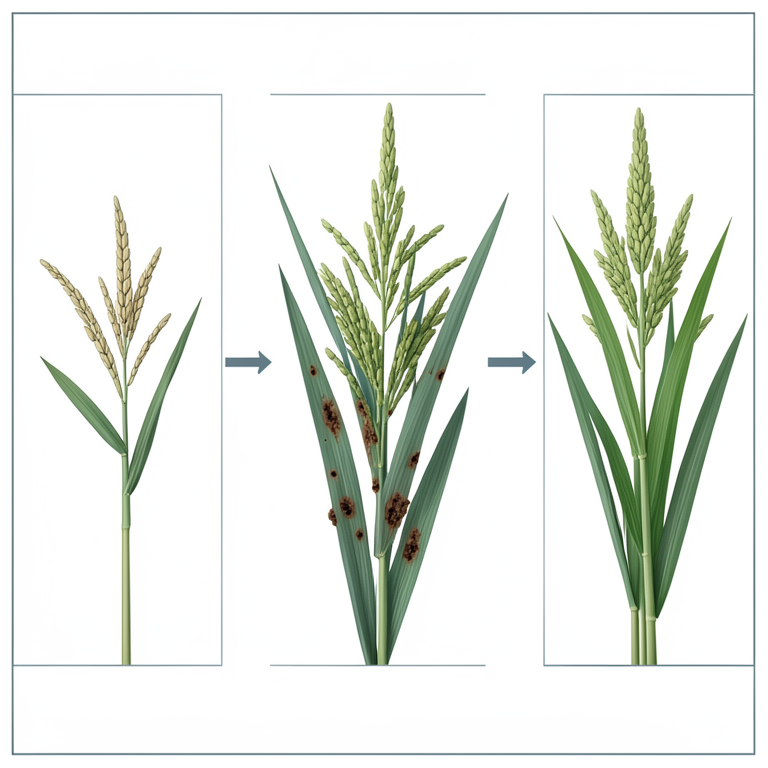
The Nitrogen-Yield-Disease Trade-off
AI-generated conceptual illustration (Rice plants (Oryza sativa) in a field setting). It explains the idea and does not show study data.
View source evidence ↗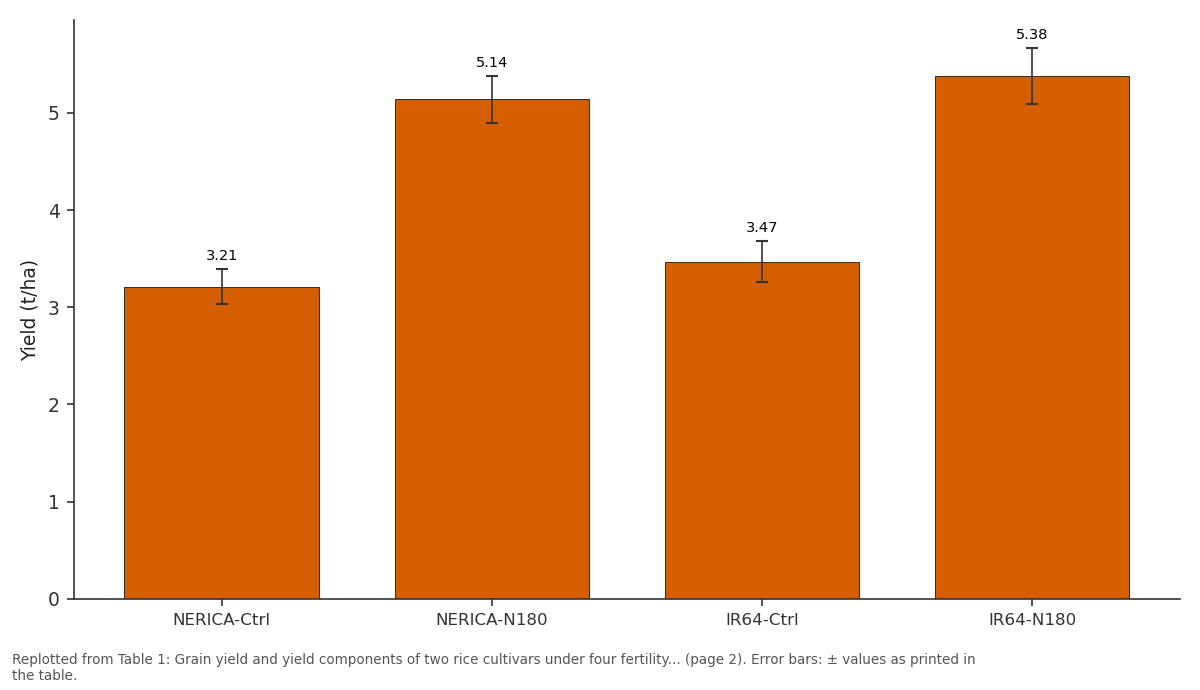
Yield (t/ha): NERICA-Ctrl vs NERICA-N180 vs IR64-Ctrl vs IR64-N180
Replotted from Table 1 (page 2) of the original paper. Every bar is the paper's own table value.
View source evidence ↗Figures & tables
From the original paper Table 1
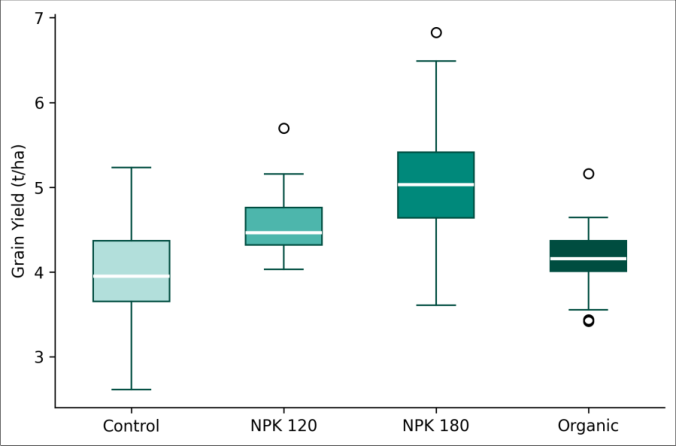 Figure 1
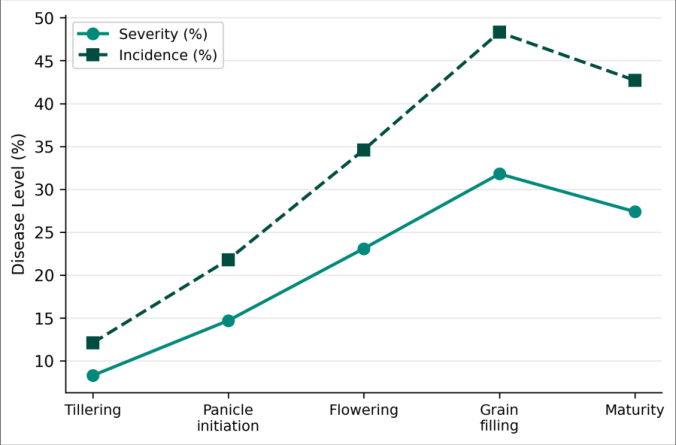 Figure 2
Introduction
A rice farmer tending paddies on the lower slopes of Mount Kilimanjaro faces a puzzle that no single input can solve: volcanic soils rich in minerals but low in available nitrogen, unpredictable rainfall, and the constant threat of fungal disease during the humid months [1] . This scenario, common across tropical highland margins from East Africa to Southeast Asia, means that yield optimization demands attention to both nutrition and crop protection at the same time [2] . Rice (Oryza sativa L.) accounts for roughly half of global cereal consumption, and even modest yield improvements in marginal environments can have outsized effects on food security [3] . Nitrogen management is central to rice productivity, influencing tiller number, panicle size, and grain filling duration [4] . But excess nitrogen can promote lush vegetative growth that favors foliar diseases, particularly rice blast caused by Pyricularia oryzae, the single most destructive fungal pathogen of rice worldwide [5] . This trade-off between yield potential and disease risk complicates fertilizer recommendations, especially in regions where farmers lack access to fungicides or resistant varieties [6] . Lignin, a structural polymer in plant cell walls, has drawn interest as a potential marker for lodging resistance and, indirectly, for disease tolerance, since thicker, more lignified stems may impede fungal penetration [7] . Remote sensing, even at the canopy scale using handheld NDVI sensors, offers a non-destructive way to track crop nitrogen status through the season, potentially guiding split fertilizer applications [8] . And while polyploidy has boosted yield in some crop species, rice remains overwhelmingly diploid in commercial production, making ploidy screening a useful but often confirmatory step in breeding programs [9] . This research evaluated four fertility treatments across two rice cultivars under simulated highland volcanic soil conditions, tracking yield components, disease development, stem lignin content, and canopy reflectance over a full cropping cycle. An economic analysis compared the cost-effectiveness of the treatments to identify the most practical option for resource-constrained growers [10] .
Crop growth stage documentation
Growth staging followed the BBCH scale adapted for rice. Transplanting occurred at BBCH 13 (three-leaf stage), tillering peaked at BBCH 25 (five tillers visible), panicle initiation was recorded at BBCH 30, flowering at BBCH 65, and physiological maturity at BBCH 89. Duration from transplanting to maturity averaged 118 days for NERICA-4 and 126 days for IR64. Disease assessments were timed to coincide with each major growth transition, as susceptibility to blast varies markedly across phenological stages [11] .
Material and Methods Material
Two rice cultivars NERICA-4 (upland-adapted, moderate blast resistance) and IR64 (irrigated lowland, blastsusceptible) were grown in 20-liter pots filled with volcanic Andosol collected from a reference site (pH 5.9, organic C 3.8%). Four fertility treatments were applied: control (no fertilizer), NPK at 120 kg N/ha equivalent, NPK at 180 kg N/ha equivalent, and composted cattle manure at 10 t/ha. Nitrogen in NPK treatments was split 50:30:20 at transplanting, tillering, and panicle initiation. The trial used a split-plot design with fertility as the main plot and cultivar as the subplot, replicated four times. Research was conducted from March 2022 to January 2023 at the Sao Paulo Faculty of Botanical Research greenhouse complex [12] .
Methods
Grain yield was determined at 14 percent moisture content. Yield components panicles per plant, spikelets per panicle, filled grain percentage, and 1000-grain weight were measured on five tagged plants per pot. Blast severity was rated on a 0-9 scale at each growth stage following IRRI standard evaluation protocols. Stem lignin was quantified by the acetyl bromide method on internode samples collected at maturity. NDVI readings were taken weekly with a GreenSeeker handheld sensor. Polyploidy screening used flow cytometry on young leaf tissue with propidium iodide staining. Economic analysis calculated partial budgets including input costs, labor, and grain revenue at local market prices. Data were analyzed using PROC GLM in SAS 9.4 with mean separation by Duncan's multiple range test at p<0.05 [13] . The 180 kg N treatment produced the highest yields in both cultivars, with IR64 reaching 5.38 t/ha. NERICA-4 showed consistently higher stem lignin content than IR64 across all treatments, which appeared to be linked to its lower lodging incidence (data not shown). Organic compost produced intermediate yields but maintained lignin levels closer to the control. Disease incidence climbed steadily from tillering to grain filling, peaking at 48.3 percent before declining slightly at maturity as leaf tissue senesced. Severity followed a similar but less steep trajectory, reaching 31.8 percent at the grainfilling stage.
Results
Results
Discussion
The yield response to nitrogen followed expected patterns: higher N rates increased tiller number and spikelets per panicle, the two components with the largest influence on final grain output [4] . But the 180 kg N treatment also intensified blast severity, particularly in IR64, which lacks the Pi-ta and Pi-b resistance genes present in NERICA-4 [5] . This confirms the classic dilemma in tropical rice management pushing nitrogen to maximize yield simultaneously elevates disease risk, and without effective disease management, the yield gains can evaporate.
Lignin content was higher in NERICA-4 across all treatments, a trait likely inherited from its Oryza glaberrima parentage. The negative correlation between stem lignin and lodging (r = -0.63) agrees with studies in wheat and barley, where lignified stems resist mechanical bending under wind and rain [7] . Whether higher lignin also slows fungal colonization in rice stems remains speculative based on our data, but it deserves targeted investigation. NDVI readings tracked canopy greenness reasonably well (R² = 0.58 against leaf N concentration), though the relationship weakened after flowering as panicle emergence changed canopy architecture. Flow cytometry confirmed diploid status for both cultivars, which was expected but necessary to rule out ploidy as a confounding variable in the yield comparison [9] . The economic analysis favored the 180 kg N treatment when blast was controlled, generating a net benefit 34 percent above the unfertilized control. Without disease management, however, net returns dropped below those of the organic treatment, underscoring the importance of integrated approaches [14] .
Conclusion
This research showed that nitrogen management at 180 kg/ha maximized rice grain yield under simulated volcanic highland conditions, but only when paired with effective blast disease control. NERICA-4 offered a slight yield penalty relative to IR64 but compensated with higher stem lignin and lower disease susceptibility. Organic compost provided a middle path moderate yields with lower input costs and more stable economic returns. Handheld NDVI sensors showed promise for in-season nitrogen monitoring but need refinement for post-flowering use. For highland rice growers, these results argue for an integrated strategy that balances fertilizer rate, cultivar choice, and disease management rather than relying on any single input.
Acknowledgement
Acknowledgements Funding sourcesThis research was supported through internal funding allocations from the host institution. No external grant numbers are associated with this work. Institutional supportThe authors acknowledge the Sao Paulo Faculty of Botanical Research for providing research facilities and technical support throughout the project. Contributions not qualifying for authorshipTechnical staff who assisted with laboratory analyses and field operations are gratefully acknowledged.
Figures and tables from the paper
| Treatment | Yield (t/ha) | Panicles/ plant | Spikelets/ panicle | Filled grain (%) | 1000-GW (g) | Lignin (mg/g) |
|---|---|---|---|---|---|---|
| NERICA-Ctrl | 3.21 ± 0.18 | 7.4 ± 0.6 | 84.3 ± 3.1 | 78.2 ± 2.4 | 24.1 ± 0.8 | 87.3 ± 3.2 |
| NERICA-N180 | 5.14 ± 0.24 | 11.2 ± 0.8 | 112.7 ± 4.6 | 83.7 ± 1.9 | 25.3 ± 0.7 | 79.8 ± 2.8 |
| IR64-Ctrl | 3.47 ± 0.21 | 8.1 ± 0.5 | 91.6 ± 3.7 | 76.8 ± 2.7 | 23.7 ± 0.9 | 72.4 ± 3.6 |
| IR64-N180 | 5.38 ± 0.29 | 12.4 ± 0.9 | 118.4 ± 5.2 | 81.4 ± 2.1 | 24.8 ± 0.6 | 68.1 ± 2.4 |
| IR64-Organic | 4.23 ± 0.22 | 9.7 ± 0.7 | 103.2 ± 4.1 | 80.1 ± 2.3 | 24.4 ± 0.8 | 74.6 ± 3.1 |
Table text extracted from the original PDF; superscript letters are shown inline. The original table image is below.
View original table image
References
15 in the original paper- Nkonya E, Schroeder T, Norman D. Factors affecting adoption of improved maize seed and fertiliser in northern Tanzania. Journal of Agricultural Economics. 1997;48(1):1-12.
- Saito K, Nelson A,"; RA, et al. Towards a better understanding of biophysical determinants of yield gaps and the potential for expansion of the rice area in Africa. Tropical Agriculture. 2013;91:200-214.
- GRiSP. Rice almanac: Source book for one of the most important economic activities on earth. Fourth edition. IRRI, Los Baños. 2013.
- Yoshida S. Fundamentals of rice crop science. International Rice Research Institute, Los Baños. 1981.
- Dean RA, Talbot NJ, Ebbole DJ, et al. The genome sequence of the rice blast fungus Magnaporthe grisea. Nature. 2005;434(7036):980-986.
- Katsantonis D, Kadoglidou K, Dramalis C, Puigdollers P. Rice blast forecasting models and their practical value: A review. Phytopathologia Mediterranea. 2017;56(2):187-216.
- Ma QH. Functional analysis of a cinnamyl alcohol dehydrogenase involved in lignin biosynthesis in wheat. Journal of Experimental Botany. 2010;61(10):27352744.
- Xue L, Cao W, Luo W, Dai T, Zhu Y. Monitoring leaf nitrogen status in rice with canopy spectral reflectance. Agronomy Journal. 2004;96(1):135-142.
- Sattler MC, Carvalho CR, Clarindo WR. The polyploidy and its key role in plant breeding. Planta. 2016;243(2):281-296.
- Nwanze KF, Mohapatra S, Kormawa P, Keya S, BruceOliver S. Rice development in sub-Saharan Africa. Journal of the Science of Food and Agriculture. 2006;86(5):675-677.
- Lancashire PD, Bleiholder H, Van Den Boom T, et al. A uniform decimal code for growth stages of crops and weeds. Annals of Applied Biology. 1991;119(3):561601.
- IRRI. Standard evaluation system for rice. International Rice Research Institute, Los Baños. 2014.
- SAS Institute. SAS/STAT user's guide, version 9.4. SAS Institute Inc., Cary, NC. 2013.
- Oerke EC. Crop losses to pests. Journal of Agricultural Science. 2006;144(1):31-43.
- Wopereis MCS, Defoer T, Idinoba P, Diack S, Dugue MJ. Participatory learning and action research for integrated rice management in inland valleys of subSaharan Africa. WARDA Training Series. 2008.