
Research article · 2026 · Full text
International Journal of Horticulture and Food ScienceEffect of organic manures on quality parameters of guava (Psidium guajava) cv. Lucknow 49
Volume 8(4) · Pages 52–54 · DOI: 10.33545/26631067.2026.v8.i4a.526 ↗
Research areasAgricultural Science and FertilizationPlant Physiology and Cultivation StudiesAgriculture, Plant Science, Crop Management
Abstract
Author-writtenThe experiment entitled "Effect of organic manures on quality in guava (Psidium guajava) cv. Lucknow 49" was conducted during 2023-2024. The experiment was laid out in randomized block design (RBD) with fourteen treatments and three replications. The treatments were designed by combined soil application of FYM, vermicompost, poultry manure and neem cake at different levels. The results revealed that combined application of FYM 10 kg + vermicompost 5 kg + poultry manure 2.5 kg + neem cake 5 kg tree-1 exhibited superior performance in increasing the quality parameters such as TSS, ascorbic acid content, TSS: acid ratio, total sugar content, reducing sugar content, non reducing sugar content and also recorded the lowest values for titrable acidity of the fruits in two successive crops. The untreated control registered the least values for all the quality parameters.
Summary
Source-checkedPlain-language reading of the full paper, prepared with AI and checked against the text. Each point links to the authors' own words.
Why it matters
- Guava is a highly significant fruit crop in India. View evidence ↗
- Organic manures serve as important sources of both major and micronutrients for plants. View evidence ↗
- Using organic manures in guava cultivation can improve fruit quality and safety by eliminating chemical residues. View evidence ↗
The question
- The study aimed to determine how different organic manures affect the quality parameters of the Lucknow 49 guava cultivar. View evidence ↗
What they did
- The experiment took place between 2023 and 2024 in Tamil Nadu, using three-year-old Lucknow 49 guava trees. View evidence ↗
- Treatments involved various combinations and levels of farmyard manure, vermicompost, poultry manure, and neem cake. View evidence ↗
- The study measured several quality parameters, including total soluble solids (TSS), ascorbic acid, titrable acidity, TSS:acid ratio, and various sugar contents. View evidence ↗
What they found
- Treatment T13 also resulted in the lowest titrable acidity, measured at 0.14% and 0.15% for the first and second crops. View evidence ↗
- Treatment T13 achieved the highest total sugar (8.50% and 8.11%), reducing sugar (5.77% and 5.51%), and non-reducing sugar (2.73% and 2.60%) in the first and second crops. View evidence ↗
- The untreated control group showed the lowest values for all measured quality parameters. View evidence ↗
What it means
- The authors conclude that the combination of 10kg FYM, 5kg vermicompost, 2.5kg poultry manure, and 5kg neem cake per tree significantly improves the quality of Lucknow 49 guava fruits. View evidence ↗
Visual summary
3 visualsIllustrations explain the paper; charts are replotted from the paper's own table values.
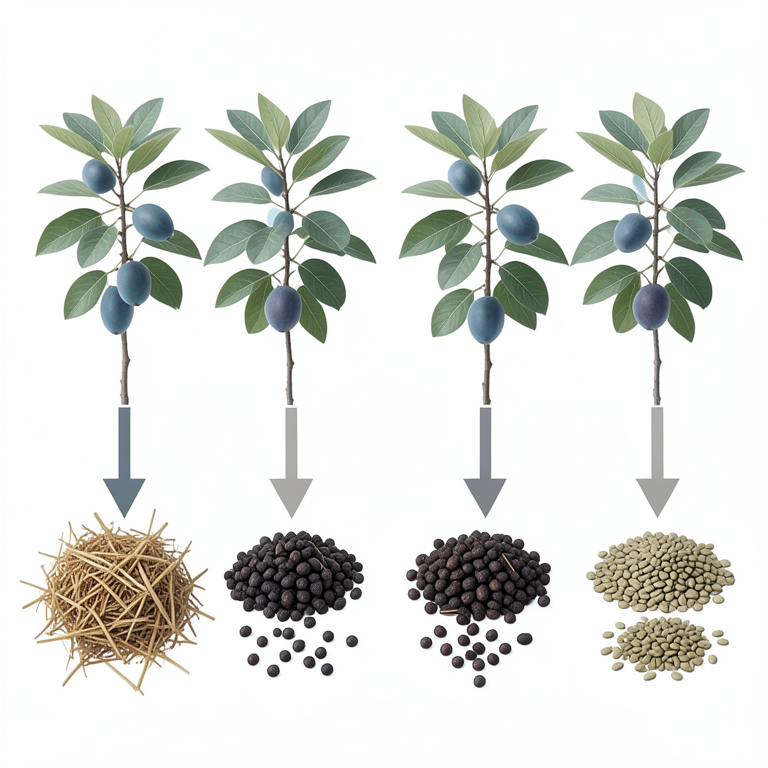
Experimental Treatment Setup
AI-generated conceptual illustration (guava plants (Psidium guajava cv. Lucknow 49)). It explains the idea and does not show study data.
View source evidence ↗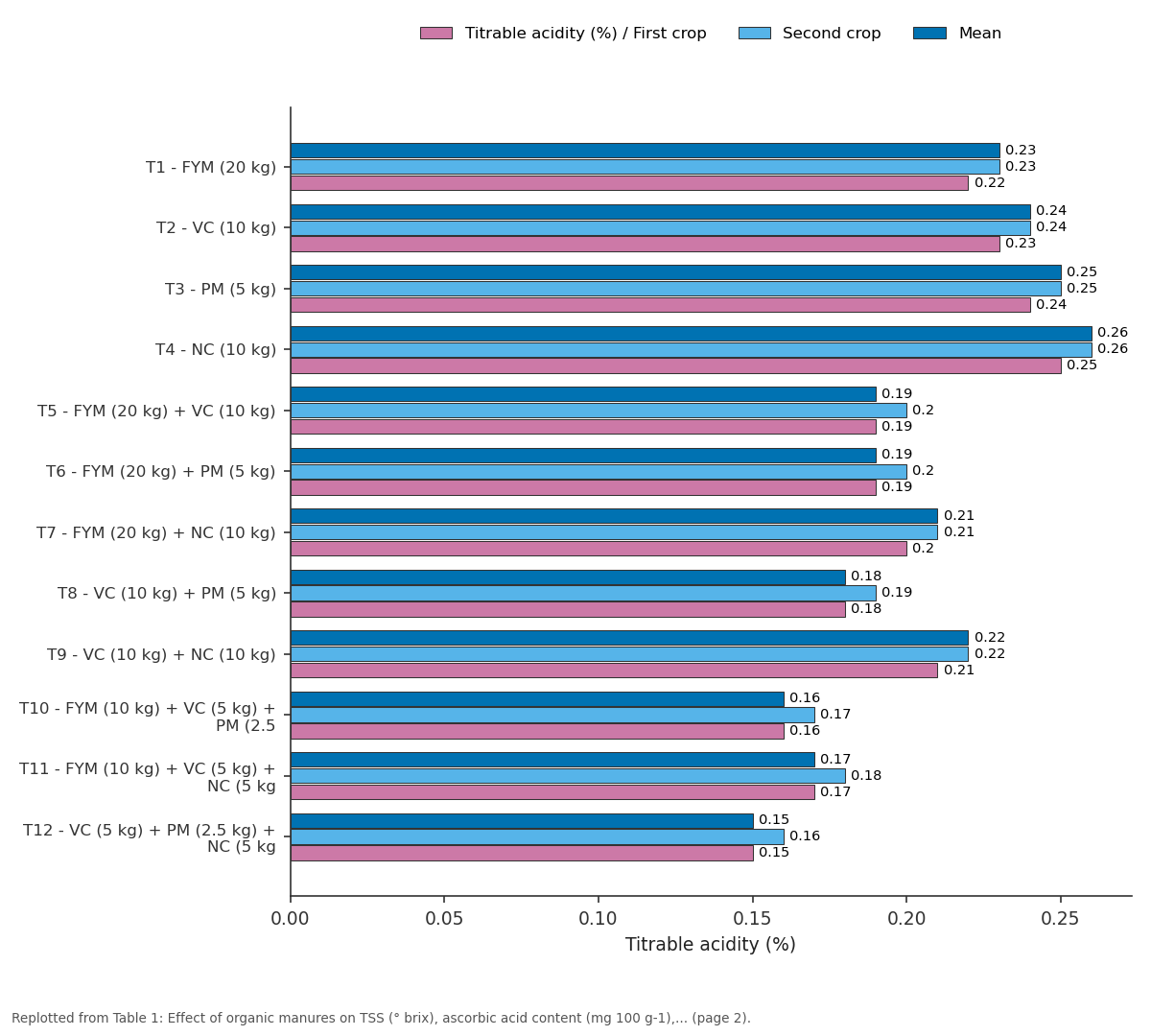
Titrable acidity (%) / First crop and Second crop and more: T1 - FYM (20 kg) vs T2 - VC (10 kg) vs T3 - PM (5 kg) vs T4 - NC (10 kg) vs T5 - FYM (20 kg) + VC...
Replotted from Table 1 (page 2) of the original paper. Every bar is the paper's own table value.
View source evidence ↗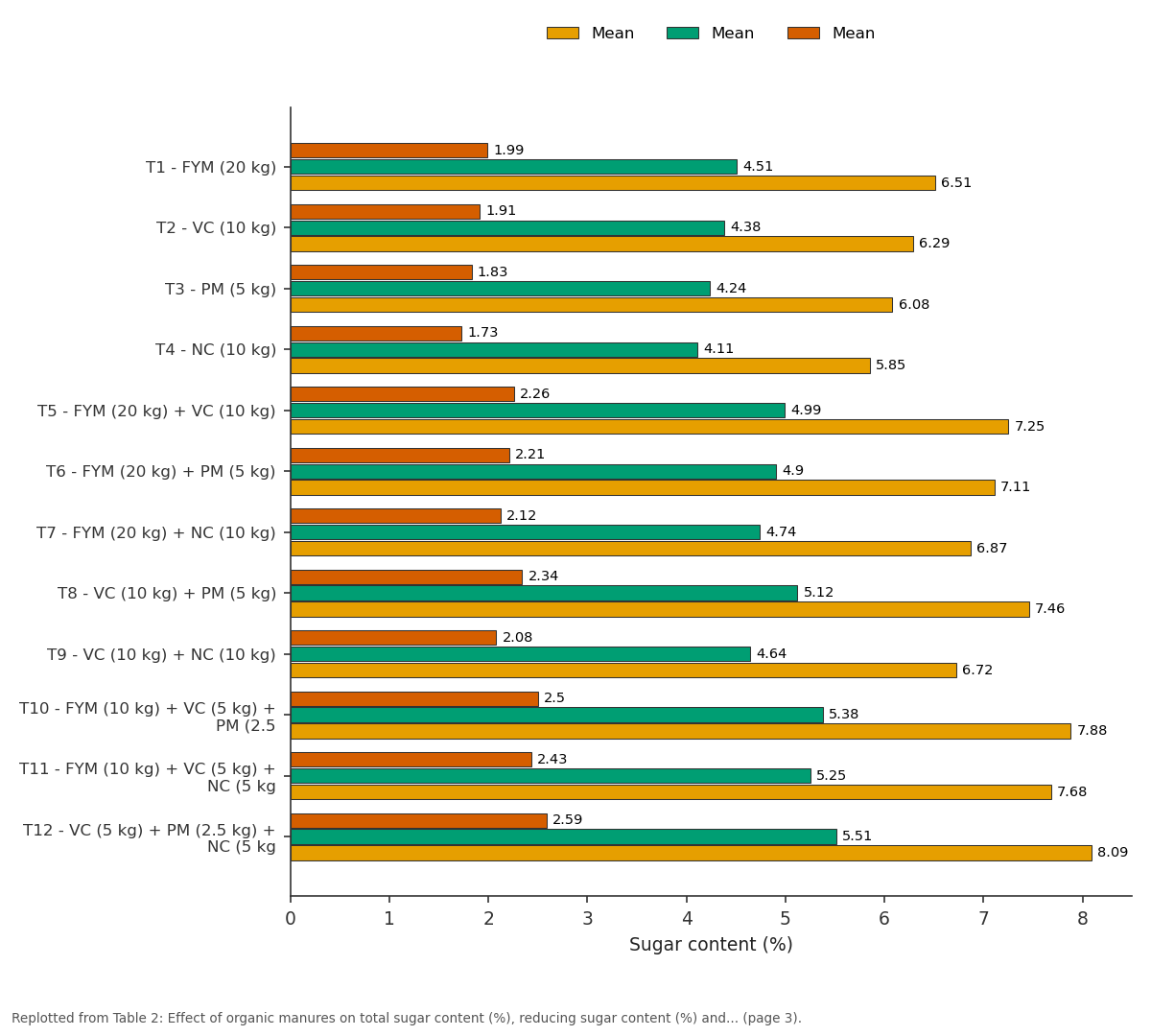
Mean and Mean and more: T1 - FYM (20 kg) vs T2 - VC (10 kg) vs T3 - PM (5 kg) vs T4 - NC (10 kg) vs T5 - FYM (20 kg) + VC...
Replotted from Table 2 (page 3) of the original paper. Every bar is the paper's own table value.
View source evidence ↗Figures & tables
From the original paper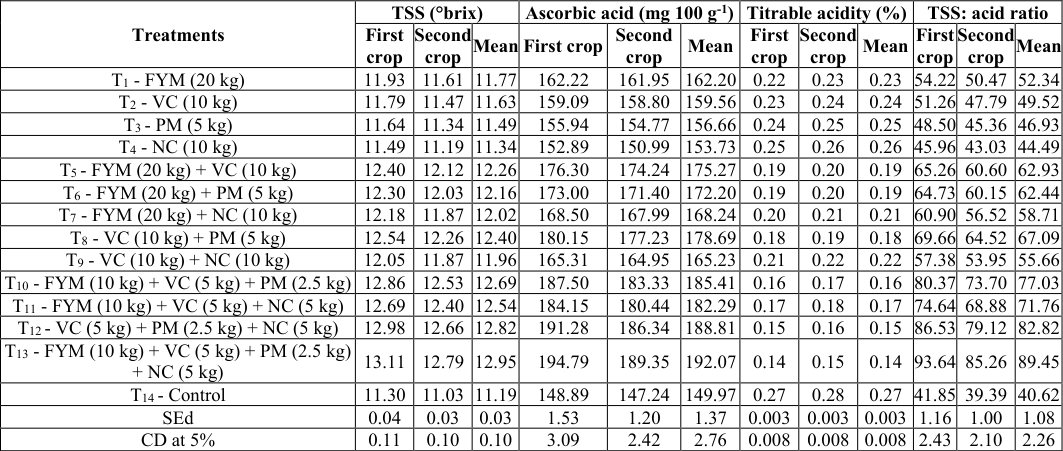 Table 1
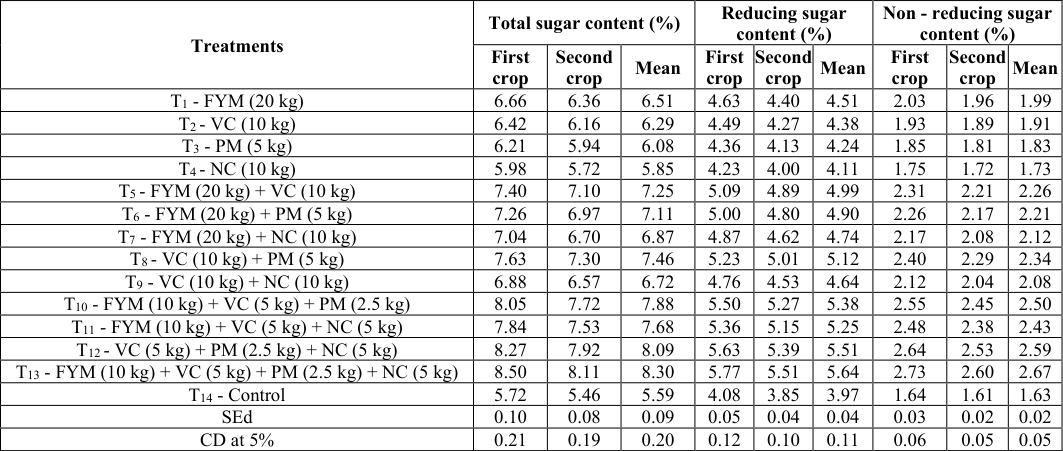 Table 2
Introduction
Guava (Psidium guajava L.) is one of the most important fruit crops in India. It belongs to the family Myrtaceae, which has 140 genera and 3000 species. It is categorized under the genus Psidium, which has 150 species, of which only Psidium guajava is economically used. It is native to Tropical South America and it was introduced in India by the Portuguese in the early 17th century. Guava is the fourth most important fruit crop in terms of area and production after mango, banana and citrus. Uttar Pradesh is the leading guava producing state in the country, followed by Maharashtra, Madhya Pradesh, Bihar, Andhra Pradesh, Haryana, Punjab, West Bengal, Chhattisgarh, Gujarat, Karnataka, and Tamil Nadu. The area under guava cultivation in India is 308 thousand hectares with an annual production of 4,582 thousand metric tonnes and a productivity of 14.87 metric tonnes hectare -1 (Anon, 2022) [2] . Organic manures are bulky substrates which are the store houses of major nutrients apart from containing a considerable amount of micronutrients (Anand Singh Rawat et al., 2022) [1] . It has more relevance to horticultural crops which are largely consumed in fresh form immediately after harvest. Guava is one such horticultural crop, where fruits are consumed after harvest along with skin and pulp and there is a feasibility of organic farming in its cultivation (Dwivedi et al., 2012) [5] . Guava plants grown with organic manures often produce fruits with better taste, texture and nutritional value and they are also free from harmful chemical residues, making them safer for consumption (Lester, 2006) [8] . Therefore, in view of the above, this study was carried out to investigate the effect of organic manures on quality parameters of guava trees cv. Lucknow 49.
Materials and Methods
The field experiment was conducted at a farmer's field in Suthamalli village, Ariyalur District, Tamil Nadu during 2023-2024. The study was carried out in three year old guava trees of the cultivar Lucknow 49. The field experiment was laid out in randomized block design with three replications. The treatment consisted of various combinations of organic manures namely farmyard manure (FYM), vermicompost (VC), poultry manure (PM) and neem cake (NC) at different levels. The treatments details are: T 1 -FYM (20 kg), T 2 -VC (10 kg), T 3 -PM (5 kg), T 4 -NC (10 kg), T 5 -FYM (20 kg) + VC (10 kg), T 6 -FYM (20 kg) + PM (5 kg), T 7 -FYM (20 kg) + NC (10 kg), T 8 -VC (10 kg) + PM (5 kg), T 9 -VC (10 kg) + NC (10 kg), T 10 -FYM (10 kg) + VC (5 kg) + PM (2.5 kg), T 11 -FYM (10 kg) + VC (5 kg) + NC (5 kg), T 12 -VC (5 kg) + PM (2.5 kg) + NC (5 kg), T 13 -FYM (10 kg) + VC (5 kg) + PM (2.5 kg) + NC (5 kg), T 14 -control. Organic manures were applied during the month of February for the first crop and August for the second crop. The observations such as total soluble solids, ascorbic acid content, titrable acidity, TSS: acid ratio, total sugar content, reducing sugar content and non -reducing sugar content were recorded. The ascorbic acid content of fruits was estimated by using 2, 6 -dichlorophenolindophenol dye method as described by Sadasivam and Manickam (1996) [10] . Titrable acidity of the fruit was determined by using the method suggested by Ranganna (1977) [9] . The reducing sugar content of the fruits was estimated following the method of Somogyi (1952) [11] . The statistical analysis following the standard procedures using DSAASTAT software in a personal computer. Critical differences (CD) were worked out at 5 per cent level of probability.
Results and Discussion
The data presented in Table 1 indicated that the soil application of different sources of organic manures at varied levels significantly influenced the quality parameters of guava. Among the treatments, application of FYM 10 kg + vermicompost 5 kg + poultry manure 2.5 kg + neem cake 5 kg tree -1 (T 13 ) registered the highest TSS (13.11 and 12.79 °brix), ascorbic acid content (194.79 and 189.35 mg 100 g - 1 ), TSS: acid ratio (93.64 and 85.26) and the same treatment recorded a lowest titrable acidity (0.14 and 0.15%) in the first and second crop respectively followed by T 12 (vermicompost 5 kg + poultry manure 2.5 kg + neem cake 5 kg tree -1 ). The least TSS (11.30 and 11.03 ° brix), ascorbic acid content (148.89 and 147.24 mg 100 g -1 ) and TSS: acid ratio (93.64 and 85.26) in the first crop and second crop were recorded in the untreated control (T 14 ). Application of organic manures increased the fruit quality parameters which might be due to the better role of nutrients which is involved in the carbohydrate synthesis, breakdown and translocation of starch, synthesis of protein and neutralization of physiologically important organic acids. The increase in ascorbic acid content due to various organic treatments may due to the proper nutrition to the treated plants which ultimately improves the vitamin and mineral contents of the fruits (Anand Singh Rawat et al., 2022) [1] . Poultry manures may enhance the ascorbic acid content in fruits through a sustained release of essential macro and micro nutrients. This balanced nutrient supply could facilitate carbohydrate assimilation, subsequently boosting ascorbic acid synthesis (Devi and Mitra, 2018) [4] . Results in Table 2 revealed that the quality parameters was significantly influenced by different treatments. Soil application of FYM 10 kg + vermicompost 5 kg + poultry manure 2.5 kg + neem cake 5 kg (T 13 ) recorded the highest values of total sugar content (8.50% and 8.11%), reducing sugar content (5.77% and 5.51%) and non -reducing sugar content (2.73% and 2.60%) in the first and second crop respectively. The next best treatment was T 12 (vermicompost 5 kg + poultry manure 2.5 kg + neem cake 5 kg tree -1 ). The treatment (T 14 ) control recorded the least values for total sugar content, reducing sugar content and non -reducing sugar content in fruits compared to all other treatments. The increased fruit quality characteristics are attributable to the addition of various organic manures which may have promoted the biosynthesis and translocation of carbohydrates into the fruits. The increased availability of organic nitrogen and humic substances from vermicompost might have enhanced the carbohydrate metabolism in plants and stimulated the accumulation of reducing sugars and non-reducing sugars. The increased sugar content in fruits due to the application of poultry manures proved the direct effect of availability of vital nutrients and indirect effect of sustained release of growth hormones and vitamins as observed by Butani and Chovatia, (2014) [3] . Similar findings on the effect of organic manures on quality of guava fruits were also reported by Goswami et al. (2015) [6] , Tyagi et al. (2018) [12] and Kumrawat et al. (2018) [7] . Among the different sources of organic manures evaluated in the present study, FYM 10 kg + vermicompost 5 kg + poultry manure 2.5 kg + neem cake 5 kg tree -1 significantly enhanced quality parameters of Lucknow 49 guava fruits.
| Treatments | Total sugar content (%) | — | — | Reducing sugar content (%) | — | — | Non - reducing sugar content (%) | — | — |
|---|---|---|---|---|---|---|---|---|---|
| First crop | Second crop | Mean | First crop | Second crop | Mean | First crop | Second crop | Mean | |
| T1 - FYM (20 kg) | 6.66 | 6.36 | 6.51 | 4.63 | 4.40 | 4.51 | 2.03 | 1.96 | 1.99 |
| T2 - VC (10 kg) | 6.42 | 6.16 | 6.29 | 4.49 | 4.27 | 4.38 | 1.93 | 1.89 | 1.91 |
| T3 - PM (5 kg) | 6.21 | 5.94 | 6.08 | 4.36 | 4.13 | 4.24 | 1.85 | 1.81 | 1.83 |
| T4 - NC (10 kg) | 5.98 | 5.72 | 5.85 | 4.23 | 4.00 | 4.11 | 1.75 | 1.72 | 1.73 |
| T5 - FYM (20 kg) + VC (10 kg) | 7.40 | 7.10 | 7.25 | 5.09 | 4.89 | 4.99 | 2.31 | 2.21 | 2.26 |
| T6 - FYM (20 kg) + PM (5 kg) | 7.26 | 6.97 | 7.11 | 5.00 | 4.80 | 4.90 | 2.26 | 2.17 | 2.21 |
| T7 - FYM (20 kg) + NC (10 kg) | 7.04 | 6.70 | 6.87 | 4.87 | 4.62 | 4.74 | 2.17 | 2.08 | 2.12 |
| T8 - VC (10 kg) + PM (5 kg) | 7.63 | 7.30 | 7.46 | 5.23 | 5.01 | 5.12 | 2.40 | 2.29 | 2.34 |
| T9 - VC (10 kg) + NC (10 kg) | 6.88 | 6.57 | 6.72 | 4.76 | 4.53 | 4.64 | 2.12 | 2.04 | 2.08 |
| T10 - FYM (10 kg) + VC (5 kg) + PM (2.5 kg) | 8.05 | 7.72 | 7.88 | 5.50 | 5.27 | 5.38 | 2.55 | 2.45 | 2.50 |
| T11 - FYM (10 kg) + VC (5 kg) + NC (5 kg) | 7.84 | 7.53 | 7.68 | 5.36 | 5.15 | 5.25 | 2.48 | 2.38 | 2.43 |
| T12 - VC (5 kg) + PM (2.5 kg) + NC (5 kg) | 8.27 | 7.92 | 8.09 | 5.63 | 5.39 | 5.51 | 2.64 | 2.53 | 2.59 |
| T13 - FYM (10 kg) + VC (5 kg) + PM (2.5 kg) + NC (5 kg) | 8.50 | 8.11 | 8.30 | 5.77 | 5.51 | 5.64 | 2.73 | 2.60 | 2.67 |
| T14 - Control | 5.72 | 5.46 | 5.59 | 4.08 | 3.85 | 3.97 | 1.64 | 1.61 | 1.63 |
| SEd | 0.10 | 0.08 | 0.09 | 0.05 | 0.04 | 0.04 | 0.03 | 0.02 | 0.02 |
| CD at 5% | 0.21 | 0.19 | 0.20 | 0.12 | 0.10 | 0.11 | 0.06 | 0.05 | 0.05 |
Table text extracted from the original PDF; superscript letters are shown inline. The original table image is below.
View original table image
| Treatments | TSS (°brix) | — | — | Ascorbic acid (mg 100 g-1) | — | — | Titrable acidity (%) | — | — | TSS: acid ratio | — | — |
|---|---|---|---|---|---|---|---|---|---|---|---|---|
| First crop | Second crop | Mean | First crop | Second crop | Mean | First crop | Second crop | Mean | First crop | Second crop | Mean | |
| T1 - FYM (20 kg) | 11.93 | 11.61 | 11.77 | 162.22 | 161.95 | 162.20 | 0.22 | 0.23 | 0.23 | 54.22 | 50.47 | 52.34 |
| T2 - VC (10 kg) | 11.79 | 11.47 | 11.63 | 159.09 | 158.80 | 159.56 | 0.23 | 0.24 | 0.24 | 51.26 | 47.79 | 49.52 |
| T3 - PM (5 kg) | 11.64 | 11.34 | 11.49 | 155.94 | 154.77 | 156.66 | 0.24 | 0.25 | 0.25 | 48.50 | 45.36 | 46.93 |
| T4 - NC (10 kg) | 11.49 | 11.19 | 11.34 | 152.89 | 150.99 | 153.73 | 0.25 | 0.26 | 0.26 | 45.96 | 43.03 | 44.49 |
| T5 - FYM (20 kg) + VC (10 kg) | 12.40 | 12.12 | 12.26 | 176.30 | 174.24 | 175.27 | 0.19 | 0.20 | 0.19 | 65.26 | 60.60 | 62.93 |
| T6 - FYM (20 kg) + PM (5 kg) | 12.30 | 12.03 | 12.16 | 173.00 | 171.40 | 172.20 | 0.19 | 0.20 | 0.19 | 64.73 | 60.15 | 62.44 |
| T7 - FYM (20 kg) + NC (10 kg) | 12.18 | 11.87 | 12.02 | 168.50 | 167.99 | 168.24 | 0.20 | 0.21 | 0.21 | 60.90 | 56.52 | 58.71 |
| T8 - VC (10 kg) + PM (5 kg) | 12.54 | 12.26 | 12.40 | 180.15 | 177.23 | 178.69 | 0.18 | 0.19 | 0.18 | 69.66 | 64.52 | 67.09 |
| T9 - VC (10 kg) + NC (10 kg) | 12.05 | 11.87 | 11.96 | 165.31 | 164.95 | 165.23 | 0.21 | 0.22 | 0.22 | 57.38 | 53.95 | 55.66 |
| T10 - FYM (10 kg) + VC (5 kg) + PM (2.5 kg) | 12.86 | 12.53 | 12.69 | 187.50 | 183.33 | 185.41 | 0.16 | 0.17 | 0.16 | 80.37 | 73.70 | 77.03 |
| T11 - FYM (10 kg) + VC (5 kg) + NC (5 kg) | 12.69 | 12.40 | 12.54 | 184.15 | 180.44 | 182.29 | 0.17 | 0.18 | 0.17 | 74.64 | 68.88 | 71.76 |
| T12 - VC (5 kg) + PM (2.5 kg) + NC (5 kg) | 12.98 | 12.66 | 12.82 | 191.28 | 186.34 | 188.81 | 0.15 | 0.16 | 0.15 | 86.53 | 79.12 | 82.82 |
| T13 - FYM (10 kg) + VC (5 kg) + PM (2.5 kg) + NC (5 kg) | 13.11 | 12.79 | 12.95 | 194.79 | 189.35 | 192.07 | 0.14 | 0.15 | 0.14 | 93.64 | 85.26 | 89.45 |
| T14 - Control | 11.30 | 11.03 | 11.19 | 148.89 | 147.24 | 149.97 | 0.27 | 0.28 | 0.27 | 41.85 | 39.39 | 40.62 |
| SEd | 0.04 | 0.03 | 0.03 | 1.53 | 1.20 | 1.37 | 0.003 | 0.003 | 0.003 | 1.16 | 1.00 | 1.08 |
| CD at 5% | 0.11 | 0.10 | 0.10 | 3.09 | 2.42 | 2.76 | 0.008 | 0.008 | 0.008 | 2.43 | 2.10 | 2.26 |
Table text extracted from the original PDF; superscript letters are shown inline. The original table image is below.
View original table image
References
12 in the original paper- Anand Singh Rawat, Bhanu Pratap, Manoj Gaund, Prithvi Pal, Ajendra Kumar. Studies on the comparative performance of organic manures on physico-chemical attributes of winter season guava (Psidium guajava) in cv. Lucknow 49. Journal of Pharmaceutical Innovation. 2022;11:114-119.
- Anonymous. Indian Horticulture Database. New Delhi: National Horticulture Board, Government of India; 2022.
- Butani AM, Chovatia RS. Effect of chemical fertilizers and vermicompost on biochemical parameters of banana (Musa paradisiaca L.) cv. Grand Naine. Asian Journal of Horticulture. 2014;9:412-415.
- Devi HL, Mitra SK. Organic nutrient management system for cultivation of pineapple (Ananas comosus) cv. Kew. Innovative Farming. 2018;3:181-184.
- Dwivedi DH, Lata R, Ram RB, Babu M. Effect of biofertilizer and organic manures on yield and quality of Red Fleshed guava. Acta Horticulturae. 2012;933:239244.
- Goswami AK, Lal S, Thakare M, Mishra DS, Kumar R. Studies on integrated nutrient management on yield and quality of guava cv. Pant Prabhat. Indian Journal of Horticulture. 2015;72:139-142.
- Kumrawat D, Kanpure RN, Singh OP, Bhandari J, Kachouli B. Effect of integrated nutrient management on yield and quality parameters of guava cv. Lucknow 49. Journal of Pharmacognosy and Phytochemistry. 2018;7:1668-1670.
- Lester GE. Environmental regulation of human health nutrients (ascorbic acid content, beta-carotene and folic acid) in fruits and vegetables. Journal of Horticultural Sciences. 2006;41:59-64.
- Ranganna S. Manual of analysis of fruit and vegetable products. New Delhi: Tata McGraw-Hill Publishing Company Limited; 1977. 7-49 p.
- Sadasivam S, Manickam A. Biochemical methods. 2nd ed. New Delhi: New Age International Limited Publishers; 1996.
- Somogyi N. Notes on sugar determination. Journal of Biological Chemistry. 1952;200:145-154.
- Tyagi SK, Singh SS, Mishra SP, Sirothia P, Gautam SS. Studies on effect integrated nutrient management in improving yield and quality of guava cv. Lucknow 49. International Journal of Tropical Agriculture. 2018;36:978-983.