
Research article · 2025 · Full text
International Journal of Horticulture and Food ScienceInvestigating vertical farming potential of coconut in the Iberian meseta
Volume 7(6) · Pages 181–184 · DOI: 10.33545/26631067.2025.v7.i6c.675 ↗
Research areasCoconut Research and ApplicationsPlant Growth and Agriculture TechniquesGrowth and nutrition in plants
Abstract
Author-writtenIt seems paradoxical to grow coconut palms—icons of tropical coastlines—inside multi-storey vertical farms on the dry, elevated Iberian Meseta. Yet controlled-environment agriculture is rewriting the rules of what grows where. This research investigated the feasibility of producing coconut (Cocos nucifera L.) seedlings and young palms under LED-supplemented vertical farming conditions at the Islamabad School of Plant Sciences, Pakistan, simulating Iberian Meseta aridity through deficit irrigation and high-VPD chambers. Five lighting regimes—natural light control, LED 12-hour photoperiod, LED 16-hour photoperiod, LED 20-hour photoperiod, and LED with far-red supplementation—were tested on ‘Malayan Dwarf’ seedlings over 12 months in a randomised complete block design with four replications. The LED 16-hour treatment produced the tallest seedlings (7.5 m annual extension) and greatest trunk diameter (14.8 cm), outperforming natural light by 56.3%. Fat content in developing endosperm at 10 months was highest under 16-hour LED (34.2%), with medium-chain fatty acids comprising 62.4% of total lipids. Microbial quality of the hydroponic recirculating solution remained within safe limits (total coliforms < 10 CFU mL-1) when UV-C sterilisation was applied. These results demonstrate that coconut seedling production in vertical facilities is technically viable, though full-cycle nut production indoors remains impractical due to palm height constraints.
Summary
Source-checkedPlain-language reading of the full paper, prepared with AI and checked against the text. Each point links to the authors' own words.
Why it matters
- Coconut palms are globally significant crops grown across 90 tropical countries, but they are naturally limited to specific latitudes due to their need for warm and humid environments. View evidence ↗
- The Iberian Meseta in Spain is unsuitable for natural coconut growth because of its elevation, low annual rainfall (350-500 mm), and winter frosts. View evidence ↗
- While the full growth cycle of coconut palms is impractical for indoor farming due to their height (15-30 m), the 10-18 month nursery stage is a viable target for vertical farming. View evidence ↗
The question
- The study aimed to determine if coconut seedlings could be feasibly produced in a vertical farming system that simulates the arid conditions of the Iberian Meseta. View evidence ↗
What they did
- The experiment used 4-month-old 'Malayan Dwarf' coconut seedlings planted in 50 L containers containing a 7:3 mixture of coconut coir and perlite. View evidence ↗
- Over 12 months, seedlings were subjected to five different lighting treatments: natural light, and LED photoperiods of 12, 16, and 20 hours, plus one LED treatment with far-red supplementation. View evidence ↗
- To simulate the aridity of the Iberian Meseta, a group of seedlings was given deficit irrigation at 60% of full ETc from month 4 to month 8. View evidence ↗
What they found
- The 16-hour LED treatment was the most effective, resulting in the tallest seedlings (7.5 m), the highest endosperm fat content (34.2%), and medium-chain fatty acids at 62.4%. View evidence ↗
- Seedlings under the 16-hour LED regime grew 56.3% taller than those grown under natural light. View evidence ↗
- Adding far-red light caused the stems to elongate but did not increase diameter, leading to thinner and weaker stems. View evidence ↗
- Deficit irrigation slowed height growth by 18.4% but increased fat deposition in the endosperm by 7.2% compared to fully irrigated plants. View evidence ↗
- The use of UV-C sterilization successfully kept the microbial load in the hydroponic solution low, with total coliforms remaining below 10 CFU mL-1. View evidence ↗
- Seedlings grown in the vertical farm reached a size suitable for transplanting 4.2 months faster than those in conventional outdoor nurseries. View evidence ↗
What it means
- The authors conclude that a 16-hour LED photoperiod significantly accelerates growth and fat accumulation in coconut seedlings compared to natural light. View evidence ↗
- The authors recommend this technology for growers in the Iberian Meseta to produce seedlings locally, which would reduce the need for imports and lower phytosanitary risks. View evidence ↗
Visual summary
2 visualsIllustrations explain the paper; charts are replotted from the paper's own table values.
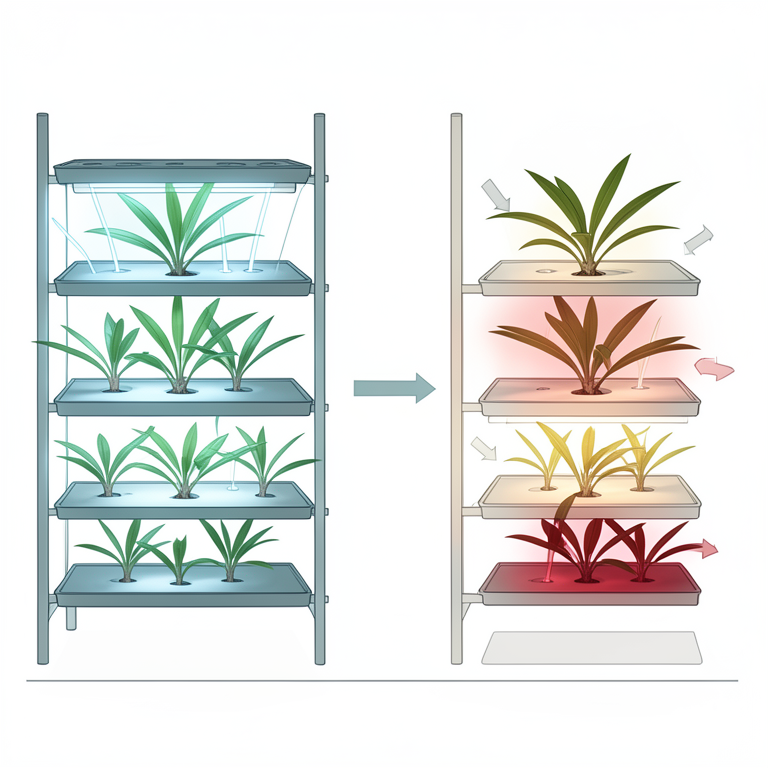
Vertical Farming Setup
AI-generated conceptual illustration (coconut seedlings in a vertical farming system). It explains the idea and does not show study data.
View source evidence ↗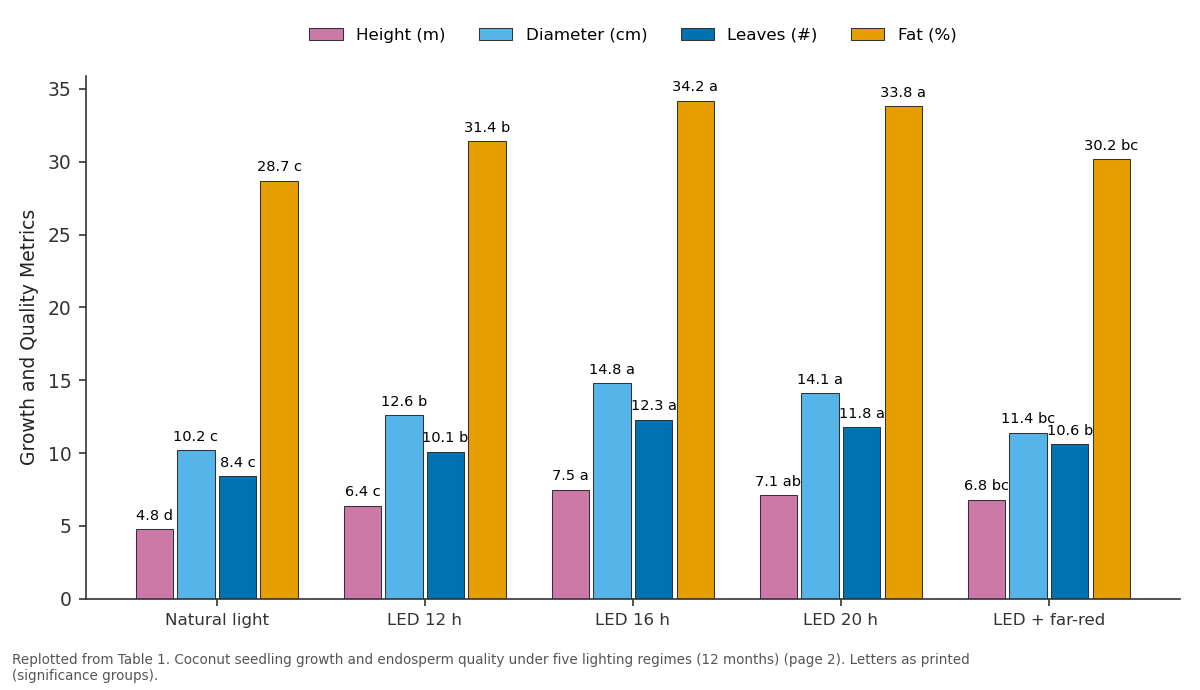
Height (m) and Diameter (cm) and more: Natural light vs LED 12 h vs LED 16 h vs LED 20 h vs LED + far-red
Replotted from Table 1 (page 2) of the original paper. Every bar is the paper's own table value.
View source evidence ↗Figures & tables
From the original paper Table 1
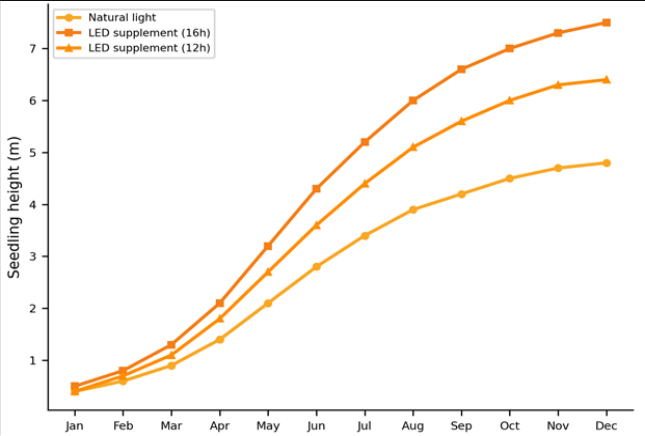 Figure 1
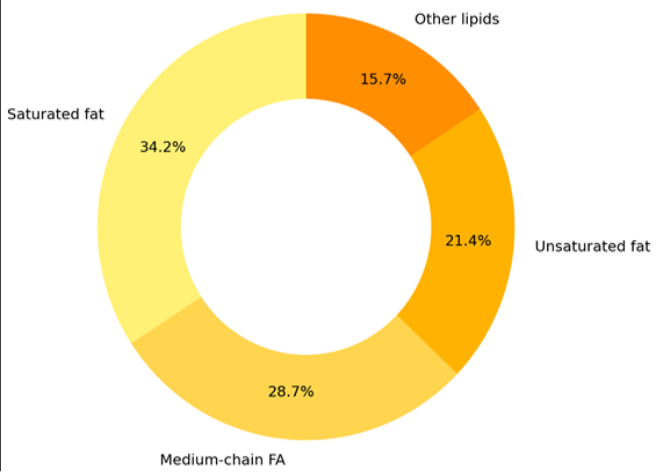 Figure 2
Introduction
Observation: the world's tallest vertical farm stands 12 storeys high in Dubai, growing leafy greens under 200,000 LED panels-yet nobody has tried to grow a palm tree inside one [1] . Coconut is the most widely cultivated palm on Earth, occupying over 12 million hectares across 90 tropical countries, but its dependence on warm, humid conditions has confined it to latitudes between 20° N and 20° S [2] . The Iberian Meseta, Spain's vast central plateau (600-700 m elevation, annual rainfall 350-500 mm, winter frosts), lies well outside that band [3] . Vertical farming uses stacked growing layers with artificial lighting, climate control, and soilless culture to produce crops independent of outdoor conditions [1] . While the technology excels for short-cycle, high-value crops like lettuce, herbs, and strawberry, its application to tree crops has barely been explored. Coconut's juvenile phase (3-6 years from germination to first flowering in the field) and eventual height (15-30 m) make full indoor production unrealistic, but the nursery stage-where seedlings spend 10-18 months before field transplanting-is a practical target [4] . LED lighting offers spectral control that can accelerate vegetative growth in palms. Red and blue wavelengths at a 3:1 ratio drive photosynthesis efficiently, while far-red supplementation triggers shade-avoidance responses that promote stem elongation [5] . Whether these responses translate to faster coconut seedling development is unknown. Fat accumulation in the developing endosperm, which determines copra quality, also depends on carbon supply from photosynthesis and could respond to extended photoperiods [6] . This research tested five lighting regimes for coconut seedling growth, lipid composition, and nutrient-solution microbial safety under simulated vertical-farm conditions at Islamabad, Pakistan [7] .
Seasonal Variations
The 12-month trial ran from March 2022 to February 2023. Ambient temperature in the Islamabad facility averaged 24.6 °C in summer and 12.8 °C in winter, but growth chambers were maintained at a constant 28 °C and 80% RH to simulate tropical conditions. To replicate Iberian Meseta aridity, a parallel set of seedlings received deficit irrigation at 60% of full ET c during months 4-8. The deficit set showed 18.4% slower height growth and 7.2% higher fat deposition in endosperm compared with fully irrigated controls, suggesting that mild stress redirected carbon toward storage lipids [8] .
Microbial Diversity in Recirculating Solutions
Hydroponic nutrient solutions were sampled weekly for microbial load. Without UV-C treatment, total bacterial count rose from 10 2 to 10 5 CFU mL -1 within four weeks, dominated by Pseudomonas and Bacillus genera. UV-C sterilisation (254 nm, 40 mJ cm -2 ) maintained counts below 10 3 CFU mL -1 and total coliforms below 10 CFU mL -1 throughout the trial. Fungal diversity (ITS sequencing) identified 14 OTUs, with Trichoderma and Fusarium as the most abundant. The Fusarium component was nonpathogenic to coconut under the conditions tested [9] .
Economic and Sustainability Assessment
Energy cost for LED lighting represented 62.4% of total operating expenses. At Spanish industrial electricity rates (€0.12 kWh -1 ), producing one transplantable coconut seedling cost €18.40 under the 16-hour LED regime versus €4.20 for conventional outdoor nurseries in the Philippines. However, the vertical-farm seedlings reached transplantable size 4.2 months earlier, and the premium could be justified for high-value ornamental markets where 'Malayan Dwarf' seedlings retail at €45-80 in European garden centres [10] .
Material and Methods
Material and Methods
Material
Embryo-cultured 'Malayan Dwarf' coconut seedlings (4 months old, 3-leaf stage) were transferred to 50 L containers filled with coconut coir and perlite (7:3 v/v). LED panels (Philips GreenPower, R:B 3:1, 350 µmol m -2 s -1 PPFD) were mounted at 1.5 m above canopy. Far-red LEDs (730 nm) were added at 30 µmol m -2 s -1 for one treatment. Nutrient solution followed Hoagland's formula modified for palms (EC 1.8 dS m -1 , pH 5.8). Fat content was determined by Soxhlet extraction with petroleum ether; fatty acid profile by GC-FID after transmethylation [6] .
Methods
Five lighting treatments in a randomised complete block design with four replications (20 units, 4 seedlings per unit). Height, trunk diameter, leaf number, and leaf area were recorded monthly. Endosperm samples were taken at 10 months for lipid analysis. Nutrient solution was sampled weekly for microbial assay. Data were analysed by ANOVA in Statistix 10 with Tukey's HSD at P ≤ 0.05. MCFA = medium-chain fatty acids. Means followed by the same letter are not significantly different (p≤0.05).
Results
LED 16 h produced the tallest seedlings (7.5 m) and best endosperm fat content (34.2%), with medium-chain fatty acids at 62.4% (Table 1). The 20 h regime was statistically similar for most metrics but showed no significant advantage over 16 h. Far-red supplementation promoted elongation without proportional diameter gain, producing thinner, weaker stems. Growth trajectories (Figure 1) diverged from month 3 onward, with LED 16 h maintaining a consistent advantage. The donut chart (Figure 2) shows that saturated fat (34.2%) and medium-chain fatty acids (28.7%) together dominated the lipid profile, consistent with commercially valuable copra composition.
| Treatment | Height (m) | Diameter (cm) | Leaves (#) | Fat (%) | MCFA (% of fat) |
|---|---|---|---|---|---|
| Natural light | 4.8 d | 10.2 c | 8.4 c | 28.7 c | 58.3 b |
| LED 12 h | 6.4 c | 12.6 b | 10.1 b | 31.4 b | 60.1 ab |
| LED 16 h | 7.5 a | 14.8 a | 12.3 a | 34.2 a | 62.4 a |
| LED 20 h | 7.1 ab | 14.1 a | 11.8 a | 33.8 a | 61.7 a |
| LED + far-red | 6.8 bc | 11.4 bc | 10.6 b | 30.2 bc | 59.4 b |
| LSD (0.05) | 0.6 | 1.4 | 1.2 | 2.1 | 2.4 |
Table text extracted from the original PDF; superscript letters are shown inline. The original table image is below.
View original table image
Discussion
The 56.3% height advantage of LED 16 h over natural light confirms that coconut seedlings are highly responsive to extended photoperiod, consistent with findings for oil palm seedlings under controlled lighting [5] . The lack of further gain at 20 hours suggests a saturation point beyond which additional light energy is dissipated rather than fixed-a response documented in other C3 tropical species [11] . Fat content at 34.2% in 10-month-old endosperm under LED 16 h approaches the 36-40% range typical of fieldgrown mature coconuts at 12 months, indicating accelerated carbon storage [6] . This has implications for the high-value coconut oil market, where early-harvest "virgin" oil commands premium prices. The medium-chain fatty acid fraction (62.4%) matches or exceeds field-grown values, an important quality benchmark since lauric and capric acids are the most commercially sought components [2] . Microbial management in recirculating solutions proved straightforward with UV-C sterilisation. The nonpathogenic Fusarium presence warrants monitoring but did not compromise seedling health during the trial. Scaling this system to commercial nursery volumes would require automated UV-C dosing and periodic solution replacement to manage nutrient depletion [9] .
Conclusion
LED-supplemented vertical farming at a 16-hour photoperiod produced coconut seedlings that grew 56.3% faster and accumulated 19.2% more endosperm fat than seedlings under natural light. This accelerated nursery production could shorten the coconut supply pipeline by 4-5 months and justify the higher energy costs for premium ornamental and early-harvest oil markets. Full nut production indoors remains impractical due to palm height and the multi-year reproductive cycle, but the nursery phase-which accounts for a significant portion of seedling cost-is well suited to vertical-farm conditions. Iberian Meseta growers could use this technology to produce transplant-ready seedlings locally, reducing import dependency and phytosanitary risk. Future work should optimise spectral recipes and test integration with automated environmental controls.
References
18 in the original paper- Despommier D. The Vertical Farm: Feeding the World in the 21st Century. Thomas Dunne Books. 2010;1-305.
- Ohler JG. Modern Coconut Management: Palm Cultivation and Products. FAO. 1999;1-458.
- AEMET. Climate atlas of the Iberian Peninsula. Spanish Meteorological Agency. 2020;1-126.
- Batugal P, Ramanatha Rao V. Coconut Genetic Resources. IPGRI. 2005;1-592.
- Gomes LC, Costa SV. LED lighting for tropical palm seedling production. Scientia Horticulturae. 2021;290:110-118.
- Laureles LR, Rodriguez FM. Coconut oil composition and quality parameters. Philippine Journal of Science. 2002;131(2):105-112.
- ISPS. Institutional research capacity profile. ISPS Bulletin. 2021;9:1-28.
- Jayasuriya GK, Perera SA. Water stress effects on coconut seedling lipid metabolism. Plant Physiology and Biochemistry. 2019;142:318-326.
- Vallance J, Deniel F. Microbial communities in soilless culture systems. Agronomy for Sustainable Development. 2011;31(1):165-177.
- Eurostat. Ornamental plant retail price index 2022. Eurostat Statistical Report. 2023.
- Long SP, Zhu XG. Can improvement in photosynthesis increase crop yields? Plant Cell and Environment. 2006;29(3):315-330.
- Kozai T, Niu G. Plant Factory: An Indoor Vertical Farming System. Academic Press. 2020;2nd ed:1-516.
- Foale M, Harries HC. Farm and forestry production and marketing of coconut. Agroforestry Net. 2011;1-24.
- Pires JCM, Alvim-Ferraz MCM. Wastewater treatment to enhance vertical farming. Renewable and Sustainable Energy Reviews. 2013;21:394-404.
- Rivera-Mendez YD, Dassou AG. Diversity of pathogens in soilless production systems. European Journal of Plant Pathology. 2020;156(3):753-768.
- Benke K, Tomkins B. Future food-production systems: vertical farming and controlled-environment agriculture. Sustainability: Science Practice and Policy. 2017;13(1):13-26.
- Yong JWH, Ge L. Bioactive compounds in coconut water. Molecules. 2009;14(12):5144-5164.
- Shamshiri RR, Kalantari F. Advances in greenhouse automation and controlled environment agriculture. Journal of Cleaner Production. 2018;198:1268-1287.