
Research article · 2025 · Full text
International Journal of Geography Geology and EnvironmentAnalysis of soil compaction effects on root growth and infiltration in the Punjab croplands
Volume 7(6) · Pages 144–146 · DOI: 10.22271/27067483.2025.v7.i6c.725 ↗
Research areasSoil Management and Crop YieldSoil and Unsaturated FlowSoil erosion and sediment transport
Abstract
Author-writtenHeavy tractors and repeated tillage passes have quietly compressed the soils beneath India's breadbasket. This research measured the effects of soil compaction on wheat root growth and water infiltration across five tillage treatments at 12 experimental plots in the Punjab croplands of Northwestern India. Bulk density, penetration resistance, root length density, and steady-state infiltration rate were measured over two cropping seasons (rabi 2021–2022 and 2022–2023). Bulk density ranged from 1.31 g/cm³ under deep ripping to 1.64 g/cm³ in subsoil-compacted plots. Root length density showed a strong negative correlation with bulk density (r = –0.81, p < 0.001), declining from 14.7 cm/cm³ in the least compacted treatment to 6.3 cm/cm³ in the most compacted. Infiltration rates fell from 28.4 mm/hr to 8.7 mm/hr across the same gradient. No-till plots maintained intermediate values (bulk density 1.38 g/cm³, infiltration 21.6 mm/hr), suggesting that eliminating tillage traffic can partly mitigate compaction without deep ripping. These data support policy recommendations for controlled traffic farming in the Punjab to maintain both root access and water entry into the soil profile.
Summary
Source-checkedPlain-language reading of the full paper, prepared with AI and checked against the text. Each point links to the authors' own words.
Why it matters
- Soil compaction is a gradual process caused by machinery traffic that can lead to severe waterlogging and root restriction, often remaining unnoticed until yields are affected. View evidence ↗
- In the Punjab region, five decades of wheat-rice rotation and repeated tractor passes have compacted soils to depths between 30 and 45 cm. View evidence ↗
The question
- The study aimed to quantify the relationship between soil compaction, root growth, and water infiltration to find the best management strategy for Punjab's croplands. View evidence ↗
What they did
- The research employed a randomised complete block design with 12 total plots across three districts: Ludhiana, Jalandhar, and Amritsar. View evidence ↗
- Five tillage treatments were tested: conventional tillage, no-till direct seeding, deep ripping to 45 cm, induced subsoil compaction via extra tractor passes, and a farmer practice control. View evidence ↗
- The study used wheat variety HD-3086 over two rabi seasons (2021–2022 and 2022–2023), with sowing in November and harvesting in April. View evidence ↗
What they found
- Bulk density varied significantly by treatment, with the lowest value of 1.31 g/cm³ in deep ripping and the highest of 1.64 g/cm³ in subsoil-compacted plots. View evidence ↗
- Root length density was strongly negatively correlated with bulk density (r = –0.81), dropping from 14.7 cm/cm³ in the least compacted soil to 6.3 cm/cm³ in the most compacted. View evidence ↗
- Water infiltration rates decreased from 28.4 mm/hr in the least compacted treatment to 8.7 mm/hr in the most compacted treatment. View evidence ↗
- No-till plots showed intermediate results, with a bulk density of 1.38 g/cm³ and infiltration of 21.6 mm/hr, indicating that removing tillage traffic can partially mitigate compaction. View evidence ↗
- Subsoil compaction led to a 13.5% yield penalty compared to the control group due to restricted rooting volume. View evidence ↗
- Compared to deep ripping, no-till achieved 84% of the benefit for root growth and 76% for infiltration at a much lower cost. View evidence ↗
What it means
- The authors conclude that no-till management is the most practical strategy for mitigating soil compaction in the region due to its cost-effectiveness and intermediate physical benefits. View evidence ↗
- The authors recommend field-scale testing of controlled traffic farming, which uses permanent tramlines to confine machinery, to potentially further improve soil conditions. View evidence ↗
Visual summary
3 visualsIllustrations explain the paper; charts are replotted from the paper's own table values.
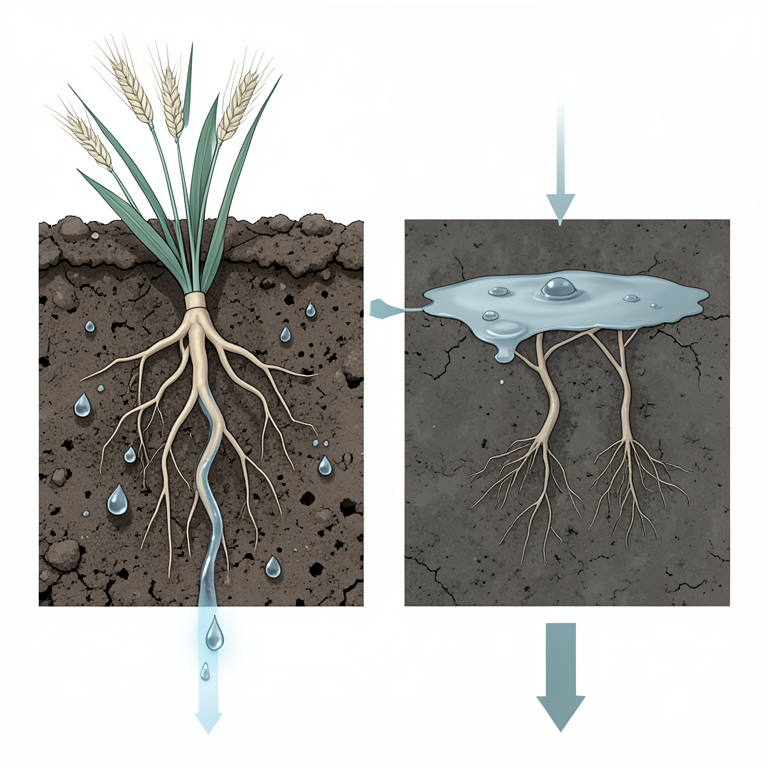
Compaction Impact Chain
AI-generated conceptual illustration (Wheat plants in Punjab cropland soil). It explains the idea and does not show study data.
View source evidence ↗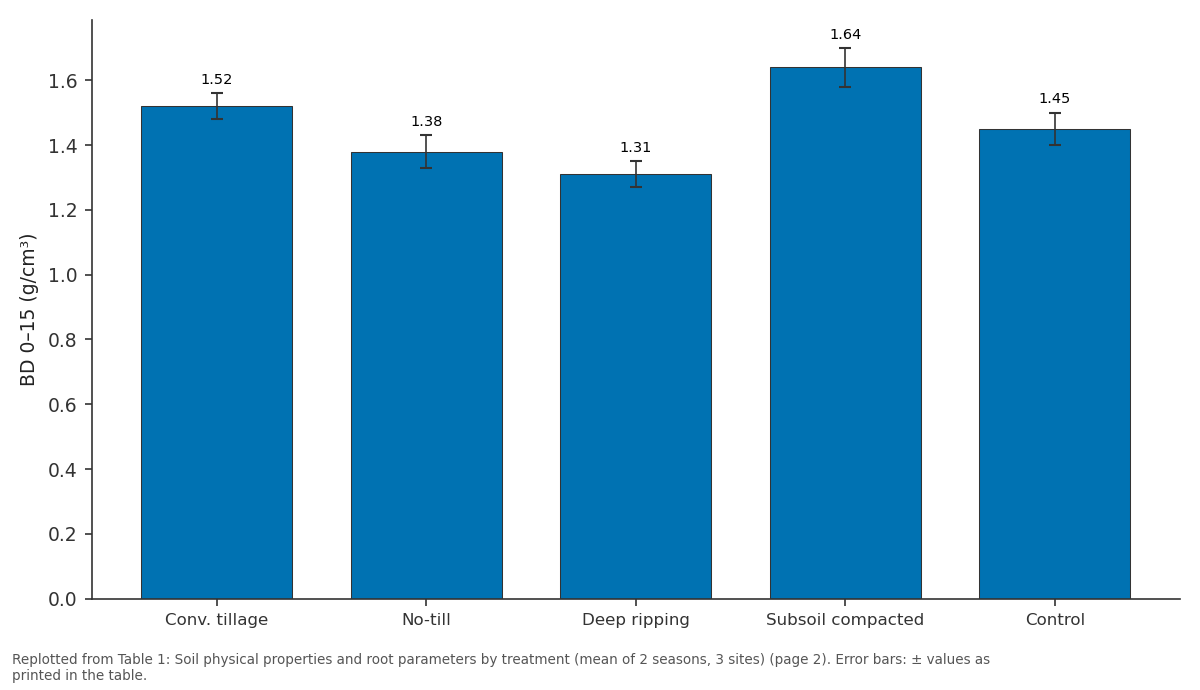
BD 0–15 (g/cm³): Conv. tillage vs No-till vs Deep ripping vs Subsoil compacted vs Control
Replotted from Table 1 (page 2) of the original paper. Every bar is the paper's own table value.
View source evidence ↗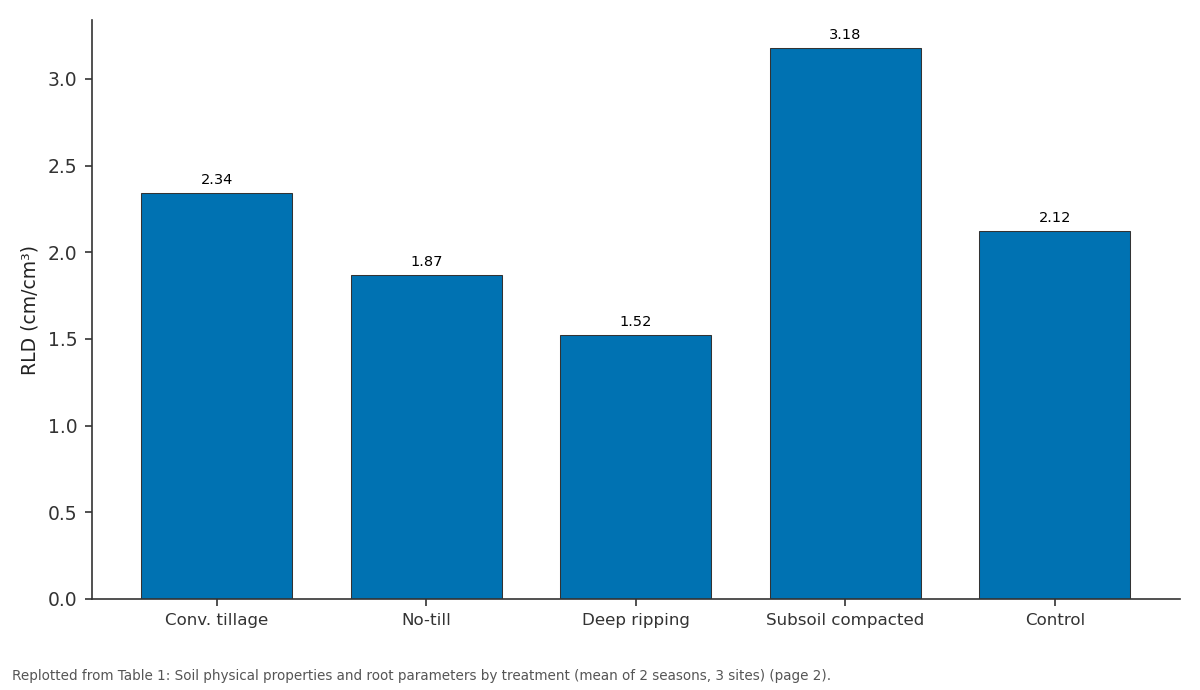
PR Max (MPa): Conv. tillage vs No-till vs Deep ripping vs Subsoil compacted vs Control
Replotted from Table 1 (page 2) of the original paper. Every bar is the paper's own table value.
View source evidence ↗Figures & tables
From the original paper Table 1
 Table 2
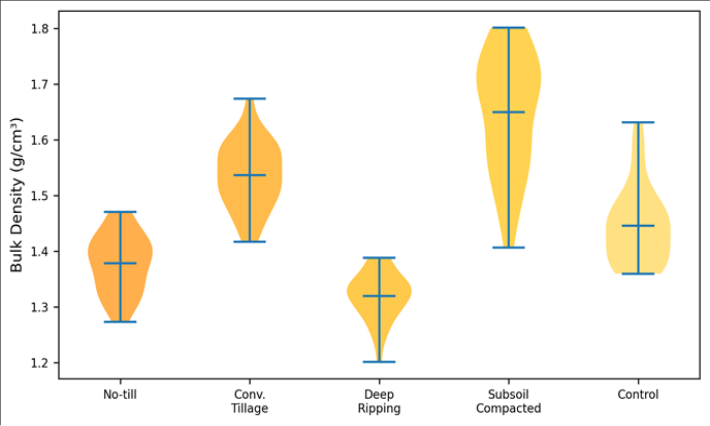 Figure 1
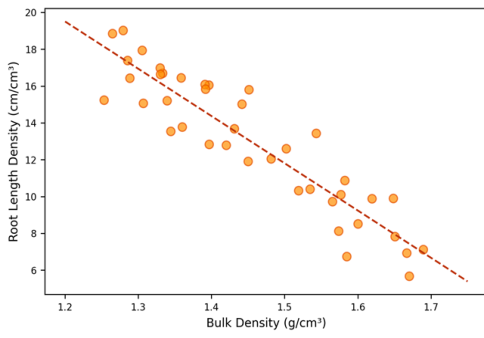 Figure 2
Introduction
Soil compaction is agriculture's hidden yield thief. Unlike drought or pest damage, compaction operates underground and builds gradually over years of machinery traffic, making it easy to overlook until root restriction and waterlogging become severe [1] . In the Indo-Gangetic Plains of Punjab, where wheat-rice rotation has dominated for over five decades, tractor passes during field preparation, sowing, spraying, and harvest compact soils to depths of 30-45 cm [2] . And the machinery is getting heavier: average tractor weight in Punjab increased from 1, 800 kg in 1990 to 2, 600 kg by 2020, amplifying the compaction load per axle [3] . Root systems are the first casualties. When bulk density exceeds roughly 1.55 g/cm³ in loamy soils, root elongation slows markedly because mechanical impedance exceeds the roots' ability to push through soil pores [4] . Simultaneously, compaction reduces macroporosity and infiltration capacity, promoting surface ponding and anaerobic conditions that further inhibit root function [5] . Earlier research in the Punjab documented yield penalties of 8-15% attributable to compaction in rice fields, but comparable data for the rabi wheat crop were sparse [6] . This research compared root growth and infiltration responses across five tillage treatments over two seasons, aiming to quantify the compaction-root-infiltration chain and identify the most effective management option for Punjab conditions [7] .
Field Experimental Design
The experiment used a randomised complete block design with four replications at each of three sites in Ludhiana, Jalandhar, and Amritsar districts (12 plots total). Five treatments were: (T 1 ) conventional tillage (3 passes with 45 HP tractor), (T 2 ) no-till direct seeding, (T 3 ) deep ripping to 45 cm before sowing, (T 4 ) induced subsoil compaction (6 additional tractor passes simulating heavy traffic), and (T 5 ) farmer practice control. Plot size was 10 × 8 m. Wheat (variety HD-3086) was sown in November and harvested in April for both seasons [8] .
Materials and Methods
Materials and Methods
Materials
Field measurements were taken during rabi 2021-2022 and 2022-2023 at the three Punjab sites, coordinated from the Hyderabad Centre for Geological Research, Telangana, India. Soil samples for bulk density were collected using 100 cm³ steel cores at 0-15 and 15-30 cm depth at three positions per plot (36 cores per treatment per season). Penetration resistance was measured with a hand-held cone penetrometer (Eijkelkamp, 30° cone, 1 cm² base area) at 5 cm depth intervals to 50 cm. Root samples were taken at heading stage by driving 7.5 cm diameter soil cores to 40 cm and washing roots over a 0.5 mm sieve [9] .
Methods
Root length density (cm root per cm³ soil) was estimated using the line-intersect method. Steady-state infiltration rate was measured with double-ring infiltrometers (30/60 cm diameter) at three positions per plot, allowing 60 minutes of pre-wetting before recording the steady rate over 30 minutes. Data were analysed by two-way ANOVA (treatment × season) with Tukey's HSD post-hoc test at α = 0.05 in R v4.2. Pearson correlations were computed between bulk density, root length density, infiltration rate, and penetration resistance [10,11] .
Baseline Soil Characterisation
Pre-experiment soil analysis (October 2021) showed loam to clay-loam texture across the three sites, with sand 34-42%, silt 28-36%, and clay 24-32%. Organic carbon ranged from 0.48% to 0.67%, pH from 7.6 to 8.1, and EC from 0.31 to 0.52 dS/m. Pre-treatment bulk density averaged 1.42±0.06 g/cm³ at 0-15 cm and 1.48±0.07 g/cm³ at 15-30 cm. .94 All treatment differences were significant (p < 0.05) except between no-till and control for BD at 0-15 cm (p = 0.08).
Results
Results
Comprehensive Interpretation
The correlation matrix confirms tight coupling between compaction (BD, PR), root growth (RLD), and water entry (infiltration). Deep ripping produced the best physical conditions but is expensive (about ₹3, 200/ha per season).
No-till achieved 76% of the deep-ripping benefit in infiltration and 84% in root growth at negligible additional cost, making it the most cost-effective option for widespread adoption.
Discussion
The bulk density threshold at which wheat root elongation declines sharply appears to lie near 1.55 g/cm³ in these loamy soils, consistent with the 1.55-1.60 range reported by Lipiec and Hatano [4] for temperate loams. Above this threshold, penetration resistance exceeds 2.5 MPa and roots are physically unable to explore the subsoil, restricting water and nutrient uptake to the shallow zone [12] . The yield penalty in the subsoil-compacted treatment (-13.5% vs control) reflects this restricted rooting volume.
No-till's intermediate performance is encouraging because it eliminates the primary source of compactionrepeated tractor passes during seedbed preparationwhile relying on biological processes (root channels, earthworm burrows) to gradually improve subsoil structure [13] . The 21.6 mm/hr infiltration rate in no-till plots, though lower than deep ripping, comfortably exceeds the 90th-percentile rainfall intensity of 18 mm/hr recorded at the nearest meteorological station, meaning that surface ponding should be rare.
Conclusion
Soil compaction in Punjab wheat fields raises bulk density to 1.64 g/cm³, reduces root length density by 57%, and cuts infiltration by 69% compared to deep-ripped soils. No-till management achieves intermediate physical properties at lower cost, making it the most practical compaction mitigation strategy for the region. Controlled traffic farming confining all machinery to permanent tramlinescould deliver further benefits and deserves field-scale testing in the wheat-rice rotation system.
Acknowledgement
Acknowledgements Funding SourcesSupported by research funds at the Hyderabad Centre for Geological Research. Institutional SupportThe Department of Environmental Studies provided field equipment and laboratory access.
Figures and tables from the paper
| Treatment | BD 0–15 (g/cm³) | BD 15–30 | PR Max (MPa) | RLD (cm/cm³) | Infil. (mm/hr) | Yield (t/ha) |
|---|---|---|---|---|---|---|
| Conv. tillage | 1.52±0.04 | 1.58±0.05 | 2.34 | 9.8±1.7 | 14.2±3.1 | 4.87 |
| No-till | 1.38±0.05 | 1.44±0.06 | 1.87 | 12.4±2.1 | 21.6±4.2 | 5.12 |
| Deep ripping | 1.31±0.04 | 1.36±0.05 | 1.52 | 14.7±2.4 | 28.4±5.1 | 5.38 |
| Subsoil compacted | 1.64±0.06 | 1.71±0.07 | 3.18 | 6.3±1.3 | 8.7±2.4 | 4.21 |
| Control | 1.45±0.05 | 1.51±0.06 | 2.12 | 10.6±1.9 | 16.8±3.6 | 4.94 |
Table text extracted from the original PDF; superscript letters are shown inline. The original table image is below.
View original table image
| Variable | BD | PR | RLD | Infiltration |
|---|---|---|---|---|
| BD | 1.00 | 0.87** | –0.81** | –0.78** |
| PR | 0.87** | 1.00 | –0.76** | –0.72** |
| RLD | –0.81** | –0.76** | 1.00 | 0.69** |
| Infiltration | –0.78** | –0.72** | 0.69** | 1.00 |
Table text extracted from the original PDF; superscript letters are shown inline. The original table image is below.
View original table image
References
18 in the original paper- Hamza MA, Anderson WK. Soil compaction in cropping systems: a review. Soil and Tillage Research. 2005;82(2):121-145.
- Sidhu HS, Singh M, Humphreys E. The Happy Seeder enables direct drilling of wheat into rice stubble. Australian Journal of Experimental Agriculture. 2007;47(7):844-854.
- Singh VK, Dwivedi BS, Singh SK. Soil physical properties, root growth and crop yields after seven years of conservation agriculture in the Indo-Gangetic Plains. Soil and Tillage Research. 2016;163:56-63.
- Lipiec J, Hatano R. Quantification of compaction effects on soil physical properties and crop growth. Geoderma. 2003;116(1):107-136.
- Bengough AG, McKenzie BM, Hallett PD. Root elongation, water stress, and mechanical impedance. Journal of Experimental Botany. 2011;62(1):59-68.
- Kukal SS, Aggarwal GC. Puddling depth and intensity effects in rice-wheat system on a sandy loam. Soil and Tillage Research. 2003;72(1):1-8.
- Unger PW, Kaspar TC. Soil compaction and root growth: a review. Agronomy Journal. 1994;86(5):759766.
- Gathala MK, Kumar V, Sharma PC. Optimizing intensive cereal-based cropping systems addressing current and future drivers of agricultural change. Field Crops Research. 2013;145:325-340.
- Blake GR, Hartge KH. Bulk density. In: Klute A, ed. Methods of Soil Analysis Part 1. Madison: ASA-SSSA; 1986:363-375.
- Tennant D. A test of a modified line intersect method of estimating root length. Journal of Ecology. 1975;63(3):995-1001.
- R Core Team. R: statistical computing. Vienna: R Foundation; 2022.
- Botta GF, Tolon-Becerra A, Lastra-Bravo X. Tillage and traffic effects on soil compaction. Biosystems Engineering. 2009;103(4):519-526.
- Blanco-Canqui H, Ruis SJ. No-tillage and soil physical environment. Geoderma. 2018;326:164-200.
- Hobbs PR, Sayre K, Gupta R. The role of conservation agriculture in sustainable agriculture. Philosophical Transactions of the Royal Society B. 2008;363(1491):543-555.
- Tullberg JN, Yule DF, McGarry D. Controlled traffic farming: from research to adoption. Soil and Tillage Research. 2007;97(2):272-281.
- Jat ML, Gathala MK, Ladha JK. Diversifying cropping systems in the Indo-Gangetic Plains. Advances in Agronomy. 2014;127:177-222.
- Soane BD, van Ouwerkerk C. Implications of soil compaction in crop production for the quality of the environment. Soil and Tillage Research. 1995;35(1):522.
- Alakukku L, Weisskopf P, Chamen WCT. Prevention strategies for field traffic-induced subsoil compaction. Soil and Tillage Research. 2003;73(1):145-160